From the Program Chair

Ken Levy, Program Chair

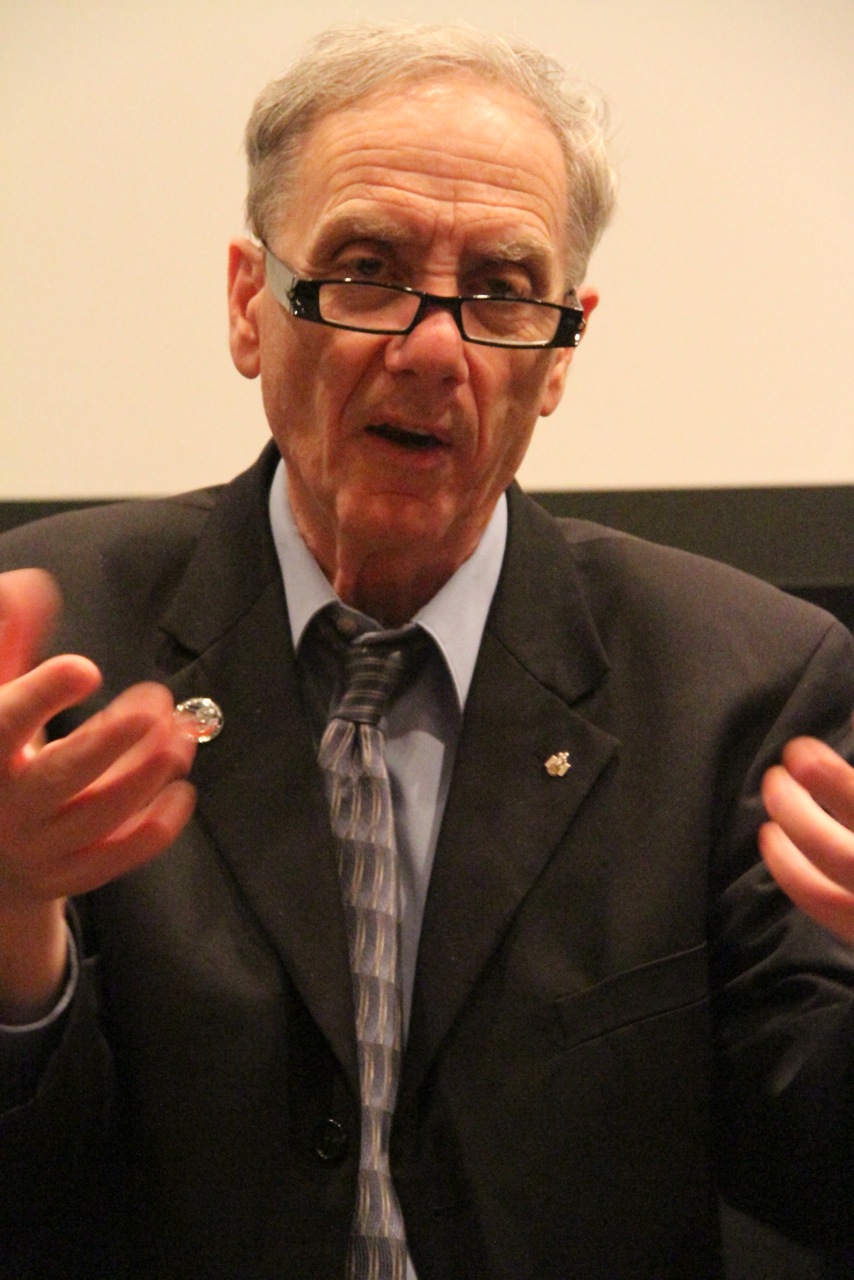
Dr. Mario Livio.  Photo Credit: Ken Levy

Dr. Mario Livio. Photo Credit: Ken Levy

Many thanks to Mario Livio for a great lecture on the latest scientific achievements of the Hubble Space Telescope to close the season.

It’s been a great experience serving as Program Chair. Great thanks to Ludy and all who helped with lecture suggestions and encouraging words. All the best to Kathleen Otto as she takes over as Program Chair for 2012-2013.

It may be the end of the lecture series but there are still many activities to keep us busy. Here are a few:

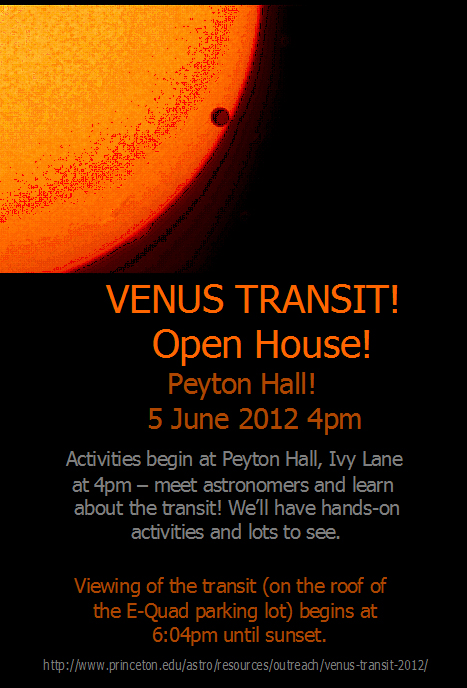
June 5 – Transit of Venus
AAAP and Princeton Astrophysics Open House:
Transit of Venus Observation
Transit of Venus NASA webcast
More on Transit of Venus

July 19 – Space Shuttle Enterprise takes up residency at the Intrepid Sea, Air and Space Museum, NYC. Visit Intrepid Museum

Through August 12 – Beyond Planet Earth, curated by AAAP lecturer Mike Shara at the American Museum of Natural History

Every clear Friday night – Come to AAAP Washington Crossing for Observing the skies. http://www.princetonastronomy.org/

Current issue of Newsweek: cover story Welcome to the Multiverse by Brian Greene

…and many current books for summer reading such as Knocking on Heaven’s Door: How Physics and Scientific Thinking Illuminate the Universe and the Modern World by Lisa Randall

Have a great Summer and Clear Skies!

Posted in June 2012, Sidereal Times | Tagged , | Leave a comment

From the Outreach Chair

David Letcher, Outreach Chair

Scout troop 556 will be camping overnight at the Washington-Crossing State Park on Saturday, June 9th. Volunteers Jeff Bernardis and Ira Polans will lead sky viewing at the observatory. One or two additional volunteers to help would be appreciated.

Posted in June 2012, Sidereal Times | Tagged , , , | Leave a comment

May 8, 2012 AAAP Meeting Minutes

by Michael Wright, Secretary

Director Ludy D’Angelo called the meeting to order.

  1. Ludy introduced Renee Hlozek, a post-doc in Princeton’s Astrophysics Department, who invited the club to join the Department’s Transit of Venus program on June 5. They plan to begin with a lecture in Peyton Hall, move to the Engineering Quad parking deck for observations and return to Peyton Hall to watch the conclusion of the transit via a live feed from Hawaii. Also, there will be activities for children. Ludy recommended that the club participate and suggested that it be discussed during the business meeting.
    Ludy asked for a show of hands from those in the audience who are club members and verified that a quorum was present for election of 2012-2013 officers. He asked for nominations from the floor. Receiving none, he announced the slate of candidates, which was presented by the nominating committee chair at the April 10, 2012 meeting and published in Sidereal Times:a.   Director                      Ludy D’Angelo
    b.   Assistant Director     Jeff Bernardis
    c.   Program Chair           Kathleen Otto
    d.   Treasurer                  Michael Mitrano
    e.   Secretary                   Michael WrightBy a show of hands, members voted unanimously for this slate of officers for 2012-2013.

    Ken Levy introduced the speaker, Dr. Mario Livio of the Space Telescope Science Institute, who presented an awe inspiring talk on the latest scientific achievements of the Hubble space telescope and answered many questions from the audience.

    Following an intermission, Assistant Dir. Jeff Bernardis conducted the business meeting.

  2. Transit of Venus (Part 1): The proposal to join with Princeton Astrophysics was discussed. Rex Parker questioned whether the club would get public exposure. Logistical questions were discussed. The consensus was to join with Princeton Astrophysics.
  3. Program Report:  Jeff announced that the next meeting will be the annual planetarium show by Bill Murray on May 12. Bill said that members may arrive at 7:30, and children are welcome.
    Jeff thanked Ken Levy for the outstanding line up of speakers that he arranged this season. Members showed appreciation with a round of applause.
  4. Observatory Report:  John Church reported that Rex Parker, Jeff Bernardes, Gene Ramsey, Bill Murray and he tested the Gemini GoTo mount by simulating the Hastings-Byrne with a weighted timber. The mount performed well except the power switch had to be repaired and a new power supply is needed. John Giles volunteered to contact Losmandy for a new supply. The cost should be about $70. When the supply is replaced, the new mount will be installed. The mount can be operated like the existing mount (i.e. manually or by remote control) or via GoTo using the computerized handbox.
    Chair Gene Ramsey reported that the observatory needs to be painted this year. The metal rails need to be thoroughly stripped before repainting. John and he recommend getting the advice of a professional painter on how to do it. Also, the water supply is weak, and we still have a health notice prohibiting drinking the water. Gene has provided bottled water in the bathroom.
  5. Outreach Report:  Chair David Letcher described the upcoming outreach events:
    May 29 – Millstone River School, Plainsboro
    June 9 (Sat) – Scout Troop 556 camping and visiting the observatory
    Hopewell Borough Camp Out – The town has requested astronomers to assist with naked eye stargazing (no scopes, green lasers only). Four hundred campers are expected on the St. Michael tract. Rich Armitage has agreed to front this event for the club.
  6. Website:  Rex Parker asked whether John Miller, who was not present, could post the duty roster to the web site.
  7. Sidereal Times:  Co-editor Michael Wright said that the deadline for the next issue is May 31. He thanked those that contributed the interesting articles over the past few months and encouraged them to continue. He pointed out that the blog, handled by Co-editor Surabhi Agarwal, is getting an average of 40 hits per day.
  8. Transit of Venus Event:  We should put information on our website and ask people to register if they intend to attend. Therefore we would have an accurate idea of how many to plan for. Ken Kramer stated that he can get observing glasses from NASA. The viewing site still has to be checked out before more planning can begin.
  9. Transit of Venus (Part 2):  John Church pointed out that PU’s commencement is on the same day, which caused concern about whether lack of parking and congestion in town would create logistical problems. Some felt we might get a crowd of parents and students, but others felt that this might discourage the locals from surrounding towns from participating. The merits of the Pole Farm site, a county park on Federal City Road in Lawrenceville, were discussed. Jeff agreed to discuss the concerns with Ludy and suggest that he discuss them with Renee Hlozek before making a commitment. Michael Wright agreed to prepare a press release once a decision was made and pointed out that it must be submitted to the media at least two weeks before the event.

Assistant Director Jeff Bernardis adjourned the meeting.

Posted in June 2012, Sidereal Times | Tagged , , | Leave a comment

Treasurer’s Report

Michael Mitrano, Treasurer

With one recent renewal, our member count now stands at 92. It is AAAP policy that new memberships received in June – the last month of our fiscal year – are applied toward membership for the upcoming year, so this may be our final count.

Expenses during the month included our new table banner for use in settings like Communiversity and Super Science Sunday. Our year-to-date surplus is about $1,300. On a cumulative basis, our surplus is about $22,000.

Following the end of June, I will prepare a detailed report covering the fiscal year.

Posted in June 2012, Sidereal Times | Tagged , | Leave a comment

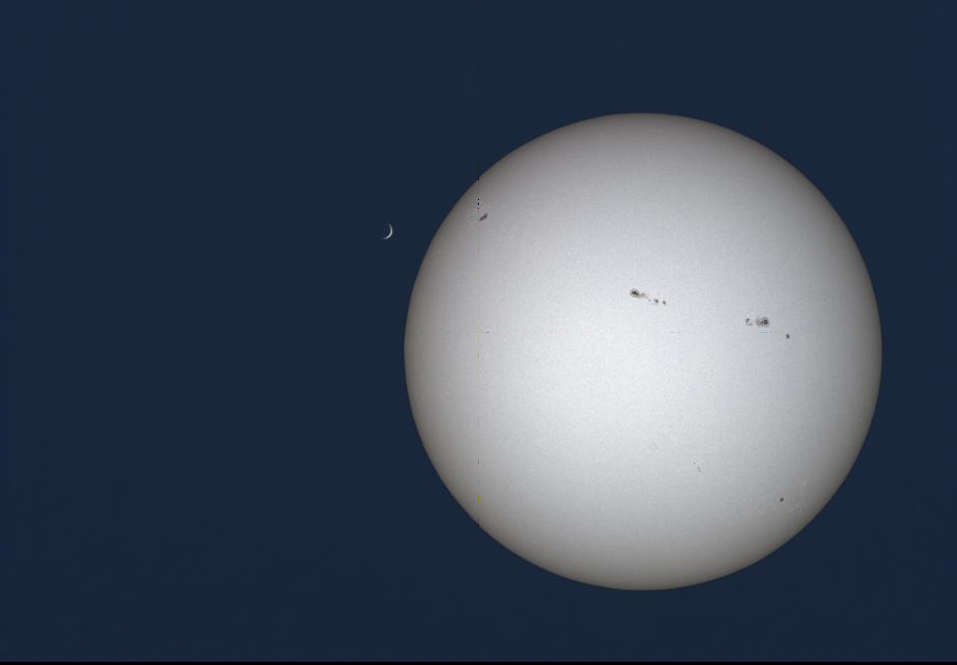
Venus and the Sun

Venus and the Sun. Photo Credit: Bob Vanderbei

Venus and the Sun. Photo Credit: Bob Vanderbei


Bob Vanderbei took pictures of the Sun and Venus on the same day (May 19, just two weeks before the transit) using the same equipment (Canon DSLR on 3.5″ Questar) and combined them into this montage in which Venus is moved close to the Sun.

Posted in June 2012, Sidereal Times | Tagged , , | 2 Comments

Geometrical Optics and the Hastings-Byrne Refractor: Part III

by John Church

In the March and April issues I reviewed the relatively simple equations that allow a lens designer to specify the total curvatures of both elements of a two-element (crown and flint) achromatic refractor objective, and how our H-B refractor satisfies these equations. This part of the theory is fine as far as it goes, but it’s not nearly far enough. The designer is still left with the problem of how to specify the separate front and rear surface radii for each of the two lens elements. In fact, there are infinite numbers of related radii pairs for each element that would still give an achromatic objective of the desired focal length, but most of the final results would wind up with such bad spherical aberration and coma that the completed objective would be essentially useless in practice.

Spherical aberration happens because parallel rays (such as rays coming from a very distant object such as a star) passing through the edge of a single converging lens element with spherical surfaces will generally come to a nearer focus than rays passing through zones closer to the center. For a diverging lens (e.g. the flint element of an achromatic objective), the same effect occurs, but in the opposite direction. The trick is to make the positive spherical aberration of the crown element get cancelled out by the negative aberration of the flint element. This sounds easy in theory, but in fact it is a very difficult problem that taxed the capabilities of the best mathematicians in Europe from about 1735 to 1760. Solving the problem to good enough precision required the use of very complex equations, because the laws of refraction depend on trigonometry (sines, tangents, etc.) and not on straight algebra.

The French mathematicians Alexis Clairaut and Jean le Rond d’Alembert then got involved. They were intense rivals that had competed on celestial mechanics, predicting the upcoming perihelion passage of Halley’s comet, and the like. They were so competitive that they often refused to attend each other’s lectures at the Royal Academy of Sciences. Clairaut, in particular, appreciated that not only should aberrations be corrected for on-axis objects such as stars or planets in the middle of the field, but also for off-axis objects such as extended star fields, the moon, and even wide double stars. In fact, he discovered the aberrations now known as coma and astigmatism, and plotted their effects in beautifully detailed graphs that can still be seen in his original papers. His equations determine all four radii for an objective we now call “aplanatic” (not wandering), i.e. one with negligible spherical aberration and coma. Clairaut was the first to publish his equations; d’Alembert followed soon afterward with different but equivalent equations. He later claimed that he would have been first except for delays caused by Europe then being in upheaval from the Seven Years’ War.

A few lenses were made that actually were designed by Clairaut’s equations. But Clairaut died of smallpox shortly after completing the work. With his rival gone, d’Alembert lost interest in the subject and went on to other things. Their work was forgotten for a long period, and in fact the flint glass of that era was not really good enough to make full use of the finer points of the math.

Lens design then reverted to pure empiricism until Joseph Fraunhofer appeared on the scene in the early 1800’s. Fraunhofer considerably advanced the art of making good flint glass; he then designed some fine lenses that were nearly coma-free, but he left no notes as to how he had done this. He may in fact have used the French equations, but nobody knows for sure. Much later in the 1800’s, a number of papers appeared in which the authors “rediscovered” the French work (without giving credit!) and developed methods to allow the equations to be solved by relatively straightforward, though still complex, algebra. Such methods have continued to appear through the years, even into the mid-20th century; they are all mathematically identical. The general process is now called third-order theory, as the trigonometric sines of the small angles involved are replaced by a simple and accurate algebraic approximation involving the third power of the angles as expressed in radians.

I wrote two papers 1, 2 for Sky & Telescope that go into this subject in more detail than can be given here. The first of these describes the work of Clairaut and d’Alembert and the historical significance of their contributions. In the second one, I gave a listing for a BASIC program that solves the French equations, based on the 1887 algorithm supplied by C. Moser 3 and showed how this would have some-what improved the performance of the famous Königsberg heliometer. This objective was designed by Fraunhofer in 1822, but not constructed until after his death in 1826. It was used by Bessel in 1838 for the determination of the parallax of 61 Cygni, giving the first reasonably accurate distance to another star.

How closely did Hastings adhere to an optimal design for our 6-1/4-inch scope? For the glasses that he used, my program gives the following radii for a desired focal length of 2,313 mm: R1 = + 1,416 mm, R2 = – 592 mm, R3 = – 610 mm, and R4 = –3,002 mm. The first surface is slightly flatter than the actual radius of + 1,336 mm, while the remaining surfaces are slightly deeper. But the difference in performance as shown by accurate ray-tracing, taking into account the actual element thicknesses and their small spacing, is small. Both objectives are well corrected for both spherical aberration and coma, with the optimal form being a little better in these respects. The main point is that the shapes of both elements of the optimal design and Hastings’s design are very similar, and in fact all two-element aplanatic achromats with the crown lens in advance will have similar shapes for all ordinary types of glasses.

Some fine objectives have also been constructed with the flint lens in advance, such as the Johns Hopkins 9.4-inch and the Sproul 24-inch 4. Both of these were also designed by Hastings, and he made the first one himself. Having the flint forward (“Steinheil form”) gives lens shapes which are somewhat more resistant to flexure than those with the crown ahead, and they also can have somewhat better correction for zonal spherical aberration. However, as flint glass is softer than crown and is also more liable to atmospheric attack, the type has generally been less used than the crown-ahead form. The BASIC pro-gram that I published gives optimal results with the flint-ahead form also, after changing one algebraic sign.

1 J. Church, Sky & Telescope, September 1983, p. 259-261.
2 J. Church, Sky & Telescope, November 1984, p. 450-451.
3 C. Moser, Zeitschrift für Instrumentenkunde, Vol. 17, 1887, p. 321-322.
4 J. Church, Sky & Telescope, March 1982, p. 302-308.

Posted in June 2012, Sidereal Times | Tagged , , | Leave a comment

Spectacular SpaceX Dragon Launch

by Dr. Ken Kremer

Following the spectacular May 22 nighttime blastoff of the SpaceX Falcon 9 rocket and the Dragon commercial resupply capsule, the successful docking at the International Space Station (ISS) and the safe splashdown on May 31, human exploration of the cosmos embarked on a radical new course that will never be the same again.

SpaceX-2

SpaceX Falcon 9 rocket poised at Pad 40 on Cape Canaveral Air Force Station. Credit: Ken Kremer

Dragon is the world’s first commercial spacecraft. It is the linchpin in NASA’s bold Commercial Crew and Cargo program aimed at significantly driving down the cost of transporting cargo and crews to low Earth orbit by using private commercial companies to foster competition and innovation in the free market setting of the new, post shuttle Era of Commercial Space Transportation.

The long awaited liftoff of the SpaceX Falcon 9 rocket at 3:44 a.m. lit up the Florida Space Coast for miles around as it roared off Pad 40 at Cape Canaveral, Florida on a history making mission as the first private spaceship bound for the International Space Station (ISS). I witnessed the spectacular predawn launch as a member of the press from an elevation of 525 feet on the roof of the iconic Vehicle Assembly Building (VAB), where all the Space Shuttle missions and Apollo moon landing flights were prepared for blastoff. In a split second the page was turned to open a new era in humankind’s exploration and exploitation of space.

SpaceX-3

SpaceX Falcon 9 rocket poised at Pad 40 on Cape Canaveral Air Force Station prior to May 22 liftoff. Credit: Ken Kremer

Prior to blastoff I toured the SpaceX launch pad for a close-up look and photo shoot of the Falcon 9/Dragon duo poised for liftoff from Space Launch Complex- 40 at Cape Canaveral Air Force Station.

The on time Falcon 9 blastoff came three days after the first launch attempt was aborted at T Minus 0 when a computer automatically shutdown the already firing engines as it detected a high chamber pressure in one of the nine first stage engines.

Dragon is the world’s first commercial spacecraft whose purpose is to carry supplies to and from the ISS and partially replace the cargo capabilities previously performed by NASA’s now retired fleet of space shuttle orbiters. Dragon was designed, developed and built by Hawthorne, Calif., based SpaceX Corporation, founded in 2002 by CEO and Chief Designer Elon Musk.

SpaceX-1

SpaceX Falcon 9 rocket clears the tower after liftoff at 3:44 a.m. on May 22, 2012 from Space Launch Complex-40 at Cape Canaveral Air Force Station, Fla., on the first commercial mission to loft the Dragon cargo resupply vehicle to the International Space Station. Credit: Ken Kremer

Three days after liftoff, Dragon became the first private spacecraft to rendezvous and dock with the ISS on May 25. Astronauts Don Pettit of NASA and Andrea Kuipers of ESA deftly berthed Dragon at an open Earth-facing port on the Harmony module after being dramatically captured by the astronauts using the station’s 58 foot long robotic arm in a landmark event in space history as the Dragon and the ISS were passing about 251 miles above Earth.

The astronauts opened the hatch and ‘Entered the Dragon’ for the first time a day later on May 26 and then proceeded to unload the nearly 1100 pounds of stowed cargo and refill it with more than 1300 pounds of science samples and trash for the return trip to Earth. With the successful splashdown all objectives of the historic test flight were fully achieved. The first operational Dragon cargo mission could launch as early as September 2012.

Read more about the Dragon mission in Ken’s articles at Universe Today:
Historic opening of New Space Era
History making docking at Space Station
Dragon’s ocean splashdown

Astronomy Outreach by Ken Kremer
Rittenhouse Astronomical Society (RAS) at the Franklin Institute:Philadelphia, PA, June 13, Wed, 7 PM. “Curiosity Mars landing, DAWN at Asteroid Vesta & GRAIL Lunar Orbiters”

Adirondack Public Observatory – Adirondack State Park: Tupper Lake,NY, July 13 & 14.
“8 Years of Mars Rovers & Search for Life- Mars & Vesta in 3 D”.
http://www.apobservatory.org/pages/etc/events_KenKremer.html
http://apobservatory.org/pages/img/etc/kremer_poster_med.jpg

Ken Kremer:  Spaceflight magazine & Universe Today
Ken has a selection of his Shuttle photos and Mars mosaics for sale as postcards and frameable prints.

Please contact Ken for more info or science outreach presentations:
Email: kremerken@yahoo.com   website:  www.kenkremer.com
http://www.universetoday.com/author/ken-kremer/

Posted in June 2012, Sidereal Times | Tagged , , | 1 Comment

Snippets

compiled by Bryan Hubbard

Asteroid nudged by sunlight: Most precise measurement of Yarkovsky effect
Published: Thursday, May 24, 2012 – 22:31 in Astronomy & Space

Scientists on NASA’s asteroid sample return mission, Origins, Spectral Interpretation, Resource Identification, Security, Regolith Explorer (OSIRIS-REx), have measured the orbit of their destination asteroid, 1999 RQ36, with such accuracy they were able to directly measure the drift resulting from a subtle but important force called the Yarkovsky effect — the slight push created when the asteroid absorbs sunlight and re-emits that energy as heat. “The new orbit for the half-kilometer (one-third mile) diameter 1999 RQ36 is the most precise asteroid orbit ever obtained,” said OSIRIS-REx team member Steven Chesley of the NASA Jet Propulsion Laboratory, Pasadena, Calif. He presented the findings May 19 at the Asteroids, Comets and Meteors 2012 meeting in Niigata, Japan.

The complete article may be found at: Most precise measurement of Yarkovsky effect

Herschel Space Observatory study reveals galaxy-packed filament
Published: Thursday, May 17, 2012 – 14:33 in Astronomy & Space

A McGill led research team using the Herschel Space Observatory has discovered a giant, galaxy-packed filament ablaze with billions of new stars. The filament connects two clusters of galaxies that, along with a third cluster, will smash together and give rise to one of the largest galaxy superclusters in the universe. The filament is the first structure of its kind spied in a critical era of cosmic buildup when colossal collections of galaxies called superclusters began to take shape. The glowing galactic bridge offers astronomers a unique opportunity to explore how galaxies evolve and merge to form superclusters.

For the full story go to – Galaxy-packed Filament

New IBEX data show heliosphere’s long-theorized bow shock does not exist
Published: Thursday, May 10, 2012 – 22:31 in Astronomy & Space

New results from NASA’s Interstellar Boundary Explorer (IBEX) reveal that the bow shock, widely accepted by researchers to precede the heliosphere as it plows through tenuous gas and dust from the galaxy does not exist. According to a paper published in the journal Science online, the latest refinements in relative speed and local interstellar magnetic field strength prevent the heliosphere, the magnetic “bubble” that cocoons Earth and the other planets, from developing a bow shock. The bow shock would consist of ionized gas or plasma that abruptly and discontinuously changes in density in the region of space that lies straight ahead of the heliosphere.

The complete article may be found at: Heliosphere’s bow shock does not exist

NASA’s Chandra sees remarkable outburst from old black hole
Published: Monday, April 30, 2012 – 15:35 in Astronomy & Space

An extraordinary outburst produced by a black hole in a nearby galaxy has provided direct evidence for a population of old, volatile stellar black holes. The discovery, made by astronomers using NASA’s Chandra X-ray Observatory, provides new insight into the nature of a mysterious class of black holes that can produce as much energy in X-rays as a million suns radiate at all wavelengths. Researchers used Chandra to discover a new ultraluminous X-ray source, or ULX. These objects give off more X-rays than most binary systems, in which a companion star orbits the remains of a collapsed star. These collapsed stars form either a dense core called a neutron star or a black hole. The extra X-ray emission suggests ULXs contain black holes that might be much more massive than the ones found elsewhere in our galaxy.

For the full story go to – Outburst from old black hole

Posted in June 2012, Sidereal Times | Tagged , , , , | Leave a comment

From the Director

Ludovico D’Angelo, Director

Since the last meeting, several things have occurred that are noteworthy to report. The first is that Baldpate Mountain will not suit for the Transit of Venus viewing. We are looking at alternative sites, but more than likely we will end up at Washington Crossing near the soccer fields.

The second noteworthy observation is that we have had four open public nights in a row. All with fairly clear skies! There has not been too much grumbling about walking from the parking area near the soccer fields to the observatory.

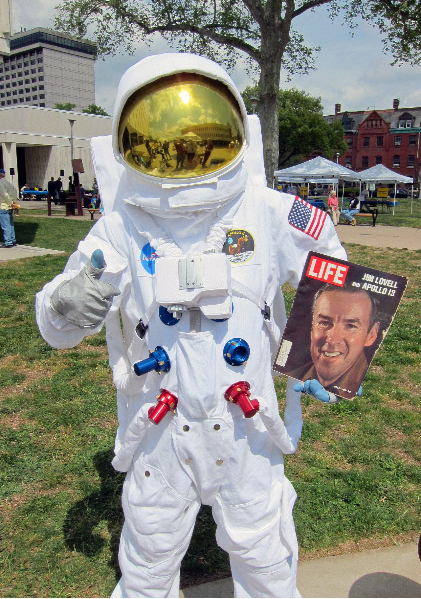
Jim Lovell had fun at Super Science Day. Credit: David Kaplan

Jim Lovell had fun at Super Science Day. Credit: David Kaplan

And thirdly, we had a very successful day at the NJ State Museum complex for Super Science Day on April 21st. We had five scopes set up: two in H-Alpha and three with white light filters. We gave out club info. Many people looked at the Sun and were very impressed by it. During the whole day, there was a significant solar prominence seen in H-Alpha, and there were at least seven sunspots seen in the other scopes. I want to thank those that volunteered: David Kaplan, Michael Wright, Larry Kane, Victor Davis, and Pat and Mary Hayes. Great Job!

I am hoping that we get as many for Communiversity on April 28th.

Our next meeting is May 8th at 8 p.m. Mario Livio will be our guest speaker. At that meeting, we will vote for the new Board of Trustees, it will be our last meeting this season with a guest speaker. In June we will gather at the State Planetarium where our member, Bill Murray, will show us great wonders of the universe inside.
See you on May 8th!

Posted in May 2012, Sidereal Times | Tagged , | Leave a comment

From the Program Chair

Ken Levy, Program Chair

Many thanks to our April lecturer, Professor Gregory Matloff, for his talk on Biosphere Extension.

Our 2011-2012 Peyton Hall lecture season concludes with a real cosmic bang – a definite not to be missed lecture by Dr. Mario Livio on the latest scientific discoveries of the Hubble Space telescope. Dr. Livio is a senior astrophysicist at the Hubble Space Telescope Science Institute. He joined the Institute in 1991 as head of the Archive Branch, and also served as the Head of the Institute’s Science Division. Prior to coming to the Institute, he completed his undergraduate studies at the Hebrew University in Jerusalem, his M.Sc. degree at the Weizmann Institute, and his Ph.D. (in theoretical astrophysics) at Tel-Aviv University. He was a professor of physics in the physics department of the Technion-Israel Institute of Technology from 1981 until 1991.

Dr. Mario Livio

Dr. Mario Livio

In the past decade, Mario focused particularly on the topics of supernova explosions and their use in cosmology to determine the rate of expansion of the Universe, on the nature of “dark energy”, on the formation of black holes and the possibility to extract energy from them, on the formation of planets in disks around young stars, and on the emergence of intelligent life in the Universe. Mario has published over 400 scientific papers.

In addition to his scientific interests, Mario is a self-proclaimed ‘art fanatic’ who owns many hundreds of art books. During the past few years, he combined his passions for science and art in three popular books: “The Accelerating Universe” (2000), which discusses the ‘beauty’ of fundamental theories of the Universe, “The Golden Ratio” (2002), which tells the story of an astonishing number, and “The Equation That Couldn’t Be Solved” (2005), which is the first extensive popular account of Group Theory – the language of symmetry. His new book, “Is God a Mathematician?” appeared in January 2009. The book discusses why mathematics is powerful at describing things ranging from the laws of nature to the properties of ordinary knots. Dr Livio lectures very frequently to the public. He has given more than 20 full-day seminars to the public at the Smithsonian Institution in Washington D.C, and numerous lectures at venues such a the Hayden Planetarium in New York, The Maryland Institute College of Art, The Cleveland Museum of Natural History, The Glasgow Planetarium, and many more.

Dr. Livio is also interviewed often in the media, including two appearances on “60 Minutes.” His book “The Golden Ratio” won him the “Peano Prize” for 2003, and the “International Pythagoras Prize” for 2004, as the best popular book on mathematics.

Posted in May 2012, Sidereal Times | Tagged , , | Leave a comment