From the Director

Ludovico D’Angelo, Director

Alert! Alert! Our next few meetings will not be at Peyton Hall! Since professors have first dibs on the Peyton Hall space, we have been dislodged temporarily from our usual meeting place. So in October, we will meet in McCosh 10. It was the only room available. It seats 350, so let’s try to fill it up. Our meetings after October will be in McCormick 101, which is much more like Peyton’s lecture hall.

We had a great time at the annual picnic on September 15th. There were about 30 club members and their families there. We had good food and clear observing for a time after it got dark. But of course, it started to cloud up, so we were only there until 9:30 or so. Thanks to Jim McHenry for bringing his grill out and to everyone who helped clean up afterwards.

Plans are under way to have a 50th anniversary celebration dinner at the Prospect House on the Princeton Campus. We hope to get things finalized by the next Board meeting on October 3rd. Volunteers to help plan are needed and appreciated. Please contact Kate Otto, Program Chair. Soon you will get more information on the event. If you know any past AAAPers who can contribute to Sidereal Times for our special issue in November and would like to attend the celebration dinner, please have them contact Michael Wright or Surabhi Agarwal at editors@princetonastronomy.org. Please contribute your own remembrances, special events, experiences, and pictures.

This year, we were not able to secure the Hope Center for an October StarQuest. So it will be postponed until next year. They do have an opening in November during the new moon weekend. The Board decided not to reserve the space since we expect it will be too cold. If anyone still wants to do StarQuest in November (I know there are some cold weather amateurs out there), please contact me. If there is a critical mass of participants, then it may be doable. Of course, there will not be raffle prizes or speakers, but there will be food, fellowship, a warm lodge, and hopefully a clear dark sky.

We look forward to our next meeting on October 9th in McCosh 10. Our guest speaker is yet to be determined. Watch your email or the AAAP Facebook page for updates on the speaker.

See you on the 9th at 8:00 pm in McCosh 10!

Posted in October 2012, Sidereal Times | Tagged , , | Leave a comment

From the Program Chair

Kate Otto, Program Chair

Sunyaev–Zel'dovich Array, Owen Valley Radio Observatory

Sunyaev–Zel’dovich Array, Owen Valley Radio Observatory. Photo: Emleitch

In an effort to make the evening interesting and informative, we have invited Dr. Rashid Sunyaev to join us on October 9th. Those of you who heard David Spergel speak last month on “Illuminating the Evolution of the Universe with the Cosmic Microwave Background” heard Dr. Sunyaey’s name mentioned a few times; the Sunyaev–Zel’dovich effect being either the Sunyaev–Zel’dovich thermal effect or the Sunyaev–Zel’dovich kinematic effect. Hat’s off to David for being able to say all three quickly!

Rashid A. Sunyaev is Director of the Max-Planck-Institut für Astrophysik.

Prof. Rashid Sunyaev

Prof. Rashid Sunyaev.

He will be at the Institute for Advanced Studies for the month of October and has expressed an interest in speaking to the AAAP. We will know this week if his calendar is open for October 9th. As a backup, we are arranging for another speaker or panel discussion. Watch you email for more announcements. In the interim, thanks to all of the members who have sent in speaker and interesting club meetings ideas.

A special thanks to the 50th Anniversary Planning Committee, who are currently organizing the Nov. 4 anniversary dinner and other celebrations. They need more volunteers so please contact me or one of the other officers if you are willing to help. Don’t be shy.

Posted in October 2012, Sidereal Times | Tagged , , | Leave a comment

From the Outreach Chair

David Letcher, Outreach Chair

The four Friday evening public lectures on backyard astronomy, by yours truly, are in full swing. My first class met on Friday evening, September 14. I introduced the audience to vocabulary and the objects commonly seen in our backyards. The second session dealt with the types of telescopes and eyepieces as well as certain vocabulary such as magnification, focal length and field of view. The next class will emphasize the solar system. Finally on October 5, we will study stars and galaxies.

I should mention that members Gene Ramsey and Larry Kane have been helpful to me at the public lectures. Thanks also go to the observatory teams that have shown the class various sky objects after each class.

Well, its star party season! Now that schools are in session, I am receiving requests for star parties. As of this writing, we have a star party on Tuesday, October 16 at the Linwood middle school in North Brunswick. I am pleased to report that we have four volunteers signed up for that one with a couple of tentative ones still deciding.

Another request just came in from an elementary school in South Brunswick but the date has not been decided yet.

Posted in October 2012, Sidereal Times | Tagged , | Leave a comment

September, 2012 AAAP Meeting Minutes

by Michael Wright, Secretary

The meeting was called to order by Director Ludy D’Angelo.

Ludy welcomed everyone to the first lecture and meeting of the 2012-2013 season and AAAP’s 50th year. Also, he reminded members that 2012-2013 dues are now due. He announced that AAAP would be holding our annual picnic on Saturday, September 15 at the pavilion at the Nature Center in Washington Crossing Park and a 50th anniversary dinner at Prospect House on the Princeton campus on Sunday, November 4.

Kate Otto, Program Chair introduced the speaker, Dr. David Spergel of Princeton’s Astrophysical Sciences Department. Prof, Spergel gave an absorbing talk on “Illuminating the Evolution of the Universe with the Cosmic Microwave Background” in which he explained recent discoveries based upon data collected by Wilkinson Microwave Anisotropy Probe and the Atacama Cosmology Telescope.

After a brief break, Ludy reconvened the business portion of the meeting.

  1. Website:
    1. Kate Otto asked why Sidereal Times on the website is out of date. John Miller, webmaster, replied that after Michael Wright implemented the blog on WordPress, there was no need to post PDF’s of ST on the website. A notice and link on the website points users to the WordPress site.
    2. Victor Davis asked if there are plans to archive audio of the monthly lectures on the website. Ludy replied that Ken Levy did it while he was Program Chair and he has the files. Kate will contact Ken about them. Future lectures could be recorded if someone with the necessary skills and equipment would volunteer. Victor said that he might be able to do it and would look into it.
    3. Mary Hayes asked how to get to the roster. John said that he would provide instructions and the password to her.
  2. Secretary’s Report: no report. The deadline for the next Sidereal Times will be September 27.
  3. Treasurer’s Report: no report.
  4. Program Report: Kate Otto reported that she is still trying to get a speaker for the October meeting. Renee Hlozek of Princeton Astrophysics and Rachel Somerville of Rutgers are committed for December and February respectively. Kate is waiting for commitments from Michael Strauss of Princeton Astrophysics and Robert Wilson, co-discoverer of the CMB.
  5. Outreach Report: David Letcher reported that the school year is just beginning so no schools have contacted him yet. The Meteor Watch co-sponsored with the D&R Greenway was a success even though not many meteors were seen. Victor Davis and Brian Van View brought their telescopes. Dan Reynolds gave an introduction to meteors in general and the Perseid shower.
  6. Bill Murray said that he will be bringing visitors from the planetarium show on October 12 and 19 to the Friday night observatory open houses.
  7. Mary Hayes asked if keyholder could wear name tags when they are on duty so the public can identify them. Ludy said it could be done but someone would have to volunteer to make and distribute the name tags.
  8. Observatory Donation:
    1. Michael Wright reported that UACNJ is asking all clubs to paint their observatories at Jenny Jump. AAAP’s observatory has peeling paint, and some wood needs to be replaced. UACNJ endorsed AAAP’s proposal to place the donated observatory on AAAP’s site at Jenny Jump provided that it does not obstruct views from other observatories and AAAP submits plans to the park for review. They said that AAAP could use UACNJ’s wifi for data if it meets our needs. They recommended an emergency shutdown procedure. Gil Jeffer volunteered to work with AAAP and be our onsite contact in an emergency.
    2. Jeff Bernardes reported that he obtained a quote from Observadome of $11,000 for a ring to install the dome on, plus $6,000 for shipping. A section of the existing dome would have to shipped to Observadome so they cam match it to the ring. The consensus was that this option was too expensive so AAAP will investigate mounting the dome on the existing structure.
  9. Observatory Report: Gene Ramsey, Observatory Chair, thanked members for the cards and well wishes that he received during his convalescence after heart surgery. John Church reported that he received a quote of $900 from Bear Claw Exteriors to power wash and paint the exterior of the observatory, which he recommended that AAAP accept. This quote does not include repairing the stucco on the piers. After a brief discussion, Larry Kane made a motion to accept the quote and hire Bear Claw Exteriors. It was seconded by Bill Murray. The motion passed. Ludy announced that Brick Yard Road was paved but the park had not opened it for AAAP’s use yet. The park was considering how to lock the gates. John Church said that the plan is to install the new G-11 mount when the public observing season is over and asked whether the power supply was repaired. John Giles said that he would make the repair before then.
  10. Robert Vanderbei passed on a request from Gaspar Bakos of Princeton Astrophysics to borrow a 12-inch dob for his class until the one he ordered arrives. Michael Wright suggested lending the club’s 8-inch dob. He could contact Gaspar and make arrangements to transfer the scope. Jeff Bernardis made a motion, seconded by Michael, to loan the club’s dob. The motion passed.
  11. Bill Murray is starting an astronomy club at Trenton Catholic Academy and needs telescopes and books. Ludy asked members to consider donating unused books. Ludy said that he would support loaning the club’s three telescopes that are stored in his garage. They are in various sates of repair, but they be made usable if the students would like take them on as a project. Jeff Bernardis made a motion to loan the scopes to the school. It was seconded by David Letcher. The motion passed.
  12. Starquest: Ludy explained that Hope Conference Center is booked up for the rest of 2012 so we can-not hold Starquest there this year. All of 2013 is available. Ludy asked when members wanted to hold Starquest between June and November 2013. The choices were narrowed down to the weekends of June 8 or September 5. By a show of hands, the membership showed a preference for September 5, 2013
  13. 50th Anniversary Celebrations
    1. Kate announced that the anniversary dinner would be held on Sunday, November 4 from 4:00 to 8:00 p.m. at Prospect House on the Princeton campus. A speaker for the event was briefly dis-cussed. Kate and Surabhi Agarwal searched the archive and are working on a slide presentation. They asked John Church to help identify members and events in the pictures, to which he agreed. Surabhi asked for approval to purchase an external hard-drive to store scanned documents. Mi-chael suggested buying a second one for backup. The Board approved the purchase of two 1-TB drives for a total of $250 – $300.
    2. Michael said that he and Surabhi are planning a special edition of Sidereal Times for November. The theme will be “50 years past and 50 years to come”. He has asked Freeman Dyson to contrib-ute an article about how our understanding of the universe has changed over the past 50 years, but has not received a commitment yet. Ken Kremer has agreed to write an article about the past 50 years of space exploration. Michael asked for someone to write about how observing equipment has changed. He requested members write reminiscences and submit photos about the club mem-bers and events. Also, he needs help from a graphic artist to help produce a timeline. Arshad Jilani agreed to help with the timeline.
  14. Ludy announced that the next board meeting will be on October 3.

Ludy adjourned the meeting.

Posted in October 2012, Sidereal Times | Tagged , | Leave a comment

Treasurer’s Report

Michael Mitrano, Treasurer

Dues payments are only beginning to come in this early in our fiscal year, which began on July 1. All members who have not made dues payments for the current year are asked to do so.

Thus far we have 17 dues payments along with $125 in contributions for a total of $805 in revenue. Routine minor expenses along with outlays of $162 for calendars to be sold this fall and $900 for the Washington Crossing observatory power washing and painting leave us with a fiscal year-to-date deficit of $476. This will be eliminated as dues renewals come in.

On a cumulative basis, our surplus is approximately $21 thousand.

Posted in October 2012, Sidereal Times | Tagged , | Leave a comment

Sidereal Times Needs You

Michael Wright and Surabhi Agarwal, Co-editors

To celebrate the kick-off of AAAP’s 50th year, we would like the November issue to be a celebration of the club’s history and accomplishments. We are producing an illiustrated commemorative booklet with specially written articles. We still need members to make this their celebration by contributing personal photographs, artwork or reminiscences about important events or notable members. If you have paper copies, we will scan them for you. Help make this issue really special by submitting your contributions. Email contribution and inquiries to editors@princetonastronomy.org.

Posted in October 2012, Sidereal Times | Tagged , , | Leave a comment

The Observatory Has Been Painted

by John Church

After a complete power washing and also spot bleaching where needed, our Simpson Observatory at Washington Crossing State Park is sporting a brand new double coat of white latex semi-gloss on the exterior of the cinder blocks and a double coat of white latex gloss on the exterior woodwork. The latter was also scraped and wire-brushed to insure that all scaled portions of the old paint were completely removed.

Power washing and wire brushing the steelwork removed all of the peeled portions of the previous red overcoat. The brown primer that was put on some years ago was still in good condition. The steelwork was then given two coats of glossy black oil-based Rustoleum.

This work was done by Bearclaw Exteriors, which is close by in Ewing Township. The owner, Eric dePugh, is interested in astronomy himself and would like to come to the next open house that occurs on a good night. Gene Ramsey and I showed him the instruments in the building.

I was there during the day and a half job, with Gene there a good part of time as well. I hope it meets with everyone’s approval. We still need some work on the masonry of the supporting pillars for the steelwork, and we have some leads for possible contractors.

Posted in October 2012, Sidereal Times | Tagged , , | Leave a comment

2012 AAAP Picnic

This slideshow requires JavaScript.


Pictures by John Miller www.nounpix.com

Posted in October 2012, Sidereal Times | Tagged , | Leave a comment

Transit of Venus June 5, 2012

by Ira Polans

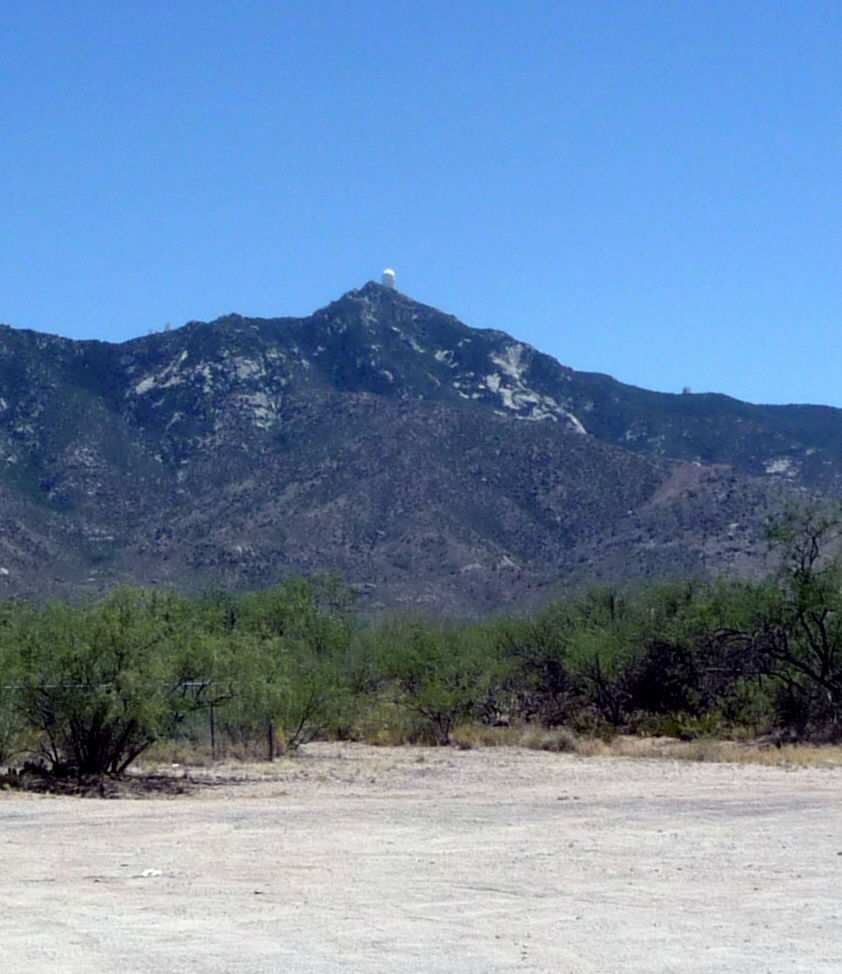
From the base of Kitt Peak, you can see the domes of the various telescopes along the ridgeline.

From the base of Kitt Peak, you can see the domes of the various telescopes along the ridgeline. Photo: Ira Polans

In 2004 when Venus last transited the sun, I was not yet a member of the AAAP. While I had made plans to observe the event, the plans did not work out. Realizing that the 2012 transit would be my last chance to see one, I decided to maximize my chances. After researching the options, my wife and I took a trip to Tucson, AZ to view the event.

Tucson was chosen because it has several advantages over the Northeast. The main one being that there would be a small chance of a cloudy sky on the day of the transit.

The famed McMath-Pierce Solar Telescope

The famed McMath-Pierce Solar Telescope. Photo: Ira Polans

Another attraction was that Kitt Peak National Observatory planned a special program for the transit. Also, my wife’s parents had retired to the Southwest. This trip would give us a chance to spend some time with them.

The trip from Tucson to Kitt Peak is about 60 miles. However since part of the trip is up the mountain, it takes about 90 minutes to get there. Most of the drive is through the Sonoran desert, which is famous for the Saguaro cactus. To me, any part of the Southwestern landscape is beautiful, and this part of the desert I hadn’t seen before. The last part of the trip is the ascent of the mountain on a winding road. The ascent is about 4000 feet. When you arrive at the summit, you drive past a few domes to the Visitor Center which is at 6875 feet.

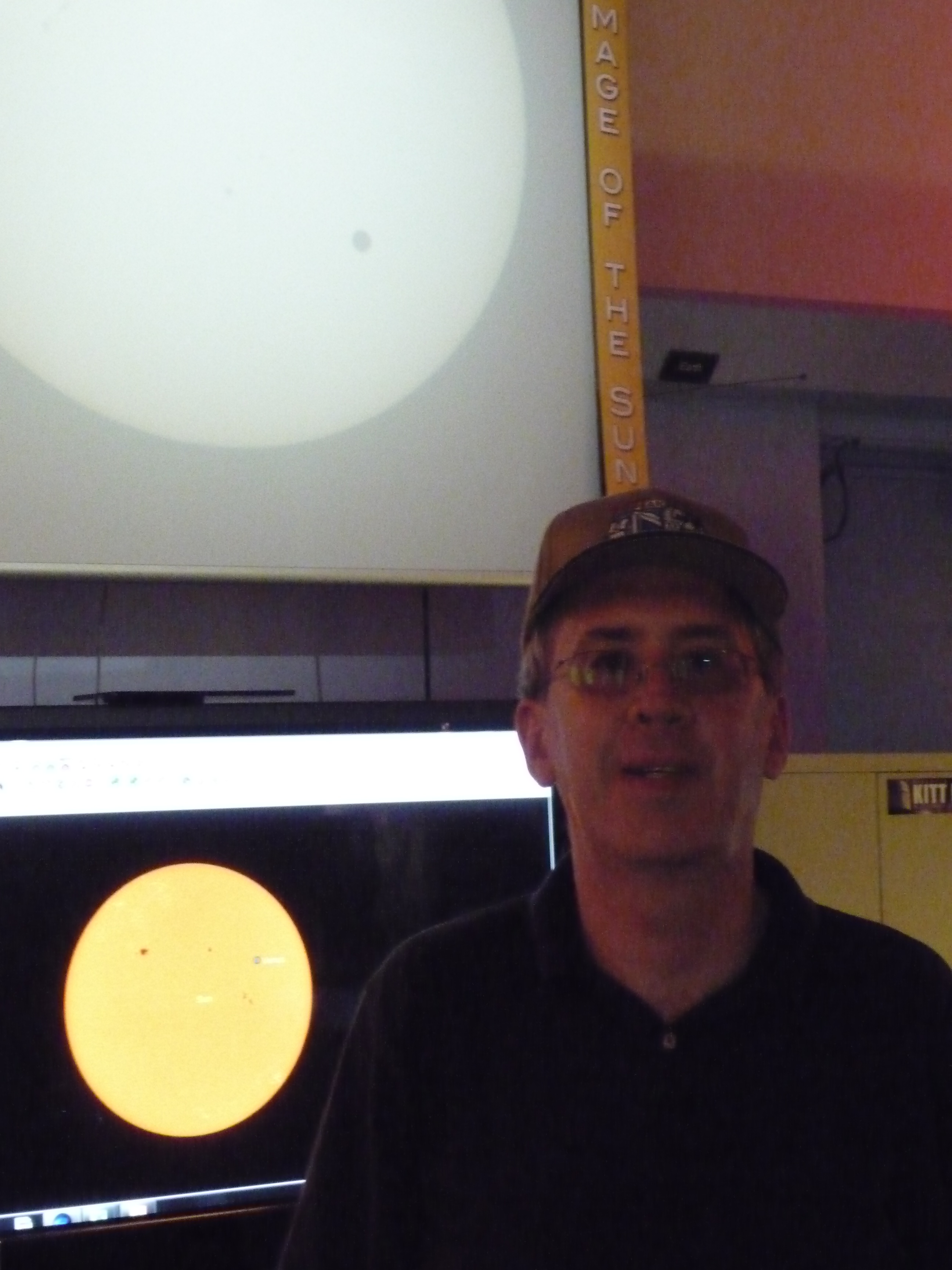
Ira During the Transit

Ira in front of the heliostat mid-transit. The Sun’s image at the bottom is computer plotted. The Sun’s image at the top is the projection from the heliostat.

The Visitor’s Center contains a small museum, a 20” telescope, and a heliostat. For the transit, they also had several amateur telescopes in the courtyard, binoculars, and a sunspotter solar telescope. Of course all the optics had the proper filters. In addition all attendees of the transit program received eclipse shades for safely viewing the sun.

Check-in was at 2:00 pm and the transit began at 3:05 pm. The heliostat projected the image onto a screen about four feet tall. While I knew there would be scopes outside, I thought it would be best to watch second contact here. When the transit began I was surprised by two things. The first was how big Venus appeared against the Sun. The second was how long it took Venus to separate itself from the Sun’s limb. I was aware of the back teardrop affect, but to me and many others in the room, Venus just seemed to stick to the limb.

Looking-Up

View from the bottom of the missile silo looking up showing the partially retracted silo door. It is locked in this position so the Russians know this is not an active missile base. This missile when operational could have delivered the largest warhead in the US arsenal.

Historically a transit of Venus was important because it allowed astronomers to figure out how big the solar system really is. Without an event likes this, the best astronomers could do was measure the relative distances between planets. By using trigonometry, parallax, and accurate timings of second and third contact, along with Kepler’s third law they could finally figure out the actual distance from the Earth to the Sun. And once they knew that they could figure out the distances to the planets.
To give the attendees a better idea of the effort involved in applying this technique, Andrea Wulf lectured us about her book “Chasing Venus: The Race to Measure the Heavens”. In her lecture, Andrea told us about how 18th century astronomers worldwide worked together to capture the information need to make the calculation during the transits of 1761 and 1769.

As previously mentioned the Visitor’s Center has a 20” telescope. As the Sun began to set, the telescope was put into use. Rather than look at the Sun and the transit, we had a chance to see Betelgeuse and Sirius. This was possible because the telescope is computerized.

During the trip I had the opportunity to tour one of the remaining Titan II missile silos and visit the Pima Air and Space Museum. Both of these are in the Tucson area.

Posted in October 2012, Sidereal Times | Tagged , , | Leave a comment

Home Observatory – Dream to Reality

By Rex Parker

I know that I’m not alone in longing for a home observatory. A permanent set up, ready to power on, impress your friends, bring the stars home! Over the past dozen years my heavy “portable” mount has been dragged outside, tinkered with and toggled to set up and align a telescope for an observing session. Counterweights, balance, polar alignment, star-database-connection, CCD imager-link, finally ready to do astronomy. These sessions typically ended in early morning hours with some splendid moments and good images, but often with mixed results or even no success. After bringing it all back in and falling asleep after 2 AM, sleep-deprived, I often repeated the same process a night or two later.

Fast-forward a few years. There is a better way. Considering home observatory designs, we were drawn to roll-off roof concepts. Admittedly the dome brings a certain cache, yet the wide night sky over open roof is compelling. Still, aesthetics seemed absent in many sky sheds and outbuilding designs. Then my wife Carol chanced upon a Fine Gardening magazine ad for Gardensheds.com, a company that designs and builds custom sheds to enhance the garden and yard. On a hope and wish, I called them and learned that the Architect Ken Smith and company were local/regional and interested in talking about a home observatory design. This could become a prototype for them in the amateur astronomy market.


I proceeded to measure, calculate, and sketch the dimensions and angles needed for astronomy equipment as Gardensheds evolved an architectural drawing. We settled on a 10 x 10 ft building with 10 x 10 adjoining deck, limited by township set-backs. This size proved to be commodious, just right. The roof rolls over the deck area with nice symmetry, form and function. The walls are 6’-3” high, stand-up height which blocks stray light. Built at an indoor facility using cypress siding and floor, and recycled roofing material, with steel casters/track for the roll-off roof, the entire building was brought in on a trailer and placed onto the site (see picture). In advance, we formed a 3-ft deep, 14-in concrete footing as base for the Advanced Telescope Systems aluminum pier holding the mount. This is isolated from the building by a circular cutout in the floor to prevent vibrations. A conduit brought AC electricity to the observatory which was pre-wired with outlets and red lighting fixtures. A Wifi booster brings the observatory online with our home network to download software updates for telescope programs.

The observatory houses a Losmandy G11 equatorial mount carrying a Takahashi FS128 refractor and SBIG ST10-XME (below) and a Celestron C11. Now I’m dreaming of that perfect deep-sky astrophoto.

Posted in October 2012, Sidereal Times | Tagged , | 2 Comments