A Candle in the Dark

An Editorial, by Michael Wright, Co-Editor

candleNovember 5, 1962: A few weeks before, the Cuban missile crisis had been resolved and the Soviets were removing their missiles from the island nation. Wally Schirra had just completed the fifth Mercury flight, but the US still lagged behind in the race to the moon. More US military advisors were going to Vietnam as the conflict there was escalating. Televisions were black-and-white and required turning a knob on the set to select among the handful of available channels. Johnny Carson had just begun his 30 year run as host of the Tonight Show. And a group of ten amateur astronomers met in the home of Robert Sanders to start the Amateur Astronomers Association of Princeton.

The world has changed dramatically in the last 50 years. Some changes the AAAP founders might have had an inkling about, such as the Civil Rights Act of 1964 and the Vietnam war. As space enthusiasts they were probably optimistic that the US would land on the moon “before the decade is out.” But who would have predicted the Chinese cultural revolution, Woodstock, Watergate, the environmental movement, gas rationing, the hostage crisis, Three Mile Island and Chernobyl, the collapse of the USSR, the European Union, the Gulf War, Oklahoma City, September 11, Iraq and Afghanistan, Dolly the sheep, the war on drugs, global warming, a black President, and legal gay marriage. The Earth is a smaller place due to fiber optics and geosynchronous communications satellites that flash our communications around the globe. Inexpensive air travel allows more travelers than ever to visit foreign counties. China and India, both nuclear powers, have emerged as major players in the global economy. Europe and the US remain leaders of the industrialized nations, but they have been suffering through “the Great Recession” for the past three years.

In 1962 Americans were fascinated with science, technology, engineering and math (STEM). It was going to improve our lives and take us to the Moon. While we don’t have personal jet packs and flying cars yet, STEM has delivered many unanticipated marvels such as Hubble, the Internet, and GPS. The US adequately funded STEM research and education 50 years ago. Now our scientists compete for limited basic research funding, and our infrastructure is crumbling because we neglected to fund maintenance and improvements. American’s enthusiasm and understanding of STEM has waned to the point that most do not have an inkling about the science and engineering that runs their favorite gadgets. Compared to other industrialized nations, US students are lagging on standardized test of math and science. Pseudoscience and superstition are rampant as evidenced by the popularity of psychics, ghost hunters and the occult. As Carl Sagan described in Demon Haunted World, science is a candle in the dark. It is not just a body of knowledge, but the best method of discovering the truth and disposing of myths and superstitions. Science should inform our decisions and solutions to the challenges that confront us individually and as a society.

Since 1962 the AAAP has grown nine-fold in membership, built two observatories, hosted over 400 lectures and 20 star parties, and undertaken thousands of hours of outreach at local schools and at our observatory in Washington Crossing State Park. Currently, we are considering installing a fully automated telescope and mount for remote astrophotography under a new dome at our Jenny Jump observatory. Members have kept our candle lit and will continue to kindle interest in science by sharing our passion for astronomy and space exploration.

On the 100th anniversary of AAAP in 2062, our grandchildren will be running the club. The world will be a far different place than what we can imagine. Will climate change reshape our civilization as some predict? Will mankind make another giant leap off the Earth to Mars, the Moon or an asteroid? If future Sidereal Times editors reflect on the next 50 years, I hope they will say that our generation carried the torch, and the world is an even better place than today.
Posted in December 2012, Sidereal Times | Tagged , | Leave a comment

From the Director

Ludovico D’Angelo, Director

Happy Anniversary to our club! This month marks the 50th anniversary of the first recorded meeting in November 1962. I feel privileged to be the club’s Director at this time. Plans are moving forward for a special event to commemorate this milestone.

In 1962, I was all of 1½ years old when the club was started. My first remembrances of anything astronomy/space related were of course the Mercury to Apollo space programs. The landings on the moon really made me interested. I was riveted to the TV and the broadcasts of the missions. I started to collect books, build model rockets and pretended to be an astronaut with the borrowed shopping cart space ship. Didn’t we all have one? My father worked at the physics annex lab near Fitzrandolph Observatory on the Princeton University campus. He was a maintenance person there. He had gone to university in Italy, was a smart man, and met many of the professors at his work. He was always interested in physics. He got me my first telescope: a small Newtonian that a professor gave to him. I think I was about 8 or 9 years old.

As a teenager, I started attending the open houses at Peyton Hall. I viewed Saturn through the Alvin Clark telescope that is now a museum piece in the dome conference room of Peyton Hall. I attended lots of meetings then (probably AAAP meetings!). I visited the Fritzrandolph Observatory also. I saw my first transit, the transit of Mercury, on the rooftop of the then new Fine Hall building (I was in 8th grade). I remember waking up very early to be there at sunrise to view the transit. This year I saw the transit of Venus. Astronomy and the AAAP, I am sure, were very active as I was growing up in Princeton. Since I could never afford a telescope when I was younger, the passion for astronomy drained away as I graduated high school. Since there were no telescopes where I went to school in Wisconsin, there was no upkeep of my interest there. That was a shame really, since it was very dark there when you went into the countryside.

My interest was sparked once again when my wife asked if it would be a good idea to get a telescope for my 8-year old triplet boys. I said: Sure! What a great idea! So the first scope I got for them was a Meade ETX -90 under adult supervision of course. I now own a Celestron 9.25 SCT and a PST. We all joined the AAAP soon afterwards. I became its Secretary in 2007, and have been on the Board since then except for 1 year. I am the current Director of the AAAP.

What I presented is a little of my history related to our hobby, an interest that may come and go, but it is always there if you want it to be.

I know there are many similar stories out there among the club members. Let’s hear yours this year as we commemorate our 50th! How about an article or two each month? Tell your story! Let others know of your enthusiasm!

Hurricane Sandy has come and gone. I hope that all of you have gotten power back by the time this reaches you. The state park at Washington Crossing is currently closed due to storm damage. Many trees have fallen in the park. We have a report the observatory has not been damaged. When we are able to access the park again, we will inspect the workings in more detail.

See you all at our next meeting on November 13th at 8 PM. We are back to Peyton Hall on the Princeton University campus.

Posted in November 2012, Sidereal Times | Tagged , | Leave a comment

From the Program Chair

Kate Otto, Program Chair

Renée Hlozek

Renée Hlozek

Our speaker for the November 13 meeting will be Renée Hlozek, a Lyman Spitzer Jr. Postdoctoral Fellow in the Astrophysical Sciences Department at Princeton University.

In her talk entitled “The Cosmic Shopping List: Constituents and Symmetries in the Universe”, she will discuss how observations of the universe fit into our larger understanding of the universe on many different levels – from the very small to the largest scales.

Before moving to Princeton, Renée completed her DPhil in Astrophysics at Oxford University on a Rhodes Scholarship. Originally from South Africa, she grew up and studied in both Pretoria and Cape Town, and was recently named in the Mail and Guardian’s 200 Young South Africans list for 2012.

Her research focuses on theoretical and observational cosmology, where she analyzes data from telescopes such as the Atacama Cosmology Telescope (ACT) in Chile in order to understand the initial conditions of the universe.

We are really looking forward to hearing from this Rising Star! More about Renée can be found on her website

Posted in November 2012, Sidereal Times | Tagged , , | Leave a comment

From the Outreach Chair

David Letcher, Outreach Chair

First, I am pleased to report that my four lectures on backyard astronomy were successfully delivered on the Friday evenings of September 14 through October 5. We had a good turnout ranging from about a dozen to almost two dozen folks, in age from preteen to AARP age. Many thanks go to Wayne Henderek, Resource Interpretive Specialist at the Washington’s Crossing Nature Center, AAAP volunteers Gene Ramsey and Larry Kane, and the observatory teams.

Our immediate, past star party was held on October 16th in North Brunswick. The sky was clear but light pollution cut down on what we could see. We were able to show some double stars, M57 and the Andromeda Galaxy, M31. Thanks go to David Zahler, Pat and Mary Hayes, and yours truly for volunteering.

Our next star party is planned for Wednesday, November 28 in West Windsor. An email was sent out asking for volunteers to help out.

That’s all for now!

Posted in November 2012, Sidereal Times | Tagged , | Leave a comment

October 9, 2012 AAAP Meeting Minutes

by Michael Wright, Secretary

After a brief delay for member to find the new meeting location, the meeting was called to order by Director Ludy D’Angelo. He welcomed everyone to the meeting and reminded members that 2012-2013 membership dues are now due.

Kate Otto, Program Chair, introduced the speaker, Dr. Rashid Sunyaev, Director of the Max-Planck-Institut für Astrophysik. Dr. Sunyaev explained how he and Prof. Yakov B. Zel’dovich of the Moscow Institute of Applied Mathematics theorized that electrons associated with gas in galaxy clusters scatter the cosmic microwave background radiation, which led to a theory for the evolution of density fluctuations in the early universe.

Before leaving to drive Dr. Sunyaev home, Kate proposed a combined fishing and astronomy trip to Maine.

After a brief break, Ludy reconvened the business portion of the meeting.

  1. Board Meeting: The October 3, 2012 meeting was cancelled due to a lack of a quorum.
  2. 50th Anniversary Dinner: Ludy announced that the 50th anniversary dinner that was planned for November has been postponed until the spring. The dinner will probably be held in a local restaurant because Prospect House is too expensive.
  3. Secretary’s Report/Sidereal Times: The editors were planning a special booklet to be distributed at the anniversary dinner in November. Since the dinner is postponed to the spring, the deadline for submitting articles has been extended. The deadline for the November regular issue of Sidereal Times will be twelve days before the next meeting. Ludy said that we should include anniversary related articles in the November issue anyway. He asked members to submit photos and reminiscences to the editors for the November issue.
  4. Treasurer’s Report: No report
  5. Program Report: No Report
  6. Planetarium Show/Observatory Night: Bill Murray reported that the public planetarium show/observatory night planned by the museum for Oct. 19 has been postponed to November because of a lack of participation.
  7. Outreach Report: David Letcher announced that outreach star parties are planned for Oct. 16 at Linwood Middle School in North Brunswick and Oct. 23 in South Brunswick. Anyone interested in helping should contact David.
  8. Observatory Report: John Church reported that Bear Claw Exteriors power washed and painted the exterior of the observatory. Rex Parker reported that Team 6 had many visitors on their last observatory night despite poor sky conditions. Michael Wright reported that Team 4 was also very busy with visitors. Ludy reported that Brick Yard Road is still not open for AAAP’s use. He remains in contact with the park superintendent about the issue. Teams are no longer required to post someone at the parking lot because visitors appear to have learned the way to the observatory. Repairs to the power supply for the new G-11 mount were discussed. John Giles and Jeff Bernardis agreed to work on the power supply.
  9. Observatory Donation: Ludy reported that the next step is to prepare a sketch to submit to Jenny Jump for approval.
  10. Board Meeting: announced that the next one will be January 15.
  11. Princeton Adult School: John Giles announced that he received a request from Princeton Adult School for someone to teach an adult astronomy class including sessions at the observatory. Ludy said that this would be too big of a commitment for the club; however, we could put a notice in Sidereal Times to see if any individual members would be interested. Mary suggested that they contact Princeton Astrophysics Department.
  12. Facebook: Michael encouraged members to “friend” the AAAP on Facebook. The club page has announcements and event listings that he will update.
  13. 50th Anniversary Booklet: Surabhi explained that she and Kate have looked through the archive and found pictures, which she is digitizing. More are needed for Sidereal Times and the anniversary booklet. If members have any that they would like to share, please submit them to Surabhi.
  14. Loaner Scopes: Mary asked what scopes the club has for loan. Ludy replied that currently the club has an 8-inch Orion dob and a PST at the observatory, which the members can borrow. He suggested that this be publicized in Sidereal Times.

Ludy adjourned the meeting.

Before the meeting Mary Hayes passed out name tags that she prepared for the members to wear. Thank you Mary.

Posted in November 2012, Sidereal Times | Tagged , | Leave a comment

Treasurer’s Report

Michael Mitrano, Treasurer

Member renewals have been coming in. At this point, AAAP has 22 renewing and new members for the current fiscal year. Expenses thus far have been modest – picnic supplies, hard drives for the AAAP archives, and some minor items. At this early point in the fiscal year, revenues exceed expenses by about $500.

On a cumulative basis, our surplus is about $21,900.

Posted in November 2012, Sidereal Times | Tagged , | Leave a comment

The PSRC Cosmology Group Invites New Members

by Steve Newfield

Six months ago eight people with a great interest in cosmology started meeting weekly to discuss all aspects of cosmology. We meet each Friday for about an hour and a half to discuss various cosmology topics (big bang, dark matter/energy, black holes, galaxies, etc). We would like to add new members to our group.

Current members have varied backgrounds. Most don’t have degrees in astronomy, and most have not worked in the field, but we have a lot of knowledge through classes, books, lectures, web, etc. Some have technical backgrounds, some don’t. We realize that there is much to learn and discuss.

At the weekly meetings, we decide what topics to cover next and a few members volunteer to do some research for future discussions. They research the topic (web, books, etc) and send email to the group with web links and/or short write-ups. They then lead a discussion at a future meeting.

The meetings are at the Princeton Senior Resource Center (PSRC) from 10 to 11:30 am on Fridays.

We would like to add the new members on December 7 or soon thereafter.

If you are interested in joining our study group, please contact me at steve.newfield@yahoo.com

Posted in November 2012, Sidereal Times | Tagged , | Leave a comment

When I Worked on Mars

by Arshad Jilani

Viking OPAG Team 1977 (Arshad is fourth from left.)

Viking OPAG Team 1977 (Arshad is fourth from left.)

Canopus is a bluish-white star, about 300 light years away. This star, the second brightest in the sky after Sirius, became a major focus of my life, thirty-five years ago.

In April, 1977, I moved from the Philadelphia area to Pasadena, CA, to work on assignment with NASA at the Jet Propulsion Laboratory (JPL), from my parent company, General Electric. This was early in my career, where I had been working in GE’s Aerospace Business on missile reentry systems, robotic manipulators, control algorithms for Space Shuttle manipulator prototypes and other such esoterical projects. In the summer of 1976, NASA’s Project Viking, the first successful attempt at soft landings on Mars, had put two Landers on the planet, each with an associated Orbiter. One section of the Viking Flight Team was called the Orbiter Power Analysis Group (OPAG), which was staffed by GE.

I, along with two colleagues from Philadelphia, was asked if I would like to work on the Viking program. All of us, being single and early in our careers, jumped at this unusual opportunity. Upon arrival at JPL, we were each given different assignments in OPAG; mine was to work on the Canopus Trackers of the two Orbiters. As JPL employees, we were also Caltech faculty. We also had to very quickly familiarize ourselves with a million acronyms, as NASA-speak is totally unintelligible without knowing these.

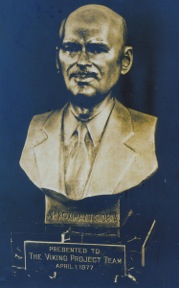
Goddard Trophy

Goddard Trophy

The Canopus Star Tracker (CST) is a small ‘telescope’ mounted on spacecraft to provide orientation to the vehicle by acquiring reference stars during and after planned maneuvers. These trackers are upgraded with the latest optical and electronic technology each time a new spacecraft is launched into space. During maneuvers, a vehicle drifts ever so slightly from its planned trajectory, and without being able to track a specific reference star, it would be very difficult to return the spacecraft to its intended path. The CST is a very sensitive instrument and, like other devices on a spacecraft, degrades over time due to particles settling on the lens and deterioration of its light detectors. The star Canopus, which gives its name to the device, is used to periodically re-calibrate the Tracker and gives us a measure of deterioration of the optics over time.

My task was twofold. First, I had to select the stars to be used for roll reference and secondly, I had to determine the deterioration of the device so that tracking calculations could be upgraded to reflect the lat-est baseline.

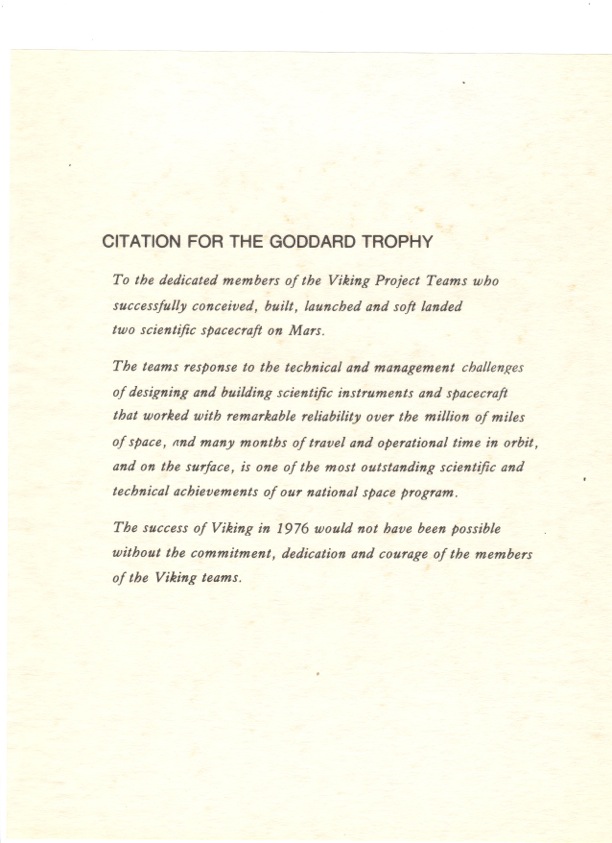
Goddard Trophy Citation

Goddard Trophy Citation

I had been a casual rooftop astronomer from the age of fifteen, when a friend, whom I met on a visit to Sri Lanka, showed me the fascinating sight of Jupiter and its moons through his six-inch refractor. At eighteen, in my hometown of Peshawar, Pakistan, my mother got me a three-and-a-half-inch Newtonian which I used every evening on the flat roof of our house, which was located in a sparsely populated area, on the edge of town. In those days (the late sixties) you could clearly see the sky at night including the Milky Way and such dim features as the Andromeda Galaxy with the naked eye. This, as in most metropolitan areas of the world, is no longer true.

My knowledge of the stars made my task at JPL much easier than it might have been. I had to look at many factors to determine which star to recommend as a reference before a maneuver could take place. One of the major challenges was that during a maneuver, we had to avoid any star that might enter Mars Straylight. Mars Straylight refers to unwanted light that could enter the CST from the surface of Mars or due to the proximity of sunlight during maneuvers. A lot of time was spent finding ‘bright’ stars that would remain in the ‘dark’ throughout and immediately after the maneuver. After pouring over printouts of star intensities and Mars Straylight maps I would select the reference star to be used. Each week, I would provide my selection by Tuesday, which, along with maneuver commands, would be uplinked to the Orbiter on Wednesday. Typical maneuvers included thematic mapping of the Mars surface, picture taking, etc. Maneuver results would be received at JPL by Thursday. These results would be reviewed on Friday along with requests for the next week’s maneuvers, and the cycle would be repeated all over again. The data received from maneuvers was reviewed, each week, by several astronomers such as Carl Sagan and others, to determine the next steps.

One time we were having a hard time finding a satisfactory star because Jupiter kept popping into the Tracker’s field of view. I suggested using Jupiter instead of fighting it, due to the short length of the maneuver, and to my surprise, my suggestion was accepted and it was added to the list of reference ‘stars’ for space missions.

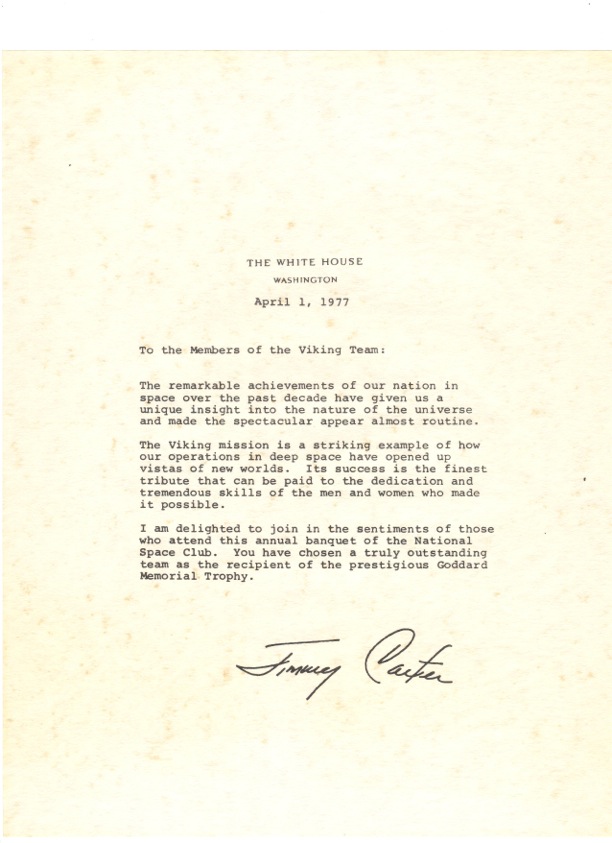
Goddard Trophy,  Letter from Jimmy Carter

Goddard Trophy, Letter from Jimmy Carter

With my knowledge of robotics, I also worked, informally, with the Viking Lander team on tricky problems that would arise from time to time with the robotic arms on the Landers. I also got to know some of the leading experts in robotics, who were at JPL at the time, and was able to participate in discussions of future planetary rovers.

While working on Viking, we received a letter of congratulations from President Jimmy Carter and the prestigious NASA Goddard Award.

I made many friends among the Viking Mars community and joined the JPL Ski Club. In addition, I was able to visit Mt. Wilson Observatory a number of times to satisfy any observational desires.

This experience, working across so many disparate teams, had a major impact on my successful thirty-seven year career in GE, spanning many countries in Europe and Asia, and was extremely rewarding for my family also, who moved with me on several of my assignments.

Posted in November 2012, Sidereal Times | Tagged , , | Leave a comment

Leonard Digges – Inventor of the Telescope?

by Dave Letcher

Sometime around 1515 – 1520 Leonard Digges was born in Barham, a parish in Kent, UK. He died about 1559. Digges was well-known as a mathematician and surveyor; in fact he is credited with the invention of the theodolite. Digges wrote on many topics including military engineering, surveying, and cartog-raphy, in English too rather than the Latin or Greek traditionally used for scholarly articles.

Much of what we know about Leonard Digges comes from writings by his son, the famous English mathematician and astronomer Sir Thomas Digges, who was born in 1546 and died in 1595. Thomas promoted the Copernican system and postulated the “dark night sky paradox” but more about him in a future article. It should be noted that, after Thomas’s father died, he was entrusted to the guardianship of a Mr. John Dee, whom historians regard as a Renaissance natural philosopher.

Thomas, in his 1570 book, “Pantometria” describes his father’s use of a “proportional glass” to view people and objects at a distance. Colin A. Ronan, FRAS (1920 – 1995), a British astronomer and specialist in the history and philosophy of science claimed that Thomas’s description is of a telescope, either a reflector or refractor. Ronan suggests Leonard’s invention of a functioning telescope dates to sometime between 1540 and 1559. Some have suggested that some of Thomas’s description is exaggerated, perhaps due to praise given to an adored father but other parts appear to be credible. In the quote that follows we read a portion of what Thomas wrote.

“… my father by his continual painful [painstaking] practices, assisted with demonstra-tions Mathematical, was able, and sundry times hath by proportional Glasses duly situate in convenient angles, not only discovered things far off, read letters, numbered pieces of money with the very coin and superscription thereof, cast by some of his friends of pur-pose upon downs in open fields, but also seven miles off declared what hath been done at that instant in private places.”

Writings by William Bourne (c. 1535 – 1582), an English mathematician and Leonard’s colleague have provided us with information about Leonard’s experiments using lenses and mirrors. Why don’t we know much more from Leonard himself? Probably because he took part in the 1554 rebellion-went-bad led by Sir Thomas Wyatt against Queen Mary. Leonard, initially condemned to death had his sentence commut-ed but he forfeited all of his estate.

Sources:
Leonard Digges (scientist). http://en.wikipedia.org/wiki/Leonard_Digges_(scientist) Retrieved October 24, 2012.

Greene, Nick. Leonard Digges. http://space.about.com/od/astronomerbiographies/a/Leonard_Digges.htm. Retrieved October 24, 2012.

Ronan, Colin. Leonard and Thomas Digges. Journal of the British Astronomical Association, 101(6):1991.

The first telescope? http://www.actionoptics.co.uk/The First Telescope.htm.

Posted in November 2012, Sidereal Times | Tagged , | Leave a comment

Endeavour Departs Kennedy Space Center

by Dr. Ken Kremer

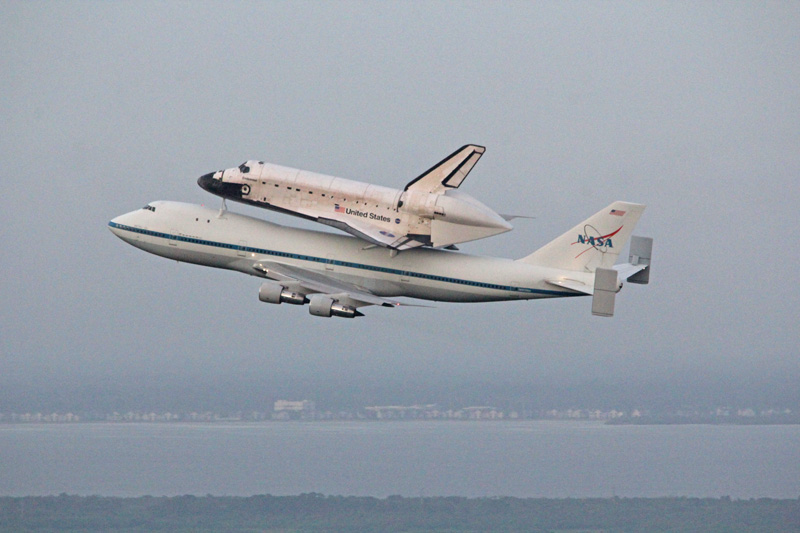
Endeavour Departs Kennedy Space Center.  Photo: Ken Kremer

Endeavour Departs Kennedy Space Center. Photo: Ken Kremer

Space Shuttle Endeavour bid farewell forever to NASA’s Kennedy Space Center in Florida as she departed under cloudy skies on September 19, marking the final flight of NASA’s storied shuttle program.

Endeavour was securely fastened atop the specially modified Boeing 747 Shuttle Carrier Aircraft as she taxied down the runway and embarked on a history-making, cross-country, ferry flight to Los Angeles International Airport and her eternal home in California.

Hordes of excited spectators gathered in hopes of catching one last magnificent glimpse of the piggybacked pair as they flew two looping north-south victory laps over the Florida Space Coast. Finally she made a return pass over the KSC shuttle landing strip before leaving the area behind to the full gamut of emotions both happy and sad.

As a member of the press, I witnessed the entire spectacle with a band of photojournalists from a perch on the roof of the iconic Vehicle Assembly Building.

Seeing the orbiter flyaway from the breathtaking altitude of 525 feet atop the VAB was a decidedly different experience from earlier this year when I watched the arrivals of shuttles Discovery and Enterprise amidst huge crowds of gleeful and cheering onlookers from the National Air & Space Museum at Dulles in Virginia and the Statue of Liberty in New York City. Endeavour landed back in California at Edwards Air Force Base on Sept. 20. In mid October, the 100-ton orbiter was hauled through the streets of Los Angeles to her final home at the California Science Center.

Read more at my Universe Today story here:
http://www.universetoday.com/97446/endeavour-departs-kennedy-forever-for-california-home/
See my latest Curiosity mosaics published at NBC News , PBS Nova Mars Documentary on Nov 14 (9 PM) and Scientific American :
http://cosmiclog.nbcnews.com/_news/2012/10/19/14564505-scenes-from-mars-promised-land?lite
http://www.pbs.org/wgbh/nova/space/ultimate-mars-challenge.html
http://www.scientificamerican.com/gallery_directory.cfm?photo_id=A0EDAD7B-C88B-291B-317F41BCD4B465C0

Astronomy Outreach by Dr. Ken Kremer

Amateur Astronomer’s Inc (AAI) at Union County College: Cranford, NJ, Nov 16, 8 PM, “Curiosity and the Search for Life on Mars (in 3-D)”.
AAI Website: http://www.asterism.org

STAR Astronomy Club at Monmouth Museum, Brookdale Community College, Lincroft, NJ. Dec 6, 8 PM. “Atlantis, the Premature End of NASA’s Shuttle Program and What’s Beyond for NASA.”
Ken Kremer: Spaceflight magazine & Universe Today

Please contact Ken for more info or science outreach presentations:
Email: kremerken@yahoo.com website: www.kenkremer.com
http://www.universetoday.com/author/ken-kremer/

Posted in November 2012, Sidereal Times | Tagged , | Leave a comment