Note From The Editor

by Surabhi Agarwal

Dear Members,

Wishing you all a very Happy New Year filled with clear skies and celestial wonders! As we embark on another year of exploration and discovery, I’m thrilled to welcome Abhinav Sukla as our new student editor. He brings fresh energy and enthusiasm to Sidereal Times, and we look forward to his contributions.

At the same time, I would like to extend my heartfelt gratitude to our outgoing student editor, Yugandhara Luthra, for her dedication and hard work. Her contributions have enriched our magazine and inspired our members. We wish her every success in her further studies in astrophysics and look forward to seeing her achievements in the field. Perhaps, in a couple of years, we should invite her back to the club to share her journey and insights with us in a talk!

As we look to the skies, it’s vital to remember the challenges here on Earth, particularly the imminent threat of climate change. Each of us can take small yet impactful steps to mitigate its effects, starting in our own homes and backyards. Planting native flowers, trees, and bushes not only enhances biodiversity but also provides crucial support for local fauna, including pollinators, birds, and other wildlife. Together, let’s do our part to preserve and protect our planet while we continue to explore the wonders beyond it.

I would also like to share details I received in an email to the editors about a fantastic getaway cabin in Livingston Manor, NY. The destination features Bortle Class 3 skies, with minimal light pollution. It promises to offer an exceptional stargazing experience with spacious grounds for setting up telescopes and other equipment. The name of the place is Amber Lake Chalet.

Here’s to a year of growth, collaboration, and unforgettable nights under the stars.

Posted in January 2025, Sidereal Times | Tagged , | Leave a comment

Neutron Stars: The Mysterious Engines of Cosmic Creation

by Abhinav Sukla, co-editor

Neutron stars are the dense remnants of massive stars that underwent supernova explosions. When a star goes supernova, it collapses in on itself as it no longer has any materials inside of it to fuse. Normally, the nuclear fusion occurring inside of a star releases energy. As the star fuses heavier and heavier elements, however, it comes to a point where fusion no longer produces any energy.

Iron is the heaviest element that can be produced via fusion in a star’s core, as its fusion does not release energy but instead consumes it. This leads to the creation of an iron core. Due to this lack of fusion, the star has no interior force to push back against the powerful inward force of its own gravity and collapses. A neutron star is formed when the iron core collapses under gravity, and the protons and electrons combine to form neutrons. This phenomenon is what gives neutron stars their names. The rest of the star’s matter bounces off of this ball after collapsing, leading to a massive outward shockwave that gives supernovae their explosive reputation.

The remaining compressed iron ball becomes a neutron star, which can have masses over thrice that of our sun, while only being about 20 kilometers across. Neutron stars are some of the most extreme objects in the universe. The compression of the original star’s magnetic field decreases the area through which the magnetic field lines have to pass drastically, proportionally increasing the magnetic field of neutron stars to about 10^8 Tesla, which is 2 trillion times that of Earth’s. Due to the massively shrunk radii of neutron stars, the conservation of angular momentum results in their spinning extremely fast, sometimes hundreds of times every second, as the rotational speed increases as the radius decreases.

All of this matter packed into a miniscule, superheated, and highly magnetized space results in completely unique conditions. I will be discussing the different layers of matter in a neutron star and what each of them look like.

Outer Crust
Despite being the most “tame” out of all of the layers, the outer crust is still extremely hot and densely packed. Magnetars, which are neutron stars with even more powerful magnetic fields than normal, can have surface temperatures of over 10 billion degrees celsius when newly formed. In this layer iron nuclei are still intact, but the electrons have been stripped away in a process known as electron degeneracy and float between the nuclei.

Inner Crust
As the force of gravity gets stronger, more and more electrons and protons merge to neutrons, and the iron nuclei are even more densely packed. The nuclei are pushed so close together in the deeper parts of the crust that they begin to deform against each other and merge, creating large, misshapen shapes with thousands or millions of neutrons. Just one cubic centimeter of this highly dense matter weighs around 100 million tons, which is equivalent to around 25000 Empire State buildings!

Core
The true make up of the core of a neutron star is an elusive question that is one of astrophysics’ greatest mysteries. One of the most prominent theories is the existence of a quark-gluon plasma. Quarks are the elementary particles that make up protons and neutrons. They are essentially the tiniest building blocks in the universe. Gluons are elementary particles that carry the strong force, a force that holds quarks together. The astounding strength of gravity deep in the core of a neutron star is believed to overcome the strong force, creating a sea of quarks and gluons that are tightly packed together. Strange quarks are a flavor of quark that could make up an exotic matter called strange matter. Normally, these quarks are unstable, but in the high pressure cores of neutron stars, where up, down, and strange quarks might freely interconvert, it’s possible that strange quarks are dominant.

Why Is This Important?
When neutron stars collide, the masses of neutrons re-arrange themselves into different structures, some of which are only possible to create in the unique conditions inside neutron stars. It is possible that these collisions are the reason behind most heavy metals today. The universe as we know it would not be the same without these stars and the extraordinary environments they create.

Posted in January 2025, Sidereal Times | Tagged , , , , | Leave a comment

History of the Cosmic Web

by S. Prasad Ganti

On a recent long flight to India, I saw a documentary titled “How does the Universe work”. I am summarizing the notes I took down from this fascinating piece. How did the universe evolve from such a tiny beginning to what it is today? 

The present day universe looks like a cosmic web. Given below is an artist’s rendering, courtesy Max Planck Institute of Astrophysics. It consists of galaxies or clusters of galaxies connected to each other via thin long filaments consisting of dark matter and gases. 

This could have been a picture of interconnected neurons in a brain. Or roads in a city or across cities themselves. Or a cobweb ! It appears to be random and unplanned growth. But it is a network of lumps connected by filaments. 

The universe formed about 13.8 billion years ago from a tiny spec in a process called the Big Bang. The tiny spec was intensely dense and hot. The explosion it created led to the creation of space itself. And the time started ticking thereafter. After the aftermath of the explosion settled down after 380,000 years, atoms started forming resulting in elements Hydrogen and Helium. Bulk of it being Hydrogen with little quantities of Helium. Ironically I learned that anything other than Hydrogen and Helium are known as “metals” to astronomers. For example, Argon the gas would be a metal !

The universe in those ages was very small. Nowhere compared to the huge volume we have today spanning billions and billions of light years across. Like how human civilizations started with small groups of people growing into towns and cities much later.  

In an infant universe, it was the dark matter which created the lumps and filaments structure. This dark matter is what is invisible to us but the effects of its gravitational pull are felt. Regular matter and lighting of the web came later after the initial skeleton was built. In as little as 250 million years after the Big Bang, stars had metals.And these are the oldest stars we see today. Metals would have been formed in ancient stars older than the oldest we see today. Those ancient stars when they died would have been the raw materials for the next generation stars we see today. The conclusion is that the first generation stars died too early for us to be observing them today. 

We know by observation that massive stars glow very brightly and die soon. The medium size stars like our Sun are relatively dim and last longer, like 10 billion years. The speculation is that the first stars were1000 times more massive than our Sun. Which means they were as big as extending the size of the Sun to the orbit of Jupiter, engulfing Mercury, Venus, Earth and Mars and the asteroid belt. Massive stars die in giant explosions called supernovas. There would have been a lot more supernovas in the earlier universe. The metals got cooked pretty early in the life of our Universe.

We do not find such huge stars in our Universe today. Something like dinosaurs not existing anymore !

The filaments in the web are known to contain vast swaths of hydrogen clouds. Dark matter feeds these gases to galaxies for star formation. The dying stars then make a contribution to the super massive black holes at the center of the galaxies. Super massive black holes formed just 900 million years after the Big Bang. Seems like the baby started running, not just crawling, very early !

There were a lot more stellar and galactic collisions in the early Universe. Since the early Universe was very small and there was not much room to move around without bumping into each other. 

The expansion of the Universe happened all along and is said to be accelerating today. Dark energy is supposed to be responsible for this expansion. The dark energy arises from “nothingness” in space. Speaking at a quantum level, the particle and virtual particle pairs get created and destroyed all the time leading to dark energy. 

Not bad for capturing a few interesting things on a flight ! The more we find, the more intriguing it becomes. Just a way of telling us that we are just beginning to scratch the surface !

Posted in January 2025, Sidereal Times | Tagged , | Leave a comment

Crab Nebula…

by Mark Goresky

Crab nebula, taken with my little “smart telescope” Unistellar Equinox 2 (4.5″), 40 min exposure, Dec 3, 2024 from my back yard in Princeton N.J. (Bortle 6 sky).  

Posted in January 2025, Sidereal Times | Tagged , | Leave a comment

…And The Moon

by Jeff Beck

I just got started with lunar, solar and planetary photography with a CMOS camera (I had done lunar and solar with a DSLR previously).  Here is a recent shot (12/8) of the moon with an ASI585MC Pro camera on a Meade 8″ SCT operating at f/6.3.  Image captured and stacked with ASI Studio, and further processed in Photoshop, primarily for color balance.

Posted in January 2025, Sidereal Times | Tagged , | Leave a comment

Snippets

compiled by Arlene & David Kaplan

-NYT

Interstellar “tunnel” found that connects our solar system to other stars Space can surprise even those who spend their lives studying it. People often think of our solar system as just a few planets and a bunch of empty space.Yet new observations suggest we have been living inside a hot, less dense region, and that there may even be a strange cosmic channel connecting us to distant stars…more

-NYT
-livescience

James Webb telescope spots more than 100 new asteroids between Jupiter and Mars — and some are heading toward Earth Astronomers analyzing archival images from the James Webb Space Telescope (JWST) have discovered an unexpectedly vast population of the smallest asteroids ever seen in the asteroid belt between Mars and Jupiter. The finding could lead to better tracking of the tiny but powerful space rocks that are likely to approach Earth…more

-NYT

Superflares Erupt From Stars Like Our Sun Once Every 100 Years Our sun is a violent place. Bursts of radiation snap off the solar surface with the strength of millions of volcanic eruptions. Hot plasma churns and spews, streaming particles that can harm astronauts and satellites in space and damage electrical systems on the ground. They can also brighten up our skies with colorful lights. But scientists have observed even bigger explosions….more

-NASA

NASA’s Juno Mission Uncovers Heart of Jovian Moon’s Volcanic Rage Scientists with NASA’s Juno mission to Jupiter have discovered that the volcanoes on Jupiter’s moon Io are each likely powered by their own chamber of roiling hot magma rather than an ocean of magma. The finding solves a 44-year-old mystery about the subsurface origins of the moon’s most demonstrative geologic features…more

-NDTV

Astronomers Find Frozen Water Beyond Solar System Using James Webb Telescope In a groundbreaking finding, the James Webb Space Telescope (JWST) has discovered frozen water in a distant protoplanetary disk, located outside our Solar System. This remarkable detection was made possible by the JWST’s advanced Near-Infrared Camera (NIRCam), which captured high-resolution images of the disk…more

-alternet

New research shows most space rocks crashing into Earth come from a single source The sight of a fireball streaking across the sky brings wonder and excitement to children and adults alike. It’s a reminder that Earth is part of a much larger and incredibly dynamic system. Each year, roughlymore

-Mashable

At 2 a.m., an unexpected event led to a surprise planet discovery The astronomical confusion started at 2 a.m ET on June 26, 2023. Scientists using the powerful James Webb Space Telescope sought to observe a planet beyond our solar system (an exoplanet) called Kepler-51d, an unusual “puffy” world with a cotton candy-like density. But it passed into view two hours earlier than expected. That’s strange for a planet…more

-CNN.com

‘Black Beauty’ was found on Earth in 2011. Now, scientists say it has revealed a new clue to life on Mars A mineral trapped within a Martian meteorite that fell to Earth has revealed traces of water on Mars that date back 4.45 billion years, according to new research. The zircon grain may contain the oldest direct evidence of ancient hot water on the red planet, which may have…more

-earth.com

Mars’s gravity pulls Earth closer to the Sun, warming our climate New research hints at a fascinating and completely unexpected connection between Mars’s gravitational field and Earth’s climate. Geological evidence spanning over 65 million years suggests that deep-sea currents on Earth undergo recurring cycles of strength every 2.4 million years…more

-cosmosmagazine

Evidence mounts for undiscovered planet in Solar System The possibility that there might be a large, unknown planet lurking in the outer Solar System far beyond Pluto has long been a staple of science fiction. But for the past decade, astronomers have been finding it increasingly likely that something big – often called Planet X – might actually be out there…more

Posted in January 2025, October 2024, Sidereal Times | Tagged , | Leave a comment

From The Director

by Rex Parker, PhD director@princetonastronomers.org

Meeting December 10 at Peyton Hall.  We hope to see you in person at Peyton Hall on campus for the next monthly meeting on Dec 10 (7:30pm).  Our speaker will be Jesse Christiansen, Senior Scientist at NASA’s Exoplanet Science Institute at Caltech in Pasadena.  She will describe her research and the overall status of exoplanet discoveries. Exoplanets are planets beyond our solar system orbiting other stars, an area of astronomy that has taken off exponentially over the past 20 years with over 7000 total having been detected.  For a bit more background check out the NASA Exoplanet Science Institute website, NExScI.  More information on the presentation at AAAP can be found below in program chair Victor Davis’s section.  The meeting will also be available via Zoom (see AAAP website for link) and recorded on YouTube; past meeting recordings can be found here: https://www.youtube.com/@amateurastronomersassociat1439

At each month’s meeting we reserve a slot after the break for the Unjournal Club, in which members have the floor (and screen) for 10-15 min to discuss recent astro-related magazine articles, books, or other personal astronomy experiences and projects to share with fellow members. Last month, for example, we had a very cool presentation by member David Ackerman about his progress in making, programming, and using a spectroheliograph to image the sun in astonishing detail. To give an unjournal club presentation send an email to me or the Program Chair to hold a place on the agenda Dec 10.  This can also be done via Zoom if you are attending virtually.  Please remember that if you want to share astro images or other slides live in the auditorium, experience has shown that it’s better for connecting with the Peyton Hall projector and Zoom input to bring the file on a USB drive to insert into the laptop already connected up front during the meeting.

December Observing:  Early Winter Jewels in Taurus (the Hyades and Crab Nebula). Looking upwards toward the eastern sky in early evening in December, the rising constellations of winter offer striking forms that we recognize at a glance, reminding us of the oncoming solstice and holidays. One of my favorite constellations, Taurus, is well positioned for small telescope and binocular observing. At low power/wide field, the Hyades open cluster makes a beautiful sight forming the “V” near the red giant star Aldebaran.  The Hyades is the closest star cluster to us, a mere ~140 light years distant and about 70 light years across; the denser central group is about 10 light years in diameter. The Hyades in Greek mythology were the five daughters of Atlas and were half-sisters to the Pleiades. Based on the Hertzsprung-Russell diagram, the Hyades are much younger than our own sun at around 600 million years. 

Also in Taurus is one most amazing sights one can see and photograph in amateur telescopes, Messier 1 – the Crab Nebula.  The astrophoto below shows the eerily glowing filamentous detail in M1, which covers an area of about 6 x 4 arc-min.  To see M1 visually, larger telescopes have the advantage, and waiting for culmination on a clear moonless night plus using a deep-sky filter will help.  The annals of both Chinese and Arab history revealed notations which correspond to 1054 AD of a reddish-white new star shining as bright as Venus in the daytime sky for weeks. The supernova explosion resulting in M1 must have been impressive to see.  Early observations of M1 as a radio source showed that the intensity of the emitted radiation increased with increasing wavelength, that is, it generates “non-thermal radiation”. The mechanism for this effect remained for many years one of the deep mysteries of astrophysics, and eventually in the late 1950’s was understood as an example of the synchrotron mechanism.  The synchrotron process at the core of M1 is based on a binary pulsar at the center, the subject of the 1993 Nobel Prize in Physics won by Princeton University’s Russell Hulse and Joesph Taylor. The Princeton team drew heavily on observations of M1 in their research in the 1970’s, leading to the theory of binary pulsars and subsequent tests of General Relativity.  This was the topic of a memorable AAAP talk back in the 1990’s by Russell Hulse (who was also a longstanding AAAP member). 

Messier 1, the Crab Nebula in Taurus.   Astrophoto by Rex Parker, data from Mt Lemmon AZ and Adam Block using the Shulman 32” telescope and SBIG CCD camera).

Posted in December 2024, November 2024, Sidereal Times | Tagged , | Leave a comment

From The Program Chair

by Victor Davis, Program Chair

December Meeting

The December, 2024 meeting of the AAAP will take place in Peyton Hall on the campus of Princeton University on Tuesday, December 10th at 7:30 PM. As usual, the meeting is open to AAAP members and the public. Participants can join the meeting in-person at Peyton Hall or log in to the Zoom session as early as 7:00 pm to chat informally before the meeting begins. The evening’s guest speaker is Jessie Christiansen, Senior Scientist at NASA’s Exoplanet Science Institute, whose talk is entitled, “The Search for Earth 2.0: Why We Think It Exists, and How We’re Going to Find It.”

Options for Attending the Meeting

You may choose to attend the meeting in person or participate via Zoom or YouTube as we’ve been doing for the past few years. (See How to Participate below for details). Due to security concerns, if you log in before the host has set up internet connectivity in Peyton Hall, you may need to wait in the Waiting Room for a few minutes until the host is prepared to admit you into the meeting. You’ll need to unmute yourself to make comments or ask questions. It’s polite, though not required, for you to enable your camera so other participants can see you. A week or so after the meeting, the video of the lecture and Q&A will be posted on AAAP’s public YouTube channel.

The traditional “meet the speaker” dinner will be held at Winberie’s Restaurant & Bar, One Palmer Square, Princeton, NJ. Reservation is for 5:45 pm. Please advise the Program Chair if you plan to attend.

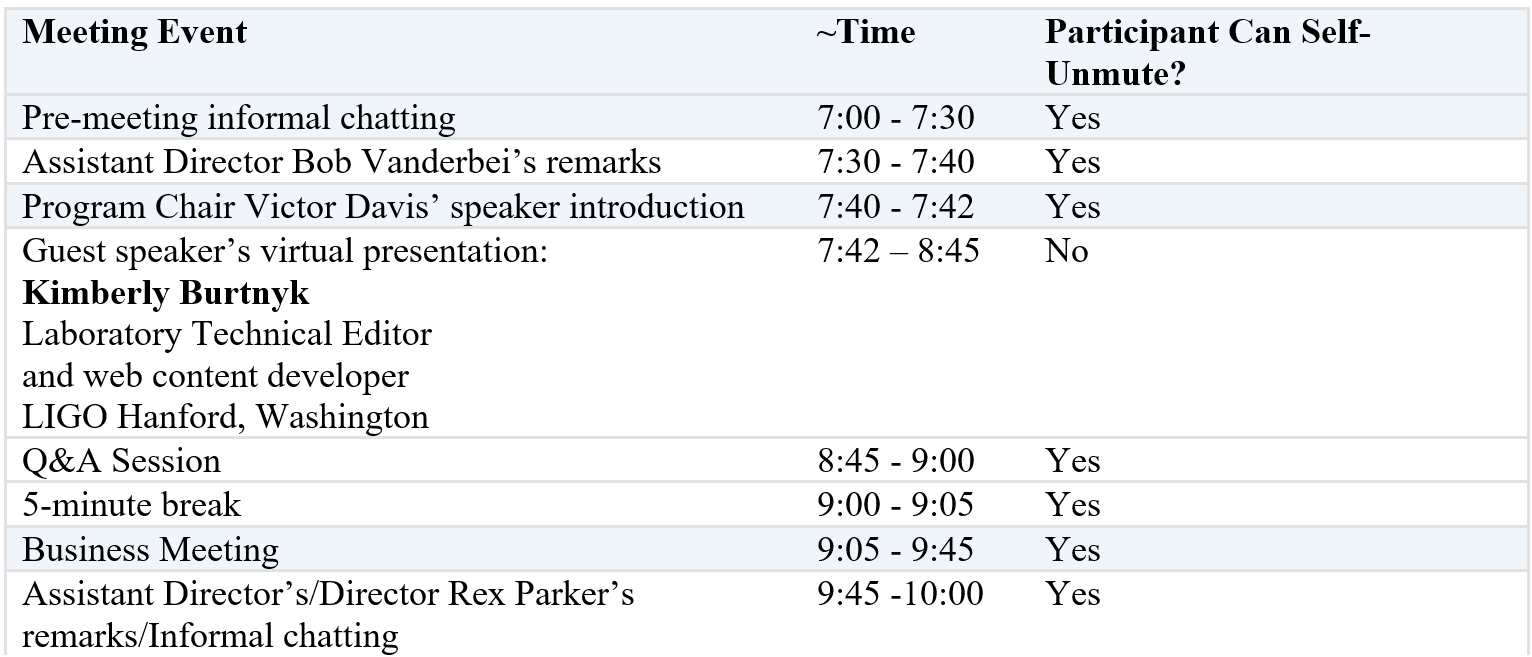
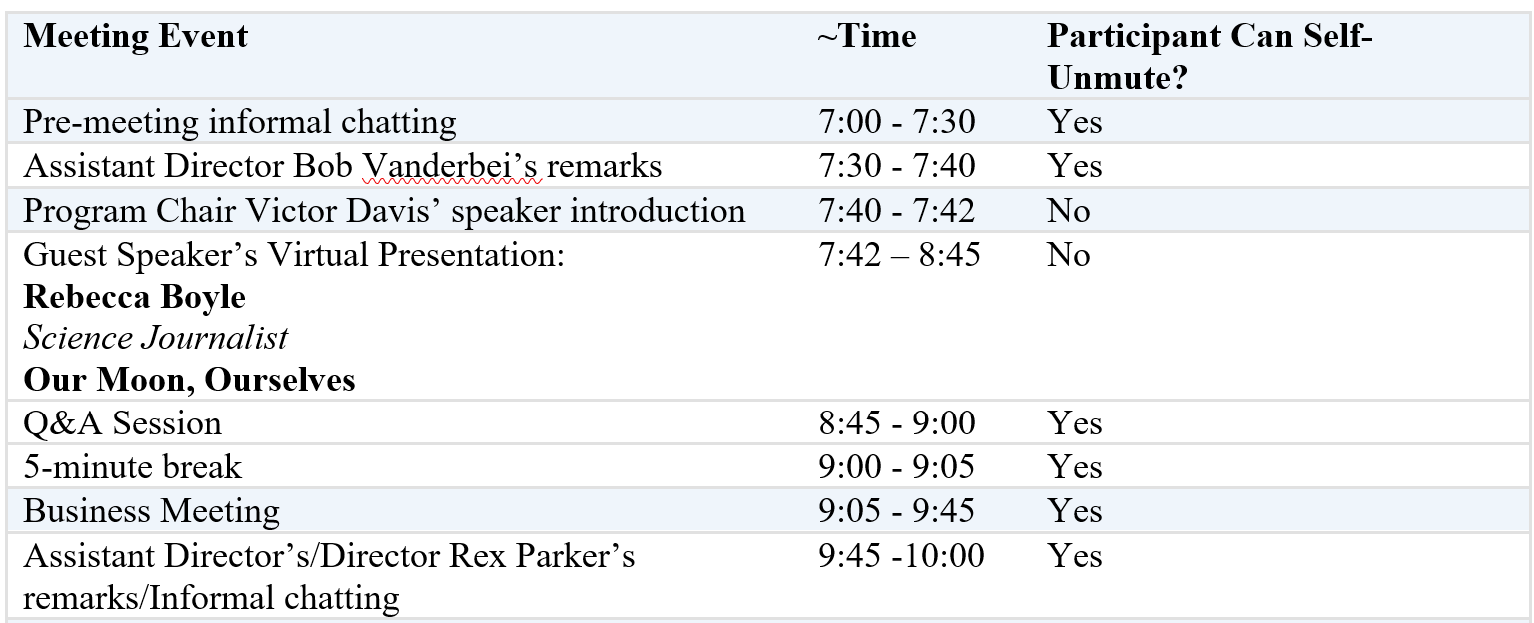
Here’s the anticipated agenda for December, 2024’s monthly meeting of the AAAP:

(Times are approximate)

Getting to Peyton Hall
The parking lots across the street (Ivy Lane) from Peyton Hall are now construction sites, unavailable for parking. We’ve been advised by the administration of the astrophysics department that we should park in the new enclosed parking garage off Fitzrandolph street and walk around the stadium and athletic fields. Here’s a map of the campus and walking routes from the parking garage to Peyton Hall. The map shows the recently completed East Garage. Not shown is an access road Sweet Gum that connects from Faculty Road to an entrance at the lower left corner of the garage. Stadium Road connects from Fitzrandolph Road to another entrance at the opposite corner (and higher level) of the garage. It’s about a 10-15 minute walk from the parking garage to Peyton Hall.


The Search for Earth 2.0: Why We Think It Exists, and How We’re Going to Find It.
For thousands of years, we’ve wondered if the Earth is unique, or if there are other Earths out there to find. In just the last 30 years, we’ve progressed from merely wondering if planets exist around other stars to knowing that almost every star we see has planets. Ambitious planet searches have been probing further and further, finding planetary systems of an incredible – and incredibly surprising! – variety. However, we have yet to discover another planet that might be like Earth – a rocky planet orbiting just the right distance from a Sun-like star to have liquid water on its surface. NASA has a audacious new plan for a next-generation flagship telescope that will directly image Earth-like planets around nearby stars, but it will take all of our ingenuity and technical prowess to achieve this incredible feat. Dr. Jessie Christiansen, Chief Scientist of NASA’s Exoplanet Science Institute, will walk us through the past, present, and future of our hunt for Earth 2.0.

Jessie Christiansen
Dr. Christiansen hails from Australia, and earned her PhD from the University of New South Wales. She’s been a Postdoctoral Research Fellow at the Center for Astrophysics, Harvard/Smithsonian, part of the Kepler science team at NASA’s Ames Research Center and the SETI Institute, and has been a Staff Scientist and now Senior Scientist at NASA’s Exoplanet Science Institute at Caltech. She’s Project Scientist of the NASA Exoplanet Science Archive. Dr. Christiansen has won numerous awards for scholarship and exceptional science and engineering achievement. She’s published extensively in research topics related to the detection and characterization of exoplanets and their atmospheres. Dr. Christiansen is committed to supporting diversity in science and mentors children and women in the areas of science, technology, engineering, and mathematics. She’s a frequent explainer of science at professional colloquia, to the public, and on broadcast media.

How to Participate (Links)

Meeting link Meeting link
Click the above icons for Zoom and YouTube
Zoom Meeting ID: 830 6908 5296 and
Passcode: 812904

Date Featured SpeakerTopic
January 12,
2025
Rebecca Boyle
rebecca.b.boyle@gmail.com

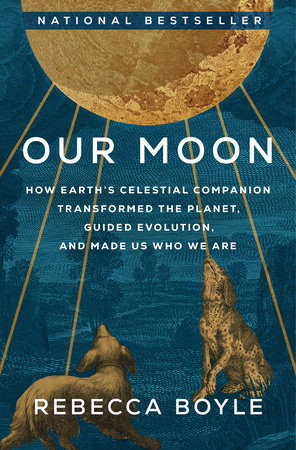
Rebecca Boyle, science writer, essayist, and Contributing Editor to Scientific American, will discuss her new book, “Our Moon: How Earth’s Celestial Companion Transformed the Planet, Guided Evolution, and Made Us Who We Are.”  Suggested by Ira Polans.

As always, members’ comments and suggestions are gratefully accepted and much appreciated.

victor.davis@verizon.net
program@princetonastronomers
(908) 581-1780 cell

Posted in November 2024, Sidereal Times | Tagged , , , , , , | Leave a comment

Minutes of the November 12, 2024 AAAP Board Meeting

by Gene Allen, Secretary

A brief meeting was convened in Peyton Hall at 2200 following the monthly meeting.

In attendance were:

Rex Parker, Director
Bob Vanderbei, Assistant Director
Michael Mitrano, Treasurer
Victor Davis, Program Chair
Dave Skitt, Observatory Co-Chair
Bill Murray, Outreach Chair
Gene Allen, Secretary

Bill explained that the UACNJ Board meets this coming Saturday to consider his proposal for the reactivation of the AAAP observatory at Jenny Jump State Park. The proposal was detailed in the Board Minutes of September 4, 2024. Michael Mitrano explained that we need only add back the Jenny Jump location to our liability coverage that was removed a few years ago. It does increase our premium but not by much. A unanimous vote approved the change.

Dave reported challenges with acquiring the foam carpet square for the observatory. The needed total comes close to the $1,000 that the Board can approve without putting it to the membership. With tax it likely exceeds $1,000. We are tax exempt, but only when using an organization check, not when purchased by one of our members. There is currently a substantial discount in effect that will expire shortly. A unanimous vote formally approved the purchase up to $1,000. Michael will coordinate with Dave to execute the purchase.

Posted in December 2024, Sidereal Times | Tagged , , | Leave a comment

Minutes of the November 12, 2024 Meeting

by Gene Allen, Secretary

Director Rex Parker opened the meeting in Peyton Hall and on Zoom at 1938. There were 41 in attendance.

Rex noted views and images of comet C/2023 A3 and the unusual sighting of the aurora borealis here in central New Jersey. Spiral galaxy M33 transits (is at its highest point in the sky) tonight at 2200 and is perfectly positioned for imaging. The Pleiades, M45, are also well positioned for viewing naked eye or with binoculars but in a telescope need a super wide field of view.

Program Chair Victor Davis introduced Dr Manuel Cuesta, a Postdoctoral Research Associate at Princeton University. His lecture was “Remote Observations of Solar Dynamics and Results from the Parker Solar Probe.”

Questions and a break followed his talk.

The meeting reconvened with an Unjournal Presentation by Member David Ackerman describing the spectroheliograph he built and the images it has yielded.

The question period had run long and technical challenges starting the lengthy Unjournal Presentation left little time for general discussion without unduly delaying a Board of Directors meeting that needed to follow.

The meeting was adjourned at 2155.

As of November 11, we have 214 active members. So far in CY2024, renewals number 114 and expirations number 48, giving us a 70% retention rate.

Posted in December 2024, Sidereal Times | Tagged , | Leave a comment