
by S. Prasad Ganti
Millions of people made long journeys across the US to catch a glimpse of the total solar eclipse on April 8th 2024. The totality lasted up to 4 mins. First I will write about the logistics of getting to the path of totality and watching the eclipse. The second part is about the science of the sun and eclipses.
The path of totality was about 115 miles wide and passed diagonally from Texas to Vermont. It was a much hyped event as the next total eclipse is not expected for another two decades in the US. I may not be around to watch that. The laws of economics kicked in to capitalize on this opportunity. Airline fares, hotels, rental cars all had jacked up prices. We decided on a strategy to guarantee sighting the most sought after event without spending a fortune.
From our home in Jacksonville, Florida, the nearest place geographically was Jonesboro, Arkansas, about 800 miles away. We decided to drive instead of flying. The nearest city which was outside the path of totality is Memphis, Tennessee, which had reasonable hotel rates. We checked in Memphis a couple of days earlier and saw the National Civil Rights Museum at Lorraine Motel where Martin Luther King was assassinated. Also Beale Street, the home of Blues music.
We checked the weather forecast the night before. In addition to Jonesboro, we had three other towns as alternates within a 25 miles radius. Based on the weather forecast, we settled on Walnut Ridge, which was about 25 miles west of Jonesboro, and had a longer duration of eclipse (3:46). On April 8th morning we started early in the morning crossing the Mississippi river into Arkansas. Early morning fog started burning up as we moved closer to our destination. There was not much traffic and we arrived at Walnut Ridge City Park a good 3 hours before the start of the eclipse. Few clouds were there but nothing threatened the viewing of the eclipse.
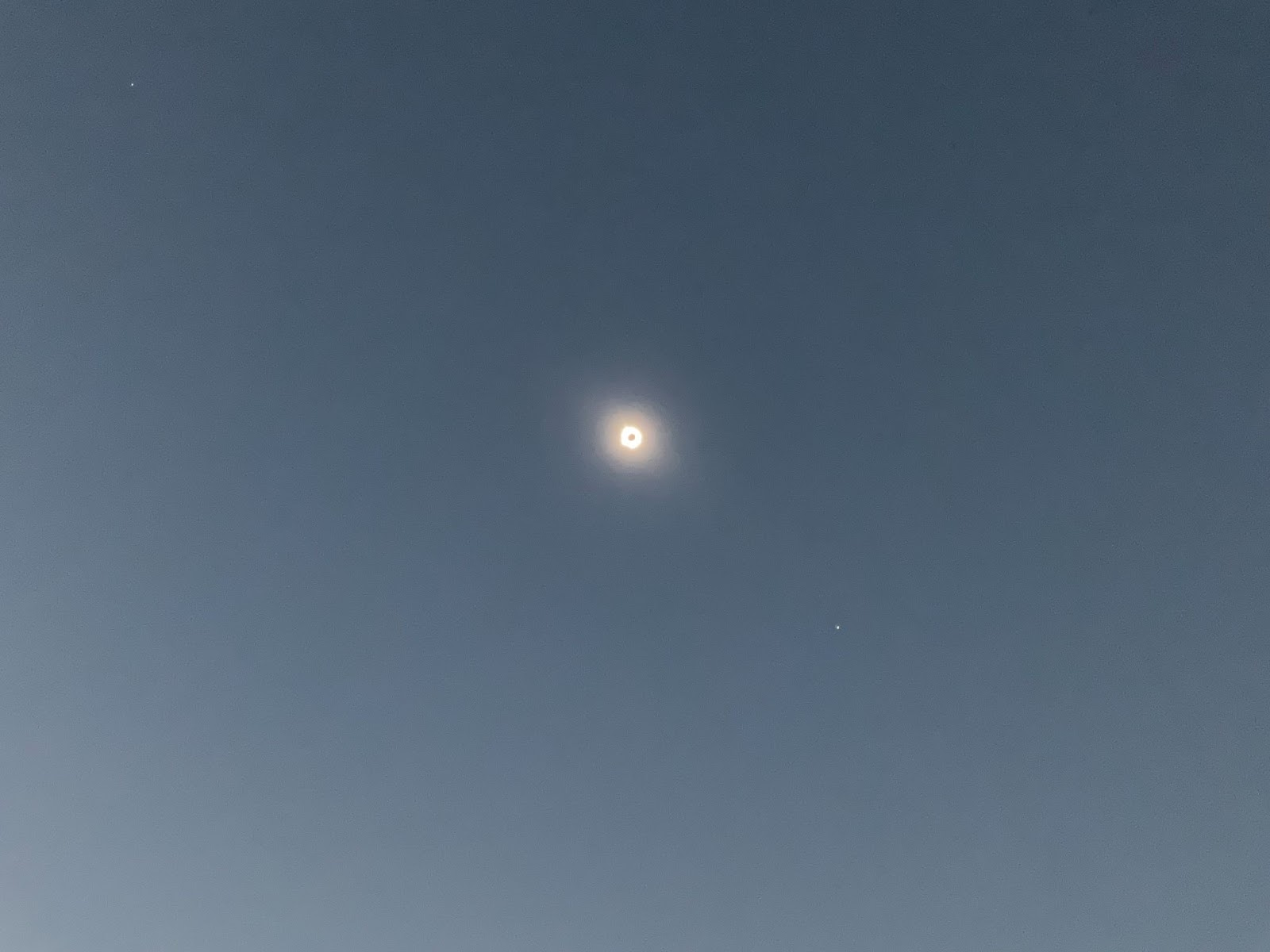
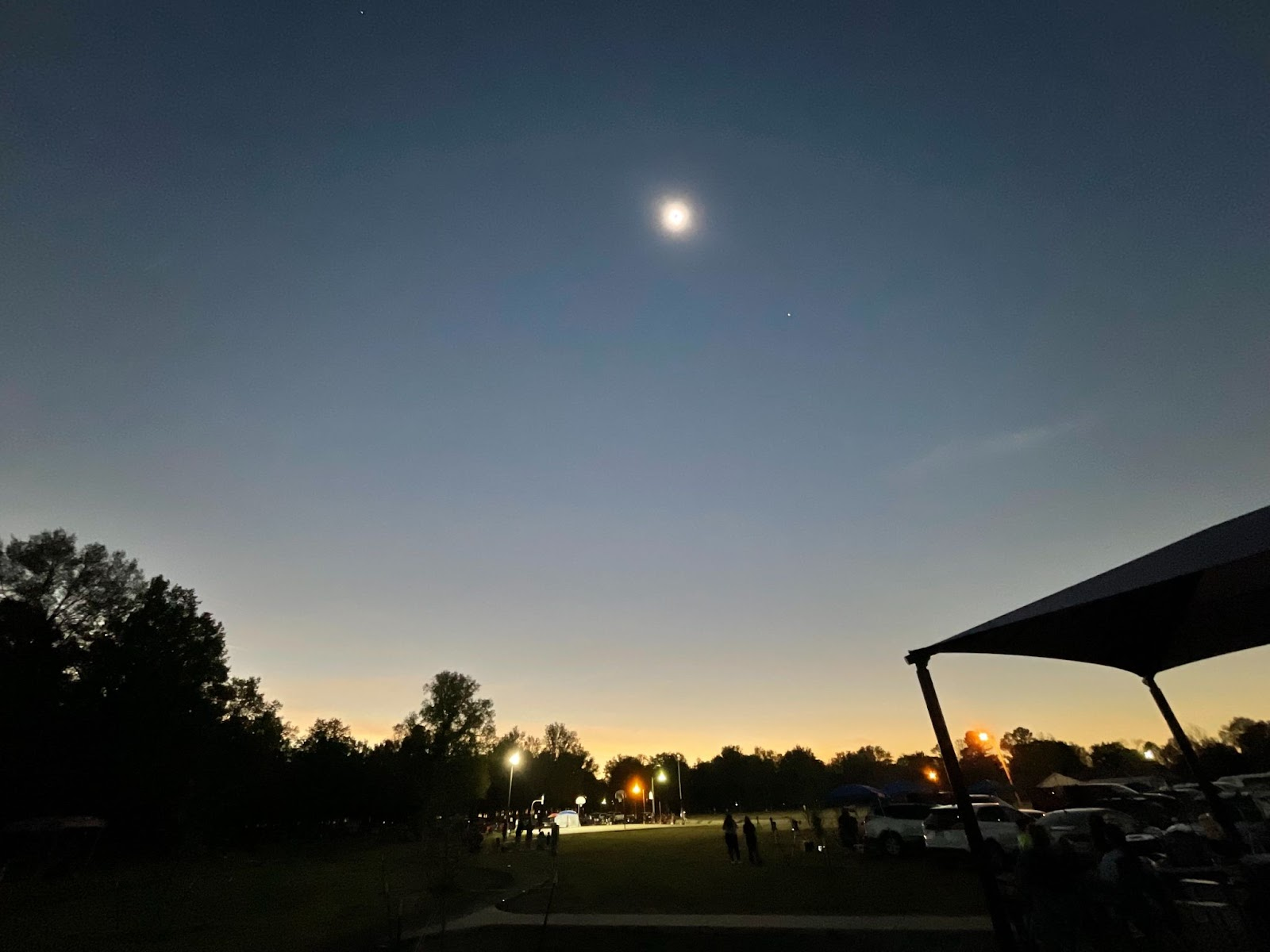
Around 1230, the moon started covering the sun. Nothing much happened till a significant portion of the sun was covered. The light dimmed and the temperature dropped. It was a peculiar kind of light, not that of dusk, but a hue not observed normally. Suddenly it became dark and the distant lights in the Park came on automatically. The sight of a black circle in the midst of the sun was memorable. It lasted close to 4 minutes. And then the events occurred in reverse order before full sunlight was restored. Pictures taken using my iPad pro capture the event. The pictures are more of a personal memorabilia than representing any semblance of excellence in astrophotography. The first picture shows the eclipsed Sun with 3 visible planets – bottom right, top right and top left.
Second picture shows the lights in the Park which came on automatically as the eclipse created darkness.
On the way back, getting out of the Park was easier. The town of Walnut Ridge, unknown to most people, had its 15 minutes of fame. As someone was heard saying “Walnut what ?”. Someone else said “Where is the Ridge ? As it was all a flat open land”. As we moved away from the town towards Memphis, the traffic increased. The eclipse traffic from the nearby towns of Arkansas came to converge at the bridges across the Mississippi river into Memphis. We got stuck for three hours. It was an OK price to pay for the wonderful natural spectacle. Rest of the trip home was uneventful.
Now to the science of eclipses. A small body like the moon can blot out the entire sun because coincidentally the ratio of the size of the sun to the moon is the same as the ratio of the distance of the sun and the moon from the earth, which is about 400. Total eclipses dont happen often because the orbital plane of the moon around the earth is tilted compared to the orbital plane of the earth around the sun. Not in the same country for several years or decades.
Incidentally, the outer layer of the sun called corona is about 2 million degrees, much hotter than 10,000 degrees on the surface. This corona normally gets totally outshone by the sun. During a total eclipse, the corona comes into view. During one such eclipse in the 1800s, the sunlight on the edges was analyzed spectroscopically and a new element called Helium was discovered. It is a very rare element on the earth.
Most famous experiment done during an eclipse was in 1919 when Arthur Eddington set out to prove Einstein’s general theory of relativity that light bends in the presence of gravity. Stars in the sun’s proximity which are not normally visible are visible during a total eclipse. Eddington led a team to Brazil while another team went to Africa just as a backup in case the first team hit clouds. Both the teams measured the bending of starlight while it passed through the outer fringes of the sun. And the bending of light agreed completely with Einstein’s calculations.
While eclipses help do the scientific observations, now with the benefit of space probes with coronagraphs (which block most of the sun, like eclipses do), it is easier to do observations any time round the clock. NASA’s Parker probe and India’s Aditya are observing the sun from millions of miles closer to the sun.
While reminiscing about the past eclipse, waiting for the total eclipse in India about a decade from now.


