
by S. Prasad Ganti
Different space missions have different goals. The scripting of operations is done accordingly. For example, the Hubble Space Telescope had the goal of looking at different parts of the sky and capturing images of the stars and the galaxies. Chandrayaan 3 had the goal of landing closer to the south pole of the moon. Sometimes gambles are taken midstream to see if a better outcome can be obtained. Like an afterthought which did not exist in the initial script for the mission. Let us look at a couple of such examples.
In 1995, scientists took a gamble using Hubble. They decided to focus the telescope on a dark patch of the sky where there seems to be nothing visible either to the naked eye or the other powerful ground based telescopes. They were surprised to find thousands of galaxies from the early history of our universe showing up in this deep field image. They followed it up with an ultra deep field image in 2004. The image given below courtesy NASA, required 800 exposures taken over the course of 400 Hubble orbits around the Earth. Obviously, such complex images are assembled from thousands of individual pictures and colors are assigned based on the frequencies of the signals received.
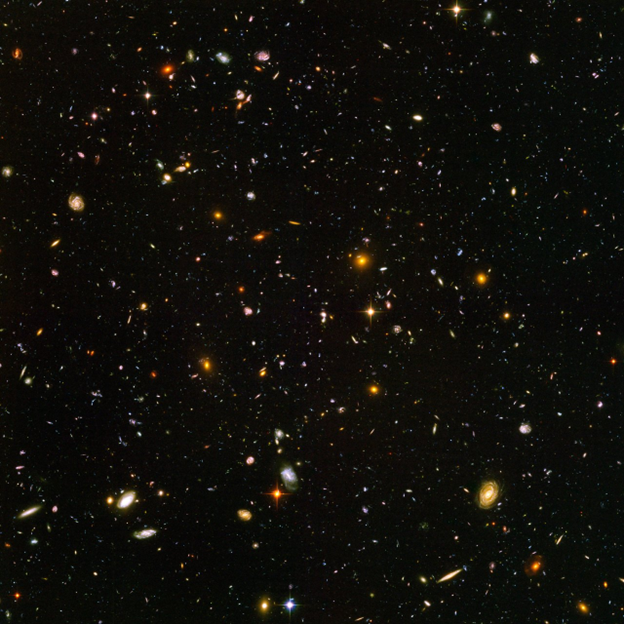
Bottomline is that dark patches of sky may not be really dark. It could be the limitation of our sensors – eyes or man made sensors. It is possible that the gamble would have failed and we could have come up with pure darkness or absence of any visible objects. And thereby wasted Hubble observation time which could have been used for some other purpose. There are lots of requests from different astronomers for observation time on such telescopes. The allocation of observation time is done after careful considerations.
Chandrayaan 3 is India’s moon landing mission. The lander landed closer to the South Pole in Aug 2023. The orbiter called the propulsion module (PM) orbited the moon for some time thereafter. The mission team realized that there is still about 100 kg of propellant left in the PM. The team might have been defensive in determining the amount of the propellant required. Since all the maneuvers went according to the plan, there was no need to dip into the propellant reserve. The team then decided to bring the PM back to the Earth.
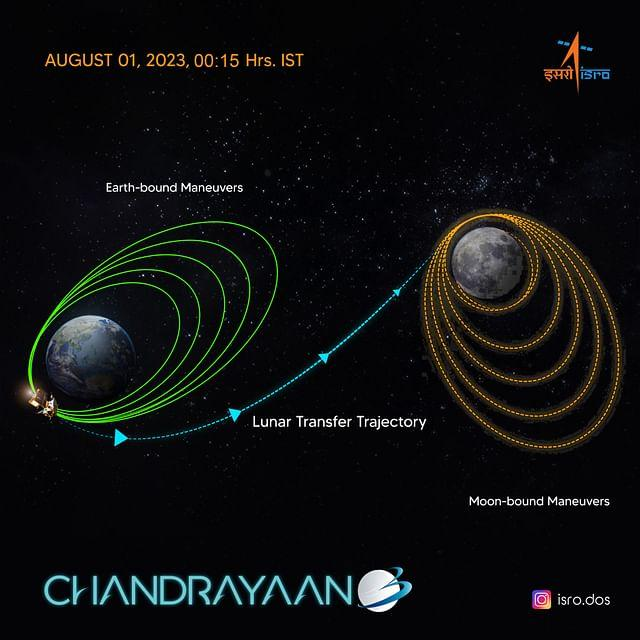
To understand how the PM was brought back to the Earth, the following picture, courtesy ISRO (Indian Space Research Organization), shows how it was sent to the moon in the first place. A series of elongated orbits around the Earth before insertion into the Lunar Transfer Trajectory. And then some orbits around the Moon to stabilize into a close circular orbit. The reverse process was undertaken to bring it back to the Earth. It took a couple of months before the PM reached the Earth in December 2023.
The gamble could have failed and the PM could have been lost in space. But then there was no use of the PM orbiting the moon till it exhausted its fuel. With this return journey, it was proved that ISRO can use the gravity assist of the Moon to fling back a spacecraft towards the Earth.
A second afterthought was to see if the Lander could be re-ignited to take off from the lunar surface. A brief reignition did occur and the Lander did raise a few feet into the air and landed again a few feet away. It is a small distance, but then it proved that if a lunar sample needs to be carried back to the Earth, the lander can take off and dock with the PM, which can bring it back to the Earth. These afterthoughts laid the groundwork for future missions with more capabilities.
Both these afterthoughts proved to be beneficial. Good sense prevailed in coming up with such ideas and executing them successfully.


