by Rex Parker, PhD director@princetonastronomers.org
UPDATE: 01/08/2024
Inclement weather is expected tomorrow, Tuesday, January 9th.
AAAP meeting will be on Zoom only.
Denizens of Planet Earth Declare another New Year! I hope the beginning of 2024 finds you with recharged batteries and a renewed sense of wonder about the universe around us. Sharing that sensibility is part of our role as amateur astronomers. As you may have realized at family and friend gatherings over the holidays, as a Princeton Amateur Astronomer you will be called upon to interpret the physics behind celestial phenomena. You’re the go-to person to describe what is seen by telescopes from the Webb to your own backyard setup, to discuss why we should land humans on the moon again and explore Mars and the asteroids, and just how do Lagrange points work anyway?
The New Year in astronomy for AAAP will begin on Jan 9 (7:30pm) as we convene again on campus. It would be great to have a big member turnout at Peyton Hall for guest speaker Lia Medeiros, formerly of the IAS and now NASA Hubble Einstein Fellow in Astrophysical Sciences at Princeton. Thanks to the efforts of Dave and Ira, we plan to continue Zooming live from Peyton Hall for those who cannot attend in person. For more on the presentation and the Zoom link see Victor’s article below.
With the start of a new year comes opportunities in our club. Here are a few areas to enhance member experience and up our game as a science-outreach organization.
- Increase the participation and contributions by members in real-time at the regular monthly club meetings.
- Provide learning opportunities for members and public to better understand the night sky and the physics of the cosmos, with increased hands-on astronomy observing and imaging in its many forms.
- Strengthen our links and interactions the Princeton Astrophysics Dept faculty, post-docs, staff, and students, during the meetings and outreach events.
When the Sun Stands Still. The term solstice refers to the shortest day of the year and is celebrated around the world as a return to light. From Etymology Online, solstice derives from mid-13th century Old French, taken from Latin solstitium, sol (the sun) + past participle stem of sistere (stand still, take a stand). Though winter solstice is the shortest day and longest night of the year, this is not the earliest sunset nor latest sunrise. The disconnect between modern clock time and solar days is best understood through the use of ephemerides software. One of the best programs out there is the software developed by the US Naval Observatory, the “Multi-year Interactive Computer Almanac” (MICA, v 2.2.2). But for a few years MICA was unavailable following the demise of the venerable astronomy publisher Wilmann-Bell. Now we have good news (from their website): “Sky & Telescope and the American Astronomical Society are thrilled and honored to continue the legacy of Willmann-Bell publishing as an imprint of AAS Sky Publishing, LLC.” You can now acquire MICA, the one-of-a-kind ephemeris program at modest cost from the website Willmann-Bell, an imprint of AAS Sky Publishing, LLC – ShopAtSky.Com Using MICA, I found the times of sunrise, sunset, and the length of night for central NJ over one year, and plotted the data in Excel (seeFigure below). The earliest sunsets come before, and the latest sunrises after, the longest night on solstice Dec 21.

The “Un-journal Club” Wants You. AAAP’s monthly meetings feature a guest speaker, usually a professional, followed by highlights of club activities and member conversations. This year we want to continue the Un-journal Club, a fun term evoking (provoking?) the journal clubs common in science grad school programs. For AAAP the Unjournal Club is simply brief informal presentations given in the second half of the meeting by members. These don’t need scholarly journal-like topics, but merely engage members with what you care about in astronomy. You can use PowerPoint slides, JPEG’s, astro-images, travel pictures (e.g., bring on a USB memory stick), book reviews, whatever you want including simply your voice. To get onto the schedule for an upcoming meeting, please contact me or program chair Victor Davis.
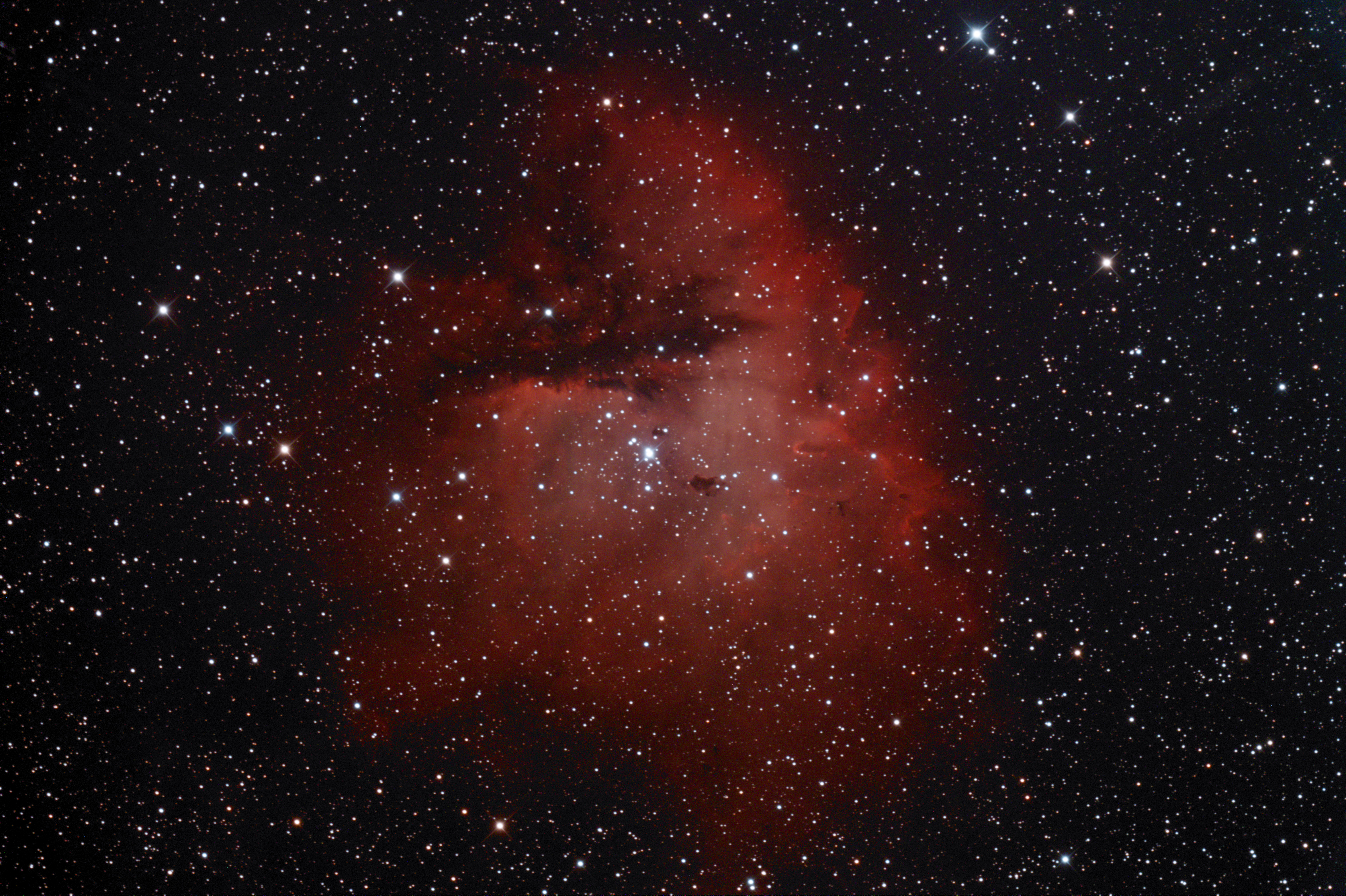
Pac-Man Nebula, NGC 281 in the Winter Constellation Cassiopeia. The distinct shape of this emission nebula, also termed an SH-II region where new stars form out of a vast cloud of interstellar gas, recalls the “Pac-Man” computer game from the 1980’s. It was first described by the famed American astronomer Edward Barnard in 1883. Distance ~9500 light years, about 20×30 arcmin in angular size.
Astrophoto by Rex Parker taken from NJ. Telescope: 12.5”AGO Dall-Kirkham Cassegrain reflector; camera: ZWO ASI2400MC; filter: Antlia RGB Tri-Band filter; image is from 17x10min exposures on Nov 16 2023.