From the Program Chair

by Ira Polans, Program Chair

All monthly club meetings have been cancelled due to Princeton University closing its campus and the need to social distance. I have reached out to the speakers affected by the cancellation (March, April, and May) and all have agreed in principle to give their talks once things return to normal.

While we’re going through this difficult time please stay safe and healthy.

Posted in April 2020, Sidereal Times | Tagged , | Leave a comment

Observatory Public Nights Postponed. Our Skies Remain Open

by Dave Skitt, Observatory Chairperson

The State of New Jersey closed our public state park buildings. This is part of the COVID 19 virus response. AAAP delayed the opening of our observatory for Friday Night Public Observing for your safety. This delay will remain in effect until NJ lifts the group congregation restriction.

All is not lost; the skies will remain open. How you might ask? Through the marvel of telescope technology and the internet.

AAAP recently assembled “the outreach scope” from a pre-owned Orion ED 80 refractor and iOptron AZM Pro mount. We equipped it with a flip mirror and the clubs’ Starlight Xpress Ultrastar C camera.

Appearing in this months edition of Sidereal Times is, Novice EAA Imager Captures Rare, Unseen Astronomical Phenomenon. There I describe the pleasure to dabble with the scope and learn how to use it. Inspired by my church switching to online video services, I have now learned how to broadcast live streaming video from the Ultrastar camera to the internet.

I invite you to check out our club’s Twitter page (@Princetonastro). Our social media is your temporary observatory gateway. Using Twitter, we will observe together over the next several Friday nights. I will be live broadcasting night sky views from my home observatory, weather permitting.

Together we wait for the AAAP observatory to re-open. There, we can share the stellar photons at the eyepiece. For the meanwhile, I hope you will join me in this technological substitute.

Posted in April 2020, Sidereal Times | Tagged , | Leave a comment

Nominations for AAAP Officers for 2020-21

by John Church, Nominations Chair

Dear Members,

Director Rex Parker has kindly asked me to serve as Nominations Chair for our upcoming May election. I am therefore very pleased to report that all of our present officers have agreed to be nominated for another term. In my estimation they have all performed admirably in their respective posts, often above and beyond the call of duty.

The slate is as follows:

For Director: Rex Parker
For Assistant Director: Larry Kane
For Secretary: John Miller
For Treasurer: Michael Mitrano
For Program Chair: Ira Polans
For Observatory Chair: Dave Skitt
For Outreach Chair: Gene Allen

As always, additional nominations can be made by any member in good standing. However, because we will not be able to meet in Peyton Hall to actually conduct the election in May, arrangements are being made to accept any additional nominations and conduct the election electronically. Please stay tuned to Sidereal Times for further details.

In this difficult time we need to keep the club up and running to the best of our ability. It is unfortunate that we cannot presently meet in person, hear all those wonderful programs that Ira has been arranging, and share anecdotes and personal greetings, but this too shall pass. In the meantime, we are still able to stay in touch electronically. Thank goodness the Coronavirus has not infected our computers!

John Church
Nominations Chair

Posted in April 2020, Sidereal Times | Tagged , , , | Leave a comment

Freeman J. Dyson: A Personal Remembrance

by John Church

The Amateur Astronomers Association of Princeton joins the world in mourning the passing of renowned mathematical physicist and noted author Freeman J. Dyson on February 28 of this year at the age of 96.

Freeman, an Emeritus Professor at the Institute for Advanced Study in Princeton, was a great supporter of the role of amateurs in astronomy. A member of the AAAP for nearly 50 years, he helped us build our observatory in Washington Crossing State Park as well as giving the club many lectures in the Peyton Hall auditorium, which was always filled to capacity for such treats.

I first met Freeman in the early 1970’s after having summarized an article of his entitled “Energy in the Universe.” I remember telephoning him (with some trepidation) and asking if he would consider joining the AAAP. He responded that he would indeed be interested. This led to a friendship that lasted nearly half a century, of which more anon.

Here are some abridged selections from back issues of our newsletter Sidereal Times that mention Freeman’s long involvement with the club:

The Nov. 10, 1973 transit of Mercury was observed and timed from John Church’s driveway, using the club’s 6-inch refractor. Present were Freeman Dyson and Tullio Regge of the Institute for Advanced Study. A report was sent to Sky and Telescope, and the timings were published. With Freeman’s help, plans were proceeding to place a club observatory in a modified aluminum garage at the Institute that would be put on roll-off tracks. Member and civil engineer Karl Koehler prepared detailed drawings for the project. This proposal was not adopted due to finding that the Institute would have required construction to be performed by outside labor, which the AAAP could not have afforded.

AAAP member and Institute for Advanced Study Prof. Freeman Dyson was the speaker for the September 1986 meeting.

Prof. Freeman Dyson, long-time AAAP member who participated in the observatory construction in the late ‘70’s, presented a talk entitled “Hunting Comets and Planets” at the November 1990 meeting.

Prof. and AAAP member Freeman Dyson spoke to the AAAP on the subject of “Revolutions in Astronomy” at the December 1993 meeting.

AAAP held its 40th Anniversary Dinner at the Frist Center on the Princeton campus in November 2002. Freeman Dyson, one of the Washington Crossing observatory’s builders, spoke on “A New Way To Look For Life In Cold Places Far From The Sun.”

Our 50th Anniversary Dinner was held on the campus of the Institute in November 2012, at which Freeman also spoke.

On a personal note, my wife and I were invited to the Institute’s Sept. 2013 “Dreams of Earth and Sky” celebration of Freeman’s career. At the banquet on the final evening I gave a few remarks on Freeman’s contributions to our club, including the part he took in the building of our observatory in Washington Crossing State Park in 1977 and 1978. He was there at the site on many Saturdays. Here is a photo of him helping to dig the trench for the foundation:

Freeman J. Dyson digging foundation

photo by Richard Peery ©2020

On one fine Saturday afternoon, Freeman and I laid the fourth tier of cinder blocks in the east wall of the observatory. He helped with the project in many other ways as well.

I had the privilege of meeting privately with Freeman in his Institute office on many occasions when we discussed various topics in physics, astronomy, and cosmology. (Unfortunately, I haven’t kept written notes of our discussions.) On these occasions he would kindly host me for lunch in the Institute’s cafeteria. He very generously gave of his time to critique my draft of a personal memoir entitled From Eve and Morning that I issued privately in 2003. I have several of his books that he signed for me.

Freeman’s talents as a superbly clear and concise writer in multitudes of areas not necessarily related to physics are so well known that it would be superfluous for me to comment further here. As but one example, he served for many years as an invited contributor to the New York Review of Books. These wonderfully-written pieces engendered many replies, not always in agreement with his own views on subjects such as climate change and the role of enormous projects. He was a fan of small projects done inexpensively by individuals and small teams.

To conclude, here is a quotation from one of Freeman’s articles in the New York Review of Books on the subject of “Final Theories in Physics.” This is, I think, a good summary of his philosophy.

I find the idea of a Final Theory repugnant because it diminishes both the richness of nature and the richness of human destiny. I prefer to live in a universe full of inexhaustible mysteries, and to belong to a species destined for inexhaustible intellectual growth.

We in the Amateur Astronomers Association of Princeton will fondly remember Freeman and his many contributions to the welfare of our club as well as in so many other areas.

– John Church

Posted in April 2020, Sidereal Times | Tagged , | Leave a comment

Gene’s Tele Vue Baseball Cap

by Dave Skitt
Observatory Chairperson

Gene’s Tele Vue Baseball Cap

To keep the memory of Gene Ramsey alive, I wrote a short piece about Gene and his Tele Vue baseball cap. It was posted in Tele Vue’s February 2020 Blog.

Posted in April 2020, Sidereal Times | Tagged , , | Leave a comment

Novice EAA Imager Captures Rare, Unseen Astronomical Phenomenon

by Dave Skitt, Observatory Chairperson

If you’ve been reading my emails lately, you know that Dr. Rex Parker, PhD, and I conducted a Keyholder training session on Sunday, March 8, 2020.  We focused on the clubs’ expanding Electronically Assisted Astronomy (EAA) capabilities.  

As a novice EAA imager, I thought the session went very well.  All in attendance exclaimed how rapidly the new EAA technology was evolving and broadening the reach of what can be seen with relatively short exposures.  Despite the nearly full moon, the images of M42 with the ZWO camera on the C14 and the Ultrastar camera on the cOrion ADA, 80mm outreach scope were nearly identical.  The only difference were the exposure times:  5 seconds with the C14 versus 24 with the outreach scope.

After the session, I stayed behind to practice some more with the outreach scope/camera and iOptron AZM Pro mount. I decided to really test the limits and image some objects in the constellation between Virgo and Canes Virenatici.  

Home of globular cluster, M53, the Black Eye galaxy (M64), the Coma Pinwheel galaxy (M99) and the Needle galaxy (NGC 4565), the constellation Coma Viranices (“Viranices Hair”) presents some fine challenges for EAA.  I wanted to narrow down what camera settings would work best on this spread of objects.

I started my adventure on M53.  But not before I synced the mount on Denebola in Leo and tweaked my focus on nearby Cor Caroli with a N95 focus mask.  The AZMP mount got M53 dead on!  The Ultrastars’ stacked 20 second exposures revealed it to be a “rather vivid and round nebula of sars”, just as Johann Bode had described it when he discovered it in 1775.  Awesome!

Next up, M64.  Not nearly dead on but toggling the flip mirror helped me center the fuzzy oval in the eyepiece.  Flip back to the camera.   Wow!  Here, 30 second stacked exposures revealed M64s’ irregular shape, uneven brightness and cool texture.  The dark “Black Eye” dust feature was stunning.

Since it was getting late, I decided to skip “the Pins” (M99) and go straight to “the Needle”, NGC 4565.   This would be a good challenge to end the night.  

Now the AZMP’s slews are quiet.  Really quiet.  So much so that I wasn’t sure that it had moved far enough to hit the Needle.  Rushing in the cold, I typed in 14 days seconds in the exposure box and hit enter.  What appeared on the screen took my breath away.  I shivered.

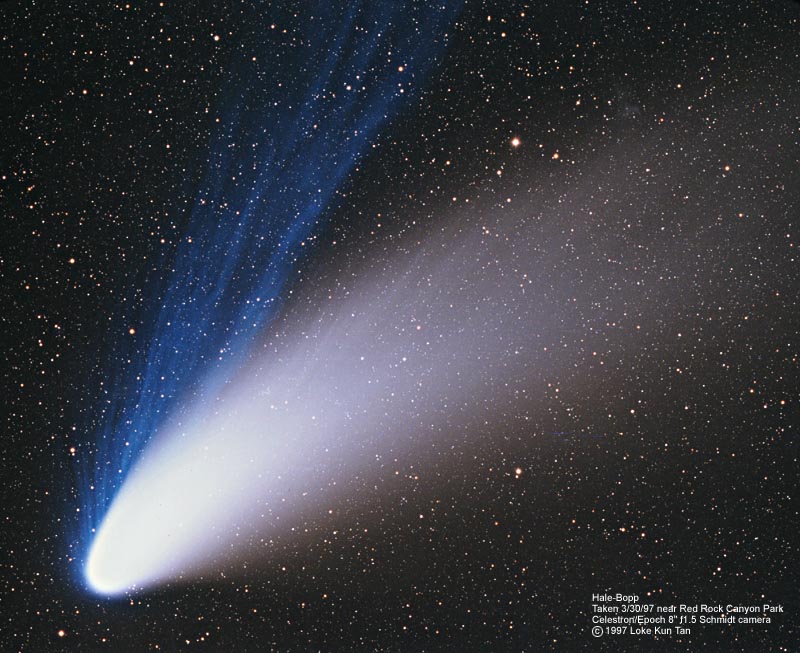
Close up, the image looked like a comet. But when viewed six feet from the screen, it looked like a planetary nebula.  Had I not cleared the image cache before slewing?  Could it be both?  I took a screenshot and texted it to Tom Swords, a passionate comet hunter.  “That’s not a comet”, Tom replied.

I then texted the image to Dr. Parker along with the RA/DEC coordinates (16h 55m 33.86s/-41o 50’ 51.6”).  His extensive background in astro-imaging lead him to believe I had stumbled upon some novel astronomical phenomena.  He immediately called Dr. David Nyell at Central Management for Official Sightings and sent him the image and data.  

Twenty-four hours later, Dr. D. Nyell replied.  “We at CMOS can only state that the object observed at those coordinates is a presumptive positive sighting.  The data will be forwarded to the Copernicus Celestial Discovery Center via their Hotline.  Please refrain from additional observations until April 5th.  At such time we will reassess our position”.  

Early Tuesday morning, I received a frantic phone call from someone who identified herself as Vira Di’ Seaz.  She exclaimed “the C-CD-C has confirmed that you have caught the CO-VID-EAA-19 virus, aka, the CoronEAA virus.  Please self-quarantine yourself at the observatory for 14 days for further observation.”  

“Fourteen Days?  What do I do after 14 days?”, I blurted out.

After a short pause, Vira replied, “Well…, Corona Borealis will be higher in the sky by then.  You could poke around there with your telescope until this whole thing blows over…”!

April Fools.

P.S.:  The coordinates given above are for NGC 6231 located in Scorpius.  It is labeled in Stellarium planetarium software as the “False Comet Nebula”.

artists conception of surreal galaxy

COVID-19 (but not EAA) Free in 2020!


AAAP’s Outreach Telescope: Orion ED80 refractor complete with “N95 Focus Mask” and Starlight Xpress Ultrastar Color Camera on iOptron AZM Pro mount. Additional side-view photo of AAAP’s Outreach Telescope on the right.

Posted in April 2020, Sidereal Times | Tagged , | Leave a comment