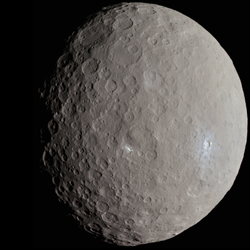
The Dark Side of the Universe – March 8, 2016

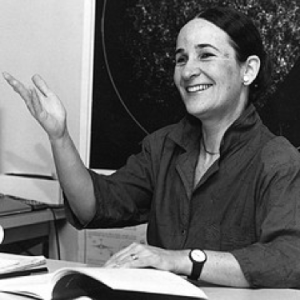
Dr. Netah Bahcall

Dr. Neta A. Bahcall

By Ira Polans, Program Chair

 The March meeting of the AAAP will be held on the 9th at 7:30 PM in Peyton Hall on the Princeton University campus. The speaker is Dr. Neta A. Bahcall, Eugene Higgins Professor of Astrophysics at Princeton University. Dr. Bahcall will discuss “The Dark Side of the Universe”.

What is the Universe made of? Recent observations suggest surprising results: most of the content of the Universe is dark and unexpected; not only most of the matter in the Universe is dark and unconventional but, more surprisingly, the major component of the Universe may be in the form of ‘dark energy’—a form of energy that opposes the pull of gravity and causes the expansion of the universe to accelerate. By combining recent observations of clusters of large-scale structure, distant supernovae, and the cosmic microwave background, we find evidence for a Universe that has only 5% normal baryonic matter, 20% non-baryonic dark matter, and 75% ‘dark energy’. The observations suggest a Universe that is lightweight, with only 25% of the critical mass-density needed to halt the Universal expansion; the Universe will likely expand forever. Dr. Bahcall will discuss the observations of the dark side of the Universe and their implications.

We will not have a March meet-the-speaker dinner.

Our April speaker will be Dr. James Green, Director of the Planetary Science Division at NASA Headquarters. Dr. Green will speak on “New Discoveries in the Outer Solar System: Ceres, Pluto, and Planet X”.

We urge you and friends to attend one or both of these meetings.

Posted in Sidereal Times | Leave a comment

Public Astronomy Lecture – University of the Sciences

by Ira Polans, Program Chair

Our November speaker, Dr Paul Halpern, has invited AAAP members and the general public to a series of free astronomy lectures at the University of the Sciences in Philadelphia on Wednesday, March 23 and Thursday, March 24 by astronomer Dr. Susana Deustua of the Space Science Telescope Institute (NASA).

  • Wednesday, March 23 from 4:00 PM – 5:00 PM
    Women in Astronomy
    Whitecar Hall, Room 207
  • Thursday, March 24 from 1:00 PM – 2:00 PM
    The Accelerating Universe and Dark Energy
    Science and Technology Center, Room 137

The University of the Sciences is located in West Philadelphia, 43rd St. and Woodland Ave. The lectures are sponsored by the Harlow Shapley Lecture Series, American Astronomical Society.

Posted in Sidereal Times | Leave a comment

2016 Stokes Star Party

The Stokes Star Party will be held April 1 and 2 this year at the New Jersey School of Conservation in Stokes State Forest, 1 Wapalanne Road, Branchville, NJ 07826.

Members interested in attending can find more information on the star party website: http://stokesstarparty.com

From the website:

The 2016 Spring Star Party is NOT New Moon weekend, this is the Last Quarter Moon. However, the Moon will not rise at this site until approximately 3:25am the morning of Saturday, April 2. Thus, Friday night’s observing will be dark and mostly Moonless, as will Saturday night’s as the Moon doesn’t rise until approximately 4:10am Sunday morning.

We selected this weekend because the Rockland Astronomy Club (RAC) scheduled the Northeast Astronomy Forum (NEAF) during April’s New Moon weekend. So as not to cause a conflict of dates for those interested in attending both events, the Stokes Star Party was moved from our usual April New Moon schedule.

The main observing field during the 2006 event. (Credit: Tom Olgetree)

“New Jersey” and “dark skies” are not usually companions within the same sentence, but the Stokes Star Party has begun a tradition of taking advantage of the remaining dark skies in the Garden State. Nestled up in the far Northwest corner of the state is Stokes State Forest, inside of which is found the 240-acre abode of the New Jersey School of Conservation (NJSOC). Owned and operated by Montclair State University (MSU), this tract of land is preserved as an environmental extension station for the College of Science and Mathematics at MSU.

As such, the NJSOC has become an ideal setting for star-gazing under night skies that are the least obstructed by light pollution in the state.

With the coordination of John Miller (Pearl Observatory), Rob Teeter (Teeter’s Telescopes) and a handful of other dedicated observers, the Stokes Star Party has become a “right of passage” every April as the first Northeast Star Party of the calendar year.

Posted in March 2016, Sidereal Times | Tagged | Leave a comment

Treasurer’s Report

by Michael Mitrano, Treasurer

Thus far in our fiscal year that ends in June, we have 81 members.  Our dues revenue at this point is almost exactly the same as it was a year ago at the same date.

Revenue for the fiscal year to date is about $7,500, with nearly $4,000 of that resulting from the sale of donated equipment and the C14 that we removed from service in Washington Crossing State Park.  Even with repair and improvement costs for the observatory, which total $1,200 so far, we still have a year-to-date surplus of nearly $4 thousand.

On a cumulative basis, the AAAP’s surplus is about $27 thousand.

Posted in March 2016, Sidereal Times | Tagged , | Leave a comment

Minutes of the February 2016 Meeting

by James Poinsett, Secretary

  • “Saving Hubble” was shown before the meeting followed by a lecture by the filmmaker, David Gaynes.
  • The meeting was called to order at 9:00 after the movie and lecture.
  • The new website is live. Good job Surabhi and Mike. Surabhi is still waiting for some additional items to be added to the site.
  • There was a brief discussion on the newly discovered Planet X.
  • There will be a board meeting on Tuesday, March 29th at 7:00 PM at the West Windsor Branch of the Mercer County Library. All members are welcome.
  • Ways to help keyholders refresh their knowledge of the night sky were discussed. There will be refresher classes at the NJ State Planetarium on Saturday mornings, Feb 13 & 20.
  • StarQuest 2016 was discussed. The only new moon nights available are April 8 and October 28. Other options discussed were last quarter moon weekends of Sept 23 or Oct 21. A concensus of club members present agreed to the weekend of October 28th.
  • UAC NJ is soliciting donations to refurbish their observatory at Jenny Jump. Board members present agreed to a $200 donation by the club.
  • The observatory is open and operational, but be careful as there is snow all around. Four wheel drives vehicles are recommended until the snow is gone.
  • Observatory improvement ideas are wanted for the next board meeting.
  • Larry will survey club interest in a trip to view the 2017 total solar eclipse.
  • The keyholder schedule for the upcoming viewing season will be adjusted so the same teams are not on the holiday weekends every year. Keyholder email address and phone numbers will be added to the schedule to facilitate communication between teams.
  • Meeting was adjourned at 9:55
Posted in March 2016 | Tagged , | Leave a comment

Gravitational Waves

by Prasad Ganti

A couple of weeks back came the news that gravitational waves have been detected proving one of Einstein’s predictions. Rex wanted to see if we can arrange for a talk on this topic. The same sentiment was expressed by the program co-ordinator of “Science on Saturday” at the Princeton Plasma Physics Laboratory. Since our lectures are booked until June, we will try to find a speaker for September or later this year.

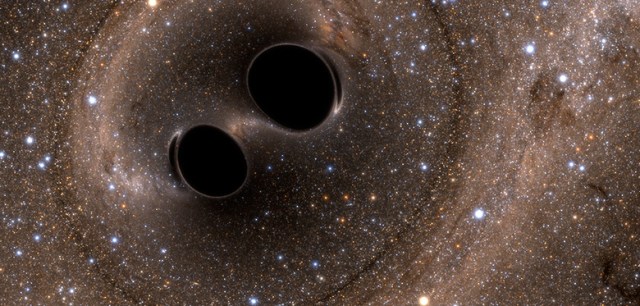
Einstein came up with the General Theory of Relativity about a hundred years ago in which gravity was a main player in the sculpting of our Universe. Most of his predictions regarding the bending of light due to space-time curvature and slowing of time in presence of gravitational fields have been proved. One thing left over was the prediction of gravitational waves. These ripples in the fabric of space are supposed to be created when violent cosmic events happen like the collision of two black holes. We have witnessed other extreme events like cosmic collision of galaxies and supernova explosions, but they are too mild to produce gravitational waves. No one has witnessed collision of black holes so far.

Black holes are a gravitational extremity predicted by Einstein. Since it is is a very compact gravitational well, absorbing all the radiation and giving nothing out, they have been observed indirectly through their effect on other visible bodies around them. Most of the galaxies are supposed to have a black hole at their centers, including our own Milky Way and our neighbor Andromeda. Finding two black holes in the vicinity of each other leading to a collision is rare events Finding such scenarios in our neighborhood or even within a few million light years is nearly impossible. If such a thing does exist, the human race may cease to exist!

Looking further into space also means looking back into the past. Because of the vast distances involved, even light takes millions or billions of years to reach us. As a result, the gravitational waves tend to be very feeble by the time they reach us. Detection of such waves is as much engineering as science. Like telescopes are detectors for light and radiation like infrared, ultraviolet etc., a precise interferometer was constructed in an L-shape with two2.5-mile arms. A laser beam fired along both the arms is reflected by end mirrors. Any discrepancy in arrival of the beams to the starting point could indicate the presence of gravitational waves.

LIGO Facilities in Washington and Louisiana (Credit: Caltech)

LIGO Facilities in Washington and Louisiana (Credit: Caltech)

The mirrors are highly polished and guarded against any other terrestrial vibrations. The tubes themselves have a high vacuum and are very cold. To verify that a signal is not due to another source of vibrations, two such devices were built. Called LIGO (Laser Interferometer Gravitational-Wave Observatory), one is located in Louisiana and other in Washington state. Both of them detected the gravitational waves in a recent collision of two compact black holes. There is very high degree of confidence in the scientific community that these were indeed gravitational waves. More such observations are required to be totally certain. Since the equipment is becoming more sensitive and sophisticated, we can expect similar observations in the future.

LISA (Laser Interferometer Space Antenna), a set of 3 satellites with lasers and mirrors, will be positioned a million miles from the Earth, where the gravity from Sun and Earth cancel each other out. This Lagrangian points is a good spots for observing gravitational waves. Let us see if LISA can detect other gravitational waves including the ones from the Big Bang itself.

Coming on the heels of the discovery of Higgs Boson a few years back, this has been a phenomenal discovery. What is next ? Unification of gravity and quantum mechanics via the string theory? Discovery of multi verses? Just when we thought that we learnt a lot about cosmology, it seems like nature threw a wrench into the works and we stumbled upon dark matter and dark energy. Making us realize that we still have a long way to go. Learning is a quest, not a destination.

Posted in Sidereal Times | Leave a comment

Eta Carinae

by Robert Vanderbei

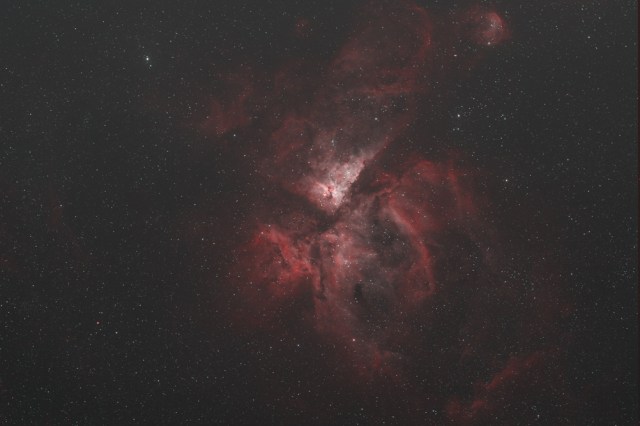
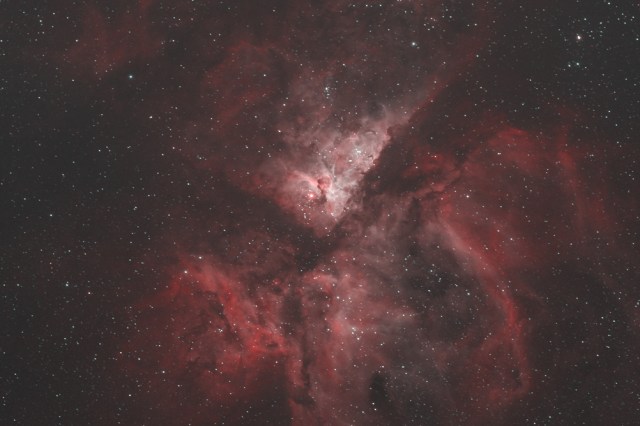
Two images of Eta Carinae taken on February 7, 2016. SBIG Universal on Takahashi FSQ-104D H-alpha = 40 min, OIII = 6 min Two-minute unguided exposures. Richardson-Lucy deconvolution, Gaussian blur, Log.

ngc3372-HaOIII-RL10-Blur-Log-dimmer_25pct

ngc3372-HaOIII-RL10-Blur-Log-dimmer-crop-50pct

Posted in March 2016, Sidereal Times | Tagged , , | Leave a comment

Snippets

Compiled by David Kaplan and Michael Wright

CHINATELESCOPEChina Telescope to Displace 9,000 Villagers in Hunt for Extraterrestrials
Thousands of villagers in Guizhou Province are being relocated to make room for a $184 million telescope to detect signs of alien life.

Exotic Cosmic Locales Available as Space Tourism Posters
Fourteen space travel posters of colorful, exotic cosmic settings are now available free for downloading and printing.

Stephen Hawking: ‘Things can get out of a black hole’
An illustrated version of Prof Stephen Hawking’s second Reith lecture, Black holes ain’t as black as they are painted. Prof Hawking examines scientific thinking about black holes and challenges the idea that all matter and information is destroyed irretrievably within them.

Madness and Genius
Cosmologist Janna Levin on the Vitalizing Power of Obsessiveness, from Newton to Einstein

Saturn rings

Saturn’s Rings: Less than Meets the Eye?
A recent study from NASA’s Cassini mission proves that, in the mysterious and beautiful rings of Saturn, appearances can be deceiving.

Event Horizon Snapshot Due in 2017
A global network of nine radio telescopes is set to take the first ever picture of a black hole’s event horizon in 2017.

Why Can’t You Remember Your Future?
Physicist Paul Davies on The Puzzlement of Why We Experience Time as Linear

Wrapping Armchairs in Wire, and Other Childhood Attempts to Travel in Time
Whether we were influenced by C.S. Lewis or Doctor Who, many of us have distinct memories of fantasizing about time travel as kids.

Where NASA’s Rocket Countdown Came From
On December 1, 2014, NASA retired a historic piece of equipment at Kennedy Space Center in Florida. It wasn’t a rocket, or even a deep space nine-iron—it was the original countdown clock, an analog display the size of a titan’s wristwatch that stood across the river from the rocket launch site and stoically ticked off the seconds until blastoff.

Cosmic Solitude
Polish Nobel Laureate Wislawa Szymborska on How the Prospect of Being Alone in the Universe Can Make Us Better Stewards of Our Humanity

Color_global_view_of_Ceres_-_Oxo_and_Haulani_cratersNew Animation Takes a Colorful Flight Over Ceres
A colorful new animation shows a simulated flight over the surface of dwarf planet Ceres, based on images from NASA’s Dawn spacecraft.

Ceres: Keeping Well-Guarded Secrets for 215 Years
In 1801, when an astronomer pointed his telescope at a seemingly star-like point of light, he probably had no idea a robotic emissary from Earth would one day be sent there.

James Webb: Hubble Successor Maintains Course
James Webb, the space telescope that will take over from Hubble, is reaching some key milestones in its preparation for launch in 2018.

Posted in February 2016 | Tagged , , | Leave a comment

UPDATE: “Saving Hubble” – February 9, 2016 Movie & Lecture

by Ira Polans, Program Chair

The Amateur Astronomers Association of Princeton is pleased to announce that immediately before the regular February meeting we will show the film “Saving Hubble” in Peyton Hall. The film is 70 minutes long. The showing will begin promptly at 6:00 PM. Since this is close to the dinner hour, the club will provide a light meal (think pizza and beverages). For this reason, the meet-the speaker dinner is canceled for February. Please join us for the screening, or the regular lecture and club meeting at 7:30 PM.

Posted in Sidereal Times | Leave a comment

From the Director

by Rex Parker, Director
Rex


Upcoming events and ideas for AAAP members

  • Night-sky refresher at Planetarium
  • Changing of equipment at the Observatory
  • Software tools for your consideration

A Rare Opportunity for AAAP Members ONLY
Night-sky refresher at the Planetarium – Yes, hands-on astronomy can be done right  despite the light pollution that we all lament!  AAAP is offering a “night sky refresher” opportunity for members wishing to better understand which deep sky objects are visible over the seasons, how to find and identify them, and how to more effectively show them to others. We’ll utilize the considerable strengths of the planetarium along with the expert knowledge of planetarium staffer and AAAP member Bill Murray. Depending on member participation, one or more dates are being arranged in the near future. We need your input, so please take this survey to help us determine best dates for the planetarium sessions.  https://www.surveymonkey.com/r/VDM9QZT

Take Advantage of the New Celestron-14 to Add Photography to Your Observing Skills
Changing equipment at the Observatory – We’re anxious to unveil the new Celestron-14 telescope now installed at the observatory (see photos in this issue). The advantage of the new telescope is Fastar capability.  Fastar is a design invented by Celestron where the secondary mirror is swapped for a special lens and camera mount to allow CCD imaging from the front end of the scope. This results in a very fast focal ratio (f/2.3) which gives a wide field and shorter exposure times for astrophotography, making the whole endeavor easier. We’ll be discussing how to take advantage of this, potentially acquiring a Fastar lens and an appropriate camera later this spring;  you could also use your own camera.  For a taste of what can be done in astrophotography, have a look at the website I recently developed to display my own deep sky images obtained right here in central New Jersey over the past year or two. (http://rexparkerpixels.com/)

The club’s original C-14 telescope had been at our observatory since the millennium turned, a source of pride to members and a wonder to thousands of visitors through the years.  Fittingly, it was sold this month to the North Jersey Astronomy Group, a well-established astronomy club with connections to Montclair State University. With NJAG, the telescope will continue its productive life for New Jersey amateur astronomers and public outreach.

In Search of Something in the Sky?
Software tools for your consideration – Even experienced astronomers need better tools to figure out which celestial objects are visible or best positioned on any given date and time. A number of good software programs are available to help do this.  Software Bisque’s TheSkyX is a truly outstanding planetarium and telescope control program that keyholders are familiar with, as TheSky v6 is currently in use at the observatory. Another program I would like to see more members using is SkyTools3, produced by Skyhound of Cloudcroft, NM.  SkyTools has an extensive database and integrates the core tasks of observation planning, charting, real time observing, and logging into a single tool. No matter the level of expertise, this program lets you get more out of observing, minimizing time spent at the computer and maximizing time under the night sky. There are different levels and costs of the software available.  Let me know if you’re already using this program. If you aren’t, I highly recommend you check it out on-line:  http://www.skyhound.com/order.html

In the News
Ancient Babylonians figured Jupiter’s position through integral calculus.  The current media fanfare about five planets in the early morning sky sets the stage for a remarkable archaeo-astronomy discovery which made the cover of Science this month (M. Ossendrijver, Science 351, issue 6272, Jan 29 2016).  Dr Ossendrijver of Berlin’s Humboldt University, an astrophysicist turned historian, studied clay tablets from the 4th century BCE with weekly pilgrimages to the British Museum’s vast collection of Babylonian cuneiform tablets. A few tablets prescribed the drawing of trapezoidal figures along with a reference to Jupiter, which Babylonians favored as vehicle of their patron god Marduk. As described in the Science commentary on the paper, Ossendrijver received from a colleague photos of an uncatalogued tablet that seemed to depict some kind of astronomical calculation.  Alone in his office a few months later, he realized the blurry photos showed inscriptions identical to the trapezoid inscriptions he’d been studying.  He concluded that the trapezoid calculations were a tool for determining Jupiter’s displacement each day along the ecliptic over 60 days from when the planet first appears in the night sky before dawn.  This is when Jupiter’s apparent motion slows due to the combination of its orbit and earth’s, so that a graph of apparent velocity vs time slopes downward and the area under the curve is a trapezoid. The area under the curve gives the distance Jupiter moved along the ecliptic during the 60 days. This was the true “Eureka!” moment for Dr Ossendrijver, as he realized the ancient Babylonian astronomer-scribes had used the basic calculus operation of the integral nearly two thousand years before Newton and Gottfried!

Posted in January 2016, Sidereal Times | Tagged , , , , , | Leave a comment