From the Program Chair

By Ira Polans

The October AAAP meeting is on the 10th at 7:30PM in Peyton Hall on the Princeton University campus. The presentation will be divided into two 30 minute parts. The first part is “The AAAP’s 2017 Total Solar Eclipse Trip to Monmouth, OR” by club member Arshad Jilani. The second part is “Astro-Imaging with Skynet” by AAAP Director, Rex Parker. The October presentations wrap-up our talks about the solar eclipse and promote a new member benefit.. The October presentations wrap our talks about the solar eclipse and promote a new member benefit.


The Great American Eclipse of August 21, 2017, is an event that amateur astronomers and others across the US will remember for a lifetime. Arshad Jilani and other AAAP team members went to Monmouth, OR, near Portland, to observe the eclipse. Since Monmouth was in the path of totality, they were able to see the eclipse as could only be observed from such locations. Arshad recorded the event and gives us an interesting personalized insight into the people, the drama, the location and of course the event itself as it unfolded for the rapturous observers. He has used a number of member photos and videos to bring the occasion to life for the rest of us

Telescopes and imaging technologies and software are essential tools of the trade to professional and amateur astronomers alike. However, for most of us breaking in to astro-imaging has high entry barriers. To provide a practical path to learning, AAAP has obtained access to Skynet, a remote astro-imaging network developed by the Univ. of North Carolina, Chapel Hill, Physics and Astronomy Dept. The Skynet telescopes typically are 16” imaging scopes with large format CCD cameras located all over the world. In this talk, approaches to remote imaging will be discussed with emphasis on Skynet. Members can begin learning hands-on remote astronomical imaging at no cost through access to Skynet provided by AAAP.

There will not be a club dinner prior to the meeting.

Looking forward to you joining us at the October meeting!

Posted in October 2017, Sidereal Times | Tagged , , , | Leave a comment

From the Treasurer

By Michael Mitrano

The income statements and balance sheet show the AAAP’s financial results for the fiscal year that ended on June 30, 2017, and the AAAP’s financial position at the beginning and the end of the year.

You will see that the AAAP had a deficit for the fiscal year that roughly equals the amount spent on observatory upgrades. During the year, we added the Mewlon telescope with several eyepieces and replaced the computer equipment. Under the AAAP’s method of accounting, investments in equipment that has long-term benefit is shown as an expense in the year we purchase the equipment.

StarQuest also showed a significant loss. 2016 StarQuest’s revenue was lower than in past years, when the events ranged from having a strong surplus to showing a small deficit.

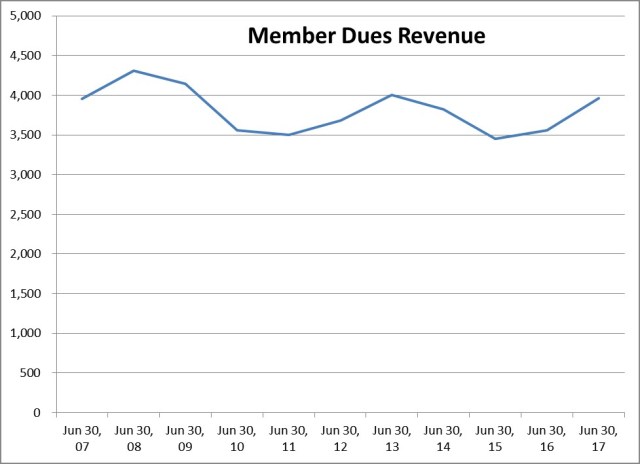
Membership for FY 2017 was strong, with a total of 107 members by year end. The chart on the right shows annual membership revenue, which has fluctuated with a slight downward trend.

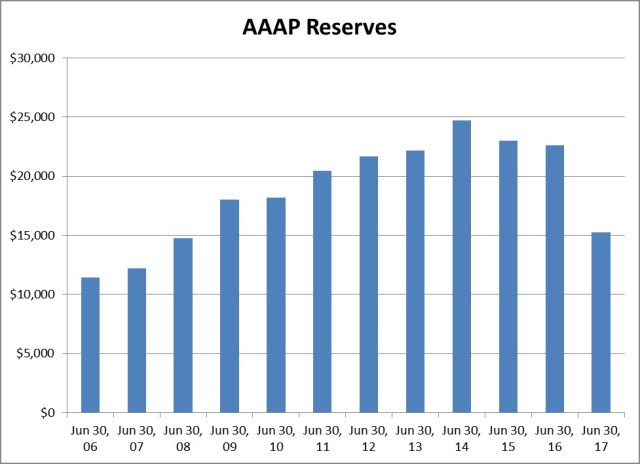
The chart below shows AAAP reserves over the past 12 years. They grew over many years to very high levels relative to the annual expenses of the organization. In recent years we have invested more of those reserves into our program and facility.

Our cash balances and cumulative reserves are close to $15 thousand, equaling roughly two years of the association’s total average annual expenses from FY 2013 through FY 2017.

Please let me know if you have any questions about the report.

Posted in October 2017, Sidereal Times | Tagged | Leave a comment

The Cycle of Eclipses

by John Church

Many of my fellow AAAP members will have heard of the “saros”: the 18 years, 11 and one-third day cycle when eclipses of the sun and moon recur with nearly the same circumstances. To be more precise, the cycle lasts 6,585.3211 days. The reason that eclipses recur like this is that in this period there will have been 223 synodic months (new moons or full moons), 239 anomalistic months (returns of the moon to its perigee or apogee, its closest or farthest distance to earth), and 242 draconic months (returns of the moon to a particular one of its nodes, the two points where its path crosses the ecliptic every month and eclipses can happen if the sun is nearby.

This cycle was known to ancient skywatchers; the word “saros” is derived from the Sumerian “shar,” meaning “multitude” or “large number.” Its usefulness lies in the fact that if you see an eclipse of the sun or moon of a particular kind, i.e. total or partial and lasting a certain length of time, there will be a similar one 18 years, 11 and one-third days later.

Therein lies two difficulties. The major one is that in the extra one-third of a day, the earth will have rotated 120 degrees of longitude eastward from where you were the first time. In the case of a lunar eclipse, these are visible over such a large area that you might be lucky enough to see both of them without having to travel. In the case of a solar eclipse, as we all know, these are only total or annular in a very restricted path, but there is still a significant area where one can see at least a partial eclipse.

If one is patient enough to wait three whole saroses (a so-called “triple saros” or 54 years and about 31 days depending on how many leap years intervened), the same kind of eclipse will come back to roughly the same part of the earth where you were the first time. However, because of the extra days, the earth will now be in a different part of its slightly elliptical orbit and a different distance from the sun. The sun will also be at a different altitude, if visible at all. So if it’s a solar eclipse, the path will not be exactly where it was before and the duration will not be the same. However, in most cases you will still see something similar, if you are not clouded out.

I have been lucky enough to have seen several solar eclipses of about the same character separated by these intervals. The attached images, taken from https://eclipse.gsfc.nasa.gov/SEpubs/5MCSE.html (Espenak and Meeus, public domain), show these eclipse paths. I have added red dots to show where I was when these eclipses happened.

The individual saros series are in the upper left. If the series number is the same, then these two eclipses are in the same individual series but separated by one or more 18 + year intervals. A series starts with a small partial eclipse near the north or south pole and slowly progresses southward or northward until no more eclipses take place in that series. The only solar eclipse series currently active are those numbered from 117 to 156; the others occurred before or will occur after the 5000-year period of the maps.

click on photo to enlarge

The “x’s” in the diagrams are the subsolar points (where the sun is in the zenith) at the time and place of maximum eclipse, which is shown by an 8-pointed star. The Earth is oriented to show the full eclipse path, with the subsolar point always on the “meridian.” The dotted lines are where there is a 50% partial eclipse.

The first eclipse of which I have any reliable memory was the annular one of 1951. In Virginia, my father and I got up before sunrise and went to a park where we might have seen the annular phase. However, it was cloudy. Later on it did clear up and we saw a large partial eclipse.

The next one was in 1954, which was total farther north, and it was clear in the morning. We did see something like a 70% eclipse, which was still quite nice. I could not know then that in 1972 I and my growing family would see the next one in the series in New Brunswick, Canada as a fine total eclipse through high thin clouds. The one in 1954 was near the beginning of its track and the one in 1972 was near the end of its track, which made it possible to see both of these from the eastern part of North America despite the 120-degree turn in the earth mentioned earlier for two eclipses separated by one saros.

The first total I ever saw was at Old Point Comfort, Virginia, in March 1970 in a clear sky. One “triple saros” after this, there will be the eclipse of April 2024. I hope to be lucky enough to see this one as a total also, to complete one full triple cycle of totals.

In between these two was the large partial one in 1963 when I was a graduate student in Wisconsin. Again, I had no idea that I would see it as a superb total this August in Oregon with a group of club members. In a sense, this does complete a triple saros, but without having seen them both of them as totals.

Two other eclipses of memory were the annular (but nearly total) one of 1984 and the annular of 1994. I and my two sons were in Virginia in the central path in 1984 but were clouded out of the central phase. (Later on, of course, it cleared up.) The notable thing about this eclipse was how it suddenly got very dark for a few seconds and then as suddenly lightened up again. The cattle in a neighboring field were startled and vocalized.

In 1994, my workplace in Piscataway took a break around lunchtime on a Tuesday and we were treated to a very large partial. Some AAAP members may have seen this as a long-duration annular elsewhere. If so, it would be interesting to hear their stories about it, or about other totals that they may have observed.

Posted in October 2017, Sidereal Times | Tagged , , | Leave a comment

Biosphere 2

by Prasad Ganti

On a recent vacation to Arizona, the Grand Canyon state, I had the opportunity to visit Biosphere 2, near Tucson. It is a futuristic looking structure containing a sample of ecosystems found on Earth. Used currently for conducting experiments on the impact of climate change on an accelerated timescale, it was once a habitat for a voluntary group of people who lived in its sealed premises for two years from 1991 to 1993, as part of an experiment on the sustainability of life in such a closed, and scaled down ecosystem.

My first curiosity was why Biosphere 2 ? Where is Biosphere 1 ? I found that our planet Earth is Biosphere 1. The giant set of ecosystems sustaining life all around us. Millions or billions of members within each of the millions of species. It remains in harmony but for some extinctions from time to time, some as part of nature, and some forced upon by an intelligent specie called Homo Sapiens or the human beings. Other than quick experiments which can be done to predict how Biosphere 1 will behave in future, Biosphere 2 also serves as a laboratory for habitats which need to be setup in mankind’s quest for colonizing planets or moons in the future. To test the viability of different life support systems.

I recently read the book titled “The Human Experiment” by Jane Poynter who was one of the Biosphere residents for two years. An interesting experience and some interesting observations. I am not sure if I would give up two years of my life to stay in such seclusion, but this team did endure a lot to become the guinea pigs. There were some controversies regarding the experiment itself, but overall, it was more than a glass half full kind of scenario.

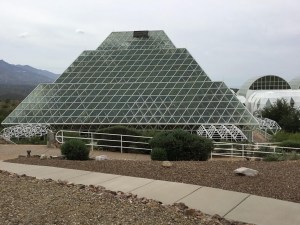
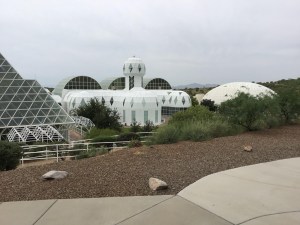
The Biosphere 2 was financed in its entirety of a quarter million dollars by Ed Bass, a Texas billionaire who is labelled as an ecopreneur, an entrepreneur who deals with ecological ventures. Putting his inherited wealth to good use, he contributed immensely towards the study of ecosystems. Covering an area of little more than three acres, it was architected as a series of space frame based structures. Space frame is a mesh of lightweight metallic bars, interspersed by glass. Double panes of glass sandwiching a shatter-resistant plastic film. It was constructed as the tightest building on the Earth. Once sealed, the atmosphere could not escape into Biosphere 1, nor anything could get in. It was tighter than the space shuttle. An engineering marvel in support of science! The pictures below were taken from my iPad pro.


The entire complex contains a habitat, a rainforest, a savannah, a desert, a marsh, an ocean, and some land for agriculture. The habitat contains living quarters for the inhabitants. Agricultural land is for growing crops for sustaining life within the sealed system. The ecosystems have been built with great care by importing the plant and live species from around the world. There are lot of equipment in the basement to control the environment in different parts of the Biosphere 2. The vast gamut of machinery is dubbed as Technosphere. There are sensors placed all over the Biosphere 2 which feed into the Technosphere below.

Once the Biosphere 2 is sealed, the pressure inside would fluctuate wildly as changing temperatures caused by changing seasons and the sunlight falling through the glass, causing the air inside to expand and contract. The Biosphere 2 needs lungs to breathe. For the Biosphere’s lungs, a round steel chamber the size of a large ice rink with a neoprene roof, was attached to the side of the Biosphere. The flexible ceiling would act like a bladder, rising as the pressure increased, and sagging as the pressure lowered. I could not think of such a need or a contraption earlier.
The team which lived inside for two years, prepared for a life in seclusion. First by being on a boat in the middle of Indian ocean for a month or so. And then staying in the Australian outback for about a year. Far from any civilization or its conveniences, it was similar to how small groups of people live in space like the Russian Space Station Mir or the International Space Station. Or in the research labs in Antarctica. Although they did all the chores like growing food, cooking, cleaning, recycling, operating the machinery by themselves, they did have gadgets for cooking, laundry etc.

The team grew starchy foods like white potatoes, sweet potatoes, rice, wheat sorghum etc. The variety in crops made the land use sustainable. No fertilizers or chemicals were used as they could contaminate the atmosphere and could make life unbearable. They were constrained in the amount of meat they could eat. They started with some livestock and nothing else could come from outside. The cattle had to multiply before being slaughtered for meat. The inhabitants had to grow all the food for their needs. As a result, they became skinny, often craving for all the nice food which the waving visitors were eating beyond the glass walls. There were some conflicts within different members of the group from time to time. It is to be expected from a small isolated group of people living together for extended periods of time. A simplistic lifestyle reminiscent of our forefathers! The experiment resulted in some species becoming extinct, which was to be expected, and more importantly proved that human beings could live.

There were a couple of occasions when there had to be an external intervention. Jane Poynter cut her finger very badly to the extent of dismembering. One of the inhabitants was a doctor. He could not do much. She had to be carried out to a hospital. She was back after a few hours. Second time was the reduction in levels of oxygen. It was later found to have been caused by concrete, which breathes in oxygen long after its curing is over. Oxygen was pumped from outside to make up for the loss. Other than these incidents, there was near perfect isolation.

There are enclosed systems like rainforests in other parts of the world like Gardens by the Bay in Singapore, but such a diverse set of ecosystems, along with life support systems all under one roof is really unique. Biosphere 2 is not sealed anymore, there are no more human experiments, only ecology related experiments conducted by visiting scientists. Administered by the University of Arizona, it is an excellent science facility which tourists can find very interesting.

Posted in October 2017, Sidereal Times | Tagged , | Leave a comment

Trifinder Trouble

by Ted Frimet

It’s the end of the world as we know it.

A brief recapitulation on the status of my cats endeavor to improve the sighting accuracy of my 12 inch dobsonian telescope by way of collapsing his cat tower onto my behemoth. The cat survived. And the dob has good views. Good news, all around. As for the horizon challenge laid out by a member of another club – I am at the precipice of understanding, by way of an 80 year old scholar, that given the several concentric lines that represent each passing billion year eon, that our shared astronomical sight lines extend from one point in a horizon, to another. As a line is drawn, from the observers point to the observed, as a geometric chord across the curvature of our graph, the area under the curve is my horizon.

Hence, my answer to the esteemed gentlemen of other club grand stature is that I now proclaim “horizon” to be a relative term. Did anyone take a breath? Did you want some dressing with that word salad? Wait for it. One more verbal equivalent of the hand jiggle to get all the wiggly wigglies out!

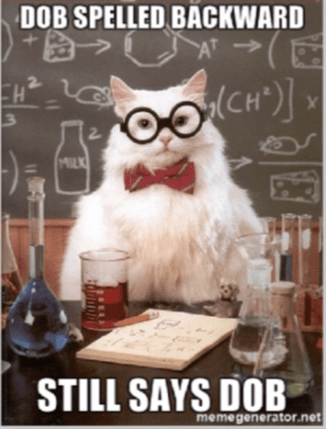
If you fast forward to the end of this essay, you will find an embedded cat meme, produced by yours truly. I would rather you get the message, other than the fortuitous laugh. The message being, “please spay or neuter your pets”. This message comes to you, across a vast emptiness of space and time, experienced by myself, and my recently adopted feral family of one. This cat, although not personally reared to be a telescope destroyer, has recently chucked up a couple of hairballs in protest of my dobs’ temporary location in her lioness lair. However, to be fair, she is good company, and we have changed her name from “Hissy cat” to “Priss” of the Hunger Games variety. Could not ask for a better companion while hunting down faint fuzzies.

Your world is about to come to an end. And I don’t mean to relay any confidence, that this article dated September 23, 2017 has anything, coincidental to share with the end of world phenomenon espoused by others. They don’t write here, and I don’t credit ‘em being credible. Besides, I am hardly on the cusp of credibility, myself. Here is what I had to say on that: After careful calculations with a rubber band, and a ruler, I have prognosticated that a 28 meter wide asteroid will impinge operability of the ISS composting toilet, creating a causality “Do – Loop”.

No, sincerely – the only astronomical item that might coincide with the end of world event, is Asteroid J2012 TC4. The Apparent Magnitude (as seen from Earth) should be just under 22, for today. It will be closest on October 13th. As it approaches Earth with 0.10 lunar distance, the gravity will accelerate the asteroid, increasing its APMag from 16 to 13. Making it a decent target for amateur level scopes.

Unfortunately for AAAP members, the asteroid will be either below the horizon, at peak magnitude, or below the tree line. The end of the world however will have a vantage point, no matter where you observe from!

Wiggles done. Engines engaged. Warp drive committed. And now…the end of the world: PUT AWAY YOUR TELRAD. Ah got your attention. At this years Starquest we happen
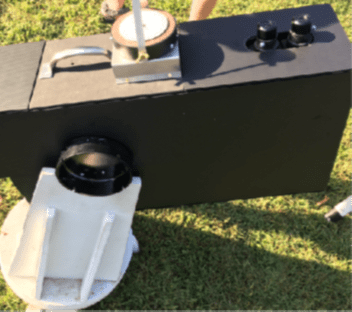
across Dr. Peter Wraight, and his hand developed and simply sublime construction of astronomy grade binocular viewing devices. After being completely blown away by the reflective mirror he employed in one, and the 100mm lenses from another, I am pleased to say that you no longer have to crane your neck to get a good view of the sky thru binoculars. Could this almost be too good to be true? Well, yes. There is a slight bit of craning to be done, however, not what you would expect from Dr. Wraight.

Peter has developed a finder. You decide on a target in the night sky, and pick two guide stars of magnitude 3 or brighter. You then can either calculate, or use his NGC guide book (with pre-calculations) to obtain, a reference angle. He has written program code to doggedly convert right ascension/declination into his new Trifinder system.


As pictured above on our finder disc, two sides of a triangle (not shown), one leg ends at one guide star, the other leg – the other star. And at their vertices you will find your target. Easy Peasee. And if you didn’t get it the first time, the vertice angle is formed by the two legs. On Peter’s finder, one leg is calibrated and can span up to 18 degrees with illuminated dots for each degree, while the other is represented by a small illuminated line pointing toward three illuminated dots and spans 22 degrees. The finder incorporates a simple lens and a semi reflective perspex disc to effectively project an infinity image of this “triangle” on the sky above. Move the dob so the end points are on the guide stars, and Wa-La! – target acquired at the vertice. The seeing is the believing! I’d write more on The Trifinder, however, we should all encourage Dr. Peter Wraight to publish his work, on the web for all to know and tell.

Meme as promised:

Posted in October 2017, Sidereal Times | Tagged , , | Leave a comment

Snippets

compiled by Arlene & David Kaplan

-BBC, Sky & Telescope

-BBC, Sky & Telescope

Florence: Largest asteroid in century to safely fly by Earth
The largest asteroid in more than a century is set to pass by Earth at a relatively close distance of 4.4 million miles (7 million km), Nasa says. Florence measures 2.7 miles (4.4km) in diameter and will not pose a threat to Earth for centuries to come…more

Credit- Swansea Univ./CERN

Credit- Swansea Univ./CERN

Swansea scientists make antihydrogen breakthrough
A team from Swansea University is one step closer to answering the mysteries of antimatter and the Big Bang after making a scientific breakthrough.
Scientists from the university’s College of Science have created and measured the properties of antihydrogen for the first time…more

Chicxulub Crater -BBC

Chicxulub Crater -BBC

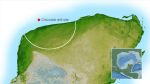
Asteroid strike made ‘instant Himalayas’
Scientists say they can now describe in detail how the asteroid that wiped out the dinosaurs produced its huge crater.
The reconstruction of the event 66 million years ago was made possible by drilling into the remnant bowl and analyzing its rocks…more

Elon Musk - NYT

Elon Musk – NYT

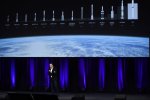
Elon Musk’s Mars Vision
ADELAIDE, Australia — Elon Musk is revising his ambitions for sending people to Mars, and he says he now has a clearer picture of how his company, SpaceX, can make money along the way. The key is a new rocket…more

The LIGO and Virgo detectors -NYT

The LIGO and Virgo detectors -NYT

New Gravitational Wave Detection From Colliding Black Holes
In another step forward for the rapidly expanding universe of invisible astronomy, scientists said on Wednesday that on Aug. 14 they had recorded the space-time reverberations known as gravitational waves from the collision of a pair of black holes 1.8 billion light years away from here…more

Posted in October 2017, Sidereal Times | Tagged , | Leave a comment

From the Director

Rex


by Rex Parker, Director

Another Season for AAAP
Our intrepid member “Totality Group” has returned from Oregon, the partial eclipse was seen by >300 people here at AAAP’s Washington Crossing Observatory, and September’s cooler weather has arrived in central NJ. We’re turning the page for a new season of great programs and fun events in AAAP, starting with the first monthly meeting on Sept 12 (see the announcement from Program Director Ira Polans in this issue). We’ll talk about member eclipse experiences at the Sept 12 meeting and want to hear from all of you with stories to share.

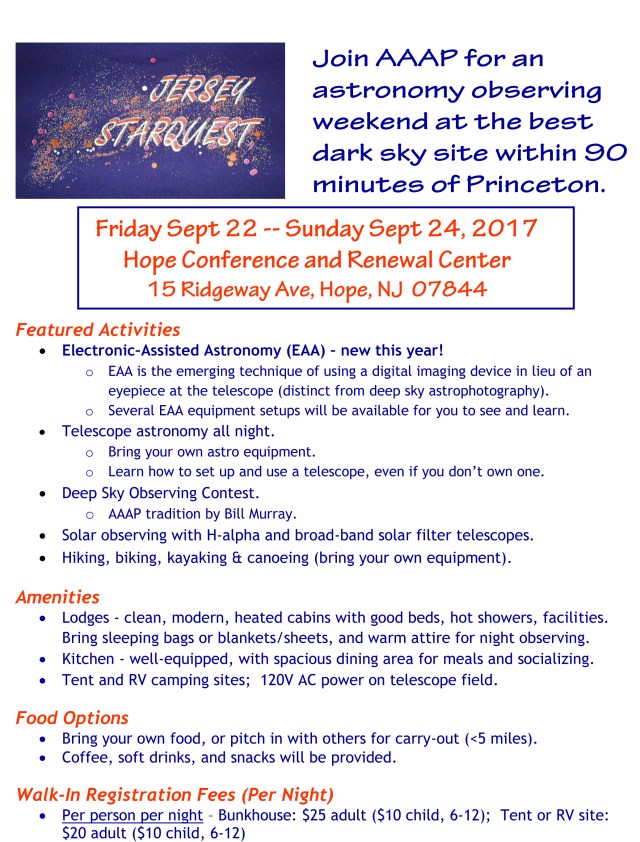
Autumn equinox arrives on Sept 22 which by coincidence is the first day of Jersey StarQuest, AAAP’s annual astro-observing event in northwest NJ. There’s a history here – if I’m counting right, this is the 26th StarQuest sponsored by our club. This year we’re featuring Electronic-Assisted Astronomy (EAA) live on the observing field. EAA is the emerging technique of using a digital imaging device in lieu of an eyepiece at the telescope for near-real-time viewing (distinct from long-exposure deep sky astrophotography). Several EAA equipment setups will be available for you to see and learn at StarQuest, as well as eyepiece-based systems. Weather-permitting, telescopes will be running all night giving you a chance to learn from experienced members even if you don’t yet own a telescope. See the announcement below for more info. We’re requesting that you return an intent-to-participate form (in the flier sent by e-mail to all members, and on the website) but no advance payment is needed, pay upon arrival.

Electronic Assisted Astronomy (EAA) Using the SX Ultrastar-Color Camera.
EAA is fast becoming one of the most capable techniques for astronomy observing especially in areas with significant light pollution. The upcoming Jersey Starquest event is featuring EAA (see above). Advances in camera hardware and software make near-live imaging with small telescopes more feasible than ever. Following on the recent suggestion that the club acquire this technology to improve the quality of outreach by members, I further tested one example of this camera technology, the Starlight Xpress Ultrastar-color CCD camera. There are a few other cameras out there to consider, some of which will be demonstrated by members at Starquest.

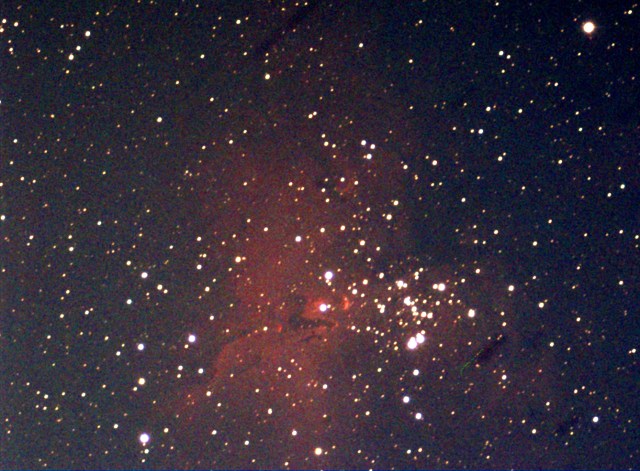
In the mid-summer edition of ST I showed images from the Ultrastar-C using the club’s Mewlon-250 telescope, a powerful 3-meter focal length scope. However, more practical for portable field use and outreach would be a wider field refractor on a lightweight portable mount. Below is a screen shot of the Eagle Nebula, M16, taken with a 5” refractor (FL=1m) on a relatively simple Celestron GP equatorial mount only roughly polar-aligned in the field. The image represents what you see on the screen in “real-time” with no further processing beyond the 7 second align/stack/mean by Starlight Live software.


Screenshot of Eagle Nebula (M16) as seen in near-real-time using EAA technology. M16 is a star-forming region about 7000 light years away in the constellation Sagitarrius. Screenshot from Ultrastar-C/Starlight Live using a 5” refractor in the field on a small portable mount. By RAP Aug 8 2017.

Skynet Update – Remote Imaging for Members
To date 10 AAAP members (of 24 with accounts) have accessed the remote telescope network capabilities offered by our participation in UNC-Chapel Hill’s Skynet. AAAP is sponsoring and paying for access to this system in order to give members a learning opportunity in remote astro-imaging. The telescopes are located all over the world, typically 16” imaging scopes of Ritchey Chretien pedigree with high quality large format CCD cameras. If you’re interested but not yet involved, send me an e-mail note to get set up. Full dtails are explained in the June issue of AAAP’s Sidereal Times. Also see the Skynet web site, https://skynet.unc.edu/skynet

Posted in September 2017, Sidereal Times | Tagged , | Leave a comment

From the Program Chair

By Ira Polans

The September AAAP meeting is on the 12th at 7:30PM in Peyton Hall on the Princeton University campus. The talk is on the “Strange New Worlds” of exoplanets by Dr. Josh Winn, Princeton University.
Did you know that it wasn’t until the 1990s that scientists could be sure there were planets beyond our solar system? Since then, astronomers have discovered thousands of these planets —known as “exoplanets”—circling distant stars. Dr Winn will explain why it took so long to find planets around other stars, what new technologies and techniques were required, and what kind of planets have been found. Recent advances have revealed bizarre new worlds unlike anything in our Solar System, while also bringing us right to the threshold of finding other planets similar to Earth. Dr. Winn’s talk will also cover the latest findings of earth-sized planets recently announced by NASA.

Prior to the meeting there will be a meet-the-speaker dinner at 6PM at Winberie’s in Palmer Square in Princeton. . If you’re interested in attending please contact program@princetonastronomy.org no later than Noon on September 12.

If you have suggestions for speakers please send them to program@princetonastronomy.org. Please provide the speaker’s name, topic, and affiliation. Thanks!

We look forward to seeing you at the September meeting and the dinner!

Posted in September 2017, Sidereal Times | Tagged , , | Leave a comment

My Moment of Totality

by Tom Hammell

For 2 minutes 15 seconds I was one with the universe and understood all its mysteries…at least that is how I felt during the total eclipse on August 21. Maybe this was just the feeling of joy of seeing the eclipse after a long flight, some even longer drives and little sleep in the previous couple of days. Although most eclipse chasers picked a town to be at months before the eclipse day I kept my plans flexible so that I could adjust to the ever changing weather forecast to make sure I had a 100% clear sky on eclipse day.

On the Friday before the eclipse I flew to Denver. The western part of the US offered the best possibility of clear weather. From Denver I could get 1000 miles east or west, in two days, along the path of the eclipse. On Saturday I checked the eclipse weather forecast. There was a 70% chance of clear skies in Casper Wyoming, 80% in Rexburg Idaho, and 85% in Weiser Idaho. So to maximize our chances of having a clear sky for the eclipse we spend 2 days driving 800+ miles to Boise Idaho by the border with Oregon.

Monday, the day of the eclipse, we get up at 4am, to get ahead of any crowds or traffic. We drive north just over 60 miles to a town called Smith’s Ferry based on the advice of a local man in Boise. Smith’s Ferry, he said, should be less crowded than the other towns in the area which are already over flowing with eclipse watchers. It is also on the center line of the eclipse so it will give us the most amount of totality for this area. The less crowed claim proves to be correct as we pull into a mostly empty grass field by the Payette river at 6am. We are able to get a spot along the river with a clear view to the east and south. Next to us two astronomers from Sweden pull in. The first thing they do is to plant a set of Swedish flags in front of their car to mark out where they plan to set up their equipment. They tell me that they are claiming that land for Sweden. When I reminded them that this is already sovereign US territory they laugh and say don’t worry you can have it back at the end of the day. We were now in the company of some fun fellow astronomers which was good.

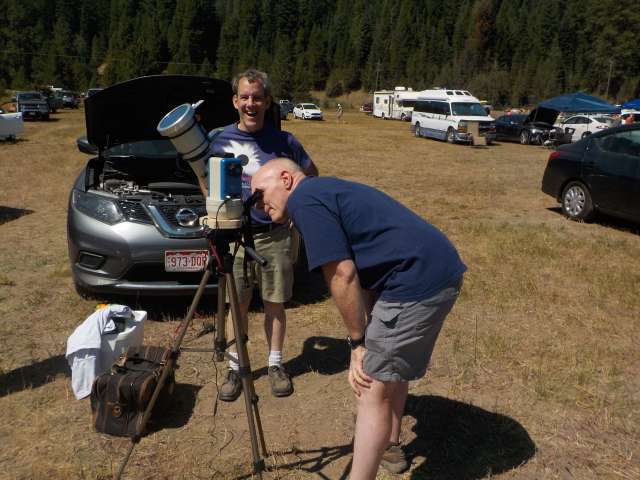
After parking and getting to know the people around us we set up our equipment. I have an iOptron Smartstar Cube-G R80 This is an inexpensive and very compact GOTO telescope with a built-in GPS. It was very easy to fit in my carry on luggage. The telescope itself is a 80mm, f/5 achromatic refractor. This is a wide field instrument and is perfect for observing the full disks of the Sun and Moon. This scope worked flawlessly for the 3 plus hours of the eclipse and I was very impress with the performance not only of the GOTO system but of the optics of the scope itself.

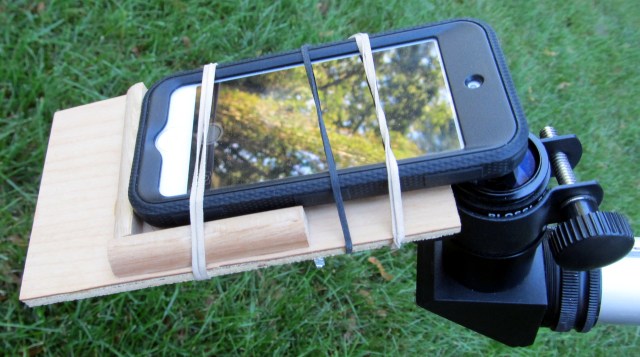
For taking pictures of the eclipse I used an IPod Touch which has a 5 MP camera and just used the built in Camera App. I made a home made jig that attached it to the eye piece to align it and keep it steady when taking pictures. This is a very portable and simple set up that with a little practice can take very good photos.

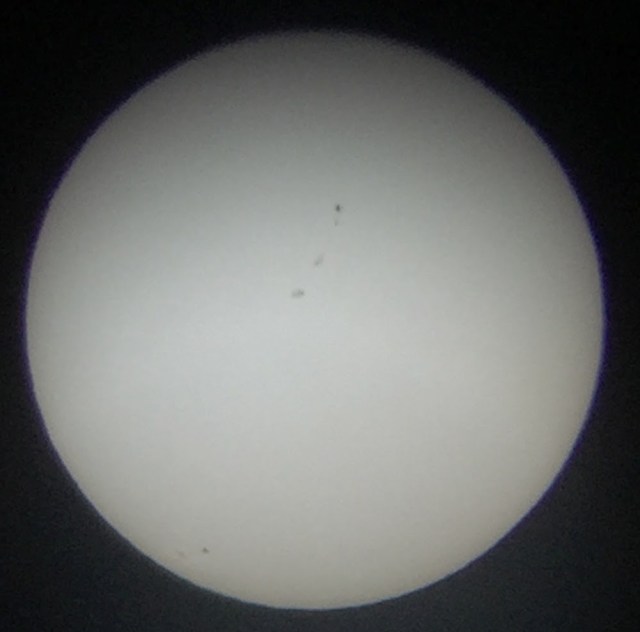
With my solar filter on the telescope I took a couple of test photos to get a full disk image of the sun. It had some interesting sun spots on it and made a good picture.

At 10:11am I saw the shadow of the moon start to encroach on the sun and knew it was only a matter of time before I would see my first total eclipse.

The excitement kept building as the eclipse progressed. I had a constant stream of people coming over for a look through the telescope. I enjoyed explaining what they were seeing and sharing their delight at seeing the eclipse.
I took pictures every 10-15 mins to document the progress of the Moon passing in front of the Sun. About 20 mins before totality I noticed it getting colder and darker. It was really weird to see it getting darker as the Sun was rising. You might think it was like the twilight after a sun set but it felt different than that some how. In the next 15 minutes the temperature dropped at least 10 degrees and the sky went from sunny to a bright twilight.

As the totality approached I connected my IPod Touch to the telescope and made sure the focus was good. I also a had Cannon power shot point and shot camera set up on a tripod to take a wide angle view of the eclipse. This camera has a couple of different manual modes. I chose shutter speed priority mode and set it for ¼ secs shutter speed hoping it would capture something.

You can somehow feel when the totality is about to occur and as it approached the crowd started to yell and clap. When the Moon finally covered the Sun at 11:26 am everybody screamed and cheered. I quickly started taking pictures through the telescope which was easy as all I had to do was push the shutter button on the IPod Touch. I took one picture with my Cannon camera then gave up on it as it didn’t look like the exposure was set correctly and I didn’t want to waste any precious time playing with shutter speeds. (Next time I will have a camera that can do bracketed exposures)

Anybody who has seen an eclipse will tell you it is important in the moments of totality to not get too caught up trying to get the perfect picture and to just relax and watch the totality with your naked eyes. As this article explains, the human eye can see and put together multiple exposures and wavelengths together in a way a camera can’t. Although I got some great pictures, the actual view I saw was much different. The corona I saw with my naked eyes was bigger and more complex than the pictures. The color of the sky and corona were also a lot different. Some people have described the light thrown off by the corona like the light of the full moon but to me it looked brighter than a full moon without throwing off enough light to cast shadows like moonlight does.

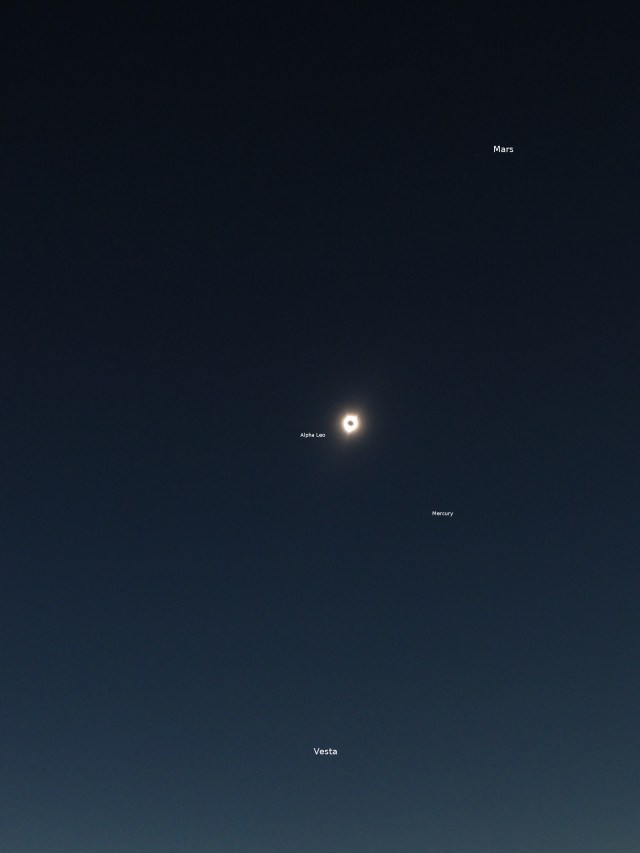
As totality continued I stayed by the telescope adjusting the exposure of the IPod Touch and took a picture every 15 to 20 seconds. Since I had practiced so much before the trip I could do it with out really taking my eyes off the sky. This let me just enjoy the moment and focus on looking at the totality with my naked eyes. It was also fun identifying the planets and stars I could see. It was a glorious 2 mins and 15 seconds that can not be described.

The totality was visually and intellectually beautiful but the thing that surprised me the most was the emotional impact of the moment. The people around us that we had been hanging out with for the past few hours felt like family and when the totality occurred I could feel the joy and happiness of our collective group. When I said I felt connected to the universe at the beginning of this article I not only meant I felt connected to the sun, moon and earth but also felt connected to the people around me. I know it is a feeling I will have with me every time I think of this moment.

At the end of the totality there were more cheers and high fives. We watched the end of the eclipse as we digested the experience. It was definitely worth the trouble and expense to see it and I now know why people travel all over the world to see an eclipse.

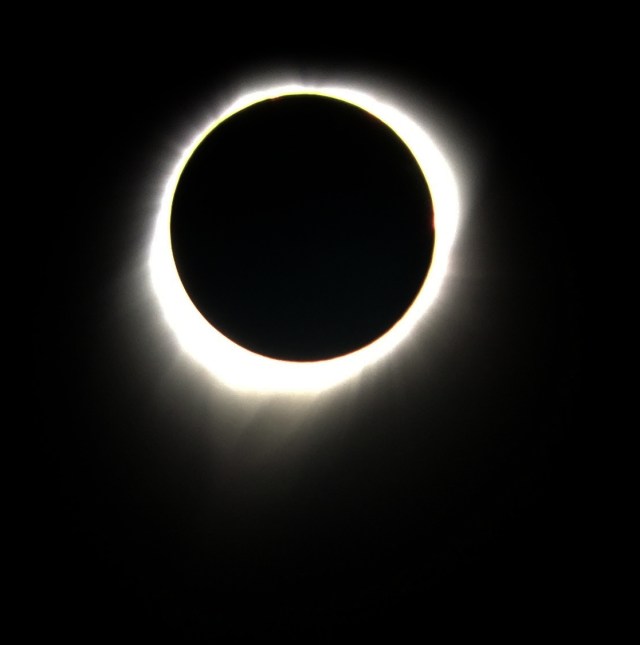
I am very happy with the way my pictures turned out. I got a decent shot of the bright corona.

I managed to get a picture of one of the three solar flares that were coming off the Sun at this time.

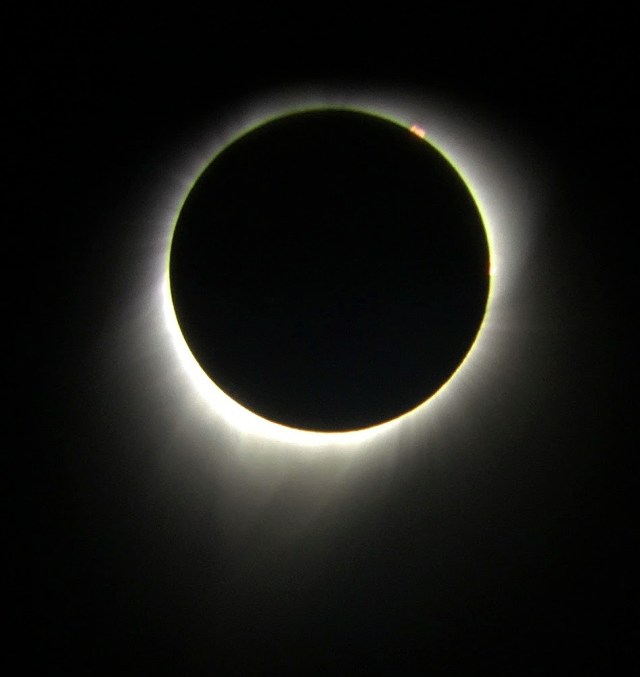
And because of pure luck in timing I got a picture of the diamond ring.

Even my wide angle shot came out pretty good. The corona is over exposed and I wish I could have captured more of the stars I could see with the naked eye but ¼ second exposure ended up being a good compromise.

I am not a professional photographer or have the equipment to do real astrophotography but think my simple set up did a pretty good job of getting pictures of the eclipse. For my next eclipse (and I’m already thinking about April 8, 2024) I will probably change my set up a little. My iOptron Smartstar Cube-G R80 was the perfect scope for watching the eclipse. For taking pictures, through the telescope, I may either get a better camera or a better app so that I can take a wider range of exposures and number of photos. This will allow me to stack and process them to improve the quality of the pictures. Lastly and most importantly I will bring along some cold beer so that I can celebrate with my fellow eclipse watchers to enjoy the moment even more.

For more of Tom Hammell’s photos click here.

Posted in September 2017, Sidereal Times | Tagged , | Leave a comment

First Time Experiencing a Total Solar Eclipse

by Ira Polans

Although I’ve been an amateur astronomer for most of my life, I’ve never had a chance to observe a total solar eclipse before. When some of us decided to go to Oregon to see the eclipse, I thought it was an opportunity that I couldn’t pass up.

The original plan was to take some pictures during the partial phases. Then watch totality from beginning to end. As it turned out things didn’t go quite as planned. I also brought binoculars along with the appropriate solar filters.

My traveling companion for the trip was my brother Michael. When we got to the observing site I first put on the eclipse glasses and was surprised to see sunspots. I confirmed this a few moments later with the binoculars.

Then I set-up the camera (point and shoot) to take pictures of the partial phases

This slideshow requires JavaScript.


Finally totality came!

I wasn’t planning to take pictures during totality as I wanted to follow the advice I was given by many experienced observers. But the change in the sky was so sudden I decided to take some pictures (many did not come out). As it turns out I almost didn’t actually view the eclipse. About half way through I realized this and stopped taking pictures.

I was amazed at how inky black the moon was and how the sky was colored!! I expected to see stars and planets around the Sun. I also thought I would see Venus, Surprisingly I saw none of these objects. I also did not see any shadow bands but I really didn’t look for them.

After a brief glimpse of totality Bailey’s Beads and the diamond ring effect appeared. Both my brother and I were surprised at how bright they were. A few minutes later the sky returned to daylight and the eclipse was over.

Overall it was a great experience and I encourage anybody who hasn’t seen a total solar eclipse to go and see one!!!

Posted in September 2017, Sidereal Times | Tagged , | Leave a comment