Ok. I’ll take what I can get. It is a dangerous thing to shout out a Hypothesis. Especially when professional scientists are doing the math, and writing their journal entries. And then you find a match! Ok, maybe this is a Sheldon moment. Not to be outdone, by this beloved member of the Big Bang Theory, I read the ensuing article. I chased down a few of the citations from the dusty, dank corridors of the WWW. Coughing up the dust, from this proverbial library, I find Russian literature that was previously hidden from my sight.
In the August 6, 2019 essay, “Planetary Nebula”, I chastised myself for being unable to source citations. My bridge forming relativistic electron scaffold, streaming from an active black hole, was not to be found. I couldn’t make the stream culpable for forming the matrix upon which white dwarfs caste their nebulae upon.
Within the reach of this Amateur, we were hopelessly entrenched with binary stars in the formation of Planetary Nebula. I discussed how those systems had long discarded their gas. They had left their binary partner, a White Dwarf, naked and alone.
Thru an online lecture, I learned to appreciate complementary light spectrums, and how they indicated the presence of binary stars, in nebulae local parentis. I finally alluded in closing, to complementary light spectrums, and periodicity of the light curve. “Perhaps where there is no light, there is only a hole. Look closely and find periods, with no complementary light spectrum, sans the ever present White Dwarf.”
I can now be a bit braver, and no longer hide in prose. Black holes are x-ray emitters and can be detected with x-ray telescopes. When Black Holes are quiet, they do not emit x-rays, and are not detectable. However, they can be detected if gravitationally bound to the White Dwarf. The dwarfs periodicity can be measured – either by occultation light data, or by alteration in her orbital data.
Kevin T Smith, writes the report on “A noninteracting low-mass black hole – giant star binary system”, (Science 01 Nov 2019: Vol. 366, Issue 6465, pp. 637-640 DOI: 10.1126/science.aau4005), writes about a 2.6 solar mass object that emits no light, including x-rays. Combining radial velocity and photometrics demonstrates that the massive star is in a binary system, paired with a black hole.
What led me to chuckle, were two references that I had long sought out. They were hiding in the Harvard repositories. This is the quote (Smith, et al) that brought me to their doorstep:
“Quiescent noninteracting black hole stellar binaries have not been found in radial velocity searches, although the existence of such systems has been discussed for decades (10, 11).”
(10) O. K. Guseinov, Y. B. Zel’dovich, Collapsed stars in binary systems. Sov. Astron. 10, 251 (1966). Google Scholar
(11) V. L. Trimble, K. S. Thorne, Spectroscopic binaries and collapsed stars. Astrophys. J. 156, 1013 (1969). doi:10.1086/150032 CrossRefGoogle Scholar
I gingerly keyed into the citation, numbered 10. The original article was submitted October 18, 1965. The Journal hailed from Soviet Astronomy, Vol. 10, p251. It discusses detection of collapsed stars, which are members of spectroscopic binaries.
I hold my breath, as I click on citation, numbered 11. In the abstract, I find, “the absence of a secondary spectrum in these systems, could, in principle, result from the secondary star’s being either a collapsed star or a massive neutron star.”
Although Einstein predicted black holes in 1916, the term “black hole” wasn’t coined until John Wheeler did so in 1967. So there are two caveats, here. In the citation, there is no mention of a black hole, only “collapsed stars”. And secondarily, the author appears uncomfortable with the lack of x-ray emissions. Reading further, they discard unseen companions that are less than the Chandrasekhar limit, and declare the unseen companion as a white dwarf. They back-reference to Zel’dovich & Guseinov, where discovery of x-rays or gamma-rays, “would constitute evidence for the presence of a collapsed star or neutron-star secondary.”
I remain comfortable in my wheel-house this morning. I add to the mix, from August’s essay, that nebular gas, structured upon relativistic outflow of electrons, and in many cases, no longer appearing present among the many nascent white dwarfs, have had their gaseous orbs and out-layers, gobbled up, long ago, by their unseen partner, a black hole. No Watson. No Holmes. Just sheer dumb luck.
The daily commute to backfill, in Norristown, sometimes has me waiting in the off-ramp. Car is idle, and I spy a bird on the left shoulder. She sits atop a tree. Looks like a bad version of a Blue Spruce. Not the bird, the tree. I wonder at her, as she lofts from the tree, and off into the brush, nearer to my gas guzzling, carbon spewing, iron chariot. Ok, not so much a guzzler. Sure, there is a carbon footprint – yet my car is mostly light steel, aluminum and plastic. The bird flies away. Ironic.
You’ve read the preamble, and you are confused. So am I. How did this experience ever spew intelligence onto the light bending affects of gravitational lensing? I dunno. No clue.
Here is what did follow, as I stepped onto the accelerator;
[which by now you should all know that this isn’t your fathers gas pedal – it is a link to actuate, via micro-controller, your mass flow air sensors, and aggregate accoutrements.]
was a brief time foray into a meager graphic analysis of how I could measure density differences of a gravitational lens.
Here it is briefly. It is brief because I choose not to augment my mind-scape with mathematics. I leave that to you, all. Calculus, anyone? Ok. My bad. It is simply because I can’t possibly drink another cup of coffee, without offending someone, or something. Sigh. I could probably use a dose of polynomial mathematics, where each band of the Cross is represented by a separate variable and coefficient – and the answer is the total mass of the lens. “What?” – Lil John.
Borrow, beg or steal three Hubble images. They need to be representative of a gravitational lensing effect. No time? No worries. I’ve done this for you in a past essay. We’ll repost the three images. Here is the link: Ring Around The Rosies
Caveat Emptor. I dug these out on my own, and they aren’t the BEST images of gravitational lensing effects, ever. Whomsoever, they will do. ‘That’ll do, pig. That’ll do.’
The best ever would show an Einstein Cross. So, for now, use your imagination. Take the composite image, and put it into a graphics program. Or print it out, in full color, and put it onto the table before you. No matter. (Hey, maybe that’s a pun- ‘no matter’ – hehe).
Construct a Cartesian plane onto your image. You know? Four quadrants. Cool beans. Find a matching element, from one of the mirror image galaxies, that was smeared across the page. Measure it, coordinate – to – matching coordinate. You are going to see if there was any subtle movement, in any mirror image.
Or more easily enough, look at my composite. I have stacked three Grayscale images, and enabled them as RED, GREEN and BLUE, in a graphics program. They appear to you, in the above link, as ‘black and white’, separately, and color (RGB) when combined. Where-ever you find subtle color shifts, in different quadrants, please know that the grayscale values shifted, over time. Remember that each image used in the composite was taken at a different time. You would imagine that there would be shift in the image. However, I would expect that each mirror image would shift the same. It does not. Did it? You tell me. After all, it’s your Universe.
In an Einstein Cross, the images that swirl, up and down, left and right, have some variance in position. If you deconstruct the images, and their effect, perhaps by means of a reverse-Gaussian algorithm, you might come to one of two of my conclusions. Either space-time was severely constrained, or warped, differently in each of the quadrants. Or the massive galaxies that make up the galactic lens have an obvious geometry and structure that can be recreated by studying an Einstein Cross’.
Yes, the geometry and structure of the massive galaxies warp space-time, and create the lens. Yes, I think that you can at the very least, know which quadrant has a more “dense” allocation of gravity bending space-time matter. Above we hint at the structure, and function of what is behind the eye of this Cosmological Camera obscura.
If you have access to more advanced channels of Cosmology, may I recommend a cup of Quasars, detected in the background, and to meter the differences in their absorption spectrum? This notion, I must admit, was borrowed from the article, “Gas filaments of the cosmic web located around active galaxies in a protocluster”, Science, 4 October 2019, Col 366, Issue 6461, pp 97-100.
Ok. I am going to actually write about the Milgram Experiment (2). That was where volunteers gave shocks to people. The shocks were make-believe, and the persons receiving the shocks faked their pain and suffering. A high number of participants shocked the subjects, despite the apparent visual suffering. And to Milgram’s surprise, the increase shock level would have killed a participant; yet the volunteer continued to deliver the fatal dose. Some, as they left the center, never inquired as to the health or welfare of those they acted on. Milgram discovered a persons intent to follow authority, without question.
Without realizing it, somehow I have connected the dots between Nazi Germany, California’s early Eugenics program in denying the Deaf their reproductive rights (3), and people that write hurtful, and lasting social imprints on the World Wide Web. The first resulted in the deaths of millions, while the second was the progenitor of Shoah. I wait with baited breathe as to the outcome of the Third. Perhaps societal participants writing on the wall, with impunity, is not what it seems to be.
With minds not yet fully developed until the age of 21, the brain simply cannot distinguish between reality and fantasy. An adult watches a movie, and your brain transcends you from your chair, to the scene. A child reads a negative post, and is transfixed into a self-harming relationship. They have been baited with your breath. I regret to discuss the outcome of your make-believe Milgram shock.
When we write comments on the performances of others, in a service industry, we can be blunt. Not everyone has the talent of tongue, these days. Most write three or fewer sentences to ascribe their wonder, or blatant dissatisfaction. However, now, in this brief pause between the pauses, I am in dismay. I attribute this to both the public’s fractured memory and the proclivity of the few to practice harmful graffiti.
When you write negatively, be gentle not only with your target audience – be gentle with yourself. Because all the while; all that you experience – your sight, sound, taste, and thoughts, are all recreations in your mindset. Yes. It is an argument that you have with your own ethos. The model that you create is simply yourself. You walk blind in the Universe. Nothing is out there. It is all inside your head.
If you have read up-to-this point, perhaps now you are ready for a new truth. That the lists of ideological mis-steps that you believe in, do order themselves to cause harm to others. The social queues that appear to be unrelated are part of a fuzzy logic system. Simply because the interdependent players remain invisible to you, does not in any way blunt the edge of the knife. When one part of a system is stressed, it will affect the whole. Your practice of leaving behind a curt comment, is only you whetting the edge of a realm where you believe there is absence of malice.
However, I mis-speak. You have decided to not go on. You could continue. The experiment may have required that. It may have been absolutely necessary, and you would have had no other choice. So said, Milgram. You have only written once on the wall. Yet the difference between the Milgram experiment and your licentiousness, is that one act was fleeting; while all the while your participation in a social experiment continues on, day-after-day. Forgive me for being the one that reminds the few – that your practice here, is the undoing of teenagers, everywhere. For you have caste the mold where all learn how to write. Nestled in your brief grammatical structure are the implements of where young minds go to their demise.
Wherefore art thou, Astronomy? He said twice, “I was in a car accident”. I pretended not to hear. I wanted to make sure I delivered the Dob, and beat the rain. It was going to rain. It always clouds in, during an Astronomy event. Why would the conclusion of a sale be any different?
For the past few weeks, I had posted my offer for the great behemoth. Hundreds looked, dozens watched. Several had offered. Many were refused. Of course, all were kicked to the curb, until the last offer. It wasn’t low, and it wasn’t high. It wasn’t even middle of the row. The price was simply right. I accepted. This sale was pre-empted for local pick-up, no delivery. Upon payment, I contacted the buyer. They were busy that afternoon.
Time is a precious thing. Weather can make it more valuable. I needed to look between the clouds, and focus on the light that I could see. Later it would rain. Tomorrow it would certainly be wet. Now is the time. I said, “let me come out to you”. We agreed. An hour later I waited in a driveway, Dob in SUV. Movement. Transfer. New telescope in another home. Nestled under the tree, perhaps? Not really. It isn’t Christmas. Heck, it isn’t Chanukah or Kwanzaa, either.
I am now in the present. The Universe reaches out and taps me on the shoulder this rainy, Sunday morning. It does so with impunity and anonymity. Let’s You and I put away the lazy Susan, and spin a yarn on a crises. Synthetic opioids. Many have the same story. We are truly embedded. It is my time to read the writing on the wall. I am hopeful that I am not succoring to a Milgram experiment. I could list off what I knew of synthetic opioids. I ask you, “what do you know”?
Visit the CDC website and read more about Brenda, Cortney, Devin, Judy, Katie, Mike, Noah, and more. The song remains the same.
The CDC site triggers a memory. A dear friend had committed suicide. So they said. Her fentanyl patch had ruptured. Later we learned that these patches were defective, delivering a fatal dose. I parlayed the story, and suggested that they contact a lawyer. Perhaps there is a class action lawsuit to participate in? A lawyer would know. Always best to send a friend to a doctor who knows best. Or in this case a Juris Doctor.
I will not know the outcome of the story. Not ever. Few are the words that are written on the wall. There is no Milgram participant here to give a shock. My only hope is that all of you, will continue to keep to your ethics. As Amateur Astronomers, as you come out of your seclusion to interact with the public, all I ask is that you too, do not go gently into that dark night.
“Chapter 84.” For Hearing People Only: Answers to Some of the Most Commonly Asked Questions about the Deaf Community, Its Culture, and the “Deaf Reality”, by Matthew S. Moore and Linda Levitan, Deaf Life Press, 2016, pp. 545–554.
Nobel physics prize
Three scientists have been awarded the 2019 Nobel Prize in Physics for “ground-breaking” discoveries about the Universe. James Peebles, Michel Mayor and Didier Queloz were announced as this year’s winners at a ceremony in Stockholm. The winners will share the prize money of nine million kronor (£738,000)…more
-Carnegie Institution For Science
Saturn overtakes Jupiter as planet with most moons
Jupiter had been the “moon king” for some 20 years. Saturn has overtaken Jupiter as the planet with the most moons, according to US researchers. The moons were discovered using the Subaru telescope on Maunakea, Hawaii. Dr Sheppard told BBC News that Jupiter had been the planet with most known moons since the late 1990s…more
-BBC
Milky Way explosion detected
The Hubble observatory has found evidence of a cataclysmic flare that punched its way out of our galaxy about 3.5 million years ago. A massive burst of ionising radiation exploded from our galaxy’s heart. The impact was felt 200,000 light-years away. The discovery that the Milky Way’s centre was more dynamic than previously…more
-TAS
‘dark Universe’ makes progress
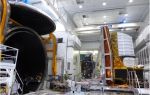
Europe’s space mission to uncover the secrets of the “dark Universe” has reached a key milestone. The test model of the Euclid telescope has just emerged from a chamber where it was subjected to the kind of conditions experienced in orbit…more
NASA engineer invents physics-breaking new space engine
Star Trek’s Montgomery Scott famously said “ye cannot change the laws of physics”, but a real-life space engineer says he might have just done that. David Burns of NASA’s Marshall Space Flight Center in Alabama has unveiled what he’s calling the ‘helical engine’, which could potentially power flights across space without using any fuel at all…more
by Rex Parker, Phd director@princetonastronomy.org
Speakers for Astronomy
Our guest speaker at the October 8 meeting will be John Church, PhD. John is a former Director and longtime member of AAAP. See Ira’s article below for information about this presentation. Have you considered giving a 10-minute member talk following the intermission at an upcoming meeting? This is a great way for members to get to know each other and share experiences in the club – tales of recent astronomy life, perhaps a book or travel review, observing tips, a new telescope, slides optional. Please contact me or Program Chair Ira Polans to get onto the schedule for an upcoming meeting.
Saturday Night Fever
The AI running the weather program didn’t do us any favors on Sat, Sept 28, and we cancelled the Gravity Hill Star Party. However we really want to develop a tradition of member Saturday nights with telescopes. The potential benefit of this came out in the recent member survey, where 62 of 80 responders said they own a telescope but only 37 use it once in a while or more often. Becoming more skilled with telescopes is important to 67 yet only 38 are able to take advantage of using the AAAP Observatory more than once a year.
We encourage members to set up telescopes on clear nights at the west end of the soccer fields at Washington Crossing State Park. This secure location has wide views of the sky and is easily accessed off Rte 579/Bear Tavern Rd on the way to the Observatory and through much of the year no gate opening is needed. After soccer seasons ends in November the front gate at Bear Tavern Rd may be locked, but AAAP KeyHolders can open the lock.
To start out, let’s initiate Saturday night telescope sessions with members as follows (beginning October 19):
Send an e-mail to me by noon on Saturdays
Include “telescope” in your e-mail subject line
In your note, mention the time, expected duration, and what telescope you’d bring
I’ll broadcast an e-mail note to the membership that day
Big Improvements in Video Astronomy
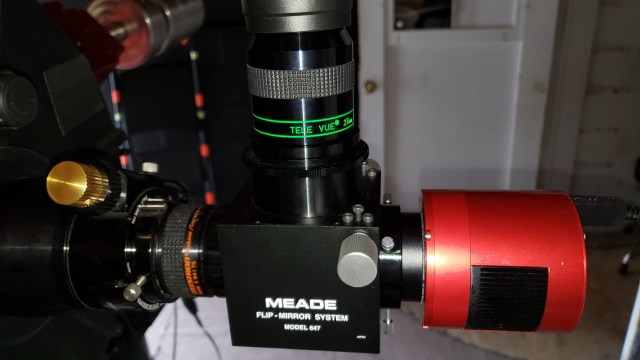
Plans are underway to mount the club’s ZWO-ASI294 color CMOS camera onto the Celestron-14. This would replace the function of the Ultrastar color CCD camera currently on the 5-inch refractor and allow eyepiece use with the refractor to give a wide/rich-field view alongside the C-14. Importantly, the smaller, lighter, and easier to use Ultrastar would become available for members to use in outreach.
The ZWO is a technological marvel which illustrates why CMOS sensor technology is displacing the CCD in astronomy applications. This month we acquired the hardware needed for the ZWO camera to be mated to the Celestron-14, a Meade model 647 2” flip mirror assembly allowing users to flip back and forth between eyepiece glass and camera video. A focal reducer was added to widen the field of view. The picture below, from a work session at the Observatory with Tom Swords and David and Jennifer Skitt, shows the setup we hope to install after the current public Friday night season is over.
Configuration of the ZWO-294 camera on the C-14 with Meade flip mirror (see text).
The October meeting of the AAAP will be held on the 8th at 7:30 PM in the auditorium of Peyton Hall on the Princeton University campus. The talk is When Ireland Was the Center of the Universe by long time club member John Church.
In the late 1840’s, William Parsons, the 3rd Earl of Rosse, constructed and mounted a 72-inch aperture Newtonian reflecting telescope in central Ireland. Remarkably, this was to remain the largest telescope in the world until the 100-inch Hooker telescope was placed in service in 1917 on Mt. Wilson in California.
Parsons was the first to see and depict the spiral structure of an exterior galaxy, M51 or the Whirlpool Galaxy, in the constellation of Canes Venatici near the tail of Ursa Major. He used his telescope to examine many other galaxies and objects as well. His drawing of M1, the supernova remnant in Taurus, led to its being named the Crab nebula.
In the mid 1800’s, telescope mirrors were made of speculum metal, an alloy of 3 parts of copper and 1 part of tin. Parsons needed several tries to finally get satisfactory blanks. He designed and made his own large steam-powered machine to grind and polish the nearly 3-ton mirrors. He made two of them so that when one was being re-polished, the telescope could still be used.
Mounting such a mirror in a movable tube was a major engineering project. An equatorial mounting was out of the question, so Parsons designed and constructed a huge alt-azimuth mounting between two 40-foot high masonry walls. This allowed the 12-ton telescope assembly to swing a few degrees out of the meridian each way and observe a large arc of sky. Slow-motion controls were provided for both altitude and azimuth.
Access to the eyepiece can be a major issue even with small Newtonians. Parsons solved this problem with an elaborate array of movable galleries mounted on the western masonry wall Several assistants were needed at every observing session to raise and lower the assembly and move the galleries.
Our speaker, John Church, visited the Rosse estate in 2004 after he and his wife had attended a family wedding on the west coast of Ireland. The castle, which is the home of the present Earl, dates from about 1620. The estate also contains a fine arboretum and other attractions including the I-LOFAR (Irish Low Frequency Array) radio telescope installed in 2017, the westernmost of 50 such stations.
Two changes are being made for the 10 minute talks this season. First, the talk will be given after the intermission. Second, we are instituting a 10 minute limit. Since we want to keep the talks to 10 minutes, the speaker will be given a 90 second warning to wrap up the talk. If you’re interested in giving a 10 minute talk for our October meeting please contact Larry at assist.director@princetonastronomhy.org. Or if you’re thinking about giving a talk later in the year please contact either Rex or me.
There will not be a meet the speaker dinner prior to the meeting.
Finally I will not be able to join you at the meeting but think the talk will be interesting! See you in November.
Our meeting schedule resumed in September and the Observatory will be closing at the end of October. The Outreach season should be ramping down, but it really is not. We still have three or maybe four for this month.
Friday, October 4 at Simpson EVEN IF IT’S CLOUDY!
Sixteen 4th grade Girl Scouts plan to visit and are requesting the Pocket Solar System exercise at about sunset before an evening of star gazing. We need a couple of folding tables and SOMEONE TO LEAD THE PSS, as well as some members who can bring their scopes for additional viewing opportunities. If it’s cloudy or worse, we have permission from the park superintendent to use the Nature Center Pavilion, and a tour of the roofed Observatory can be offered. Volunteers so far are Rowena Pullan and Victor Davis.
SATURDAY, October 19 at Simpson
Hopewell Cub Scout Pack 71 will be camping in the park and are asking for us to open the Observatory for 30 Scouts plus some parents and leaders. We need some Keyholder volunteers and some Members to bring extra scopes. Forgot this one in my last email blast, so if folks don’t see this one and volunteer I will have to ring the bell again.
Sunday, October 20 in Pennington
LIBRARY PRESENTATION BY GENE ALLEN at 6:30pm in the Pennington Public Library, 30 North Main Street, followed, weather permitting, by star gazing nearby. Members are requested to bring scopes for a group of TBD. Sunset is at 6:12, and the presentation lasts about 45 minutes, so plan to set up to receive guests by 7:30. Exact observing location is TBD. Volunteers so far: Dave Skitt (s), David Reis (s), Tim Donney (s). I will be solidifying details after I get back from Florida.
Friday, October 25 in Yardley
Star gazing opportunity for ten Daisy Scouts (K-1) with moms. Plan for set up at sunset 1830. This event is still tentative and may move up earlier in the month or go away altogether.
Director Rex Parker opened the meeting at 7:30 p.m. AAAP overview and upcoming events schedule were discussed. Program Chair Ira Polans then introduced the guest lecturer.
Prior to the AAAP progress meeting, member Jeff Pinyan presented a 10 minute talk about the importance and techniques to accomplish more effective public outreach.
Gene Allen, Public Outreach Coordinator, asked if members were interested in bringing telescopes to the Midnight Magic Full Moon Bike Ridge (subsequently cancelled due to local environment difficulties).
David Skitt, Observatory Co-Chair, headed a discussion regarding:
The Bisque SkySoft mount operations software renewal.
Observatory physical plant repairs and upgrades.
Alert about the new observatory alarm system code changes and exit times.
Awesome is our outreach from AAAP. Gene led the way, this past year, with receiving event after event. Everyone, it seems, except yours truly, volunteered to be on or off site, and provided the very essence of their being, with telescope in hand. Congratulations to all! We few, we happy few…we band of Amateur Astronomers!
I found myself embedded with the UACNJ board meeting, Saturday, September 21, 2019. As an alternate to AAAPs presence, I took the opportunity to second a motion of the board. This was to empower UACNJ to look into revising its by-laws to have new membership rules adopted. Primarily this was to assist a ham-radio group, in their pursuit to install, and maintain a repeater station, at Jenny Jump. You may ask, “how important is this to you and to me?” If in a time of cellular communication failure, ham radio operators form the network for cross national and global communications. At the Jump, vis-a-vis the homestead of UACNJ, the repeater would be the conduit for the I91 corridor.
The current dogma is that a joining club must be Astronomy related. By Jovian Loudspeaker I declare, “hoist the flag of the ham”! After our seconding the motion, all were in favor, except one still voice. And yes, even one voice has its reason. However, you may forgive me. I have unconditional support for this venture. The UACNJ board vetted the new clubs proposal, prior to discussion. They will be of assistance to Astronomy’s treasure trove of outreach. Can they improve upon a Jovian radio, or breathe life into the satellite dish in the back yard? Why not, I ask you? It does suffice to say, that we empowered the board to look into the by-laws for discussion, and did not merit a decision at the point of the meeting.
A week, less a day, goes by. And it is Friday night at Washington Crossing Park. My AAAP Keyholder schedule has me on site here, this evening. It is immediately followed by Keyholder Team Five at the Jump, on Saturday.
I am early at Jenny Jump, and arrive some time before 4 PM. I go about my Team Leader checklist, and quickly settle down to some air conditioned comfort in the living room. I spy a comfy padded chair. Taking a seat, I unbundle the six or so Science, AAAS Journals, that have accumulated as of late. I read a few notional articles of interest. Biology has always come easy to me. So my eye searches for the quick study. Ah, I find it! “Bacteria Send Messages to Colonize Plant Roots”. An epic report that I comprehend, in the 30 August 2019, Longwitz & Werner, p910. It whets my appetite for more.
I have been eating more than my fair share, as of late. I have immersed myself into a college level course in American Sign Language. Video-Logs (VLOGs) are a requisite. And seeing myself in profile, exposes my Buddha-Belly to the masses. Deaf culture must have a good look, and laugh it off at the battle of the bulge. However, I am learning. All the while, keeping my head above water. It is not failure that I fear. I will earn a grade, and it will be just. My just rewards are quick in coming. You see, coming to terms with a language improves cognitive performance. It is one of the big three. Learn a musical instrument, perform an art, or learn language, anew. Clearly this VLOG requires a trained, and dyed-in-the-wool professional interpreter to grade it. Here it is. Theodore in the Nude. See, Olgivy was right. sex sells!.
I lean forward into my chair, at the Jump. Flipping thru the contents, I look for anything Astro-related in Science. Astrochronology, 30 August, Zeebe & Lourens, p926. Galactic Archaeology with Gaia, 6 September, Wyse, p979. Quantum Darwinism Seen in Diamond Traps, 13 September, p 1070, by Adrian Cho, and an article on Cosmology, same flavor of September, a perspective by Jee, p1076. I didn’t get a head-ache, as some of you might gamble. I did, however, eventually run out of steam, and gathered the tomes of my childhood, and put them into the front seat of the car. Yet, never did I subside my thoughts, until allowing the quantum gates to open.
As discussed by Zeebe and Lourens, they have produced a new astronomical solution to Earths orbital eccentricity. Within their writings are meaningful comparisons of the Paleocene-Eocene boundary, and Solar System Chaos. If you ever get the chance opportunity, turn to their Figure 3, and stick your thumb onto page 928. Discover for yourself an abrupt Resonance Transition, as the interval between eccentricities takes a deep dive 55 millions years before the present. Yes, our solar system is chaotic, and it undergoes a specific resonance pattern. It was, however, punctuated by a transition. More importantly, however, is that the scope of the article instills within this community, a more precise time-piece by which to measure Earths past and future climate.
The insights brought to us by Rosemary Wyse, reveals how satellite data shows us the Milky Way’s turbulent past. I recall a previous essay, where I discussed the Sagittarius Dwarf Galaxy impinging on our Milky Way. She left her gravitational mark upon our spiral arms, in the form of gravitational bars. “Up and down rides the hair”, I spoke. Yet, here is more classical science, punctuated by Gaia data.
A billion stars studied, with three dimensional velocity espoused a brighter subset of approximately 7 million stars. Studying the spectroscopic analysis yields a sense of those that have higher, or lesser values of metallic elements. Sequencing these stars shows us stellar color as “blue halo (low metallacity) and red halo (high metallicity)”, p980 et.al. (cited Gaia Collaboration, Astron Astrophys. 616.10 (2018)). Coupled with the velocity studies, I learn anew.
Galaxies that have merged with the Milky Way shewn off few of their stars and accrete to the mass of our stellar halo and our thick disk. Stars in the red halo are similar to our thick disk stars. Stars in our galactic core, have halo kinematics that are elemental matches for stars from dwarf galaxies. The Milky Way, as Gaia Astrometric Satellite is tattle tailing on, has been a very naughty gobbler of smaller siblings that come her way. Currently, we are in the mire of merging with the Sagittarius dwarf spheroid. The article continues and merits the quote, “predicted to produce a wealth of features in phase space, including flaring and warping of the outer disk and inducing bending modes”.
Dare I speak of Quantum Darwinism? The cup before you, be it filled with coffee, tea, or me, exists. I will not dare to take it from you, as you are required to be in the present to give it, well, its existence. Quantumly speaking (ugh – a misuse of the treasured word, how badly this will go for us), every electron within the mug, is smeared across the entire Universe. Its interaction with the environment is you taking a sip. Perhaps simply viewing the inscription on the side of the coffee mug, (My mother-in-law’s “Life Begins at Retirement”) coalesces and collapses the wave form. It brings the mug to You. What Quantum Darwinism speaks of is that there were multiple ‘schmears’. Despite you conjuring up the classical state, and “observers agree that the cup is here, the gigantic branch persists, unrealized, like a parallel world.” (Cho, et.al.). Seen in a diamond trap, reality emerges from the quantum foam. I am in agreement. Time will tell, and become both judge and jury.
Would somebody, “please save me”!! When we speak of the Hubble Constant, I speak to the number of us that are inner circle. You and me, included. Hubbles number is in a state of flux, as it continues to be perfected. Yes, the Universe is expanding. The H(0) redshift values are invaluable as they inferred velocity. The Cosmic Microwave Background (CMB) also pitched in, to indirectly validate the value of H(0). Yet, what got my goat going, in the article entitled, “A measurement of the Hubble constant from angular diameter distances to two gravitational lenses”, wasn’t old pipe smokin’ Hubble, per se. It was the value in outreach in Jenny Jump State Park, here at UACNJ, on a Saturday night.
You and I embraced an essay, written on Gravitational Lensing, found here:
What I now have to add is a twist that was spoken to the public, on a Saturday night, before the 16 inch Buinis telescope.
I put away my journals, and put on my hat, and keyholder ID chain and card. I was a weather denier. AAAP had cancelled its star party, slated to be held at Gravity Hill Barn. I was sad for the club, and the feelings persisted. At the Jump, my co-lead inspired me, as he opened the hut to the grand 16 inch telescope. It was a profound experience, as I realized that the massive mirror needed to cool off. We pushed the roof open, and he set the scope skyward to vent the heat from the behemoth.
Asked if I would be OK, on my maiden voyage with the Buinis, I concurred. Off he went to help host the monthly lectures in the club basement go smooth as silk. This time our talk was given by Greg Waldron. Greg, I wish I was there to hear you speak. I admire your knowledge base. Clouds in the distance. Rumbling, I felt. Flashes of lightening. “No rain, yet”, I muttered to myself.
People travel from all over. Hours on the road. All with expectations to catch a skyward glimpse of the unimaginable. Having a scope open, even on questionable nights, brings home stories of, “I’ve just seen the biggest telescope, ever!”. Here, see it on my social network! Come here, to Warren County. You wouldn’t believe what those Astronomers do, there! So it goes, with good customer service. Open the door, and let them see your wares. Even if the clouds persist. Seeing is believing. I am a believer, now that I’ve seen.
I choose Jupiter. The mighty Buinis moved her gears, and set herself high above the horizon. Many a Jovian satellite could now be brought into focus. While twiddling the focuser, the great gaseous orb yielded a spectacular view. Yes, despite not using a longer focal length refractor, the planetary view was great this Saturday night!
I made a business decision. All of us know the tale of Saturn as every child’s first impressive view. I shook my money maker, and changed course, to our left. The Buinis, being somewhat of a ham, decided to take the long way ‘bout. She landed on the rings. A spectacular view for the end of September. Girded by the Cassini Division, once again I too was greeted by an old friend. I was surprised by a member of the public, who asked if the view remained the same. Struggle did I, as I spoke of Saturns and Earth orbit, and the chance meeting that we would see the old man, tilted on edge. I summoned up a description that ‘he shewn up his tartan kilt’, allowing us to see between the nether-rings. And it clouded. More cloud lightening in the distance. More outreach to be done. Jupiter set. Saturn not be seen. Look up, and find your way into the night sky, then, I shouted aimlessly to myself!
I recently relearned my lesson as to where to find M13. A favorite of Astronomers to be found in the mighty constellation of Hercules. I owe my schooling to our fellow club members of AAAP. Thank you for our Friday night, post public viewing. I took what I learned, and weighed anchor, to slip the ship, upwards and to the right. Aglow are the pearls of point light wonder. Globular cluster to be seen, and joyous were all to be in the light of M13 at the Jump.
My friend, and accomplished Astrophotographer, Alex, came in. We didn’t recognize each other at first. Alex sported a brand new hair cut, and I was covering my ancient gray with a blue baseball cap. We reintroduced each other, chatted awhile. I recall when Alex was out imaging, and I was at his side, viewing Andromeda. Playing music to keep up with the calls of the Red Fox’s from the grove below, we pined together that the local fauna would go amok, if we played Rock ’n Roll. Alex then braved the parking duties for the night. Good job, Alex. 62 or more happy peoples rolled in by means of their iron horse. More clouds skewed the view. I looked up to Vega.
The Ring Nebula is always my favorite. It was in fact, the reason why I purchased, as my third telescope, a 12 inch Dobsonian. I wanted to make sure, that despite the limitations in viewing, in my back yard, I could wonder the view for hours on end. I am so inspired by the luminance emanated from the central White Dwarf. Yes, Darwinism has not imbued the Ultra-Violet spectrum to Homo sapien. Yet, the Universe has been kind to us. She has presented the physics of visible light, as the silent gas ring re-radiates UV into the pleasure of our narrowly confined optics.
UP, up to Vega, and with Lyre, we conjure up the Ring! Briefly though be the view. Step up and quickly take a peek. The clouds you see, are forming up, on top of the Jump. The ring continues to be visible for a few salutary minutes. And then a lecture overcomes me. I teach of what I know of the curvature of space-time, photonic flight, and gravitational lensing. Some sentient being, somewhere in the Universe opened the Quantum Gate. Here it is:
There are massive galaxies that have coalesced in the Universe. Their very bodies deform space-time and form up a lens. Where they would have blocked the view points of galaxies, from behind their path comes the curving of light. The Einstein Cross is such an excellent example of gravitational lensing, that I am inspired to go further.
Clouds roll in. Lightening in the Valley below. Go further. Speak now! I see that a variable star may be captured above, and then below in the cross. You see them in different frames. Why then did they not occur above, left and right at all the same time? Luminosity distances be damned! I saw the light, from the top, first and foremost because space-time is not an evenly distributed medium. It is curvilinear, and has variance in density. In my own humble opinion, it is folded like an accordion. Up and down travels the nascent photon. It tarries a long distance. If one were to poke thru the folds, as if with a pencil thru the accordion pleats, our massless visitor would have a short-cut. Wormhole, you say? Be damned the steel tensile strength of space-time and fold it yourself! Take the short-cut to your distance relatives. Worry not about the ever expanding distances between galaxies, when all the while some of you will birth grand-children’s grandchild to make the great escape!
Clouds. No more view. Sigh. On goes the lecture. The light that took the path thru a greater optical density, appears to us later in time. Our great listeners already were versed on Relativity, and the observer reference frame. Yes, they took in with a great draw of breath the limits imposed by the speed of light. And to their humble credit, all weighed in positively that the velocity limit has no bearing on the ever expanding space between the galaxies. How proud I am, of those that visit the Jump!
A good many questions followed. Among them was, if we see more than one copy of a galaxy, due to lensing, how do we know if the galaxy count is correct? Quickly I immersed them in the visual of the fun house. Surrounded by mirrors, reflecting your very being, you see many more of you than exist. Yet you are one. The count is validated as you are now a scientist participating in a thought experiment that is grounded by your experience. I dare not, now, as then, express the arrow from my quiver, that many are the quantum count, waiting for you, the observer to find focus for our shared reality. More clouds.
I am lost to the clouds. Many are the members of the Amateur community that have looked skyward for ages, since 8, and and up. Younger those may be, that I am simply unaware of. It is you, those solid members that have learned the night sky, by wrote. My fellow team leader shows up, and I defer to him. I can see no other opportunity than to try to peer thru the clouded veil and look up to the brightest star, Vega. There is a brief pause as he sets the sail, anew.
His age becomes his knowledge. Albiero. Yes, the blue and gold is the last view of the evening. The wisdom that manifests now is to see what we can, with the heart of an Amateur at the rudder. That the public, should be given every opportunity to see what is possible with the great 16 inch Buinis. Damn the torpedos, full steam ahead! There she belies, ‘captain. I have her, astern!
All took their turn, politely turning over the event, one eye-full at a time. The good ship Buinis took sail that evening, and delivered content, causation, and happiness. What more can an Amateur ask for, doing outreach, on a public night?



 Amateur Astronomers Association of Princeton