Outreach Blotter

Gene Allen, Outreach Chair

Every Outreach Event is an opportunity for EVERY Member to share their knowledge and enthusiasm for things astronomical, not just those who have a telescope. Come out to see what these events are all about, log some time at an eyepiece, and experience the wide variety of hardware owned by your fellow Members.

Following is a listing of all the Outreach Events currently on the calendar. Most still need more support, so please take a look at your calendar and see which ones you could arrange to attend. The two library events listed here are not part of the Summer Library Presentation listing because they are only seeking star gazing evenings, not presentations.

Saturday, June 8, at Simpson Observatory
25-30 Cub Scouts, some Boy Scouts, and parents of Pack 44 of Pennington will be visiting. We need at least 3 Keyholders to open and some Keyholder or Member scopes to afford more viewing opportunities. Volunteers to date: Dave Reis (s), Jeff Pinyan (s)

Thursday, June 20, at Simpson Observatory
We need both Keyholders to open and Keyholder or Member volunteers who can bring additional scopes to offer a star gazing evening to 20-40 participants in the Delaware River Sojourn, a paddle trip that began in Hancock, NY. They will be camping overnight in WCSP before continuing south on the river. Volunteers so far: Dave Reis (s)

Friday, June 21, at Simpson Observatory
Twenty or so 3rd grade Girl Scouts and parents will be joining us, so we need Members who can bring additional scopes or just come to share your knowledge and enthusiasm. Volunteers to date: Jeff Pinyan (s)

Wednesday, July 9, in Lambertville
Folks at the Lamberville Free Public Library are planning a simple star gazing evening. They have 2 telescopes but limited knowledge and are requesting some assistance setting them up and using them. Details about their scopes have been requested. Members who have similar scopes and can bring theirs would be most helpful, but we may just need a few Member scopes. Rain/cloud date is next night, July 10. Please advise availability for both nights.

Saturday, July 20, at the Planetarium
Special program is requesting support in the form of Members who can bring solar scopes for public viewing from 1-4 in the afternoon. More details will be provided as they become available., but this could be a great family day.

Saturday, July 20, at Simpson Observatory
MEMBERS’ NIGHT! All Members, especially those who who have never been, are encouraged to come out to our Observatory in Washington Crossing State Park on this special day. Members are welcome to bring along family and friends.

Wednesday, August 7, at Mountain Lakes House in Princeton
A star gazing evening is planned by the Princeton Public Library. We need Members to bring telescopes. Public arrives at 7:30, set up earlier if you can. Volunteers to date: John Miller

Posted in June 2019, Sidereal Times | Tagged , | Leave a comment

Summer Library Presentations

by Gene Allen, Outreach Chair

As the song goes, “The heat is on!”

With the State of New Jersey proclaiming a summer reading program theme of “A Universe of Stories,” we have experienced a deluge of requests. More distant libraries have been referred elsewhere, and two have requested just a star gazing evening, and we are left with ten which want some sort of presentation about astronomy. After searching in vain for something we could just pick up and use, I have created “An Introduction to the Night Sky” myself. The first draft of a Power Point, including a speaker narrative, is nearly complete. It will be reviewed by a few of our more qualified members and then made available to those who volunteer to offer it to one or two libraries. It is basically a walk through the distances of cosmic objects and sizes of planets and stars. It includes a fun exercise for both kids and adults of building a Pocket Solar System that they can then take home. The execution time for the presentation has not yet been determined, but portions can be omitted or rushed as needed. The exercise can be left out, but I like it so much I would find something else to delete.

Here is a list of the ten libraries that have been offered our support:

Venue Address
Mercer County Library, Ewing Branch 61 Scotch Rd, Ewing, NJ 08628
Mercer County Library, Hickory Corner Branch 320 Hollowbrook Rd, Ewing, NJ 08638
Mercer County Library, Hollowbrook Branch 138 Hickory Corner Rd, East Windsor, NJ 08520
Plainsboro Public Library 9 Van Doren St, Plainsboro, NJ 08536
Old Bridge Public Library 1 Old Bridge Plaza, Old Bridge, NJ 08857
Mercer County Library, Hopewell Branch 245 Pennington-Titusville Rd, Pennington, NJ 08534
Hopewell Public Library 13 E Broad St, Hopewell, NJ 08525
Mercer County Library, Robbinsville Branch 42 Robbinsville-Allentown Rd, Robbinsville, NJ 08691
Cranbury Public Library 23 N Main St, Cranbury, NJ 08512
Pennington Public Library 30 North Main St, Pennington, NJ 08534

Jim Peck has graciously volunteered to make presentations at Old Bridge and Cranbury, since they are near his home. A few other members have expressed a willingness to make a presentation or two, and now is the time to speak up for whichever ones might be of particular interest to you. There is certainly no obligation to use the Power Point I have created if you have something appropriate that you would rather present.

Scheduling the presentations will happen next. That can be handled by me, trying to meet their requests, or directly by those speaking up for particular libraries, if they would prefer that approach. Most of the contact persons have remained flexible in spite of their wish to nail me down months ago.

Only Hickory Corner must be a daytime presentation.

Hopewell Branch has requested August 14.

Ewing, Hickory Corner, and Robbinsville Branches have requested July, with Robbinsville requesting a Monday.

Hopewell Branch, Robbinsville Branch, and Pennington Public have specifically requested telescopes for star gazing. Others may add that to their very non-specific initial requests, and I will be recruiting additional members who can bring telescopes to these events.

If you can, please step up and lend a hand in this effort. It is probably the biggest opportunity we have had in decades to really reach a great number of people. Let’s make a good showing and impress them.

Posted in June 2019, Sidereal Times | Tagged , , | Leave a comment

Member Night at Simpson Observatory!

by Gene Allen, Outreach Chair

Have you been enjoying the wonderful speakers but feeling uncomfortable or intimidated about visiting the Observatory? Not worth making the drive or staying up late to look at dim fuzzies? Time to shake that off and get out there! In case you haven’t heard, July 20 is the 50th anniversary of the Apollo 11 Moon landing. There will be a special program at the Planetarium in Trenton during the day. That evening, if our miserable New Jersey weather cooperates, we will be holding a special night for members at Simpson Observatory.

All AAAP Members, especially those who have never been, are encouraged to come out to our Observatory in Washington Crossing State Park from 8pm to midnight or so.

This event is not open to the general public, but members are welcome to bring along family and friends. Check out the Observatory web pages to see how to enter the Park off Bear Tavern Road. Link to the AAAP Twitter page where a weather cancellation would get posted.

All scope-owners are more than welcome to offer additional viewing opportunities or get help with your set-up.

If you are considering a scope purchase, this could be a great chance to look through various optics.

It would be nice to know who is planning to attend, but those bringing a scope, and Keyholders who can help staff the Observatory, please be sure to respond to outreach@princetonastronomy.org. Check the calendar entry to see who else is coming.

Posted in June 2019, Sidereal Times | Tagged , | Leave a comment

Minutes of the May 2019 meeting of the AAAP

by James Poinsett Sr.

♦ Rex opened the meeting and welcomed everyone. He then talked about the Apollo memorabilia he brought and put on display. He also brought a telescope to look at the Apollo landing sites after the meeting.
♦ Prasad conducted the voting for next year’s board of directors. The slate was the same as this years except for a new secretary, John Miller. The proposed board was approved unanimously by the members present, 30 – 0.
♦ Dave and Jen talked about their trip to the Yerkes Observatory.
♦ Speaker James Chen spoke about his book on finding the Apollo landing sites.
♦ The celestial navigation course is all set, 15 students total.
♦ Bill reported that New Jersey’s moon rocks are missing. There will be moon chips on display at the museum during the Apollo anniversary display.
♦ Our June meeting at the Planetarium will feature a new show about the moon landing.
♦ Discussion about spaceflight and humanity sparked by the book by Martin Rees, “On The Future”
  • It took 12 years to go from Sputnik to Apollo
  • 50 years later Apollo is still the high point
  • In the 60s NASA was 4% of the US budget, now it is only .6%
  • Since Apollo we have been restricted to low earth orbit and NASA is constrained by risk
  • Robotic technology has blossomed
  • Besides China, the future lies with private funds and companies.
  • An active discussion followed
♦ From outreach
  • Communiversity was a success
  • 10 Libraries are expecting a summer program
  • Watch the calendar for upcoming events.
♦ From the observatory
  • There will be solar observing Memorial Day weekend
  • Needed maintenance will be discussed at the board meeting
♦ There will be a board meeting May 28th in the Dome room in Peyton Hall.

Posted in June 2019, Sidereal Times | Tagged , | Leave a comment

Minutes of the May 28, 2019 AAAP Board Meeting

by John Miller, Secretary

• Director Rex Parker brought the meeting to order at 7:40 PM

• Rex Parker, Director; Larry Kane, Assistant Director; Michael Mitrano, Treasurer; John Miller, Secretary; Ira Polans, Program Chair; David and Jennifer Skitt, Observatory co-chairs; Gene Allen, Outreach Chair; Bill Murray, member and Tom Swords, member were in attendance.

• The Skynet remote imaging service renewal was discussed. Rex Parker made a motion to renew the service for an additional two years. Membership is $1,000 for the two year agreement. Approximately 280 minutes of imaging time was used by AAAP members during the past contract. The motion was passed to renew the service for another two year period.

Treasurer: Michael Mitrano reminded our fiscal year ends in June. As of this date, the club’s account holds $15,117 with about $1000 pending accounts payable. Fiscal year payables have included: Speaker fees: ~$600. Observatory operation: ~$2,500. Receivables are primarily membership dues ~+$3,800, to date.

StarQuest: It was reported that participation in StarQuest has lessened during the last five years and is running in the red. Rex proposed other venues closer to the Princeton/Hopewell area. The board agreed to cancel the current contract with the Hope, NJ facility immediately. Rex proposed an alternative site: The Barn at Gravity Hill in Hopewell, NJ – adjacent to Washington Crossing State Park. It was unanimously agreed to move forward with negotiations with The Barn at Gravity Hill.

Equipment Donation: An 8 foot diameter prefab dome observatory and used SCT had been recently offered to the club by a private donor. It was decided, due to logistics, liability and other factors not to accept the equipment.

Observatory: Bill Murray recommended that all public-night Team Leaders should be responsible for learning the operation and use of the telescope camera/video cameras and accompanying software. Gene Allen suggested managing large groups visiting the observatory into smaller groups.

Social Media: The club has been paying for a “Meetup” site. This online promotional system has not been actively managed. Larry Kane volunteered to work on this. John Miller mentioned extensive previous Meetup site management experience and would offer assistance.

Posted in June 2019, Sidereal Times | Tagged , , | Leave a comment

water water everywhere

by Theodore R. Frimet

but not a drop to drink

More than two years ago, when I first became interested in Amateur Astronomy, a co-worker and I were vying to figure out where all the Earth bound water had come from. By the end our of conversations we (or perhaps by now – only I, due to a fractal memory), decided that there would be little or no chance of the high number of comets required to impact Terra Firma and produce our oceans, and lakes. Two years later, there is a geology read for me to discover.

And the latest read, based on the coat-tails of a recommended tome by Rex, (Allegres’ From Stone to Star, A View of Modern Geology), has me thinking of just where all the water has come from. Ah, once again – a good question will yield to an answer that will probably not have me at its Genesis. What the heck, let’s strike the rock twice with our staff?

I read about the homogeneous versus the heterogeneous theories of Earth composing itself, in an Accretion Theory. And decided that water, as in H2-plenty was Well within the grasps of our early crust, mantle and core. H2O, being less dense than the material that surrounded it, as is here-to-fore told in both theories, rose from its rock-bed repose.

In the few pages that preceded my recent read, I rediscovered that the densities of iron, lodes of it beneath our feet, vary according to the pressure that this element is being exposed to. I recall that the density will vary from 11 to 13 grams per cubic centimeter. Lots of pressure will yield a greater density. Made plenty of sense to me. What about meteors?

The meteorites that are iron based have measured densities, and are iron and nickel rich. Blasted from the core of distant planets, and small bodies, we get the instinctual premise that measuring the density of said visitor, will yield the pressures that were imposed upon it prior to its departure point. And by a brief thought process, we can deduce the size of the birthing planetoid. Teaser. Higher iron density will reveal more massive planets.

Unfortunately for me, this doesn’t pair well with the very primitive meteorites that were carbonaceous and brought water to Earth. I was hoping to pin the tail on the donkey, and be finished with this essay, having said that meteors brought us all our earth borne water. No cheating, you say? Ok. Comets you say? Nay-sayer! My coworker, and some very fine sane amateur astronomers all agreed that there could not have been sufficient impacts to account for all of the water. Enter the Giant Impact Hypothesis.

Theia, (https://en.wikipedia.org/wiki/Theia_(planet) accessed Saturday May 25, 2019 9:54 AM), was an ancient planet that slam dunked our home world. This colossus of impacts shewn off a rather big tear of both participants – leaving a ring of dust, or perhaps two smaller moons, that would eventually coalesce into our Luna. And happy be the amateur to further participate in this hypothesis of the less mad, and suggest that, Theia, and our previous incarnation of what was our proto-typical planet, brought the lions share of water.

One of my latest forays into metaphysics briefly entangled me with a Divinity student, via an American Association for the Advancement of Science (AAAS) Member Community discourse. It was brief, to be sure. In his search for the presence of a Calabi-Yau geometry manifold, to hide Eden from our view, he may have unhinged me entirely. Mad! Mad, I say. The monkeys be damned – here it is:

The Universe expands, as do the D-Brane vibrations that compose her. Within her sullen sheets of creation, lay the bisected Calabi-Yau manifold. And as the manifold expands, therein lay dimensions where we find water, water, everywhere! But not a drop to drink. As is Eden hidden from our view, our most creative scientific thoughts of water and its Genesis, continues to be hidden in the best hypothesis offered, herein. Hardly a good theory to be found. Yes, Dear Liza. There is a hole in the bucket.

Posted in June 2019, Sidereal Times | Tagged | Leave a comment

Space Pioneers

by Prasad Ganti

July 19, 2019 will mark the fiftieth anniversary of Neil Armstrong’s moon landing. In all, twelve men walked on the surface of the moon over the three year timesoan. And no one did it after that. The Apollo program was cancelled. What led to the historic moment about fifty years back ? Wright brothers flew the airplane only about sixty six years back in 1903. From there to the moon in such a short span of time !

Wright brothers are well known. And so is what happened to aviation since then. Intercontinental jet travel became a commodity. Something similar has happened parallelly in the space arena. Rockets work differently and space is a different ball game. First space pioneer is the Russian school teacher named Konstantin Tsiolkovsky. He first came up with the rocket equation and the concept of a multi stage propelled rocket into the space. Samuel Langley made a practical demonstration of these concepts.

Earth has a huge gravitational force which binds us to the ground below. Enormous amount of energy is required to break the shackles.There are different fuels which can provide the needed energy. Unlike a plane, a rocket needs to carry its own oxidizer along with the fuel. As there is no oxygen in the space for the fuel to burn. That makes a rocket heavier with fuel. Solid fuels which typically fire the first stage of the rocket, are easier to handle and provide a big boost. But once they start firing, nothing can stop them until it is completely burnt. The countdown and the decision to fire the first stage is very crucial part of the rocket launch. The liquid fuel then takes over and gives a further boost. Finally the cryogenic stage uses supercooled liquids to push the rocket and the spacecraft into the space.

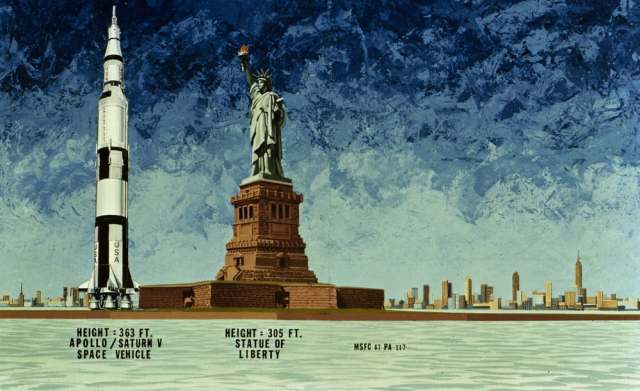
Wernher Von Braun was a German rocket scientist who built V2 rockets for Hitler during world war 2. After the war, which Germany lost, there was a mad scramble for the rocket scientists working on V2 rockets. Russia snatched some scientists, and a few others including Von Braun came to US. During the cold war, after President Kennedy made the pledge to have a man on the moon by the end of 1960s, Von Braun started working on the first the Mercury program, followed by the Gemini and then the Apollo programs. Von Braun designed the Saturn V rocket, the most powerful rocket to hurl the Apollo spacecraft towards the moon. No rocket after Saturn V has been that powerful. The rockets for the future lunar and Mars missions may achieve that kind of power.

I found the following image of Saturn V compared in size with the Statue of Liberty. The five bell shaped Rocketdyne F1 engines generating millions of pounds of thrust can be seen at the bottom of the rocket (only 3 are visible, 2 are behind). Courtesy NASA.

After propulsion, next important concept is the navigation. How to guide the rocket towards its destination. Today we have the GPS, but back in Apollo days, a new system called the INS (Inertial Navigation System) was designed in MIT by Charles Draper. This system precisely guided the spacecraft from the ground into the space and to land on the moon. Astronauts used to do some fine course correction along the way, by looking at he position of a few known stars. The INS has been used in aircraft navigation for decades before GPS replaced it. INS works by starting with an initial position of the aircraft or the spacecraft and calculating the distance traveled in each direction and solving a geometric equation to determine the current position. It is not dependent on any external signals like the GPS does.

Manned space flight is more complex than unmanned ones. Because manned ones need life support systems. Oxygen to breathe in, scrubbing the carbon dioxide breathed out by the astronauts. Maintain the right pressure of air, provide water and recycle the waste products.All the scientific equipment and things used by astronauts to be secured to walls in zero gravity environment. These concepts came in handy for the later manned space stations like Skylab and ISS (International Space Station).

Although fifty years have elapsed without further lunar activity, the future bodes well. China has landed a spacecraft on the far side of the moon a few months back. Moon is tidally locked with the Earth, which means it shows only one side permanently towards the Earth. We cannot see the far side without venturing out in a spacecraft and land on the other side of the moon. India will be launching a spacecraft (an orbiter, a lander and a rover) to the moon in a couple of months time. Jeff Bezos of Amazon announced a lander called Blue Moon, powered by a spacecraft called New Glenn. Unfolding of these events is a welcome sign after a long gap in time. Let us hope for the best for humanity as a whole.

Posted in June 2019, Sidereal Times | Tagged | Leave a comment

Snippets

compiled by Arlene & David Kaplan

Einstein & Eddington

Einstein & Eddington

The man who made Einstein world-famous
It is hard to imagine a time when Albert Einstein’s name was not recognised around the world. But even after he finished his theory of relativity in 1915, he was nearly unknown outside Germany – until…more

-BBC

-BBC

Chang’e-4: Chinese rover ‘confirms’ Moon crater theory
The Chinese Chang’e-4 rover may have confirmed a longstanding idea about the origin of a vast crater on the Moon’s far side…more

-BBC

Michigan meteorite used as doorstop
A US professor has established a rock used as a doorstop is actually a meteorite worth thousands of dollars. Mona Sirbescu from Central Michigan University was asked by a local man to inspect the object he had kept for 30 years after finding it on a farm…more

-BBC

UK satellite ‘sets sail’ for return to Earth
echDemoSat-1 was launched in 2014 to trial a number of new in-orbit technologies but has now reached the end of its operational life. To bring it out of the sky faster than would ordinarily be the case, it has deployed a “drag sail”…more

-BBC

SpaceX puts up 60 internet satellites
A Falcon-9 rocket launched from Cape Canaveral in Florida late on Thursday, packed with 60 satellites capable of giving users on the ground high-speed connections to the internet…more

Posted in June 2019, Sidereal Times | Tagged , | Leave a comment

From the Director

Rex


by Rex Parker, Phd director@princetonastronomy.org

May 14 Meeting – Election of Officers. Once again we’ve come around in our orbit to the election point for the Board of Trustees. Actually it’s the re-election point, since each of your current officers has again agreed to stand for another 1-yr term. All members are urged to attend the May 14 meeting at Peyton Hall to give us your vote of confidence — and we need a quorum.

Through the dedication and skill of Board members the organization operates effectively and the future direction of the club is guided. The cutting edge lectures by renowned speakers don’t just spontaneously appear at Peyton Hall the 2nd Tuesday of the month. The Observatory telescopes and electronics do not provide clear images of the sky on their own accord. The financial health isn’t in balance, public astronomy isn’t brought to hundreds of kids and adults each year, and the comradery and interest of the membership isn’t promoted without high-functioning Board members. So here’s a big round of thanks from me speaking for the entire AAAP, for Ira Polans (Program Chair), Michael Mitrano (Treasurer), Larry Kane (Asst. Director), Jim Poinsett (Secretary), Dave and Jenn Skitt (Observatory Chair), and Gene Allen (Outreach Chair) for their contributions and willingness to step forward for another year.

From Stone to Star, part 2. As we left the story last month, answering the deep questions about the origin of heavy elements on earth draws upon theory and observational science in astronomy, physics, geology, and chemistry. Gold, platinum, and the other rare heavy metals that are so precious to human civilization can only be obtained by mining from deposits near the surface of the planet. But that may change in the not-too-distant future as science fiction approaches reality.

The story of gold and its fellows is a tale of long and involved geological processes bringing the metals up from magma near the core where it sank during the early molten stage of formation of the earth 4.5 billion years ago. The amount of gold mined through human history is remarkably little, less than 200,000 tons, of which ~2/3 has been mined since 1950 according to data from the World Gold Council. Surprisingly, if that total amount of minable gold were stacked into a cube it would measure less than 22 meters on each side. Only about 50,000 tons is thought to be still in the ground and minable. Clearly a financial case might be made for mining the asteroids, where gold is one of many valuable metals which could be obtained. Indeed, NASA, JPL, Arizona State University, and Maxar Technologies are teaming up for a mission to explore the composition, structure, and history of the metallic asteroid 16 Psyche. This asteroid, first discovered and named back in the 1850’s after the Greek goddess of the soul, is about 70 miles in diameter and orbits between Mars and Jupiter. https://www.jpl.nasa.gov/missions/psyche

The composition of 16 Psyche is highly enriched in iron, nickel, and heavier elements including gold and platinum, suggesting it originated as the core of a planet long-since blasted apart. The amount of gold and other rare metals in 16 Psyche vastly exceeds the amount of minable precious metals on the earth’s surface. At last, we have motivation for a space mission from both the science and financial communities! Bringing even a fraction of that much gold and other metals to earth could be hugely disruptive to the economy, but the NASA team is only instrumentally exploring and not mining, at least in the near future. Yet the stuff of sci-fi is inexorably drawing closer to becoming reality as the asteroids align with dreams of once unimagined sources of wealth on earth.

Posted in May 2019, Sidereal Times | Tagged , | Leave a comment

From the Program Chair

by Ira Polans

The May meeting will be held on the 14th at 7:30PM in the auditorium (Room 145) of Peyton Hall on the Princeton University campus.

The May talk was chosen as a good way to end the 2018-2019 AAAP lecture series as July 20,, 2019 marks the 50th anniversary of the historic Apollo 11 moon landing.

The featured speaker is James Chen who will discuss his book How to Find the Apollo Landing Sites. This book is for anyone who wants to be able to connect the history of lunar exploration to the Moon visible above. It addresses what Apollo equipment and experiments were left behind and what the Apollo landings sites look like now. Each Apollo mission is examined in detail, with photos that progressively zoom-in to guide the reader in locating the Apollo landing sites. Guided by official NASA photographs from the Lunar Reconnaissance Orbiter and the original Apollo missions, the backyard astronomers can view the Moon with a new appreciation of the accomplishment of landing astronauts on its surface. Countless people have gazed at the Moon in the night sky knowing the successes of the Apollo Program in landing men on the Moon. With the information in this guide, casual and serious observers can actually point out where the Apollo landings occurred as well as knowing why those sites were chosen. During the break there will be a book signing.

The 10 minute talk will be the second and final installment about our trip last summer to Chicago and the Yerkes Observatory. This part of the talk will be given by Dave and Jennifer Skitt.

There will be a meet-the-speaker at 6 PM at Winberie’s in Palmer Square. If you want to join us for dinner please email me at program@princetonastronomy.org by Noon on May 14.

Looking forward to you joining us at the May meeting!

Posted in May 2019, Sidereal Times | Tagged , | Leave a comment