From the Program Chair

by Ira Polans

The December meeting of the AAAP will be held on the 10th at 7:30 PM in the auditorium of Peyton Hall on the Princeton University campus. The talk is on Gamma-ray Bursts: Unraveling the mystery of the universe’s brightest explosions by Patrick Crumley Postdoctoral Research Associate at Princeton University.

Understanding the source of gamma-ray bursts–brief, extremely bright flashes of gamma-rays–was a driving force in high energy astronomy for more than 30 years. The mystery started when gamma-ray bursts were serendipitously discovered by nuclear anti-proliferation satellites at the height of the cold war, and the final piece of the puzzle came just 2 years ago in 2017 with the first simultaneous detection of a gamma-ray burst in both gravity waves and gamma-rays. I will give an overview of the history of high energy astronomy, and how satellites, ground based observers, and theorists all worked in concert to unravel the mystery of the gamma-ray bursters. Because of the hard work of several academic generations of astronomers, we now know that gamma-ray bursts are produced by luminous jets traveling close to the speed of light, launched by the most violent explosions in the universe: the death of massive stars in a supernova, or in the merger of two neutron stars.

We’re looking for a member to give the first 10 minute talk of the season. If you’re interested please contact me at program@princetonastonomy.org and let me know which month you want to give your talk. If you have an idea and are unsure how to present it please contact Rex at director@princetonastronomy.org or Ira at program@princetonastonomy.org. As announced earlier rather than give your talk at the beginning of the meeting your talk will be given after the break.

There will be a meet the speaker dinner at 6 PM at Winberie’s in Palmer Square prior to the meeting. If you are interested in attending please email me by noon on December 10 at program@princetonastonomy.org.

Posted in December 2019, Sidereal Times | Tagged , | Leave a comment

An Outreach Scope Takes Shape

by Gene Allen, Outreach Chair

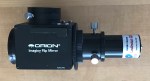
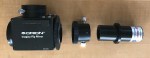
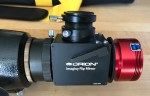
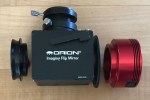
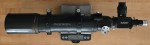
At the NJAA flea market in High Bridge, Dave Skitt and I agreed with Tom Swords in purchasing a used Orion ED80 refractor for use as an Outreach scope. A few years ago I had proposed that the club should have a scope that a member could take to an Outreach Event if they had no hardware of their own or had only top shelf gear that they chose not to put at risk. My concept was that it would be a simple, very portable rig with a flip mirror to be able to show both eyepiece and camera views. It would reside in the Observatory and be available as an additional scope on public nights if it was not otherwise occupied.


Tom is a refractor devotee and knew the history of their production and the quality of the glass in the lenses. The price was modest (half the price of new) and the seller threw in a flip mirror. Tom did a masterful job cleaning and tuning it up, and I have been gathering the additional pieces it needs to become operational: a super short 2” to T-thread nosepiece to connect the flip mirror to the focuser, a T-thread to 1.25” eyepiece holder to allow the Ultrastar astrocam to fit the straight-through port, and an inexpensive bag to keep it all together and protected. ZWO cameras can screw directly onto the flip mirror, and there is a locking ring that can secure a camera in the appropriate orientation once we figure out what that is.

For now it can ride my Porta II mount but I think it needs one that’s self-aligning and go-to so it’s easy for newbies to operate. It will probably ride my AZ Mount Pro for checkout, and that would be an excellent choice for it, but it’s pricey. The AZ-GTi also ticks those boxes for 75% less money, but it’s fairly new and may not yet be fully debugged.

The choice of camera is challenging. Do we pick up a used laptop to utilize either the Ultrastar we already own or a less expensive ZWO? Do we skip the laptop hassle and spring for a lower resolution Revolution Imager that comes with its own monitor? My assembly test-fitting checks so far have used my Lodestar X2 and ASI224MC that match the configuration of the club cameras.

The kit should probably have maybe two or three parfocal eyepieces and, once we get a bit more of these pieces figured out, some foam will get custom cut to properly cradle the scope and stuff in the bag. If you have an appropriate piece of hardware sitting unused, donate it. And stay tuned for further developments!

Posted in December 2019, Sidereal Times | Tagged , | Leave a comment

Minutes of the November 12, 2019 AAAP Meeting

by John Miller, Secretary

● Director Rex Parker opened the meeting, 7:30PM. Presented current events affecting the AAAP. This included various club activities (key holder procedures, field trips, outreach, guest speakers).

● Guest speaker Josh Winn, Princeton University Department of Astrophysical Sciences, was a popular draw. Discussion of Exoplanets. About 125 attendees.

● Professor Winn’s presentation focused of TESS: Transiting Exoplanet Survey Satellite.

● John Church gave a brief talk about the Mercury transit. The AAAP’s Hastings-Byrne refractor has observed 4 Mercury transits throughout its history.

● There was no Treasurer report.

● Rex did a post-lecture talk on current, selected objects in the November sky (Andromeda, Perseus, Pegasus, Triangulum).

● David Skitt, observatory chair, reported that the Sky 10 software had been renewed. The observatory pillar repair project remains under review for contractors.

● The meeting adjourned at 10PM.

Posted in December 2019, Sidereal Times | Tagged , | Leave a comment

this side of the truth

by Theodore R. Frimet

you may not see

The Martian Conundrum. Atmospheric Carbon Dioxide (CO2), seasonally freezes and coalesces into frozen ice, on the Martian poles. What should follow is that all gases will similarly ice up. That is, when measured, the atmosphere will have less Oxygen (O2) and less Methane (CH4). “the amount of the gas in the air rose throughout spring and summer by as much as 30%, and then dropped back to levels predicted by known chemistry in fall. This pattern repeated each spring, though the amount of oxygen added to the atmosphere varied, implying that something was producing it and then taking it away.” (1) There is a team looking at methane’s seasonal variability and wondering if it could be tied to O2 fluctuations, as well.

How? No one knows. Not just yet. Perhaps You and I, do.

Planetary scientists are caught up with the rise and fall of CO2, due to nominal seasonal fluctuations. They are flummoxed by increases of O2 and Methane that do not seem to follow the same predictable pattern.

Without introducing biological devices as the overall causality for this non-linear event, this essay will introduce my Theory of Grignard Reactions at the Martian Surface, driving a proposed CO2-Carboxylic Acid Cycle. I additionally propose a Hypothesis of Earth’s contribution of her own Magnetic field. My thoughts are Terra’s orbital cycle and Mars Seasons co-opt the benefit of the tail end of Earths magnetic field. This seasonal adjustment of Earths residual affect guides Highly Energetic Solar Energy Particles (SEP) to the Martian surface. Both ideas may open the door to further discussion of the Martian atmospheric science conundrum.

Perhaps my use of the word, “theory” is too liberal. And clearly I have not done all of my homework, in studying Earth and Mars orbit. As it pertains to the “shadow” of Earth’s magnetic field, “my dog ate my homework”. Caution: be sure not to overuse the same reason for not turning in your homework. [see final notes at end of essay].

I was out, late last night, in the Soccer Field of Washington Crossing Park, from the hours of 6 PM until just past 10 PM. So, I am too bushed for more research, this Saturday, November 23rd morning. It was cold, outside baby! I was vetting my new purchase of an Explore Scientific (ES) 30mm 82 degree eyepiece, and the ES 99% Reflective 2″ Diagonal. I was tied at the knot to my push-to (often used in outreach), an 8” Meade LX200 GPS (Frankenstein’d), with 2″ Rear Port Adapter for Meade & Celestron SCT Telescopes. This simple, one-off adapter purchase from telescopeadapters.com made my evening a great view. Comfort was established with military surplus undergarments that wicked away moisture. My new overgarment, IRON-TUFF® COVERALLS WITH HOOD, from refrigiwear.com kept its promises on its minus 50 degree protection. Don’t get me started on my Baffin Impact Men’s Insulated Snow Boot rated to minus 148 F. Yet, when I woke up this morning, I had to crawl out of bed. Thankfully, Janet made an extra pot of coffee. We call her “the barista” of Lincoln Street.

I was looking for a swank title for this essay. Just the other day I got around to flipping thru the Collected Poetry of Dylan Thomas. I became a fan of Dylan, when I learned that he authored a favorite poem of mine, “Do not go gentle into that good night”. Regretfully, having now had two Poets to compare my likes, Dylan now goes the way of Robert Frost. I say regretfully, because my palette seems to hearken unto only one poem, from each. It has become evident that I have a distinct dislike for the remainder. So sad. Is there hope, yet for me? Probably not, as the current title is blase, and non-indicative of the Astrochemical Mars tour de force that I have in mind for you, below!

Fortunately, this essay will be brief, and easy to understand. However, it will not be complete. I have yet to aggregate the knowledge by which I can commit to the production of Oxygen and Methane. Read below, and you may acknowledge what was missing from the Science reports.

Grignard Reactions. Yup. When Grignard first published his work, nobody could reproduce it in the laboratory. That is until they figured out what was wrong. Grignard didn’t have fluorescent lights in his lab. Perhaps he couldn’t afford them? I dunno. When fellow scientists eliminated this source of Ultra Violet radiation from the experiment, Grignards’ reaction was faithfully reproduced. Or at least, so the tale was told to my classmates by my Organic Chemistry (OC) teacher of 1980/1981 moeity.

Disclaimer: I took an Incomplete on that first grade by virtue of deciding not to hand in my last lab (probably would have been a “D”), and took a Withdrawal upon attempting OC, during that summertime. They called it “OC jetlag” back then. I however had a bad case of undiagnosed hyperthyroidism, which interfered greatly with my learning process.

CO2 interferes with UV reaching the Martian surface. Yes, CO2 does not ONLY affect infrared sources of energy. So it goes, that with the off-season (non-winter) INCREASE in atmospheric CO2, there is an increased rate of reaction for Grignard reactants, (absent the interference of UV) resulting in higher concentrations of Carboxylic Acids.

Here, let’s summarize what we have so far. I’m not an organic chemist, and yet I am telling you that CO2 blocks UV. Grignard reactions result. An increase in CO2 yields Grignard reactions, and more Carboxylic Acids. With me? Good. Because a little faith is required in the below chemical statement:

RCO2H + NaHCO3 ==> [RCO2(-)Na+] + CO2 + H2O

Oops, did we just create water on Mars?
Wait a minute, you promised Oxygen and Methane!
Ok. ok. k.

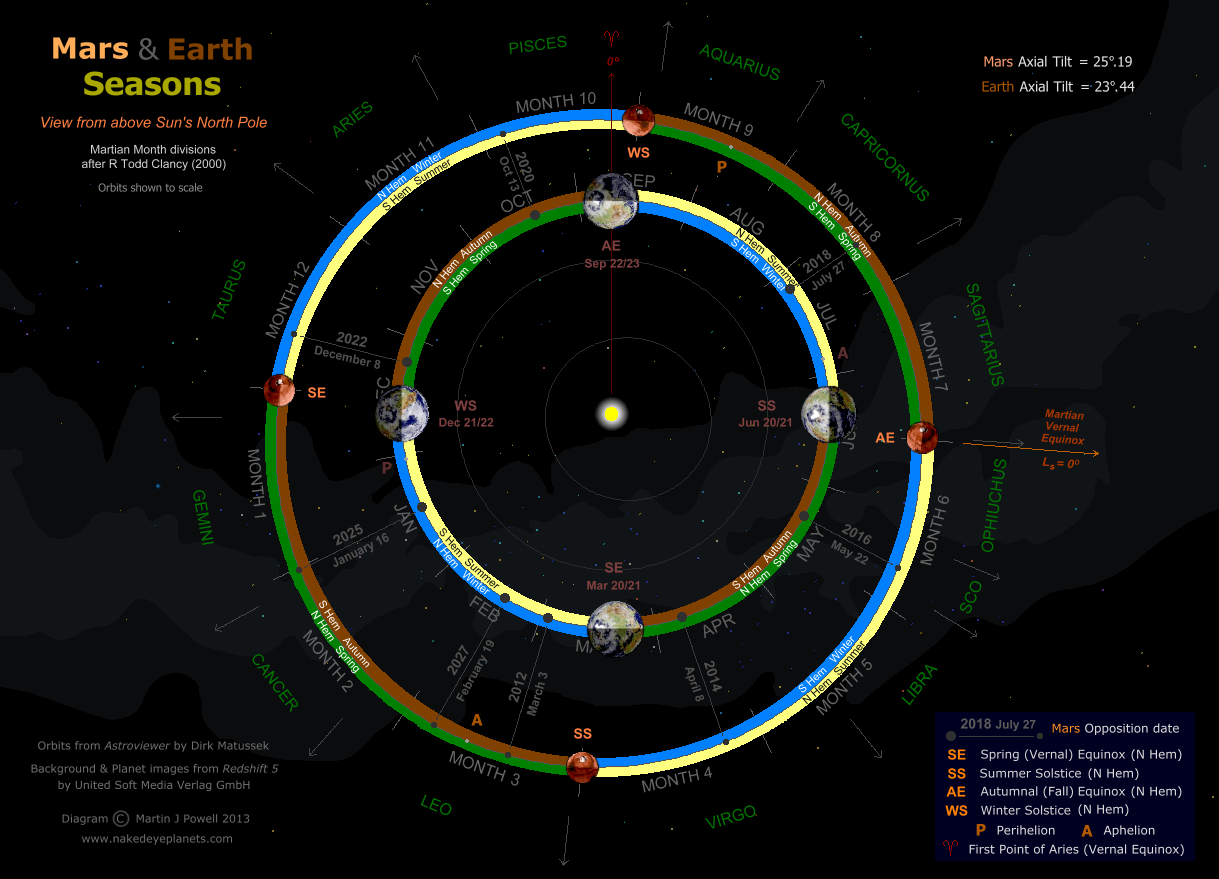
In the absence of atmospheric gases, since they coalesced frozen at the poles, creates a thinning of the protective Martian blanket. My hypothesis is that Highly Energetic Solar Energy Particles (SEP) could penetrate to Mars surface. The Martian Winter Solstice and Earths Autumnal Equinox occurs when our orbits are closest together (1). That allows Earths magnetic field to outsource to Mars, aligning SEP hits to the Martian surface. This added energy, not including cosmic rays, can bounce CO2 around, releasing additional Oxygen:

CO2 ==> CO + O
Oops, did we just release a highly reactive Oxygen atom? Why yes, we did!
Now, I am not a chemist. Yet it doesn’t take much in the way of imagination to reorganize CH3COOH into:

CH4, CO2, or H2O

Let’s try and see if we can work out a formula?

CH3COOH ==> CH4 + CO2

There be Methane!

Where is the diatomic Oxygen?
CO2 ==> CO + O
O + O ==> O2

Ok, the above is a stretch of my imagination. However I have been working hard on the Grignard theory in the absence of seasonal atmospheric CO2. So this side of the truth, you may not get to see, or hear of from any other Amateur Astronomers on this topic. The chaos of combining seasonal Earths Magnetic shielding affect on Mars, which directs SEP hits, and the decrease in atmospheric CO2, which down-regulates the Grignard reaction, is too much to hoof about.

Wait, are we blind, here? If there is a decrease in CO2 in the atmosphere, there should be a decrease in the Grignard reactions! Um, Yes. Or rather, Alice, try the cake that reads, “eat me”. That is essentially correct. Fewer Carboxylic Acids are produced, and with less atmospheric CO2, the drive to produce more reactants occurs, as stated, again, below:

CH3COOH ==> CH4 + CO2

There be Methane! We were already presumptive on where the O2 came from, weren’t we, Old Sport? As for the “30 percent increase”, the rate of reaction is not tied to the rate of CO2 capture at the poles. This is because a new Calculus is required to accommodate seasonal CO2 flux, our SEP factor, the seasonal interaction of our magnetic fields, and Sun activity. Don’t even get me started on Cosmic Rays. Yawn. I need another poet.

Failure is abundant
To grasp the rewards
of failure is
To grasp the rewards
of success

That’ll do.

References:
http://www.nakedeyeplanets.com/mars-seasons.htm

copyright Martin J. Powel.

The Conundrum:

With Mars Methane Mystery Unsolved, Curiosity Serves Scientists a New One: Oxygen

https://iopscience.iop.org/article/10.3847/1538-4365/aa9f28/pdf

This laboratory study simulated the abiotic formation of carboxylic acids (RCOOH) in interstellar analogous ices of carbon dioxide (CO2) and methane (CH4) at 10 K upon exposure to energetic electrons.

Despite the importance of carboxylic acids in extraterrestrial environments, their detailed formation routes have not yet been resolved.

My notes:

Since Martian atmospheric CO2 is seasonally condensed, to a solid, at the poles, it follows that the rate of reaction, increases, forming up more product (CO2).

Methane (CH4) is released, while Carboxylic Acid is produced. Both are reasonable due to radiation exposure, in the laboratory, to disassociate a free O from CO2.
CO2 ==> O + CO

https://agupubs.onlinelibrary.wiley.com/doi/full/10.1029/2019JE006175
“Max CO2 pressure during Northern Fall shortly after perihelion”

and finally:

10 Best Excuses for Not Doing Your Homework, August 2, 2012 – by Ananya Rao-Middleton: https://blog.tutorhub.com/2012/08/02/10-best-excuses-for-not-doing-your-homework/amp-on/

Posted in December 2019, Sidereal Times | Tagged | Leave a comment

Two out of three ain’t bad

by Ralph Marantino

In 1994 I journeyed to the lighthouse at the Atlantic Highlands. In the dark I set up three optical units. First a Tele Vue Genesis SDF 101mm refractor with a Thousand Oaks glass white light solar filter. I soon followed with two Coronado Solar refractors a double stacked 40mm PST @ .5 Angstroms and a 70 mm Calcium K line telescope. I set up all of the telescopes to observe at 45X a perfect field of view. The sky was clear all day and I observed the entire transit.

I drove down to Columbia South Carolina for the past total Solar eclipse and was clouded out at the last fifteen minutes, enough said about that.

This past Monday I set up the Tele Vue refractor on my front lawn and gave the entire block and some children waiting for the school bus a good look at the transit of Mercury across the solar disk. I agree with Meatloaf that Two out of three ain’t bad.

I am ready to trade Tele Vue Bino Vue with Barlow and two 25mm Plossl eyepieces for either Tele Vue 41mm Panoptic or Tele Vue 31mm Nagler type 5 for my next transit. Anyone?

Posted in December 2019, Sidereal Times | Tagged | Leave a comment

Mercury Rising

by Theodore R. Frimet

of mice and bears

Needless to say, do not look directly at the Sun. Do not put filters on an eyepiece and look thru it. In either of these cases, you will be permanently blinded. Let’s take a dip, in the transit of Mercury.

It is a day before the Mercury Transit. For those not inclined to follow the lore of Astronomy, a transit is when a planet appears to move across the sphere of the sun. We, here on Earth, see a planet between our line of sight, and the Sun. It will appear as a small black dot, moving across old Sol. The ‘morrow will be Mercury.

I put away the 8 inch Celestron, and closed up the observatory. I made a few trips. One back to the car, to store the astro chair, and a sky guide. The other, twice to the Jenny Jump house, to store my eyepiece collection. 57 percent clouds were never defined as chaos or waves. The entire sky was blotted out. Thin white wisps turned vaping thick.

iPhone 6S Plus – 30mm 82 degree FOV ES eyepiece, 8” Celestron CST

About an hour, or few earlier, I had the moon in my sights. Clouds be damned. In the beginning there was hope. Then there were 17 percent clouds. The moon perversely shined thru the thick veil. The newly purchased 2 inch 82 degree 30mm Explore Scientific (ES) eyepiece, performed stellarly. The 99 percent reflective ES star diagonal performed flawlessly. Both gobbled up the moon light, and delivered performance to my satisfaction. I will leave a good review.

Bringing in clothing was a busy business. Always overpacking, it took at least three trips from the car, to the house. Right. Sign in sheet. Ok. Check all the doors, and make sure they are locked – windows too. Water on. Lights. Check. Homework. Yes, there is always homework to be done. This time it was preparation for my American Sign Language Class. I’d send you a link to my latest assignment – however I need to continue to work on it. Janet has volunteered to help when I return home.

She watched me as I had anxiety, during packing. Caught me on the back end, after returning from shopping, she did. The generalized panic was well intended by my brain, as I did not want to forget anything. I thought I did. I went back into the house to look for my black bag. Only to realize that it was well packed in the back of the car. Off to Burger King, and order two Impossible Burgers, with fries. Went back home to Janet’s surprise. I quickly gestured to the coffee maker, and expressed that two 20 cent containers outbid several dollar worth of custom coffee on the road. Gas is expensive to Jenny Jump. I needed to economize. Not complaining you see. There is plenty of free, old soda, at no cost, waiting in our club kitchen. Slurp. Fizz. Pop.

Bears. There is too much quiet when you observe alone. No takers, you see, other than the tried and true. Most others, who would volunteer, were off to their native clubs for the transit. Quiet, now. There is no noise. What was that? I hear something in the distance. Barking dogs. Dog, why do you bark? Is it a bear? When do bears hibernate in New Jersey? I’m from Pennsylvania, so these NJ bears might have a different disposition. Google it. Oh bother! Black Bears do not hibernate. As long as there is a ready food source, they stay up like teenagers into the night! What is that I hear, now? Ok. Time go get a hold on my imagination. Play Steely Dan on my iPhone. Ahhhh….Bears don’t like Steely Dan, do they?

The Celestron refuses to yield and align. A few attempts later I realize that I need to adjust the date time group. After repeating this process, a few times, I get jazzed up and proficient. The moon stays put in the center of the eyepiece. Yes. I like that 2 inch ES.

I fire off one email to UACNJ members. I was going to send them a picture of the moon. Really? How exciting would that be for the membership? Probably not too much of an event. They struggle to accept my long invitations to read these essays. Rambling about, some time and some where. Most of the time, writing about themes that wouldn’t stir the milk in your coffee. Too thick for thieves, that is. Very tough stuff. Even I slug thru the re-reads.

I telegraph the thin veil of clouds, and how the moon is visually appealing. Too late to conjure up visitors to the Jump. Remember, tomorrow is the Transit of Mercury. And there are few takers for parking or telescope operations for the public view. Why would one bother to reply to a veiled attempt to attract another club member, in situ?

The operating instructions for the extra observatory are sublime. They are quite literally the handwriting on the wall. Chris thought of everything. And I am most grateful. That is, until I try to push open the roof to the observatory. Stuck after 20 inches, or so. I try again. Doesn’t budge a bit. I wish I had a second pair of hands. I didn’t curse much, or make much ado over it. Moving to the back of the shed – I leaned into it. Nothing. Time to wander among the Bears.

Outside, I grab hold of the overhang. I press the backside of my body against the shed. Push. Push, I do. It moves with ease, and extends well beyond the mark. I reverse course, and set it aligned with the overhang. Perfection. No Bears. Shush!

It’s cold outside. No so cold if you were walking about. However any amateur knows that sitting silent in the cold can take its toll. I thought a jacket would suffice. My hands on metal spoke volumes for me. Lock the shed, and head for the house.

I brought cold weather gear. My go bag has all my clothing ready for me, at a moments notice. Last year we introduced extreme cold weather boots. Lovely things, they are. This year the investment was furthered to a cold weather coverall. Blessing be. Club members chimed in to assist to establish their favorite retail haunts. At the end of the day, however, I went shopping for an Atlanta Georgia company. Clothing made in U.S.A. Refrigiwear. Iron-Tuff Coveralls with Hood keep me protected down to -50 F.

I was thinking that maybe they were Bear proof, too? Perhaps that was asking too much. I took the iPhone out of my pocket, and laid it down on the wooden shelf. Playing more Steely Dan, I calmed my nerves. What was that? Probably just a raccoon, or a groundhog. I coughed up loudly, telling the outside world to stay outside. I turned the lock on the door. Didn’t want the bear to think that he was welcome. Click. I heard a grunt. I grunted back. No more grunts to be heard.

The boots were warm. I only had one sock layer on this evening. So the boots were a little wobbly. Not too much, though. I used to wear Army surplus Muk Luks and several layers of socks. They were unstable to walk in. After a year or few in those, that instability prompted my investment in Baffins. Good boots. I remembered to buy them one size too large. They would accommodate many layers of socks. One layer is not enough. Yet tonight, they were only slightly wobbly, as I moved from shed to house.

The old free cola in the kitchen isn’t too bad, this evening. I take another slug. Swish. Tasty. I look back into the refrigerator and spy my dinner. Microwave is here, so why not? I don’t feel very hungry. Two vegetarian whoppers were enough it would seem.

Shut in against the cold. Moon obscured by clouds. What to do? I think. Yes, tomorrow is the Transit of Mercury. I didn’t see it the last time. I knew who did, though. I wasn’t an Amateur yet. I complained to Janet that our backyard had too much light pollution. I couldn’t see the stars that I wanted to. Go to Washington Crossing Park, she said. We took a day trip.

Outside the fence, I parked the car. Janet said she would stay, and play the radio. She was comfortable there. I walked, and walked. Down the broken ground, gravel strewn about. Another fence, and then to the right. A sign. A house. No. An observatory. The roof open, and a telescope pointed skyward. I saw the unmistakable solar filter. Pretty big for a 14 inch telescope. There he was.

His grandson was in a small room, vetted just outside of the telescope’s reach. Later I would learn that it was the control room. Gene stopped, and started to talk to me. Nice guy. I thought I’d come across many nice guys, like Gene. No. As it turns out, I learned from second hand reports that Gene was kind of special. There was only one Gene.

Gene said that he would welcome me into the club. He was kind of excited when he said that we needed more husband and wife teams. He really liked that idea. Gene, it turned out, was fond of some very special people. At the time, I didn’t appreciate how indebted the art and science of amateur astronomy would be to Gene, and to those he treasured. That was the Mercury Transit, a few years back. It was Gene’s last.

Tomorrow will be my first. We may cloud in. That’s OK. Chris is technically proficient and will summon up websites that will produce for the public. I will have some reflective guard gear on. If no clouds, I will have a 6 inch Celestron on a German Equatorial mount at the ready, with white light filter.

The public will be here, tomorrow. I told Janet that those who are interested, know. And those that don’t – might have the day off and would like to visit an open observatory. We will be open. It’s a good way to spend Veterans day. I’m a veteran, by the way. I thought that you should know that, now. It’s on my drivers license, so it must be true.

I had visions of spying Andromeda Galaxy this evening. And would wait for the two o’clock showing of the Great Orion Nebula. Both are my friends, and this is their time of year to visit. Clouds, it would seem, were not the bane of Steinbeck. If it were, he might have written:The best laid plans of bears and astronomers often go astray. Well, it wasn’t Steinbeck. Truth be told, it was Robert Burns. And it wasn’t “astray” it was “awry”. Did either of them pick up a telescope to watch the Mercury Transit? I fear not. Probably never with a bear.

Posted in December 2019, Sidereal Times | Tagged | Leave a comment

Snippets

compiled by Arlene & David Kaplan

-Yu Jingchuan/Beijing Planetarium

Scientists find ‘monster’ black hole
Before now, scientists did not think it was possible for a stellar black hole to have a mass larger than 20 times that of the sun, an approximation based on their understanding of the way stars evolve and die in the Milky Way.

But that assumption was metaphorically crushed in the gravity of a “monster” black hole that a group of Chinese-led international scientists discovered …more

-NASA

Voyagers shed light on Solar System’s structure
Data sent back by the two Voyager spacecraft have shed new light on the structure of the Solar System.
Forty-two years after they were launched, the spacecraft are still going strong and exploring the outer reaches of our cosmic neighbourhood…more

-NASA

Nasa probes oxygen mystery on Mars
The oxygen in Martian air is changing in a way that can’t currently be explained by known chemical processes.
That’s the claim of scientists working on the Curiosity rover mission, who have been taking measurements of the gas. They discovered that the amount of oxygen in Martian “air” rose by 30%…more

-NASA

Supernova 1987A: ‘Blob’ hides long-sought remnant
Scientists believe they’ve finally tracked down the dead remnant from Supernova 1987A – one of their favourite star explosions. Astronomers knew the object must exist but had always struggled to identify its location because of a shroud of obscuring dust…more

-BBC

Supernova 1987A: ‘Blob’ hides long-sought remnant
A team of British scientists has arrived in the Antarctic to try to find the continent’s “missing meteorites”. The group, from the University of Manchester, will spend six weeks scouring a remote region for lumps of iron that have fallen from the sky. These pieces of metal represent the shattered remains…more

-Forbes

‘This Is Not Cool!’ – Astronomers Despair
In the early hours of the morning today, Monday, November 18, two astronomers checked in on their remotely operated telescope in Chile, expecting to see images of distant stars and galaxies. Instead, they saw a train of…more

Posted in December 2019, Sidereal Times | Tagged | Leave a comment

From the Director

Rex


by Rex Parker, Phd director@princetonastronomy.org

November 12 Meeting
I’m back in Jersey after an exhilarating African safari last month, and am looking forward to seeing a good turnout at Peyton Hall Nov 12 for the presentation by Dr Joshua Winn of Princeton University (see Ira’s section below). Our dues-paid-up membership stands at 86 and counting. We’ve had several new members come aboard in the past few months, so if you have joined recently please introduce yourself at the break.

Farewell Prasad
As he prepares to leave New Jersey in a job-related relocation, I would like to give a big THANKS to Prasad Ganti on behalf of all the membership. Prasad has been associate editor for this publication for several years now, and his skill and dedication in editing and publishing Sidereal Times will be greatly missed, as will his participation as Keyholder at the Observatory. We wish you all the best in your future endeavors, Prasad, and hope you’ll stay connected with astronomy in the future.

8 Ways to Do Astronomy in AAAP

  1. Attend the presentations at Peyton Hall (2nd Tuesday each month)
  2. Give a 10-min member talk about your astro experiences (e-mail to program@princetonastronomy.org)
  3. Observe with state-of-the-art equipment at the Observatory
  4. Saturday night telescopes with members at WC State Park (see October Sidereal Times)
  5. Borrow the club’s SX Ultrastar color CCD camera to use with your own scope
  6. Get a Skynet account and do remote astrophotography from home (see below>)
  7. Go on an astro field trip with AAAP (recent trips include US Naval Observatory, Smithsonian Air & Space Museum, Princeton Plasma Physics Lab)
  8. Propose a field trip based on your own ideas and dreams

Andromeda!
To seek out Andromeda the constellation in the autumn sky has always been compelling – but perhaps a little mysterious too. For me the mystery stems from the lore of Greek mythology, which needs to be retold over and over as worthy legends do. Andromeda was the daughter of the king Cepheus and his wife Cassiopeia of ancient Aethiopia. Queen Cassiopeia boasted that Andromeda’s beauty even exceeded that of the Nereid sea nymphs, Poseidon’s minion, invoking the wrath of the god of the sea and storms. Poseidon thus sent the sea monster Cetus to ravage Andromeda as punishment for Cassiopeia’s hubris. It was the great hero Perseus himself who then rescued Andromeda as she was chained to the rocks by the sea, which is how he came to be her husband. Today many of the principals in this legend have a constellation named for them!

Figuring out exactly which stars are in the constellation is also part of Andromeda’s mystery (Figure below), even though it was first catalogued by Ptolemy in the 2nd century. It has no first magnitude stars, with Alpheratz, Mirach, and Almach all 2nd magnitude. I had always thought (until now) that Alpheratz was part of neighboring Pegasus since it forms the NE corner of the great square of Pegasus, but officially Alpheratz is considered part of Andromeda. But today Andromeda is probably better known as home for the Great Galaxy, Messier 31, the nearest large spiral galaxy to our own at ~3 million light years distance (red arrow in Figure). This spectacular deep sky object is for most people the first galaxy seen outside our own Milky Way and is the only spiral galaxy that can be considered a definite, obvious naked-eye object.. It is often said that the Milky Way galaxy’s appearance to an observer located in the Andromeda galaxy would look much like M31 does to us. According to Robert Burnham (Burnham’s Celestial Handbook), the Andromeda Galaxy was documented long before the invention of the telescope, mentioned in Persian writings from 905 AD. The first record of a telescopic observation was from Simon Marius of Germany in 1611, when he compared it to “the light of a candle shining through horn” (Burnham). This is a fairly accurate visual description even today for telescopes using eyepieces. However, the advent of astrophotography changed all that.

The constellation Andromeda is home to the Great Galaxy known as Messier 31 (red arrow). Figure from TheSkyX software.

In the middle of November in central NJ, the Great Galaxy in Andromeda transits (reaches is maximal elevation in the sky) at 9PM and is very close to the zenith. It’s placed splendidly for optimal astrophotography, which is better done with small amateur scopes than large, due to its immense size spanning ~3 degrees (6 times the moon’s diameter). Using a portable 3” refractor (Takahashi FC-76, focal length 600 mm) and a one-shot color camera (ZWO ASI-091), I photographed M31 the week before Halloween (Figure below). Note that two other galaxies are also in this image – M32 is the round object below the M31 core, and M110 in the upper right displays a hint of spiral structure. The final image here is the result of 17 x 20 minute subframes (total exposure 5.6 hours). All of the equipment to take photos like this is available to AAAP members at the Observatory!

The Great Galaxy in Andromeda, Messier 31, photographed with a small telescope in central NJ. North is up. Astrophoto © RAParker.

Skynet Remote Imaging for AAAP members
A good way to get going in astrophotography and learn more about how modern astronomy is done is to check out Skynet, a unique benefit of AAAP membership not offered by other astronomy clubs in the region. In June we renewed the contract with UNC-Chapel Hill for another two years. Skynet is the brainchild of Dr Dan Reichart of the Physics and Astronomy Dept at UNC-Chapel Hill. The internet-based queue scheduling software program runs on UNC computers to connect a system of observatories established for remote imaging. The Skynet Robotic Telescope Network comprises more than a dozen telescopes around the world in Chile, Australia, Italy, Canada, and the US. Each telescope is set up with robotic tracking mount, CCD camera, and filters for remote image acquisition. Tutorial videos are made available when you obtain a user account.

For both beginning astronomers or seasoned observers, Skynet’s easy-to-use interface taps into an extensive hardware network and large database of celestial objects from the Messier and NGC deep sky catalogs. It includes a basic image processing program “Afterglow” that runs on the server so you don’t need any special software on your computer. If desired you can download the data files and process the images you obtained at home on your own PC. Skynet is intended as an introduction to modern astronomy and astrophotography, and is used by science students at UNC and other institutions. Interested AAAP members are urged to take advantage of the club’s paid investment in this technology. Send me an e-mail note to get your Skynet user account at no cost to you as an individual. Email director@princetonastronomy.org

Posted in November 2019, Sidereal Times | Tagged , | Leave a comment

From the Assistant Director

by Larry Kane

I am putting together a AAAP member and member family field trip to the InfoAge Science and History Center located in Wall, New Jersey. This is the home of an operational 60 foot radio telescope. Our tour will be on December 14 at 1:00PM. Admission will be $10.00. While I have not yet visited this site myself, it looks intriguing and should be both informative and entertaining. I am awaiting the maximum number of attendees they can accommodate, but hope that fifteen to twenty of us won’t be too many. So let me know if you want to join the tour.by sending me a note to: assist.director@princetonastronomy.org.

The information below was copied from the InfoAge Center website https://infoage.org/visiting/

Please come visit us!

  • We’re open 1:00PM-5:00PM on Wednesday, Saturday, and Sunday
  • Admission is $7 for ages 13+ and $4 for ages 12 and younger
  • Our main campus is at 2201 Marconi Rd., Wall, NJ 07719 (Overview Map)
  • There are several buildings, so dress for outdoor weather (Campus Map)
  • ISEC (InfoAge Space Exploration Center) is a short walk south at 2300 Marconi Road
  • Parking at InfoAge is always free
  • InfoAge is a science and history center at the Jersey shore. We formed in 1998 as a 501(c)(3) educational non-profit organization. Our mission is to preserve, teach, and honor scientific innovation and history in order to inspire new generations of thinkers, dreamers, and visionaries.

Posted in November 2019, Sidereal Times | Tagged | Leave a comment

From the Program Chair

by Ira Polans

The November meeting of the AAAP will be held on the 12th at 7:30 PM in the auditorium of Peyton Hall on the Princeton University campus. The talk is on The Transiting Exoplanet Survey Satellite by Professor Joshua Winn of Princeton University.

We all know that 8 planets—or maybe 9 —orbit the Sun. Did you also know that astronomers have identified 4,000 planets orbiting stars elsewhere in the Galaxy? Most of them were discovered by a space telescope called Kepler that stopped operating last year. Now, a new space telescope is continuing the search: the Transiting Exoplanet Survey Satellite, or TESS. Professor Winn will describe the reasons why TESS was launched, and the results that have been achieved to date. These results include not only newly discovered planets, but also new insights into stellar pulsations, new observations of a star being shredded by a black hole, and new evidence for a system of comets orbiting the nearby star Beta Pictoris.

Two changes were made to the 10 minute talks this season. First, the talk will be given after the intermission. Second, we are instituting a 10 minute limit. Since we want to keep the talks to 10 minutes, the speaker will be given a 90 second warning to wrap up the talk. If you’re interested in giving a 10 minute talk for our November meeting or a future meeting please contact Rex at or Ira at program@princetonastonomy.org.

There will be a meet the speaker dinner at 6 PM at Winberie’s in Palmer Square prior to the meeting. If you are interested in attending please email me by noon on November 12.

Posted in November 2019, Sidereal Times | Tagged , | Leave a comment