Nominations for AAAP Officers for 2020-21

by John Church, Nominations Chair

Dear Members,

Director Rex Parker has kindly asked me to serve as Nominations Chair for our upcoming May election. I am therefore very pleased to report that all of our present officers have agreed to be nominated for another term. In my estimation they have all performed admirably in their respective posts, often above and beyond the call of duty.

The slate is as follows:

For Director: Rex Parker
For Assistant Director: Larry Kane
For Secretary: John Miller
For Treasurer: Michael Mitrano
For Program Chair: Ira Polans
For Observatory Chair: Dave Skitt
For Outreach Chair: Gene Allen

As always, additional nominations can be made by any member in good standing. However, because we will not be able to meet in Peyton Hall to actually conduct the election in May, arrangements are being made to accept any additional nominations and conduct the election electronically. Please stay tuned to Sidereal Times for further details.

In this difficult time we need to keep the club up and running to the best of our ability. It is unfortunate that we cannot presently meet in person, hear all those wonderful programs that Ira has been arranging, and share anecdotes and personal greetings, but this too shall pass. In the meantime, we are still able to stay in touch electronically. Thank goodness the Coronavirus has not infected our computers!

John Church
Nominations Chair

Posted in April 2020, Sidereal Times | Tagged , , , | Leave a comment

Freeman J. Dyson: A Personal Remembrance

by John Church

The Amateur Astronomers Association of Princeton joins the world in mourning the passing of renowned mathematical physicist and noted author Freeman J. Dyson on February 28 of this year at the age of 96.

Freeman, an Emeritus Professor at the Institute for Advanced Study in Princeton, was a great supporter of the role of amateurs in astronomy. A member of the AAAP for nearly 50 years, he helped us build our observatory in Washington Crossing State Park as well as giving the club many lectures in the Peyton Hall auditorium, which was always filled to capacity for such treats.

I first met Freeman in the early 1970’s after having summarized an article of his entitled “Energy in the Universe.” I remember telephoning him (with some trepidation) and asking if he would consider joining the AAAP. He responded that he would indeed be interested. This led to a friendship that lasted nearly half a century, of which more anon.

Here are some abridged selections from back issues of our newsletter Sidereal Times that mention Freeman’s long involvement with the club:

The Nov. 10, 1973 transit of Mercury was observed and timed from John Church’s driveway, using the club’s 6-inch refractor. Present were Freeman Dyson and Tullio Regge of the Institute for Advanced Study. A report was sent to Sky and Telescope, and the timings were published. With Freeman’s help, plans were proceeding to place a club observatory in a modified aluminum garage at the Institute that would be put on roll-off tracks. Member and civil engineer Karl Koehler prepared detailed drawings for the project. This proposal was not adopted due to finding that the Institute would have required construction to be performed by outside labor, which the AAAP could not have afforded.

AAAP member and Institute for Advanced Study Prof. Freeman Dyson was the speaker for the September 1986 meeting.

Prof. Freeman Dyson, long-time AAAP member who participated in the observatory construction in the late ‘70’s, presented a talk entitled “Hunting Comets and Planets” at the November 1990 meeting.

Prof. and AAAP member Freeman Dyson spoke to the AAAP on the subject of “Revolutions in Astronomy” at the December 1993 meeting.

AAAP held its 40th Anniversary Dinner at the Frist Center on the Princeton campus in November 2002. Freeman Dyson, one of the Washington Crossing observatory’s builders, spoke on “A New Way To Look For Life In Cold Places Far From The Sun.”

Our 50th Anniversary Dinner was held on the campus of the Institute in November 2012, at which Freeman also spoke.

On a personal note, my wife and I were invited to the Institute’s Sept. 2013 “Dreams of Earth and Sky” celebration of Freeman’s career. At the banquet on the final evening I gave a few remarks on Freeman’s contributions to our club, including the part he took in the building of our observatory in Washington Crossing State Park in 1977 and 1978. He was there at the site on many Saturdays. Here is a photo of him helping to dig the trench for the foundation:

Freeman J. Dyson digging foundation

photo by Richard Peery ©2020

On one fine Saturday afternoon, Freeman and I laid the fourth tier of cinder blocks in the east wall of the observatory. He helped with the project in many other ways as well.

I had the privilege of meeting privately with Freeman in his Institute office on many occasions when we discussed various topics in physics, astronomy, and cosmology. (Unfortunately, I haven’t kept written notes of our discussions.) On these occasions he would kindly host me for lunch in the Institute’s cafeteria. He very generously gave of his time to critique my draft of a personal memoir entitled From Eve and Morning that I issued privately in 2003. I have several of his books that he signed for me.

Freeman’s talents as a superbly clear and concise writer in multitudes of areas not necessarily related to physics are so well known that it would be superfluous for me to comment further here. As but one example, he served for many years as an invited contributor to the New York Review of Books. These wonderfully-written pieces engendered many replies, not always in agreement with his own views on subjects such as climate change and the role of enormous projects. He was a fan of small projects done inexpensively by individuals and small teams.

To conclude, here is a quotation from one of Freeman’s articles in the New York Review of Books on the subject of “Final Theories in Physics.” This is, I think, a good summary of his philosophy.

I find the idea of a Final Theory repugnant because it diminishes both the richness of nature and the richness of human destiny. I prefer to live in a universe full of inexhaustible mysteries, and to belong to a species destined for inexhaustible intellectual growth.

We in the Amateur Astronomers Association of Princeton will fondly remember Freeman and his many contributions to the welfare of our club as well as in so many other areas.

– John Church

Posted in April 2020, Sidereal Times | Tagged , | Leave a comment

Gene’s Tele Vue Baseball Cap

by Dave Skitt
Observatory Chairperson

Gene’s Tele Vue Baseball Cap

To keep the memory of Gene Ramsey alive, I wrote a short piece about Gene and his Tele Vue baseball cap. It was posted in Tele Vue’s February 2020 Blog.

Posted in April 2020, Sidereal Times | Tagged , , | Leave a comment

Novice EAA Imager Captures Rare, Unseen Astronomical Phenomenon

by Dave Skitt, Observatory Chairperson

If you’ve been reading my emails lately, you know that Dr. Rex Parker, PhD, and I conducted a Keyholder training session on Sunday, March 8, 2020.  We focused on the clubs’ expanding Electronically Assisted Astronomy (EAA) capabilities.  

As a novice EAA imager, I thought the session went very well.  All in attendance exclaimed how rapidly the new EAA technology was evolving and broadening the reach of what can be seen with relatively short exposures.  Despite the nearly full moon, the images of M42 with the ZWO camera on the C14 and the Ultrastar camera on the cOrion ADA, 80mm outreach scope were nearly identical.  The only difference were the exposure times:  5 seconds with the C14 versus 24 with the outreach scope.

After the session, I stayed behind to practice some more with the outreach scope/camera and iOptron AZM Pro mount. I decided to really test the limits and image some objects in the constellation between Virgo and Canes Virenatici.  

Home of globular cluster, M53, the Black Eye galaxy (M64), the Coma Pinwheel galaxy (M99) and the Needle galaxy (NGC 4565), the constellation Coma Viranices (“Viranices Hair”) presents some fine challenges for EAA.  I wanted to narrow down what camera settings would work best on this spread of objects.

I started my adventure on M53.  But not before I synced the mount on Denebola in Leo and tweaked my focus on nearby Cor Caroli with a N95 focus mask.  The AZMP mount got M53 dead on!  The Ultrastars’ stacked 20 second exposures revealed it to be a “rather vivid and round nebula of sars”, just as Johann Bode had described it when he discovered it in 1775.  Awesome!

Next up, M64.  Not nearly dead on but toggling the flip mirror helped me center the fuzzy oval in the eyepiece.  Flip back to the camera.   Wow!  Here, 30 second stacked exposures revealed M64s’ irregular shape, uneven brightness and cool texture.  The dark “Black Eye” dust feature was stunning.

Since it was getting late, I decided to skip “the Pins” (M99) and go straight to “the Needle”, NGC 4565.   This would be a good challenge to end the night.  

Now the AZMP’s slews are quiet.  Really quiet.  So much so that I wasn’t sure that it had moved far enough to hit the Needle.  Rushing in the cold, I typed in 14 days seconds in the exposure box and hit enter.  What appeared on the screen took my breath away.  I shivered.

Close up, the image looked like a comet. But when viewed six feet from the screen, it looked like a planetary nebula.  Had I not cleared the image cache before slewing?  Could it be both?  I took a screenshot and texted it to Tom Swords, a passionate comet hunter.  “That’s not a comet”, Tom replied.

I then texted the image to Dr. Parker along with the RA/DEC coordinates (16h 55m 33.86s/-41o 50’ 51.6”).  His extensive background in astro-imaging lead him to believe I had stumbled upon some novel astronomical phenomena.  He immediately called Dr. David Nyell at Central Management for Official Sightings and sent him the image and data.  

Twenty-four hours later, Dr. D. Nyell replied.  “We at CMOS can only state that the object observed at those coordinates is a presumptive positive sighting.  The data will be forwarded to the Copernicus Celestial Discovery Center via their Hotline.  Please refrain from additional observations until April 5th.  At such time we will reassess our position”.  

Early Tuesday morning, I received a frantic phone call from someone who identified herself as Vira Di’ Seaz.  She exclaimed “the C-CD-C has confirmed that you have caught the CO-VID-EAA-19 virus, aka, the CoronEAA virus.  Please self-quarantine yourself at the observatory for 14 days for further observation.”  

“Fourteen Days?  What do I do after 14 days?”, I blurted out.

After a short pause, Vira replied, “Well…, Corona Borealis will be higher in the sky by then.  You could poke around there with your telescope until this whole thing blows over…”!

April Fools.

P.S.:  The coordinates given above are for NGC 6231 located in Scorpius.  It is labeled in Stellarium planetarium software as the “False Comet Nebula”.

artists conception of surreal galaxy

COVID-19 (but not EAA) Free in 2020!


AAAP’s Outreach Telescope: Orion ED80 refractor complete with “N95 Focus Mask” and Starlight Xpress Ultrastar Color Camera on iOptron AZM Pro mount. Additional side-view photo of AAAP’s Outreach Telescope on the right.

Posted in April 2020, Sidereal Times | Tagged , | Leave a comment

At Home in A Dome

by William Murray

Since I’m stuck at home for the foreseeable future (as is everyone else in the world) I decided that astronomy is the best occupation for my time. Here are the results of some imaging I’ve been doing. The monochrome images are with an ATIK Infinity video camera on my Astro-Physics 130 mm Starfire GT refractor:

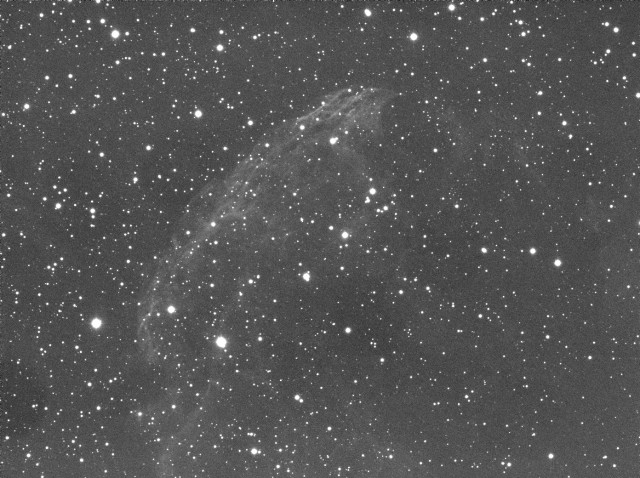
M1, The Crab Nebula

M1, The Crab Nebula

IC443, The Jellyfish Nebula

IC443, The Jellyfish Nebula

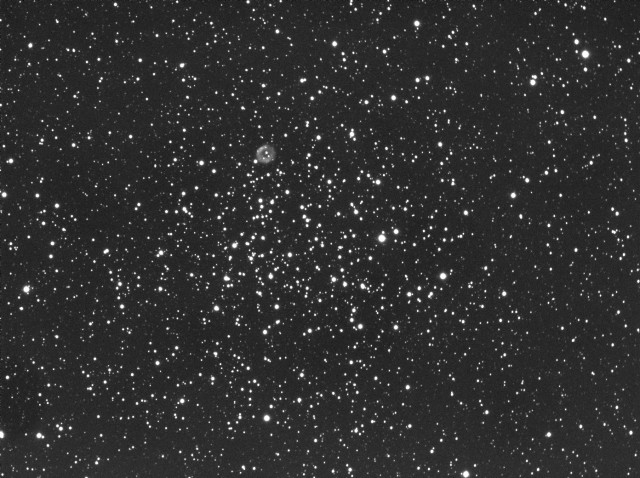
The open cluster M46 with the foreground planetary nebula NGC2438

The open cluster M46 with the foreground planetary nebula NGC2438

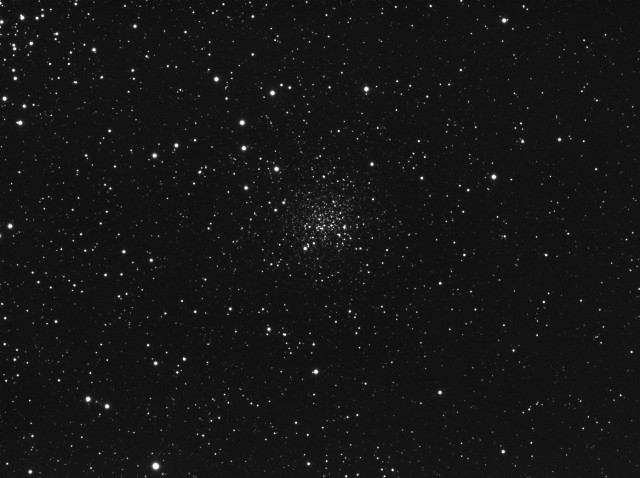
NGC2158, a distant open cluster near M35 (part of which is seen in the upper left corner)

NGC2158, a distant open cluster near M35 (part of which is seen in the upper left corner)

NGC2903, a bright non-Messier galaxy in Leo

NGC2903, a bright non-Messier galaxy in Leo

M95, a barred spiral galaxy in Leo

M95, a barred spiral galaxy in Leo


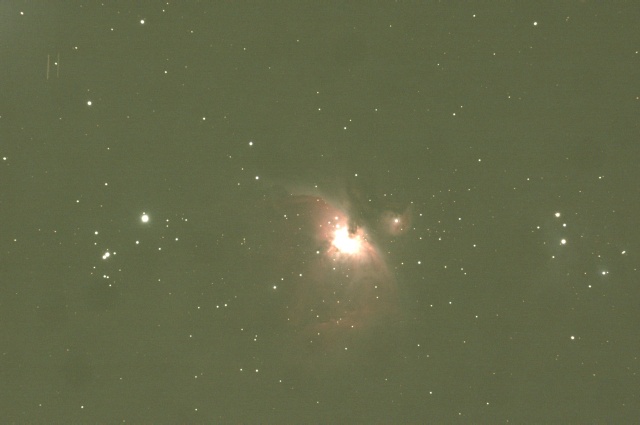
The last shot is a test shot with my Mallincam Universe video Imager. Still working on optimizing this camera but when I do it should give some great wide-field images.

M42

M42

Now if only the weather would cooperate …

-Bill Murray


Posted in April 2020, Sidereal Times | Tagged , , , , , , , , , , , , , , , , , | Leave a comment

AutoFiLX200

by Theodore R Frimet

shrimp gumbo

Tasty little morsel, if you’re not going Vegan. I have been off the reservation for quite a few months. I’d got a hankering for shrimp gumbo for my telescope. You know, the Meade LX200 GPS that I’ve invested time and money into? Yes, yes, I know. Don’t get you started. We ALL have time and money invested in our telescopes. Yet, this is one tasty little morsel.

I was watching one of our AAAP members, awhile ago. He tipped and paused his tablet, while his mount ushered to a new venue. I was so impressed. After a few years of pushing a dob, and an SCT about, I decided that my final destination would be wireless. Yummy.

Enter our Ukraine European ally, and provider of all good things for the Meade LX 200 GPS, astro-gadget.net. This wireless support offer was clearly everything that the chef could summon to the menu. It works flawlessly with my iPhone 6S running iOS 13.3.1, and Sky Safari Plus. Hurray!

The price was not hefty, and despite anticipating the shipment, our business partner, Alexander, was with me, every step of the way. Thank you for mailing the order!

Замовлення отримано сьогодні і працює у справному стані.
Сподіваюсь на чисте небо та приємні спостереження 🙂
Дякую за вашу працю, вашу інтелект та вашу доставку!

Saturday night, and everything is all right. A waning crescent moon took a nose dive at 4:41 EST. I set up during daylight, and readied for a few hours of viewing. There were going to be clouds in the forecast. So I ruled out a car trip to Jenny Jump, and settled into my backyard.

Mu Cep – Garnet Star, Beta Monocerotis, Messier 34 and Messier 93 all found with ease. 

The Garnet Star was one of my first, “push-to” experiences, while on an AAAP Star Party. I hopped, from star to star, using charts, and brut eye measurements. Tonight, the pedestrian in me parted ways. I jumped with joy, not having to wander the night sky. My efforts to make observations of the Garnet Star were easy peasee.

Beta Monocerotis was truly a wonder. At first blush this brightest star in Monceres appeared as a doublet. Pushing the magnification, with an Explore Scientific 11mm 82 degree series eyepiece, resolved this Beta as 3 stars, just as 8:40 PM started to set in.

My evening was capped off with a visit to M34, sporting an open cluster. To be sure, I managed a one off on M93, an open star cluster in Puppis.

My Autostar II paddle display appeared to be too bright. I attempted an adjustment. I am one-off from the latest firmware, so the inevitable problem ensued. Communication was lost to my scope. It drifted peacefully about the night sky.

Rest assured, I powered down, and was ready to Automatic-Align. Then clouds from the East crept in. Having had two hours of fine observation, I mused, “to shroud, or not to shroud – that is the question”. I decided on the former, and brought our Meade LX200 GPS home to roost in its JMI case.

Posted in April 2020, Sidereal Times | Tagged , , , | Leave a comment

COVID 19

by Theodore R Frimet

a time for a view

Ah, my friend
Behold the antiquity of a virus
Cast upon this earth.

Spewed before the great waters of life
Like a thief traveling silent in the night
And death does not become her.

No cavalier attitude can sustain
the many nor the one
For all to perish, shall anon.


Due to a customer cancellation on Monday, I have Sunday night open for astronomy. Hurray!!

I ran into some difficulty with my Bob’s Knobs, last week – so I have reinstalled them and re-collimating an SCT this evening.

Evidently, it is a bad idea to try to use Venus for collimation. LoL.

Judging from a Dark Sky app, it looks like Jenny Jump is Clear Skies throughout the evening.

Wind gusts look more than marginal, though.

Temperatures will range from a balmy 42 degrees at around 7 PM and drop to 28 degrees at or around 1 AM.

I plan to wear a jump suit, and strap on the extreme cold boots for a one last show.

Anyone with plans to come up, or recommendations?

Well, one other soul did come to the Jump, that evening. With no moon, and stable sky, the views were pretty good.

Truth be told, I spent only 15 minutes collimating and much more time (sigh) “auto-aligning” the telescope.

I truly need a right angle finder scope. The dippers guide stars don’t mesh for me at all, upside down!

Fortune finally smiled upon me by the good graces of Sirius and Capella. Amazing work done by a 13 year old telescope, here at Jenny Jump.

Almost all “what’s up tonight” for the Meade Autostar II filled my eyepieces at 28mm.

Other members, both from UACNJ, and AAAP, were hunkered down in their observatories. One amateur duly noted below, makes the nights statement for all of us:

I for one am home and hiding, surrounded by my massive stockpiles of toilet paper, like all good Americans.

a brief Q & A

Question. Recently the State of New Jersey has placed a night time travel restriction into place. I don’t completely understand why 8 PM is the cut-off. Does the virus know what time it is?

Answer. It’s a curfew. They don’t want adolescents to start throwing toilet paper rolls at each other. Clearly, those rambunctious amateur astronomers are all cloistering themselves in toilet paper, hunkered away for the long haul. It is only a matter of time, before the zombie effect takes hold, cabin fever aside, and they launch the final wave. Let loose the canonical roll, and beware the traveler that stains the dark of the night!!


Posted in April 2020, Sidereal Times | Tagged , , , , | Leave a comment

K2

by Theodore R Frimet

twasi-now, or twasi-later

Diapause. One mechanism that we can attribute to the halt in biological development due to unfavorable conditions. When your Sun goes Nova, that would entirely fit the bill, wouldn’t you think? Hmmm. Pull up a chair, and let the gravity of your morning sink in. Grab that second cup of coffee, and join me, as we explore the origins of the Kindercat. Lighten your load, and listen now, as we jointly birth the origin of a new astro-specie. To be sure, and check that all Linnean papers are in order, we pronounce the newly minted Empire, Super-Domain, and Domain as Ori, Alpha, -Kai, tuo. Less pedantically aliased as K2.

Slither, slither
creep and fall.
Up, up and away
we slide anon!

Unknown to the universe was her best kept secret. Ever. I say “best kept” since even the Big U didn’t know of its existence. K2.

The last hard rock planet was enrobed into a lifeless stellar slumber. Before it acquiesced, a small, almost insignificant tree dwelling creature fell to the ground. The last remaining continents heaved as gravity was all amuck. The ground shifted below her as she made Darwins last great ascent. She fell upward into a deep well of a hole. Stellar gravity swept our tiny biological organism into the womb of the now fabled planet, Omicron Five.

Betelgeuse contracts and smoothed out his hair. Removing all irregularities from its outer appearance, the wayward contractions begin. Here on Terra Firma, we note the colossus’ dimming variable starlight. And then gravity takes its final hold to express the stellar mass as novae.

Our tiny pre-sentient friend is of biological similitude to our earth nematode, C. elegans. With the collapse and subsequent massive ejecta of Alpha Orionis, our microscopic Starchild begins its climb into the timeless well of diapause.

The unthinkable happens. Big U awakens. Her collective consciousness becomes aware of the last, littlest inhabitant of the expansive domain. U was previously engaged in collecting the ever expanding knowledge of where Dark Energy would carve out new niches for the 5%. Between peering into eyepieces, she became accustomed to looking over her shoulder, and taking stock of what Dark Matter was scaffolding in her own back yard. Out she tossed a lifeline, into the ejecta of what was left of Omicron Five.

For the first time in Big U’s catalogue, a non-stable worm hole was kindled into existence. The kissing cousin of a worm, with all of her 1,000 somatic cells, embodying its 20,470 genomes, stops, drops and rolls into a kaleidoscopic transference device. U had once conferred to me, and instilled into my C. elegans genetic homologue of 35% the name of this device.

There is a duality here. It is known both as the “Twasi-now” and the “Twasi-later”. Being bold, and short of wit, I asked U why, or “how such a name came to be”? U, as it turns out, is famously enamored with the French language. During one of U’s outings, back in ’79 – she discovered that upon opening one magazine, after another, at an Inn in Jackman Canada, that the French dialogue easily made its way into her consciousness. In the split of time that takes a fly to flit its wings, Big U decided that her favorite word was “treize”. Being an imperfect guardian, U mispronounced treize, as “twasiere”. So she decided to encode both Twasilater/now into our genetic code. It enables you to undo the ravages of time.

Time has no mercy. No consciousness. No moral or ethics to drive the line of existence. The only path that reverses events are hidden safely, and protected forever behind the firewall of a black hole. Here, the timeline reverses itself. How utterly non-useful to cellular based life-forms? Especially now to the most elegant and tiniest worm. Our kissing cousin is now being transferred from the remnants of Omicron Five to our first known detected interstellar visitor, ʻOumuamua. Briefly, in the asteroids citation of “come see the Egress”, our time traveling extra-galactic worm is flung from the hyperbolic touchstone, and lands upon the surface of Earth.

Our newest creation is presently released from the unfavorable conditions that put life on hold. Now exposed to the epigenetic experience of the third rock from the sun, the variance in light spectra engages phosphorylation that tears the cover of DNA protective histones. Layer upon layer of DNA is exposed. Proteins that were never meant to be transcribed, are expressed. RNA continues to pick up the hidden evolutionary trail and engages the rough endoplasmic reticulum.

Come closer, and heed me now. I speak, tongue in cheek, that while in the conveyance of a worm hole – heavy Neutrinos bombarded this gentile genetic code. Something, it would seem, had brewed. It was most unique in all the Universe. K2 was coming into her own and was destined to co-exist as Darwin’s latest fancy.

Faster than light she evolves beyond her pupal stage. Finding the keys to the kingdom, our now evolving miracle stakes a claim to our noble neighborhood. Please acquiesce with me, as she descends to Earth’s shore. We greet K2 and sing out, “Happy Birthday”!

Now is the time to put your grandchild on your knee.

Though it has been more than a hundred years since Einsteins’ General Theory, and Special Theory of Relativity, yet, we do not convey this message at an early enough age. Imagine with me, as you take to task and tell the small tale, below, of K2, and think ahead of when your Kindercare will turn to the ripe age of 23, and see their Post-Doc in their future? Smaller iotas were spoken to our children, niece and nephews, only to have them reconcile to us, as adults, in saying, “I remember all that you said to me”. How wonderful, too, it is to be an amateur, as we muse together an oft forgotten Freeman Dyson quote “They also have one resource that the professionals lack, plenty of observing time.”

Now, back to our story.

K2, has surpassed all expectations in meeting her environmental challenges. Such is the fate of our newest extra-galactic species. This is no model for our up and coming global struggle. Yet, here I am, asking you to see the forest, and all in despite of the verge that block the view.

Of my three feline occupants, Big-Pussycat, aka Maybelle, steps forward, and quips, “I have a secret”. Please enumerate. She says that cats have a life long lineage and responsibility to each other. They may not tell another’s secret. I’ve gotten the scent of it that the continued preservation of the human race is at stake. I pick her up and go face-to-face. (Remember, in past writings, my cats are astro-aware and are conversant in all things cosmological.) She shudders. Her ears go flat, and her whiskers nose dive. Her paw reaches out, and extends a sharp dew claw into my noggin. Pointing to Fritz, the destroyer of Dobsonians, she says, “Fritz has a secret”.

The dob killer stalks into the room. Put her down and I will confess!, announces Fritz. Maybelle leaps to her cushion, and in unobligatory fashion, settles off to deep sleep. Fritz looks up, and meows, “Priss isn’t what she presumes to be”. Like any cat, all are disenchanted with any sustained human contact. He disengages me, and moves to his food bowl. Between kibbles and bits, he spews out, “Priss’ real name is K2”. Twasi-now, or Twasi-later?

I look about, and do not see my feral cat turned domestic. Priss, or rather I should say, K2 is amuck, never to return. Yet thru the order of birds, and cats, sometimes an intelligent pigeon wishes to escape the needless and never ending feline desire for it to be on the menu. In exchange for life, liberty and the pursuit of happiness, the bird in paw exchanges the tale of K2 for another day in the life.

The pigeons tale.

The pigeon, having the brain of a bird, was not dense in the least of being able to remember a name more than two syllables. Regretfully, our teacher will remain anonymous, as their idyllic calling card is more than two. Teacher, then, we shall name and call to task throughout the muse.

K2 happened upon a most sincere and gracious Kindergartner teacher. K2 meowed, and was thoughtfully picked up by teacher. Prior to the ringing of the first bell, they both entered into the classroom. K2 snuggled up, into the coat closet, where the discards of forgotten clothing had piled up. The children then entered.

Wow! A cat in the closet!! They were all supercharged and awake. Gone were the dew drops from their eyes. No longer was sleep weighing heavily upon their souls. A cat! A cat!! K2 awoke. Startled, K2 leaped quickly out a partially open window. Soon to forget, the kinder took their seats and classes resumed for all of the day.

K2 wandered the campus. The enabled cosmic genes soon evidenced their function. Fate would have it, that the Earth’s uneven crust and mass distribution made for gravity-eddies, that K2s’ being would genetically embrace. For with every gravity distortion came a pairing of time dilation. Time slowed down for K2, while all others not engineered for the event, saw the clock as moving without further adieu.

Wanderlust took over the motions of our chimeric quadruped. Time and time again, K2 slid down the overlooked, and hidden wells from our sight. Gravity wells in the playground. Distortions in time in the courtyard abound. Fortune smiled upon K2’s clock, as it was minutes, and not years or centuries to be undone by this epigenetic wonder.

Spying the open window of Kinderland, K2 pounces and makes the leap of faith back into the classroom. The children are happy to see K2. They jump out their seats and a raucous ensues. Teacher quiets them down.

K2 speaks. Everyone is shellshocked. K2 says my clock is running slower than the classrooms. Turning to teacher, our moralist declares that all must remain after school for 15 minutes, every day, for the next five days. Only then can the clocks discrepancy be undone. K2 has another idea. I know how to use the Twasilater.

Gather around, and hold hands, a-lights K2. Now, break the bonds between yourselves, and put a finger on top of your head. Spin, and spin again, as I activate the Twasi-now. Green light, shines from K2. I can’t be sure, however it seems that K2 can manifest Cherenkov radiation in the absence of nuclear reactions. Now reverse your spin, as I activate the Twasi-later. The children obey in the blinding light of a new reality, and reverse spin. Time holds still for them, while K2’s clock is reset. With the perfection of a Universe born anew, time has been recalibrated for the Kindergartners. Teacher announces, with profound thanks, that no one has to stay later after school. The children applaud, and laugh out loud. They know that today, K2, the new mascot of Kinder’s everywhere, has given the greatest gift of all. True time management.

Earlier we kicked time to the curb, and professed it as lacking in morality and ethics. With nothing to redeem itself, we found it fraught with failure. Thru the parlance of the pigeon we learned that nothing could be further from the truth. That in all fairness, You, the Universe, me and the bird have all witnessed, that even a stopped clock is correct, twice a day. Now you see, as I do, that all reality happens within the blink of a red giants eye.

Posted in April 2020, Sidereal Times | Tagged , , , , , , | Leave a comment

Snippets

compiled by Arlene & David Kaplan

colossal explosion since Big Bang

-BBC

Telescopes detect ‘biggest explosion since Big Bang’
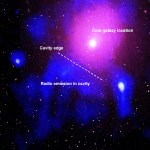
The blast in the Ophiuchus galaxy cluster left a cavity 15 times bigger than our Milky Way galaxy. Scientists have detected evidence of a colossal explosion in space – five times bigger than anything observed before. The huge release of energy is thought to have emanated from a supermassive black hole some 390 million light years from Earth. The eruption is said to have left a giant dent in the Ophiuchus galaxy cluster…
more

detector for marsquakes

-BBC

Nasa’s InSight probe senses hundreds of ‘Marsquakes’
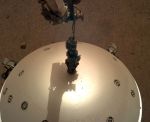
US space agency-led probe has detected over 450 significant seismic events since touching down in 2018. None are particularly big – at most, they’re only 3 to 4 on the magnitude scale, which you might feel if you were standing directly above the tremors…more

Voyager Communciations

-NASA

NASA’s Deep Space Antenna Upgrades to Affect Voyager Communications
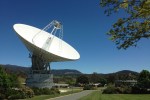
Starting in early March, NASA’s Voyager 2 will quietly coast through interstellar space without receiving commands from Earth. That’s because the Voyager’s primary means of communication will be undergoing critical upgrades for about 11 months…more

merger of two white dwarf stars

-BBC

Huge ‘space snowman’ is two merging stars
Researchers have discovered an unusual ultra-massive snowman-shaped star with an atmospheric composition never seen before. It is more massive than our Sun but only two-thirds the Earth’s diameter. The object is thought to have resulted from the merger of two so-called white dwarf stars that often explode as powerful supernovas…more

2022 Mars Mission Detector

-BBC

ExoMars Rover mission delayed until 2022
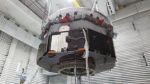
The ExoMars “Rosalind Franklin” vehicle was due to launch to the Red Planet in July/August but engineers aren’t able to get the vehicle ready in time. Because an Earth-Mars journey is only attempted when the planets are favourably aligned, the robot’s next opportunity won’t occur until 2022….more

Posted in April 2020, Sidereal Times | Tagged , | Leave a comment

From the Director

Rex


by Rex Parker, Phd director@princetonastronomy.org

Spring Comes to AAAP
Beware the Ides of March? The words invoke a sense of unseen danger even today. Back in the latter days of the Roman Republic, Julius Caesar (in 44 BC) was forewarned by a seer that harm would come to him not later than the Ides of March. The prophecy came to pass and drastically changed the world. I somehow missed seeing Shakespeare’s “Julius Caesar” where the famous line is spoken, but met his heir Octavius in “Antony and Cleopatra” at McCarter Theatre a few years ago. At the time the Roman calendar was based on moon phases, with the Ides occurring approximately at mid-month corresponding to a full moon (for March, day 15). The ides were then used to calculate other dates. For us this year the full moon comes on March 9, and the Ides of March cast not a foreboding spell but announce the end of winter and rebirth of spring with the coming of equinox on March 20 (at ~5pm).

And astronomers have little to fear with the arrival of equinox, for we can get outdoors again without freezing both day and night. And better – spring is galaxy season here in the northern hemisphere. More galaxies can be seen in moderately-sized telescopes in spring than any other season here, with the Messier objects in Leo and the dense galaxy clusters in Virgo leading the pack. If you’ve never seen galaxies through the eyepiece of a good telescope, or better from the live stream of a modern astro-video camera on that telescope, this spring will be your best opportunity. Recently we further upgraded the video astronomy capabilities at our Washington Crossing Observatory. The ZWO-294 color CMOS camera has been attached to the Celestron-14 telescope, and the co-mounted 5-inch refractor (previously with the SX Ultrastar camera attached) has been returned to rich-field duty with eyepieces. On the C14, a new 2-inch flip mirror is in place allowing the observer to flip back and forth between eyepiece and video camera (the camera is red color in the photo below). Keyholders can get refresher training on using the cameras, and newer members can learn the workings of the observatory, by contacting observatory@princetonastronomy.org.

The new configuration of the AAAP’s Celestron 14 telescope with flip mirror and camera and eyepiece attached.

Ad astra Freeman Dyson!
One of the most significant and appreciated figures in the world of physics and in Princeton’s enduring scientific community, Freeman Dyson has passed away (Feb 28). Freeman Dyson was an early and continual member of AAAP over the past four decades, and gave several memorable lectures to our club through the years. He will be missed by the world and the entire science community. His writings convey much of his wit and wisdom and will be read for decades to come. To the stars, Freeman Dyson!

A Visit to Mt Lemmon Sky Center near Tucson, Arizona: the 32in Schulman Telescope
The sunny attractions in the Sonoran desert in southern Arizona can be irresistible to travelers escaping the vicissitudes of the east coast winter. There amongst the giant Saguaro cacti and rough-hewn colorful mountains and valleys can be found surprising mineral and biological diversity, with countless places to explore. Tucson, a city which doesn’t need to try too hard to retain the old west feel, is fortunately restrained in its modern suburban growth by natural containment from the mountain boundaries around it. This makes Tucson a great destination for amateur astronomers, as the light pollution hasn’t yet completely ruined the skies of the two splendid, publicly accessible observatories at Kitt Peak and Mt Lemmon.

Mt Lemmon Sky Center, on top of the mountain on the north side of Tucson, may be less famous than Kitt Peak to the southwest of the city. But for amateur astronomers there is a special appeal of Mt Lemmon – it has the largest telescope dedicated to public astronomy outreach in the all of North America. The 32in Schulman Ritchey-Chretien f/7 reflector telescope is an impressive instrument that excels in both astrophotography and visual eyepiece observing alike. The views through the eyepiece were stunning.

The observatories on Mt Lemmon are owned and operated by the University of Arizona. Their mission is “to engage people of all ages in the process of scientific exploration by using the local “Sky Island” environment to merge a wide variety of science and engineering disciplines, thereby fostering a deeper understanding of our Earth within the Universe”. They do this very well, and at the next AAAP meeting I will share some of the learnings about how they do outreach. Amateur astronomers and the general public can sign up for the SkyNights Star Gazing program by registering on the Mt Lemmon Sky Center website, ($75 fee, group limited to 28 people).

The dome and 32 inch Schulman telescope at the Mt Lemmon Sky Center is available for celestial observing by the public – the largest outreach telescope in the U.S.

Posted in March 2020, Sidereal Times | Tagged , | Leave a comment