From the Program Chair

By Victor Davis

From The Program Chair

by Victor Davis

The October 2021 meeting of the AAAP will take place (virtually) on Tuesday, October 12th at 7:30 PM. (See How to Join the October Meeting below for details). This meeting is open to AAAP members and the general public. Due to the number of possible attendees, we will use the Waiting Room. This means when you login into Zoom you will not be taken directly to the meeting. The waiting room will be opened at 7:00 PM. Prior to the meeting start time (7:30 PM) you may socialize with others in the waiting room. The meeting room has a capacity of 100 people.

For the Q&A session, you may ask your question using chat or may unmute yourself and ask your question directly to the speaker. To address background noise issues, we are going to follow the rules in the table below regarding audio. If you are not speaking, please remember to mute yourself. You are encouraged, but not required, to turn your video on.

Meeting EventParticipant Can Speak?Participant Can Self-Unmute?
Director Rex’s General RemarksYesYes
Program Chair Victor’s  Speaker IntroductionYesYes
Speaker PresentationNoNo
Q&A SessionStart All on MuteYes                                    
5-minute bio breakYesYes
Journal Club presentation (none scheduled)Start All on MuteNo
Business MeetingStart All on MuteYes
Director’s closing remarksNoNo
   
Only the Business part of the meeting will be locked.

Featured Speaker:  Dr. Tansu Daylan is a TESS Postdoctoral Associate at Princeton University’s Department of Astrophysical Sciences. His presentation is entitled, “Exoplanets Transiting Faint Stars in the TESS Full Frame Images.”  The Transiting Exoplanet Survey Satellite (TESS) is proceeding with its mission of discovering small planets transiting bright stars. TESS is able to determine the mass of these host stars and hence bulk and atmospheric characterization of the transiting exoplanets. Exoplanet searches using TESS have so far focused on bright host stars or on specific populations (e.g. young) of stars.  Dr. Daylan has been working on extending the TESS survey to fainter host stars with a limiting magnitude of about T=13.5. Toward that end, he uses the Quick Look Pipeline (QLP) light curves to construct summary metrics from the full frame images to vet Threshold Crossing Events by excluding false positives such as eclipsing binaries, stellar variability, and other factors. Preliminary results of this effort recently pushed the number of TESS Objects of Interest above 4400, with a further 1500 candidates expected by the end of the extended mission. This projected yield is especially important to achieve a full-sky demographic survey of exoplanets with a well-characterized selection function.  

tansu_daylan

Dr. Daylan describes himself as a self-conscious and inquiring ingredient of our Universe, pondering on its constituents, origin, evolution, and elegant symmetries. Before that, he was a collection of elements spread throughout a molecular cloud in the pre-Solar neighborhood that eventually collapsed to become the Sun and its retinue of planets. Subsequently, he became a curious child growing up in the beautiful city of Istanbul. Dr. Daylan graduated from the Robert College, and completed undergraduate studies in electrical and electronics engineering and physics at Middle East Technical University (METU) in Ankara, Turkey. He completed his PhD at Harvard working on constructing novel statistical methods to search for signatures of dark matter. Dr. Daylan is now a TESS postdoctoral associate at MIT with a visiting appointment at Princeton University. Dr. Daylan is active in teaching and outreach aimed at communicating and advocating the scientific method across cultures and generations.

AAAP webcast:  This month’s AAAP meeting, beginning with Rex’s opening remarks and ending at the break before the business meeting, will be webcast live on YouTube and recorded for subsequent public access on AAAP’s YouTube channel. Be aware that your interactions during this segment, including questions to our guest speaker, may be recorded for posterity. 

YouTube Link: https://youtu.be/lzEzOaSceHo

This session will be recorded and saved on YouTube. Send me an email at program@princetonastronomy.org if you have any concerns. 

Using Zoom: While we are social distancing, the AAAP Board has chosen to use Zoom for our meetings, based our belief that many members have already have used Zoom and its ease of learning. One of its great features is you can choose whether you want to install the software on your computer or use it within your browser.

How to Join the October Meeting: For the meeting, we are going to follow a simple two-step process:

  1. Please make sure you have Zoom installed on your computer. You do not need a Zoom account or need to create one to join the meeting. Nor are you required to use a webcam.
  2. Please visit our website for the Zoom link.
  3. This session will be recorded and saved on YouTube. Send me an email at program@princetonastronomy.org if you have any concerns.

NOTE: The Zoom site has many training videos. If you’re unsure how Zoom works you might want to view the videos on how to join a meeting or how to check your computer’s audio and video before the meeting.

WANTED: Members with interesting stories to tell. During the past months, we’ve enjoyed interesting and informative talks from AAAP members, and we’d like to keep the momentum going! We hope to make these short presentations a regular feature of our monthly meetings. We’d like to know what members are doing or what members are thinking about in the broad range of topics encompassed by astronomy. A brief ten-minute (or so) presentation is a good way to introduce yourself and the topics you care about to the club membership. If you are interested in presenting a topic of interest, please contact either director@princetonastronomy.org or program@princetonastronomy.org

A look ahead at future guest speakers:

November 9, 2021         Jesus (Jesse) Rivera, Visiting Assistant Professor of Astronomy at Swarthmore  College, will discuss radio astronomy and his work researching dusty star-forming galaxies (DSFGs).

December 14, 2021       Joleen Carlberg will talk about her work as a Support Scientist on the Space Telescope Imaging Spectrograph (STIS) team.

January 11, 2022           Robert Williams, former director of the Space Telescope Science Institute (STSci),  will talk about his controversial and courageous decision to commit about 100 hours of time on the HST to staring at what was at the time considered to be a relatively bare patch of sky, creating what is now known as the Hubble Deep Field.

February 8, 2022           Chris Spalding a 51 Pegasi b postdoctoral fellow in astronomy at Princeton University,  will talk about his research to understand planet formation by way of simple theoretical  descriptions of planetary dynamics.

As always, your comments and suggestions are gratefully accepted.

Victor

Posted in October 2021, Sidereal Times | Tagged , | Leave a comment

Minutes of the August 31, 2021 AAAP Board of Trustees meeting (online)

by John Miller, Secretary

            ● Director Rex Parker opened the Zoom meeting at 7:30 P.M. There were 13 attendees

            ● The agenda included:

            * club finances and membership.

            * upcoming season meetings (speakers, Peyton Hall availability).

            * observatory update.

            * member involvement opportunities.

            ● Treasurer Michael Mitrano reviewed a newly-updated organization balance sheet for the fiscal year ending June 30, 2021. John Miller initiated a motion for discussion regarding simplifying (his term) general membership renewal schedule from a fiscal year term to a calendar-year term.  A discussion ensued and the motion to change to a calendar-year renewal time frame was passed.

            ●  Rex contacted Susan Duncan, Department Manager at Princeton University’s Department of Astrophysical Sciences.  John Miller had a meeting with Department Chair Michael Strauss. The outcome of these discussions was: the AAAP will be restricted from using Peyton Hall for the foreseeable future. Both Covid-19 and a  massive construction project across from Peyton Hall were cited.  John Miller and Larry Kane agreed to investigate alternative physical meeting locations.

            ● Program Chair Victor Davis reviewed the upcoming season’s guest speaker roster. He has commitments through the Spring of 2022. The Board agreed Victor arranged for an excellent schedule.

            ● The idea of locating an appropriate vendor to produce new AAAP logo merchandise, e.g. baseball caps, golf shirts, etc. was well received.  

            ●  The Board is still at a stalemate concerning having an engineering vendor submit a letter and drawings, required by the State, to proceed with the observatory repair.

            ● David Skitt proposed keeping the observatory open for Public Friday Nights through     November, to make up for Covid closures.  The Board agreed and the Key holders will be notified to see if enough are willing to participate.

            ● The idea of a telescope loaner program was proposed. Portable telescopes owned by the AAAP could be borrowed by members for a pre-set period. The Board agreed with the idea, with details and rules to be determined.  A facilitator is needed for the project.

Social media activity expansion by the AAAP was reviewed.  Len Cacciatore and John Miller talked about integrating a third-party online merch store into the club website.The meeting adjourned at 9:45 P.M.

Posted in October 2021, Sidereal Times | Tagged , , | Leave a comment

Women who missed out on Nobel prizes

by S. Prasad Ganti

The season of Nobel prizes is coming soon, in a week or so. It has been more than a century of Nobel prizes for the highest human achievements in the field of Sciences,Literature, Economics and Peace. Some controversies and some supposed misses have occurred in the past. I would like to mention three such cases involving women. 

Recently, Anthony Hewish died. He won a Nobel prize in physics in 1974 along with Martin Ryle for the discovery of Pulsars, which are now known as spinning neutron stars. This discovery was made using a Radio telescope. The Radio astronomy group in Cavendish Laboratory in Cambridge was headed by Martin Ryle. Here Hewish was working with a graduate student Jocelyn Bell. In 1967, it was Bell who discovered a pattern in the data from the radio telescope. She painstakingly looked at a lot of data and firmly established that the data was all coming from an unknown type of astronomical object, a new source of radio signals.

Subsequent discoveries revealed that some massive stars at the end of their lives turn into neutron stars which are very dense objects. Such spinning objects emit radio waves which is what Bell discovered. When time came for awarding a Nobel prize for this discovery, Ryle and Hewish won, leaving Bell out. The Nobel committee never explains their decisions. Fred Hoyle, the famous physicist who came up with the Steady state theory of the Universe, criticized the Nobel committee about the decision to leave Bell out. Was it because she was just a Phd student at the time of discovery ? Was it because of gender inequality ?

Hoyle himself got left out later. Other than steady state theory which he admitted was wrong after the evidence for cosmic background radiation was firmly established and the Big bang theory gained prominence, he did pioneering work for nucleosynthesis which explained how stars including our sun generate energy through nuclear fusion reactions. And how most of the elements in our Universe are formed in the stars. When time came for the awarding of a Nobel prize, Willy Fowler, Hoyle’s collaborator, along with Subramanyan Chandrasekhar received the prize. But not Hoyle. Was it because of his insistence on steady state theory and derision of the Big bang theory ? Was it because of his criticism of the Nobel committee for leaving Bell out earlier?                 

Henrietta Leavitt was one among a group of women who worked in the Harvard Astronomy department and were known as computers. This was before the actual computers came into the picture. These women analyzed the data and did all the computations by hand to derive conclusions. Leavitt analyzed data from a group of stars known as Cepheids. These stars blink with a certain regularity. She found a relationship between the period of fluctuation and apparent brightness from a group of Cepheids in the Magellanic cloud. By measuring the distance to one such star (through other methods like parallax wherein measuring the position of the same star during different places of the Earth or at different times), a standard candle has been established. The distance of any other Cepheid can be measured by the period of its blinks. Using the same standard candle, Edwin Hubble found that Andromeda is a separate galaxy and is very far away (about 2 million light years). 

It is reported that the Nobel committee was very impressed with the discovery of the standard candle and wanted to nominate Leavitt for a Nobel prize. By the time they made their inquiries, she was already dead (died of cancer in 1921). Hubble’s discovery paved the way for other distant galaxies and that they are all moving away from each other. After he died, a Nobel committee member told his widow that Hubble was being considered for a Nobel prize when he died. 

The last example is of a chemist whose discovery impacted the life sciences, not astronomy. Rosalind Franklin worked on X-ray crystallography, which uses X-rays to bombard any given substance and then the resulting diffraction is used  to determine the structure of the molecules. In one of her studies, she pictured a double helical shape. Francis Crick and James Watson saw those pictures and they got ideas that the structure of the DNA molecule is similar. She also corrected their model of the DNA molecule. She died of cancer at an early age of 37 in 1956. Watson, Crick and Franklin’s boss Maurice Wilkins won the 1962 Nobel prize for the discovery of DNA structure. While Franklin did a lot of work in other areas like structure of coal and viruses, she did not get any credit for the DNA molecule, which contains the script of life. 

I am not interested in speculations, scandals and complaints, but to salute the people who made significant contributions and put them on the same pedestal as their lucky counterparts. 

Posted in October 2021, Sidereal Times | Tagged , | Leave a comment

Book Review I

By Richard Sherman 

The Mission by David W. Brown  

Published 2021 

Grade:  B+ 

Hardback $20.99, Paperback $18.99 on Amazon  

480 pages 

Here’s an astronomy book that isn’t filled with science. Rather, this newly-released book is the story of the men and women that battled for more than a decade to get the Europa Clipper mission approved. After years of despair, and countless losses to Mars-obsessed administrations, the turning point finally came in 2012 when the Hubble Space Telescope revealed 200 km high vapor plumes shooting from Jupiter’s icy moon Europa. The Mission details the passion and foresight of a group of people, and tells us a bit about the lives (and death), their personal and professional struggles, and their enduring commitment to get an orbiting spacecraft to Europa.  

“Orbiters are all about getting a global view. Here is where Cassini comes in. Each time it orbits Saturn, Cassini swings by Titan to change its orbital plane—its angle of travel. Titan is an enormous moon and has the perfect gravity for that. So Titan lets Cassini fly higher or lower over Saturn and see different parts of its rings. And every time Cassini flies by Titan, it keeps its science instruments switched on and gets some new slice of the mysterious moon. By orbiting Saturn, we have been able to capture eighty-five percent of Titan…because of all those flybys. So if we want a global view to understand Europa at Jupiter, we can do it just like Cassini: with multiple flybys.”  

The author, David W. Brown, has a very distinctive style—I would call it “casual conversation”—and this quickens the pace of a 400 page book (480 pages including the acknowledgements, notes, and index). In addition, Mr. Brown includes a handy list of more than two dozen individuals and their roles in the front of the book. Because The Mission details the various setbacks and challenges and the many people impacted, the book jumps around temporally and I found it easy to get lost on the sequence of events. I think the book could have benefited from a timeline of events as a reference. There are 16 pages of black and white photographs in the center of the book which are primarily images of the people (so don’t expect any “wow” images of Europa or Jupiter).    

I enjoyed the book—it gave me great insight into the passion and commitment of the people behind the science and imagery. Thanks to The Mission, I am now following the Europa Clipper mission online, and you can too, at:  https://www.jpl.nasa.gov/missions/europa-clipper.

Posted in October 2021, Sidereal Times | Tagged , , | Leave a comment

Book Review II

by Richard Sherman

Galaxies by Govert Schilling 

Published 2019  

Grade:  A 

Hardback $32.99 on Amazon  

240 pages 

If you are fascinated by galaxies and love great photos of galaxies, then this is the book for you. I thoroughly enjoyed Govert Schilling’s book—the writing was excellent, the photographs were outstanding, and the graphics were well-done.   

A large, expensive, hardback book like this must have great photographs, and this book is packed with fascinating images—dozens are spread over two pages which makes for exceptional viewing. For example, pages 220-221 show 27 images of galaxies taken by the Hubble Space Telescope that are, or are almost colliding. Very cool. The photo credits listed at the back of Galaxies span two full pages and four packed columns. In short, the pictures alone are worth the price of the book. 

The graphics are also helpful and well done. My favorite is perhaps the graphic (page 168) that shows the movement through space of the Laniakea Supercluster of galaxies. Then on page 210, a two-page spread shows four galaxies as they appear today, and how they might have looked four billion and 11 billion years ago.  

There are six chapters: Our Milky Way, Cosmic Neighbors, A Gallery of Galaxies, Monsters and Gluttons, Galaxy Clusters, and Birth and Evolution. The writing is excellent, and complex subjects, like the Epoch of Reionization, and Dark Energy are handled with enough detail to provide a basic understanding, but without so much detail that your head starts spinning.  

I will end with a quote. In noting that matter only constitutes about 4% of the universe, Schilling writes, “The true nature of this mysterious dark energy is still unknown. Nor do we know whether there may be a relationship to the equally mysterious dark matter already mentioned in this book. The fact is that the universe hasn’t become more comprehensible in recent decades.” 

This is a wonderful book to add to your “astro library” and I hope you enjoy it as much as I did.   

Posted in October 2021, Sidereal Times | Tagged , , | Leave a comment

Snippets

compiled by Arlene and David Kaplan

Orbiting 3 Stars at Once It’s called a circumtriple planet, and evidence that one exists suggests that planet formation is less unusual than once believed. GW Ori is a star system 1,300 light years from Earth in the constellation of Orion. …more

Nasa Selects Landing Site for Moon Rover Mission Nasa is sending a robotic rover to look for water-ice near a crater at the Moon’s South Pole. In 2023, the golf cart-sized vehicle will land near the western edge of Nobile Crater, a 73km-wide depression that is almost permanently in shadow…more

Where NASA Will Send Its First Robotic Moon Rover to Search for Ice The agency picked the Nobile crater near the lunar south pole to seek frozen water that will be essential to future astronaut missions…more

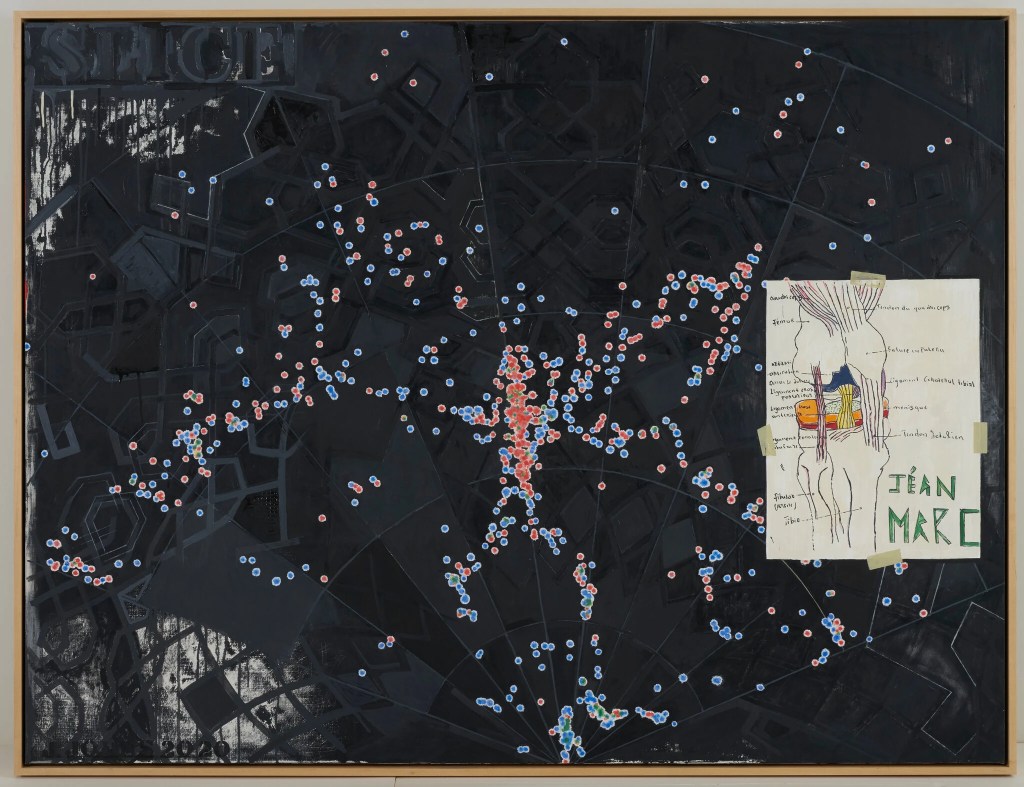
All the World in a ‘Slice’ of Art At 91, Jasper Johns is turning out impressive and touchingly personal work. The newest painting by him was inspired by a fan letter from an astrophysicist. Likely to be a standout of his upcoming show, “Jasper Johns: Mind/Mirror,”…more

James Webb: Hubble successor given Mid-December launch date It’s a date for your diary and one that’s not to be missed. The $10bn James Webb Space Telescope is expected to launch on 18 December. Yes, countless targeted lift-offs have come and gone in the past, but this one has a reality to it that the others didn’t: the successor observatory to Hubble is now actually built…more

Saturn’s Rings Are Like a Seismometer That Reveal the Planet’s Core: Convulsions in the planet’s interior are picked up in the region known as the C ring, and help scientists understand what lies within…more

NASA’s Perseverance Rover Successfully Cores Its First Rock Data received late Sept. 1 from NASA’s Perseverance rover indicate the team has achieved its goal of successfully coring a Mars rock. The initial images downlinked after the historic event show an intact sample present in the tube after coring…more

Carolyn Shoemaker, Hunter of Comets and Asteroids, Dies at 92 After her children left for college, she unexpectedly became astronomy’s record-setting spotter of unidentified objects hurtling through the cosmos. Dr. Shoemaker also worried that a comet hitting Earth could threaten human civilization…more

NASA’s Perseverance Rover Collects First Mars Rock Sample NASA’s Perseverance rover today completed the collection of the first sample of Martian rock, a core from Jezero Crater slightly thicker than a pencil. Mission controllers at NASA’s Jet Propulsion Laboratory (JPL) in Southern California received data that confirmed the historic milestone…more

Dame Jocelyn Bell-Burnell: NI Scientist Awarded Royal Society’s Highest Prize A leading astrophysicist from Northern Ireland has been awarded the world’s oldest scientific prize for her work on the discovery of pulsars. Dame Jocelyn Bell Burnell is only the second woman to be awarded the Royal Society’s highest prize, the Copley Medal…more

International Space Station facing irreparable failures, Russia warns The International Space Station (ISS) could suffer “irreparable” failures due to outdated equipment and hardware, a Russian official has warned. At least 80 percent of in-flight systems on the Russian segment of the ISS had passed their expiry date, Vladimir Solovyov told state media….more

One of the largest comets ever seen is headed our way. Comet Bernardinelli-Bernstein offers a rare opportunity for a generation of astronomers to study an object from the extreme edges of the solar system. More than 2.7 billion miles from the sun—29 times farther than Earth treads—a tiny sliver of sunlight reflected off something plummeting…more

Posted in October 2021, Sidereal Times | Tagged , | Leave a comment

From The Director

by Rex Parker, PhD  director@princetonastronomy.org

New Season Starting, Campus Return Delayed.  The highly anticipated new season of monthly AAAP meetings will begin on Tuesday September 14 (7:30pm).  Guest lecturers from near and distant locales will again be the theme this year as we continue to meet virtually by Zoom.  See the section below for information about the guest speaker for Sept 14.  Despite our hopes, Princeton University and the Astrophysical Sciences Dept have communicated that on-campus groups should be limited to students and staff.  Our return to Peyton Hall is going to be delayed for a while.  

Our virtual meeting format features two halves with intermission, with the guest speaker presenting during the first hour.  Club activities and conversations highlight the second hour, giving us a chance to elevate the art of amateur astronomy with discussions of hands-on observing and other perspectives from members.  One way you can participate and promote club interactions is by giving an informal “Journal Club” presentation, a short ~10 minute talk about an astronomy topic you especially care about. This works well with audiovisuals (e.g., Powerpoint slides, JPEGs, etc.) using screen-sharing in Zoom.  But it certainly doesn’t need to be scholarly, rather it’s intended to be fun and help club members engage.  To get onto the agenda for an upcoming meeting, shoot a note to me at director@princetonastronomy.org or to program chair Victor Davis at program@princetonastronomy.org.

New Roles – Looking for a Few Members to Help the Club.  As we move further into the virtual meeting era, several opportunities have evolved for members to contribute as facilitators of club activities.  The Board has endorsed the following new roles (special thanks to Dave and Jenn S. and Victor D. for thoughtful ideas).  If you are interested in volunteering to take on one of these new roles, please e-mail me at director@princetonastronomy.org.

  • Night Sky Network Toolkit facilitator:  Promote the ongoing link between AAAP and NSN.  Sort through the various NASA/JPL Night Sky Network toolkits we’ve received and determine how best to utilize them in our outreach and public night events.  Practice with the toolkits and train others how to use them.  For the NSN website go to https://nightsky.jpl.nasa.gov/index.cfm

Facilitator Benefits:  You get to explore interesting packages delivered from NSN.  Learn about astronomy from well thought out materials for all age groups — cool stuff to play with.  Interact with members and public.  Get to teach astronomy facts and concepts.

  • Loaner telescope program facilitator:  The club owns a few telescopes and related equipment and occasionally receives donations which we keep or sell.  The role here would be to set up and run a loaner telescope program for members.  Learn about, practice with, maintain, and possibly store the telescopes and make them available for members to use.  Train members on how to use telescopes.  Develop a system to keep track of loaner whereabouts and ensure good condition of the equipment.

Facilitator Benefits:  You get to graciously accept occasional donations from the public.  Learn how to evaluate telescope completeness and condition.  Learn how to set up and use different scopes and mounts, eyepieces and cameras.  Get to play with donated scopes at your leisure.  Interact with members and share knowledge.

  • Social media facilitator:  Provide contents and update our ongoing AAAP Twitter, Facebook and YouTube accounts.  Look into other forms of social media and how they could be utilized for the club’s benefit.  Develop means for members to privately contact/message other members in or out of our current email and newsletter systems for daily chat, invitations to observatory, share stories or photos, etc.  This could be a message board or similar function so that members can connect.

Facilitator Benefits:  Connect with members and public who are heard but not necessarily seen.  Utilize various resources to learn more about astronomy. Interact with members and share knowledge.  Broaden our network of AAAP followers.  Pass the knowledge on to new generations of members and public.  

  • AAAP “merch” facilitator:  Arrange acquisition of AAAP-logo emblazoned clothing, hats, and other merchandise for members to purchase and to give away to speakers and special guests.  Examine possible on-line stores to create AAAP-branded minor merch offerings.  Acquire free literature from various sources to hand out at the observatory and public outreach.

Facilitator Benefits:  Connect with vendors and on-line merchandisers.  Learn what it takes to make, buy, and sell custom merchandize and marketing materials.  Share the stuff and interact with members and public.

Stay Tuned for Big News.  What are the most important scientific questions in astronomy? For the overarching goals of astronomy, research at the cutting edge will need new instrumentation and larger than ever telescopes. Moreover, these telescopes need to gather and measure different ranges of wavelength and energy of light.   The challenge from a science planning perspective is prioritizing the funding for big astronomy, and only a few major projects will ultimately succeed in receiving the needed billions. Competition among proposals is fierce. 

Astronomy in the US has evolved a process in which the National Academies of Science, Engineering, and Medicine conduct the Astronomy and Astrophysics Decadal Survey.  This formal 10 year planning process ranks the proposed projects, and prioritizes which major new telescopes and observatories on earth and in space will receive federal funding.  Recent big project examples such as the James Webb and the Hubble space telescopes became reality in part due to endorsements from Decadal Surveys of the past.  The imminent release of the current Decadal Survey summary is going to produce waves of excitement and disappointment and make its impact in the direction of astro science throughout the 2020’s.   

Posted in Sidereal Times | Leave a comment

From the Program Chair

by Victor Davis

The September 2021 meeting of the AAAP will take place (virtually) on Tuesday, September 14th at 7:30 PM. (See How to Join the September Meeting below for details). This meeting is open to AAAP members and the general public. Due to the number of possible attendees, we will use the Waiting Room. This means when you login into Zoom you will not be taken directly to the meeting. The waiting room will be opened at 7:00 PM. Prior to the meeting start time (7:30 PM) you may socialize with others in the waiting room. The meeting room has a capacity of 100 people. During this pre-meeting period, you have the opportunity to commiserate with other meeting attendees informally either verbally or using the app’s “chat” function. Instructions for using Zoom’s chat function are available at https://support.zoom.us/hc/en-us/articles/203650445-Using-in-meeting-chat. At the conclusion of the meeting’s agenda discussions, we’ll leave the zoom link open until 10:00 pm to allow informal chats among meeting attendees.

For the Q&A session, you may ask your question using chat or may unmute yourself and ask your question directly to the speaker. To address background noise issues, we are going to follow the rules in the table below regarding audio. If you are not speaking, please remember to mute yourself. You are encouraged, but not required, to turn your video on.

Meeting EventParticipant Can Speak?Participant Can Self-Unmute?
Director Rex’s General RemarksYesYes
Program Chair Victor’s  Speaker IntroductionYesYes
Speaker PresentationNoNo
Q&A SessionStart All on MuteYes                                    
5-minute bio breakYesYes
Journal Club presentation (none scheduled)Start All on MuteNo
Business MeetingStart All on MuteYes
Director’s closing remarksNoNo
   

Only the Business part of the meeting will be locked.

Featured Speaker:  Prof. Emily Levesque is a professor of astronomy at the University of Washington. Her presentation is entitled “The Last Stargazers,” a behind-the-scenes tour of life as a professional astronomer. Spoiler alert: Eyepieces are rarely involved.

Prof. Levesque’s research explores how the most massive stars in the universe evolve and die. She’s observed using some of the most powerful telescopes in the world, and has experienced engaging true stories (and collected tall tales) of the adventures and misadventures that accompany our exploration of the universe: A bird that mimicked a black hole. The astronomer that discovered microwave ovens. A telescope that got shot. And…wait for it…a telescope support engineer who advised, “have you tried turning it off and back on again?”

We’ll learn how professional astronomers collect data using world-class telescopes, meet the people who run them, and explore the crucial role of human curiosity in the past, present, and future of scientific discovery. “The Last Stargazers” is based on her critically acclaimed popular science book of the same title.


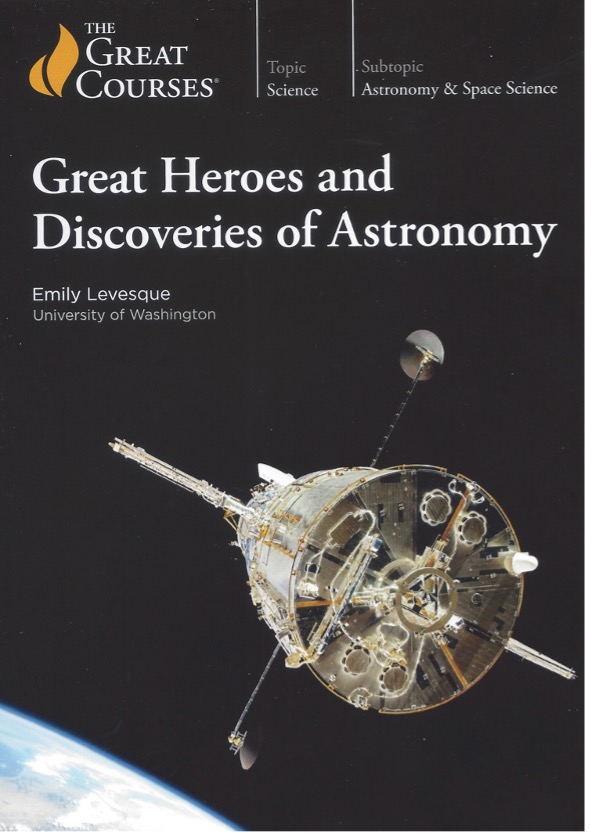
Prof. Levesque has also created a course for The Learning Company, “Great Heroes and Discoveries of Astronomy,” which explores the science and heroes behind the great astronomical discoveries of the past few centuries.

Emily Levesque earned her undergraduate degree in physics from MIT and her PhD in astronomy from the University of Hawai’i. She has observed for upwards of fifty nights on many of the world’s largest telescopes. Her research has taken her into the Antarctic stratosphere in an experimental aircraft. Her academic accolades include the 2014 Annie Jump Cannon award, a 2017 Alfred P. Sloan fellowship, a 2019 Cottrell Scholar award, and the 2020 Newton Lacy Pierce prize. 

AAAP Webcast:  This month’s AAAP meeting, beginning with Rex’s opening remarks and ending at the break before the business meeting, will be webcast live on YouTube and recorded for subsequent public access on AAAP’s YouTube channel. Be aware that your interactions during this segment, including questions to our guest speaker, may be recorded for posterity. 

YouTube live Link: https://youtu.be/ow6cmB3Sm1Y

This session will be recorded and saved on YouTube. Send me an email at program@princetonastronomy.org if you have any concerns. 

Using Zoom: While we are social distancing, the AAAP Board has chosen to use Zoom for our meetings, based our belief that many members have already have used Zoom and its ease of learning. One of its great features is you can choose whether you want to install the software on your computer or use it within your browser.

How to Join the September Meeting: For the meeting, we are going to follow a simple two-step process:

  1. Please make sure you have Zoom installed on your computer. You do not need a Zoom account or need to create one to join the meeting. Nor are you required to use a webcam.
  2. Please visit our website for the link to the meeting.
  3. This session will be recorded and saved on YouTube. Send me an email at program@princetonastronomy.org if you have any concerns.

NOTE: The Zoom site has many training videos. If you’re unsure how Zoom works you might want to view the videos on how to join a meeting or how to check your computer’s audio and video before the meeting.

WANTED: Members with interesting stories to tell. During the past months, we’ve enjoyed interesting and informative talks from AAAP members, and we’d like to keep the momentum going! We hope to make these short presentations a regular feature of our monthly meetings. We’d like to know what members are doing or what members are thinking about in the broad range of topics encompassed by astronomy. A brief ten-minute (or so) presentation is a good way to introduce yourself and the topics you care about to the club membership. If you are interested in presenting a topic of interest, please contact either director@princetonastronomy.org or program@princetonastronomy.org

A look ahead at future guest speakers:

October 12, 2021           Tansu Daylan, TESS postdoctoral research associate in astronomy at Princeton University, will talk about his ongoing projects with the Transiting Exoplanet Survey Satellite. 

November 9, 2021         Jesus (Jesse) Rivera, Visiting Assistant Professor of Astronomy at Swarthmore College, will discuss radio astronomy and his work researching dusty star-forming galaxies (DSFGs).

December 14, 2021       Joleen Carlberg will talk about her work as a Support Scientist on the Space Telescope Imaging Spectrograph (STIS) team.

January 11, 2022           Robert Williams, former director of the Space Telescope Science Institute (STSci), will talk about his controversial and courageous decision to commit about 100 hours of time on the HST to staring at what was at the time considered to be a relatively bare patch of sky, creating what is now known as the Hubble Deep Field.

February 8, 2022           Chris Spalding a 51 Pegasi b postdoctoral fellow in astronomy at Princeton University, will talk about his research to understand planet formation by way of simple theoretical descriptions of planetary dynamics.

In the C where C is D department, I’d like to acknowledge the advice, moral support, and social media wrangling provided by Bill Thomas, Ira Polans, and Dave Skitt. Thanks so much, guys, for all that you do. As always, your comments and suggestions are gratefully accepted.

NOTE: At this time, we do not know when we’ll be invited to return to Peyton Hall for in-person meetings. Based on Rex’s correspondence with the folks in the Princeton astrophysics department, they have established restrictive measures regarding public events on University premises, so it seems our return is not imminent. We expect to be zooming for the foreseeable future, and we are discussing the logistics of zooming even when we are able to meet in person. Several potential guest speakers have expressed a desire to speak to our club only when live meetings are possible, so a sooner-than-expected return to “normalcy” may involve revising our roster of speakers. 

Victor

Posted in Sidereal Times | Leave a comment

From the Treasurer

by Michael Mitrano

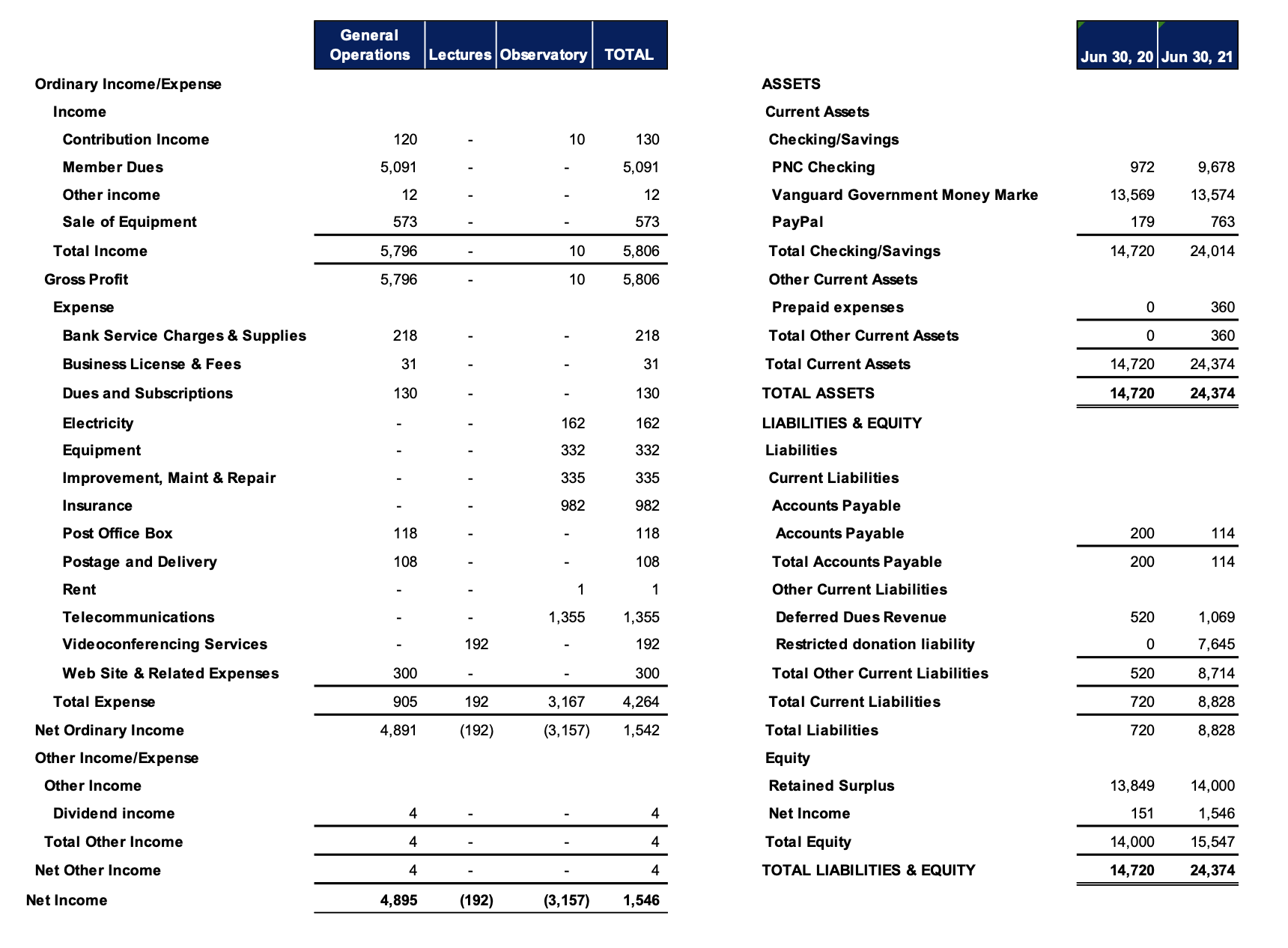
The income statement and balance sheet below show the AAAP’s financial results for the fiscal year that ended on June 30, 2021, and our financial position at the beginning and the end of the year.


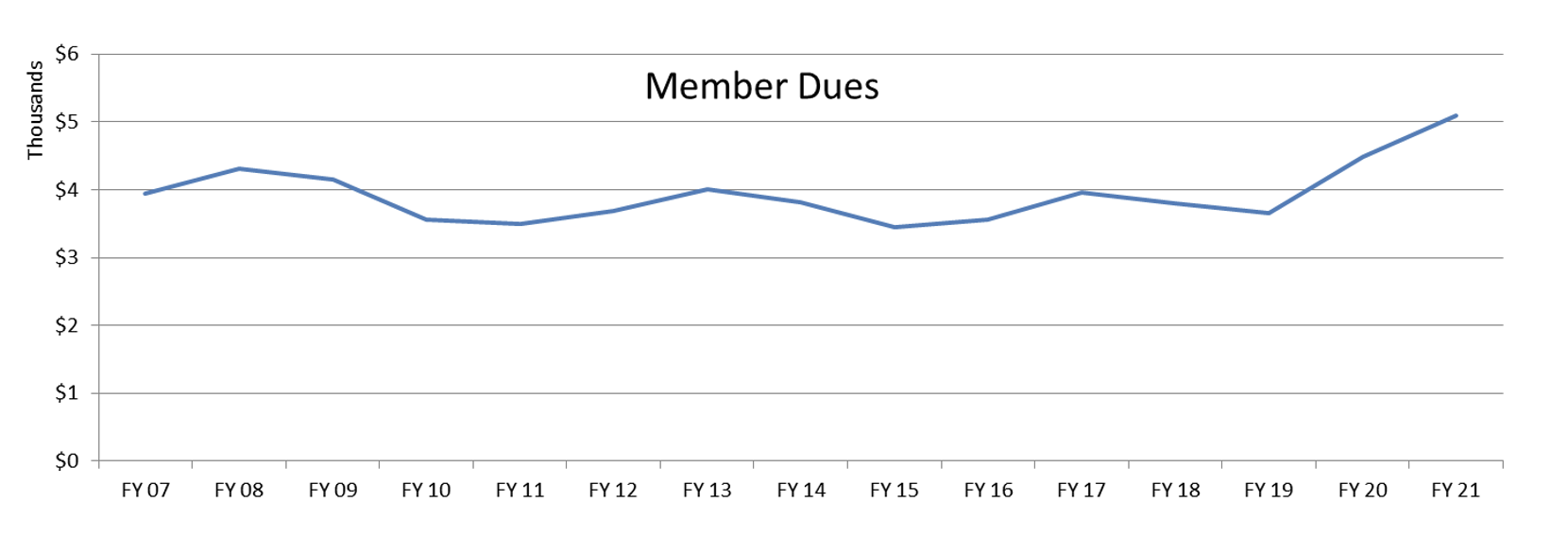
The AAAP had strong $1,546 surplus for the fiscal year, driven primarily by substantial increase in membership.  The chart below shows member dues for the past 15 years:

We ended the year with a record 147 dues-paying members.

PayPal fees – incurred when members pay via PayPal – account for most of our banking fees and roughly equal five members’ dues income.  Payments via check to the PO box are always welcome. Some members use their bank’s recurring billpay service to send a dues check each July.

We received $7,645 in donations toward observatory repairs during FY 2021 but these are not included in the income statement. Rather, they show as a restricted donation liability on the balance sheet at June 30.  Under the rules of accounting for restricted donations, they are taken into income at the time when they are used for their restricted purpose.  Hopefully the observatory repairs will take place in FY 2022.

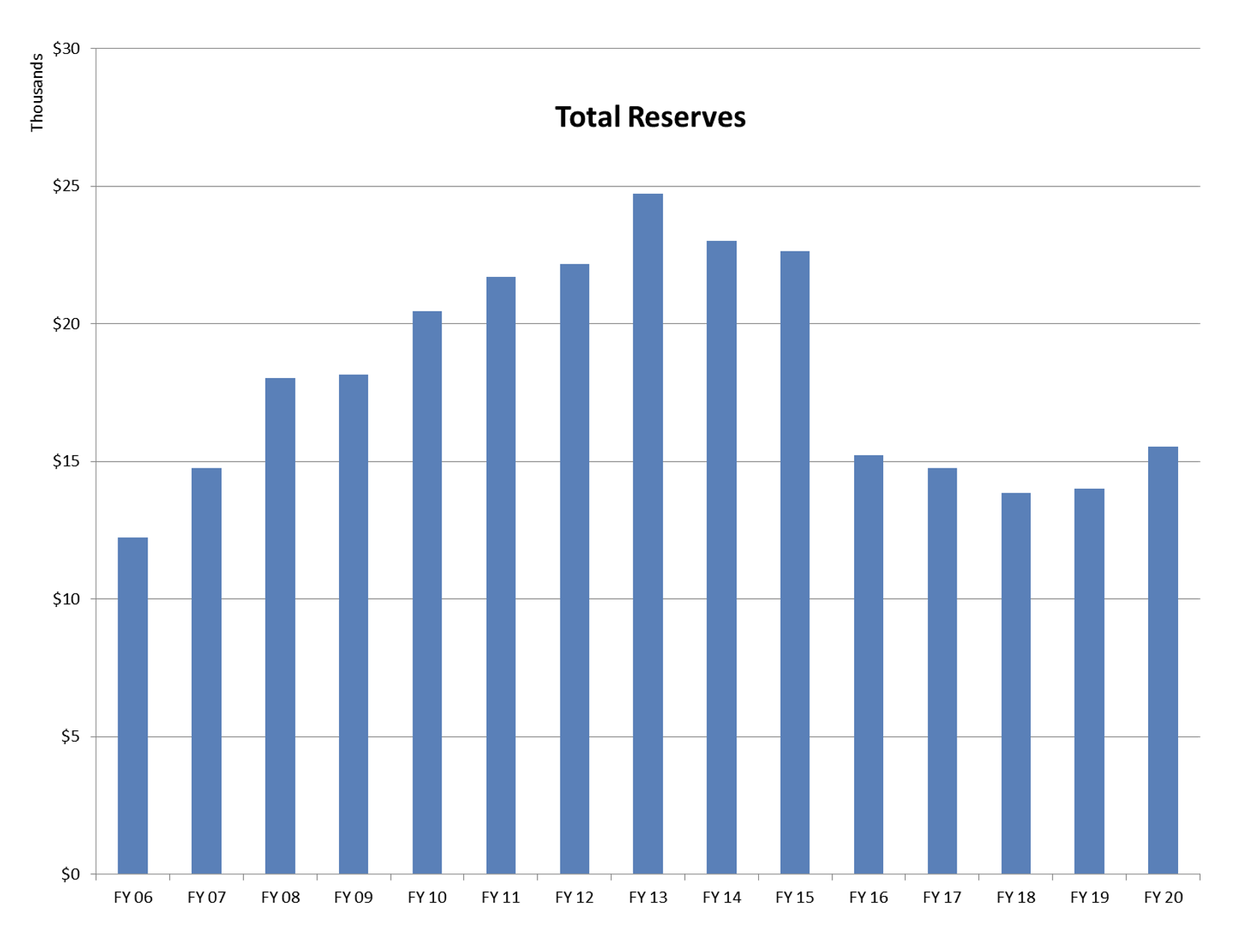
The chart below shows AAAP reserves over the past 15 years.

Our cumulative reserves are close to $16 thousand, equaling nearly four years of the association’s expenses at last year’s level.

Kindly let me know if you have any questions about the report.

Michael Mitrano, Treasurer

August 26, 2021

Posted in Mid-summer 2020, Sidereal Times | Tagged , | Leave a comment