From the Program Chair

By Victor Davis

The November 2021 meeting of the AAAP will take place (virtually) on Tuesday, November 9th at 7:30 PM. (See How to Join the November Meeting below for details). This meeting is open to AAAP members and the general public. Participants will be able to log in to the meeting as early as 7:00 pm, and will be able to chat informally with others who log in early. In previous Zoom meetings, people joining the meeting before 7:30 pm were queued into the “waiting room.” Since the waiting room does not permit hobnobbing among participants, the host will now open access to the meeting as soon as participants log in. This means that when you log in to Zoom you join the meeting directly, unmuted. Please be mindful of your mute/unmute status and mute yourself before the meeting starts promptly at 7:30 pm.

For the Q&A session, you may ask your question using chat or may unmute yourself and ask your question directly to the speaker. To address background noise issues, we are going to follow the rules in the table below regarding audio. If you are not speaking, please remember to mute yourself. You are encouraged, but not required, to turn your video on.

Meeting EventParticipant Can Speak?Participant Can Self-Unmute?
Director Rex’s General RemarksYesYes
Program Chair Victor’s  Speaker IntroductionYesYes
Speaker PresentationNoNo
Q&A SessionStart All on MuteYes                                    
5-minute bio breakYesYes
Journal Club presentation (none scheduled)Start All on MuteNo
Business MeetingStart All on MuteYes
Director’s closing remarksNoNo
   
Only the Business part of the meeting will be locked.

Featured Speaker:  Dr. Jesus (Jesse) Rivera is a Visiting Assistant Professor of Astronomy at Swarthmore College. His presentation is entitled, “Beyond the Visible Universe.”

Since the earliest days of astronomy, scientists have explored the Universe through visible wavelengths, and we’ve gained enormous insights through this window into space. But much of the Universe is dim or invisible at these wavelengths, so to form a fuller picture of what is out there, we need to study more than visible light alone. In this talk, Prof. Rivera will give an overview of the field of radio astronomy, including the types of information we gather from observing the sky at radio wavelengths, and how radio telescopes differ from their more common optical counterparts. From there, he will discuss his specific area of research and how he uses a combination of telescopes to study gravitationally lensed, dusty star-forming galaxies as a means of probing galaxy formation and evolution.

JesusRivera

Dr. Rivera attended The University of Texas at Brownsville, where he worked on the detection of gravitational waves using pulsars. He earned his Masters degree and PhD in astrophysics from Rutgers, researching dusty star-forming galaxies with Dr. Andrew Baker. He is currently a Visiting Assistant Professor of Astronomy at Swarthmore College, where he is also a Consortium for Faculty Diversity Postdoctoral Fellow.

Prof. Rivera is an avid amateur astronomer and is active in outreach activities; conducting physics demonstrations in elementary schools, promoting graduate studies to high school and community college students, and organizing initiatives to communicate science and astronomy to the general public. He’s also interested in influencing science policy, participating in AAS activities aimed at engaging with policymakers to make them aware of the needs of the scientific community.

AAAP webcast:  This month’s AAAP meeting, beginning with Rex’s opening remarks and ending at the break before the business meeting, will be webcast live on YouTube and recorded for subsequent public access on AAAP’s YouTube channel. Be aware that your interactions during this segment, including questions to our guest speaker, may be recorded for posterity. 

YouTube Link: Jesse Rivera: Radio astronomy – Researching Dusty Star-Forming Galaxies (DSFGs)

This session will be recorded and saved on YouTube. Send me an email at program@princetonastronomy.org if you have any concerns. 

Using Zoom: While we are social distancing, the AAAP Board has chosen to use Zoom for our meetings, based our belief that many members have already have used Zoom and its ease of learning. One of its great features is you can choose whether you want to install the software on your computer or use it within your browser.

How to Join the November Meeting: For the meeting, we are going to follow a simple two-step process:

  1. Please make sure you have Zoom installed on your computer. You do not need a Zoom account or need to create one to join the meeting. Nor are you required to use a webcam.
  2. Please visit our website for the Zoom link.
  3. This session will be recorded and saved on YouTube. Send me an email at program@princetonastronomy.org if you have any concerns.

NOTE: The Zoom site has many training videos. If you’re unsure how Zoom works you might want to view the videos on how to join a meeting or how to check your computer’s audio and video before the meeting.

WANTED: Members with interesting stories to tell. During the past months, we’ve enjoyed interesting and informative talks from AAAP members, and we’d like to keep the momentum going! We hope to make these short presentations a regular feature of our monthly meetings. We’d like to know what members are doing or what members are thinking about in the broad range of topics encompassed by astronomy. A brief ten-minute (or so) presentation is a good way to introduce yourself and the topics you care about to the club membership. If you are interested in presenting a topic of interest, please contact either director@princetonastronomy.org or program@princetonastronomy.org

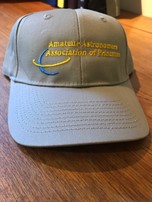
Finishing the Hat. Beginning this past September, in lieu of a free meal at a local eatery, guest speakers are each receiving a AAAP baseball cap to thank them for presenting to us. Yes, there’s now AAAP swag!
A look ahead at future hat recipients::

December 14, 2021       Joleen Carlberg will talk about her work as a Support Scientist on the Space Telescope Imaging Spectrograph (STIS) team.

January 11, 2022           Robert Williams, former director of the Space Telescope Science Institute (STSci),  will talk about his controversial and courageous decision to commit about 100 hours of time on the HST to staring at what was at the time considered to be a relatively bare patch of sky, creating what is now known as the Hubble Deep Field.

February 8, 2022           Chris Spalding a 51 Pegasi b postdoctoral fellow in astronomy at Princeton University,  will talk about his research to understand planet formation by way of simple theoretical  descriptions of planetary dynamics.

Thanks to Bill Thomas, Ira Polans, and Dave Skitt for their valuable advice and assistance.

As always, your comments and suggestions are gratefully accepted.

Victor

Posted in November 2021, October 2021, Sidereal Times | Tagged , | Leave a comment

Extension of our Friday Night Public Observing Season

by Dave and Jennifer Skitt, Observatory Chairperson(s)

The AAAP Board has voted to extend the Friday night public season until the last Friday in November.  We felt that the delayed season start due to pandemic restrictions and poor weather warranted giving club members and the public additional opportunity to observe the night skies.  And, it will allow us a chance to see/show Fall and early Winter objects not visible during the Summer.  

There will be no assigned “Keyholder Team” for the extra four weeks, so all Keyholders are asked to participate as you are available.  I will act as “Team Leader” to make the go/no-go decision between 4 and 5 pm each week.  All Keyholders will be emailed with the decision.  

The public will be notified of our open/closed status via our Twitter (@Princetonastro) and Facebook (Amateur Astronomers Association of Princeton) pages each Friday afternoon after 5 pm.  The public may also call the Observatory at 609-737-2575 after 7 pm.  If the weather is clear and someone picks, chances are we are open for observing.  Observing will begin after 7:30 pm.  Directions to the Observatory can be found here:  https://princetonastronomy.org/public_nights.html and here:  https://princetonastronomy.org/AAAP-Simpson-Observatory-Map.jpg

Jennifer and I have been extremely pleased with club member, Keyholder and public participation in our observing nights thus far and look forward to continuing as long as the November weather holds out.  Remember to dress warm, wear a hat and bring your passion for stargazing to the park this Fall!

Posted in November 2021, Sidereal Times | Tagged , | Leave a comment

Minutes of the October 12th, 2021 AAAP Members General Meeting (online)

by John Miller, Secretary

●  The October meeting convened at 7:30 PM via Zoom and Yahoo (online).  There were initially about 45 online attendees.

●   As of this date, there are 169 members in the Amateur Astronomers Association of Princeton.

●   Rex Parker reviewed the night’s agenda. He also reviewed the current status of Sky & Telescope magazine, mentioning how the publication had been rescued financially by the American Astronomical Society.

●  Victor Davis introduced the evening’s guest speaker: Princeton University visiting postdoc – Tansu Daylan.  His presentation was titled: “Exoplanets Transiting Faint Stars in the TESS Full Frame Images.”   It was very well received.

●  Following the guest presentation, the committee and club planning session commenced. Rex ran a Galaxy Quiz, designed for online participation.

●  Observatory Co-Chair David Skitt gave attendees an update report regarding the observatory repair scheduling status.  He said that AAAP Treasurer, Michael Mitrano had obtained the required drawings and had uploaded same to the appropriate State offices. As of this meeting, David said Michael had received no feedback from the State on the matter.

●  David also reported that the observatory public night attendance averaged between 15 and 40 guests.  He added that, due to the Covid virus open house interruptions during the year, the observatory would extend the public nights schedule to the end of this November.

● The new idea of creating special projects facilitators was discussed.  The facilitators would currently be responsible for managing three services: AAAP Merchandise; AAAP Social Media development and interaction and a Night Sky Network liaison. The following volunteers stepped forward to begin the process: Debra Mayes, Social Media; Rich Sherman, Merchandise and Ira Polans, NSN.

● Member Todd Reichert volunteered to examine the viability of a AAAP telescope-loaner program.

●  The meeting adjourned at 10:00 P.M.

Posted in November 2021, Sidereal Times | Tagged , , | Leave a comment

AAAP Merchandise

by Rich Sherman

Hello AAAP members,  

I’m fellow member Rich Sherman, and I’m helping the AAAP update its merchandise program. We developed a simple 5 question survey that takes about one minute to complete. Your input is valuable and will help us decide which items to offer. Please note that these items will have the AAAP logo so we can proudly show our support for the club.

To protect the privacy of people’s email addresses, you will see that this email is being sent to “director@princetonastronomy.org” (Rex’s email) while everyone else’s email address is on the BCC line. 

We will move forward with the responses received by Tuesday, November 9, 2021.  

Thanks in advance for your time and I look forward to sharing good news in the future.  

Now here’s the link:  https://forms.gle/dKrhGf9soZNjg1tj9

Clear Skies

Rich

Posted in November 2021, Sidereal Times | Tagged , | Leave a comment

Book Review

by Richard Sherman

The Smallest Lights in the Universe by Sara Seager  

Published 2021  

Grade:  A- 

Paperback $14.99 on Amazon  

336 pages 

A brilliant young scientist begins her career that will take her to the elite echelons of exoplanet research. She finds love. Has two kids. Buys a house. And then her husband dies.   

Dr. Seager shares her personal and professional story with us in The Smallest Lights in the Universe. She shows great courage in her honesty: she confesses her real emotions over those painful, turbulent years as her strong, outdoorsman husband develop cancer and dies, leaving Sara to find a way forward. This is not a happy book. There are no beautiful images. But it is a real book, an honest book. Although we learn about various exoplanet programs and her efforts to find Earth-like planets orbiting other stars, the book is carried by the honesty, the determination and the courage of one woman dealt a tragic life-turning blow. And she just happens to be a brilliant scientist.      

Of note to AAAP members, Dr. Seager spent 1999-2002 at Princeton University.  Chapter 4 begins:  “Einstein’s oasis at the Institute for Advanced Studies felt more like a launchpad to me, the seeds of ignition in every blade of grass. I sat under those enormous trees throughout the fall of 1999 and pondered the next step in my journey to the farthest reaches of the galaxy.” And later, “The word ‘no’ was banned from our gatherings. David Spergel was our team’s local committee lead, and we met every week at Princeton’s Peyton Hall. A practically visible current leapt like voltage from one dreamer to the next, each new idea lighting up the room a little more brightly. For a brief spell we had the budgets and youth to imagine a seriously fantastical future.” 

So why an A- and not an A? I am probably being unfair (after all, the subtitle is “A Memoir”), but I guess the book took a toll on me emotionally. I would have gladly traded some pages of her grief to hide in cold-hard science. Maybe I’d rather be confused by complex science than saddened by the family’s suffering. I even put the book down for a week to get some distance as her husband reached his final days.   

As the book nears its end, Dr. Seager’s personal life and career finally find new footing.  She writes, “Sometimes you need darkness to see. Sometimes you need light.” I thought this was a profound observation for all of us amateur astronomers.   

As I finished the book, I began to wonder: is it less important to find intelligent life on other planets as it is to find compassionate life on our own? 

P.S. There is a free PDF book entitled Is There Life Out There? on the author’s website that I am currently reading. You can access it at:  https://www.saraseager.com/wp-content/uploads/2020/07/book-is-there-life-out-there.pdf.  Lastly, I learned about cool retro downloadable images/posters for different objects in the solar system from The Smallest Lights in the Universe. Check them out at: https://www.jpl.nasa.gov/galleries/visions-of-the-future 

Posted in November 2021, Sidereal Times | Tagged , | 1 Comment

Lucky Lucy?

by S. Prasad Ganti

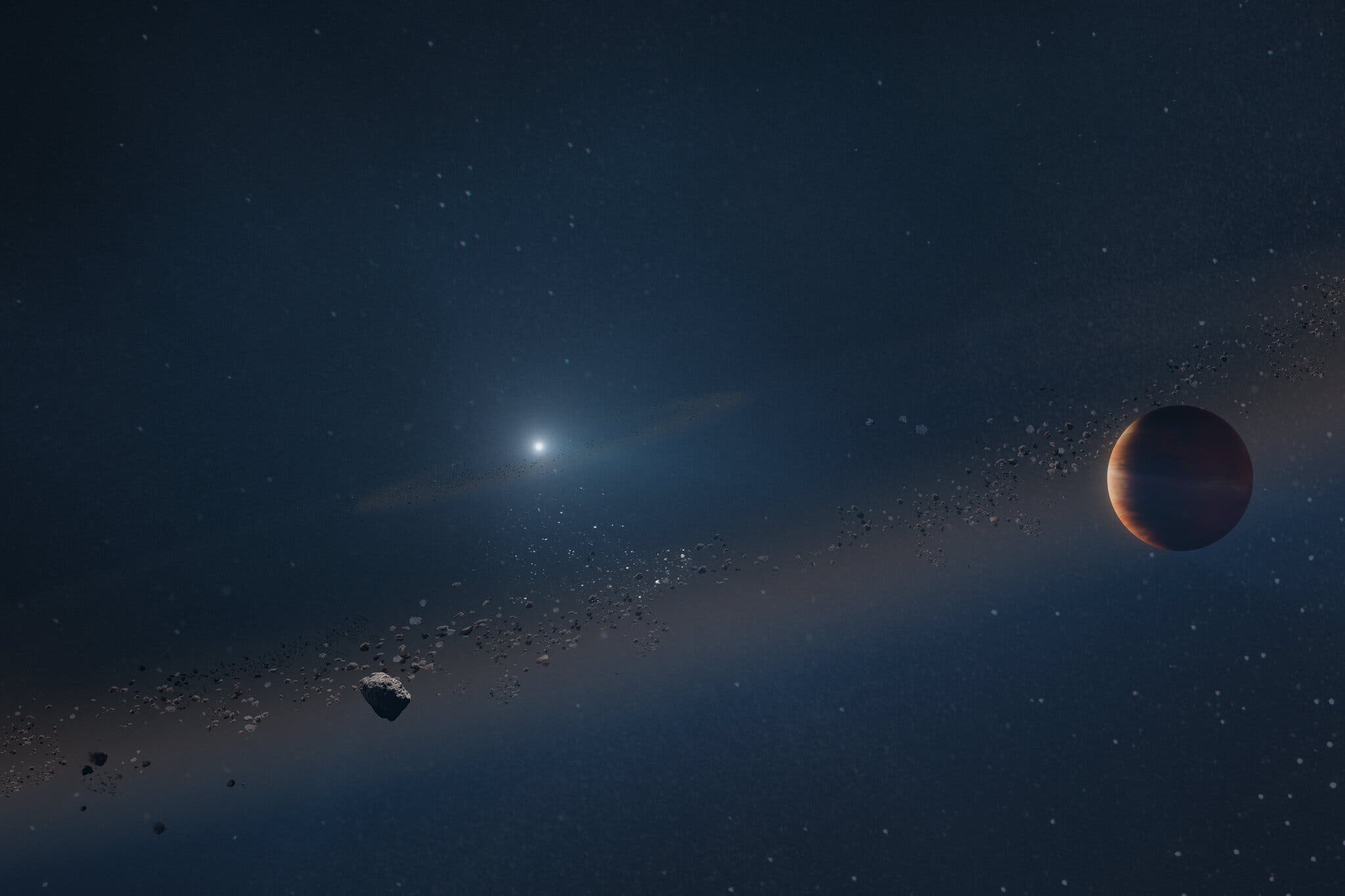
The “Lucy” spacecraft was launched recently on a twelve year mission to visit asteroids. Asteroids are left over remnants from the sculpting of the solar system about four and half billion years ago. Spacecraft in the past have visited asteroids. Both as flybys and landings. What is different about this mission is the number and types of asteroids to be visited over a longer span of time when the spacecraft crisscrosses the orbit between Earth and Jupiter a few times. After launch the spacecraft was found to have a minor handicap in terms of a lack of confirmation of the latching of one of the two solar panels. Regardless, the spacecraft has been pushed out of the Earth’s bounds on its way to the asteroids. Will Lucy be lucky and complete its mission ?

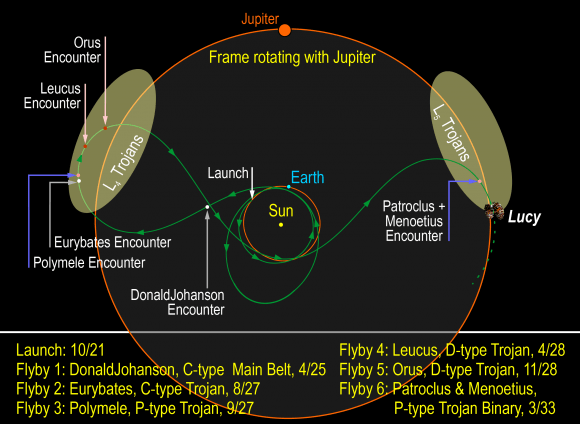
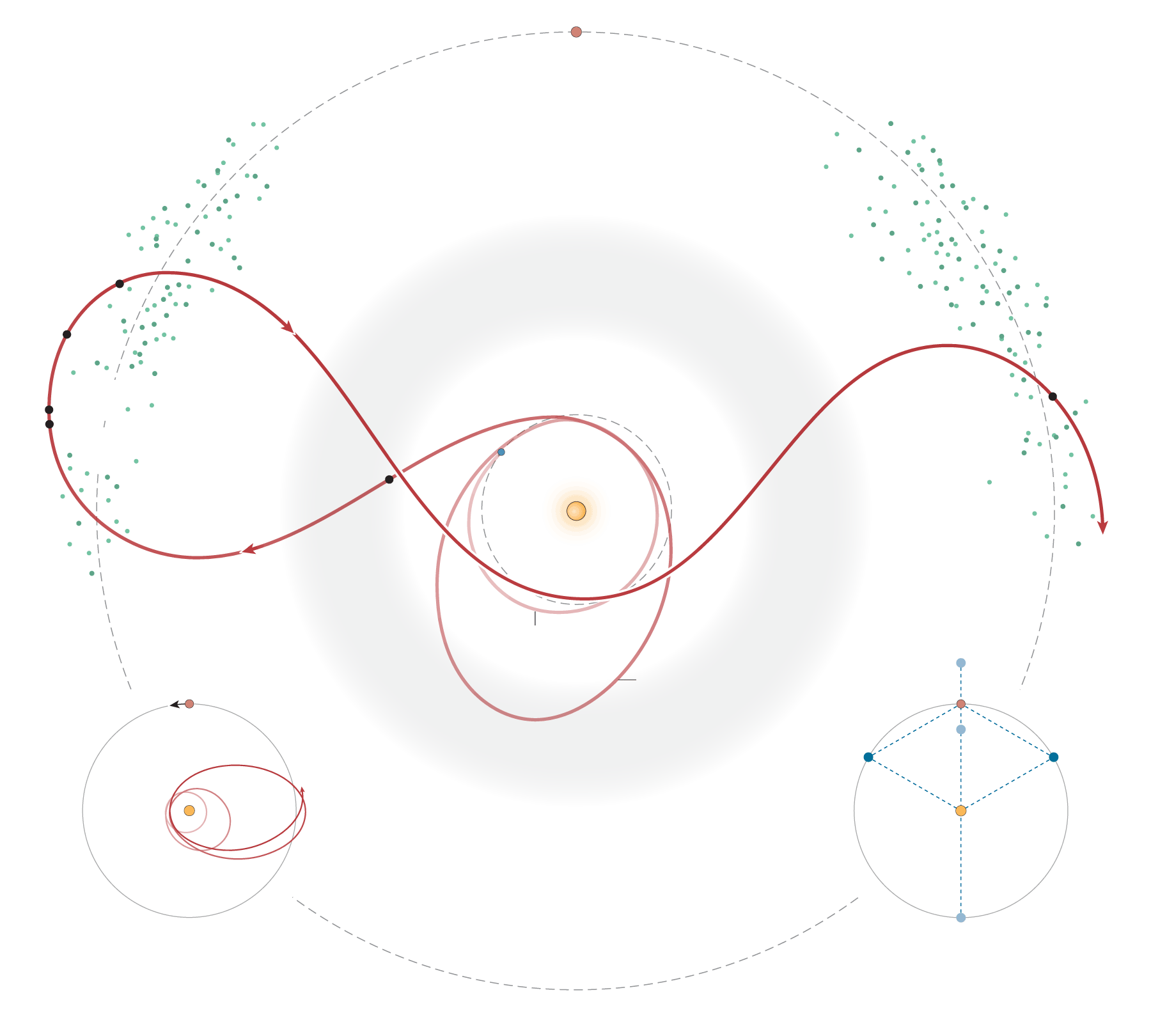
Asteroids are pretty interesting as they are the left over building materials from the formation of our solarr system. It is like some pieces of bricks, stone, wood, pipes and electrical cables lying around even after a building is complete. They offer some clues about how the building was constructed. Majority of asteroids are located in the asteroid belt between Mars and Jupiter. Thousands of pieces orbiting the Sun in a narrow band. In addition, there are some asteroids in the vicinity of Jupiter. Jupiter being such a massive planet – a big ball of gas, has its own entourage of remnant debris as it orbits the Sun. These asteroids are called Trojans.  They move in the same orbit as Jupiter moves around the Sun. Not around Jupiter. They are concentrated in two areas in Jupiter’s orbit around the Sun. These areas are called Lagrange points – named for a French mathematician called Joseph Lagrange. At these points in space, the gravity of Jupiter is negated by the gravity of Sun and the asteroids can park themselves peacefully without the pulls of the massive bodies. There can be 5 possible Lagrange points named L1 through L5 for any two massive objects in space. In case of Trojans, the asteroids are parked in L4 and L5 points. The picture below shows the asteroids and the path Lucy will take. It is a great picture courtesy Southwest Research Institute. Lucy would be visiting one main asteroid (named Donald Johanson) and 7 Trojan asteroids as per the picture below.

Now let us come to the naming of the spacecraft. Lucy is named for a 3.2 million year old hominid skeleton (a human like ancestor) discovered in 1974 by a paleoanthropologist named Donald Johanson. And where did Johanson get the name from ? From a Beatles song “Lucy in the sky with diamonds” which was playing at the campsite in Africa when the discovery was made. In 2025, Lucy will reach the main asteroid between Mars and Jupiter, not surprisingly named Donald Johanson. Other Trojan asteroids will follow later as per schedule given in the picture. These encounters are all flybys with no orbiting or landing on any of the asteroids. Extensive imaging will be done as Lucy flies by each of the asteroids. The images will be captured in multiple wavelengths in order to determine the detailed geophysical features.

The mission is planned for twelve years but could be extended on how things go. A lot depends on the power source for Lucy. Typically spacecraft going that far out from Sun do not depend on solar energy as Sun’s light dims with the distance. Lucy is being powered by two massive solar arrays each generating about five hundred watts of energy at such distances. Closer to Earth they generate a lot more power.  All the electronics on the Lucy are expected to operate within this power budget. The power generated is about half of a typical household iron used for pressing clothes. It is a great design indeed !

Because of the size of the solar arrays, they have been folded at the time of launching from Earth. They are expected to unfurl once in space and latch so that they retain the shape on the journey to the asteroids. One of the arrays did not confirm the latching process. It seems to be functioning fine regardless. The lack of confirmation may just have been a miss. Keeping the power generation in mind, Lucy has been steered beyond the confines of the Earth. Mission control will keep an eye on the journey and whatever they can do to fix or get a confirmation that everything is OK. They have a few years to work out the kinks during this long journey. It is like watching a car move while checking remotely on what is wrong with it and hopefully fix.  Good luck to Lucy mission to achieve its goals and much more!

Posted in November 2021, Sidereal Times | Tagged , | Leave a comment

To James Bond fans.

by Richard Sherman

“No Time to Die,” the latest James Bond movie was released to theaters in October. Ahead of watching Daniel Craig’s latest film as the timeless James Bond, I decided to re-watch a few films, including “Quantum of Solace.” The explosive climax occurs in the desert where Commander Bond has to rescue the girl and dispatch with the evil Dominic Green amidst a fusillade of gunfire and burning buildings.

I wondered where this was shot, so I googled it and learned the scene was shot at the European Southern Observatory (ESO) Paranal in the Atacama Desert. This location is perhaps best known among astronomers as the host site for the Very Large Telescope (VLT). The website for ESO Paranal has a lot of great information and can be found at:  https://www.eso.org/public/teles-instr/paranal-observatory/.

There is also an excellent YouTube video, including comments from Daniel Craig at:  https://www.eso.org/public/usa/videos/eso0838a/?lang 

Posted in November 2021, Sidereal Times | Tagged , , , | Leave a comment

Snippets

compiled by Arlene & David Kaplan

-NYT

Meteorite Crashes Through Ceiling and Lands on Woman’s Bed
After a fireball streaked through the Canadian sky, Ruth Hamilton, of British Columbia, found a 2.8-pound rock the size of a large man’s fist near her pillow. She was fast asleep in her home in British Columbia when she awoke to the sound of her dog barking, followed by “an explosion.”…more

-NYT
-NYT

Why NASA Launched a Robotic Archaeologist Named Lucy NASA launched a probe toward clusters of asteroids along Jupiter’s orbital path. They’re known as the Trojan swarms, and they represent the final unexplored regions of asteroids in the solar system. The spacecraft, a deep-space robotic archaeologist named Lucy. In a vast odyssey across the solar system, the mission will study asteroids known as Trojans that may contain secrets of how the planets ended up in their current orbits….more

-NYT

$10bn James Webb Space Telescope unpacked in Kourou The $10bn successor to the Hubble observatory arrived at Europe’s Kourou spaceport five days ago after being shipped from the US. Engineers have unboxed the James Webb Space Telescope in French Guiana and will now prepare it for launch. It’s now been relieved of its transport container and…more

-BBC

Orion: Nasa’s Moon-ship is attached to SLS megarocket Nasa’s next-generation spaceship has been lifted onto the rocket that will launch it to the Moon this year or in early 2022. The Orion spacecraft was attached to the powerful Space Launch System (SLS) rocket at Nasa’s Kennedy Space Center in Florida. For its upcoming flight, Orion will fly around the Moon without astronauts…more

-BBC

Neutrino result heralds new chapter in physics A new chapter in physics has opened, according to scientists who have been searching for a vital building block of the Universe. A major experiment has been used to search for an elusive sub-atomic particle: a key component of the matter that makes up our everyday lives…more

-BBC

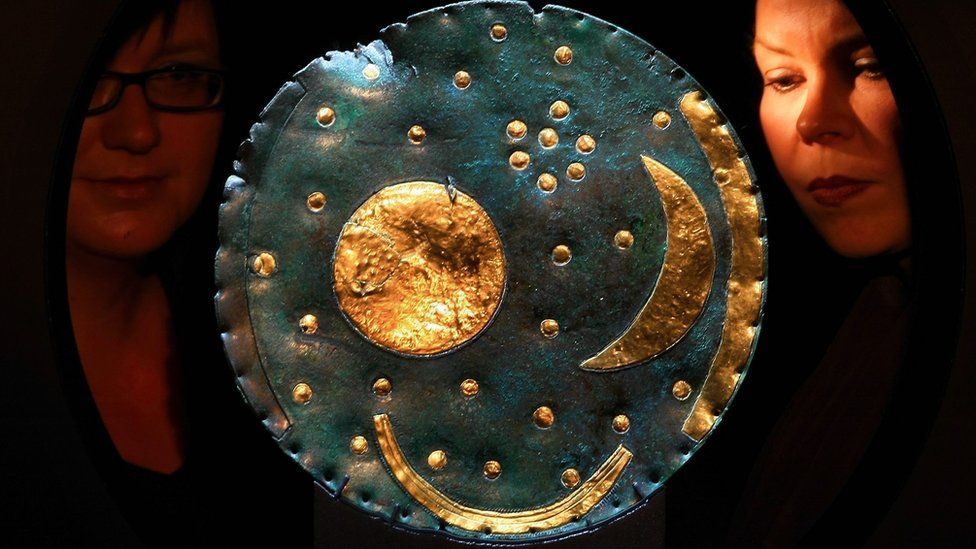
 Nebra Sky Disc: British Museum to display world’s ‘oldest map of stars’ An ancient object thought to be the world’s oldest map of the stars is to go on display at the British Museum. The Nebra Sky Disc is widely believed to be 3,600 years old, dating from the Bronze Age. The bronze disc was unearthed in Germany in…more

-BBC

Signs of first planet found outside our galaxy Astronomers have found hints of what could be the first planet ever to be discovered outside our galaxy. Nearly 5,000 “exoplanets” – worlds orbiting stars beyond our Sun – have been found so far, but all of these have been located within the Milky Way galaxy…more

Posted in November 2021, Sidereal Times | Tagged , | Leave a comment

From The Director

by Rex Parker, PhD  director@princetonastronomy.org

Connection to the Mother Ship.  AAAP has a wonderful history connecting our club with Princeton University and its Department of Astrophysical Sciences. Through the years we have had the privilege to meet in the auditorium at Peyton Hall with space-themed murals and top notch audio-visual devices for our meetings.  The number of science talks by Princeton faculty and post-docs through these years are beyond count.  Now in our new fall 2021 season of meetings naturally we look forward to returning to Peyton once COVID settles down.  However, despite our hopes, for the rest of the fall at least we will not be able to meet in person at Peyton Hall. Complicating our return is a major construction project getting underway on campus across from Peyton Hall which will make parking distant and difficult.  So, while our virtual meetings with Zoom must continue until our eventual return to the Mother Ship, let’s keep the Princeton connection strong in our minds’ eyes and let it inspire us as we “do astronomy.”   

Doing astronomy is, of course, a little different when we cannot meet in person for our regular meetings. During Zoom sessions, club activities and member conversations highlight the second hour after the main speaker has finished.  Here we seek to elevate the art, science, and joy of amateur astronomy, thus we have evolved the practice the informal “Journal Club” presentation by (usually) one member each month.  Yes, I am asking you dear reader to step up to volunteer to give a Journal Club!  This is typically a short 10 minute talk about an astro topic you especially care about — doesn’t need to be scholarly, just to be fun and engage other members with what you care about.  This works very well with audiovisuals through Zoom screen share (e.g., PowerPoint slides, JPEGs) from your home computer or mobile device. To take on a Journal Club for an upcoming meeting, contact me at director@princetonastronomy.org or  program chair Victor Davis at program@princetonastronomy.org.

Fall Observatory Season Extended.  As summer transitioned to fall the sky conditions improved, and we have had a few excellent observing public nights at the Washington Crossing Observatory.  In view of the generally warmer trends in fall weather and the desire to be able to meet as club members, the board has taken the following actions.

  • Public Friday Nights this fall are extended through the end of November. 
  • Member Friday nights will be extended through the end of December. 
  • Keyholder participation for the above nights is optional, and sessions will be coordinated by the Observatory Chair, weather permitting as usual.

Performance Test – AAAP’s ZWO Astro Camera.  Along with several AAAP members I have been extolling the virtues of astrophotography and astrovideo for our club for a while now.  For those of you interested in getting more involved in imaging, this may be a good time to revisit the technical and aesthetic side of the topic.  You may have seen at the Observatory and in our “astrovideo live” Zoom sessions the remarkable live imaging performance of the newer generation of astro cameras.  The technique of live stacking astro images in the field without extensive processing has come to be called Electronically Assisted Astronomy (EAA).  In this technique, surprisingly clear images of deep space objects can be displayed in near-real time after stacking a series of short, typically 5-20 second exposures using specialized software.  No post-processing is done other than what the software does immediately to smooth out the noise and enhance the signal in real time. 

The club’s ZWO ASI294MC Pro camera is a technological marvel and a good example of how CMOS sensor technology continues to displace the CCD in astronomy applications. The camera features a CMOS Bayer-matrix (RGGB) color sensor, the Sony IMX294. The sensor is relatively large at 19 x13 mm with diagonal 23mm (this is the so-called “4/3-inch” in sensor terminology), which is key to wider-field images. The pixel array is 4144 x 2822 for 11.3M pixels at 4.6 um pixel size. It has great sensitivity, with quantum efficiency approaching 80%, although the exact figure has not been published by ZWO.  The camera has 14-bit native bit depth, very fast download rate, low read noise, and cooling to ~30 deg C below ambient to reduce dark current noise. Results below confirm that these newer-generation CMOS color cameras are a revolutionary step forward for EAA.

To control this specific camera and run live stacking we have 3 software options.  These programs are on the club’s computer at the Observatory and available for members to learn.  The first two are free to download on your PC:  (1) ZWO ASI Live, part of the ASI Studio package, the native software designed specifically for ZWO cameras;  (2) Sharp Cap, free but with an added-cost Pro version;  and (3) TheSkyX, which includes a Live Stacking component in the camera control section of the software. The only other software required is the ZWO camera driver, downloaded from the website and installed on the PC. 

A while back I borrowed the ASI294 camera from the AAAP Observatory and hooked it up to my 12.5” f/6.7 telescope at home.  My test was carried out under far from ideal conditions, a waxing gibbous moonlit night in mid-July with hazy skies, and I even left the deck light on here at home and could barely see the stars!  I connected the camera to my AG Optical iDK 12.5” reflector scope at f/5 (using a 0.75x focal reducer on the native f/6.7 scope to give FL = 1610 mm) on a Paramount-MX running TheSkyX.  The ZWO camera sensor was cooled to -10 deg and the gain set at mid-level, the default deep sky setting. Below are unprocessed JPEGs of screen shots showing what you’d see as live images in real-time with the ZWO. These are all 3 to 5 minute stacks of 15 second subframes (i.e., 12 or 20 subframes have been averaged) with no post-processing or stretching beyond what the live image showed on the computer screen.

Members can generate EAA images similar to the ones I pasted below using the club’s camera and Celestron C-14 with f/6.3 focal reducer at the Observatory. If you have not already been trained to use the equipment, you can get going by contacting the observatory chair at observatory@princetonastronomy.org.  And yes, I did return the camera to the observatory (:>).

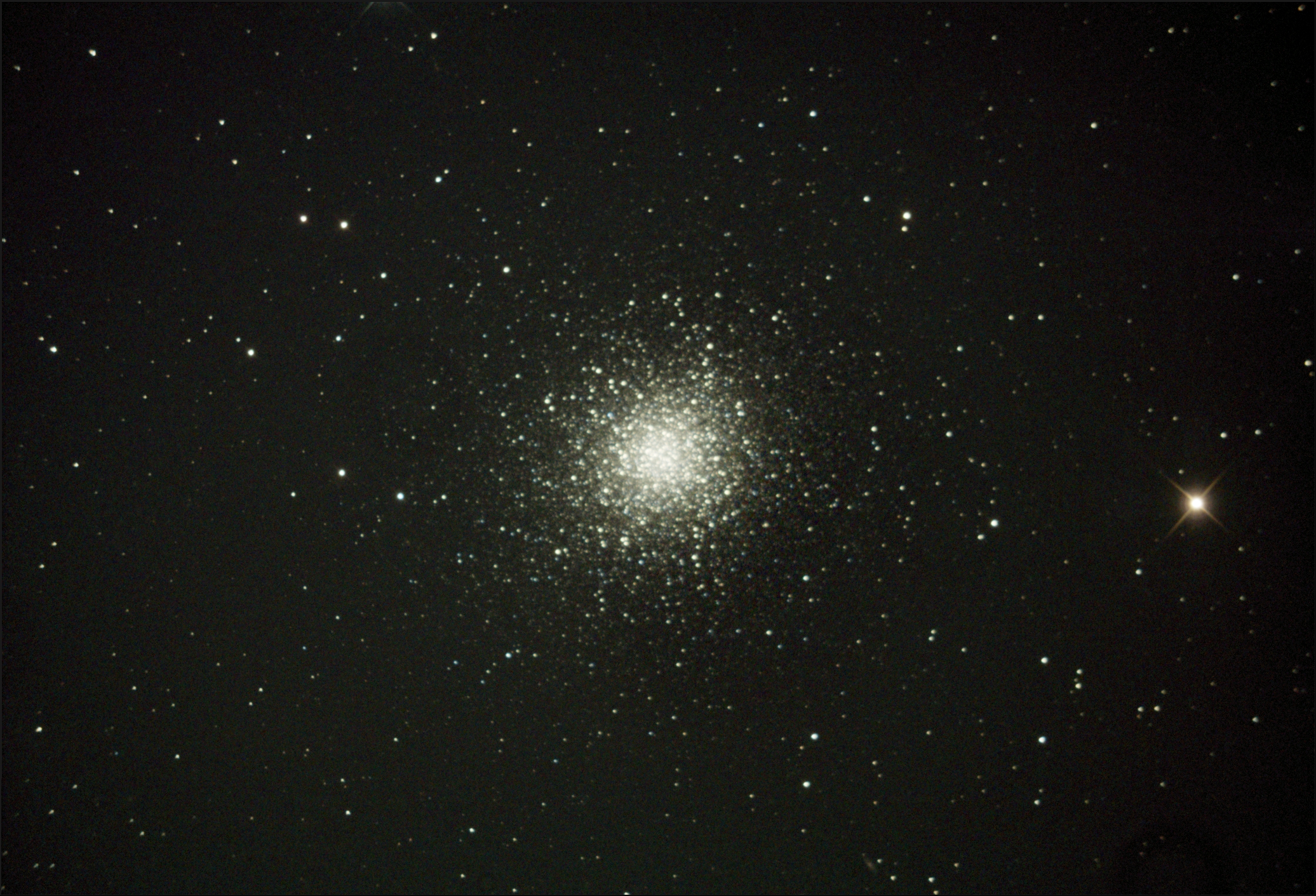
M13 Globular Cluster in Hercules, ZWO294 – 15 sec live image stacked for 3 min

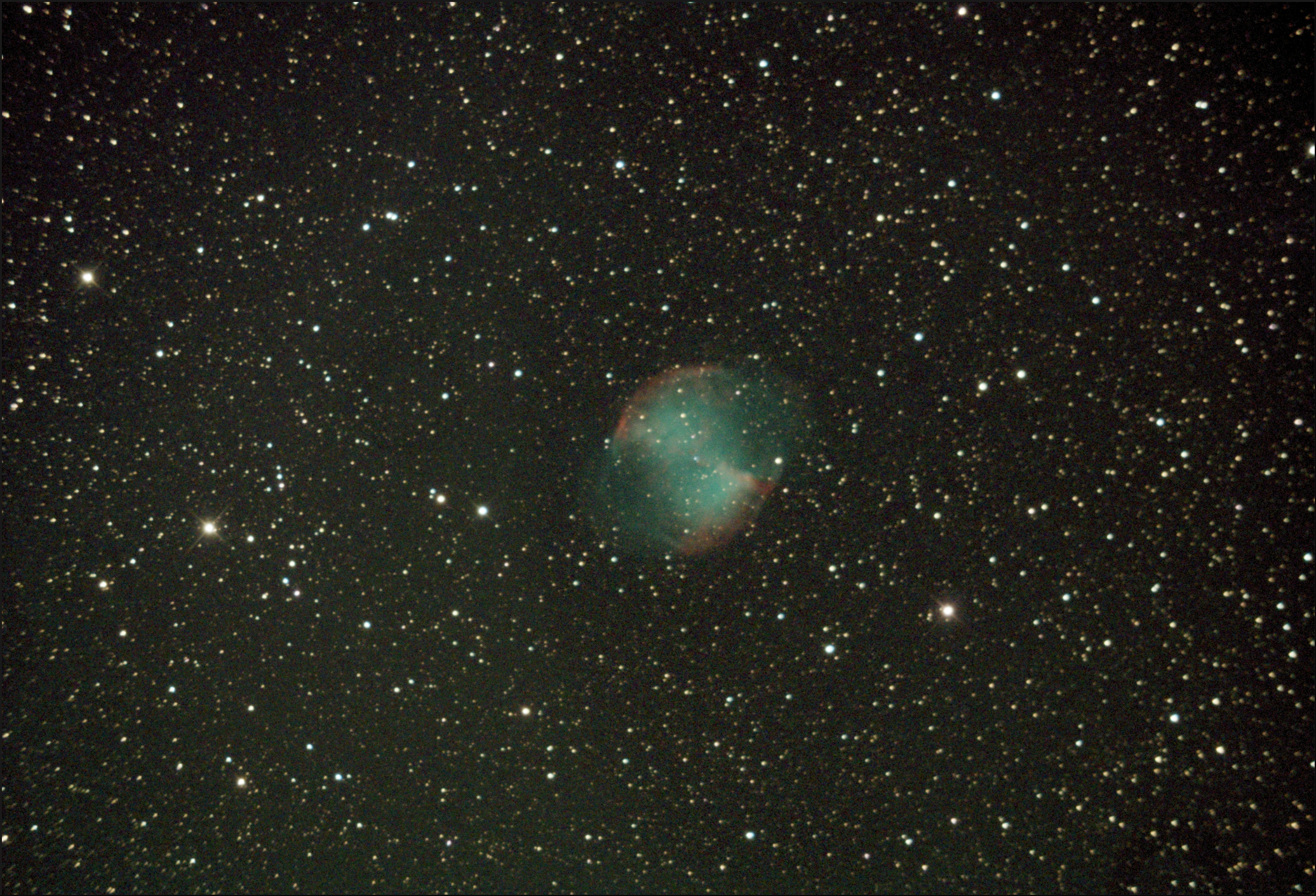
M27 Dumbell Nebula in Vulpecula, ZWO294 – 15 sec live image stacked for 3 min

M16 Eagle Nebula in Sagittarius, ZWO294 – 15 sec live image stacked for 5 min

Cirrus Nebula East in Cygnus, ZWO294 – 15 sec live image stacked for 5 min

3 New Roles – Members Help Needed.  Here are some opportunities for members to contribute to the inner workings of AAAP by as facilitators of club activities.  These are increasingly important as we move further into the virtual meeting era.  Recently, the Board defined the following new roles and we are looking for members to take these on.  I am happy to note that member Rich Sherman has volunteered to take on the role of merchandise facilitator described last month.  If you can help by taking on one of the roles below, please e-mail me at director@princetonastronomy.org.

  • Provide contents and update our ongoing AAAP Twitter, Facebook and YouTube accounts.  Look into other forms of social media and how they could be utilized for the club’s benefit.  Develop means for members to privately contact/message other members in or out of our current email and newsletter systems for daily chat, invitations to observatory, share stories or photos, etc.  This could be a message board or similar function so that members can connect.  Facilitator Benefits:  Connect with members and public who are heard but not necessarily seen.  Utilize various resources to learn more about astronomy. Interact with members and share knowledge.  Broaden our network of AAAP followers.  Pass the knowledge on to new generations of members and public.  
  • Promote the ongoing link between AAAP and NSN.  Sort through the various NASA/JPL Night Sky Network toolkits we’ve received and determine how best to utilize them in our outreach and public night events.  Practice with the toolkits and train others how to use them.  For the NSN website go to https://nightsky.jpl.nasa.gov/index.cfm.  Facilitator Benefits: You get to explore interesting packages delivered from NSN.  Learn about astronomy from well thought out materials for all age groups — cool stuff to play with.  Interact with members and public.  Get to teach astronomy facts and concepts.
  • The club owns a few telescopes and related equipment and occasionally receives donations which we keep or sell.  The role here would be to set up and run a loaner telescope program for members.  Learn about, practice with, maintain, and possibly store the telescopes and make them available for members to use.  Train members on how to use telescopes.  Develop a system to keep track of loaner whereabouts and ensure good condition of the equipment.  Facilitator Benefits:  You get to graciously accept occasional donations from the public.  Learn how to evaluate telescope completeness and condition.  Learn how to set up and use different scopes and mounts, eyepieces and cameras.  Get to play with donated scopes at your leisure.  Interact with members and share knowledge.
Posted in October 2021, Sidereal Times | Tagged , | Leave a comment