From The Director

by Rex Parker, PhD director@princetonastronomers.org

Escape from the Black Hole of Relentless News Headlines.  Though we had a couple of rainouts for May events, the lunar eclipse AstroVideo Live was saved by member Rich Sherman broadcasting from Florida May 15.  We’ll keep going with Public Open House each Friday night at the Observatory at Washington Crossing State Park.  Join the adventure of direct astronomy with excellent telescopes, along with your own family and friends – spread the word about our Friday night sessions. 

We want to see you in person at the next monthly meeting of AAAP.  The last meeting of the academic season will be held in person — for the first time since March 2020! 

June 14 meeting (7:30pm) in person at the Planetarium in Trenton The meeting will also be broadcast by You Tube and Zoom from location, although the main planetarium show on the dome cannot not be shown.  Planetarium Technician Bill Murray, AAAP member and Outreach Chair, will run the celestial show featuring a new state of the art computing and projecting system.  For more info see the Program Chair article below.

Then, just when we needed some positive science news to cut through the background of chaos and continually worrisome news reporting, the astrophysics world came through!  Over the past month we’ve seen breakthroughs in both solar system and deep sky fronts. These results from long-term projects reaching pivotal moments are even more amazing when you ponder the degree of difficulty of engineering and the depth of scientific questions being asked. 

The first-ever telescopic image of our Galaxy’s supermassive black hole, called Sagittarius A* in radio radio-astronomy, was just published from the multiyear collaboration called the Event Horizon Telescope.  This is a network of large radio telescopes linked together around the world.  A very long baseline interferometer, this is the time the black holes at the center of our galaxy could be resolved.  By coincidence, the angular size of these two black holes is similar, so the resolution of the Milky Way’s black hole is the same as M87’s, and the images look surprisingly similar.  In the image published by the group, gravitationally lensed emissions glow around a dark shadow which is the event horizon of our galaxy. This publication and a set of related papers can be read in the May 12 special issue of Astrophysical Journal Letters.

Boeing’s Starliner spacecraft returned to Earth May 25 after the first successful uncrewed test flight, with 4.5 days at the International Space Station.  It made a picture-perfect landing in the desert and met all the mission objectives, a very big deal to the future of NASA and planetary space travel.  The James Webb telescope successfully collimated its mirror and is now testing the science instrumentation, and it won’t be long until the first actual data streams come forth.  And Solar Orbiter’s new images of the sun are as dramatic as we were hoping.  Late in March, the ESA’s Solar Orbiter made its closest approach to the Sun so far, inside Mercury’s orbit, to about one-third of the Earth-Sun distance.  With the most complex science lab ever sent to the Sun, Orbiter observes solar events in multiple modes and wavelengths simultaneously.  The recent data, images, and videos are totally engaging and can be reviewed at the ESA Solar orbiter site.

George Abell’s Amazing List from Palomar.  In 1966 the American astronomer George Abell published a list of 86 likely planetary nebula based on discoveries before 1955 from the National Geographic and Palomar Sky Survey with the 48-inch Oschin telescope at Mount Palomar, California.  This telescope, sometimes referred to as the world’s largest Schmidt camera, was the forerunner of today’s deep sky surveys and conducted a dozen other surveys since 1995.  As a quick aside, the glass corrector plate has a 48-in aperture and the primary is a 72-inch f/2.5 mirror. It was originally designed to use 14-inch square photographic plates, each covering 6×6 degrees of sky, and since 2000 has used CCD detectors instead of film.  

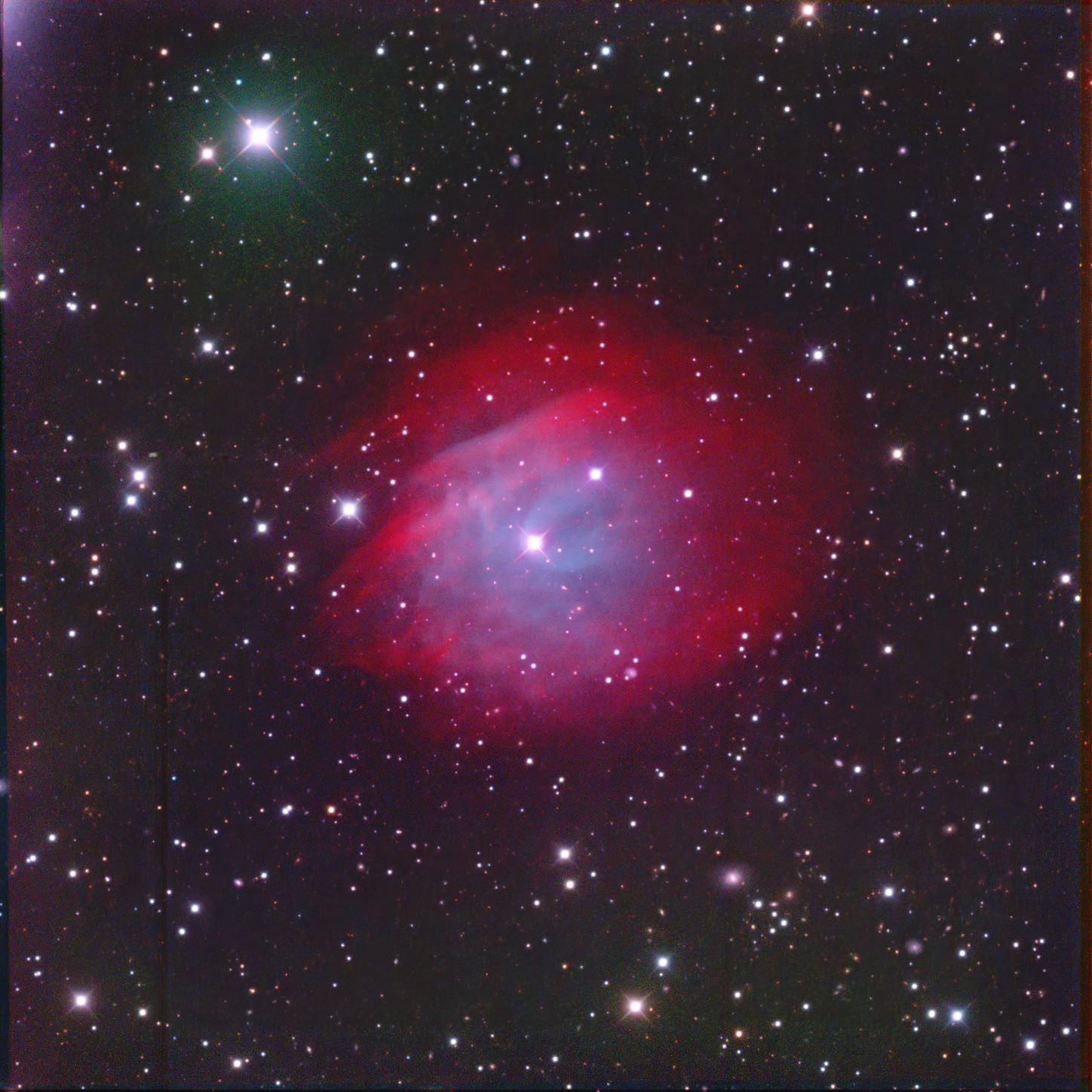
Not as well-known as the Messier list (which includes many objects that are not planetaries), the planetary nebulae on Abell’s list are fainter and more challenging to observe.  But when accessible under the right conditions they can be wonderfully mysterious with beautiful color and structure.  Last month I was fortunate to remotely observe Abell PLN 35 in the southern hemisphere constellation Hydra, using a 24” Planewave Telescope in the Chilean Andes.  The nebula emits strongly in the ionized oxygen (O-III, blue) and hydrogen (H-alpha, red) bands, with shock-wave like regions of density.  Located about 1200 light years away and about 5 light years across, Abell PLN 35 has a magnitude value 12.7 and angular diameter ~12 arc-min. 

Abell Planetary Nebula (PLN 35) Imaged with CCD Camera and 24” Telescope in Chile.  True colors are based on R, G, B filters plus H-alpha (red) and O-III (blue) narrow band filters.  Angular size, 31×31 arcmin.  The bright star in the field is magnitude 8.4.  Astrophoto by RAParker
Posted in June 2022, Sidereal Times | Tagged , | Leave a comment

From the Program Chair

By Victor Davis

The June 14, 2022 meeting of the AAAP will be an experiment combining in-person and virtual elements into a hybrid meeting.  The intention is to meet the needs of members eager to resume commiserating in person and also those who, due to inconvenience or Covid risk, choose to continue to participate virtually via Zoom. The club’s longstanding tradition is to have the final meeting of the academic year at the planetarium of the New Jersey State Museum, hosted by AAAP’s current Outreach Chair, Bill Murray. The planetarium is located at 205 West State Street, Trenton, NJ. There is ample parking behind the museum.

Unlike recent Zoom-only meetings, there will be no informal online chatting before the meeting starts promptly at 7:30 pm. In-person attendees will have the opportunity to socialize outside the planetarium building before the meeting starts. AAAP cannot access the planetarium prior to 7:00 pm, and Rex Parker, Bill Murray, and Dave Skitt will be setting up local and webcasting gear before the meeting begins.

The agenda for the meeting will be slightly different than the structure we’ve used for the past two years:

Masking

There is no masking requirement to attend this indoor, in-person meeting on premises owned by the State of New Jersey. Members who are immuno-compromized, senior citizens, or wary of respiring in close proximity to potentially infectious individuals may want to consider wearing a mask while inside the planetarium.

BillMurrayFeatured Speaker: William Murray,  Lecturer and Planetarium Technician, New Jersey State Planetarium, 
Outreach Chair, Amateur Astronomers Association of Princeton

( strgazr1@verizon.net )

“Touch the Stars”   This full-dome planetarium show dramatically showcases the robotic spacecraft used in the exploration of our Solar System and the galaxy beyond. The presentation traces the timeline to space through the history of NASA’s probes, orbiters, and landers—from the heart of our Solar System and the surfaces of its planets and moons to the grand tour of the Voyager spacecraft through the outer planets and on to interstellar space. Created with the cooperation of NASA and Lockheed Martin, “Touch the Stars” uses the latest high definition imagery, 3D vistas, and scientific data to transport the audience on a memorable voyage of discovery.

Bill will put the Planetarium’s new ultra-high resolution 8K digital video projection system through its paces for this main presentation. Unfortunately, due to copyright restrictions and the practical limitations of trying to image a planetarium dome through Zoom, virtual participants will see only a 1 ½ minute trailer of the film before the virtual meeting concludes.

A Bit About Bill Murray An amateur astronomer for more than 50 years, Bill Murray has been employed as a software engineer, physics and mathematics teacher and is currently planetarium technician and lecturer at the New Jersey State Planetarium in Trenton. He has owned more than a dozen different telescopes and is a past observatory chair, secretary, program chair, assistant director and director of the Amateur Astronomers Association of Princeton. His current position in the club is outreach chair. He observes the night skies, and dabbles in EAA, with a 130 mm Astro-Physics APO refractor from his backyard observatory.

If you choose to participate in the June meeting via Zoom:

  • Please make sure you have Zoom installed on your computer. You do not need a Zoom account or to create one to join the meeting. Nor are you required to use a webcam.
  • Please see below for the link to the meeting, or visit our website

Using Zoom: While we are social distancing, the AAAP Board has chosen to use Zoom for our meetings, based our belief that many members have already have used Zoom and its ease of learning. One of its great features is you can choose whether you want to install the software on your computer or use it within your browser.

How to Join the June Meeting: For the meeting, we are going to follow a simple two-step process:

  1. Please make sure you have Zoom installed on your computer. You do not need a Zoom account or need to create one to join the meeting. Nor are you required to use a webcam.
  2. Please visit our website for the Zoom link.

This session will be recorded and saved on YouTube. Send me an email at program@princetonastronomy.org if you have any concerns.

YouTube Link: Amateur Astronomers Association of Princeton, April 12, 2022 Meeting, 7:30 PM EST

NOTE: The Zoom site has many training videos. If you’re unsure how Zoom works you might want to view the videos on how to join a meeting or how to check your computer’s audio and video before the meeting.

Megaconstellation Webinar

In April, Dr. Paul Daniels spoke to our club on the Megaconstellation threat. He and his organization, the Federation of Astronomical Societies in the UK, hosted a webinar on 7th and 8th of May entitled, “The Challenge of Megaconstellations.” The aim of the webinar was to allow professional space operators and astronomers to explain to interested amateurs and researchers the many challenges posed by satellite megaconstellations. The event was very successful. An edited version is available online at:

https://www.youtube.com/channel/UCnmaTudqwjs9k7Gr-_WhUzw

The webinar is also available via the Federation of Astronomical Societies’ website fedastro.org.uk.

Manhattanhenge

For many of us, New York City is a magical place. It becomes a bit more magical twice a year, when Manhattan’s rectangular street grid aligns precisely with the setting Sun, creating a radiant glow of light at the end of Manhattan’s canyons of glass and steel. During these days, the Sun simultaneously illuminates buildings on both the north and south sides of every cross street of the borough’s grid. It’s a rare and beautiful sight, though drivers in cross-town traffic may be less concerned with its beauty than with pedestrians stopping in the middle of crosswalks to snap selfies.

Manhattanhenge takes place this year on May 29 and May 30, (sorry we missed it) and also on July 11 and 12. On Monday, July 11 at 8:20 pm ET, the full Sun will be setting over the Hudson River. On Tuesday, July 12, at 8:21 ET, half the Sun’s disk will meet the grid at sunset. These dates are spaced roughly equal time spans around the summer solstice. These dates work because Manhattan’s street grid is rotated 30 degrees east of geographic north. Had the streets been oriented north-south, Manhattanhenge would coincide with the equinoxes. The website of the American Museum of Natural History recommends that viewers find a spot as far east as possible that still has views of New Jersey across the Hudson River, and suggests vantage points at Manhattan’s main east/west thoroughfares:

  • 14th Street
  • 23rd Street
  • 34th Street
  • 42nd Street
  • 57th Street
  • Tudor City Overpass, Manhattan
  • Hunter’s Point South Park in Long Island City, Queens

Science popularizer Neil deGrasse Tyson invented the word “Manhattanhenge” to tie the artifacts of our modern civilization to humankind’s quest to understand the workings of the cosmos. He wonders what future archeologists might conclude from the fact that we engineered our city streets to revere sunsets on Memorial Day and Baseball’s All Star break.

Posted in June 2022, Sidereal Times | Tagged , , , | Leave a comment

From the Assistant Director

by Larry Kane, Assistant Director

At our last virtual membership meeting, I floated the idea of forming a “special interest” group within the AAAP that would work toward diminishing light pollution in the areas we do astronomy.   Based on demonstrated actions by AAAP members, these efforts will and should concentrate on locally driven efforts.  Past work by AAAP members has proven how this may be effectuated.  As a working group, we could concentrate our efforts locally and, with organizational resources from the International Dark Sky Association,, the Sierra Club and other organizations, build campaigns designed for  improvements at the municipal.

I recently rejoined both of these organizations and have found that the International Dark Sky Association (IDA) has a great numbers of ways they will support the efforts of concerned citizens to reduce light pollution.  These include videos that are available to download as well as many other resources.   To date, AAAP efforts have resulted in beneficial legislation being passed in Hopewell Township and campaigns being presented in townships of Monroe and South Brunswick.  These are only three of which I am aware of in New Jersey.

It is my hope that members Rex Parker and Surabhi Agarwal, would join in this effort to provide their experience and counsel based on their campaigns.  So I am hoping to generate real interest in the AAAP as we work to save our night skies.  When our interest group gets together, it will be via virtual meetings.   As I have a Zoom account, I can be the meeting host.  All AAAP members are welcome to be valued participants in this group.   Please let me know of your interest in doing so by sending an email to assist.director@princetonastronomy.org.  We can and will make a big difference.  Wishing all, Clear Dark Skies

Posted in June 2022, Sidereal Times | Tagged , | Leave a comment

In Response to Assistant Director Larry Kane’s Article

by Surabhi Agarwal

Light pollution is one of the least talked about type of pollution that is adversely affecting every aspect of our suburban lives, from watching the sky and disrupting our ecosystem balance to playing havoc with our health. Artificial light is a fairly new power in our hands and like any other power in human hands, it is proving to be a curse when used improperly.

This pollution keeps us from witnessing the marvels of our own galaxy in the night sky from our homes that generations before us did. The fauna around us is struggling with the disturbances in their diurnal/nocturnal rhythms resulting in various negative effects on their lives which include reproduction, diapause, growth, migration, and even coloration of plumage or body. World over, the flora is battling with interference in their photoperiodism, effecting in changes in their flowering patterns leading to timing mismatches with the emergence of their pollinators. This mismatch in turn is rapidly leading towards less food production for the world’s animal populations and the alarmingly growing human population. Interrupted sleep, fatigue, depression, obesity, heart disease, diabetes, and many other chronic problems have been linked to our confused circadian rhythms. The pollution’s contribution to climate change is enormous and requires a whole new article.

Larry has brought up a subject that really requires our attention with utmost urgency. I am in complete agreement with him. As a group of sky watchers we should put our concerted efforts to save our night skies and our local ecosystems. We have to adopt a multipronged approach for this cause. Creating awareness of the negative impacts of light pollution via our social media, local library and school talks is one prong. Taking take this cause to our local governments and pushing them to bring about sensible changes in legislation is the second one. Once we formally adopt this cause in our meeting agendas, I am sure we will add more prongs. Rex has successfully guided Hopewell Township to amend their light ordinances. I am pushing for changes in Monroe and South Brunswick using a copy of the ordinances that Rex has provided me. You will soon find a new page on our website with a copy of this document and links to our presentations on the subject. Feel free to take a copy of the document to your town council. You are also welcome to use my power point presentation.

I hope that my fellow club members will readily join in this effort to curb light pollution in their local areas.

Posted in June 2022, Sidereal Times | Tagged , | Leave a comment

Minutes of the May 10, 2022, AAAP Members General Meeting (online)

by Gene Allen, Secretary

Meeting was convened on Zoom by Director Rex Parker at 1930. Following a brief introduction and presentation of an agenda, Program Chair Victor Davis introduced Speaker/Member Dr. Robert Vanderbei. He described the background and evolution of his latest book, Welcome to the Universe in 3D. Notable in his talk was the technique of holding the viewer against one’s face and then moving it slowly away until the images become 3D for you. He also described the need to be able to view them “splay-eyed” rather than cross-eyed. After being shown the unimaginably sophisticated techniques Dr. Vanderbei had used to create the stereo images that essentially justified the publication of this third version of the book, it seemed patently unfair that Tyson had given no credit to Dr. Vanderbei in his television interview on The Late Show on April 19. More than 55 attendees were noted on Zoom throughout the presentation.

After a brief break following questions, the meeting resumed at 2109 with 40 some attending a detailed and impassioned Unjournal Presentation about the International Dark Sky Association (IDA) by Member Rich Sherman. All AAAP members are strongly encouraged to join, support, and actively participate in the IDA.

Secretary Gene Allen was asked to conduct the election of officers for the coming year. The AAAP Membership Roster had been updated the day prior to show 175 current members, meaning that the required 15% quorum amounts to 26. Earlier in the meeting he had noted that current members in attendance numbered beyond that threshold.

The election of officers was held on Zoom by a show of hands. Screenshots were taken of each page in Gallery View for subsequent confirmation.

There were 40 people online at that time and 33 of them were verified as current members. Of the members, 23 were physically holding up hands to their cameras and 5 had selected the Zoom “Show Hand” function. No hand was displayed in any manner by 3 very active members who had their video turned on, and they have since confirmed by email that they intended a “yes” vote and had lowered their hand before the page was recorded. One member unable to attend had emailed his affirmative vote to the board in advance. Only 2 members had their video off with no hand displayed. Two non-members got caught up in the moment and voted to accept the slate! The Secretary was remiss in not asking members to clear their hands and then calling for those opposed, but there were only 2 possible “no” votes. In sum, we had 32 votes in favor, and a possible but unconfirmed 2 against. The slate was confirmed:

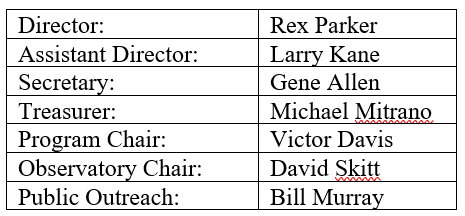
Director: Rex Parker

Assistant Director: Larry Kane

Treasurer: Michael Mitrano

Secretary: Gene Allen

Program Chair: Victor Davis

Observatory Co-Chairs: Jen & Dave Skitt

Outreach Chair: Bill Murray

A Members’ Night is scheduled for Saturday, May 14. Members are encouraged to bring their scopes to the observatory to show them off or to get help in dealing with issues they may be having with hardware or technique. Should the weather turn out to be uncooperative, it will be rescheduled.

An astrovideo Zoom event is planned for the total lunar eclipse that will occur through the middle of the night of May 15. Several members here in New Jersey will bring their telescopes to bear on the Moon, as well as one in Florida and one on the Outer Banks, where the weather may be more cooperative. Members are encouraged to view from home, with binoculars or telescopes if they have any, and report their experiences during the session. A link to connect will be disseminated by email. There was some discussion about star focus being perfectly acceptable for images of the Moon, and the need to keep camera exposures short.

Incumbent leaders have continued to serve the organization, but new, younger participants will be needed at some point. Members who aspire to leadership positions are encouraged to attend Board meetings when they occur and step up to be mentored by the respective officer.

Observatory Co-Chair Dave Skitt offered an update on the Observatory.

  • We still seek someone to coordinate and oversee professional installation of new carpet.
  • While the Nature Center post in the state park is currently vacant, the traditional solar viewing event held there over Memorial Day weekend is being planned. Members able to help answer questions and manage visitors or who can bring a properly filtered solar scope are encouraged to be in contact with Dave.
  • The ASI294 astrocamera out for repair is expected to be returned to us shortly.

The meeting was adjourned at 2202.

Posted in June 2022, Sidereal Times | Tagged , , | Leave a comment

Sunny Solar Observing Success! – May 29, 2022

by Dave Skitt, Observatory Chair

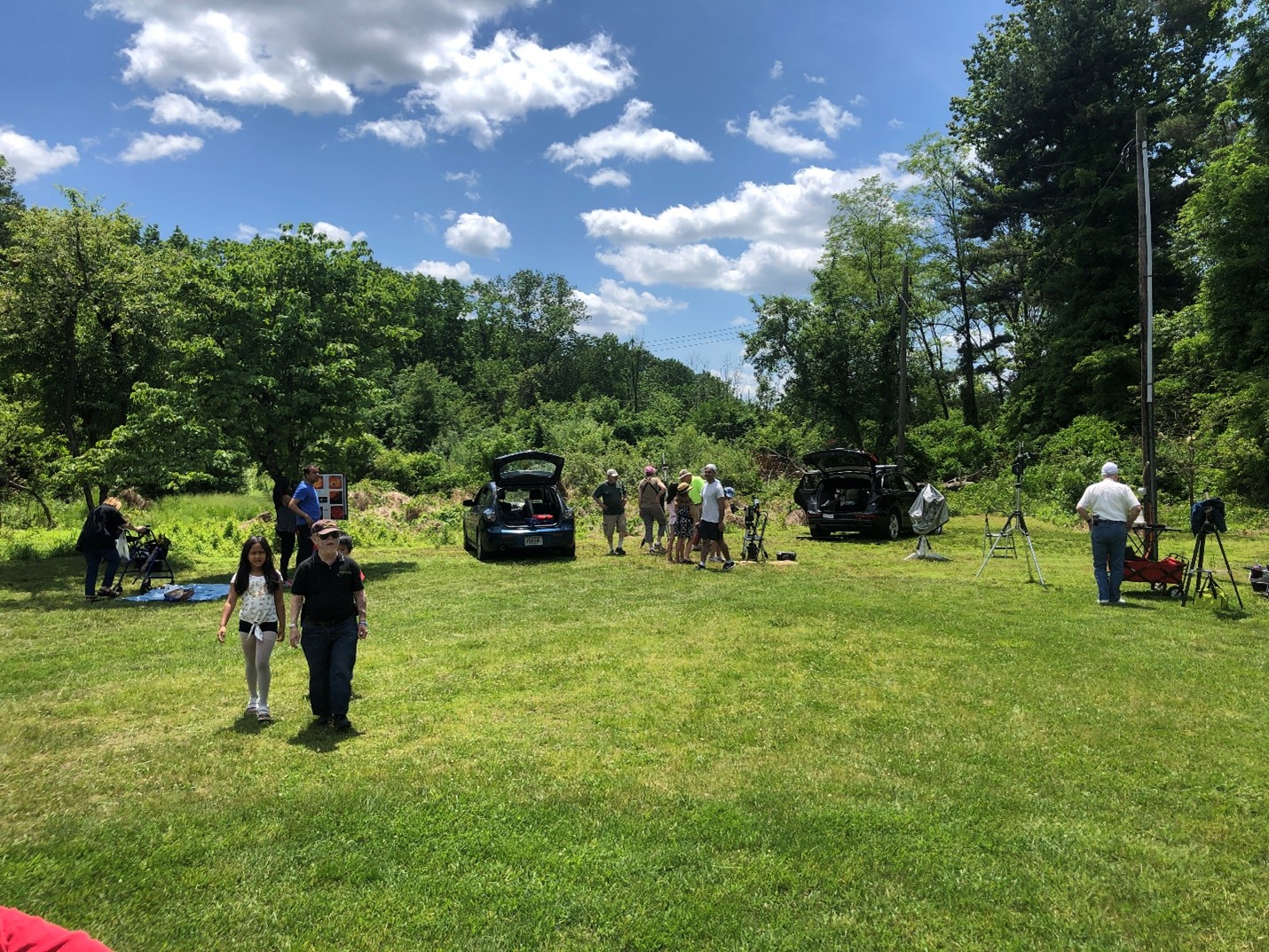
After several weeks of rains outs on public Friday nights and scheduled members nights, AAAP finally got a break with its Solar Observing event hosted at our observatory in Washington Crossing State Park. The skies were clear with only a few puffy clouds to hide the Sun (and Venus!) on Sunday, May 29, 2022.

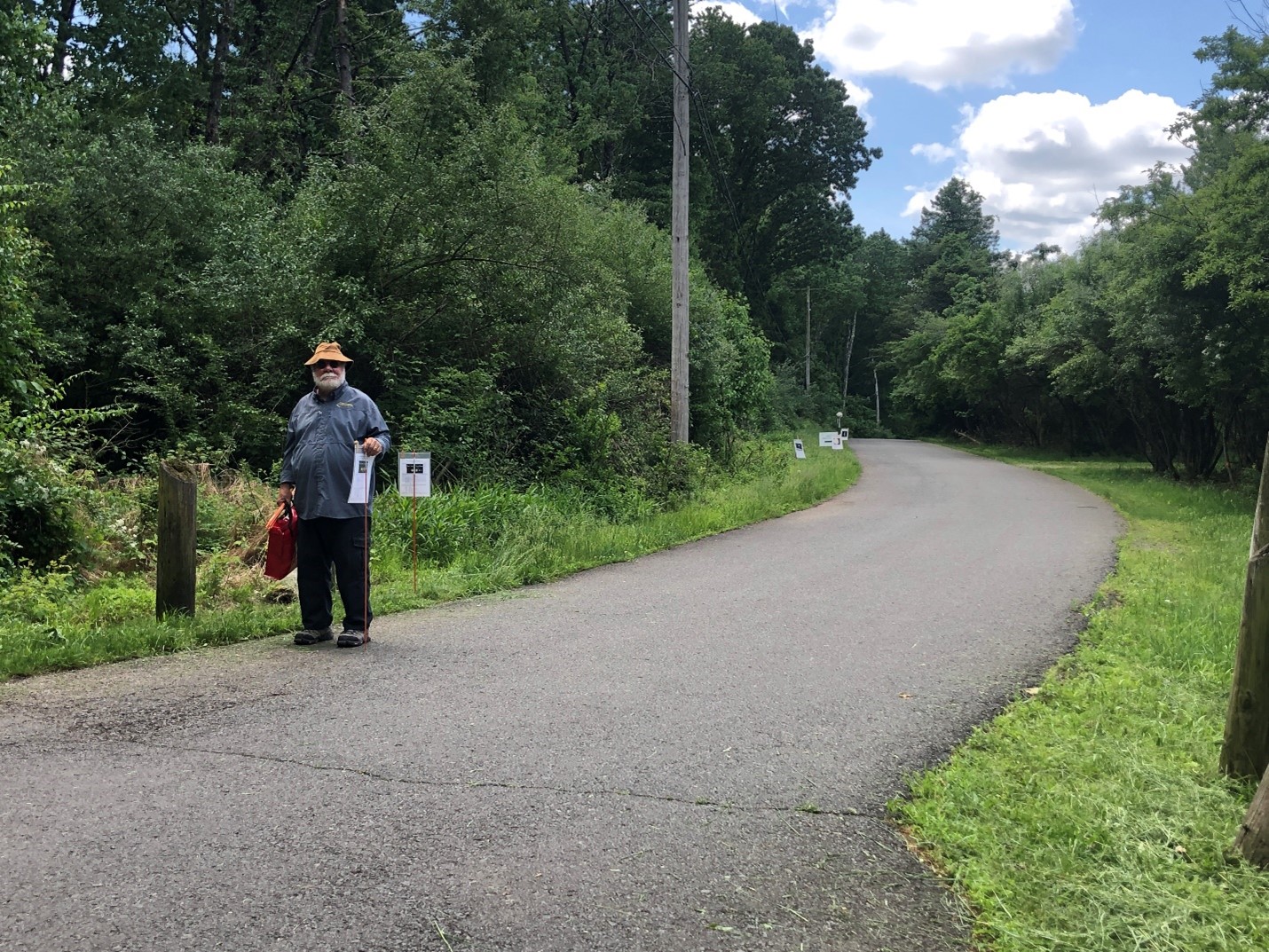
Setup for the 1 pm event began with Victor Davis placing a billboard at the park’s main entrance.  He quickly moved to set up his scope and binoculars on a parallelogram mount.  Victor then paced (plodded?) out a scale model of the solar system along the road to the observatory.  Some thought he had gotten lost in space when he didn’t return after dropping Neptune in its way-out orbit.  We all were relieved when he did reappear to attend to his equipment.  Who else would keep his filtered binoculars on track with the Sun?

Victor Davis putting up signs

Ira Polans, Tom Swords and Dave Reis appeared next to assist me with setting out banners, the literature table and signs.  Did you know that 10-Jupiters or 110 Earths can fit across the diameter of the Sun?

10 Jupiters can fit across the diameter of the Sun

Tom Swords whipped out his Scope-on-a Stick in no time.  There isn’t much to it.  It’s just a series of simple lenses mounted on a rail arranged to project the Sun’s image onto a white card at the rear.  “It works”, Tom says.

Tom had the same comment about Michael Hester’s, Raspberry Pi driven camera attached to a hydrogen-alpha filtered telescope.  I admit I didn’t get to poke my head under the black cloth Michael had over his monitor, but I can’t believe that anything that he sets his mind to wouldn’t work.  His assortment of gear takes a large cart to reach its’ final observing destination.  See if you can spot Tom’s “Scope-on-a-Stick” and Michael’s mysteriously shrouded scope in the panorama photo posted on our Twitter https://twitter.com/princetonastro and Facebook https://www.facebook.com/Amateur-Astronomers-Association-of-Princeton-225112680910838/ accounts.

I don’t know who showed up next as I ventured off to get the C-14 and Hasting-Byrne scopes fitted with their solar filters and fire up their mounts.  Before I knew it, we had a total of 9 scopes or binocular setups pointed upwards and hordes of members and public wondering in to explore the Sun and Venus in all their splendor.  I estimate we entertained, wowed and informed 75 persons.  Maybe more.

I told my wife, Jennifer, that I felt like a groom and bride at their wedding reception when everything is such a blur, but you want to savor every minute.  I thoroughly enjoyed every minute of the event.  Explaining what we were seeing, talking to new and seasoned members and looking through the various scopes.

I know I missed some things but there was so much to take in!  All I have now are the memories and these few photos.  Many thanks to everyone who helped organize, publicize, set up, host and who attended this warm and sunny event.  I look forward to more member events and the next Solar Observing planned for Labor Day Weekend!

Posted in June 2022, Sidereal Times | Tagged , , | Leave a comment

We have some equipment for sale!

by Ron Forrester

  • Star Structure 12.5″ dob, F4.8, F. L. 1500,
    • Ostahowski mirror,
    • very accurate push-to Nexus DSC controller & setting circles,
    • exceptionally smooth,
    • WIFI enabled,
    • 9×50 finder,
    • red dot laser,
    • internal battery,
    • fully computerized push to capability, 
    • dew heater,
    • breaks down to very small – fits in any car.
    • No longer made by Star Structure. He only makes 20″ dobs and up now. Mint condition. Amazing views. $4200
  • Zeiss Binoviewers made by Denis007dl. Perfect, new, unused condition. Paid $840, sell for $640
  • Explore Scientific 152mm David Levy Comet Hunter. No longer available. New in unopened box. $1200
  • Ioptron AZ Pro mount, with heavy duty pier. Extra new battery. New, unopened in box. Paid $1960 + 60 for battery , sell for $1550
  • Howie Glatter 1.25/2″ Colimator laser system & tuBlug, new /unopened. No longer available. Paid $650, sell for $500. 
  • Celestron 8″ NexStar Evolution computerized telescope, dew shield, 2 years old, mint condition. Paid 1795, sell for $1200
  • For Celestron Evolution:
    • Baader 2″ Maxbright diagonal 
    • Baader Clicklock 2″
    • Baader 2″/1.25″ adapt
    • All new /unopened
    • Paid $500 for all, sell all for $350
  • Celestron StarSense for Celestron Evolution paid $400, new unopened, sell for $250
  • Celestron AutoFocuser for Celestron Evolution. Paid $220, new unopened, sell for $150
  • Revolution Imager with every accessory offered including outreach screen & dvr. Paid $300 +$250 in accessories. Mint condition. Sell all for $250
  • Denkmeier Spacewalk 3D 8×42 binos. Paid $300, sell for $150
  • Complete set of L-O-A  3-D 2″/1.25″ eyepieces, Paid $855, new unused, sell for $550
  • Pelican heavy-duty laptop case. New. Paid $180, sell for $90
Posted in June 2022, Sidereal Times | Tagged , , | Leave a comment

From the Lens of Lisa

by Lisa Fanning

This month was very weather challenged.  I was hoping to see the May planets dance but awoke to find many clouds.  

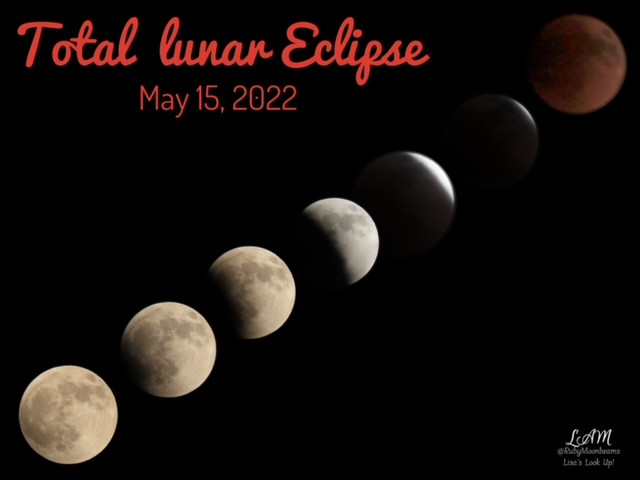
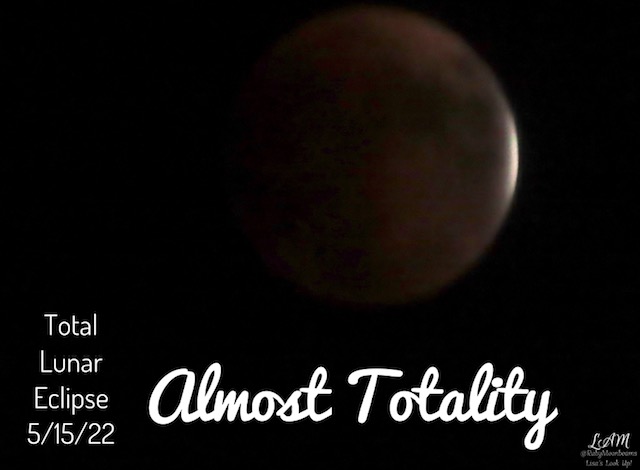
I did get lucky with the Total Lunar Eclipse on May 15

We managed to dodge the clouds long enough to get to totality before a solid wall of clouds and the rain started. Photos were taken from 10:10 PM EDT – 11:33 PM EDT (Morganville, NJ)

Posted in June 2022, Sidereal Times | Tagged , , | Leave a comment

Snippets

compiled by Arlene & David Kaplan

-Sky & Telescope

Spotting Dots on the Sun In the short time since its launch in February 2020, Solar Orbiter has already returned some incredible photos and data of the Sun. The joint European Space Agency–NASA mission is expected to have its biggest scientific breakthroughs when it tilts its orbit to be able to see the Sun’s poles — a region that we’ve never photographed…more

-Sky & Telescope
-NYT

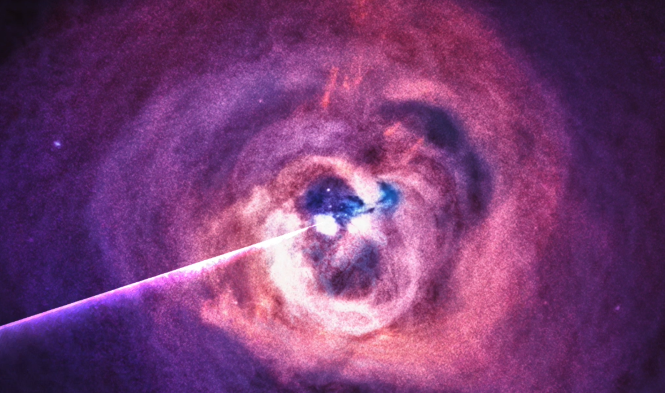
Hear the Weird Sounds of a Black Hole Singing In space you can’t hear a black hole scream, but apparently you can hear it sing. In 2003 astrophysicists working with NASA’s orbiting Chandra X-ray Observatory detected a pattern of ripples in the X-ray glow of a giant cluster of galaxies in the constellation Perseus…more

-NYT

Shards of the Planet Mercury May Be Hiding on Earth New research explains how meteorites called aubrites may actually be shattered pieces of the planet closest to the sun from the early days of the solar system. Mercury does not make sense. It is a bizarre hunk of rock with a composition that is unlike its neighboring rocky planets…more

-BBC

Interstellar probe: A mission for the generations Imagine working on a project you know you have no hope of seeing through to completion. Would you have the motivation to even get it going? Absolutely, says Ralph McNutt from Johns Hopkins University Applied Physics Laboratory (JHU-APL) in the US. McNutt, with colleagues, has just published a detailed reportmore

-BBC

Large hadron collider: A revamp that could revolutionize physics Deep underground amidst the Alps, scientists are barely able to contain their excitement. They whisper about discoveries that would radically alter our understanding of the Universe. “I’ve been hunting for the fifth force for as long as I’ve been a particle physicist,” says Dr Sam Harper. “Maybe this is the year”…more

-BBC

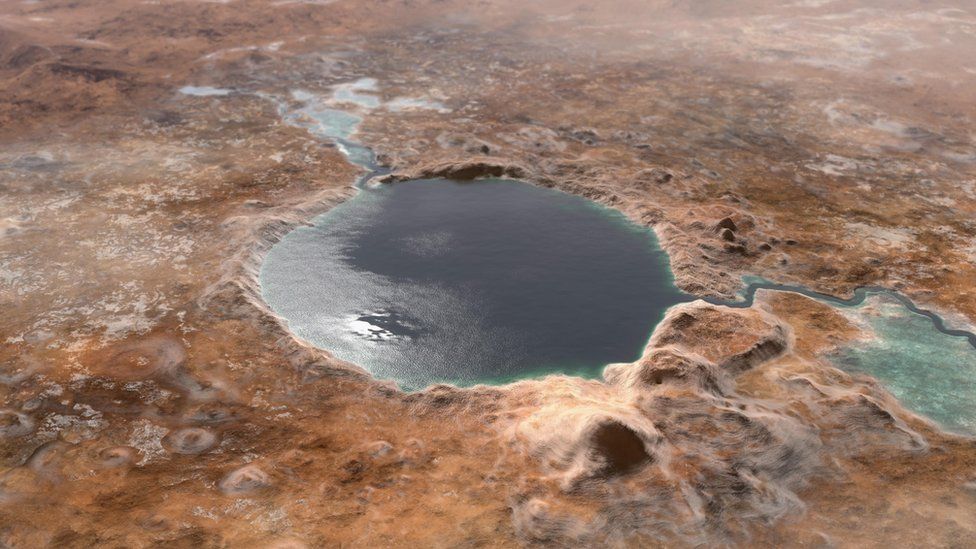
Perseverance: Nasa rover begins key drive to find life on Mars Nasa’s Perseverance rover has reached a big moment in its mission on Mars. Tuesday will see the six-wheeled robot begin the climb up an ancient delta feature in the crater where it landed. It will roll uphill, stopping every so often to examine rocks that look to have the best chance of retaining evidence of past life on the planet…more

– NYT

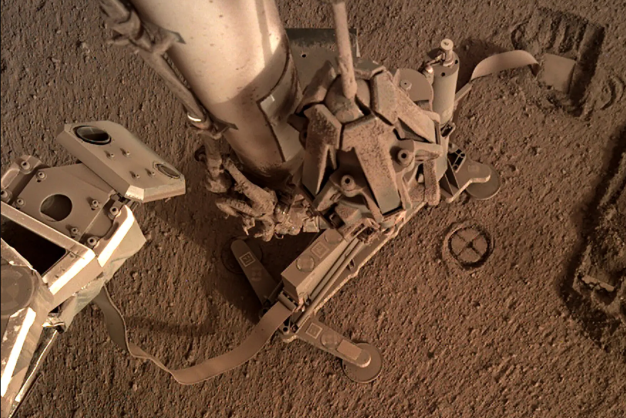
This NASA Mission Listened to Mars Shake, but Soon It Will Go Silent The InSight spacecraft, which carries a seismometer and studies the red planet’s insides, is expected to cease functioning by the end of the year. InSight, a stationary robotic probe on Mars, has been steadily growing weaker as dust accumulates on its solar panels…more

-BBC

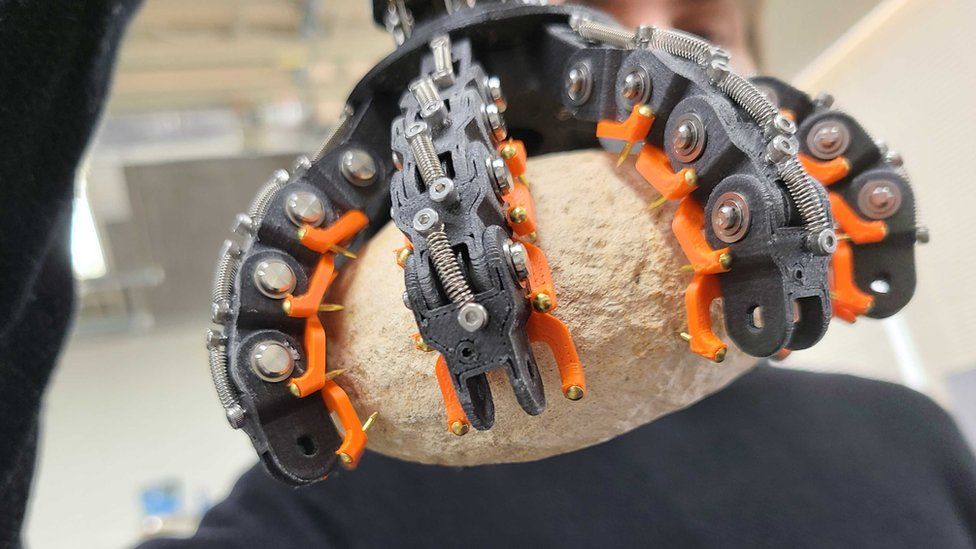
Asteroid mining “They essentially hold on to the side of the asteroid for dear life as it screams through the solar system.” Mitch Hunter-Scullion is describing a six-legged robot called Scar-e, the Space Capable Asteroid Robotic Explorer, which he aims to send to an asteroid to drill for precious metals such as iron, nickel and platinum…more

-BBC

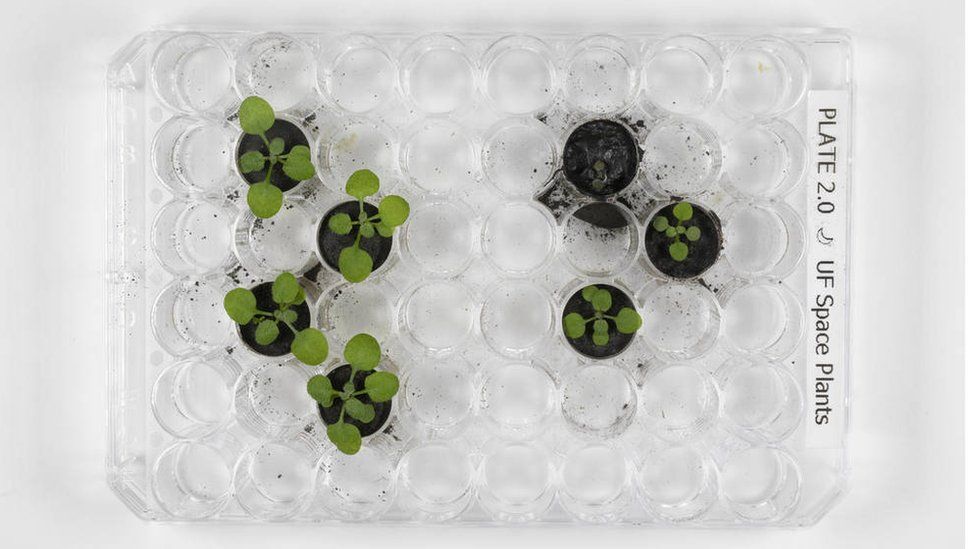
Moon soil used to grow plants for first time in breakthrough test Scientists have grown plants in lunar soil for the first time, an important step towards making long-term stays on the moon possible. Researchers used small samples of dust collected during the 1969-1972 Apollo missions to grow a type of cress. Much to their surprise, the seeds sprouted after two days…more

-BBC

Northumberland shooting star caught on one-in-million photo A family photo with the Northern Lights became a “one-in-a-million” shot after a shooting star flew in the background. Steve Swan, his partner Louise Redpath and their children were posing during a stargazing night in Northumberland on Saturday when the out-of-this-world event took place. Photographer Wil Cheung said he knew he would “never get that shot again”…more

Posted in June 2022, Sidereal Times | Tagged , | Leave a comment

From The Director

by Rex Parker, PhD director@princetonastronomers.org

Gravitate to Our Spring Events!  A total lunar eclipse, fantastic galaxies high overhead, and a close collection of planets before dawn make up a spectacular astro palette over the next month as spring emerges in full glory.  With social life returning to normal around the state, we’ve scheduled a few events to bring you back to shared astronomy experiences with fellow members – see the list below.  Note that the May 14 gathering is mostly a daylight event (starting at 5pm) to give us a chance to greet each other in person, maybe the first time in over two years.  On May14 we ask you to bring your personal telescope equipment to display and share your knowledge, or on the other hand learn how to set up and use it, ask questions and solve problems.  Shake off the cobwebs and get the hang of setting up your astro equipment in the daylight so you can better use it at night.  And if you feel like staying after sunset on May 14, this can be an observing night too.  But read on…

On Sunday May 15 we will have a total lunar eclipse here, and the Observatory will be open after sunset for members to observe it through the club’s top-notch telescopes.  The eclipse begins in earnest when the moon enters the deep shade part of earth’s shadow, the umbra, just after at 10:30 pm. Total eclipse begins about an hour later. Full eclipses occur on average only about once every 2.5 years at any given location, so don’t miss it.  And if you decide to get up before twilight that morning and throughout spring, you can see Saturn, Mars, Jupiter, and Venus all lined up in the southeast sky.

AAAP Spring Events

  • May 10, monthly meeting (7:30pm, Zoom);  election of officers;  guest speaker info below (see Victor’s article).
  • May 14, Rescheduled to May 22 – Members Day at Observatory (daytime event).  We’ll gather at 5:00 pm and continue into darkness as desired (sunset is at 8:08pm).  Meet and Greet, make contacts within the club, learn more about how to use your own telescope equipment (bring your telescope) and learn about the club’s observatory at Washington Crossing Park.   
  • May 15, Lunar Eclipse at Observatory (night event).  Moon enters umbra at 10:34pm, totality starts ~ 1hr later.  Members are invited to view the eclipse through telescopes — weather permitting.
  • June 14, monthly meeting (7:30pm) in person at the Planetarium in Trenton.  Hosted by Bill Murray, AAAP member and staff associate at the Planetarium.  This is the last meeting of the traditional academic season for AAAP.

Board Election May 10.  At the regular meeting on May 10 (Zoom) we will elect officers.  The bylaws set out 1-year terms for the 7 members of the Board of Trustees, with elections to be held at the May meeting.  Here I’d like to thank the Nominations Committee (Joy Saxena, chair;  Mark Walker, and Jennifer Sturgiss) for reaching out to the membership for candidates.  We got a couple of responses from newer members, but as the slate shaped up it has turned out to be the incumbents (below).  We do need to vote them in of course, so I am asking you to join us by Zoom for the May meeting.

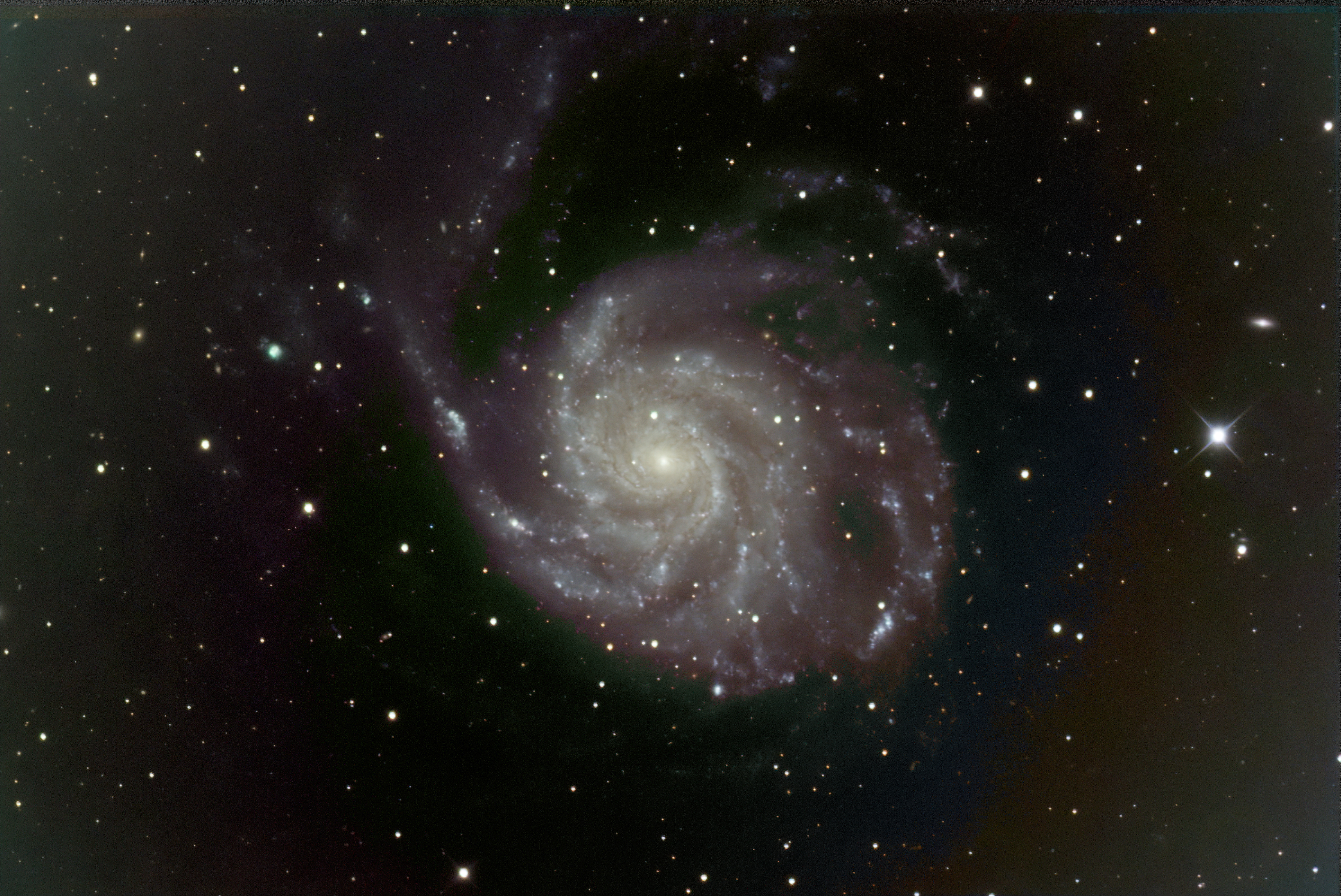
Don’t Miss It – the Best Season for Galaxies Is Spring.  Many dozens of galaxies are visible this month in small telescopes from right here in New Jersey, and even more if you’re doing astro video/photography with your scope. The constellations Virgo, Coma Berenices, Canes Venatici, and Ursa Major are chock full of galaxies, and these remain well overhead in good observing position after twilight all through May. A fine example is Messier 101 which I was fortunate to photograph last week (below).

The Pinwheel Galaxy, Messier 101, from a Telescope in New Jersey.  M101 is a face-on spiral galaxy about 25 million light-years away from us in Ursa Major.  It’s huge, about 170,000 light years diameter, twice the size of our Milky Way galaxy.  Astrophoto by RA Parker from NJ using 12.5” telescope and ASI2600MM LRGB filter technique, total exposure ~8 hrs.

Posted in May 2022, Sidereal Times | Tagged , | Leave a comment