Director Rex Parker attempted to convene the meeting at 1930 in Peyton Hall and on Zoom but his laptop decided to install an upgrade. While scrambling for a backup machine it completed but was unable to connect to the internet through the University guest wi-fi. Problems were sorted and the meeting was convened at 1951. He presented a very brief introduction including an image of the heart-shaped Antenna Galaxy in honor of Valentine’s Day, reminders that on the coming Friday comet C/2022 E3 would be very near Aldebaran and there would be a Jupiter-Venus conjunction on March 1. He also mentioned the surprising number of UFOs brought about by the recalibration of DoD radar to include very slow-moving objects.
At 1959 Program Chair Victor Davis introduced speaker Member John Church, PhD, and his presentation Cosmic Clockwork: Occultations, Eclipses & Transits. A question period followed at 2056.
NOTE: The recording of this and other AAAP talks can be found on the AAAP YouTube page at
There were 30 in-person attendees during the talk.
Following a break, the meeting was reconvened at 2105 with an Un-Journal presentation by Rich Sherman from Florida about adding a filter drawer to his imaging chain and the impressive benefits of the Optolong L-Extreme filter on nebulas.
A brief discussion considered whether it was only the radar recalibration or whether something more was happening with all the recent UFOs. No conclusions were drawn.
Mention was made of the upcoming astronomy fairs NEAIC on April 13-14 and NEAF on April 15-16. They are the world’s largest and should be experienced, even if one can manage keep the wallet securely in place.
Appreciation of the Astrovideo Live presentations was expressed along with the wish that they could be scheduled regularly. Scheduling was attempted but failed do to the availability of presenters and the NJ weather. It is best for them to be spontaneous.
It was proposed that we organize a trip to a good location to observe the solar eclipse in April 2024. Spring weather suggests that Texas might be the best destination, but Assistant Director Larry Kane has traditionally organized the field trips and should be consulted.
There was again mention of the threatened Holmdel Horn and the need to replenish the outreach handout materials at the observatory.
A meeting will be held in the Robbinsville Library about the UFOs at 1815 on February 22.
There was additional discussion about observing or imaging the comet.
The meeting was adjourned at 2201.
Our membership currently numbers 204. 16 have joined so far in 2023. We have had 19 renew while 6 have allowed their membership to expire, giving us a 76% retention rate.
Our AAAP merchandise store will shift to warmer weather apparel starting in mid-April. So if you want any winter gear, now is the time to place your order. Also, we are working to add another vendor that offers some additional apparel and non-apparel items. Stay tuned to future Sidereal Times for an update.
The AAAP store now has NEW merchandise that features our “Anniversary Edition” logo celebrating AAAP’s 60 years. Check it out at : https://aaap1962.logosoftwear.com/. The password is SiderealTimes.
The items with the new anniversary logo will have ” **Anniversary Edition** ” as the first words in the product description (note that the first 21 items on the page have the Anniversary Edition logo; the remaining items have our traditional logo). If you want a different color, or are looking for a product that you don’t see on the site, please email Rich Sherman at merchandise@princetonastronomy.org, and we will make every effort to get that item for you. Also, note that it takes about 3-4 weeks to receive your order.
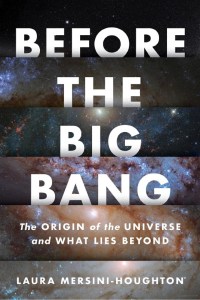
Before the Big Bang: The Origin of the Universe and What Lies Beyond By Dr. Laura Mersini-Houghton Grade: A-
Theoretical physicist, Dr. Laura Mersini-Houghton takes us on a journey through quantum physics and shows us that six signatures of a multiverse—which she predicted—really do exist in our cosmos. It is a remarkable revelation.
The book is demanding for the layman, especially those of us who are not well-versed in quantum physics. Thankfully, there are intermittent respites along the way, where Dr. Houghton shares the stories of her life and the life of her brilliant father during the difficult communist years in her native Albania. At just over 205 pages, the book seems longer due to the complexity of the subject and Dr. Houghton’s effort to build her argument for a multiverse, requiring references to complex math and properties of quantum physics.
So is the book worth it? Absolutely. But like all long journeys, there are moments of fatigue when you feel like giving up. But in the end, you discover the multiverse and that is really cool.
I have been a member of AAAP for many years but I have not been able to attend meetings lately due to my schedule. I have been broadcast engineer for most of my career but in 1998 I was contracted to supervise the design and construction of the Hayden Planetarium in NYC. It changed my life. In 2011 I joined the staff of Evens & Sutherland, assisting them with building planetariums internationally. While there I build my own small 4’ diameter portable planetarium based on the Digistar software and started teaching in public schools. I also taught for Northrop Grumman at conferences and public events about the JWST.
Along the way I met and became close friends with the late Prof. Jay Pasachoff of Williams College who asked me to build a planetarium as well. Jay invited me to my first Total Solar Eclipse in China in 2009 where I captured several videos of the event. It was my first time using a $100 equatorial mount for the live video camera.
In 2012 Jay invited me to join his team atop Haleakala to make a time lapse video of the last Transit of Venus in our lifetime. I purchased my first real mount and scope and just barely managed to align it in time for the 6.5 hour event.
On returning from the TOV I did a presentation for the AAAP where I met Robert Vanderbei. Robert approached me and asked if I could find a single image from Maui that matched images he shot from Princeton. We found two that were time stamped the same moment. Robert published a paper showing how it was possible to measure the AU from the two images.
Over the years Robert has inspired and mentored me in refining my ability to align my scope to the point of being able to image deep space objects. My equipment is modest but I have a lot of fun.
Along the way I have continued to make time lapse videos of celestial events.
Presently I am upgrading two new planetariums, one for me and one for Williams College. They are based on the new E&S D7 software and will run in 4K. I have a lot of software to update and will need to re-render many of the videos. When I finish the upgrade perhaps I can do a demo for the AAAP, it will be few months yet.
With the help of Jay Pasachoff, I was given access to 4k frames from the SDO to do some studies of various Solar structures. Here is just a tiny taste: https://youtube.com/shorts/6_Z6nPPUNy8?feature=share I have many more but have not posted them.
If you are interested, I have also posted recordings I made of the Voyager II flyby of Neptune. Voyager is one of my many obsessions. https://youtu.be/Xp22IEmotRU
Here are the two recent videos I posted on YouTube of the “Green Comet”
Hi, I am Yugandhara Luthra, a junior attending Princeton High School in New Jersey. My passion lies in the fields of science and mathematics, with a particular fascination for space exploration and its endless possibilities. As a participant in the PHS Research Program, I am fortunate enough to delve into research projects centered around stars, exoplanets, and particle accelerators. I continuously challenge myself with advanced courses from Harvard University in the field of astronomy and physics.
I am dedicated to making a positive impact on the world beyond my academic pursuits. As a leader and participant in PHS Food Aid and PHS IDEAS Center initiatives, I work on projects that benefit our community and address critical issues facing humanity. Additionally, I hold the roles as Vice-President for Odyssey of the Mind and VP-Logistics for the Science by the Scoop club at PHS. Through these various leadership positions, I am able to contribute my skills and expertise to diverse projects and collaborate with others to create positive change.
Regarding my extracurricular pursuits, I find solace in golf and reading, which provide me with a serene retreat to unwind and reconnect with myself–after a busy day or a demanding week.
Huntsville, Alabama is known as the Rocket City. This is where the rocket scientist Wernher Von Braun worked on designing rockets to fly to the moon. At what is now named as Marshall Space Flight Center, named for the late Secretary of State George Marshall.
In the 1940s, Huntsville was selected as a location for chemical weapons manufacturing for the war effort, and the Army established the Redstone Arsenal. After World War II, the base became the rocket and missile facility where Wernher Von Braun guided the development of the Redstone, Jupiter, and Pershing missiles. And the rockets that sent the first U.S. satellite into orbit and the first astronauts to the moon.
Von Braun had the idea of creating a space center open for the public so that they can better appreciate what the rocket scientists do. The state of Alabama agreed with him and thus was born the US Rocket and Space center. I had the good fortune of visiting there recently. The pictures shown below have been taken using my iPad pro. The picture below shows the main building and the parking lot.
The picture below shows the Saturn V rocket which boosted the Apollo spacecraft towards the moon. The scale of the rocket is evident from the other objects in the background. It dwarfs everything else. The Saturn V rocket is also there in Kennedy Space Center in Florida and Johnson Space Center in Houston. But in Huntsville, it stands towering and is visible from neighboring roads and highways for miles.
The picture below is of the same Saturn V rocket lit up as it was getting dark. The dimmer spot of light slightly to the left of the upper tip of the rocket is the planet Saturn !. The main building has a cross section of the Saturn V laid end to end horizontally. And each section explained in detail.
Unlike Kennedy Space Center in Florida where the Spacecraft and rockets are assembled and launched, and in Johnson Space Center where astronaut training and mission control exists, in Huntsville, the rockets and spacecraft are designed and different components like the engines are tested. It is basically an engineering shop for rockets and spacecraft. Marshall Space Flight Center is where the work gets done while the US Rocket and Space Center is where the exhibits educate the visitors. They are just a few miles apart.
Given below is a picture of a mockup of the Artemis spacecraft which recently went to the moon and came back to the earth. While Apollo is the history of the space program, Artemis is the future. The Artemis was launched using SLS (Space Launch System) which is a recent version of Saturn V. SLS along with SpaceX’s Starship rocket represent the future heavy launch vehicles.
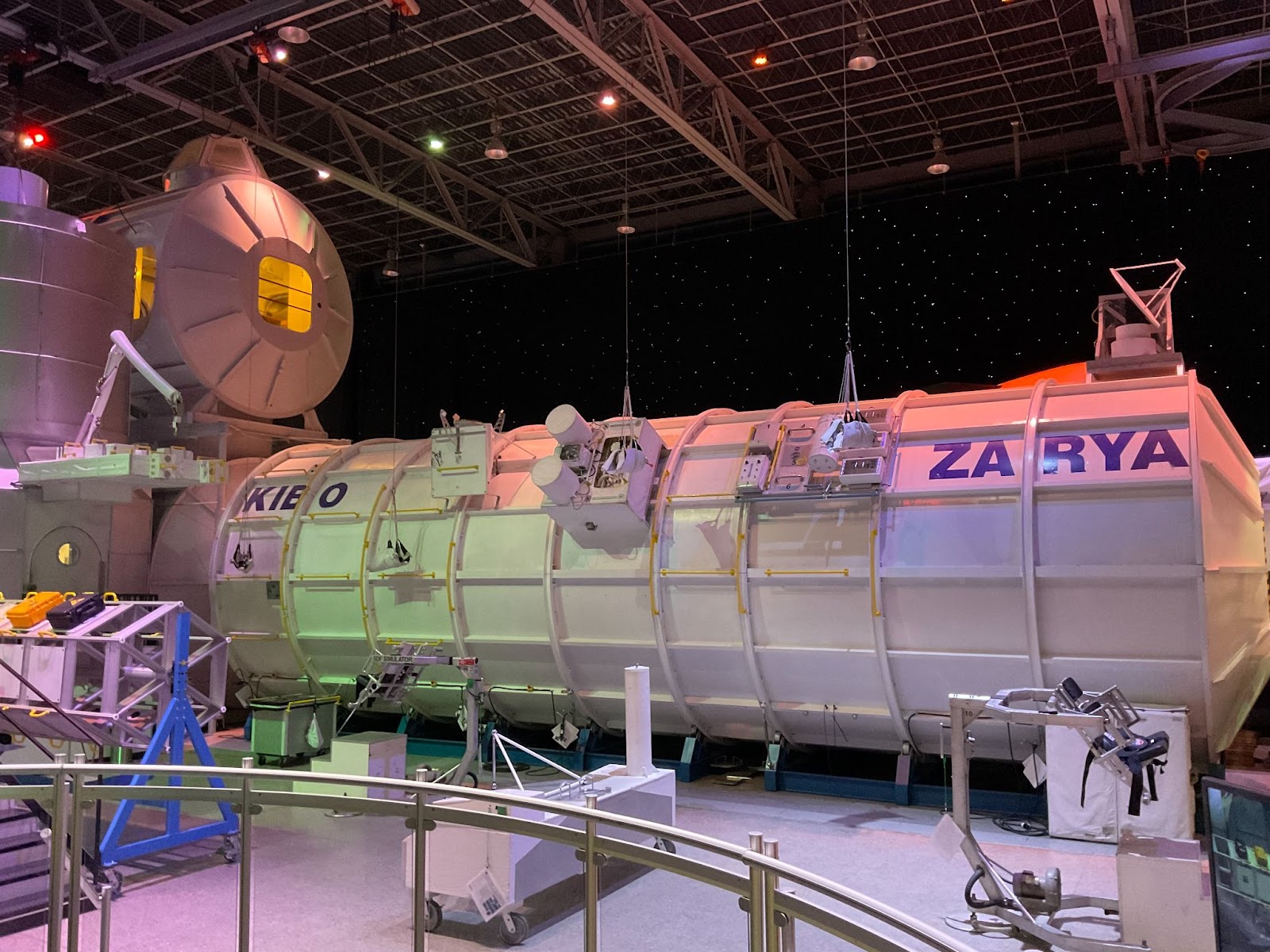
The picture given below is a mock up of the Russian module of the International Space Station called Zarya. Given the current geopolitical situation, it is difficult to imagine a Russian component being part of an international endeavor.
The US Rocket and Space Center also runs a space camp for anyone interested in getting a hang of how the astronauts are trained. Three day camps and week long camps are the most popular ones. I hope to attend one of these camps some day!
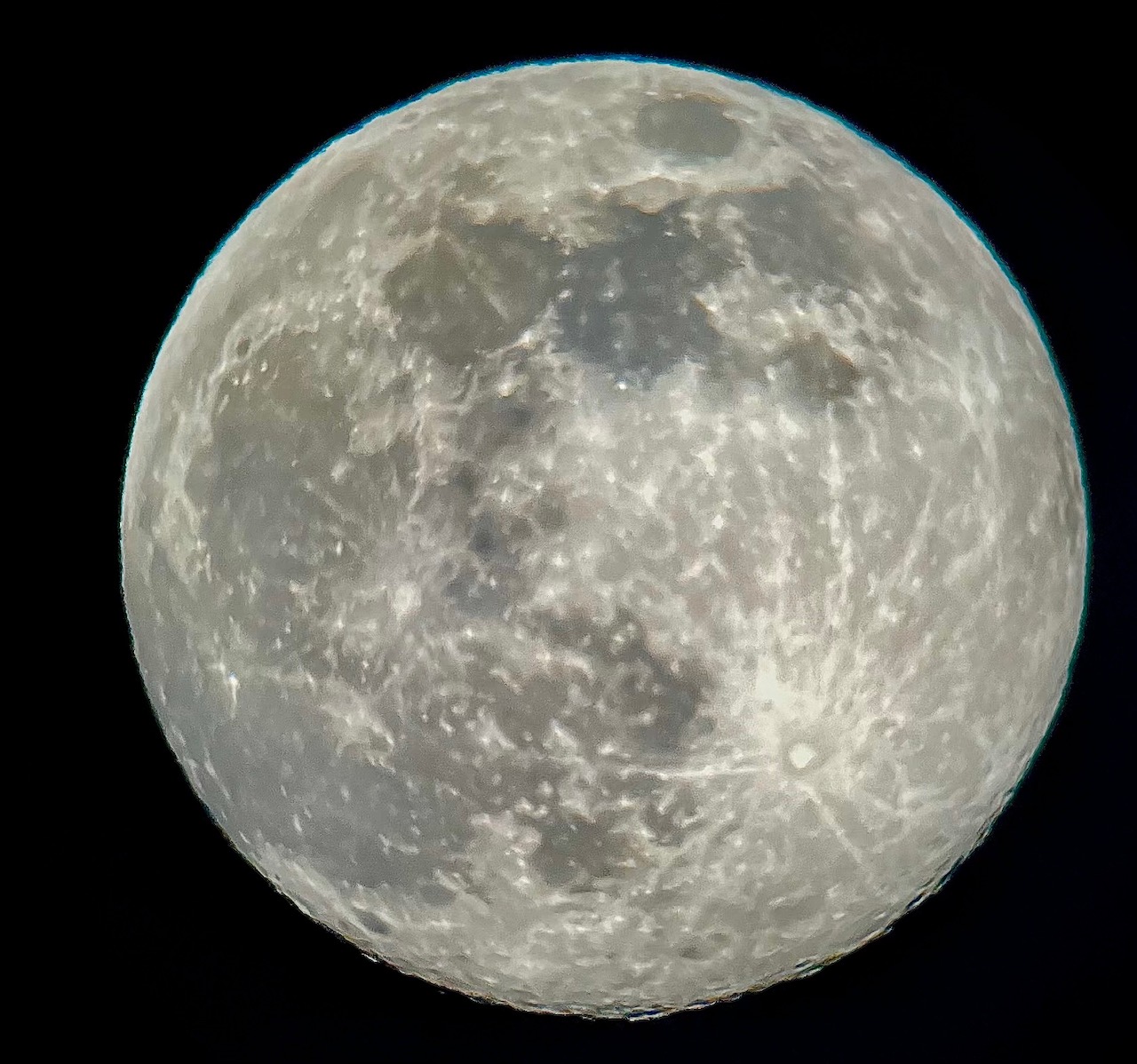
Most of my attention was turned to Venus and Jupiter for the month of February (clouds permitting.) Here’s hoping for clear skies for the conjunction.
An almost full Moon – February 4, 2023Not the best, but a doc shot of Comet ZTF and MarsFebruary 24, 2023 – Waxing Crescent Moon, Jupiter and VenusCloseup of the 26% Waxing Crescent Moon – February 24, 2023
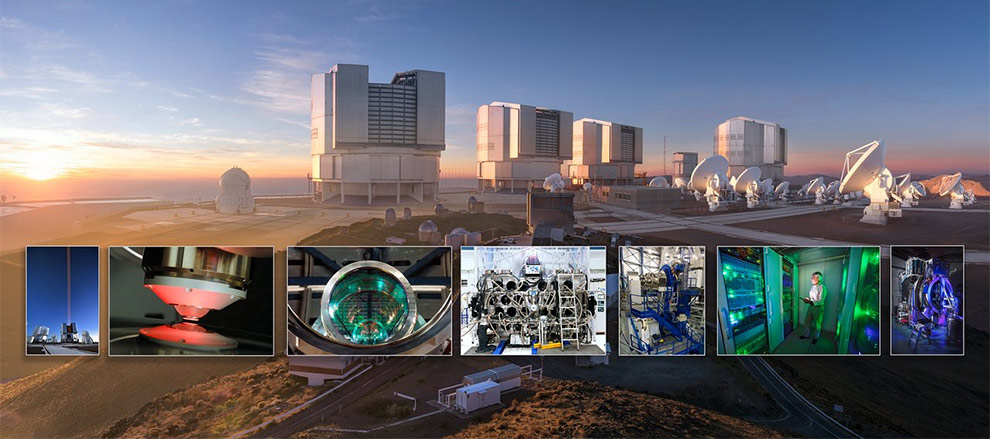
Telescopes and Instrumentation As set out in its convention, ESO provides state-of-the-art-facilities for Europe’s astronomers and promotes and organises cooperation in astronomical research. Today, ESO operates some of the world’s largest and most advanced observational facilities at three sites in northern Chile: La Silla, Paranal and Chajnantor…more
-BBC
Dark sky: Could Wales soon be home to four zones? A swathe of the north-east Wales uplands could soon be recognised as a hotspot for gazing at the stars. The Clwydian Range and Dee Valley Area of Outstanding Natural Beauty (AONB) plans to submit a bid for global recognition as a dark sky zone…more
-NYT
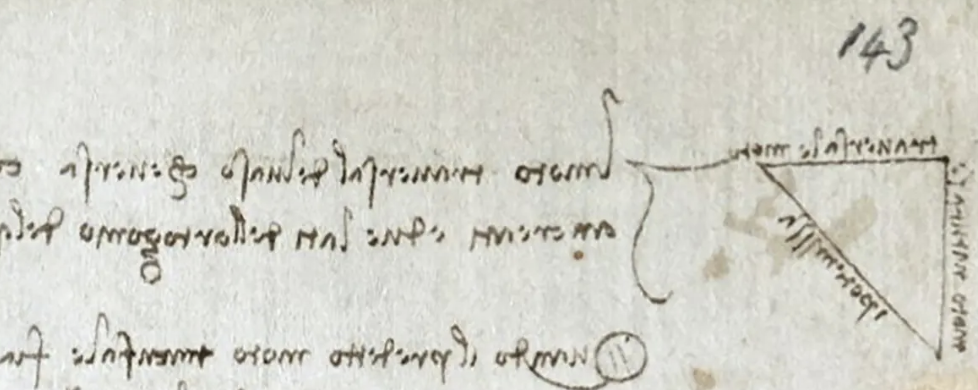
A Doodle Reveals da Vinci’s Early Deconstruction of Gravity Long before Galileo and Newton used superior mathematics to study a fundamental natural force, Leonardo calculated the gravitational constant with surprising accuracy…more
-NYT
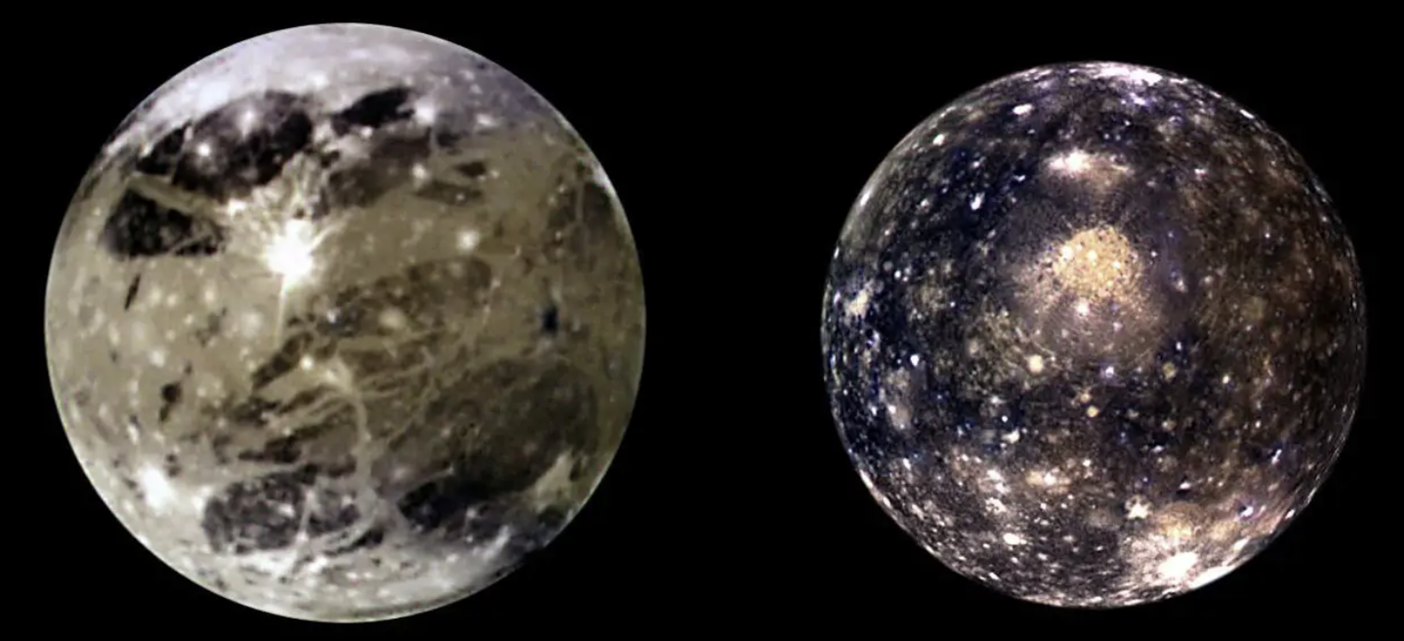
New Auroras Found Glowing in the Skies of Jupiter’s Moons A sightseeing alien touring our solar system would do well to check out the emerald and blood orange-red ribbons of Earth’s auroras. But our world isn’t the only one with spectacular light shows in its atmosphere. New research shows auroras can also be seen on the Galilean moons of Jupiter…more
-NYT
Killer Asteroids Are Hiding in Plain Sight. A New Tool Helps Spot Them. Ed Lu wants to save Earth from killer asteroids. Or at least, if there is a big space rock streaking our way, Dr. Lu, a former NASA astronaut with a doctorate in applied physics, wants to find it before it hits us — hopefully with years of advance warning and a chance for humanity to deflect it…more
-NYT
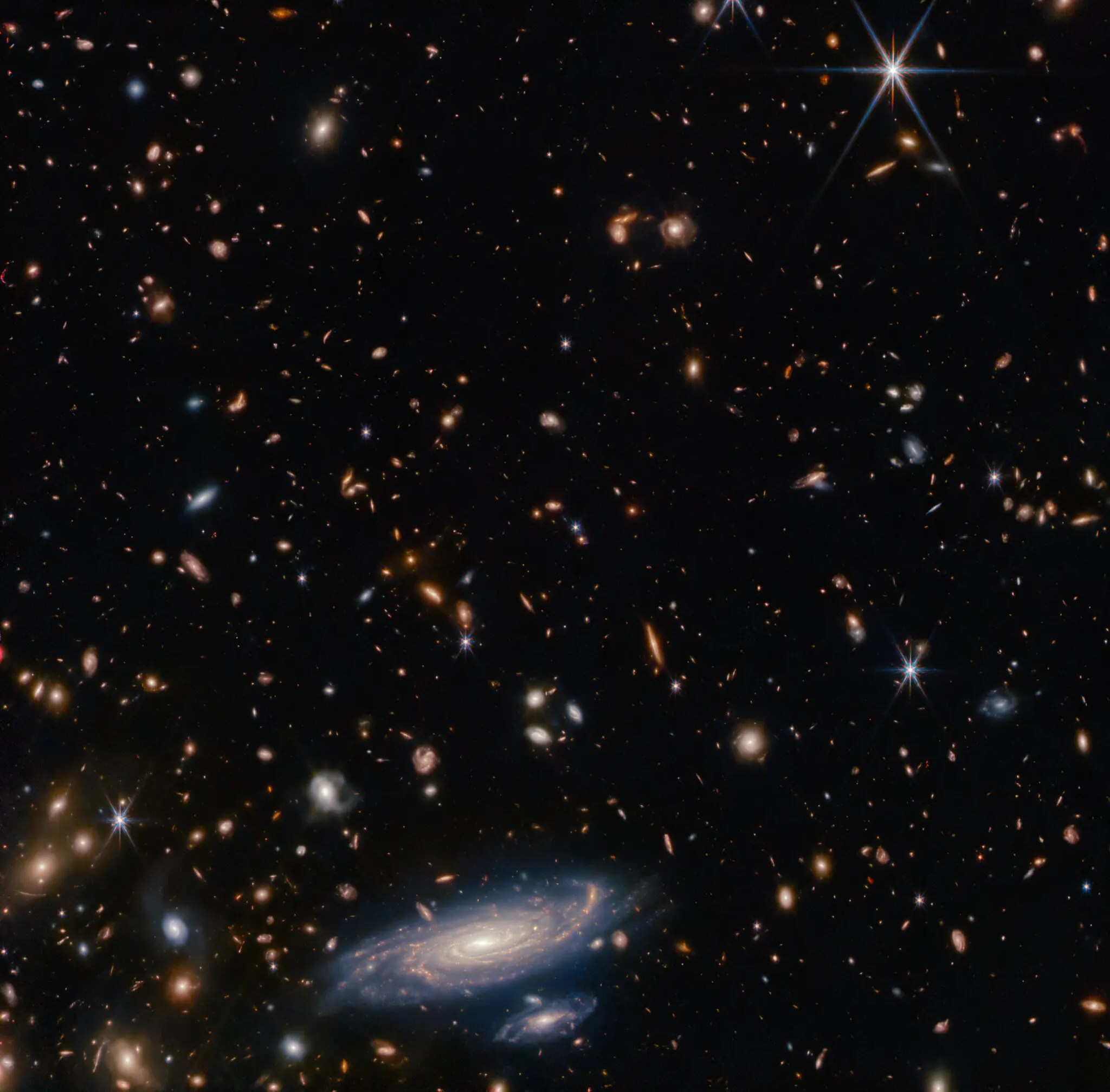
Webb Telescope Spots a Distant Spiral Galaxy Like Our Own In the unfathomable darkness and time that is the universe, every star is an omen of hope, a promise of life and shelter, like the lights of a distant ship on a cold sea. And so, courtesy of the James Webb Space Telescope, here is another reminder of the fecundity and generosity of nature: thousands of galaxies…more
-BBC
Nasa’s Mars rover Perseverance completes rock depot Nasa’s Perseverance rover has finished building a rock depot on Mars. It’s laid down a series of tubes on the ground containing a variety of rock and environmental specimens. The depot will serve as a reserve cache to be brought back to Earth in the event Perseverance is unable to complete the next stage of its mission…more
-NYT
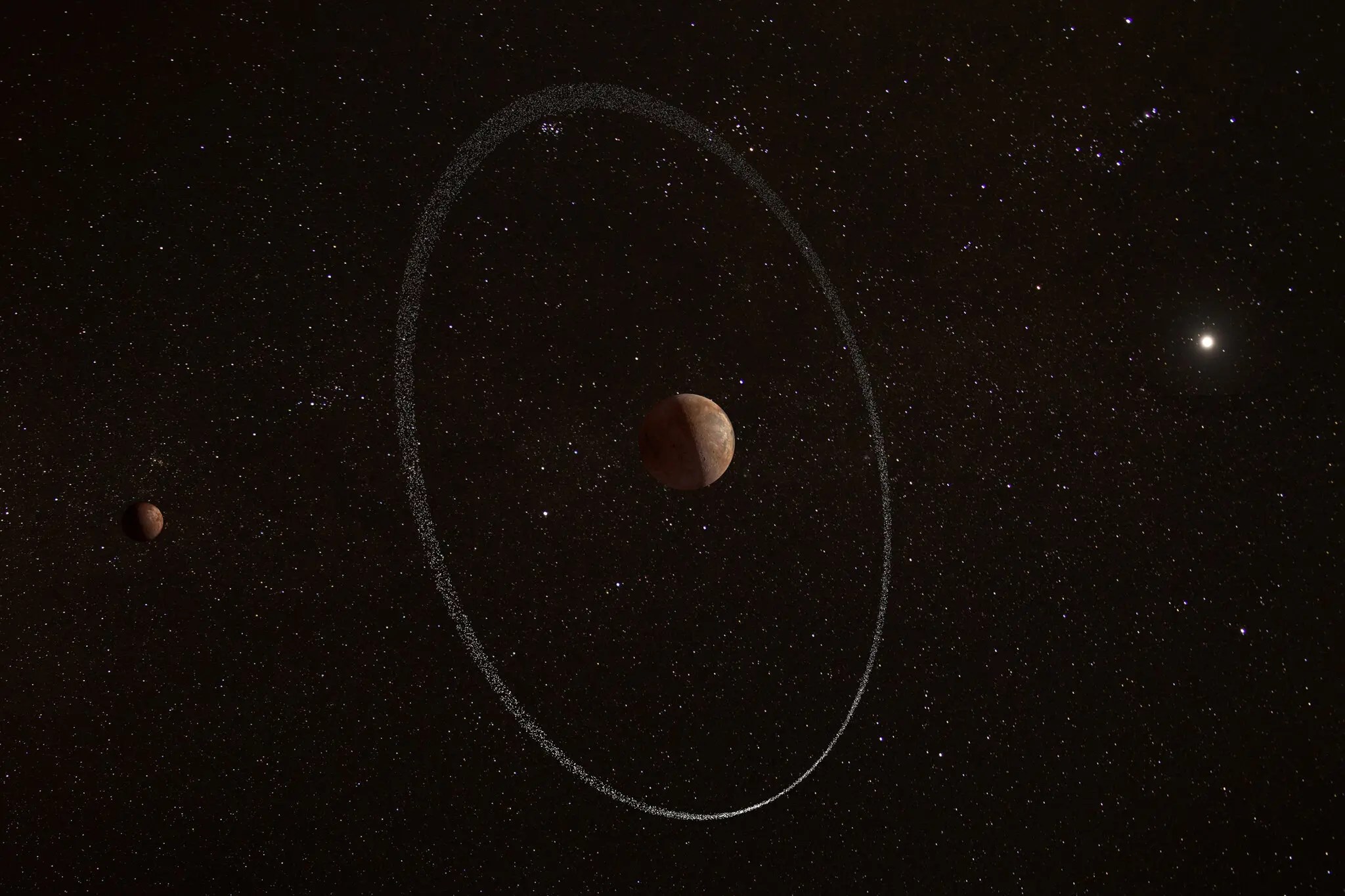
There’s a Ring Around This Dwarf Planet. It Shouldn’t Be There. A small icy world far beyond Neptune possesses a ring like the ones around Saturn. Perplexingly, the ring is at a distance where simple gravitational calculations suggest there should be none. “That’s very strange,” said Bruno Morgado, a professor at the Federal University of Rio de Janeiro in Brazil. Dr. Morgado is the lead author…more
-BBC
James Webb telescope traces arcs of dusty star formation It’s another stupendous image from the new super space telescope James Webb. The picture shows NGC 346, a region about 200,000 light years from Earth where a lot of stars are being created.Webb’s Near Infrared Camera traces the knots, arcs and filaments of gas and dust that are feeding this stellar nursery….more
by Rex Parker, PhD director@princetonastronomers.org
Meet on Campus Feb 14
We’ll be back at Princeton Feb 14 for the monthly meeting with hopes that the Peyton Hall auditorium AV upgrade is finished so we can run this as hybrid-virtual. If you absolutely cannot make it physically there will be a Zoom link for the live meeting sent by email and on the website. The massive construction project across the street continues and the old parking lots are gone forever. So the University wants us to park (free) in the new garage at 148 Fitzrandolph Rd, off of Faculty Rd. That means a 15 minute walk around the football stadium to Peyton once you park your car. Our guest speaker will be John Church of AAAP. For more information on John’s presentation and for the walking route map to Peyton Hall, see Victor’s article below
We’re looking for additional members to give an Un-journal Club, a brief informal presentation for the second half of the meeting. “Un-journal” means this is not grad school, you don’t need scholarly journal-like topics, just what you care about in astronomy. You can use PowerPoint slides, JPEG’s, astro-images, travel pictures, book reviews, whatever you want (you can bring a USB memory stick to use on my laptop, or your own laptop). To get onto the schedule for an upcoming meeting, please contact us.
AAAP Astro-Imaging Interest Group Formed
In response to growing interest in the club and technical innovations in the field, we have created a new special interest group dedicated to hands-on astro-photography in its many forms. Michael DiMario is appointed chair (thanks Michael!) and will be coordinating future sessions. Members will have received emails last month describing the proposal and an invitation to join the group. If you are interested but didn’t respond yet please contact me.
Astro Geo Connections to Extraterrestrial Objects
The distinctions between astronomy and geology blur when the object of study goes from interplanetary to earthbound. Comets and asteroids, meteors and meteorites, all have their own geochemistry story to tell. The stakes and interest have never been higher for transient near-earth objects, especially after the book “Extraterrestrial” by Avi Loeb (AAAP’s guest speaker and topic last October) threw down the gauntlet for bolder interpretation of certain unusual interplanetary objects. Dr. Loeb of Harvard, head of the Galileo Project, recently described on his blog how he is going to lead an expedition to collect fragments of the first interstellar meteor which crashed into the south Pacific in 2014. The Galileo Project expedition received more than a million dollars in funding for this and they have a boat and team of professionals experienced in ocean expeditions. They are designing and manufacturing the required sled, magnets, collection nets and mass spectrometer to find an interstellar object.
In Jan 2014 an object from interstellar space (labeled IM1) hit Earth at high speed, and the fireball disintegrated into fragments off the coast of Papua New Guinea. From the observations available Loeb identified this as the first interstellar meteor ever discovered, confirmed in 2022 by the US Space Command under the Dept of Defense and NASA. The data on the path and energy released by the fireball suggested its composition was unlike other meteors in the near earth object catalogs. This has inspired the Galileo Project looking for the meteor fragments on the ocean floor. Analyzing the fragments’ composition could indicate whether the object is natural or artificial. For more insight into the nature of this object see a recent paper by Loeb https://lweb.cfa.harvard.edu/~loeb/ALS.pdf.
The Legacy of Astronomer Fritz Zwicky
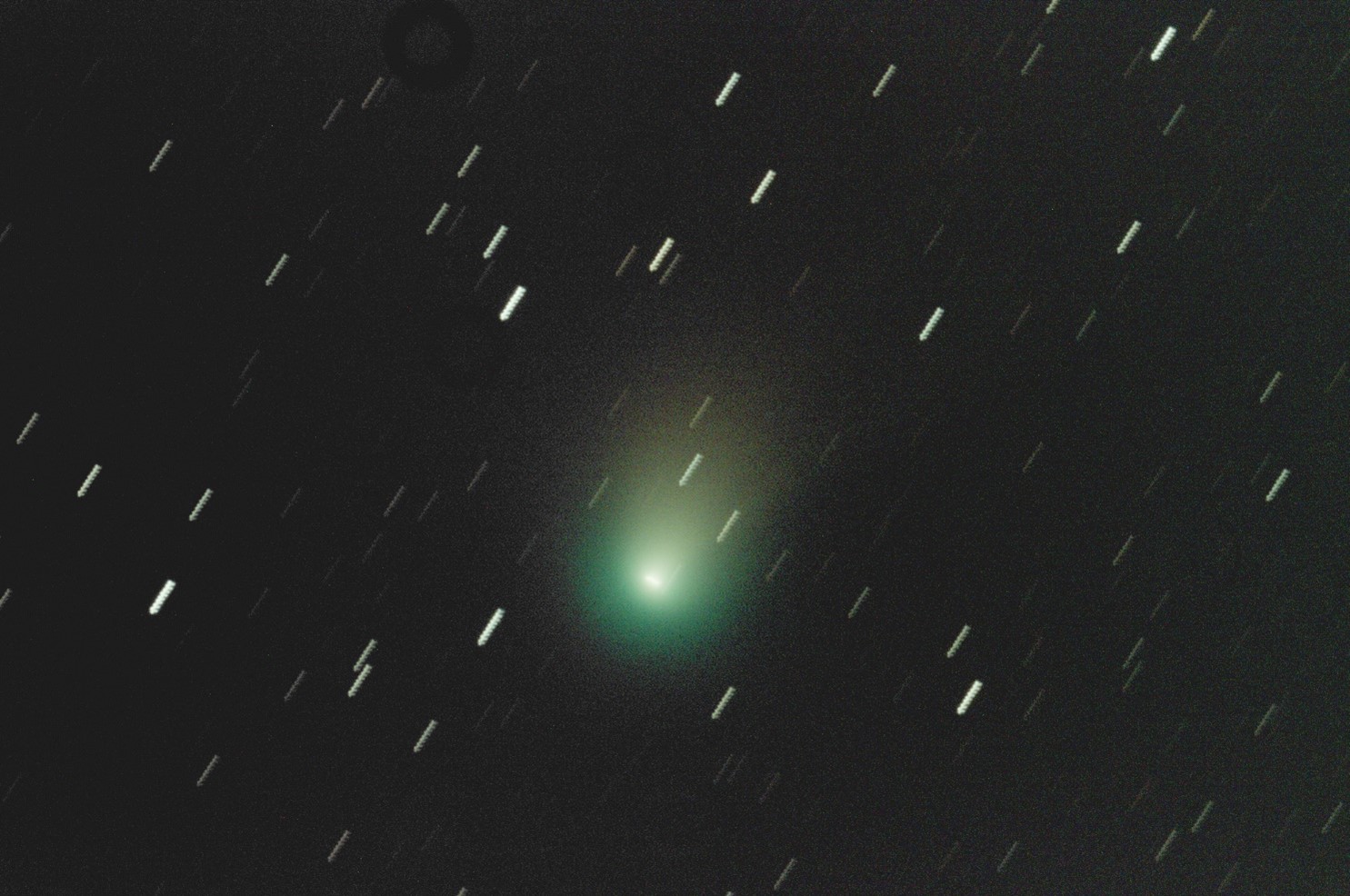
An otherwordly news item keeps popping up in the media these days. Dubbed by the media as “the green comet”, this interplanetary visitor from the Oort Cloud is C/2022 E3 (ZTF). The name translates as the 3rd comet discovered in the 5th two-week period in 2022 by the Zwicky Transient Facility (see https://www.ztf.caltech.edu/. Named for the brilliant though apparently difficult Cal Tech astronomer Fritz Zwicky, today’s ZTF project is the offspring of the National Geographic-Palomar Sky Survey conducted in the 1950s – emulsion astrophotography days. This was the first advanced photo-telescopic survey of the deep sky, reaching 22nd magnitude. The new ZTF survey is built around the same 48” Oschin Schmidt camera telescope constructed by Cal Tech in the 1940s. The original Palomar survey photographic plates were digitized decades ago and distributed as a 102-CD disk collection. It survives today as one of the optional databases in TheSkyX,software running at the club observatory (and my own). Now the Oschin Schmidt is adapted for a very large CCD sensor to provide a 47 square degree field of view and covers the whole northern sky every two nights sequentially repeating. The fast cadence is part of the innovation of time-domain astronomy, looking for fast-movers and transients including near-Earth asteroids, comets, and distant supernovae.
An Appreciation of Green Chemistry
The green color in a comet’s core but not tail is an intriguing puzzle only recently solved. It is not the same photochemistry as other astrophysical processes, for example the blue-green fluorescence emission from doubly-ionized oxygen (OII) in planetary nebulae. The nucleus of a comet is an agglomeration of rock, dust, and frozen gases. As it gets closer to the sun and larger in our skies, heat increases and causes sublimation of gases to form a nebulous envelope around the nucleus, the coma. The tail is an extension of the coma’s molecules drawn out by the solar wind. Yet the green around the nucleus disappears in the tail which instead displays a distinct reddish brown color.
It was long speculated that a comet’s green comes from the breakdown of the reactive molecule dicarbon (diatomic carbon, C2). Dicarbon is abundant in the galaxy and the solar system but kinetically unstable on earth; in flames it quickly polymerizes to carbon soot. The multiple valence states occupied by electrons of dicarbon give rise to a colorful optical spectroscopy. The famous British physicist and chemist Wollaston, member of the Royal Society, analyzed blue-green flames in 1802 — the first study of dicarbon.
A recent photochemistry lab experiment provides deeper evidence supporting a mechanism for cometary green glow. UV-laser irradiated dicarbon dichloride was analyzed spectroscopically (Borsovszky. Proc Natl Acad Sci USA 2021, Vol 118, No 52). The sample was exposed to UV plus longer wavelength radiation to generate a metastable state (a radical) of the C2 molecule in a cuvette. The radical then decays and emits a characteristic green photon. The unique emission spectrum of photo-activated dicarbon is known as the Swan band, after the famed Scots physicist Swan in the 1850s. Swan bands are characteristic of carbon stars and some nebulae as well as comets. The emission wavelength (color) is very sensitive to the environment because the chemical species producing it is short-lived. Based on the study cited above, the half-life of the dicarbon radical is only ~2 days when the comet is about 1AU from the Sun. This is the strongest physical chemistry data available explaining why a comet’s head but not tail glows green, as the coma’s dicarbon radical with short half-life dissipates in material streaming out to the tail.
Green color in the coma fades away in the tail in comet C/2022 E3 (ZTF). The image is from my home observatory before sunrise on Jan 10 using a 12.5” reflector, tracking on the comet so the stars are trailing. The image is made from 15×2 min subframes with an ASI071MC CMOS camera.
The February, 2023 meeting of the AAAP will take place IN PERSON on Tuesday, February 14th at 7:30 PM. As usual, the meeting is open to AAAP members and the public. It’s worth noting that this is Valentine’s Day, and members are reminded to be extra thoughtful toward our life partners who tolerate, and occasionally encourage, our astronomical proclivities.
Hybrid Meeting
You may choose to attend the meeting in person or participate via Zoom or YouTube as we’ve been doing for the past few years. (See How to Participate below for details). Participants who choose to participate virtually will be able to log in to the meeting as early as 7:00 pm to chat informally with others who log in early. We’ve had some security concerns during a past broadcast, so we’re re-instituting the Zoom waiting room. Please be patient for the host to recognize you and grant you entry into the meeting. Be aware that you must unmute yourself to be heard by other participants.
For the Q&A session, you may ask your question using Zoom’s chat feature or you may unmute yourself and ask your question directly to the speaker. To address background noise issues, we are going to follow the rules in the table below regarding audio. If you are not speaking, please remember to mute yourself. You are encouraged, but not required, to turn your video on.
I’ll be out of town for the meeting, but plan to participate via Zoom and introduce the guest speaker as usual.
Featured Speaker: John Church, PhD Retired Research Scientist Long-time member of AAAP j.church@mindspring.com
Cosmic Clockwork: Occultations, Eclipses, and Transits Occultations, eclipses, and transits are among the most impressive solar system events we can observe. Once portents of doom or omens of the machinations of deities, these events are vivid illustrations of celestial mechanics. Our ability to predict them accurately signals the attrition of magic into rational thought. Nevertheless, they are magical events. At no other times can we get such a sense of the power associated with the movement of massive objects in our relatively near cosmic neighborhood. In particular, a total solar eclipse is an unforgettable experience as the entire landscape quickly darkens and the sun’s magnificent corona appears for a short time.
These events have also been of deep scientific interest on many occasions. Transits of Venus were formerly used to determine the scale of the solar system. Timings of lunar occultations helped refine long-term estimates of the gradual recession of the moon. Historical records of ancient eclipses were useful in pinning down the gradual slowing of Earth’s rotation due to tidal friction. Studies of the sun’s corona enabled advancements in solar physics. Modern techniques have largely taken over in these areas, but such occasions will always remain of deep human interest.
John Church, PhD A native of Richmond, John Church graduated from the University of Virginia with a bachelor’s degree in chemistry and then earned M.S. and Ph.D. degrees from Lawrence University in Appleton, Wisconsin. His thesis work was concerned with the reaction of crystalline carbohydrate derivatives with oxygen under relatively mild conditions. He spent his career in research and development with American Can Company at their Corporate R&D laboratory in Princeton and then with Colgate-Palmolive at their Corporate Research Center in Piscataway.
John is the author of sixteen scientific, historical, and technical publications, including several on the optics of refracting telescopes as well as one on close conjunctions of Jupiter and Saturn. He holds ten U.S. patents and is the author of a book chapter on the chemistry of bleach. He has written three books and edited several others. One of his Sky & Telescope articles traced the history of the 6 ¼ inch Hastings-Byrne refractor now installed in our observatory in Washington Crossing State Park, which he and many others helped build in the late 1970’s.
John has served as Assistant Director, Director, and Program Chair of the AAAP. This September will mark his 53rd year as a club member. His civic activities include presently serving on the West Windsor Township Zoning Board of Adjustment. He is married and has three children and six grandchildren.
In 2017, John organized a trip to Oregon to watch the Total Solar Eclipse. He recorded the visit in this document “The Total Eclipse“.
AAAP webcast: This month’s AAAP meeting, beginning with Rex’s opening remarks and ending at the beginning of the business meeting, will be webcast live on YouTube and recorded for subsequent public access on AAAP’s YouTube channel. Be aware that your interactions during this segment, including questions to our guest speaker, may be recorded for posterity.
Join YouTube Live to listen to the speaker John Church using the link below –
This session will be recorded and saved on YouTube. Send me an email at program@princetonastronomy.org if you have any concerns
Using Zoom: While we are social distancing, the AAAP Board has chosen to use Zoom for our meetings, based on our belief that many members have already used Zoom and have found it easy to use. One of its great features is you can choose whether you want to install the software on your computer or use it within your browser.
Please make sure you have Zoom installed on your computer. You do not need a Zoom account or to create one to join the meeting. Nor are you required to use a webcam.
Please see below for the link to the meeting, or visit our website.
There is no “Unjournal Club” presentation scheduled this month. As you may know, guest speakers receive a baseball cap with the AAAP logo embroidered upon it as a “thank you” for making a presentation to us. We’re expanding the hat giveaway to members who contribute an “Unjournal Club” presentation to encourage participation.
We hope to make these short presentations a regular feature of our monthly meetings. We’d like to know what members are doing or what members are thinking about in the broad range of topics encompassed by astronomy. A brief ten-minute (or so) presentation is a good way to introduce yourself and the topics you care about to other club members. If you are interested in presenting a topic of interest, please contact either director@princetonastronomy.org or program@princetonastronomy.org.
A look ahead at future guest speakers:
March 14, 2023
Joe DePasquale, Space Telescope Science Institute Joe is Senior Data Imaging Developer in the Office of Public Outreach at the Space Telescope Science Institute. A colleague of January’s guest speaker, Alyssa Pagan, Joe will describe his work turning data from the James Webb Space Telescope (JWST) into images combining science and art to illuminate our perspectives on our universe.
April 11, 2023
Ira Polans, former Program Chair of AAAPIra will speak briefly on The Anasazi of the Southwest: Chaco Canyon and the Sun Dagger and then introduce the film The Sun Dagger, narrated by Robert Redford. The film tells the story of its exciting discovery in the 1970s by Washington artist Anna Sofaer and its subsequent investigation. It also examines the life and culture of the Anasazi (Ancestral Puebloan) Indians who built the calendar and thrived in the arid canyon environment a thousand years ago. Since then the sun dagger has marked the seasonal solstices and equinoxes in vivid symbolic images of light and shadow on stone. Join us to learn more about this fascinating discovery!
NOTE: This film is solely for in-person viewing, as copyright restrictions will not permit broadcasting it on the internet. This meeting will not be a hybrid meeting.
May 9, 2023
Alain Maury, Astronomer and discoverer of comets and asteroids. Alain Maury operates a time-sharing observatory near San Pedro de Atacama, Chile. He’s also an active observer and discoverer or co-discoverer of several dozen comets and asteroids, several of which (i.e. 3780 Maury) were named in his honor. He’ll talk about his observatory, its operation, and his numerous astronomical activities.
June 13, 2023
Bill Murray, AAAP’s Outreach Director and staffer at NJ State Museum planetarium Bill will give his traditional planetarium show at the New Jersey State Museum in Trenton.
Summer Hiatus
Later this fall
Gary Rendsburg, Distinguished Professor of Jewish Studies and History at Rutgers Prof. Rendsburg will talk about “The Jewish Calendar,” with emphasis on its astronomical connections to lunar months, intercalated month to adjust to the solar year, festival days, and new moon observances.
As always, members’ comments and suggestions are gratefully accepted and much appreciated.

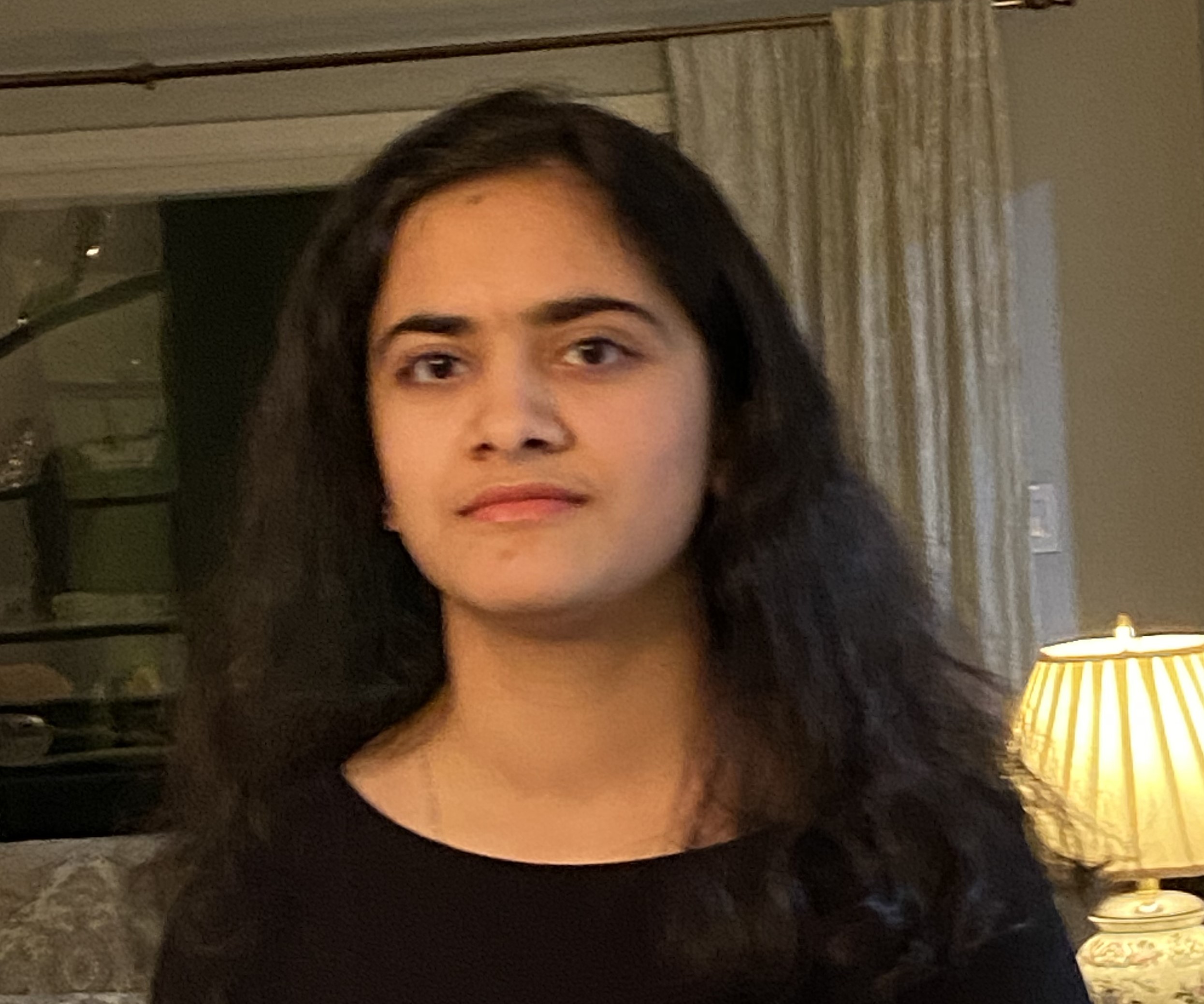 Hi, I am Yugandhara Luthra, a junior attending Princeton High School in New Jersey. My passion lies in the fields of science and mathematics, with a particular fascination for space exploration and its endless possibilities. As a participant in the PHS Research Program, I am fortunate enough to delve into research projects centered around stars, exoplanets, and particle accelerators. I continuously challenge myself with advanced courses from Harvard University in the field of astronomy and physics.












 Amateur Astronomers Association of Princeton