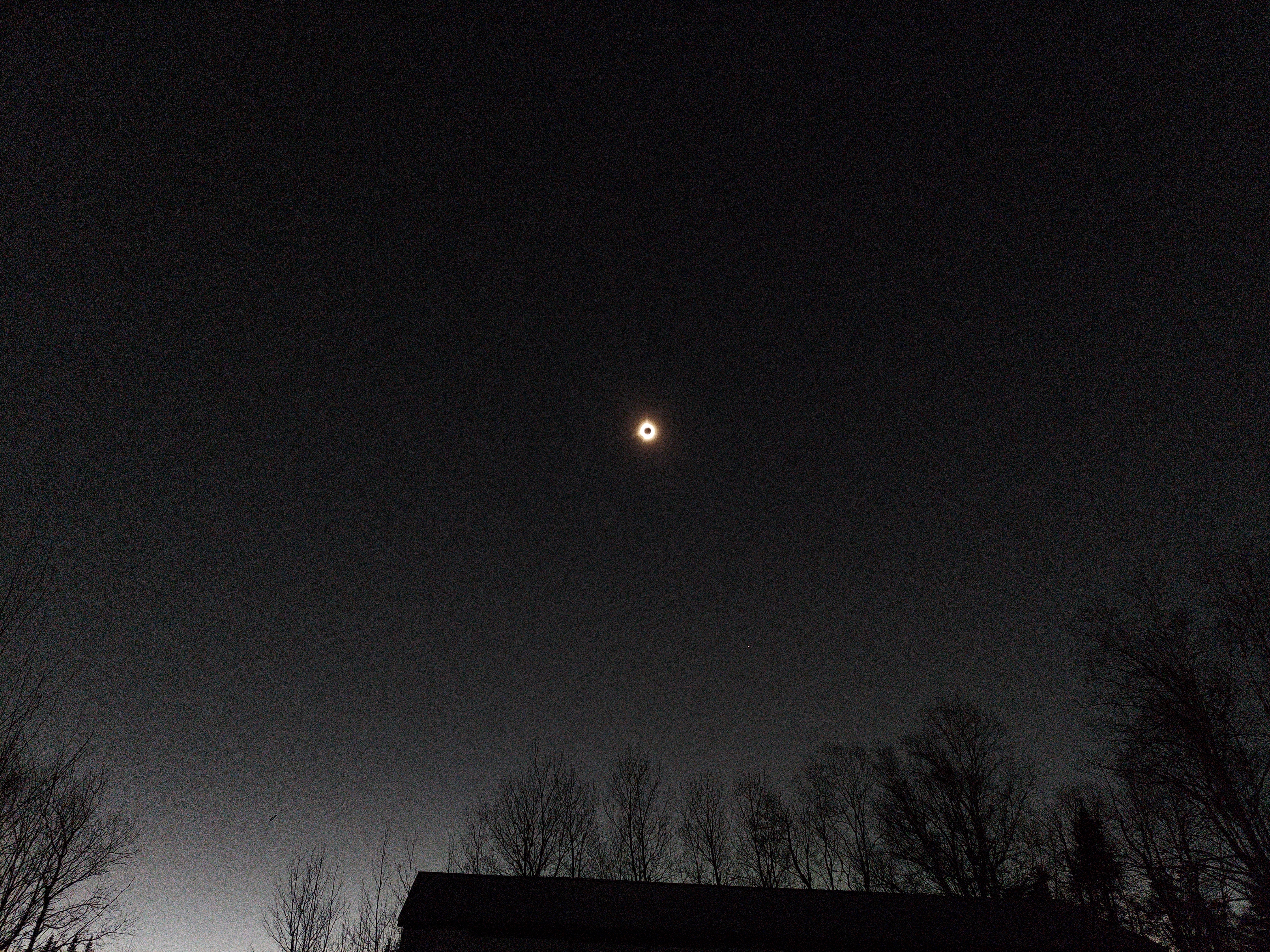
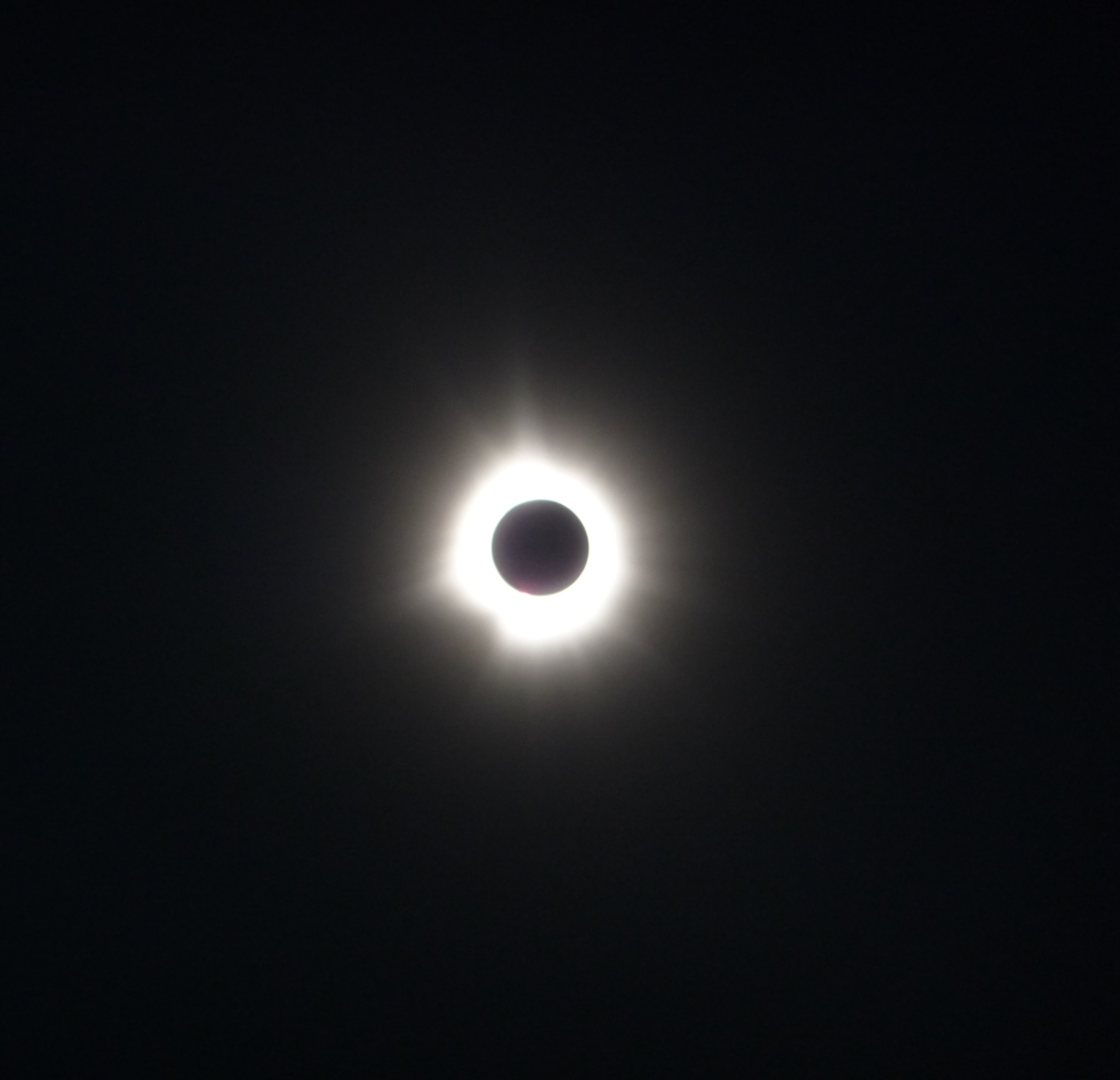
I and my wife and two of our children were fortunate to have seen this spectacular eclipse under mostly cloud-free skies at a fairgrounds near Urbana, Ohio. I had expected a large crowd, but there were only a few others. One couple had come from West Virginia; they had also seen the 2017 eclipse from another location in Oregon.
The most striking feature was the strip of naked-eye prominences along the southern limb as totality was almost over. I had never seen such a display at my three previous eclipses.
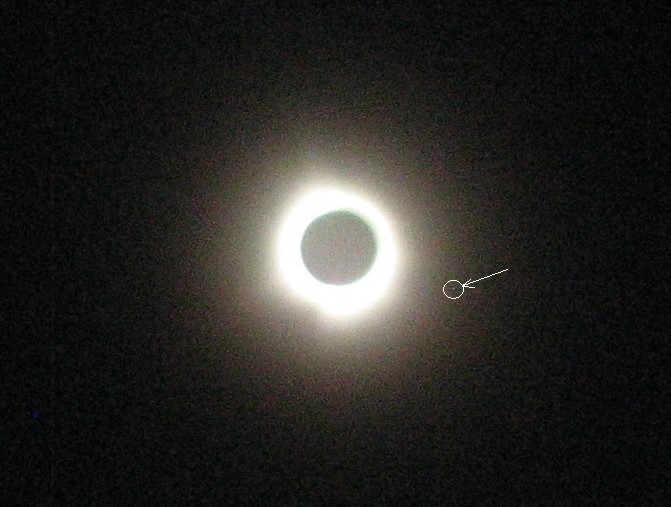
I’ve attached a photo taken with my Canon. The extremely bright inner corona is washed out, but the outer corona shows up nicely. The little dot in the circle isn’t the long-lost Vulcan, but just a dead pixel.
The images that AAAP members have captured and animated are a true visual record of the event, inspiring and amazing.
I did something different. I watched the eclipse and recorded the temperature!
I had two telescope rigs set up here in Ewing. A 60mm finder scope with Baader solar film and a 14mm TV Radian for white light viewing that was mounted on a Ioptron Minitower (previously owned by the late Gene Ramsey).
The other instrument was a Lunt LS50 Hydrogen Alpha telescope mounted on an Ioptron AZMP. The LS50 had a ASI585 camera mounted with no filters. I used ASI Capture on a HP laptop to send live screen video to a 48” monitor inside our kitchen where it was nice and dark!
I had assembled, calibrated and tested all the equipment the previous day.
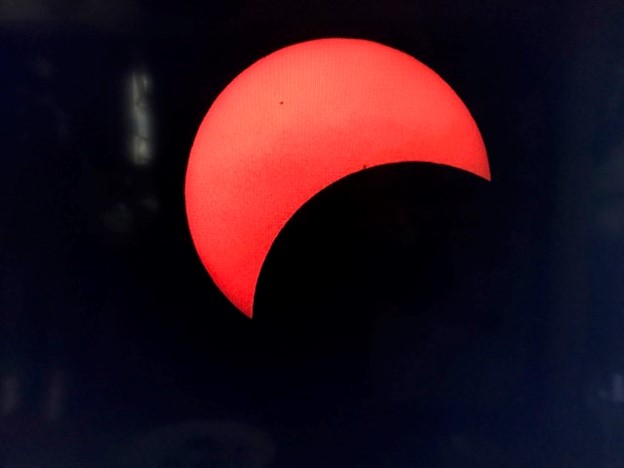
We sat and watched the monitor to observe first contact at 2:09. For the next hour we switched between indoor to outdoor for white light views. Waiting outside for the last moments prior to the maximum partial totality to arrive, we observed birds returning to their roosts. The light was dimming into grey. Shadows from tree leaves were making crescents. The moon covered the sun to 89.2% at 3:24 PM…at which time the heavy clouds arrived!
I saved no direct camera images of the eclipse but it looked great on the monitor indoors. I had first adjusted the scope to show solar prominences but retuned to show surface details as it looked better for an eclipse. I learned quite a bit about pressure tuning, adjusting the gain and exposure with the histogram tool in ASI Cap to optimize the view.
I had set up a data logger to record the temperature over the duration of the eclipse.
IBM 440SThinkPad, Elitech-RC-5 Temperature recorder, Elitech software, Data was exported as PDF and XLS.
The data recorder was in the shade suspended in air 15 inches away from any surface.
Here is the result recorded at 1minute intervals beginning at 1:54 PM to 4:34PM. Note that the chart times are in 24Hr format.
It was quite sunny and rapidly warming at the time of the data run start (1:54PM). The temperature rose 1 degree to 69.80 Deg after first contact at 2:09 PM but then began to steadily decrease. At the time of maximum partial totality (89.2% at 3:24 PM) the temp was 63.50 Deg and still decreasing. After an additional 5 minutes the temperature dropped to the lowest point of 63.10 Deg.
The temperature remained at 63.10 Deg until 3:35PM and thereafter began to rise. At 4:22 the temperature was 65.50 Deg and the recorder was stopped. It was now very cloudy and a brief rain shower occurred.
Summary: A measured change of 6.7 Deg due to an 89.2 percent reduction of the suns light. There was a delay of 5 minutes between the max totality and the lowest temperature. The duration at the low of 63.10 Deg was 6 minutes.
Please contact me if you would like a copy of the PDF or Excel data sheets.
Unsettled weather along the path of totality upended the viewing plans of many umbraphiles on the week leading up to April 8th’s total solar eclipse. So it was with our intrepid band of me, my wife Susanna, and two other couples who early on had made plans to travel to the Historic Leakey Inn close to the Mexican border in Leakey, Texas. When the weather forecast for our chosen site became reliably dismal, we instead packed up our car and drove from NJ to stay with our friends (one of the couples mentioned above) at their home in Stowe, Vermont. There we scoped out a great viewing site at the top of their road. We experienced 2 minutes 50 seconds of totality. Several prominences that we’d seen in the H-alpha scope prior to totality shone without filtration with brilliant red fluorescence at second contact. It was glorious. We chose not to photograph the eclipse except for a few “souvenir” cellphone shots a few folks took through eyepieces of my Questar and the two-tiered gizmo shown above. I’ll be looking for images captured by others that highlight the streaming corona and the brilliantly fluorescent prominences that excited us visually. The drive back to NYC on Tuesday took about ten hours, and memories of “Oh my God!” moments will always stay with us.
In Dallas, storm clouds made me flip, To Niagara, where clouds could eclipse. Then Watertown, I tried, But the clouds did deride, In Burlington, at last, caught the eclipse’s grand trip!
Now with joy, I recall that eclipse, Though my journey had twists, turns, and skips. For the next one in sight, On August twelve, twenty twenty six, oh, the delight! Greenland, Iceland, Portugal, or Spain, the next eclipse grips!
Millions of people made long journeys across the US to catch a glimpse of the total solar eclipse on April 8th 2024. The totality lasted up to 4 mins. First I will write about the logistics of getting to the path of totality and watching the eclipse. The second part is about the science of the sun and eclipses.
The path of totality was about 115 miles wide and passed diagonally from Texas to Vermont. It was a much hyped event as the next total eclipse is not expected for another two decades in the US. I may not be around to watch that. The laws of economics kicked in to capitalize on this opportunity. Airline fares, hotels, rental cars all had jacked up prices. We decided on a strategy to guarantee sighting the most sought after event without spending a fortune.
From our home in Jacksonville, Florida, the nearest place geographically was Jonesboro, Arkansas, about 800 miles away. We decided to drive instead of flying. The nearest city which was outside the path of totality is Memphis, Tennessee, which had reasonable hotel rates. We checked in Memphis a couple of days earlier and saw the National Civil Rights Museum at Lorraine Motel where Martin Luther King was assassinated. Also Beale Street, the home of Blues music.
We checked the weather forecast the night before. In addition to Jonesboro, we had three other towns as alternates within a 25 miles radius. Based on the weather forecast, we settled on Walnut Ridge, which was about 25 miles west of Jonesboro, and had a longer duration of eclipse (3:46). On April 8th morning we started early in the morning crossing the Mississippi river into Arkansas. Early morning fog started burning up as we moved closer to our destination. There was not much traffic and we arrived at Walnut Ridge City Park a good 3 hours before the start of the eclipse. Few clouds were there but nothing threatened the viewing of the eclipse.
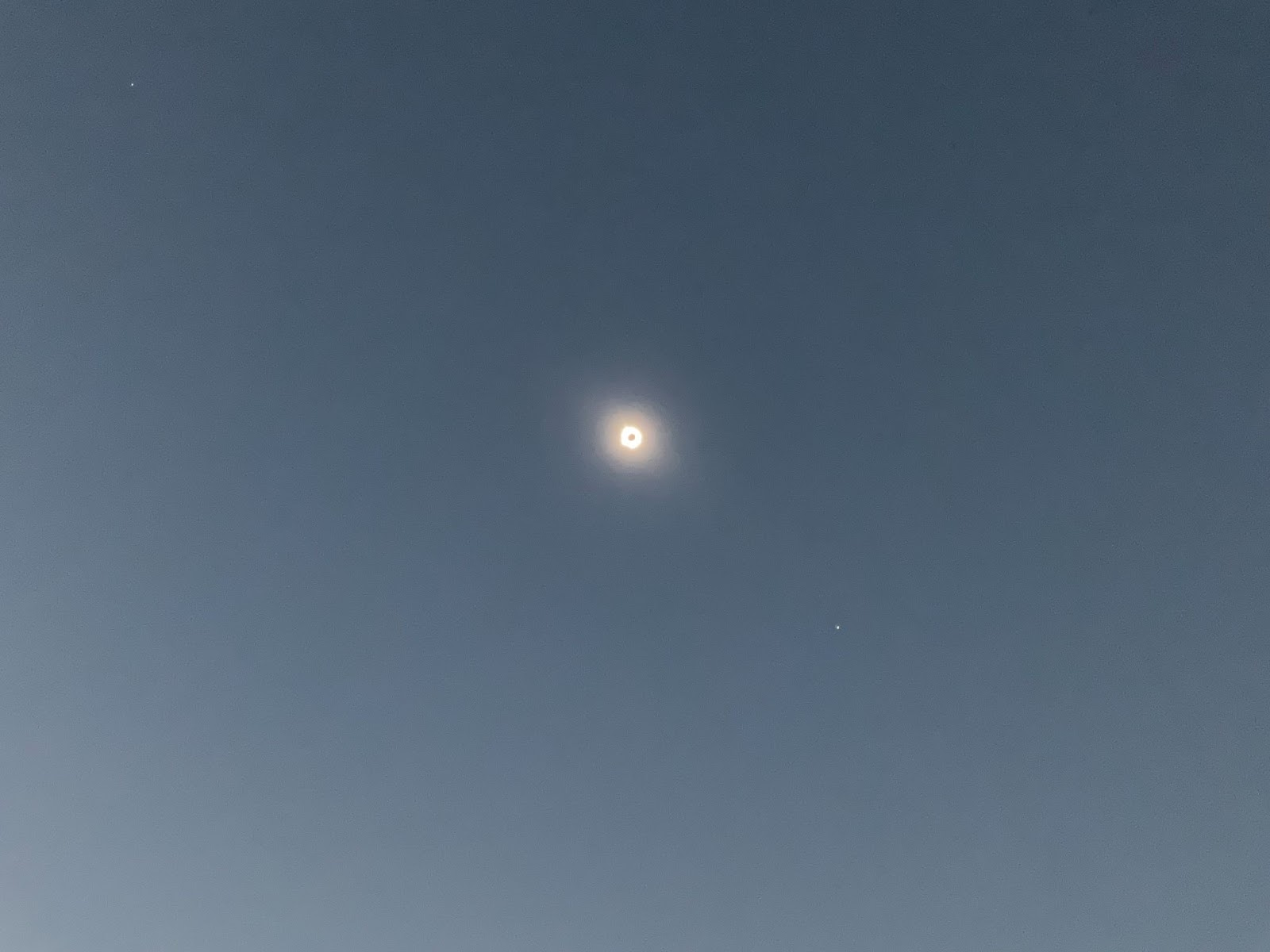
Around 1230, the moon started covering the sun. Nothing much happened till a significant portion of the sun was covered. The light dimmed and the temperature dropped. It was a peculiar kind of light, not that of dusk, but a hue not observed normally. Suddenly it became dark and the distant lights in the Park came on automatically. The sight of a black circle in the midst of the sun was memorable. It lasted close to 4 minutes. And then the events occurred in reverse order before full sunlight was restored. Pictures taken using my iPad pro capture the event. The pictures are more of a personal memorabilia than representing any semblance of excellence in astrophotography. The first picture shows the eclipsed Sun with 3 visible planets – bottom right, top right and top left.
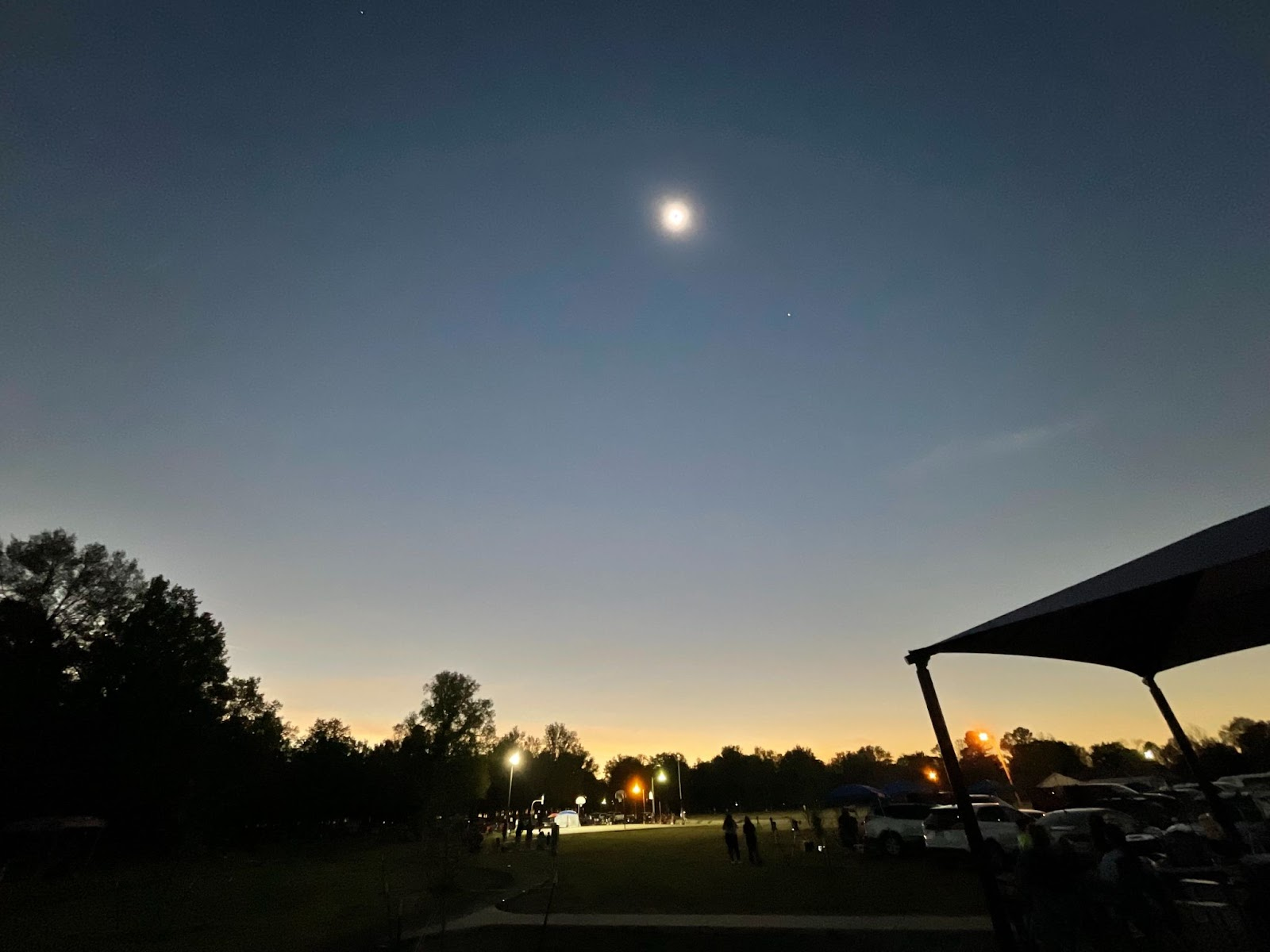
Second picture shows the lights in the Park which came on automatically as the eclipse created darkness.
On the way back, getting out of the Park was easier. The town of Walnut Ridge, unknown to most people, had its 15 minutes of fame. As someone was heard saying “Walnut what ?”. Someone else said “Where is the Ridge ? As it was all a flat open land”. As we moved away from the town towards Memphis, the traffic increased. The eclipse traffic from the nearby towns of Arkansas came to converge at the bridges across the Mississippi river into Memphis. We got stuck for three hours. It was an OK price to pay for the wonderful natural spectacle. Rest of the trip home was uneventful.
Now to the science of eclipses. A small body like the moon can blot out the entire sun because coincidentally the ratio of the size of the sun to the moon is the same as the ratio of the distance of the sun and the moon from the earth, which is about 400. Total eclipses dont happen often because the orbital plane of the moon around the earth is tilted compared to the orbital plane of the earth around the sun. Not in the same country for several years or decades.
Incidentally, the outer layer of the sun called corona is about 2 million degrees, much hotter than 10,000 degrees on the surface. This corona normally gets totally outshone by the sun. During a total eclipse, the corona comes into view. During one such eclipse in the 1800s, the sunlight on the edges was analyzed spectroscopically and a new element called Helium was discovered. It is a very rare element on the earth.
Most famous experiment done during an eclipse was in 1919 when Arthur Eddington set out to prove Einstein’s general theory of relativity that light bends in the presence of gravity. Stars in the sun’s proximity which are not normally visible are visible during a total eclipse. Eddington led a team to Brazil while another team went to Africa just as a backup in case the first team hit clouds. Both the teams measured the bending of starlight while it passed through the outer fringes of the sun. And the bending of light agreed completely with Einstein’s calculations.
While eclipses help do the scientific observations, now with the benefit of space probes with coronagraphs (which block most of the sun, like eclipses do), it is easier to do observations any time round the clock. NASA’s Parker probe and India’s Aditya are observing the sun from millions of miles closer to the sun.
While reminiscing about the past eclipse, waiting for the total eclipse in India about a decade from now.
My wife and I had long planned to travel to outside of Waco Texas to see the April 8 eclipse. But as the eclipse drew near, the weather in Texas, didn’t seem to be matching long-reange predictions. When taking another look at the expected weather along the path of totality I decided that Maine might be a good place to go. Fortunately, I have some family there, plus I was able to find an Airbnb very near the path. After cancelling our long-held reservations. The trip was rebooked. We ended up staying the night of April 6 in Scarborough, ME, then spent the nights of April 7 & 8 in Waterville, ME. On the day of the eclipse, my brother, my wife, and drove towards Jackman, ME. From the perspective of being in the path of totality, we went from around 90% in NJ, to 95% in Scarborough, to 99% in Waterville, to 3:08 minutes of totality on the way to Jackman. Driving up to Jackman was uneventful. My brother who was driving kept mentioning, that the further North we went the fewer cars there were. When we finally got close to Jackman (20+ miles) we pulled over into a pull-over (where others had stopped). The sky was crystal clear and waited for the event to begin.
Since we were planning to go to Texas to view the eclipse, I had purchased the Celeston EclipSmart 50mm telescope. What attracted it to me was the fact that it conveniently fits under the seat in front of you (including the tripod)! The one upgrade I made was getting the equivalent of a slow-motion control for the telescope. This provides easier adjustment and makes using a Barlow much easier. Since this was my wife’s first Solar eclipse I also brought a pair of EclipSmart 10 x 42 binoculars along.
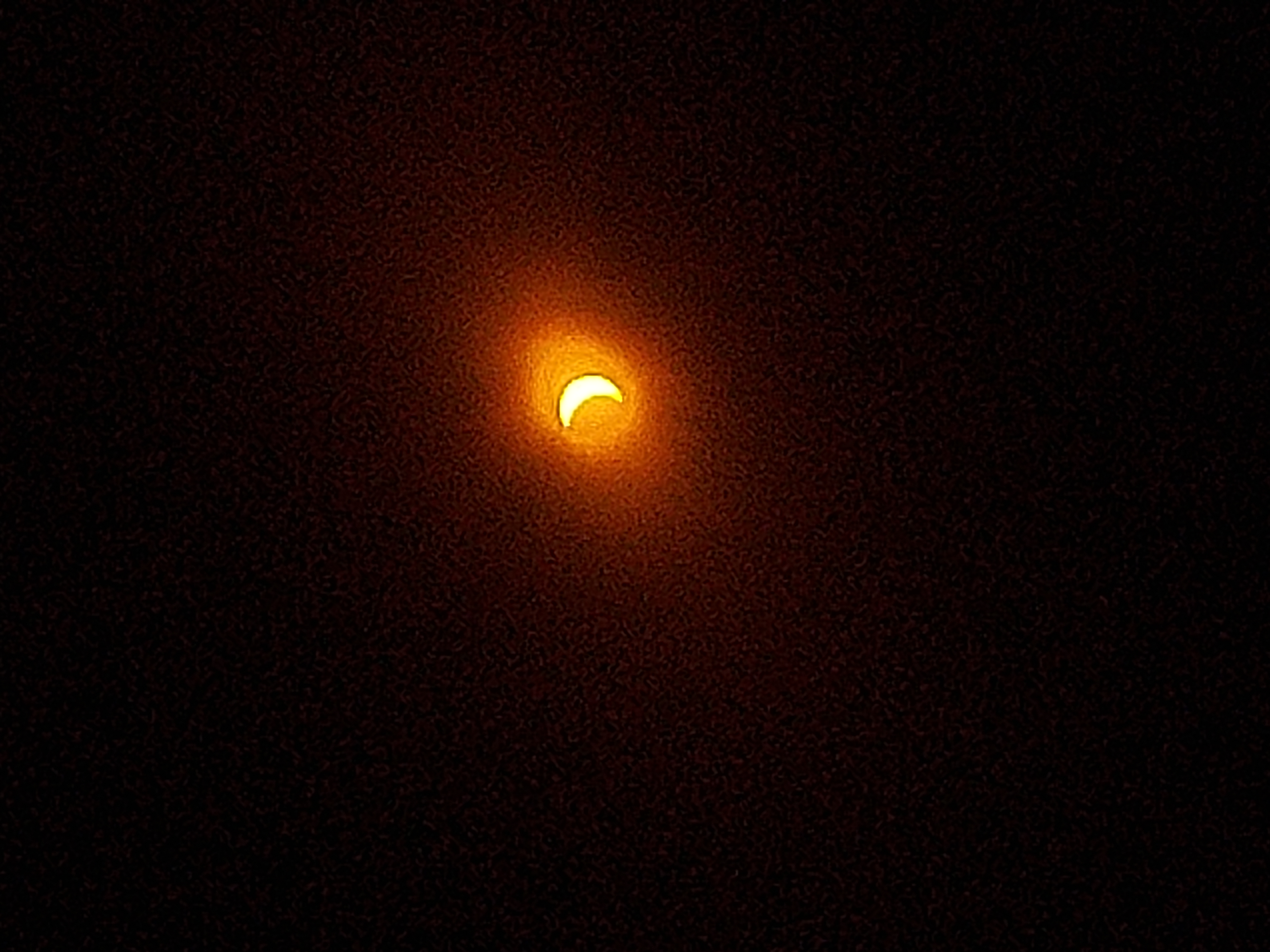
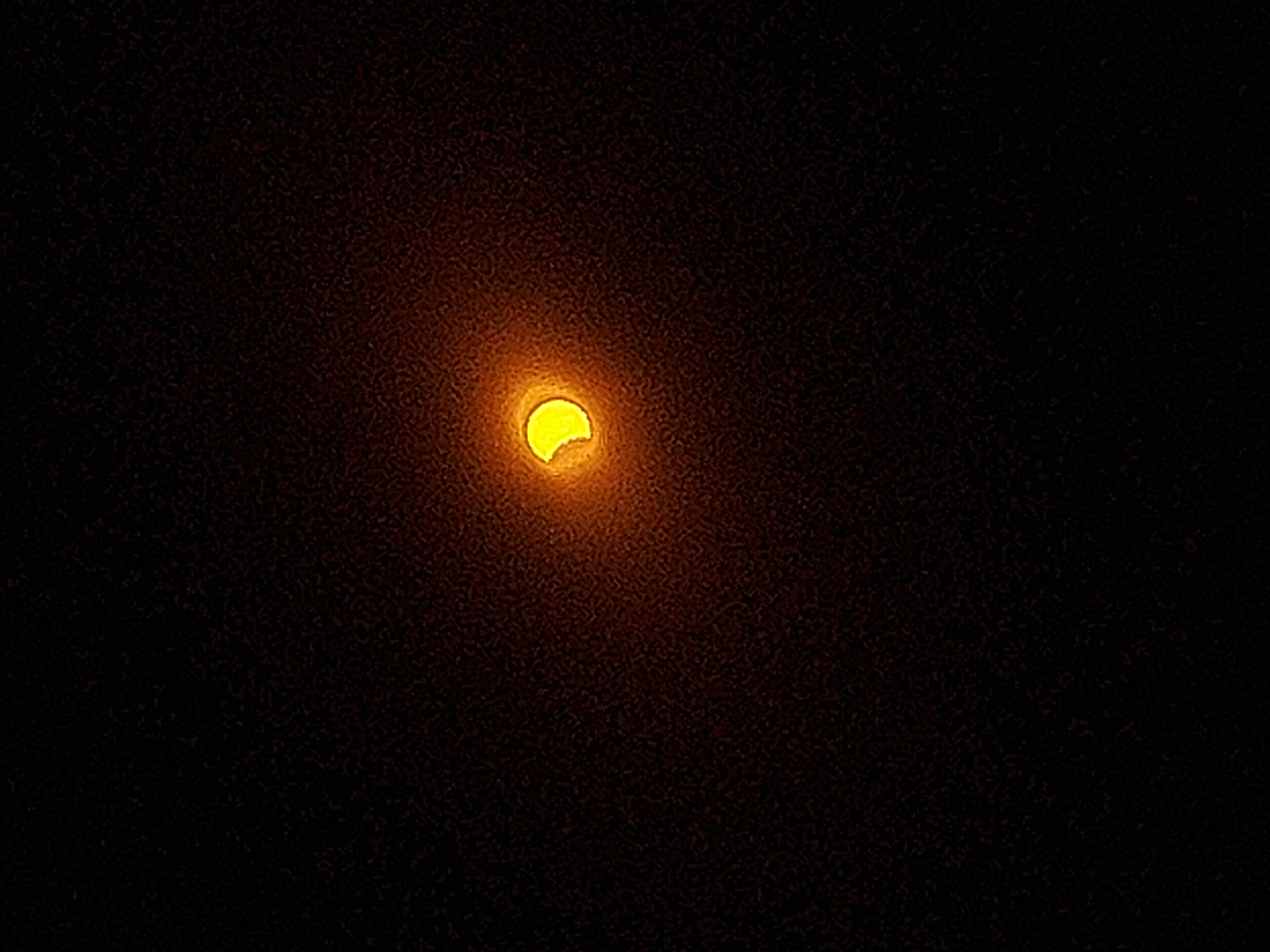
I’ve included a couple of photos that I took with my Panasonic point and shoot camera. Plus, a couple of photo taken with my cell phone (using the appropriate filter).
The month of April 2024 has brought out the tremendous skills, innovative engineering, techniques, excitement, and frankly the true astro-grit of AAAP members chasing the April 8, 2024 solar eclipse. Many members, including those whose images are displayed here, traveled to the line of eclipse totality path through the United States from Mexico to Maine. What made this event even more challenging was the typical cloud weather pattern did not behave as typically forecasted with eclipse chasers abandoning their expected clear skies in Texas for the northeast such as New York, Vermont, Maine, or Canada.
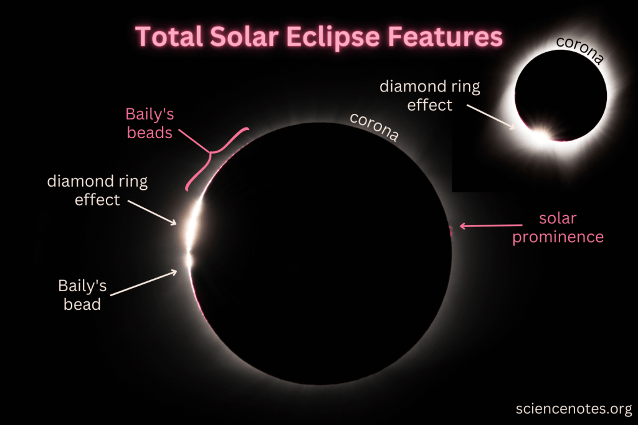
The taxonomy of a solar eclipse and summary consists of the eclipse phases of C1 that is the moment the Moon starts obscuring the sun. C2 is when totality begins. C3 is when totality ends. C4 is when the moon stops obscuring the Sun. The eclipse solar events include the diamond ring effect, Bailey’s Beads, the solar corona, and solar prominences.
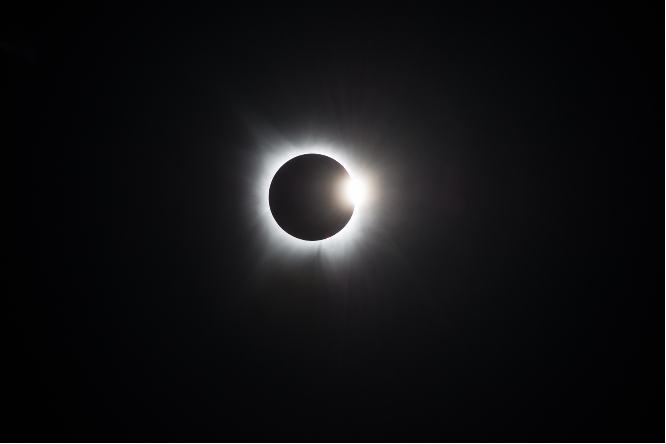
The diamond ring effect takes place just before totality and right before it ends at C2 and C3, the Moon nearly fully covers the Sun and a final bright spot of sunlight called the “diamond” remains visible. This bright visual effect resembles a diamond ring, hence the name.
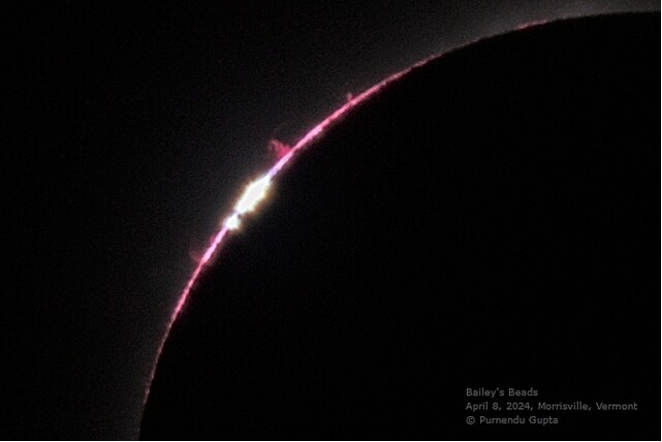
The Baily’s Beads effect, named after the British astronomer Francis Baily, is when light appears around the edge of the Moon during the seconds leading up to totality and just after. Baily’s Beads are caused by sunlight passing through valleys and between mountains on the Moon’s irregular surface. The thin reddish edge is the Sun’s chromosphere.
The solar corona is the Sun’s outer atmosphere, composed of plasma and extending millions of miles into space. The Sun’s intense brightness hides it, but it is visible during totality. The corona appears as a halo of blue-white, wispy light surrounding the dark silhouette of the Moon. The shape of the corona changes over time and the changes may be viewed by comparing past eclipse images of coronas.
The solar prominences are large, bright loops of plasma that extend from the Sun’s surface into the corona. During totality, solar prominences appear as red or pink arches near the edge of the solar disk, sometimes extending out into the corona. At times, a coronal loop may be seen as a well-defined arch-like structure in the corona made up of dense plasma confined and isolated from the surrounding medium by magnetic flux tubes. Coronal loops begin and end at two base points on the photosphere and project into the upper chromosphere and corona.
Image descriptions are edited or authored by Michael DiMario unless noted. Image capture data are by the imager.
David Ackerman – Eclipse Images
This image shows Bailey’s Beads, solar prominences, the beginning of the diamond ring effect, and the corona. If look closely, faint coronal loops may be seen at the nine to ten o’clock positions.
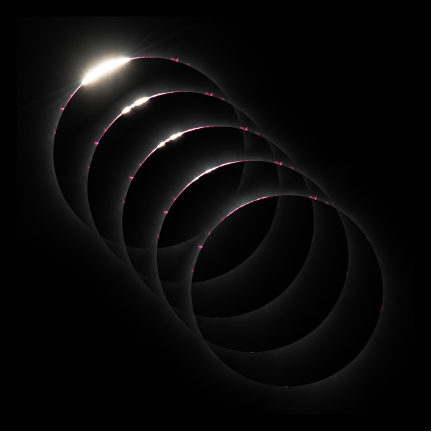
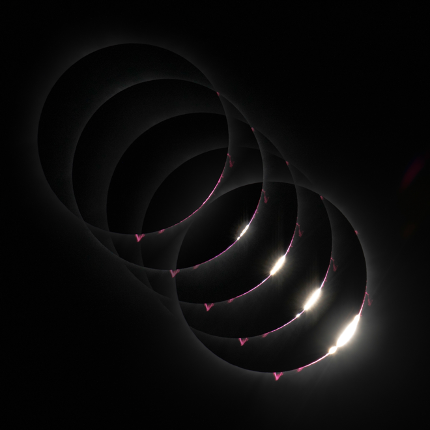
These two images show the eclipse transitioning from C2 to C3 with their corresponding diamond ring effects, Bailey’s Beads, and prominences.
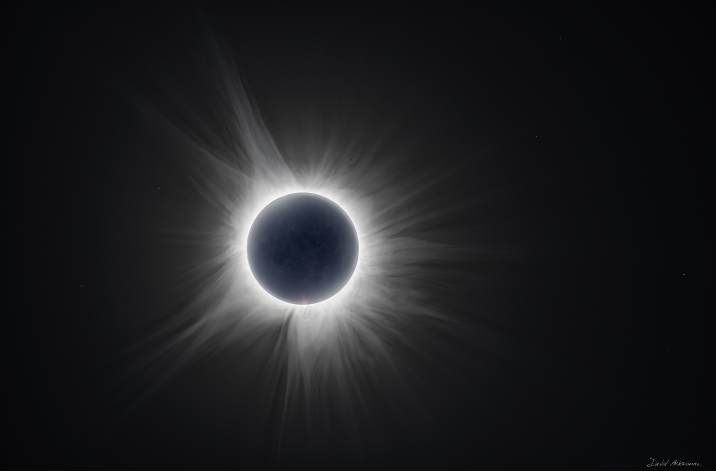
This image shows the corona in all its glory during totality. If look closely, faint coronal loops may be seen at the four, five, and six o’clock positions.
Eclipse images were captured at Magog, QC using a Nikon DSLR with a 400mm + 1.4xTC on an iOptron SkyGuider on a photographic tripod. A total of 1130 frames were captured. David used Solar Eclipse Maestro for hands-off operation requiring an Intel Mac running an antique operating system.
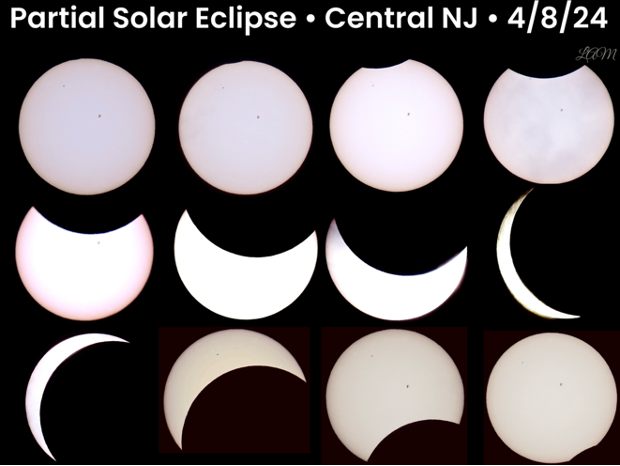
Lisa Fanning – Eclipse Progression
Eclipse was imaged in Morganville at 90% coverage. Image progression was taken with a Canon PowerShot SX70HS with Baader Astrosolar film and assembled in Bazaart.
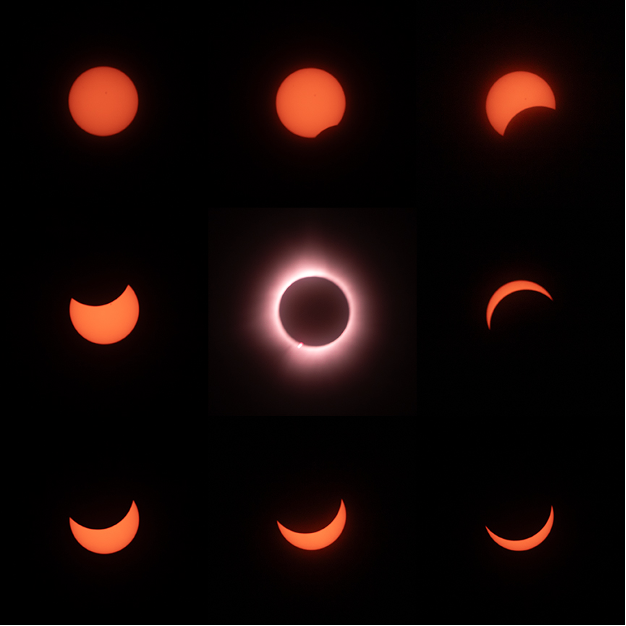
Dave Wilton – Eclipse Composite Captured Hand Held
The eclipse composites were taken manually and handheld using a Canon 6D Mark II and Redcat 51. The tripod was inadvertently left behind in the garage. The eclipse images are exceptional given that it is nigh impossible to hold a camera and long lens, in this case a Redcat 51 refractor, steady while trying to magnify the view on the camera screen to get good focus. There was also light cloud cover which obscured the outer corona.
Rich Sherman – Eclipse Diamond Ring
This image of the eclipse’s diamond ring effect was taken in Dallas, TX
It was captured with a Nikon d800 camera, 480 mm focal length at ISO 200, f/8, at 1/8th of a second. It was processed using Lightroom.
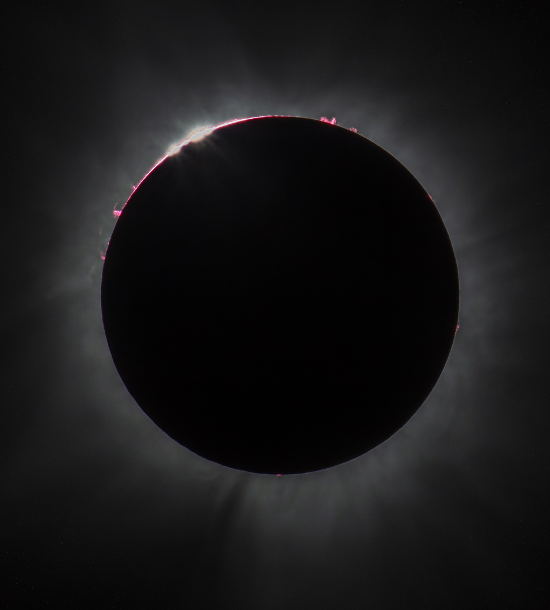
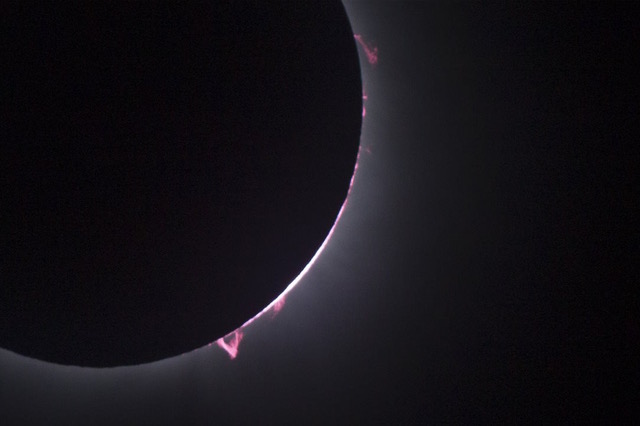
Purnendu Gupta – Eclipse Prominences and Bailey’s Beads
Image reveals the plumes of prominences rising from the red arc of chromosphere. The thickness of the arc corresponds to 10,000 km that could house the Earth. There is a hint of the solar corona in the background. Still visible are tiny white portions of the Sun, the photosphere, shining through the lunar craters and valleys forming Bailey’s Beads.
Robert Vanderbei – Eclipse Totality and Prominences
Total eclipse image captured using a 3.5” Questar and ZWO ASI2400MC Pro camera. Images processed with SharpCap Pro Sequencer; location was Plattsburg, NY.
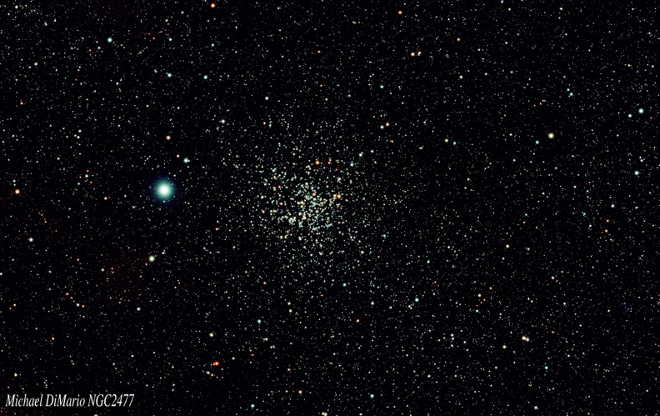
Michael DiMario – NGC 2477 Electric Guitar Open Cluster
NGC 2477 was imaged with a Takahashi FSQ-85ED Baby Q with a ASI 2600MC Pro camera and an Antilla Triband filter of 60 sub-light frames at 90 seconds each; processing in PixInsight.
NGC 2477 Electric Guitar open cluster image was taken March 31st at Big Cypress National Preserve in southwest Florida. This open cluster is typically a southern object and was taken about 25 deg above the southern horizon. Located about 2300ly – 6200ly, it is comprised of about 300 stars in the constellation Puppis. Star on left is b Pup, a rotating variable star believed to be a binary.
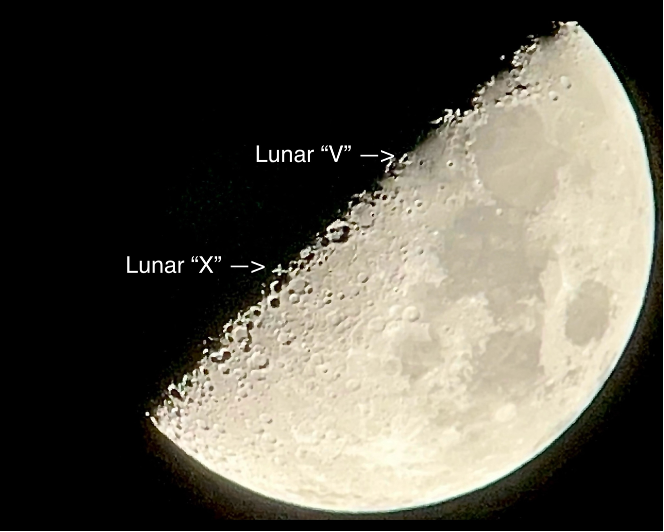
Lisa Fanning – Lunar X and Lunar V at First Quarter
Lunar First Quarter terminator image captured the Lunar X and Lunar V features of April 15, 2024 using an Apple iPhone 13 digiscope adapter attached to a Swarovski Optik Spotting Scope.
Lunar X is a “clair-obscur effect” where light and shadow creates the illusion of the letter ‘X’ on the rim of the Blanchinus, La Caille and Purbach craters. The Lunar V is also visible, formed by Ukert crater and several small craters.
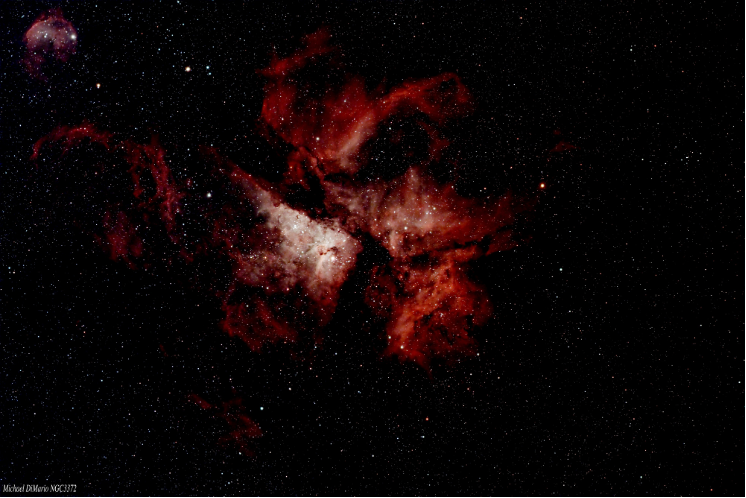
Michael DiMario – NGC 3372 Carina Nebula
NGC 3372 Carina Nebula image comprised of 23 subframes at 30 sec using a Takahashi FSQ-85ED, Antilla Triband filter, and ASI 2600 MC Pro camera; processed in PixInsight.
NGC 3372 Carina Nebula was imaged March 31st at Big Cypress National Preserve 1-2 degrees above the southern horizon making it a very difficult object to capture. NGC 3372 Carina Nebula is one of our Galaxy’s largest star-forming regions spanning over 300 ly at a distance of 7,500 ly. The Carina Nebula is home to young, extremely massive stars, including the variable Eta Carinae, a star with well over 100 times the mass of the Sun. Eta Carinae is the bright star next to the central dark notch in this field. The difficulty of imaging near the horizon is the amount of air mass that light of your target must pass through. The number of air masses at the horizon is 40. That is, stellar light passes through 39x more atmosphere than at the zenith. To check out the effects on magnitude and the derivation, see https://asterism.org/resources/atmospheric-extinction-and-refraction/.
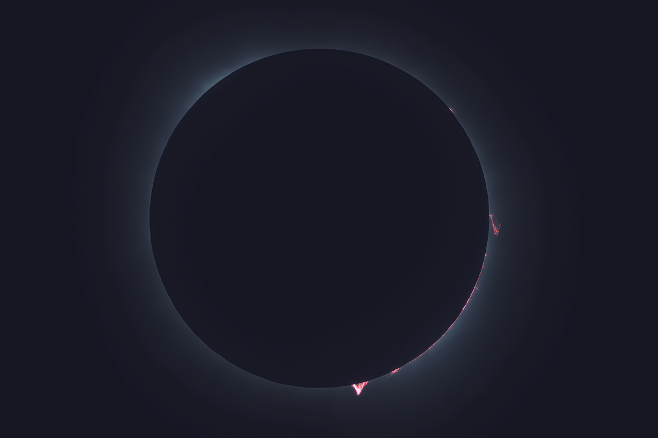
Joshua Verma – Total Solar Eclipse Prominences
This total eclipse image with prominences was captured in Cleveland, Ohio. As the official photographer of Nottingham Baptist Church, Joshua used a Skywatcher Star Adventurer, Evostar 72ed, and Canon EOS 500D and an Orion telescope for others to use. With snacks and drinks provided for all 50 people at the event, it turned out quite fun; many memories were made. A lot of people wanted to take a look inside the telescope, which provided a much closer look at the sun than they could get with the glasses. Most thoroughly enjoyed it, especially during the end of totality when the pink triangle “sun mountain” was visible. The clouds, rather than completely hindering the experience, actually created a nice effect during totality, reflecting light in such a way to create a white halo in the sky.
Glamping With the Stars As I exited Harry Reid International Airport on a bright March afternoon, my hand flew up to protect my eyes, which had grown accustomed to the dull light of a long, gray Tennessee winter. I’d headed west for the sun, but even more so for the night sky, so I was hoping for clear weather ahead…more
-NYT
A James Webb Turns To Examine Planet Showing Potential Sign Of Life NASA made a huge splash in September when it announced that its James Webb Space Telescope had spotted potential sign of life on an exoplanet dubbed K2-18b in the form of “dimethyl sulfide,” (DMS) a gas that’s produced exclusively by lifeforms on Earth…more
-Guardian
Controversial new theory of gravity rules out need for dark matter Dark matter is supposed to account for 85% of the mass in the universe, according to conventional scientific wisdom. But proponents of a radical new theory of gravity, in which space-time is “wobbly”, say their approach could render the elusive substance obsolete…more
-NYT
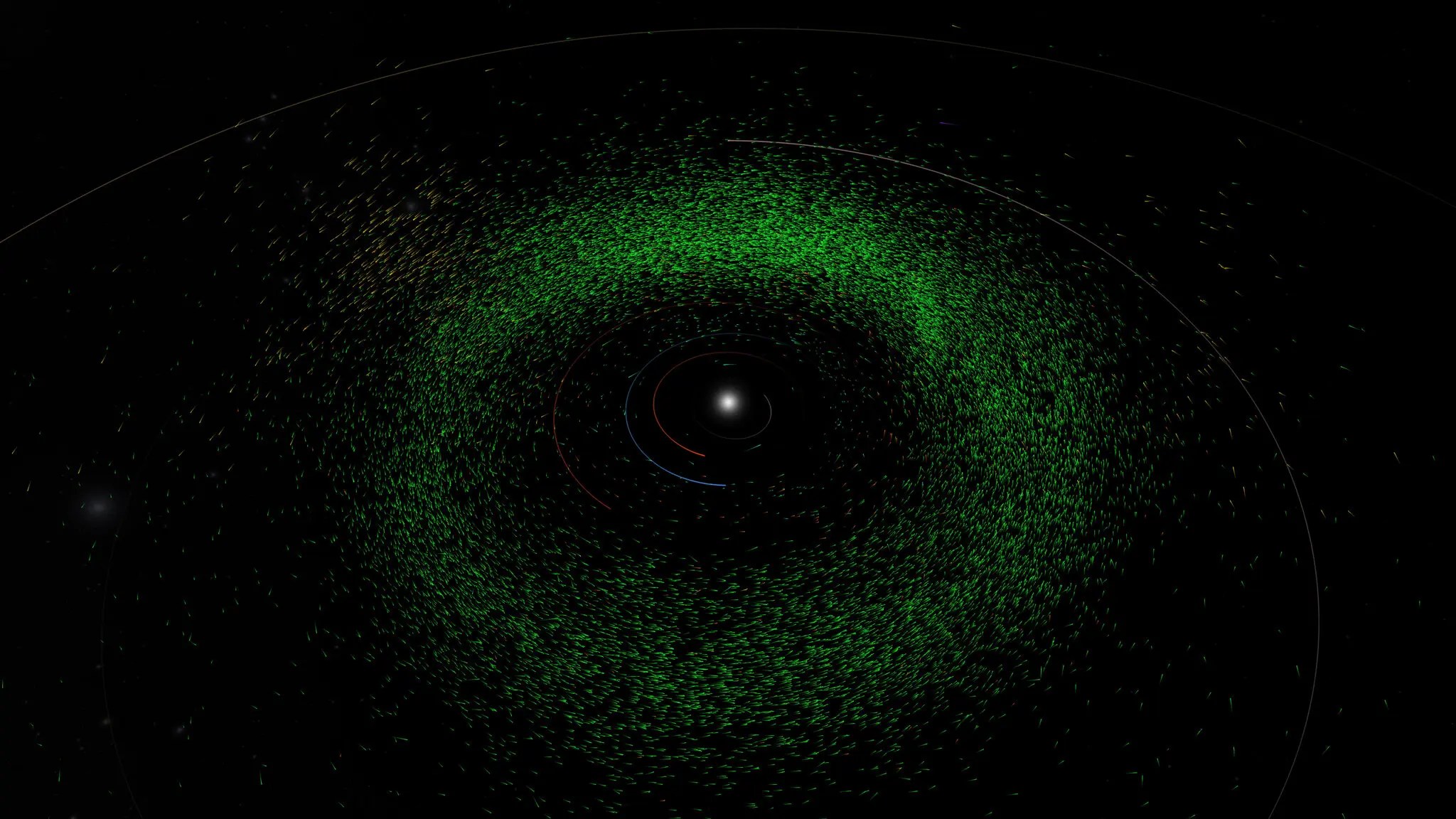
Killer Asteroid Hunters Spot 27,500 Overlooked Space Rocks A couple of years ago, a team of researchers dedicated to finding killer asteroids before they kill us came up with a neat trick. Instead of scanning the skies with telescopes for asteroids, the scientists wrote an algorithm that sifts through old pictures of the night sky, discovering about 100 asteroids that had been overlooked in those images…more
-NYT
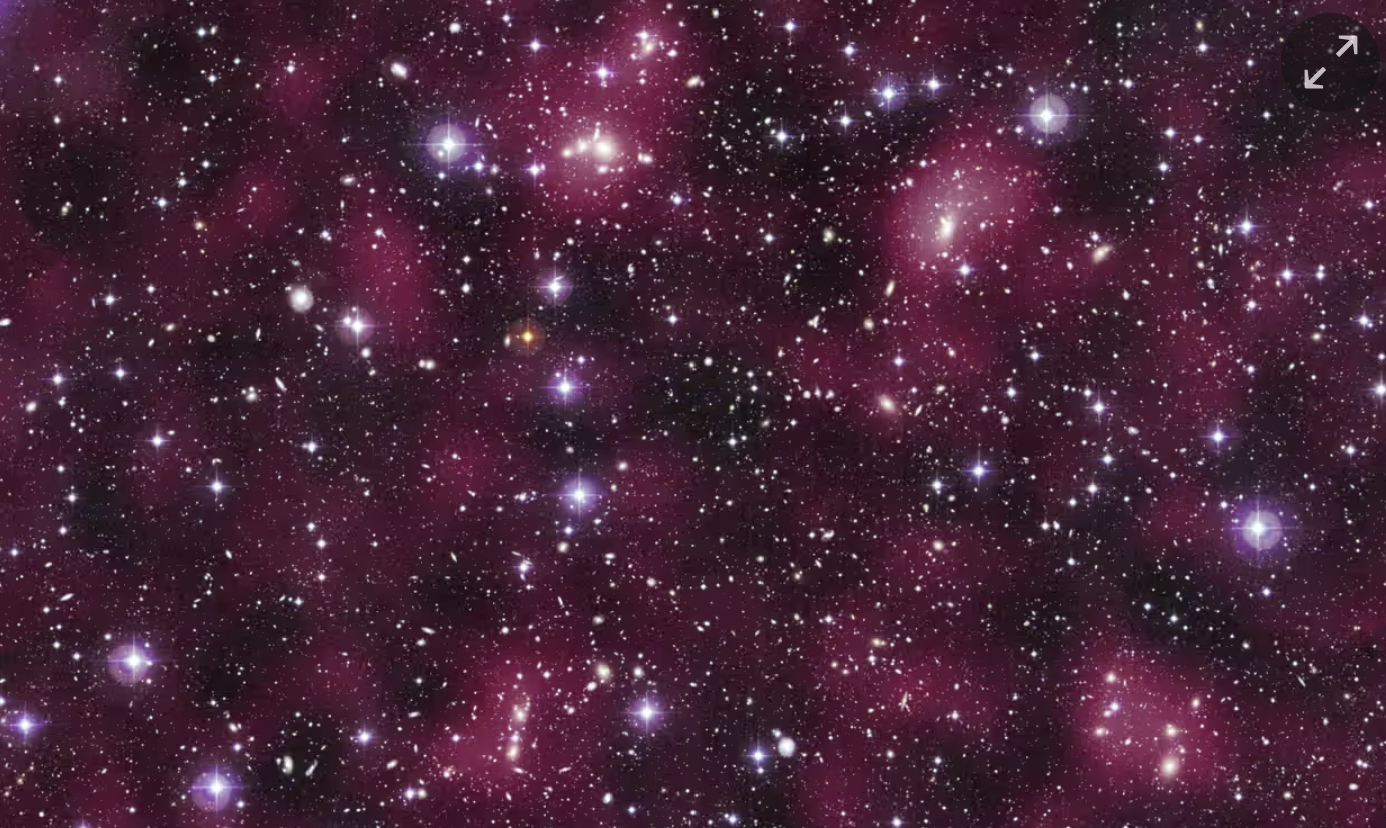
Cosmic Forecast: Blurry With a Chance of Orbital Chaos Researchers discovered that a sunlike star named HD 7977, found 247 light-years away in the constellation Cassiopeia, could have passed close enough to the sun about 2.8 million years ago to alter the orbits of the Earth and other planets…more
-NYT
She Dreams of Pink Planets and Alien Dinosaurs Have dinosaurs evolved on other worlds? Could we spot a planet of glowing organisms? What nearby star systems are positioned to observe Earth passing in front of the sun? These are just a few of the questions that Lisa Kaltenegger has joyfully tackled. As the founding director of the Carl Sagan Institute at Cornell University…more
-NYT
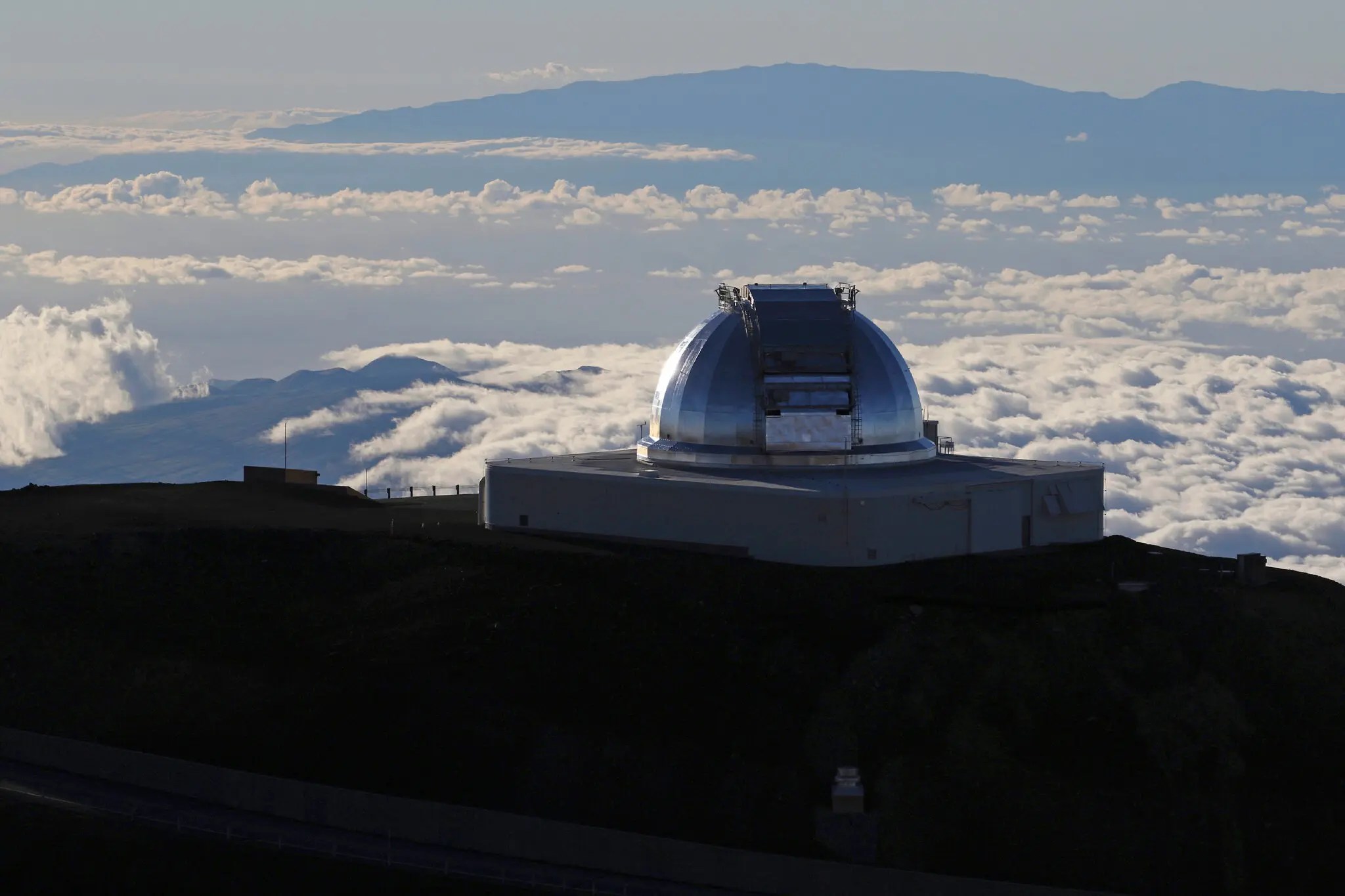
Good News and Bad News for Astronomers’ Biggest Dream The United States should commit $1.6 billion to building an “extremely large telescope” that would vault American astronomy into a new era, according to the National Science Board, which advises the National Science Foundation. In a statement on Feb. 27, the board gave the foundation until May to decide how to choose between two…more
-NYT
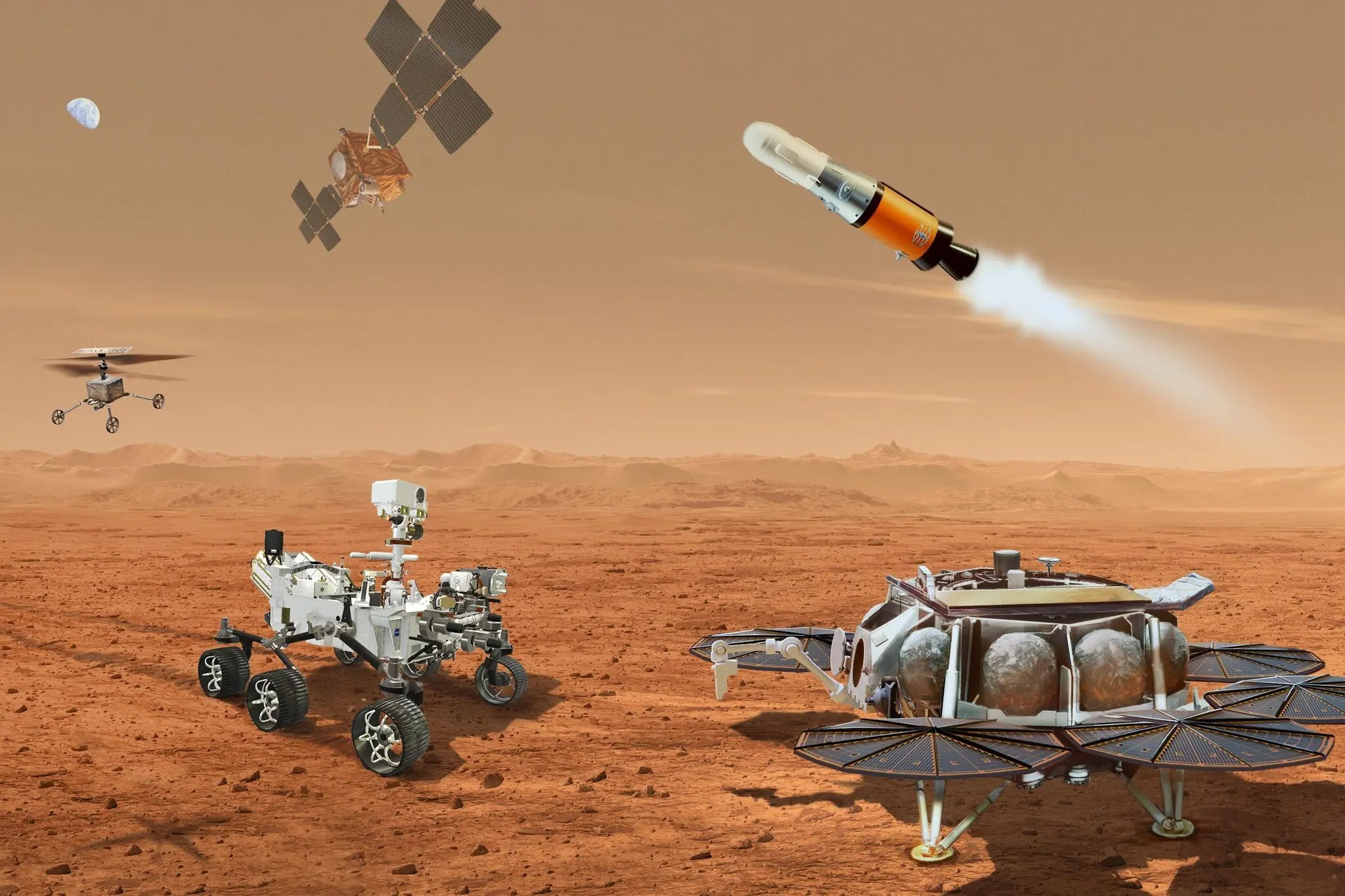
NASA Seeks ‘Hail Mary’ for Its Mars Rocks Return Mission The cost of a proposed NASA mission to gather rocks on Mars and return them to Earth is spiraling upward and slipping further into the future. So on Monday, space agency officials asked for ideas on simplifying the mission and trimming its price tag….more
-NASA
Unveiling the Sun: NASA’s Open Data Approach to Solar Eclipse Research As the world eagerly anticipates the upcoming total solar eclipse on April 8, 2024, NASA is preparing for an extraordinary opportunity for scientific discovery, open collaboration, and public engagement. At the heart of the agency’s approach to this unusual event lies a commitment to open science, ensuring that the data…more
-NASA
Meet the Two Women Leading Space Station Science The International Space Station provides researchers access to the unique features of low Earth orbit: long-duration microgravity, exposure to space, and a one-of-a-kind perspective of our planet. These special attributes enable scientists to conduct innovative experiments that can’t be done anywhere else…more
by Rex Parker, PhD director@princetonastronomers.org
No Formal AAAP Meeting April! As the calendar would have it, the monthly meeting of AAAP in April falls a day after the solar eclipse. With many of our members travelling for the eclipse at a location offering totality and clear skies, we have decided to not hold a meeting on April 8. There is ongoing interest in connecting with members via Zoom to share experiences of the eclipse on April 8. If that happens you will receive a link by e-mail. I will be one of those travelling (to Indiana) for the eclipse. Here’s hoping for clear skies along the path of totality!
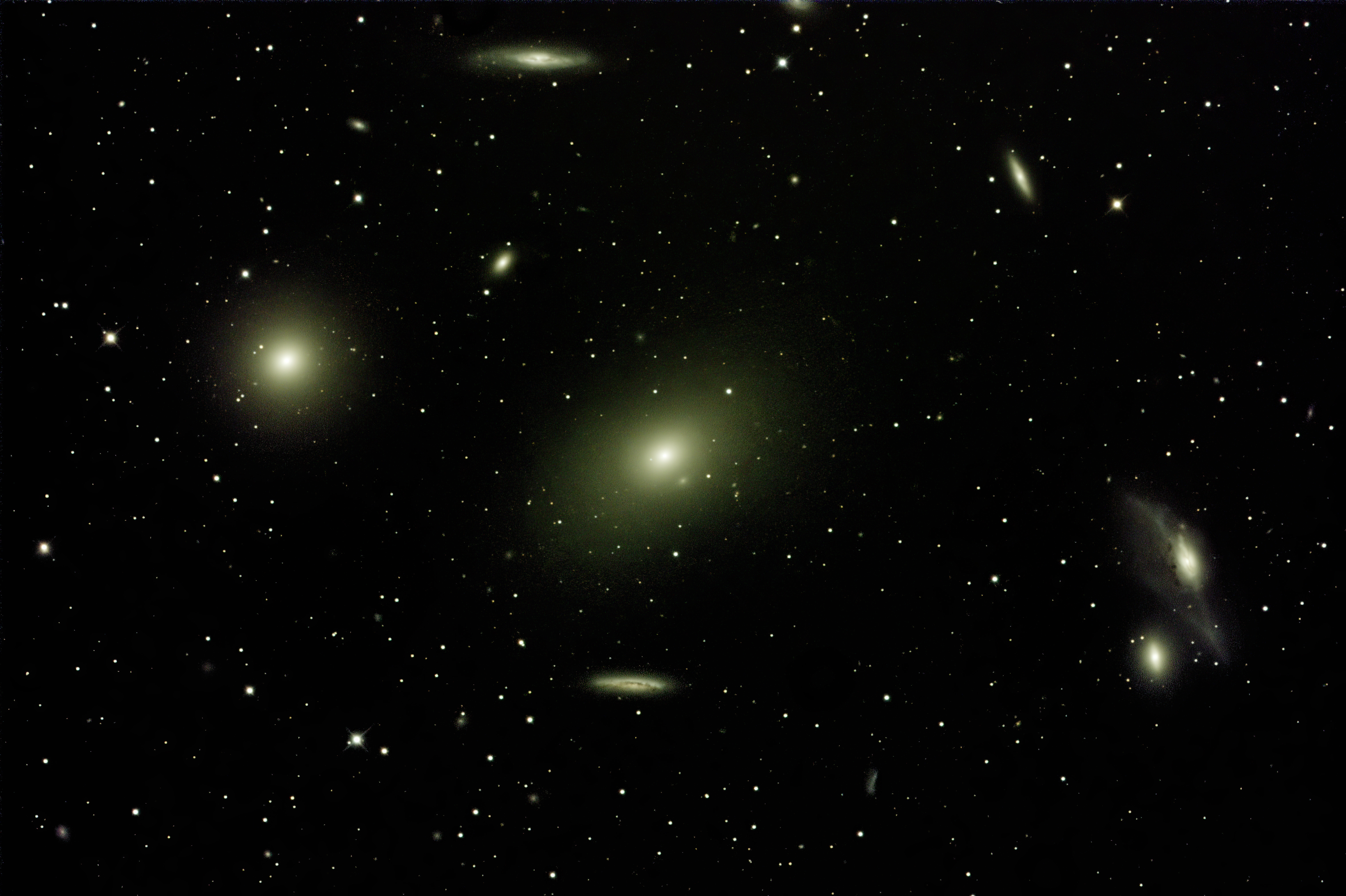
With all the excitement about the solar eclipse, don’t forget that this is also galaxy observing season! Below is my recent image (taken March 29) of the western-most part of Markarian’s Chain, a large and famous group of galaxies in Virgo. These galaxies are moving together through space, considered “near-by” at a distance of about 50 million light years.
Markarian’s Chain of Galaxies in Virgo. The 2 bright elliptical galaxies left and center are the Messier objects M84 and M86. Astrophoto by RA Parker from central NJ using a 12.5” f/6.7 reflector on Paramount MX and ASI2400MC camera.











 Amateur Astronomers Association of Princeton