From the Director

by Ludovico D’Angelo, Director AAAP

All things move along as they always do. Time is such a fleeting thing, and the days are passing quickly by. It seems only yesterday that we had our last meeting, and it’s been three weeks already. The sky has been beautiful during the daylight. I hope all the solar observers have been taking advantage. The evenings are a hit and miss. Now that it’s colder, when the sky is clear, it’s very clear.

I remind everyone that we rescheduled StarQuest to November 18-20. This is a great opportunity for beginners, amateurs and professionals to gather and observe the day and night sky. Hope Center is a relaxing, comfortable, learning environment. Bob Vanderbei will give a talk on astrophotography on Saturday, so I hope to see some of you there.

We had a great lecture given by our own club member Dr. Freeman Dyson on October 11th. He packed the house; there was no room to sit in Peyton Hall. There will be audio of his talk available if you were not there on the website.

This next month brings another club member, Ken Kremer, to talk about the last NASA shuttle mission and the future of NASA. Ken always gives a great talk, and I hope to have just as full of an auditorium for him on November 8th.

See you all on the 8th at 8:00 p.m. in Peyton Hall!

Posted in November 2011, Sidereal Times | Tagged , , | Leave a comment

From the Program Chair

by Ken Levy, Program Chair

Prof.  Freeman Dyson

Prof. Freeman Dyson discussing ways to find alien life with an auditorium full of eager listeners. Photo Credit: Ken Levy

Many thanks to Prof. Freeman Dyson whose October lecture packed Peyton Hall. Professor Dyson led a spirited discussion on the search for life within our solar system and beyond.

For those who missed the event or would like to experience it again, the complete lecture is available for MP3 download by clicking this link: https://files.me.com/kenetics/ltru94.mp3. Assuming we have the speaker’s permission, MP3’s and photos of this season’s lectures will be available for download (except September’s lecture by Jill Knapp). We’ll be posting the links to all lecture audio on the AAAP website soon.

Prof. Freeman Dyson

Prof. Freeman Dyson in an animated conversation with the audience. Photo Credit: Ken Levy


On Tuesday, November 8, 2011, AAAP’s own Dr. Ken Kremer will present “Atlantis, The End of America’s Shuttle Program and What’s Beyond for NASA”

NASA is at the crossroads. So much is happening with the shutdown of America’s shuttle program, completion of the International Space Station and the ever changing future objectives of our space program. Dr. Kremer who contributes to Universe Today and Spaceflight magazines, will present an inside point of view on the thrilling final shuttle missions to the ISS and what’s ahead for NASA in the post-shuttle era. He will share his eyewitness perspective on human spaceflight and exclusive photos of Shuttle launch operations, the next generation Orion spacecraft and the commercial SpaceX vehicles.

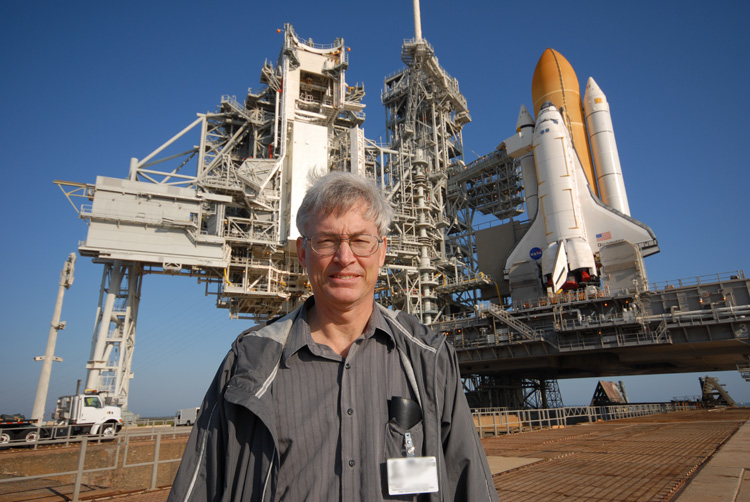
STS 131 Ken Kremer and Discovery

Dr. Ken Kremer with Discovery in the background. Photo Credit: Dr. Ken Kremer


Dr. Kremer is a freelance science journalist, speaker, scientist and photographer whose articles, space exploration images and Mars mosaics have been widely published in magazines, books and websites including NASA, Astronomy Picture of the Day, ABC News & NBC News, Astronomy, Space-flight Now, Astronomy Now, New Scientist, Planetary Society, NASA Watch, Scientific American, Space Quarterly, Universe Today and the covers of Aviation Week & Space Technology, Spaceflight and the Explorers Club magazines.

There will be a “Meet the Speaker” dinner at 6:00 pm before the meeting. To insure a place at the table, please email me at kenetics@me.com by Friday, Nov. 4th for a reservation. I’ll respond with the restaurant location, which has yet to be determined.

We look forward to seeing you in November!

Posted in November 2011, Sidereal Times | Tagged , , , , , , | Leave a comment

From the Outreach Chair

by David Letcher, Outreach Chair

I have five items to report.

First, my four Friday evening astronomy classes, held at the Nature Center, came to a close on October 21st. Judging by the comments from the attendees, they were a success! The general theme was “backyard astronomy.” Participants who attended all four sessions “graduated” by receiving a signed certificate of attendance. Many thanks to Gene Ramsey, Larry Kane, Jeff Bernardis, and Ludy D’Angelo for volunteering at the observatory and letting my students view the heavens through various telescopes.

Second, thanks to Gene Ramsey for opening the observatory and entertaining cub scouts on Saturday, October 15th.

Third, thanks to Brian van Liew and Jim Poinsett for volunteering to do a star party at the Millstone River School on Thursday evening, October 20th. This was a hastily scheduled star party, but from what Brian said, it was a success with clear skies.

Fourth, thanks to Jeff Bernardis and Gene Ramsey for opening the observatory for a group of cub scouts on October 22 and to Michael Wright, Gene Ramsey, and Larry Kane for opening the observatory for the Chapin School and many campers on October 15.
Let me know if I missed anyone’s name. I’ll be sure to mention you in the next issue.

Fifth, on the star party front, we have been invited to participate at the Upper Freehold Regional PTA’s “Science Night Live” in Allentown, NJ on Friday evening, November 18th. This event will be held at the Newell Elementary School. I’ll be sending a request for volunteers and directions soon.

That’s all for now!

Posted in November 2011, Sidereal Times | Tagged , , | Leave a comment

October 11, 2011 Board Meeting

by Larry Kane, Secretary

  • The meeting was called to order by Director Ludy D’Angelo. He presented an observatory key to new key-holder Ira Polans.
  • Ludy announced that StarQuest has been re-scheduled to November 18-20. The menu will be simplified but will still be a brunch and a dinner on Saturday. The Hope Center was very cooperative and helpful. We have a good collection of door prizes for StarQuest. Orion Telescopes made a very good donation of equipment.
  • Secretary’s Report: Kane reported that he sent out a notice to the membership requesting that the dues be paid.
  • Treasurer’s Report: The report appears in another section of the Sidereal Times.
  • Outreach: Outreach Chair David Letcher noted that he got a request from the Millstone Middle School for a Family Night on October 20. There is also a request from the Chapin School and a cub scout troop to visit the observatory on Saturday, October 22. Also, on November 18, Allentown will be holding their Science Night. David noted the help that Gene Ramsey has provided to him to run the astronomy class he is teaching at the Nature Center.
  • Observatory Committee: Gene Ramsey noted that he regularly invites campers to visit the observatory.
  • Program Chair: Mario Livio will be the speaker for May, 2012. Ludy is investigating the possibility of club members putting together a trip to Chile or New Mexico. This could be a way to celebrate the club’s 50th anniversary next year.
  • Sidereal Times: Editor Michael Wright thanked member and co-editor Surabhi Agarwal for getting out the newsletter while he was away. The next deadline for articles is October 29.
Posted in November 2011, Sidereal Times | Tagged , , , , | Leave a comment

Treasurer’s Report

by Michael Mitrano, Treasurer

We are not far into our fiscal year that began on July 1. At this point we have received many membership renewals and applications for new members, and have not had many expenses.

Membership now stands at 54 and total receipts so far are about $2,300. Membership renewals are coming in more promptly than last year, when we had only 44 member payments at this point. Expenses are only about $400, leaving us with a surplus since July 1 of about $1,900. Our cumulative surplus is about $22,500.

Posted in November 2011, Sidereal Times | Tagged , | Leave a comment

Super Jupiter

by Robert J. Vanderbei

Our planet Earth orbits the Sun once every year whereas it takes Jupiter about twelve years to complete one orbit. This means that once every thirteen months Earth catches up to Jupiter and passes it in this planetary race around the Sun. When Earth “passes” Jupiter we say that Jupiter is at “opposition”. This year’s opposition happened at 01:41 UT on October 29—just days ago.
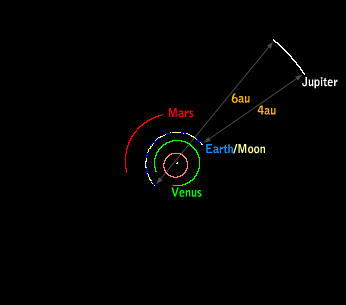
Orbits

Orbits


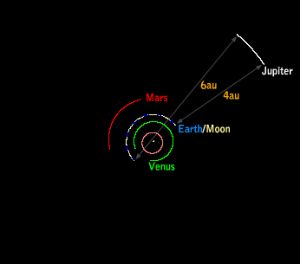
At opposition, Earth lies almost directly between the Sun and Jupiter. As a result, Jupiter is as close to Earth as it ever gets. For this opposition, it was just 3.97 astronomical units (au) away. In other words, it was just a little bit less than 4 times further from us as we are from the Sun.

Earth orbits the Sun at a distance of 1au (by definition). Jupiter orbits the Sun at a distance of 5au. As shown below, depending on where Earth and Jupiter are in their orbits around the Sun, the distance from the Earth to Jupiter varies between 4au and 6au. It is 4au at opposition and 6au when it is behind the Sun.
Jupiter

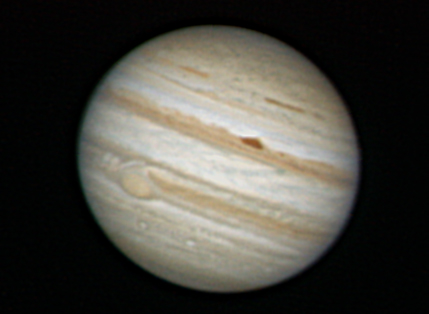
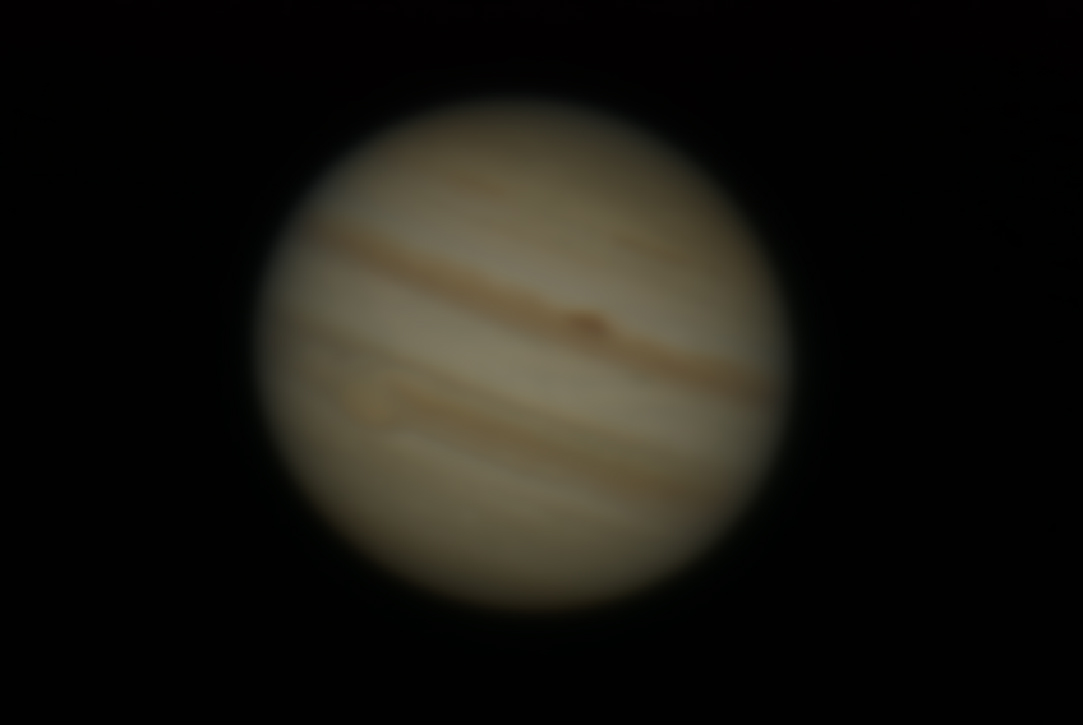
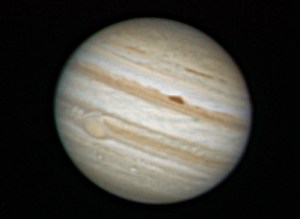
Sharpened image of Jupiter


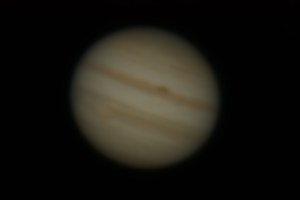
Hence, opposition is the best time to view Jupiter in a small telescope. Shown below is a picture I took of Jupiter just a few days before opposition. In this picture, Jupiter’s apparent size is as big as it ever gets for the particular telescope and camera I used.

In terms of “angular size”, Jupiter was 49.6 arcseconds in diameter at opposition. There are 60 arcseconds in one arcminute. Hence, 49.6 arcseconds is the same as 0.83 arcminutes. To put this angular size into more familiar terms, recall that the Moon is about 31 arcminutes in angular diameter. Hence, the Moon appeared about 37 times bigger than Jupiter.

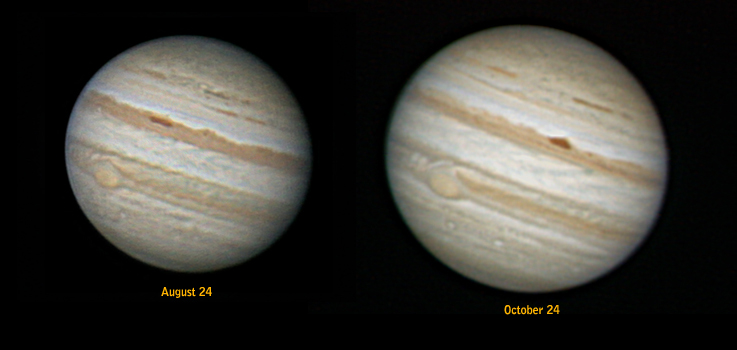
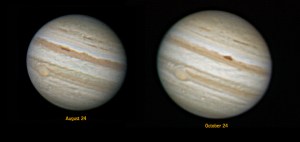
To appreciate the changing apparent size of Jupiter, it is interesting to compare pictures taken with the same equipment at different times. Last August I took a picture of Jupiter with the same equipment that I used a few days ago. Shown here are the two pictures side-by-side. Jupiter in late October was clearly bigger than it was back in August. When I took the August picture, Jupiter was 4.50 astronomical units away. Hence, its apparent size was about 12 percent smaller than now as the picture shows.
Comparing apparent sizes of Jupiter

Comparing apparent sizes of Jupiter. Left one was taken in August, right one in October.


Even though Jupiter is at closest approach right now, it will be an excellent evening object to view over the next several months. Currently, it rises in the east exactly when the Sun sets in the west. About an hour after sunset it is the blazingly bright object low in the east. Most people will think it is just another airplane off in the distance but those of us who know better can tell our friends that, no, this bright object is the majestic planet Jupiter.

Over the next few months, we will slowly draw further and further ahead of Jupiter in our orbit around the Sun and Jupiter will start to look smaller in the telescope. But, this regression will take place gradually and therefore Jupiter will continue to be spectacular for at least the next few months.

For those interested in taking pictures of Jupiter, let me offer some tips. The first and most critical factor is the weather and in particular the “seeing”. In NJ, August tends to have the nights with the best seeing and the night of August 24 was certainly a night of very good seeing. Also, seeing generally improves as the night wears on and the dropping temperature stabilizes a few degrees above dew point.

The second critical step is to make sure that the telescope is at the same temperature as the surrounding ambient air. I took these Jupiter pictures with my 10 inch Ritchey-Chretien from RCOS. It has fans that draw air over the mirror to facilitate a quick cool down. I set these fans at maximum power for about 30 minutes after which the telescope was basically the same temperature as the surrounding air.

While the telescope cools down, I work to get my camera set up. For these Jupiter shots, I used my Canon XSi DSLR camera because there is a third-party software program, EOS Camera Movie Record, that allows me to grab full-resolution real-time video from my camera directly to my computer.

Between the camera and the telescope I inserted a Televue 4x Powermate barlow lens to further magnify the image. Barlow lenses are important when imaging Jupiter and the other planets because, even at opposition, these are small objects that require as much magnification as possible.

To maximize the chance of getting a good picture, I always take several videos each a few minutes in duration. On August 24, I took 15 separate videos. On October 24, I took 16. Between recording each video, I refocus. Because of the variability caused by the seeing, it is very hard to judge when the telescope is in best focus. Hence, it’s best to take several random attempts at it and decide later which was best.
Hazy Jupiter

Hazy picture of Jupiter before sharpening


To “process” the videos into a single image, I use a program called Registax 6. Here’s how the October image looked after stacking and before doing anything to enhance the image…

To get from this blurry image to the nice sharp final image shown at the top, I used something in Registax called “wavelet sharpening”. This sharpening tool is really amazing as you can see.

Posted in November 2011, Sidereal Times | Tagged , , | Leave a comment

Yaroslav’s Sputnik Monument

by David Kaplan

Yaroslav - Monument celebrating Sputnik

Yaroslav - Monument celebrating Sputnik. Credit: David Kaplan

While traveling through Russia, we entered the town of Yaroslav and came
across this monument, which celebrates the Soviet achievement of sending the
first artificial satellite, Sputnik, into space.

Posted in November 2011, Sidereal Times | Tagged , , | Leave a comment

GRAIL Twins Launched on Lunar Gravity Mapping Mission

by Dr. Ken Kremer

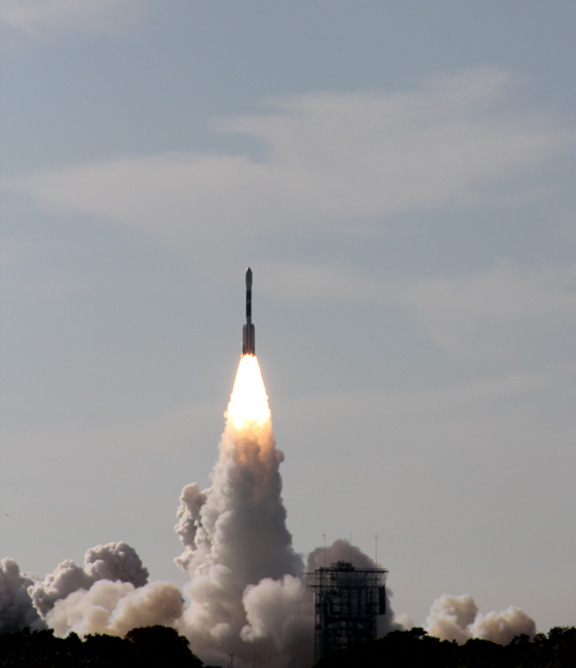
NASA renewed its focus on ground breaking science with the deafening Sept. 10 blastoff of a pair of lunar bound probes sailing on a unique path ‘From the Earth to the Moon’, for a truly challenging mission to do extraordinary science. GRAIL will map the moons interior with unparalleled precision, which will

GRAIL A and B gravity mappers rocket to the moon atop a Delta II Heavy booster on Sept. 10 from Cape Canaveral, Florida. Credit: Ken Kremer

fundamentally alter our understanding of how the moon and other rocky bodies in our solar system formed and evolved over 4.5 billion years time.

“GRAIL simply put, is a ‘Journey to the Center of the Moon’,” said Ed Weiler, NASA Associate Administrator of the Science Mission Directorate at a prelaunch briefing for reporters at KSC on Sept. 6.

GRAIL will probe the interior of the moon from crust to core and map its gravity field 100 to 1000 times better than ever before during a three-month science phase. We will learn more about the interior of the moon with GRAIL than all previous lunar missions combined.

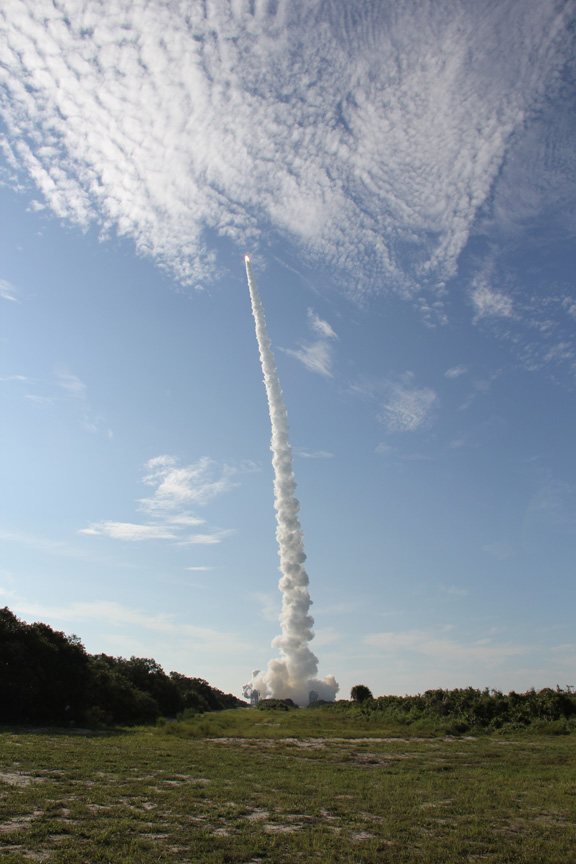
GRAIL Launch 2

GRAIL and Delta II rocket soar to space. Credit: Ken Kremer

“Precisely knowing what the gravity fields are will be critical in helping to land future human and robotic spacecraft. The moon is not very uniform. So it’s a dicey thing to fly orbits around the moon,” Weiler noted.

NASA’s dynamic duo finally blasted off for the Moon at 9:08 a.m. EDT on Sept. 10, 2011 from Space Launch Complex 17B at Canaveral Air Force Station in Florida after a two-day weather delay.

GRAIL 3

Delta II arcs over atop long exhaust plume casting shadow for long lunar journey. Credit: Ken Kremer


The nearly identical $496 Million Gravity Recovery and Interior Laboratory (GRAIL) probes were mounted side-by-side inside the nose cone atop a Delta II Heavy rocket. It thundered to life and soared into a gorgeous blue sky sprinkled with scattered clouds on a low-energy, 3.5-month journey to the moon.

This was the most powerful version of the Delta rocket family and generates 1.3 million pounds of thrust. The venerable Delta is being retired after more than 50 years of stellar service. Delta’s have launched numerous NASA science satellites including Spirit and Opportunity, Dawn, Stardust, Deep Impact and MESSENGER.

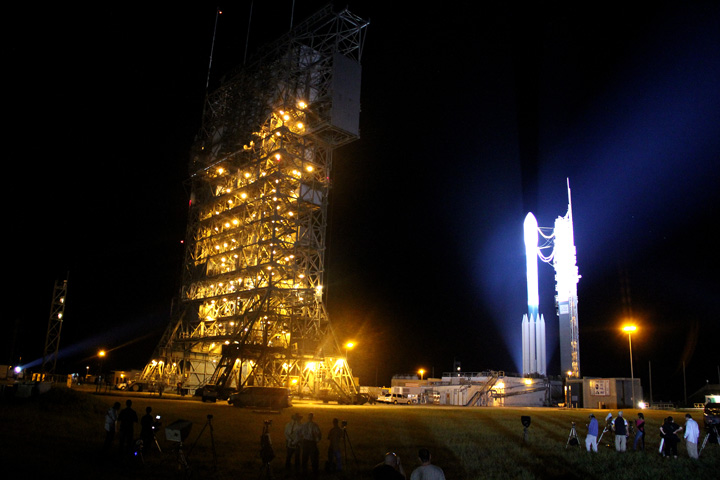
Photo Journalists

Photojournalists watch as Mobile Service Tower is retracted from around Delta II rocket at Pad 17B. Credit: Ken Kremer


Liftoff of the GRAIL duo marked the last scheduled launch of a United Launch Alliance Delta II from Florida and also the last launch from Space Launch Complex 17. This was the 356th Delta launch since the first one in 1960.
GRAIL A-B

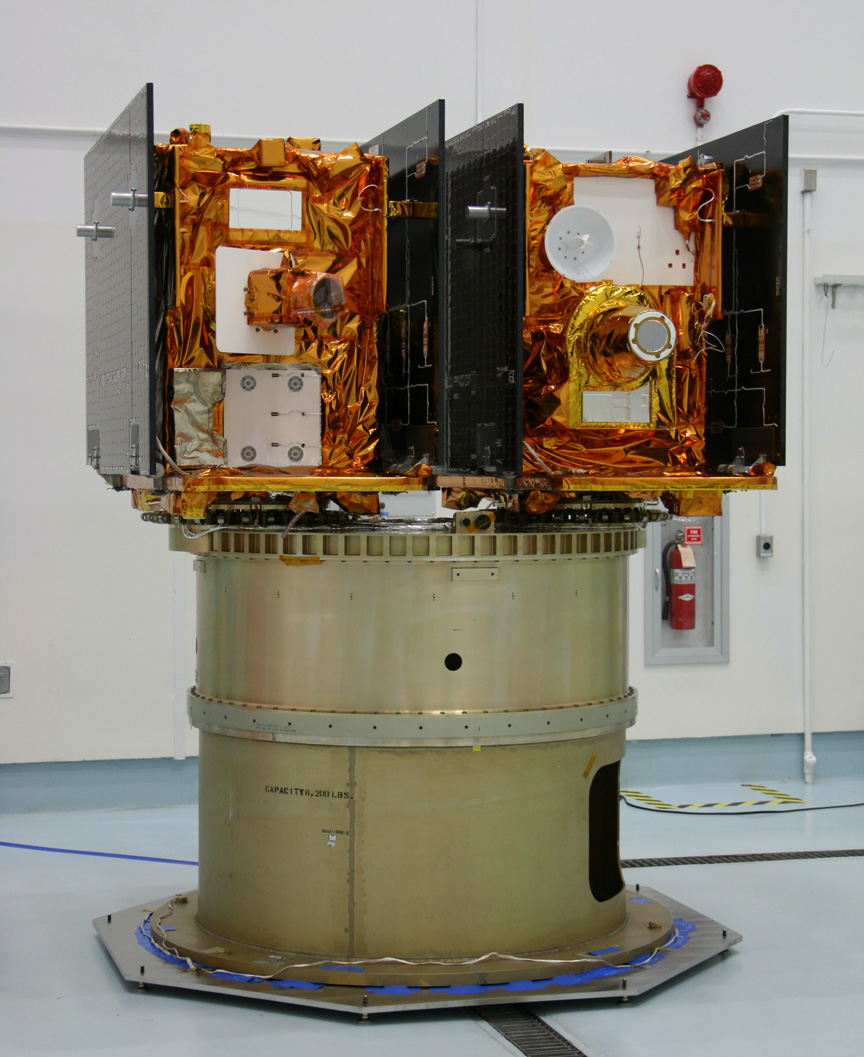
NASA’s twin GRAIL Lunar Science Probes - GRAIL B (left) and GRAIL A (right) spacecraft are readied for flight inside the clean room at Astrotech Space Operations facility before launch. Credit: Ken Kremer


On this historic occasion the media, including myself, were permitted to a observe the liftoff from a viewing location just 1.5 miles away with an unobstructed view of the launch pad, which magnified the tremendous roar and flames spewing from the 1st stage rocket engines.

GRAIL A and GRAIL B will fly in tandem formation in a nearly circular, polar orbit at an altitude of about 50 km above the lunar surface as the moon rotates beneath three times.

NASA has announced an essay writing contest to name the GRAIL probes. The contest is open to students in Grades K – 12 at schools in the United States. The deadline is November 11, 2011.

Check my GRAIL features online at Universe Today:
Student Alert: GRAIL Naming Contest – Essay Deadline November 11
GRAIL Lunar Blastoff Gallery
GRAIL Twins Awesome Launch Videos – A Journey to the Center of the Moon
NASA launches Twin Lunar Probes to Unravel Moons Core
GRAIL Unveiled for Lunar Science Trek — Launch Reset to Sept. 10
Last Delta II Rocket to Launch Extraordinary Journey to the Moon, Sept. 8
NASAs Lunar Mapping Duo Encapsulated and Ready for Sept. 8 Liftoff
GRAIL Lunar Twins Mated to Delta Rocket at Launch Pad
GRAIL Twins ready for NASA Science Expedition to the Moon: Photo Gallery

Astronomy Outreach      by Ken Kremer

Amateur Astronomers Association of Princeton:  Princeton University, Princeton, NJ, Nov 8, 8 PM  “Atlantis, the End of Americas Shuttle Program and What’s Beyond for NASA”Website: http://www.princetonastronomy.org/

Washington Crossing State Park:  Titusville NJ, Saturday, Nov 12, 1 PM. The Grand Finale of  Americas Shuttle Program and What’s Beyond for NASA”. Website: http://www.state.nj.us/dep/parksandforests/parks/washcros.html

Gloucester County College Astronomy Club: Sewell, NJ, Wednesday, Nov. 16, 8 PM. “7 Years of Mars Rovers — Mars and Vesta in 3 D”.

Website: http://www.gccnj.edu/news_and_alerts/rotating_ads/ken_kremer.cfm

Ken Kremer:  Spaceflight magazine & Universe Today

Please contact Ken for more info or science outreach presentations:

Email: kremerken@yahoo.com   website:  www.kenkremer.com

http://www.universetoday.com/author/ken-kremer/

Posted in November 2011, Sidereal Times | Tagged , , , | Leave a comment

From the Director

by Ludovico D’Angelo, Director AAAP

This last month has been a disappointing one for astronomy efforts. Sure, you could read magazine articles and visit astronomy related internet sites, but for me, there is real value getting outdoors and doing some astronomy, either by telescope or just visual scanning of the sky. The best opportunity for this is our club’s NJ StarQuest. It is an opportunity for those things plus fellowship with other like minds. But, alas, it was not to be this year. A weekend long bout of rain and clouds forced us to cancel the event. In days past this would go on rain or shine. Lately, though, the experience is that very few pre-register, and the rest wait for the weather and don’t mind paying an extra few dollars to walk on if the weather is good. Of course, this makes planning for the event very difficult. StarQuest will be rescheduled, but certainly it will also change so that there is less need for planning.

We look forward to our next meeting on October 11th in Peyton Hall. Our guest speaker will be long time AAAP club member and renowned theoretical physicist and mathematician, Dr. Freeman Dyson. The hall will certainly be filled to capacity, so get there early to secure a seat.

See you on the 11th at 8PM in Peyton Hall!

Posted in October 2011, Sidereal Times | Tagged , , | Leave a comment