Opportunity Begins Year Nine on Mars

by Dr. Ken Kremer

NASA’s resilient Opportunity robot has begun her ninth year roving around beautiful Earth-like Martian terrain where potentially life sustaining liquid water once flowed billions of years ago. Opportunity celebrated her eighth anniversary on the red planet gazing at the foothills of the vast crater named Endeavour that promises a “mother lode” of water related science – an unimaginable circumstance since the nail biting landing on the hematite rich plains of Meridiani Planum on 24 January 2004. She is now 99 months into the three month mission, that’s 33 times beyond the designers’ expectation.
Opportunity

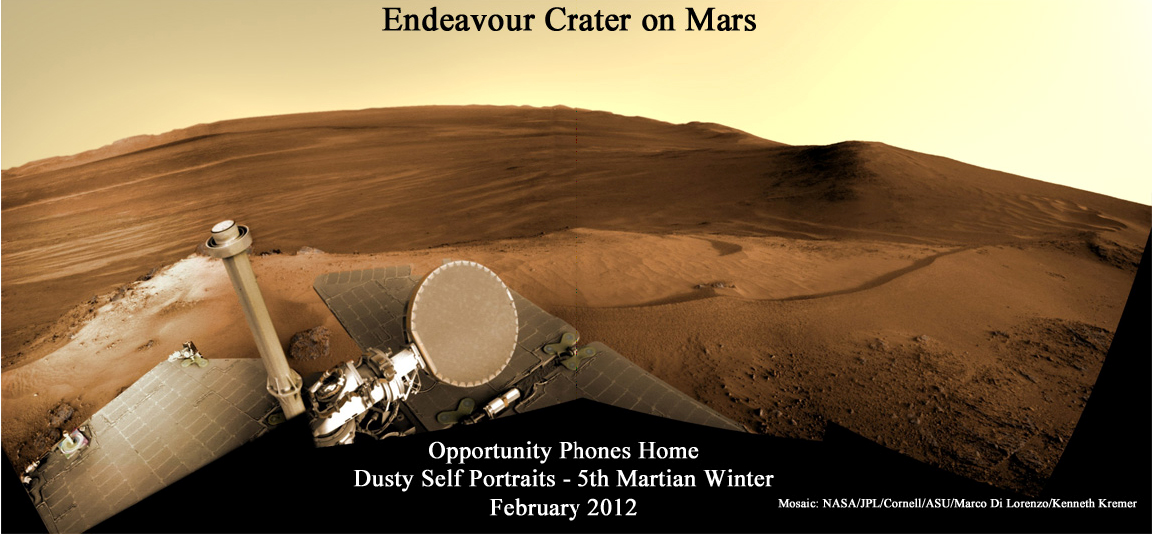
Mars Rover Opportunity. Credit: NASA/JPL/Cornell/ASU/Marco Di Lorenzo/Kenneth Kremer


Opportunity has phoned home dusty new self portraits of her beautiful body basking in the utterly frigid sunshine during her fifth winter on the Red Planet whilst overlooking Endeavour, some 14 miles in diameter.

NASA’s endearing robot is simultaneously carrying out an ambitious array of ground breaking science experiments this winter providing insight into the mysterious nature of the Martian core while sitting stationary until the energy augmenting rays of the springtime sun shower down on her from the heavens above.

“Milestones like eight years on Mars always make me look forward rather than looking back,” Rover Principal Investigator Prof. Steve Squyres of Cornell University told me for this article commemorating Opportunity’s landing. “We’ve still got a lot of exploring to do, but we’re doing it with a vehicle that was designed for a 90-sol mission. That means that every sol is a gift at this point.”

Opportunity has driven more than 21 miles across the red planet’s surface during what is truly human-kind’s first overland expedition on another planet. NASA’s twin rovers Spirit and Opportunity blasted off for Mars atop a pair of Delta II rockets in the summer of 2003 with a mission “warranty” of just 90 Martian days, or Sols.

The robot will remain parked at Endeavour for the winter on a slope at the north end of the crater rim segment called Cape York with an approximate 15-degree northerly tilt towards the life-giving sun to maximize solar energy production. The park-site is at an outcrop dubbed “Greeley Haven”, named in honor of Ronald Greeley, a beloved and recently deceased science team member.

This is the first winter that Opportunity did not have sufficient power to continue roving across the surface, because of the thick layer of dust on the solar arrays. Since Opportunity is just south of the Martian equator, the daylight hours for solar power generation are growing shorter until the southern Mars winter solstice occurs on March 30, 2012.

The rover science team is ingeniously using the lack of movement to their advantage, and Opportunity is still vigorously hard at work doing breakthrough research every day. From her stationary position, Op-portunity is conducting her first radio-science, Doppler tracking measurements to support geo-dynamic investigations and to elucidate the unknown structure of the Martian interior and core. The team was eager for the long awaited chance to carry out the radio tracking experiment with the High Gain Antenna (HGA) and determine if Mars’ core is liquid or solid. Months of data collection are required while the rover stays stationary.

“This winter science campaign will feature two-way radio tracking with Earth to determine the Martian spin axis dynamics – thus the interior structure, a long-neglected aspect of Mars,” Ray Arvidson told me. Arvidson, of Washington University in St. Louis, is the Deputy Rover Principal Investigator.

A few months after the Martian southern winter solstice, the team will drive her off the outcrop and fur-ther explore Cape York in search of further evidence of the gypsum mineral veins like “Homestake” – indicative of ancient water flow – previously discovered at Cape York. Then Opportunity will rove further south to investigate deposits of phyllosilicates, the clay minerals which stem from an earlier epoch when liquid water flowed on Mars and which may have been more favorable to sustaining life.

Meanwhile, NASA’s Curiosity Mars Science Laboratory rover is rocketing through space and on course for a pinpoint touchdown inside the layered terrain of Gale Crater on August 6, 2012. Curiosity is now America’s last planned Mars rover following the Obama administration’s cancellation of the joint NASA/ESA ExoMars rover mission.

Check Ken’s Mars features online at Universe Today and the February 2012 issue of Spaceflight magazine:
Opportunity Phones Home Dusty Self-Portraits and Ground Breaking Science
A Penny for your Curiosity on Mars
Experts React to Obama Slash to NASA’s Mars and Planetary Science Exploration
Spirit Lander – 1st Color Image from Mars Orbit
NASA’s Resilient Rover Opportunity Begins Year 9 On Mars with Audacious Science Ahead

Astronomy Outreach by Ken Kremer
Rockland Astronomy Club RAC, Rockland Community College, Suffern, NY, Mar 16, 8 PM, “NASA’s Year of the Solar System: Mars, Moon, Mercury, Vesta, Jupiter, Comets and Beyond (plus 3-D”). Website: http://www.rocklandastronomy.com/

New Jersey Astronomical Association NJAA- Vorhees State Park: High Bridge, NJ, March 24, Sat., 8 PM “Atlantis, the End of America’s Shuttle Program and What’s Beyond for NASA”. Website: http://www.njaa.org/

Ken Kremer:  Spaceflight magazine & Universe Today
Ken has a selection of his Shuttle photos and Mars mosaics for sale as postcards and frameable prints.

Please contact Ken for more info or science outreach presentations:
Email: kremerken@yahoo.com   website:  www.kenkremer.com
http://www.universetoday.com/author/ken-kremer/
Posted in March 2012, Sidereal Times | Tagged , , , | Leave a comment

From the Director

by Ludovico D’Angelo, Director AAA

We had a very productive Board of Trustee’s meeting on January 25th. Thanks to all that attended. It was crowded, but I was very pleased to have so much input into the club’s future.

On November 5, 1962, a group of astronomy enthusiasts formed the AAAP at their first meeting. This year will mark the 50th year of astronomical discovery, research, and knowledge. I am happy to be part of this club and grateful that it exists. It supplies anyone with an interest in astronomy the chance to learn and grow in knowledge through our regular meetings and guest speakers, And also through our observatories where we can observe the night sky. Read the club history online by accessing the pull down in the upper right corner of the webpage. It will give a good perspective on our 50 years.

The Board is agreed that there will be many activities that promote our club and astronomy enthusiasm in Princeton and its local surroundings as part of our 50th year. To accomplish these things, we need your participation. Activities that we have in mind are a presence at Princeton’s Communiversity in April, Super Science Day at the Trenton State Planetarium (also in April), and weekly or monthly sidewalk astronomy in Princeton throughout the year, starting in March.

We are trying to arrange a location for a public event to view the Transit of Venus, which occurs this year on June 5th. The location at this point will be Baldpate Mountain. It will be the last time to view this event from the earth for more than 100 years. Suffice to say, none of us will be here at the next occurrence.

We also had plans to show a movie “The City Dark” (which premiered in New York a few weeks ago) and have sidewalk astronomy afterwards. As it happens, the film “The City Dark” will be shown at the Princeton Public Library on February 11th at 7 pm. We will set up some scopes by the library after the movie. The director of the film, Ian Cheney, is scheduled to speak afterwards in a Q&A session along with Michael Lemonick, who spoke to our club in the fall of 2009. Go to http://www.princetonlibrary.org for details on the Princeton Environmental Film Festival.

A dinner party to celebrate the club in lieu of our November meeting has been suggested. Stay tuned for more info on this. If you would like to help plan and pick the location, please speak up!

A process is underway to create a Facebook page to expanding our presence on the web, to communicate and announce special events, and to be connected in general. It needs some help to organize, so if any of you have experience setting up a page for an organization, please contact me.

Other activities discussed at the Board meeting were trips to any one of numerous dark sky sites, to the Navel Observatory in Washington, DC, and to the Southwest. Plus there are several outreach events coming up, and some great speakers for the rest of our current season! We are just a flurry of activity (without the actual snow flurries).

If any of you should have more suggestions, please bring them to the next meeting, and also please attend the next meeting where our guest speaker will be Dr. Paul Stenhardt of Princeton University. Please stay afterwards for the discussion on planning our future astronomy events.

See you all in Peyton Hall on February 14th (Happy Valentine’s Day!) at 8 p.m.

Posted in February 2012, Sidereal Times | Tagged , , , | Leave a comment

From the Program Chair

Ken Levy, Program Chair

AAAP Enjoys Dr. Shara’s Talk  Credit: Ken Levy

AAAP Enjoys Dr. Shara’s Talk Credit: Ken Levy

Many thanks to Dr. Michael Shara who provided a fascinating talk on the structure and evolution of novae and supernovae as well as a focus on his current exhibit at the American Museum of Natural History, Beyond Planet Earth: The Future of Space Exploration. I encourage all members to visit the exhibit, now on view through August 12th. If you missed the lecture or would like to review it, please go to the following link for a complete MP3 of the talk: files.me.com/kenetics/97phzg.mp3

Dr. Michael Shara Credit: Ken Levy

Dr. Michael Shara Credit: Ken Levy

This month we’re proud to have Dr. Paul Steinhardt. Dr. Steinhardt is the Albert Einstein Professor in Science and Director of the Princeton Center for Theoretical Science at Princeton University, where he’s also on the faculty of both the Department of Physics and the Department of Astrophysical Sciences.

Dr. Steinhardt is the author of over 200 refereed articles, five patents, three technical books, numerous popular articles. In 2007, he co-authored Endless Universe: The Big Bang and Beyond, a popular book on contemporary theories of cosmology.

Dr. Paul Steinhardt.

Dr. Paul Steinhardt. Courtesy: Embry-Riddle Aeronautical University

He is one of the co-discoverers of the first natural quasicrystal and recently organized a geological expedition to Chukotka in Far Eastern Russia to find new information about its origin and search for more samples. Dr. Steinhardt will be speaking on the controversial topic “Inflationary Cosmology on Trial” from his recently published article in Scientific American; another not to miss lecture, on Valentine’s Day, Tuesday February 14th. Bring someone you love!

Posted in February 2012, Sidereal Times | Tagged , , , , | Leave a comment

From the Outreach Chair

by David Letcher, Outreach Chair

So far this 2012 season has seen us scheduled for three star parties. January 26th was to be our first of the season at Antheil School in Ewing, NJ, but very cloudy weather put a damper on that one. The next one was a very successful but chilly evening at the Lawrenceville Elementary School on Friday, January 27th. Thanks go to members Gene Ramsey, Jeff Bernardis, Victor Davis, Darryl Foyuth, and yours truly. Many children and their parents enjoyed seeing the waxing crescent moon, Jupiter, double stars, clusters and the Great Nebula in Orion.

Our next scheduled star party will be held at the Hopewell Elementary School on the evening of Friday, March 16th. Let me know if you are interested in volunteering and helping out. I’ll be sending reminder emails to our membership in the near future.

Lastly, I received a request from Ms. Emily Blackman of the D&R Greenway Land Trust in Princeton about the possibility of co-hosting an event this summer. She states that they are sched-uling a trail walk and meteor shower watching event for Sunday August 12th from 8-9:30 pm. This event will be held on Cider Mill Preserve in East Amwell. (I hope the Perseids will be visible. I’ll have to tell them that late night hours are best for seeing meteor showers.) We are asked if we would be interested in co-hosting and bringing along some telescopes for attendees to use. August is a bit into the future but keep this event in mind. That’s all for now!

Posted in February 2012, Sidereal Times | Tagged , | Leave a comment

January 10, 2012 AAAP Meeting

Larry Kane, Secretary

The meeting was called to order by Director Ludy D’Angelo.

  • Director: Ludy announced that the person who was trying for a grant to provide observing sessions at Ronald McDonalds house did not get it, but was still interested in working with us to do one or more star parties. Dates and times will be determined. Ludy also stated that he was contacted to relate what the AAAP was doing to combat light pollution. He noted that even if we do not have a program, each of us should do what we can in our communities.
  • Assistant Director: Jeff Bernardis gave a report on the electrical work and the new security system at the observatory. He will send out information about the new security system to all keyholders.
  • Observatory Report: Gene Ramsey thanked those members who helped out in the post-storm repairs. He noted that there are still low hanging vines on the telephone polls that will be pulled down in another ice storm. The gate at the soccer field is now being locked since someone drove a vehicle onto the field and tore up the grass. Since the gate will be locked, Gene thought that the park may not plow the access road after a large snow fall. Some of the drainage tiles were crushed and jagged edges were left. Gene said he will take care of the sharp edges to prevent tires from being punctured. If our lock is missing from the front gate, the park rangers should be notified. Rex Parker raised the issue of how to use the donated Losmandy mount. It was agreed that this could be discussed at the next board meeting.
  • Secretary: Larry Kane thanked Michael Wright for taking the minutes from the last membership meeting.
  • Treasurer’s Report: Michael Mitrano gave a report that appears in another section of this Sidereal Times.
  • Outreach: The next outreach for the AAAP is Jan-uary 27th from 6:30 to 8:30 p.m. at Lawrenceville Elementary School. Larry Kane stated that he got an email requesting that we join Super Science Saturday on April 24.
  • Webmaster: John Miller led a discussion on up-grading the website. Anyone interested in helping with the upgrade should contact John Miller. The AAAP Twitter account was also discussed. John stated that many people follow the AAAP on Twitter.
  • A date, January 25th, was set for the next Board meeting.
  • A discussion was held on what kind of event the AAAP should hold for the Venus Transit. Gene Ramsey suggested going to the Mercer County Park at Baldpate Mountain. Ludy suggested that once the location is set, we should heavily advertise it.
  • Ludy led a discussion on our 50th year anniversary celebration.
  • The Hope Center may not be available to hold StarQuest for the weekends we would want, during October and November.
Posted in February 2012, Sidereal Times | Tagged , , | 1 Comment

January 25, 2012 AAAP Board of Trustee’s Meeting

Larry Kane, Secretary

The meeting was called to order by Director Ludy D’Angelo.

  • Director: Ludy noted how much of the media reacted to the last, uneventful, coronal mass ejection. Ludy suggested that we could use a public outreach in Princeton to raise awareness of the night sky. Member John Church noted that November 5, 1962 was the date of the first meeting of the AAAP and is the anniversary date.
  • Treasurer Michael Mittrano provided a financial picture of the AAAP.
  • Secretary Report: Larry Kane noted that he received an email from the Director welcoming a new member and he asked about the member’s application.
  • Secretary: Larry Kane thanked Michael Wright for taking the minutes from the last membership meeting.
  • Publicity: Michael Wright noted that press releases were going out every month.
  • Outreach: The next event in Ewing on January 26 will probably be rained out. The event at Lawrence Elementary School on Friday, January 27 will be held indoors if it cannot be held outdoors. David Letcher presented a certificate that was given to the people that completed his evening astronomy course at the Nature Center. He said that he had some posters that he created for Super Science Saturday that he could bring for Friday. On March 16, we are invited to Hopewell Elementary School.
  • AAAP’s 50th Anniversary: The planning for the Venus transit in June began. It was decided to make this event a major outreach effort for our 50th anniversary year. Ludy will contact Mercer County and tell them that we want to reserve Baldpate Mountain for the event, but members should investigate other sites. Sidewalk astronomy in Princeton should be a major part of the year. Larry Kane will contact those putting together Communiversity Day. It will be held on April 28th. Bill Murray pointed out that seven of the brightest objects will be visible at night in March. This would be a good time for a sidewalk star party in Princeton. We should have a banner for our outreach efforts. Rex Parker suggested that we might check with the local farmers’ markets to do daylight observing as a club. He also suggested that we have a “kit” put together so any members could attend an outreach event and publicize the club. Other ways of celebrating the anniversary were suggested, including a banquet for members. Ira Polans mentioned several options for trips/tours in the South-west US that the club could take. A possible visit to the Naval Observatory was discussed. Larry Kane suggested that he could contact Rush Holt’s office to see if the congressman could set up a visit. Bill Murray noted that nothing is scheduled for the new moon weekend in July. Michael Wright stated that he can do a special issue of Sidereal Times for the anniversary and invited notables in the club to contribute articles. Rex suggested that we invite Princeton faculty who have provided lectures in the past to join us and become part of the celebration. Ludy will bring up some of these ideas at the next membership meeting, before everyone leaves.
  • Ludy announced that the Historical Society of Princeton contacted us inviting us to do a star party at the Updike Farm location with an historical tie. Ludy will follow up with them.
  • The topic of our club creating a Facebook page was raised.
Posted in February 2012, Sidereal Times | Tagged , , | Leave a comment

Treasurer’s Report

by Michael Mitrano, Treasurer

Membership for the current fiscal year is now up to 72, which is 6 members ahead of the same time last year but a way to go from our recent-year final count of close to 90.

Total revenue for the fiscal year to date is about $4,200. With our annual insurance bill paid and StarQuest now settled, we have a surplus so far this year of about $1,100. It is possible that further electrical work at the observatory may reduce this.

On a cumulative basis, our surplus is roughly $22,000.

Posted in February 2012, Sidereal Times | Tagged , | Leave a comment

RAS Lectures on Astronomy

The Rutgers Astronomical Society is hosting Rutgers’ physics and astronomy faculty members and several others for weekly lectures. The talks are scheduled on Thursday evenings from 8:00 – 9:00 PM in the Physics Lecture Hall on Busch Campus. The event is free and open to everyone, and there will be free pizza and drinks.

On February 9, Prof. Chuck Keeton of Rutgers University will talk about “Black Holes and the Fifth Dimension”. Free parking is available in Lot 53 and Lot 53A, a short walk from the Physics Lecture Hall. Contact RAS through their website for a free parking permit.

The current schedule of speakers and topics can be found at: RUAstronomical.com/Lectures

Posted in February 2012, Sidereal Times | Tagged , , | Leave a comment

The Ordeal of Guillaume Le Gentil

by Michael Wright, Co-Editor

Does this scenario sound familiar? You buy a new piece of gear; say an eyepiece that you are dying to try out on your favorite deep sky object. It arrives in the mail on a weekday so you decide wait until the week-end. On Saturday, Clear Sky Chart predicts above average seeing and transparency, but as you are pulling out your scope, your spouse reminds you that your child has a recital that evening. You do the right thing and put the scope back.

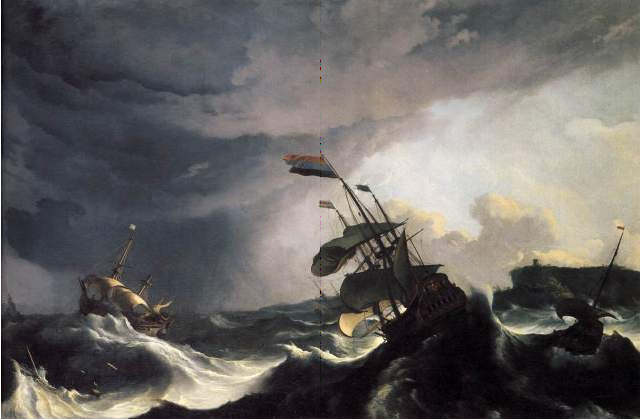
Stormy Seas Next time your observing plans are frustrated, take consolation in the story of Guillaume Le Gentil. In 1760, Le Gentil was commissioned by the French Academy of Sciences to observe the 1761 transit of Venus from Pondicherry, India. Sailing from France in March 1760, he arrived on the Isle de France (Mauritius) in July where he learned that war had broken out between France and Britain preventing further passage east. In February 1761, he was finally able to secure passage. Despite the upcoming monsoon season, he was assured that he could reach Pondicherry by mid-April in plenty of time for the transit on June 6. Unfavorable winds blew his ship off course, so it spent five weeks wandering around the Indian Ocean and the Arabian Sea. Upon nearing Mahé on the west coast of India, the captain learned that Pondicherry had been captured by the British so he decided to return to Isle de France. Le Gentil had no choice but to remain on board for the return trip. On the day of transit, Le Gentil was on board ship and unable to make accurate observations on the rolling deck.

Rather than return to France, Le Gentil decided to stay in the Indian Ocean until the next transit in 1769 and “to make all observations I could on geography, natural history, physics, astronomy, navigation, winds and tides.” This he did for a few years. In 1766, he decided that Manila in the Philippines would be the ideal spot to observe the transit so on May 1, he sailed for Manila and arrived in August. The Spanish governor of Manila was suspicious and antagonistic towards Le Gentil. Learning that Pondicherry was in French hands again, Le Gentil escaped on a Portuguese ship. On his arrival in Pondicherry on March 27, 1768, the governor welcomed him with a feast, and the next day invited him to select a location for his observatory. Le Gentil selected a palace that has been partially destroyed by the British and was now used as a powder magazine. While waiting for the June 4, 1769 transit, he prepared his observatory and studied Indian astronomy.

On the eve of the transit, the sky was perfectly clear and Le Gentil entertained the governor with views of Jupiter’s satellites. Everything appeared favorable for observing the transit the next day. Awakening during the night, Le Gentil was dismayed that the sky was overcast. He wrote “… I felt doomed, I threw myself on the bed, without being able to close my eyes.” Instead of clearing, a storm blew in bringing thicker clouds completely obscuring the Sun for the duration of the transit. Immediately after, the skies cleared and the Sun shone for the rest of the day. Le Gentil wrote in his journal that day:

“That is the fate that often awaits astronomers. I had gone more than ten thousand leagues; it seemed that I had crossed such a great expanse of seas, exiling myself from my native land, only to be the spectator of a fatal cloud which came to place itself before the Sun at the precise moment of my observation, to carry off from me the fruits of my pains and of my fatigue…”

And to add insult to injury, the skies were clear in Manila that day!

Le Gentil fell into a funk for several weeks and contracted dysentery, which delayed his return to France. Still sick, he embarked in March 1770 for home, but was forced to convalesce at the Isle de France. By July he was ready to continue his journey, but could not obtain passage until November. A hurricane damaged his ship and Le Gentil was forced to return to Isle de France again, where he received news that his heirs presumed him dead and were trying to divide his estate. On March 31, 1771, he left Isle de France for the last time and endured a stormy trip to Cadiz in Spain. Traveling overland, he reached French soil on October 8, 1771; eleven years, six months and thirteen days after setting out.

But that is not all! Upon returning home, he found his heirs fighting over his estate, funds entrusted to his agent missing, eight crates of specimens collected on his journey missing, and his seat in the Academy lost. His seat was eventually restored, but he could not recoup the lost funds or locate the missing specimens. Now, compared to Le Gentil’s ordeal, are your disappointments so terrible?

Posted in February 2012, Sidereal Times | Tagged , , , | 1 Comment