Treasurer’s Report

by Michael Mitrano, Treasurer

Our anniversary celebration was the big financial event for May.  Not all expenses have been finalized and a significant sponsorship that had been pledged has not yet been received.  The fundraising effort was tremendously successful, however, and based on sponsor and guest payments received less expense invoices in hand, the event has a deficit of about $600.  This is well under the $2,500 limit approved for the event so it is likely that we will end up within that limit — but revenues and costs are not final.  Expenses in hand (paid or to be paid) for the event total about $10 thousand, which is more than double what the Association usually spends on all other activities for a year.

If any members incurred reimbursable expenses for the Anniversary and have not gotten the receipts for me for reimbursement, please do so right away.

Membership hit the 100 mark in May, which surpasses our count for the previous three years. Non-Anniversary expenses were modest.

With the event as it now stands and all other activities combined, our fiscal year-to-date results show a surplus of about $400.

On a cumulative basis, our surplus remains about $23 thousand.

Posted in June 2013, Sidereal Times | Tagged , | Leave a comment

2013 Annual Meeting Minutes

Submitted by Michael Wright, Secretary

Director Ludy D’Angelo called the annual meeting to order.[1]  He announced that the only item of business is the election of the 2013-14 Board of Trustees.

Ludy announced the slate of candidates, which was presented by the nominating committee chair at the April 9, 2013 meeting and published in Sidereal Times:

Director – Jeff Bernardis
Assistant Director – Larry Kane
Treasurer – Michael Mitrano
Secretary – Michael Wright
Program Chair – Kathleen Otto

Ludy asked for any nominations from the floor, to which there was no response.  Ludy moved acceptance of the slate, which was seconded by Saul Moroz.  By voice vote, the members present approved the 2013-14 Board of Trustees.

Ludy adjourned the meeting.


[1] The Annual Meeting was conducted at the 50th Anniversary Celebration, which over 100 members and guests attended.

Posted in June 2013, Sidereal Times | Tagged , | Leave a comment

Photos from 50th Anniversary Celebration, May 11, 2013

This gallery contains 72 photos.

More Galleries | Tagged , | Leave a comment

50th Anniversary Celebration Poetry Contest Winning Entries

Elementary Category Winner
Middle School Category
high

Posted in June 2013, Sidereal Times | Tagged , , , , | Leave a comment

Random Thoughts From A Novice

by S. Prasad Ganti 

The 50th anniversary celebration of AAAP was a unique experience for me.  I enjoyed first the talk by Freeman Dyson on small science by amateurs followed by an interesting group discussion on whether there is anyone out there in the Universe.  Fermi was quoted as asking, “Where are the aliens?”  Dr. Richard Gott replied that they might be on their home planets like we are!   This made me think and pull out my earlier notes of my thoughts on this topic.

Sure, as per Drake’s equation, there is a likelihood of life elsewhere in this Universe, which has billions of galaxies; each galaxy with billions of stars; and each stars with several planets and moons.  Add to this parallel universes and higher dimensions as predicted by the string theory.  Our universe might be just one of the many floating in higher dimensions.  Despite such good possibilities of life elsewhere, it is not easy to find because of our hubris that we are intelligent, of the assumptions we make and they may be farther away from us.  To assume that every life is carbon based and looks and behaves like us may not be the right assumption to make.

Detecting aliens might be like detecting oil.  Oil was always there on earth for millions of years. Only recently did we develop technologies to detect and exploit oil.  The natives of Papua New Guinea were always there.  We did not find them until Europeans landed on their island in the 1930s.  With aliens it is lot more complicated than finding oil or natives. The timelines of various civilizations may not coincide.  Like stars form and die, evolution and civilizations may also follow this cyclical path.  Different civilizations may be evolving in different parts of the universe at different times, and some others may be perishing at this instant.  Only recently did our species acquire technology, which lets us explore beyond the confines of our earth.

Life might have existed millions of years ago in our neighborhood and might exist millions of years henceforth.  Neither the planets nor the stars last forever.  It is possible that life becomes extinct in some parts of the universe and takes birth in some other parts of the universe.  Life may not be in the same shape or size, or at the same level of advancement at the same time all over.  For example, on earth life was under the oceans in the microbial form of Cyanobacteria for three billion years, which oxygenated the planet and made life possible on the surface.

In spite of our recent technology, still we are not capable of looking farther and recent. The farther we look into space, the farther we are looking back into time.  We cannot look at recent events from afar because we are limited by the speed of light. As per Einstein’s theory of relativity, nothing in the Universe can travel faster than the speed of light. In the future, we might find short cuts across the universe.

Besides, human species may not represent the pinnacle of intelligent life forms.  Evolution on earth is still happening.  In a million years, which is not a major timeline from evolution’s perspective, there could be higher forms of life than us.  We might still be work in progress.

Our tools of detection may be primitive.  Our signals sent out may not be detectable by aliens. What is data for us may be gibberish for them.  After all, compressed data looks like noise. Data interpretation to a large extent depends on how it was codified.  The string of 1s and 0s on a DVD are useless unless there is an algorithm to interpret them.

All reported alien encounters so far and the presumption of presence of aliens amongst us has no substantiation.  If history is any indication, it does not serve to be too pessimistic about finding alien life.  The Kepler satellite is discovering more and more habitable planets in our own galaxy.  We might encounter aliens some day.  Till then, they will be science fiction.

Posted in June 2013, Sidereal Times | Tagged , , , | Leave a comment

Moon, a photo by Bob Vanderbei

Moon. Photo taken by Bob Vanderbei at 5:41am, May31, 2013, 8 minutes after sunrise (5:32am).

Moon. Photo taken by Bob Vanderbei at 5:41am, May31, 2013, 8 minutes after sunrise (5:32am).

Posted in June 2013, Sidereal Times | Tagged , | Leave a comment

Snippets

compiled by Surabhi Agarwal

Large asteroid zipping past Earth towing moon
Published: Sun May 31, 2013- 5:06AM on CNN
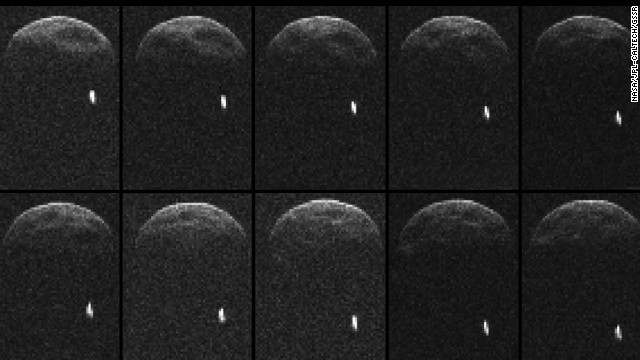
Asteroid 1998 QE2 about 3.75 million miles from Earth. The white dot is the moon, or satellite, orbiting the asteroid.

Asteroid 1998 QE2 about 3.75 million miles from Earth. The white dot is the moon, or satellite, orbiting the asteroid.

An asteroid is whizzing past Earth on Friday – and it’s traveling with its own moon in tow.

1998 QE2, as NASA has named it, will not come anywhere near enough to collide with our world. The closest it will come is about 3.6 million miles away – that’s over 15 times the distance to our moon. It will reach that point just before 5 p.m. ET.

But it’s giving astronomers the “best look at this asteroid ever,” NASA said.

The discovery of its moon — which makes it what scientists call a binary asteroid — surprised the astronomers, said NASA radar scientist Marina Brozovic, who helped take the images at Deep Space Network antenna at Goldstone, California.

The complete article may be found at: Large asteroid safely zips past Earth, dragging its moon along

3 new planets could host life
Published: Sun April 21, 2013- 8:48AM on CNN
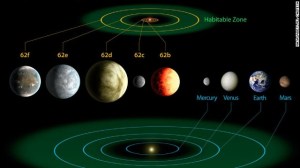
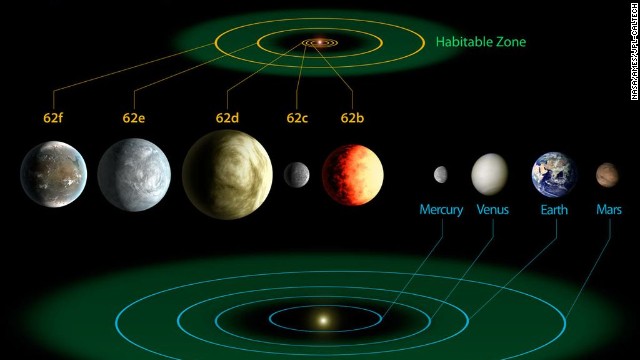
This diagram compares the planets of our own inner solar system to Kepler-62, a five-planet system about 1,200 light-years from Earth. Kepler-62e and Kepler-62f are thought capable of hosting life.

This diagram compares the planets of our own inner solar system to Kepler-62, a five-planet system about 1,200 light-years from Earth. Kepler-62e and Kepler-62f are thought capable of hosting life.

Scientists announced Thursday the discovery of three planets that are some of the best candidates so far for habitable worlds outside our own solar system — and they’re very far away.

NASA’s Kepler satellite, which is keeping an eye on more than 150,000 stars in hopes of identifying Earth-like planets, found the trio. Two of the planets — Kepler-62e and Kepler-62f — are described in a study released Thursday in the journal Sci-ence. They are part of a five-planet system in which the candidates for life are the farthest from the host star. Their host star — which corresponds to Earth’s sun, but is smaller and cooler — takes the name Kepler-62. The star’s planets are designated by letters after the star’s name. The star’s planets are designated by letters after the star’s name.

The complete article may be found at: 3 new planets

Space station detector gives first clues to ‘dark matter’
Published: Fri April 5, 2013- 6:48AM on CNN

Experiment sheds light on dark matter

Experiment sheds light on dark matter

Nearly two years after it was sent up to the International Space Station, a giant particle physics detector has provided its first results in the search for the mysterious “dark matter” believed to be a major component of the universe.

The scientists are studying flux in cosmic rays, the charged high-energy particles that permeate space, for evidence of the invisible dark matter particles colliding with each other, leading to what is termed “annihilation.”

A result of this would be a higher presence of the charged particles known as positrons, the antimatter counterpart of electrons.

The complete article may be found at: Clues to Dark Matter

Posted in June 2013, Sidereal Times | Tagged , , | Leave a comment

Curiosity Bores 2nd Hole into Mars

by Dr. Ken Kremer

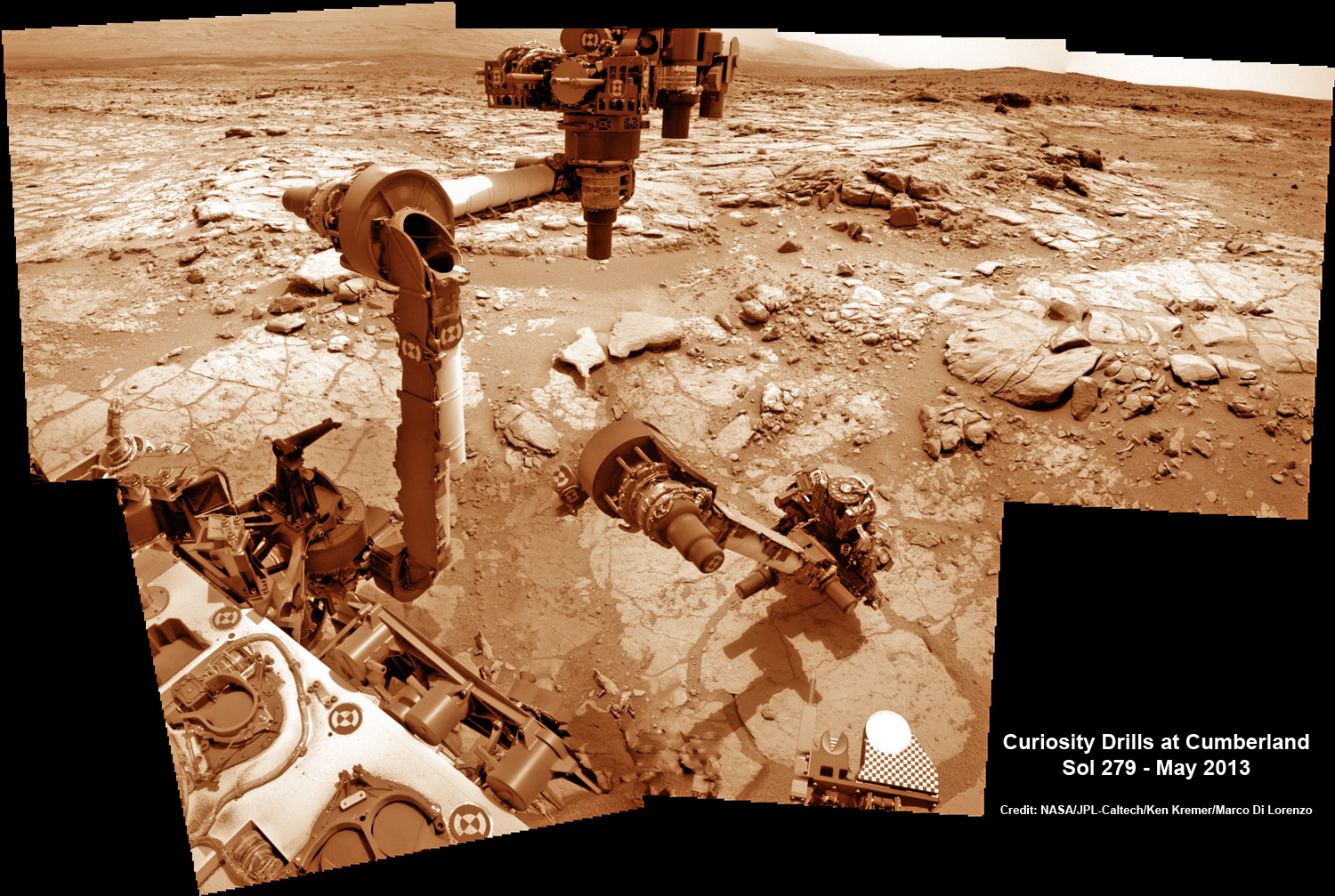
NASA’s Curiosity rover successfully bored inside ancient rocks on Mars for only the 2nd time since landing in August 2012 inside Gale Crater in search of the ingredients of life.  On May 20 (Sol 279), the rover drilled about 2.6 inches deep into a target named “Cumberland” to collect powdery samples from the rock’s interior that hold the secrets to the history of water and habitability on the Red Planet.  Chemical analysis is now in progress.

Time lapse mosaic shows Curiosity maneuvering robotic arm to drill into 2nd rock target named Cumberland on May 19, 2013 (Sol 279) for chemical sample analysis. Credit: NASA/JPL-Caltech/Ken Kremer/Marco Di Lorenzo

Time lapse mosaic shows Curiosity maneuvering robotic arm to drill into 2nd rock target named Cumberland on May 19, 2013 (Sol 279) for chemical sample analysis. Credit: NASA/JPL-Caltech/Ken Kremer/Marco Di Lorenzo


The six wheeled robot arrived at Cumberland on May 14 (Sol 274) after driving nine feet  from the 1st drill target named “John Klein” where Curiosity bored the historic first drill hole on an alien world three months ago.

Analysis of the gray colored powdery “John Klein” sample by Curiosity’s pair of onboard chemistry labs  – SAM & Chemin – revealed that  this location on Mars was habitable in the past and possesses the key chemical ingredients required to support microbial life forms- thereby successfully accomplishing the key science objective of the mission and making a historic discovery. The science team drilled into ‘Cumberland’ to determine if it possesses the same ingredients found at “John Klein”.

“We’ll drill another hole [at Cumberland] to confirm what we found in the John Klein hole,” said John Grotzinger in an interview with me for Universe Today.  Grotzinger, of the California Institute of Technology in Pasadena, California, leads the Curiosity mission. “After finishing at Cumberland we’re likely to begin the trek to Mt. Sharp.”

‘Cumberland’ and ‘John Klein’ are patches of  flat-lying bedrock shot through with pale colored hydrated mineral veins composed of calcium sulfate. Both spots are inside the ‘Yellowknife Bay’ basin that resembles a dried out lake bed.

And don’t forget to “Send Your Name to Mars” aboard NASA’s MAVEN orbiter-details here and at my AAAP short talk on Jun 11 – Deadline: July 1, 2013

Read more about Curiosity, Opportunity, Triple Conjunction at my Universe Today articles here:
Opportunity Discovers Clays Favorable to Martian Biology and Sets Sail for Motherlode of New Clues
Curiosity Drills 2nd Hole into Ancient Mars Rocks Searching for the Ingredients of Life
Rare Spectacular Triple Planet Conjunction Wows World! – Astrophoto Gallery

Astronomy Outreach by Dr. Ken Kremer
Please contact Ken for more info or science outreach presentations:
Email: kremerken@yahoo.com website: www.kenkremer.com
http://www.universetoday.com/author/ken-kremer/

Posted in June 2013, Sidereal Times | Tagged , | Leave a comment

From the Director

Ludovico D’Angelo, Director

May is upon us, and our last 2 meetings for the season are imminent. On May 11th, our 50th Anniversary dinner/panel discussion/observing will take the place of our annual meeting that would have occurred on May 14th. For those of you who haven’t signed up for the dinner, there is still time to join in. Please contact Kate Otto to make your reservation, as of today, there are an estimated 70-80 that will attend the dinner. If you can’t make the dinner, please come to the panel discussion and observing sessions. See the website for details. There will be a short business meeting prior to the main meal to vote in the new Board of Directors of the club.

Our June meeting on June 11th at 8 PM will be at the State Planetarium in Trenton. Members and their families are invited to attend.

Communiversity was on April 28th and there was a large turnout for this event. The AAAP represented with white light solar scopes. Information about the club and astronomy were given out. Many thanks to those volunteer members that helped out!

Super Science Saturday at the State Museum and Planetarium will be from 10-4 on May 4th. AAAP will again be on hand to show the sun to interested attendees. This is a great event for discovering all the available recourses for science in the area.

The next major event for AAAP will be NJ Starquest at Hope Conference Center. This event is our almost annual observing event in North Jersey., scheduled for September 6th to the 8th. There will need to be advertising and organizing to be done over the summer in order to make this a success. I hope that a group of club members will step up and take the reins of this event. Over the years it was typically a fundraiser, with raffle offerings and gust speakers. Weather it takes this form or not this year will be left to the new Board and the membership.

In closing, I would just like to say thank you to all of you who make the AAAP a vibrant force for amateur astronomy in the central New Jersey area. I have been on the Board in various positions every year except one since 2005 (I became a member in 2004). As with any organization, the success of its ability to function, promote itself, teach others, provide knowledge, is fully dependent on the membership of the club to act. I fully hope that many of you will step up and do those things that are required to make the AAAP continue to be a highly recognized club that will last for many, many years to come.

See you on May 11th at the AAAP 50th Anniversary Gala Dinner!

Posted in May 2013, Sidereal Times | Tagged , | Leave a comment