Barsoom

Michael Wright

Mars, Photo credit: Robert Vanderbei Canon XSi (450D) on 10" RC, 4x-Powermate  Video acquired with EOS_movrec ("1/6" second expo-sures), 2.00 minutes, 20 frames per second  22:50 EST, March 22, 2012  CM = 121.17deg

Photo credit: Robert Vanderbei
Canon XSi (450D) on 10" RC, 4x-Powermate
Video acquired with EOS_movrec ("1/6" second expo-sures), 2.00 minutes, 20 frames per second
22:50 EST, March 22, 2012
CM = 121.17deg

The sci-fi movie John Carter is currently in theatres.  Based on the Edgar Rice Burrough’s novels inspired by Perceval Lowell’s Mars, the movie is about the exploits of a Virginia “gentleman” magically transported to Barsoom where he battles Martians and rescues Dejah Thoris, Princess of Mars.

Coincidentally, Mars, along with Saturn, Venus and Jupiter, is visible in the evening sky this month.  Barsoom will be a prime target for the Hastings-Byrne for the next few months.


Posted in April 2012 | Tagged , , , | Leave a comment

Geometrical Optics and the Hastings-Byrne Refractor: Part II

John Church

Hastings-Byrne Refractor

Hastings-Byrne Refractor

Last month I reviewed the “lens-maker’s formula” that allows one to calculate the focal length (the inverse of the “power”) of a thin lens, provided that one knows the refractive index of the glass and the radii of the two lens surfaces.  I also mentioned that the net focal length of a combination of two thin lenses close to one another or in contact is the inverse of the sum of the two powers of the separate elements.

However, if one doesn’t already have this information, there is a simple way to find the focal length of an unknown objective.  This makes use of the “lens formula” (not to be confused with the “lens-maker’s formula”).  I used this method as one way to determine the focal length of the H-B objective, and I described the photographic way last month.

Here’s how it’s done. I supported the objective in its cell, vertically between wooden blocks on a table in my back yard.  Then I clamped a penlight about 15 feet or so away from the objective so that the light would shine through the center of the lens and approximately perpendicular to it.  I then took a piece of white cardboard and adjusted it so that the image of the penlight bulb focused sharply on this screen, which I then fixed in place.  I measured the distances from the penlight to the center of the objective, and from the center of the objective to the screen. The focal length was then given by the lens formula:

1/f   =  1/p  +  1/q

where f is the focal length, p is the distance from the light source to the objective, and q is the distance from the objective to the screen.  I measured p as 170.5 inches and q as 195.5 inches.  This gave 91.07 inches as the focal length, agreeing well with the other method using the physical diameter of an eclipsed moon on a direct-objective slide taken through the whole scope.

This “back-yard” method works for any pair of p’s and q’s, as long as one is careful to keep both of them farther away from the lens than what you guess the focal length might be.  Otherwise you’ll get a “virtual” image, i.e. one that can’t be thrown onto a screen. In the limiting case where the “penlight” is an object at infinite distance, such as a star, 1/p vanishes and so f = q, i.e. the distance from the objective to the image.  You can measure this distance directly by casting the sun’s image on a screen.  This yields a good approximation of the focal length, but it’s awkward with a long refractor pointed up at the sky.

The next subject is achromatism, or color correction. Refractors have many advantages, but they are all subject to at least some degree of chromatic aberration, (i.e. the image of a bright star or planet will have at least a touch of color fringe). The usual type of astronomical objective is composed of two elements, a “crown” element of some variant of ordinary silicate glass and a “flint” element of heavier glass, typically containing lead.  Flint glass disperses white light into its various colors much more than ordinary glass and is therefore used in decorative glassware such as chandeliers and crystal goblets. In 1733, Chester Moor Hall in England, not accepting Newton’s premature statement that an achromatic lens was impossible, designed the first such telescope objective by using a crown and a flint element.  This allowed the objective to have the same focal lengths for two widely-separated colors of light, in the red and blue ends of the spectrum, with light in the middle of the spectrum focusing at a slightly shorter distance. Perfect achromatism across the entire visible spectrum isn’t achievable in a two-element objective, because no two kinds of glasses have exactly equal ratios of refractive indexes over this wide a range. Sometimes objectives known as “apochromats” can approach this ideal, but these usually have other disadvantages.

Before Hall’s invention, conventional single-element objectives spread light out into continuously varying focal lengths, and it was necessary to have telescopes with enormous focal lengths (“aerial” telescopes) to minimize this effect.  Hall’s work was the first great advance in refracting telescopes since the early 1600’s, as it made it possible to get relatively color-free images at convenient focal ratios of f/10 or so instead of f/100 and even higher.

To design an achromatic objective with a desired total power P, we have to first know the dispersive properties of two separate kinds of glass and then solve two simultaneous linear equations to find the powers P1 and P2 of the crown and flint elements.  The power of the more dispersive (flint) glass will have to be negative and that of the crown positive, but the total power P will have to be positive in order to get a real image at the focus.  The equations are as follows:

P1  +   P2    =  P    (total power  =  sum of the individual element powers)

P11  +   P22   =  0   (to make blue and red light come to the same focus)

In the second equation, ν1  =  (n middle  – 1)/(n blue  ­–  n red)  for  the crown element and  ν2  is  the same expression for the flint element.  n middle denotes the refractive indexes of the respective glasses for light at a wavelength near the middle of the visible spectrum, and  n blue  and  n red  denote the values of the refractive indexes for (typically) the bright F and C lines of the hydrogen emission spectrum at 486.1 and 656.3 millimicrons, respectively.  These wavelengths are often chosen because they are easily accessible in the laboratory when measuring the refractive indexes of test prisms made from the glasses that will be used to make the crown and flint elements.  The Greek letter ν (“nu”) is often called the “V” number or “constringency.”

Let’s flesh out these equations with some actual numbers for the H-B objective.  We already know by two separate experiments that P = 0.432 diopters (focal length = 2.31 meters or 91.1 inches).  Hastings used the green iron emission line at 561.4 millimicron as the wavelength for minimum focus. I found by trigonometric ray tracing that he achieved nearly complete achromatization for the F and C lines of hydrogen for paraxial rays (i.e. those passing near the center of the objective where our simplified theory works the best).  For the two glasses that he used, ν1 = 56.7 and  ν2 = 36.9.

Plugging in the respective numbers to the above equations, we have

P1  +   P2  =  0.432

P1/56.7  +   P2/36.9  =  0

Resorting to our old high school math, we find required powers of 1.237 and – 0.805 for the crown and flint elements in the middle of the spectrum.  In last month’s article, I noted that P1 had an experimentally-determined value of 1.239 diopters and P2 was – 0.807.  The agreement is close enough to confirm that we’ve done the math correctly and that the simple achromatization equations give results adequate for the preliminary design of an objective.

A major issue still remains; however, one that resisted the efforts of mathematical geniuses such as Euler for about 30 years after the first achromat was made.  Knowing the powers of the crown and flint elements isn’t nearly enough to finish designing a good achromatic objective, since for each element the first and second radii can have infinite numbers of paired values. How are we to select which pair of radii to use for each element?  This choice has far-reaching consequences for spherical aberration and coma, the two most important issues after achromatization.  This complex problem was finally solved in 1764 by Alexis Clairaut and his arch-rival Jean d’Alembert, two leading scientists of the French Enlightenment. I’ll talk about how they did it next month, and how closely the H-B objective satisfies their equations.

Posted in April 2012 | Tagged , , , , | 1 Comment

Robotics Research Success at the ISS

Ken Kremer of Spaceflight magazine, Universe Today & AAAP

Astronaut Mike Fossum rides on the ISS robotic arm as he carries the RRM experiment for installation on the ISS during final spacewalk of the shuttle Era. Photo credit: NASA

Astronaut Mike Fossum rides on the ISS robotic arm as he carries the RRM experiment for installation on the ISS during final spacewalk of the shuttle Era. Photo credit: NASA

From March 7 to 9, a combined team of American and Canadian engineers successfully performed groundbreaking robotics research aboard the ISS during first-of-its-kind joint operations between NASA’s new Robotic Refueling Mission (RRM) experiment – mounted on the stations exterior backbone truss – andCanada’s Dextre robot “handyman”.

The RRM robotics technology effort aims to repair and refuel already orbiting space satellites – never intended for refurbishment – and thereby extend their operational lifetimes by several years, resulting in billions of dollars in cost savings for the government and commercial space sectors. The project is a joint effort between NASA and CSA .

Gleeful researchers shouted “Yeah !!” after the first ever dual application of RRM and Dextre as a technology test bed to demonstrate that a remotely controlled robot in the vacuum of space could accomplish delicate work tasks requiring extremely precise motion control.

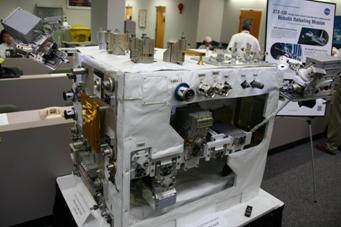
High Fidelity Mock up of RRM experiment box at KSC Press Site.  RRM was delivered to ISS during STS-135 mission.  Photo credit: Ken Kremer

High Fidelity Mock up of RRM experiment box at KSC Press Site. RRM was delivered to ISS during STS-135 mission. Photo credit: Ken Kremer

“After dedicating many months of professional and personal time to RRM, it was a great emotional rush and a reassurance for me to see the first video stream from an RRM tool,” Justin Cassidy told me in a post-op interview.  Cassidy is RRM Hardware Manager at the NASA Goddard Spaceflight Center in Greenbelt,Maryland.

The 500 pound, washing machine sized RRM experiment was carried to orbit inside the cargo bay of Space Shuttle Atlantisduring July 2011 on final shuttle mission STS-135.

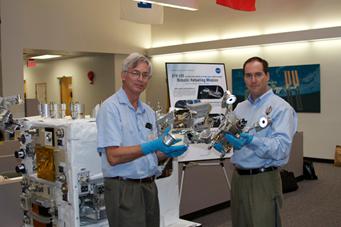
NASA Goddard RRM manager Justin Cassidy (right) and Ken Kremer manipulate RRM experiment tools.  Photo credit: Ken Kremer

NASA Goddard RRM manager Justin Cassidy (right) and Ken Kremer manipulate RRM experiment tools. Photo credit: Ken Kremer

I was quite fortunate to arrange an exclusive pre-launch visit to the actual RRM unit inside the Space Station Processing Facility (SSPF) at the Kennedy Space Center (KSC) prior to loading aboard Atlantis.  Cassidy also gave me a detailed RRM briefing at the KSC Press Site using a high fidelity mockup of the unit and with hands-on interaction to simulate servicing and maintenance techniques with the different satellite work tools, which have heritage in the Hubble Servicing Missions.

All of the RRM robotic operations at the station were remotely controlled by flight controllers on the ground, freeing up the human crew to conduct other important scientific research.

On day one of ISS ops, mission controllers on Earth deftly maneuvered the 12-foot (3.7-meter) long Dextre “handyman” to the RRM experiment box using the space station’s Canadian built robotic arm (SSRMS).  Under ground-based remote control, Dextre’s “hand” grasped and comprehensively inspected three of the four specialized satellite work tools housed inside the RRM stowage area. The Safety Cap Tool, the Wire Cutter and Blanket Manipulation Tool, and the Multifunction Tool were all functioning perfectly.

“Our teams mechanically latched the Canadian “Dextre” robot’s “hand” onto the RRM Safety Cap Tool (SCT) to mate it with the SCT’s integral electronics box and see the first on orbit video,” Cassidy explained.  “Our team burst into a shout out of “Yeah!” to commend this successful electrical functional system checkout.”

The key task was to use the Wire Cutter Tool to meticulously cut two extremely thin satellite lock wires made of steel and measuring just 20 thousandths of an inch (0.5 millimeter) in diameter.  During a total of about 43 hours of on-orbit operations, Dextre used all three tools to carry out tasks aimed at testing how well a variety of representative gas fittings, valves, screws and seals located on the outside of the RRM module could be manipulated.  It also released safety launch locks.  Everything went as nominally as could be expected and even finished slightly ahead of time.

This RRM exercise represents the first time that Dextre was utilized for a technology research and development project on the ISS and represents a major expansion of its capabilities beyond those of routine robotic maintenance of the massive orbiting laboratory.

Check Ken’s RRM feature online at Universe Today:

http://www.universetoday.com/94122/robotics-refueling-research-scores-huge-leap-at-space-station/

Astronomy Outreach by Dr. Ken Kremer

Rittenhouse Astronomical Society (RAS) at the Franklin Institute: Philadelphia, PA, June 13, Wed, 7 PM.  “Curiosity Mars Landing, DAWN at Asteroid Vesta & GRAIL Lunar Orbiters”

Adirondack Public Observatory – Adirondack State Park: Tupper Lake,NY, July 13 & 14.

“Eight Years of Mars Rovers & Search for Life – Mars & Vesta in 3 D”. http://www.apobservatory.org/pages/etc/events_KenKremer.html

Ken has a selection of his Shuttle photos and Mars mosaics for sale as postcards and frameable prints.

Email: kremerken@yahoo.com   website:  www.kenkremer.com

Posted in April 2012 | Tagged , , , | Leave a comment

From the Director

by Ludovico D’Angelo, Director AAA

March starts our process for establishing a nominations committee to help choose those within the club who will serve on the next Board of Trustees of the AAAP. If you are interested in leading this committee, or are considering a position on the Board, please let the current Board know. Please contact me or Assistant Director Jeff Bernardis concerning your interest. We must establish this committee in our March meeting. In April, the committee will introduce a slate of candidates, and in May, we will vote on the roster of candidates.

I have been thinking about how we can get more activity going in the club. We are fast approaching our public season that starts on Friday, April 6th 2012. As always, we invite the public to come out on Fridays to observe the night sky. We also have our observatory in Jenny Jump State Forest. I’d like to see more activity there starting with repair of the rotting wood and repainting of the observatory, and also some club star parties. We will also have April activities including Super Science Day and Communiversity, and, as always, our monthly meetings.

Also I have been thinking of the new members of the club, and members who are having difficulty connecting with these activities because they feel they have no knowledge of astronomy in general, or how to use their telescopes and need help. So I propose on a very basic level, the formation of various gatherings to promote more understanding. For those of you who would like to know more about our hobby, or how to go about obtaining knowledge of observing, telescope use, or understanding our guest speakers subjects, please email me. For those of you that are willing to help teach these concepts and spread your knowledge, also email me. If this is successful, I think we will be a stronger and more knowledgable club.

Our next meeting is March 13th at 8 p.m. in Peyton Hall. Our scheduled speaker is Dr. Mark Trodden of the University of Pennsylvania. See you all there.

Posted in March 2012, Sidereal Times | Tagged , | Leave a comment

From the Program Chair

Ken Levy, Program Chair

Many thanks to Dr. Paul Steinhardt for our February lecture, “Inflationary Cosmology on Trial”.

March heralds the beginning of spring with another not to miss lecture by Dr. Mark Trodden, “Modern Cosmology and the Building Blocks of the Universe”.

No two ways about it – the universe is really, really big! If we want to understand it, we need to know about nature on very large scales. On the other hand, atoms and their constituents are extremely small! To understand them requires us to know about nature on very small scales.

Mark-Trodden

Dr. Mark Trodden. Photo Credit: Discovery Retreats


The challenge of modern cosmology is to use these seemingly different aspects of physics to explain how a young, hot, small universe became the old, cold, huge universe we see today–to understand the physics of the Big Bang.

In this presentation, Dr. Trodden will tour the major ideas of 20th century cosmology and try to give a picture of how cosmologists are trying to address these questions that require the physics of the large and the physics of the small to work together.

Mark Trodden is the Fay R. and Eugene L. Langberg Professor of Physics, and co-Director of the Center for Particle Cosmology at the University of Pennsylvania. Trodden has worked broadly in both cosmology and particle physics. The majority of his work is firmly on the particle physics-cosmology border, and includes the development of the modified gravity approach to cosmic acceleration, approaches to dark energy and dark matter, extra dimensional models of particle physics and cosmology, and the matter-antimatter asymmetry of the universe.

Dr. Trodden holds an MA in Mathematics and a Certificate of Advanced Study in Mathematics from Cambridge University. He also holds a M.Sc. and a Ph.D. in Physics from Brown University. He previously held the Alumni Professorship at Syracuse University, and has held visiting positions at Cornell University, the Kavli Institute for Theoretical Physics in Santa Barbara, and as a Sir Thomas Lyle Fellow at the University of Melbourne. Dr. Trodden is a Kavli Frontiers Fellow, was awarded the Science and Technology Outreach Award of the Technology Alliance of Central New York, is a Cottrell Scholar of Research Corporation, and has chaired the National Academy of Sciences Kavli Frontiers of Science Symposium and the Working Group on Cosmological Connections of the American Linear Collider Physics Group. He sits on the editorial boards of Physics Letters B, the Journal of Cosmology and Astroparticle Physics, the New Journal of Physics, and the Springer Multiversal Journeys Series.

Posted in March 2012, Sidereal Times | Tagged , , , , | Leave a comment

From the Outreach Chair

by David Letcher, Outreach Chair

We have two star parties this month. The first one is Friday, March 16 at Hopewell Elementary School and the second one is Wednesday, March 26 at Stuart Country Day School. This second party has a rain date of Friday, March 30. Sunset is around 7 p.m. +/- so we don’t have to get there too early.

So, as usual, we need volunteers and telescopes. I’ll be providing directions and any other details that come up.

Let me know if you can help out.

Posted in March 2012, Sidereal Times | Tagged , | Leave a comment

February 14, 2012 AAAP Meeting

Larry Kane, Secretary

The meeting was called to order by Director Ludy D’Angelo.

  • Director’s Report: Most of his report is in the Sidereal Times.
  • Secretary’s Report: Nothing to report, but Larry Kane stated he had announcements on another agenda item.
  • Treasurer’s Report: The Treasurer was not in attendance, but his report appears in another section of the Sidereal Times.
  • Observatory Report: Co-chair Gene Ramsey announced that the observatory now has a working heater in the computer room. He also announced that he fixed the wheels on the computer room chair. He has instructions for operating the new alarm system. Gene also announced that the WC park rangers took our lock off the Bear Tavern Road gate because they did not realize we use the observatory during the winter. The rangers told Gene that the person who drove a vehicle onto the soccer field did $3,000 in damages and the rangers now come to see who is entering the park. Gene stated that the new keyholder public night duty schedule will be prepared soon. He recommended that anyone using the clubs telescopes on a non-public night should try use the bino-viewers.
  • Outreach: Outreach Coordinator, Dave Letcher, announced two up-coming star parties: March 16 at the Hopewell Elementary School, and March 30, March 29 or April 12 at Stewart Country Day School. Dave announced that a reporter from the US 1 newspaper approached him to do an interview about the AAAP or some current idea in astronomy. It was suggested that Bill Murray contact the reporter. Dave noted that the star party at the Lawrenceville Elementary School was well attended by both the public and the AAAP members.
  • Sidereal Times: Co-editor Michael Wright announced that the deadline for the next edition is March 1. A special 50th anniversary issue is being planned for November, 2012. Club members should consider submitting remembrances etc. that would be included in the issue. Ludy suggested that we go through the archives and put together an exhibit on the club. We can do something with the Princeton Public Library. John Church has information on past speakers and topics going back to the beginning of the club.
  • UACNJ Membership: We need to appoint a club delegate and an alternate delegate. Bill Murray volunteered to be the delegate. Michael Wright volunteered to be the alternate. Ludy announced that we, as a membership club, will be doing some star parties at Jenny Jump. UNCNJ will have a table at N.E.A.F.
  • Cole Field is now gated. There will be a meeting with several astronomy clubs in the area to discuss future access. AAAP has been invited. Jeff Bernardis will be attending the meeting.
  • 50th Anniversary Events: Secretary Larry Kane discussed his meeting with Congressman Rush Holt. The Congressman is eager to join us for the Venus transit in June and he knew many of the details concerning the location for the observation. Larry will follow up with Communiversity Day in Princeton to get the AAAP a presence there. Ludy is working on getting usinto Baldpate Park for the Venus transit. We will hire a van or shuttle bus to get the public up to the viewing site. It was suggested that after sunset, we could do night-time observing at the site. Rex Parker has a lead to pursue for renting a shuttle bus. Ludy said that we will be able to work with the Princeton Library in the future to do events with their support. He raised the idea of an anniversary dinner in November. We might invite former guest lecturers to attend the dinner. Larry announced that he made a contact at the National Air and Space Museum for group tours. Ludy said he contacted the Naval Observatory, and they go have group tours. We have to work out the logistics for both. Larry will look into doing this. Ludy wants to have a picnic in the spring.

The meeting was adjourned by the Director.

Posted in March 2012, Sidereal Times | Tagged , , | 1 Comment

Treasurer’s Report

by Michael Mitrano, Treasurer

Membership for the current fiscal year is has increased to 81, and we are continuing to receive a small number of renewals. If you have not renewed, there is still time.

Expenses during the past month have been moderate, and our surplus for the fiscal year to date is about $1,400.

On a cumulative basis, our surplus remains about $22,000.

Posted in March 2012, Sidereal Times | Tagged , | Leave a comment

AAAP Cover Story in US 1

US1

Bill Murray and Jay Schwartz on the cover of US 1. February 29, 2012


Bill Murray responded to US 1 reporter’s queries about AAAP resulting in a wonderful February 29 cover story about leap days, AAAP and the State Planetarium where Bill is an astronomy lecturer.

If you missed the print edition, the full article is available online at: US1, February 29, 2012

Posted in March 2012, Sidereal Times | Tagged , , | Leave a comment

The Rosette Nebula

Rosette Nebula

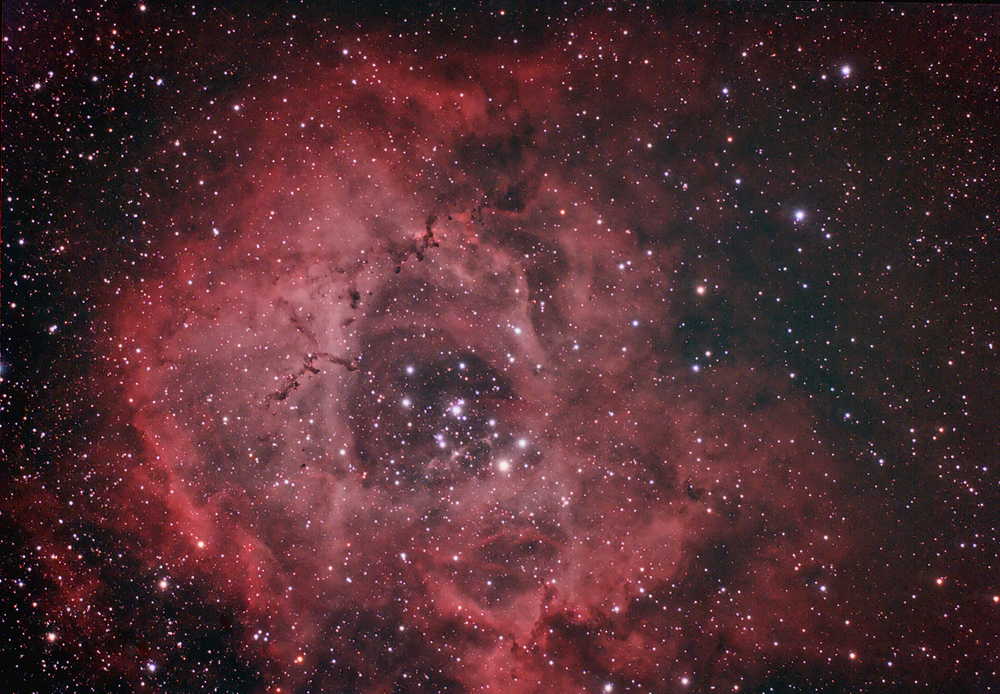
Rosette Nebula. Credit: Brian Van Liew

Astrophotography – An Inside Look

Years ago I had offered interested members a SIG (special interest group) on getting into astrophotography. Over the last year, I have not been active in imaging. Well, as it is starting to warm up, I would like to start this again. I am currently using a DSLR as my imaging camera and would like to share what I use to image with in both hardware and software.

Since this meeting would take place at my home in Belle Mead, NJ, I can only open it up to a few at a time. Once I see how much interest there is in this, I will notify the respondents a date and time that works best. I’m thinking some time in late March or in April. So if you would like to have an inside look at what it takes to image, contact me at brian@princetonastronomy.org.

Brian Van Liew

Posted in March 2012, Sidereal Times | Tagged , | Leave a comment

Snippets

compiled by Bryan Hubbard

NASA’S Chandra Finds Fastest Wind from Stellar-Mass Black Hole
Published: Tuesday, February 21, 2012 – 16:33 in Astronomy & Space

Astronomers using NASA’s Chandra X-ray Observatory have clocked the fastest wind yet discovered blowing off a disk around a stellar-mass black hole. This result has important implications for understanding how this type of black hole behaves. The record-breaking wind is moving about 20 million mph, or about 3 percent of the speed of light. This is nearly 10 times faster than had ever been seen from a stellar-mass black hole.

Stellar-mass black holes are born when extremely massive stars collapse. They typically weigh between five and 10 times the mass of the Sun. The stellar-mass black hole powering this super wind is known as IGR J17091-3624, or IGR J17091 for short.

For the full story go to – Fastest wind from stellar-mass black hole

Scientists Discover a Saturn-Like Ring System Eclipsing a Sun-Like Star
Published: Wednesday, January 11, 2012 – 14:35 in Astronomy & Space

A team of astrophysicists from the University of Rochester and Europe has discovered a ring system in the constellation Centaurus that invites comparisons to Saturn. The scientists, led by Assistant Professor of Physics and Astronomy Eric Mamajek of Rochester and the Cerro Tololo Inter-American Observatory, used data from the international SuperWASP (Wide Angle Search for Planets) and All Sky Automated Survey (ASAS) project to study the light curves of young sun-like stars in the Scorpius-Centaurus association — the nearest region of recent massive star formation to the Sun.

The basic concept of the research is straightforward. Imagine yourself sitting in a park on a sunny afternoon and a softball passes between you and the sun. The intensity of light from the sun would appear to weaken for just a moment. Then a bird then flies by, causing the intensity of the sunlight to again weaken — more or less than it did for the baseball, depending on the size of the bird and how long it took to pass. That’s the principle that allowed the researchers to discover a cosmic ring system.

For the full story go to – Saturn-Like Ring System

Discovery of the Smallest Exoplanets: The Barnard’s Star Connection
Published: Wednesday, January 11, 2012 – 17:36 in Astronomy & Space

The discovery of the three smallest planets yet orbiting a distant star, which was announced January 11 at the annual meeting of the American Astronomical Society, has an unusual connection to Barnard’s star, one of the Sun’s nearest neighbors. The discovery was made by a scientific team led by astronomers at the California Institute of Technology (Caltech) that included three members from Vanderbilt. The team used data from NASA’s Kepler mission combined with additional observations of a single star, called KOI-961, to determine that it possesses three planets that range in size from 0.57 to 0.78 times the radius of Earth. This makes them the smallest of the more than 700 exoplanets confirmed to orbit other stars.

In their investigation of KOI-961, which is about 130 light years away in the Cygnus constellation, the astronomers found that it is nearly identical to Barnard’s star, which is only six light years away in the constellation Ophiuchus. This similarity allowed them to use information about Barnard’s star, which was discovered in 1916 by Vanderbilt astronomer E.E. Barnard, to determine the mass, size and luminosity of the distant star. These values, in turn, were used to determine the size of the three new exoplanets.

For the full story go to – The Barnard’s star connection

UCLA Astronomers Solve Mystery of Vanishing Electrons
Published: Sunday, January 29, 2012 – 17:31 in Astronomy & Space

UCLA researchers have explained the puzzling disappearing act of energetic electrons in Earth’s outer radiation belt, using data collected from a fleet of orbiting spacecraft. In a paper published Jan. 29 in the advance online edition of the journal Nature Physics, the team shows that the missing electrons are swept away from the planet by a tide of solar wind particles during periods of heightened solar activity.

“This is an important milestone in understanding Earth’s space environment,” said lead study author Drew Turner, an assistant researcher in the UCLA Department of Earth and Space Sciences and a member of UCLA’s Institute for Geophysics and Planetary Physics (IGPP). “We are one step closer towards understanding and predicting space weather phenomena.”

The complete article may be found at Vanishing Electrons

Posted in March 2012, Sidereal Times | Tagged , , , | Leave a comment

Geometrical Optics and the Hastings-Byrne Refractor

By John Church

Some years ago I analyzed the objective lens of the AAAP’s historic 6-1/4-inch Hastings-Byrne (H-B) refractor and published the results in Sky & Telescope magazine, along with a history of the telescope1. The readers of Sidereal Times might be interested in knowing how the basic concepts of geometrical optics apply to this fine old instrument.

Geometrical optics starts with the idea that light consists of thin rays whose paths through transparent media can be treated by relatively simple mathematics. This approach is oversimplified in that it ignores the whole field of physical optics, where light is treated as waves rather than rays and which allows us to account for phenomena such as interference and diffraction. Diffraction causes the series of rings we see around the telescopic images of stars, with larger apertures giving smaller rings and therefore better resolution. The mathematics of physical optics is more complex than the relatively simple algebra and trigonometry we use for geometrical optics. But when it comes to lens design and optimization, geometrical optics actually works very well.

Another simplification is often used in the preliminary design of a lens, where we assume that the elements are thin in comparison with their focal lengths. This assumption is actually better than it sounds, as refractor lenses at typical f/ratios are actually thin as compared with their focal lengths. Also, the two components needed to make a color-corrected achromat are close to one another, sometimes in actual contact.

The above approach neglects color correction as well as the important field aberrations such as spherical aberration, coma, and the like. When the design of complex lenses gets farther along, we often use trigonometric ray-tracing to optimize achromatism and the actual shapes and surface curvatures of the lens elements. But for the common case of doublet refractor objectives slower than about f/10, such as the H-B lens at nearly f/15, a computer program can give excellent design results with correction of all the significant aberrations. However, this is getting away from our main story.

A converging lens is one that is thicker in the middle than at the edge. It could be either biconvex or have one surface convex and the other concave, as long as it’s thicker in the middle. Such lenses will bring light to a focus and form a real image. On the other hand, a lens that is thicker at the edge than in the middle is a diverging lens. It could be either biconcave or have one surface concave and the other convex, as long as the edge is thicker than the middle. It cannot bring light to a definite focus by itself, but in combination with a converging lens of the right focal length, it can make a lens that does form a real image. All two-element refractor lenses are like this. The H-B lens is made up of one converging and one diverging lens made of different kinds of glass, in order to provide achromatism (color correction).

The focal length of a thin lens is given by the well-known “lens-maker’s formula”:

          FL = 1/[(n – 1) (1/R1 – 1/R2>)]

where n is the refractive index of the glass, R1 is the radius of curvature of the first surface that the light encounters, and R2 is the radius of curvature of the rear surface where the light emerges. With the usual convention that light goes from left to right, a radius is considered positive if its center of curvature is to the right, and negative if to the left. Thus, for a typical biconvex lens such as the front (crown) element of the H-B objective, R1 is positive and R2 is negative.

The values of these radii as determined by my measurements with a spherometer are R1 = + 1,336 mm and R2 = – 606 mm. For light near the middle of the visible spectrum, at a wavelength of 561.4 nm, the refractive index of this glass (according to measurements by Hastings) is 1.516673. Thus, applying the lens maker’s formula, the focal length of the crown element is 807 mm for light of this wavelength.

The “power” of a lens is the inverse of its focal length. Thus, a lens with a long focal length has low power, i.e. it converges light only weakly. For the H-B crown element, the power is 1/807 = 0.001239 inverse mm. In eyeglass lenses, power is given in units of inverse meters (called “diopters”) instead of inverse mm. So the H-B crown element has a power of 1.239 diopters, which is comparable to the power of weak ordinary reading glasses.

The concept of power is useful with compound lenses such as the H-B achromat, because the power of a thin combination is simply the sum of the individual powers of the elements. The final focal length will then be the inverse of the total power. (It’s important not to confuse the power of a lens with the magnifying power of a telescope with an eyepiece in place, which is the focal length of the objective divided by the focal length of the eyepiece.)

For the flint element of the H-B objective, we have the following radii and refractive index (again for the same wavelength of light): n = 1.616333, R1 = – 625 mm, and R2 = – 3,435 mm. It’s a diverging lens, because it’s thicker at the edge than in the middle. Rounding off the results to 4 figures, its focal length comes out to – 1,240 mm and its power is – 0.0008067 inverse mm, or – 0.8067 diopters. Adding up the powers of the two elements, we get a total power of 0.0004323 inverse mm (0.4323 diopters), and a focal length of 2,313 mm, or 91.1 inches.

This is fine, but what about a direct measurement of the focal length? I experimentally determined this by two methods. First, I made a direct-objective color slide during a total lunar eclipse when the moon’s diameter was known to be 30’13” and measured the image diameter at 0.801 inches with a micrometer. The focal length came out to 91.1 inches. I also set up a 30-foot long optical bench in my back yard and meas-ured the focal length by the conjugate focus method, casting the image of a penlight bulb on a screen and getting the same result. Calculating the focal length via trigonometric ray tracing, taking into account the actual glass thicknesses and separation of the elements, gives the same value to within the limits of rounding-off errors. So for a long-focus refractor with relatively thin elements, simple theory will give excellent results for the actual focal length.

One might still ask, how does a lens designer determine in advance the relative shapes of the two elements of an achromatic lens? For a given pair of glasses, many different combinations of radii could give the same total focal length for a given wavelength of light as well as acceptable color correction. I plan to discuss this in a later article, as well as how we further determine the proper element shapes in order to minimize spherical aberration and coma.

1 J. Church, Sky & Telescope, March 1979, p. 294-300.
2 J. Church, Sky & Telescope, November 1984, p. 450-451.

Posted in March 2012, Sidereal Times | Tagged , , , | Leave a comment