Observatory Update

by David Skitt, Observatory Co-Chair

The pulley system for opening the flap has been replaced and improved which significantly reduces the effort required to open the flap to the highest position needed to clear the telescopes. And, thanks to Gene Ramsey and his trusty belt sander, we’ve managed to increase the distance between the flap and the scopes by another one quarter to one half inch!

The new setup does not change the rope-pull/opening sequence, so no additional training is needed in that department. However, even with the improvements, please continue to watch as the roof opens to be sure that it clears the telescopes and their accessories.

Thanks to Jim Poinsett, we’ve put together a laptop to use with the refractor and Paramount. It has The Sky6 running on WinXP. It was destined for the recycle bin, but after some TLC, it seems to be running fine. With some added RAM, it would likely run The SkyX if we move in that direction before upgrading the computers. It has been set up similar the current desktop, with a Keyholder account and an Admin account. It will be on the desk between the two mounts for now and connected to the mount via a USB to serial port adapter.

Posted in May 2015, Sidereal Times | Tagged , | Leave a comment

Testing the Hastings-Byrne Refractor

by John Church

Since some members had reported seeing a decline in the optical performance of the 6-1/4 inch Hastings-Byrne refractor, I conducted a thorough test of it on the night of April 18. Dave and Jen Skitt and Gene Ramsey were also present. Although the night was slightly hazy, the seeing became very good later on.

Earlier, I had removed the objective and cell and brought it home for a thorough inspection to see if there had been any physical deterioration in the glass elements. I could find none. The two elements had retained the transparency that I had seen when I first examined them in detail in the early 1970’s after I had cleaned them. Here are current photos of the front and rear surfaces:

The best way to test the optical performance of any objective is to carefully examine the image of a moderately bright star at medium magnification and then run it in and out of focus to check the roundness of the diffraction images. I did this with the 13-mm Ethos eyepiece, which is one of the best eyepieces we have. It gives a magnifying power of 178 with the 2313 mm focal length of the Hastings lens. The star exhibited a perfectly round image in-focus, with the usual faint circular diffraction rings around it.

Going in and out of focus made the rings expand and contract in a circular pattern. This shows that the objective had remained squared-on during the years since I had last adjusted it at the telescope and has suffered no change in its performance on stars. No further adjustments should be required.

This test also confirmed that the tailpiece and focusing tube were squared-on themselves, as any looseness or maladjustment would have affected the diffraction patterns. Dave had previously noticed some looseness in the screws that attach the tailpiece onto the tube and had already tightened these.

As a confirming test, I put the scope on Jupiter with the aid of my laptop and Sky 6 working the newly-installed Paramount ME. The image was really nice and had no noticeable false color. The belts were very distinct and many small details were seen. The C14 was put on it also, and we all watched Io slowly approach the disc, becoming tangent to it at the predicted time, and then gradually entering the disc. Using both scopes, we could all see the satellite as a well-defined circular white dot against the duller surface of Jupiter, well after it had fully entered the disc. If anything, I thought the Hastings did somewhat better on this than the C14.

We also looked at several close double stars, including Castor and Gamma Leonis. Again, the Hastings lens performed up to its previous high standard.

Here is one possible reason why observers could have noticed a dropoff in the apparent performance of the lens. This might have been due to using the large and very heavy Meade “hand-grenade” 40-mm eyepiece. The heavy weight could deflect the focuser, especially before their attachment screws had been tightened. For a low-power eyepiece, it would be far better to use the replacement 55-mm Plossl recently bought by Bill Murray at NEAF. This much lighter eyepiece gives essentially the same true field of view as the 40-mm Meade. The older 55-mm Plossl may have been dropped at some time, causing an obvious color ring between the interior elements, and so it should not be trusted any longer. Using this eyepiece might also have caused some problems.

Separately, Sky 6 and the Paramount ME are working very well with the refractor. Objects in far different parts of the sky are always found within the field of a low-power eyepiece. Just center them with the joystick and they will remain centered for a long time as the mount tracks. You can switch eyepieces at will and objects will remain centered.

The refractor has now been elevated a full nine inches by changing to the Paramount. This is making the observation of objects high in the sky much more convenient than it used to be. Gene Ramsey has recently donated a step stool with a custom hand-made adjustable seat finished in polished Luan plywood (thank you, Gene!). High objects can now be very comfortably viewed with the aid of this handy accessory.

Posted in May 2015, Sidereal Times | Tagged , | Leave a comment

UACNJ Astronomy Day – May 9, 2015

Astronomy Day 2015 – Saturday May 9th

Free Astronomy Presentations and Solar Observing*

North East Branch of Warren County Library
40 US Highway 46 West, Hackettstown, NJ
908-813-3858

1 PM – General Astronomy, Matt Heiss, NWJAA
2 PM – Meteorites, Walter Rothaug, RAC
3 PM – Northern Lights, Gregg Waldron, NWJAA

Free Evening Presentation and Star Party*
UACNJ Observatory
Jenny Jump State Forest, Hope, NJ
7 PM – Solar Eclipse and Northern Lights, Tony Hoffman, AAA
8 PM – Astronomy for Beginners, Ken Taylor, NWJAA

*solar observing and Star party if weather permits, presentations take place rain or shine.

Our free Saturday evening programs begin at 8:00 PM. Following a lecture on an astronomy-related topic, the public is invited to view the night sky through our telescopes until 10:30 PM.

Programs and speakers for the month of May:

5/2/2015 What’s up in the May Sky? Lonny Buinis, RVCC
5/9/2015 Astronomy for Beginners Ken Taylor, NWJAA
5/16/2015 The Northern Lights Gregg Waldron, NWJAA
5/23/2015 Beginning Astronomy Matt Heiss, NWJAA
5/30/2015 Dawn at Ceres Kris Kootale, MMAS

Please visit www.uacnj.org for a list of other topics and speakers.


Posted in April 2015, Sidereal Times | Tagged | Leave a comment

Come, Let Us Observe the Sky as Day Wanes

A Sonnet by David Kaplan

Come, let us observe the sky as day wanes,
As clouds flee and the sun vows its return,
Whilst darkness gives light to the stars and brains—
Fear not the demanding quest to discern.
You stand here a part of stars, not apart
From them, which swirl above as live embers
Birthed from primal flames at cosmos’s start.
Begin your journey and this remember—
A wild ride it is, spinning as we go,
Tilted, yearly looping that lustrous orb.
Celestial movement may appear as slow
As the mind probing to know—to absorb.
A few deep thinkers claim to understand,
But they only know that which is at hand.

Posted in May 2015, Sidereal Times | Tagged | Leave a comment

Supernovae

by S. Prasad Ganti

April’s guest lecture was about supernovae and their remnants. It reminded me of something special about them. Although they seem to be esoteric objects in the Universe, far, far away from the earth, and far away from our solar system, they are responsible for two of the major scientific understandings mankind accomplished in the twentieth century.

First, stars are being born all the time in different galaxies in different parts of the Universe. And stars die too. After exhausting their fuel, which is mainly hydrogen, stars die different kinds of death, mainly depending on their mass. Stars having a mass above 1.4 times the mass of our Sun end up as a supernova leading to either a neutron star or a black hole. The limit of 1.4 times the mass of our Sun is called Chandrasekhar limit, named for an astrophysicist Subramanian Chandrasekhar. The X-ray space telescope Chandra is named for him also. Our own Sun will end up as a white dwarf, taking a different path than its heavier cousins.

In the supernova phase, the explosion of the star is very violent, outshining everything else in the galaxy for a brief while. The first understanding that we obtained during the mid twentieth century was that heavier elements are cooked in these stellar explosions. In a process known as nucleosynthesis, elements heavier than hydrogen are made. In a star, hydrogen is compacted by the action of gravity to raise its temperature enough to create a nuclear fusion. The hydrogen atoms fuse to create helium and liberate vast amount of energy. The resulting helium is lighter than the input hydrogen atoms. The difference in mass is the creation of energy we see in form of light and other radiation from the Sun as per Einstein’s famous equation e=mc2.

Similarly, helium burns to produce higher elements like lithium, carbon, etc. Elements all the way up to iron are produced in the stars. The conditions in the stars, although extreme, are not enough to form elements heavier than iron. Something more violent is required for heavier elements like gold, uranium, etc. Supernovae are those extremely violent phenomena producing the heavier elements. That is why it is said that our wedding rings got cooked in a supernova! The nuclear fusion in the stars and the supernovae explain all the chemical elements we see around us.

The second understanding we obtained was the size of our Universe and the existence of other distant galaxies. Based on the observed spectra, the supernovae can be classified into different types. Type 1 contains hydrogen and type 2 does not. The presence of hydrogen shows up as a line at certain wavelength in the spectra. Type 1 is further classified into 1a, 1b and 1c. Type 1a are of interest to us. They show the presence of an ionized silicon in the spectra.

All the type 1a supernovae produce the same amount of brightness so they can be used as standard candles, which means that by measuring the brightness as perceived on earth, we can estimate the distance of such supernovae from us. Each galaxy has a supernova about once in hundred years. Observation of type 1a supernovae helped us understand the different galaxies and galaxy clusters in our Universe, even the remote ones. Eventually, this partly led to determining the size of our Universe.

Earlier, Edwin Hubble used a different kind of standard candle called Cepheid variables to determine that Andromeda was a different galaxy. At large distances, individual stars are no longer distinctly visible. Hence Cepheid variables from distant galaxies cannot be viewed or measured. The supernovae could be used as distant standard candles in such cases.

Supernovae are not abstract concepts. They really enhanced our understanding of our Universe.

Posted in May 2015, Sidereal Times | Tagged , | Leave a comment

Snippets

Contributed by David Kaplan

Our esteemed member, Freeman Dyson, has a new book, “Dreams of Earth and Sky“. The physicist, mathematician and author says the best books he knows about mathematics and physics are nearly a hundred years old.

The Large Hadron Collider restarts after a two-year rebuild, with scientists hoping it will give answers to fundamental questions about the universe. BBC

NASA names an asteroid after schoolgirl campaigner Malala Yousafzai. BBC

A huge effort to make a map of dark matter, the invisible stuff holding galaxies in place across the cosmos, releases its first batch of results. BBC

Dark matter becomes less ‘ghostly’. Scientists have uncovered a vital new insight into the nature of dark matter. BBC

Messenger crashes into Mercury, the story from the BBC and an interactive summary of the mission from the NYTimes.


Posted in May 2015, Sidereal Times | Tagged , | Leave a comment

SpaceX Dragon Roars to Orbit, Delivers Science to ISS

by Dr. Ken Kremer, Universe Today and AAAP

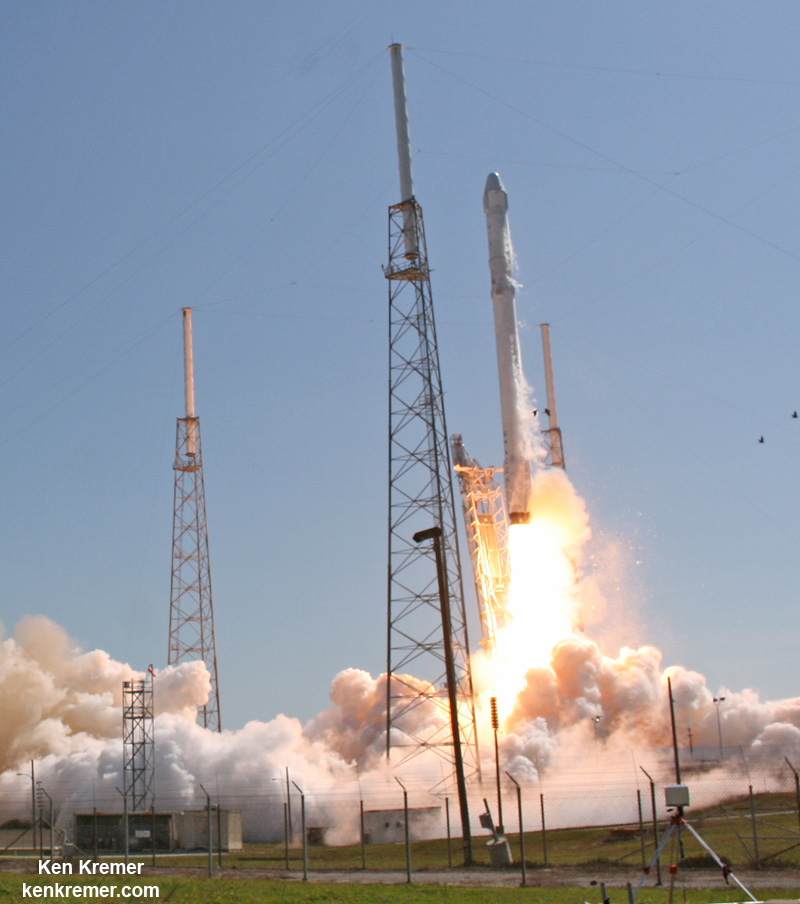
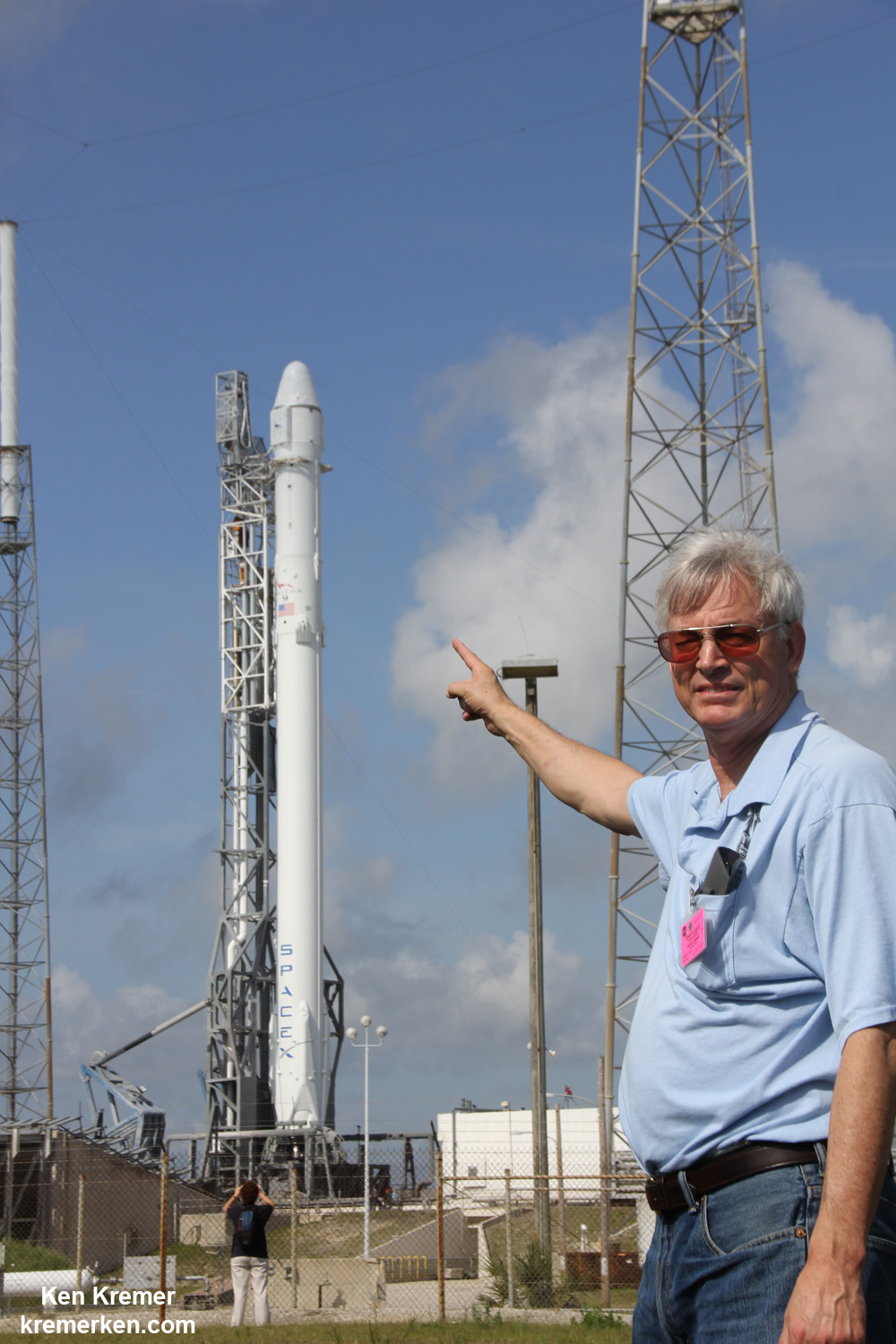
KENNEDY SPACE CENTER, FL –  In mid-April I was an eyewitness to the blastoff of the latest SpaceX Dragon to the International Space Station. With my press pass from Universe Today, I watched the launch from the roof of the VAB (Vehicle Assembly Building) where all the shuttles and Apollo Saturn V Moon rockets were assembled for launch. I also visited the  SpaceX rocket and Cape Canaveral Air Force Station launch pad hours before the launch to set up my sound activated cameras within about 200 feet of the Falcon 9 rocket.  It’s always an awesome privilege to be on the front lines of history.

SpaceX Falcon 9 and Dragon blastoff from Space Launch Complex 40 at Cape Canaveral, Fl, April 14, 2015 on the CRS-6 mission to the International Space Station. Credit: Ken Kremer/kenkremer.com

SpaceX Falcon 9 and Dragon blastoff from Space Launch Complex 40 at Cape Canaveral, Fl, April 14, 2015 on the CRS-6 mission to the International Space Station. Credit: Ken Kremer

Finally after a 24-hour delay due to threatening clouds, the SpaceX Falcon 9 rocket soared spectacularly to orbit on April 14, carrying the Dragon CRS-6 cargo freighter on a science supply run to the International Space Station (ISS). The mission will help pave the way for deep space human missions to the Moon, asteroids and Mars using NASA’s new Orion capsule and SLS rocket.

SpaceX also attempted to soft land and recover the 14-story tall first stage of the Falcon 9 rocket. It came close by landing on an ocean-going barge a few hundred miles off shore in the Atlantic Ocean, but tipped over due to excess lateral velocity after landing, and broke apart and exploded. SpaceX will try again on the next ISS mission in mid-June.

Ken Kremer and the SpaceX Falcon 9 rocket at Cape Canaveral prior to blastoff.   Credit: Ken Kremer/kenkremer.com

Ken Kremer and the SpaceX Falcon 9 rocket at Cape Canaveral before blastoff. Credit: Ken Kremer

Overall CRS-6 was the sixth SpaceX commercial resupply services mission and the seventh trip by a Dragon spacecraft to the station since 2012. SpaceX has a $1.6 billion contract with NASA to deliver 20,000 kg (44,000 pounds) of cargo to the station during a dozen Dragon cargo spacecraft flights through 2016 under NASA’s original Commercial Resupply Services (CRS) contract.

Dragon was packed with more than 4,300 pounds (1915 kilograms) of scientific experiments, technology demonstrations, crew supplies, spare parts,  food, water, clothing and assorted research gear for the six person Expedition 43 and 44 crews serving aboard the ISS, including the 1-year crew with NASA astronaut Scott Kelly.  It successfully rendezvoused with the Earth-orbiting outpost on April 17, three-day after launch.

For complete details check out my articles and photos at Universe Today.

http://www.universetoday.com/119856/spacex-dragon-launches-on-science-supply-run-to-station-booster-hard-lands-on-barge/
http://www.universetoday.com/119830/spacex-falcon-9-and-dragon-set-for-blastoff-and-bold-landing-effort-today-watch-live/
http://www.universetoday.com/119867/high-resolution-video-reveals-dramatic-spacex-falcon-rocket-barge-landing-and-launch
http://www.universetoday.com/119909/dragon-snared-by-stations-star-trek-crewmate-delivers-science-for-1-year-mission/

Astronomy Outreach by Dr. Ken Kremer

SpaceX Launches: Jun 17-20, NASA Kennedy Space Center, FL. Evening outreach at Quality Inn, Titusville, FL

Please contact Ken for more info, science outreach presentations and his space photos. Email: kremerken@yahoo.com   website: www.kenkremer.com http://www.universetoday.com/author/ken-kremer/

Posted in May 2015, Sidereal Times | Tagged , , | 1 Comment

April 14 Meeting and Lecture – Supernovae Remnants

The next AAAP meeting will be on Tuesday, April 14, 2015 at 7:30 p.m. in Bowen Hall: (see Princeton campus maps for building and parking locations).  Luke Hovey, a PhD candidate at Rutgers University, will speak to the club about his research on supernovae remnants. A meet-the -speaker dinner for AAAP members will begin at Winberries on Palmer Square at 6:00 pm.  Please RSVP to S. Prasad Ganti if you will attend the dinner.

Supernovae are among the most energetic astrophysical events of which we know with energies on the order of 3 x 10^28 (30,000,000,000,000,000,000,000,000,000) megatons of TNT. The explosion of their progenitors does not mark the end of the story, but another beginning as the chemically enriched ejecta that is blown outward enriches the gasses in galaxies. Shockwaves of these supernova remnants can trigger and quench periods of star-formation in stellar nurseries, and are thought to be the point of origin of the bulk of cosmic rays that we observe today. We will take a journey exploring the conditions and possible mechanisms of these stellar explosions and explore the astrophysical significance and usefulness in these cataclysmic events.

Luke Hovey is in final semester in the physics PhD program at Rutgers University.  He works with Professor Jack Hughes on young supernova remnants of Ia origin in the Large Magellanic Cloud.  He has  been making proper motion measurements of the forward-shocks in these remnants with multi-epoch Hubble Space Telescope (HST) imaging.  Using these measurements he is able to place limits of the age of these supernova remnants, as well as diagnosing areas where efficient Cosmic ray acceleration may be occurring.  He is also able to use these measurements to constrain the search areas for possible progenitor companions of these supernovae.

Posted in Sidereal Times | Leave a comment

From the Director

by Rex Parker, PhD, Director

Rex


Upcoming AAAP Events. Over its five decades our organization has approached amateur astronomy by combining great science presentations by the pros, hands-on telescopic observation, and science advocacy and outreach. To keep the good energy flowing I’d like to invite members to take part and help organize several projects and activities. If you’d like to help please send me a message at director@princetonastronomy.org. Upcoming events being planned include:

  • May 16: Members-only special night at Washington Crossing Observatory.
  • June 19-20: Observing weekend at the renowned astronomy dark sky site, Cherry Springs State Park in northern PA. Arrive Friday afternoon before dark and depart Sunday morning.
  • Date pending: Field trip to the US Naval Observatory in D.C.
  • Date pending: Easy road trip to see the famed Bell Labs Horn Antenna, Holmdel NJ, site of first discovery of cosmic microwave background radiation.
  • Sept 11-13: AAAP hosts Jersey Starquest, an observing weekend at a dark sky site with accommodations at Camp Hope near Jenny Jump State Forest in northern NJ.

Recently we embarked on a project to bring video imaging technology to the Observatory, and plans include opportunities for members to learn astrophotography techniques. Video astronomy (Mallincam) is a first essential step towards advanced imaging technologies, and is intended to help break through some of the difficult problems of observing and sharing interesting deep sky objects to members and the public under our light polluted skies. Due to the substantial equipment upgrade project at Washington Crossing Observatory, the observatory will not be open for public events during the month of April this season. Assuming that the equipment is ready by end of April, we plan to open in May for member and public activities.

Planning for new slate of officers. As provided in our by-laws, I have appointed Michael Wright as Chair of the Nominating Committee to assemble a slate of candidates for the 2015-16 Board of Directors. Any member interested in serving on the Board in the role of Director, Assistant Director, Treasurer, Secretary or Program Chair should contact Mike (editors@princetonastronomy.org). Nominations will be announced at the April 14 meeting, and the election will be held at the May 12 meeting.

Spring is Galaxy Season – Part 2. More galaxies are visible in moderately sized telescopes in spring than any other season, led by the dense galaxy clusters in Virgo. If you’ve never seen a galaxy through the eyepiece of a good telescope, this spring will be a great opportunity to try it. The upgrades now underway at AAAP’s Washington Crossing Observatory (new telescopes, new mount, and video astronomy technology) will make it even better. We hope that recent and long-time members will come out to experience the celestial wonders “hands-on” later this spring. Those interested in learning to use the equipment for your own studies and to be a part of our extensive public outreach programs are urged to attend the regular meetings and talk to Observatory co-chairs, Gene Ramsey and Dave & Jennifer Skitt to develop a plan for your training (e-mail: observatory@princetonastronomy.org).

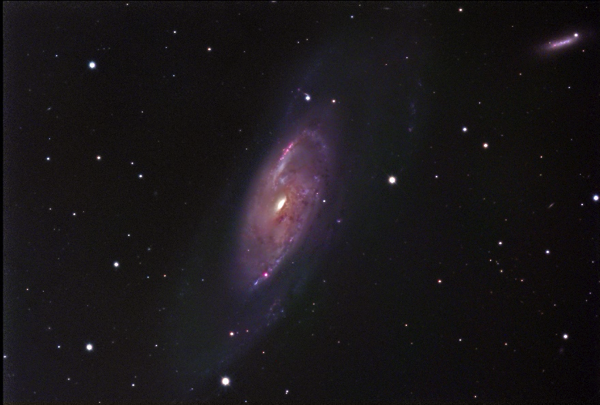
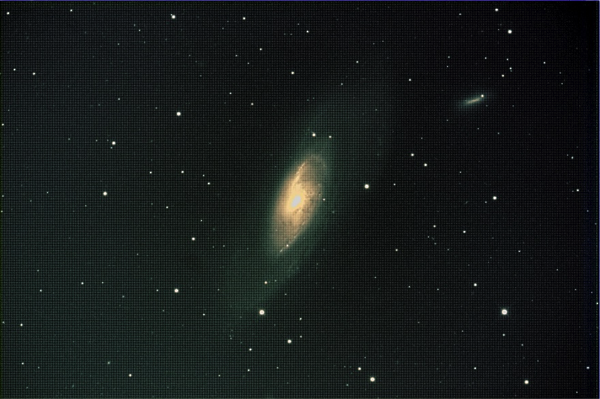
Color in the New Jersey Deep Sky? – Part 2. If you’re considering getting into astrophotography or you are already on the learning curve, you may have wondered about CCD cameras and techniques best suited for our challenging Jersey and Pennsylvania skies. The recent improving weather conditions helped me to make progress in comparing the two major techniques for deep-sky color astrophotography: one-shot color vs. LRGB. I used two different cameras/filters with the same guided tracking telescope in an observatory here in central NJ (see Part 1 in last month’s ST). As noted last month, one-shot color cameras are thought by experts to be unsuited to light-polluted areas. I wanted to test this by comparing the two methods head-to-head. Below are final images of the spiral galaxy M106, created using each method with the cameras indicated. The sky and moon conditions were similar and total exposure time was the same for each: 4.5 hours. The CCD chips of the two cameras have similar pixel sizes but different total pixel number and sensor area, so their fields of view differ. The resulting images were not cropped. While other celestial objects may compare differently, it’s pretty clear that for a target with low surface brightness like a spiral galaxy (magnitude spread out over a wide angular area), the beautiful blues and reds are more intensely captured and better balanced by the LRGB than the one-shot color camera. While that may not be true from a desert mountain site, it does seem so here in central Jersey. More comparisons will be made in the future to see how magnitude, surface brightness, and type of celestial object affects results.

M106-1

Messier-106, LRGB (ST-10XME camera & CFW8 filter wheel)


M106-2

Messier-106, one-shot color (SXVR-M25C camera)


Images by Rex Parker, taken in Titusville NJ. Cameras as indicated; Telescope: AGO 12.5-iDK astrograph; Mount: Paramount-MX; Control software: TheSkyX; Data processing: Maxim-DL5, CCD Stack, PS-CS5.

Posted in April 2015 | Tagged , | Leave a comment