From the Program Chair

By Ira Polans

New Jersey State Planetarium

New Jersey State Planetarium

The June meeting of the AAAP, and our last until next September, will take place on June 13th at the Planetarium of the New Jersey State Museum in Trenton. The meeting starts at 7:30 PM.

In addition to our normal club meeting, attendees will view a live star talk as well as our new science show at the Planetarium, “Wildest Weather in the Solar System“.

There is plenty of parking in front of the planetarium entrance behind the museum. Museum is located at –205 W. State Street, Trenton, NJ 08625.

We look forward to seeing you at the meeting.

Posted in June 2017, Sidereal Times | Tagged , , | Leave a comment

Double Dating

by Theodore R. Frimet

Are Mizar and Alcor sexting?

Mizar was presented to us as an optical double star, by NJ State Planetarium staffer and professional astronomer Bill Murray, at our Bright Spring Deep Sky Objects (DSO) presentation at the planetarium, on a rainy Saturday morning of May 13th.

As Mizar is the first double star on the list (part of the Big Dipper), I made this my priority to learn as much as this amateur could muster. The stellar light, I learned, that appears to broadcast to us from Mizar, is also imparted by its double dater, Alcor.

Mizar and Alcor, after the passing of 120 years of astronomical observation, and research, were revealed to be more than an optical binary. Below, I offer you, below, a revealing look at what is now known to be a our sextuplet!

Zeta Ursae Majoris (aka Mizar A & B), is my newest best friend and first on the bright star DSO list for AAAP Public Nights. Mizar is truly a quadruple system. Alcor, is a binary, and the pair, which I’ll dub, “AlcorUm” is therefore a sextuple (six part) system, about 83 light-years away from Sol..

Referencing author Dava Sobel’s “The Glass Universe”, pages 34-35, we give credit to Edward Pickering who noticed the “unprecedented doubling of the spectrum’s K line” on a Draper Memorial image taken March 29, 1887. Unfortunately, as soon as it was found, it was lost. Later, due to the diligence of Vassar College graduate, Miss Antonia Maury, (with honors in physics, astronomy and philosophy), saw it once again on January 7, 1889.

Sobel writes that Pickerings note read that sometimes it appears as a single, and at other times, a double! His theory eventually was proved that the small k-line separation effect is due to the two stars rotation about each other and that it completes “an orbital period every six months” (Wikipedia – Mizar and Alcor – May 13th 2017 19:42)

To be rock solid truthful, however, although the Draper Memorial group were the first to spectroscopically observe this double dating duo, credit is also due to Riccioli in 1650, G. Kirch and spouse in 1700, and “measured repeatedly since the time of Bradley in 1755”, as read from Robert Burnham’s Celestial Handbook, Volume 3, pages 1953-1954.

From Burnham we find that our optical double star has an observed separation of 8 degrees within the span of 200 years, then the period of our visually observed binary is many thousands of years. A quoted reference from Miss Agnes Clerke in 1905 speaks of a “possible accomplishment of a circuit in 10,000 years…”. Full rotation however, is reported occurring every 20.5386 days. I conclude that Miss Clerke was referring to the separation of the optical binaries, as they fall towards each other gravitationally, and push apart with their remaining momentum. As an aside, if we were able to live a few “circuits”, due diligence would divulge chaos directing the non-ordinary push and shove of such a system. This theory of mine is the result of my most current fling with author, James Gleick’s “Chaos, Making a New Science”.

Ms. Clerke made her observations two years after her honorary election into the Royal Astronomical Society, along with Lady Huggins, in 1903. She was the third woman to have held this rank. Ms. Clerke is referenced in the Sobel bibliography. I must admit to being a slow savory reader, and not having finished The Glass Universe, I cannot vouch for this lady of the Royal Astronomical Society being a Harvard Computer per se. However, at the speed of wiki, we find that overseas she was known for her collating, interpretation and summarization of astronomical research. (Wikipedia – Agnes Mary Clerke – May 14th 2017, 17:36 ).

In summary, so far…“Mizar A was the first spectroscopic binary to be discovered, by Pickering in 1889. Some spectroscopic binaries cannot be visually resolved and are discovered by studying the spectral lines of the suspect system over a long period of time. The two components of Mizar A are both about 35 times as bright as the Sun, and revolve around each other in about 20 days 12 hours and 55 minutes. Mizar B was later found to be a spectroscopic binary as well, its components completing an orbital period every six months.” (ibid)

Mizar’s fainter component, however, has different observed velocity shifts, and periods. Additional measurements showed us a third star within its grasp. Our wiki reference, and subsequent Google search leads us to an article at Sky and Telescope ( http://www.skyandtelescope.com/observing/mizar-a-fresh-look-at-an-old-friend03252015/ ) where further spectroscopy reinforces the observation that Mizar B to be a close orbiting pair of stars.

According to author and amateur astronomer Bob King, in his March 25, 2015 web article cited above, our optical binary double daters have not been found to be outside the family of our sextuplets, since 2009. It was at that time that space.com reported that the 200 inch Hale telescope at California’s Palomar Observatory discovered the companion to Alcor, an M-dwarf star, more commonly referred to as a “red dwarf”. Despite it’s small sounding name, the 2009 observation reports it to be “250 times the mass of Jupiter”, which is according to my star sense, bigger than a bread box, and one-fourth the size of Sol.

With our ventures into exoplanets, perhaps a vying eye, with an acquaintance with high resolutions, (gigahertz, hint hint radio astronomers…) we may be pleasantly surprised with a septuple (seven parts) or a perhaps even a new planetary discovery in AlcorUm.

If only red shift detection could be done at will, and fully funded to keep research active for years to come at the Green Bank Telescope, West Virginia, we’d only need to ask once or maybe twice for a peek under the bed-sheets of our sextuplet daters.

Posted in June 2017, Sidereal Times | Tagged , | Leave a comment

Exoplanets

by Prasad Ganti

In the last decade or so, there has been lot of excitement around the discovery of exoplanets, that is the planets outside of our solar system. An interesting book on this topic has been “Exoplanets” by Michael Summers and James Trefil. The pace of discovery of exoplanets has quickened since the launch of Kepler space telescope a few years back. More discoveries can be expected in the future as more such telescopes are lined up to be launched. The interest in exoplanets is to find out if there is any life outside of our Earth. The search for life continues even within our solar system. But the curiosity about how the other worlds look like and how life on them could be, persists.

The first exoplanet was discovered to be orbiting a Pulsar in the 1990s. The first normal exoplanet was found around the star 51 Pegasi. It is as big as Jupiter and is very close to its star. Closer than our Mercury is to Sun. Both of these are very strange cases. A pulsar is a dead remnant of a massive star. It is basically a neutron star which is very compact and dense, sending out a beam of radiation. A planet orbiting such a dead star? Or a massive planet orbiting so close to a regular star?

A variety of planets have been discovered. More flavors than what can be found in our solar system. Some planets are rocky and several times the size of Earth. Some planets are so light that we cannot figure out why they don’t collapse under their own gravity. Some planets made of pure carbon, with diamond mantles and cores of liquid diamond. Diamond does not exist in liquid form on Earth. Some planets are known to orbit up to four stars at a time. Some planets are so close to their stars that the rocks on their surfaces are vaporized and then fall back as rain. Then there are planets which are wandering around the galaxy, without orbiting any star. Nature never ceases to amaze us. The last case was very intriguing to me as I always imagined planets orbiting their stars.

In any solar system, a huge mass of swirling dust and gas creates the planets. The planets begin a complex dance driven by the force of gravity – what we call as a game of cosmic billiards. Planetary orbits shift around and planets can be ejected from the solar system. It is likely that there are many more rogue planets randomly moving in the galaxy than there are planets circling stars.

Planets reflect the light from their stars. But that light is too feeble to detect, given that the starlight is many time brighter and tends to mask the reflected light from the planet. But the planets do pull on the star as much as the star pulls on the planets. This pull causes a wobble of the star, which can be detected. Called the Doppler Method, it is useful for detecting larger planets closer to their stars. Also, as planets pass in front of their stars, there is dimming of light from the star. Something similar to the eclipses of the Sun and the Moon we see on the Earth. But the dimming can also occur due to sunspots, or in a double star system, when one star goes behind the other.

A planet can get heated from its interior due to radioactive decay of heavy elements like Uranium and Radium, like our Earth. Or due to tidal forces as well. Such infrared radiation (heat) can be detected, but our detectors are not as sensitive yet. Or the starlight can be filtered out to get the light from the planet alone. The James Webb Space Telescope which is scheduled to be launched in a couple of years, will have a coronagraph to do this filtering. We can determine the composition of the exoplanet’s atmosphere by directly observing the spectrum of the light. The spectrograph breaks the light into its constituent colors. Just like a prism breaks the sunlight into different colors. The spectrograph has some dark lines depending on what the atmosphere of the planet is like. The light absorbed by the elements in its atmosphere lead to these dark lines.

Kepler watches only a small patch of the sky. Despite its handicap of malfunctioning reaction wheels, it still works reasonably well. Reaction wheels are gyroscopes which keep the satellite steady. Once it identifies a candidate planet, it turns over the validation process to Hubble or other ground based telescopes. NASA will launch TESS (Transiting Exoplanet Survey Satellite) will be launched in 2018. Unlike Kepler, it will sweep the entire sky and focus on nearby stars.

The future appears to be very bright in terms of detecting the exoplanets, and possibly life outside of our Earth. We may not be alone after all!

Posted in June 2017, Sidereal Times | Tagged , | Leave a comment

Snippets

compiled by Arlene & David Kaplan

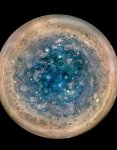
Jupiter’s south pole - NASA

Jupiter’s south pole – NASA

NASA’s Jupiter Mission Reveals the ‘Brand-New and Unexpected’
The top and bottom of Jupiter are pockmarked with a chaotic mélange of swirls that are immense storms hundreds of miles across. The planet’s interior core appears bigger than expected, and swirling electric currents are generating surprisingly strong magnetic fields…more

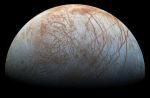
Jupiter's moon Europa -NASA

Jupiter’s moon Europa -NASA

Nasa seeks experiment ideas for Europa lander
NASA is seeking the best ideas for experiments to fly on a mission that will land on Jupiter’s moon Europa. The Jovian satellite has a deep subsurface ocean beneath its ice crust and is considered one of the top targets in the search for alien life. After decades of work, a pair of missions to the moon have been taking shape…more

7 Planets of Trappist-1 - NYT

7 Planets of Trappist-1 – NYT

The Harmony That Keeps 7 Earth-size Worlds From Colliding
In February, astronomers announced the discovery of a nearby star with seven Earth-size planets, and at least some of the planets seemed to be in a zone that could provide cozy conditions for life. The finding of these planets circling the star Trappist-1…more

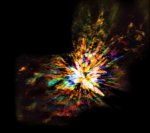
-NYT (ALMA/J. Bally/H. Drass et al. )

-NYT (ALMA/J. Bally/H. Drass et al. )

Aftermath of a Star Collision 1,900 Years Ago
About 1,900 years ago and 1,350 light years away, stars in a giant gas cloud behind the Orion constellation collided, ejecting two other young stars. With a telescope, the blast would have been visible from Earth about 500 years ago…more

Parker Solar Probe -JHU

Parker Solar Probe -JHU

Newly Named NASA Spacecraft Will Aim Straight for the Sun
Last week, NASA teased that it would have an announcement about next year’s mission to send a spacecraft into the outer atmosphere of the sun. Commenters on Twitter joked that the space agency might be sending humans there. The actual news? About 20 spacecraft have been named after prominent…more

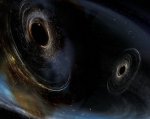
An artist’s conception of  merging black holes

An artist’s conception of merging black holes

Third Gravitational Wave Detection
The void is rocking and rolling with invisible cataclysms. Astronomers said Thursday that they had felt space-time vibrations known as gravitational waves from the merger of a pair of mammoth black holes resulting in a pit of infinitely deep darkness weighing as much as 49 suns, some 3 billion light-years from here…more

Posted in June 2017, Sidereal Times | Tagged , | Leave a comment

From the Director

Rex


by Rex Parker, Director

May 9 meeting – election of officers. We’ve come around in our orbit to the point when we elect officers again for the next season of AAAP. Or re-elect, because each of your officers has agreed to stand for another term. All members are urged to attend the May 9 meeting at Peyton Hall to give us your vote of confidence, and we do need a quorum.

This is an appropriate time to acknowledge those who have made this year an interesting and enjoyable one for AAAP. I’d like to thank Ira Polans (Program Chair), Michael Mitrano (Treasurer and chief carpenter), Larry Kane (Asst. Director), and Jim Poinsett (Secretary) for their key contributions and dedication as officers and trustees — and I’m very happy they have agreed to serve again. Others in the club made important impacts this year. I’d especially like to thank Prasad Ganti who worked with Ira and got several of the excellent program speakers this season. Further thanks go to Surabhi Agarwal for website improvements and to Surabhi and Tony Coventry for co-editing Sidereal Times; to Bill Murry for making the Planetarium a bigger part of our club; and to observatory co-chairs Dave & Jenn Skitt for driving the observatory improvements and keyholder training. Outreach is becoming an even bigger part of our mission as a club, and Gene Allen has recently agreed to join with Dave Letcher on the outreach committee. Finally, thanks go to all of the observatory keyholders (33 at last count) for representing AAAP to the community and making observatory public nights successful and fun.

AAAP Activities Coming Up

  • Celestial Refresher at the State Planetarium (May 13 at 10AM). We’re holding an astronomy night sky refresher session inside the dome so that members can improve deep sky skills away from the public and occasional pressure of finding and showing others. The Planetarium’s technical capabilities will be on display as AAAP member and Planetarium staffer Bill Murray runs the system. Location: NJ State Museum, 205 W State St in Trenton, park at the lower level near the Planetarium entry doors.
  • Members’ Nights at the Observatory (2 Saturdays, May 27 & June 24, dusk till midnight). These nights are reserved for AAAP members (you’re welcome to invite friends and family) at our Observatory at Washington Crossing State Park, NJ. This is a terrific opportunity to learn more about observing and telescope equipment, and get to know others in the club. Even if you know little or nothing about telescopes (especially so) we want to see you out there! Check out the new equipment and software which have improved the observing experience. Experienced members are asked to bring their telescopes to show others. See the website for directions.
  • Solar eclipse plans (Aug 21, 2017). If you want to join in on the Eclipse trip to Oregon, it’s essential that you make plans as soon as possible — please contact assistant director Larry Kane (assist.director@princetonastronomy.org). The chosen locale near the town of Monmouth OR, where one of our members has a family connection, is in the path of totality across the U.S. from Oregon to South Carolina. Of course, a clear sky is key, and August weather considerations are favorable at this site. NJ and surrounding states will see only a partial eclipse, far less impressive than totality.

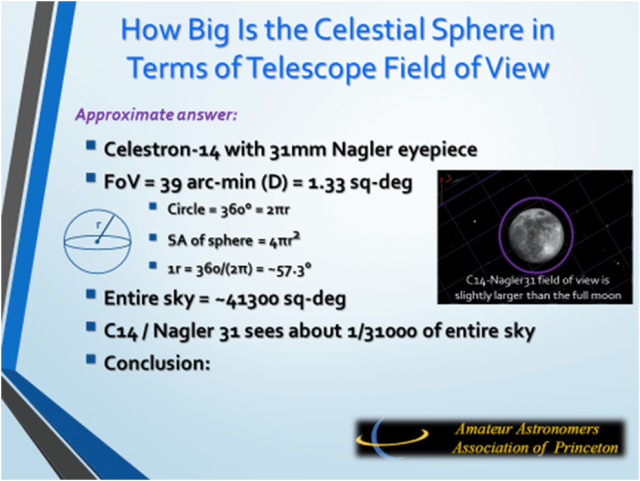
What fraction of the sky do we actually see in a telescope? At last month’s meeting we considered the size perspective of observing through the eyepiece of a telescope. To revisit that idea, here’s the slide (below) I showed giving the geometry and math. We concluded that the field of view using the equipment described is only a tiny fraction of the entire sky, about 1/31000 or ~0.0032% of the entire sky (considering the sky over a year). Yet the full moon seems so large! Of course, what this really means is that we have a lot of observing to do in the months ahead…

Posted in May 2017, Sidereal Times | Tagged , | Leave a comment

From the Program Chair

By Ira Polans

The May AAAP meeting is on the 9th at 7:30PM in Peyton Hall on the Princeton University campus. The talk is on “Dense Gas in Distant Dusty Galaxies” by Dr. Andrew Baker of Rutgers University.

To understand how galaxies evolve across cosmic time, we must understand not only their dark matter and their stars, but also the properties of their interstellar gas, from which new stars form and into which old stars release the products of nucleosynthesis. Cold, “dense” gas, in which hydrogen is largely molecular, constitutes one of the most important yet elusive components of galaxies’ interstellar media. Dr. Baker will describe how radio astronomers use molecular emission lines to detect and characterize dense gas in galaxies. He will then explain how observations of distant galaxies allow us to determine their dense gas masses and their exact distances. Such observations are especially critical for understanding recently discovered populations of galaxies that are so heavily obscured by interstellar dust that they cannot be effectively studied at optical wavelengths.

Prior to the meeting there will be a meet-the-speaker dinner at 6PM at Winberie’s in Palmer Square in Princeton. If you’re interested in attending the dinner please contact program@princetonastronomy.org by noon on May 9.

If you have suggestions for speakers please send them to program@princetonastronomy.org. Please provide the speaker’s name, topic, and affiliation. Thanks!

We look forward to seeing you at the May meeting and the dinner!

Posted in May 2017, Sidereal Times | Tagged , , | Leave a comment

Minutes of the April 11, 2017 meeting of the AAAP

by James Poinsett, Secretary

• The director, Rex Parker, called the meeting to order.

• There will be a night sky refresher at the planetarium of the NJ State Museum on Saturday, May 13th at 10:00 AM, all members are welcome to attend.

• There are members nights scheduled at the WC Observatory on Saturday May 27th and Saturday June 24th. All members are welcome, refreshments will be available.

• Mercer County Park Association is planning a campout on the summit of Baldpate Mountain on the night of August 11th for a Perseids viewing party. They have asked our assistance as night sky guides.

• Some club members are meeting near Monmouth, Oregon for the August 21st total solar eclipse. If you want more information contact Larry Kane or John Church.

• It is election time and the current Board of Directors has agreed to run for another term. If anyone else is interested please notify Gene Allen to have your name added to the slate. The current board is director:

     o Director – Rex Parker
     o Asst. Director – Larry Kane
     o Treasurer – Michael Mitrano
     o Program Chair – Ira Polans
     o Secretary – Jim Poinsett

• Rex sadly informed us that former director Dick Perry has passed away.

• There is a proposal to add Outreach and Observatory Chair positions to the board of directors. The procedure for doing this will be discussed at the next board meeting.

• There is a proposal to add a committee to help the Outreach Chairperson, the board will discuss this at the next meeting.

• Participation in outreach events has fallen off, please make every attempt to help the club reach potential new members by participating in outreach events.

• There was some discussion on how much of the night sky are we seeing through the C14 telescope at the observatory. It was concluded that using the Nagler31 eyepiece we are seeing about 1/31000th of the night sky.

• Communiversity was held on April 30th, AAAP had a table at the event.

• The Stokes Star Party was held on April 21st and 22nd.

• Larry has the logo and will be ordering shirts, details to follow at the next meeting.

• The meeting was adjourned.

Posted in May 2017, Sidereal Times | Tagged , | Leave a comment

quantum entanglement.

by Theodore R Frimet

pass the uranium, please.

It was 10 marbles for 99 cents, plus shipping, and I couldn’t resist. Imagine, uranium embedded into glass. Not a new thing, of course! Uranium glass has been around before there was electric light. Imagine having a uranium glass vase, seated by the window, catching glancing photons from the setting sun. And glowing…green. Aside from radioactive glass being, well, very cool, and out-right geeky, I was becoming transfixed on some purposeful use of uranium marbles.

It started with an attempt to find a science book, on line, in MP3 format from our local library. And I was not disappointed. I found, Entanglement, by Amir D. Aczel and installed and downloaded Overdrive onto my iPhone as quickly as I could. Azcel thoroughly presents the topic and makes it a point, to repeat key concepts and re-weave them into the storyline. Although more of a history of science, there were many tidbits that got my juices going. And my mind seemed to wander off to new horizons.

The new horizon seemed to become entangled. I found old thoughts, become washed anew. Last year, during one of our AAAP Friday night observation, I shared a thought with an astronomer that the nebula that we were viewing, was gas a-glow from ultraviolet light emanations from the white dwarf, contained within. Reradiating light, it seems, was perfectly rational. Photons, being well, photons, would excite electrons in the nebula to higher energy states, only to settle down into a lower energy state, and re-emit a photon in the process. Hence the glowing. What I was unaware of, was that there is also a process called down-conversion. And now, being titillated with a new concept, I was apt to apply it..somehow..somewhere..

I gleefully put together an email to a scientist that knows how light propagates thru a medium, and started my suggestions on green glass, and somehow ended up asking if gravitational lensing, causing Einstein rings, entangles light. Re-reading the email, I must have bit my lip, because, at the least, I never suggested having two or more telescopes aiming at the phenomena to capture entangled photons. And of course, he may have been a physicist, however, he was no astronomer. So the thought may have been lost on him in its entirety. No matter, as the light coming forth from such distant objects inherently are highly incoherent. Having had their presumed entangled photons come into contact (measurement) with other cosmological hooligans, they became less fuzzy. They collapsed their wave functions long ago.

I learned, from the auditory text, that science has been able to entangle photons, and more complex items, such as 2,000 atoms of Rubidium. Hardly stellar stuff…not just yet. So I set myself up and got insightful when the author spoke of spontaneous parametric down-conversion (SPDC). As evidenced thru the application of laser experiments and non-linear crystals; two crystals were specified, one was lithium iodate, the other barium borate. And both exhibited a faint halo – with rainbow color. That meant that not all the laser light was emitted as expected. When measured, it became apparent that for every one photon in, we get two out, and more specifically, the frequency of the two output photons was one half the frequency of the input. Later analysis proved the light was a good source of quantum entanglement. The phenomenon, according to the author of my latest fling, was discovered in 1970 by DC Burnham & DL Weinberg. The Wikipedia listing gives credit to additional authors. The implementation of SPDC as a source of entangled photons, for experiments related to coherence, was done by the likes of Leonard Mandel (May 9, 1927 – February 9, 2001) and others (another Wiki reference).

So, I found my jumping off point. It was Astronomy Day at Jenny Jump, UACNJ, and we had 20 minutes or so to kill, while a member went about finding an adapter for the present speaker’s laptop. Two other club members, helped kill time on entanglement. And my idea of entanglement of photons from Einstein Rings, and White Dwarfs, got shot down really fast. So I played my Ace card, and suggested that the UV input into a uranium crystal, yields a frequency one half of that input. UV being about 778 Ghz, green light 545 (thanks Google), Perhaps we have two photons out, for every one, in? Nope, not exactly. The math simply does not work, here. However, this is my delusion, so we march on to say we have a new source of entanglement. Nothing new under the sun, I’m told, and because I am dealing with a macro system, and coherence isn’t likely. But I persist. I want to focus the green fuzzy uranium light thru a beam splitter. With one source hitting a cut-out triangle target, and the second source becoming the ghost. Expecting much from my marbles, I want to see quantum entanglement in action.

And then the brighter of the four of us, asks me a question. What exactly is entanglement? I started to tell him how a photon becomes entangled, but he interrupts me, and says, “no, what is the cause of entanglement”. I say, give me a few seconds to think on that. And then I remember seeing an article with a picture that shows some concentric circles. And I seem to recall that there were several points of circular intersection that were referred to as “entanglement”. I also recall, at this time, learning that many different wave forms, say multiple sin and cosine waves can contribute and add to one wave form. And that one wave can represent, something, say like an electron. So the “particle” aka electron, is as spread over many probabilities as is the many waves that can represent it. And I put together the two thoughts (either of which may have been highly inaccurate) and tell my friend: “When one wave function intersects with another, the point of intersection is the entanglement.”

So when my marbles arrive, I’ll count them out, and have some fun. I am assured as long as I don’t grind the glass down for ingestion, uranium glass is presumed safe. I did order a low cost UV light source, and some eye protection, as the UV is probably more damning than the uranium will ever be. I may not ever get a chance to focus really huge telescopes onto Einstein Rings, however, in a few days, I will be able to find my marbles.

Posted in May 2017, Sidereal Times | Tagged , | Leave a comment

The Search for Extra-Terrestrial Life in the Universe

A book by Bangladeshi author Obaidur Rahman

Cover of Obaidur Rahman, a Bangladeshi author's new book "The Search for Extra-Terrestrial Life in the Universe".

Cover of Obaidur Rahman, a Bangladeshi author’s new book “The Search for Extra-Terrestrial Life in the Universe”.

Click here for the PDF version of the book.

Posted in May 2017, Sidereal Times | Tagged , | Leave a comment