If you haven’t completed the survey regarding the proposed trip to the Udvar-Hazy Air and Space Museum near DC yet, please take a few minutes to do so!
by Rex Parker, PhD director@princetonastronomy.org
Treasure on Earth Created by Kilonova. My long winter sojourn in the midwest ended a few weeks ago. Upon return I am inspired by nature with the changing of seasons and the imminence of budburst in the forests and meadows around Princeton and central Jersey. Looking out into the night sky this month I’m grateful for the changing constellations which now bring galaxies beyond count into favored position for our telescopes. With the warmer temperatures I anticipate the walk across a blooming campus to Peyton Hall for our next AAAP meeting on April 8.
The guest speaker, Eliot Quataert, is the Charles Young Professor of Astrophysical Sciences at Princeton (Charles Young is a famed astronomer from Princeton’s past, in the 1870’s). Professor Quataert will delve into some of the most energetic processes in the cosmos which underly the alchemy of the heavy elements. The heaviest elements found on earth, such as gold, platinum, and uranium, are formed in the violent processes of supernovae and neutron star mergers. The extreme processes unleashed by the merging of two neutron stars is now being scientifically termed a “kilonova”. At the atomic physics level, energetic neutrons are “captured” by other nuclei, releasing almost unimaginable amounts of energy and resulting in the generation of gravitational waves by neutron star mergers. This deep dive into neutron stars will extend our education from February’s LIGO presentation from Hanford, WA, where we learned about the origin of gravitational waves from neutron star mergers. See Program Chair Victor Davis’s section below for more on the speaker. With the encouraging sign of spring, let’s have a great member turnout at Peyton Hall, face to face. Of course, if you just cannot be there in person on April 8, do join us by Zoom (updated Zoom link is sent a few days before each meeting, and also posted on the website on page 2 under “Guest Speaker”).
National Academy of Science “Space Science Week 2025”, March 31-April 4. The past year has been amazing for space exploration. NASA’s James Webb Space Telescope discovered the most distant galaxy ever observed, Artemis II is preparing to send astronauts around the Moon for the first time in over 50 years, and three U.S. commercial landers have touched down on the Moon. These discoveries and much more are being reviewed with a focus on the future by the US National Academy of Sciences from March 31 to April 4, 2025 in Washington, D.C.
This is a joint meeting of the Space Studies Board of the U.S. National Academies in collaboration with the Aeronautics and Space Engineering Board, and Board on Physics and Astronomy. During the sessions, the oversight committees discuss upcoming advances and challenges in space and Earth science and exploration. Several of these sessions can be joined remotely by those interested, at this link: https://www.nationalacademies.org/event/03-24-2025/space-science-week-2025
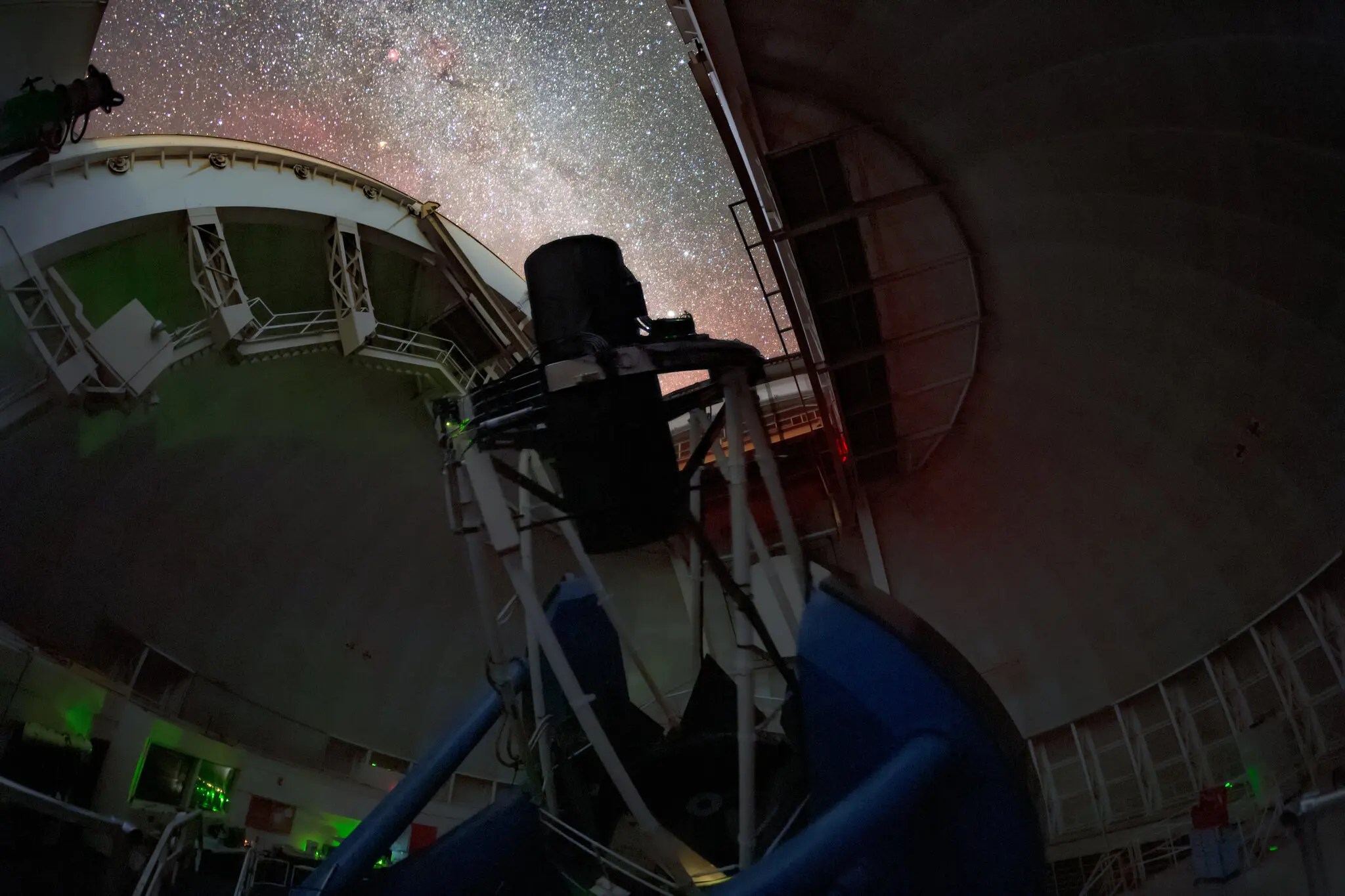
The “Un-journal Club” Wants You. After each month’s featured guest speaker, our monthly meetings provide opportunities to highlight club activities and member conversations. The Un-journal Club, a fun term evoking (provoking?) the journal clubs common in science grad school programs, is one such opportunity. For AAAP the Unjournal Club is a brief informal presentation given in the second half of the meeting by members. These don’t need scholarly journal-like topics, but merely engage members with what you care about in astronomy. You can use PowerPoint slides, JPEG’s, astro-images, travel pictures (e.g., bring on a USB memory stick), book reviews, whatever you want including simply your voice. A great example is last month’s presentation and excellent photography by member Rich Sherman of his recent trip to Kitt Peak National Observatory near Tucson AZ. To get onto the schedule for the April or other future meeting, please contact me or program chair Victor Davis.
AAAP Board Election Coming Up May 13. As directed by the by-laws, each May we hold the election of officers (the Board) for a one year term. I have asked member Dan Opdyke to be the Nominations Chair to identify candidates for the upcoming election. Below is a brief description of the duties involved for each position. If you are interested in helping AAAP as an officer (this or perhaps a future year), please contact Dan at nominations@princetopnastronomy.org. Dan will report on a slate of candidates at the April meeting.
Duties of the Officers
Director – The Director shall preside at all meetings of the Board of Trustees and at all general membership meetings. He or she shall appoint such committees as may be necessary to further the operations of AAAP. He or she shall be eligible to vote on all items of business that may be transacted at any meeting.
Assistant Director – The Assistant Director shall assist the Director in his or her duties, and shall act in his or her place in the absence of the Director.
Secretary – The Secretary shall maintain minutes of all meetings of the Board of Trustees and of the general membership, shall keep a record of the membership, and shall notify members of meeting dates. The Secretary may delegate such of these duties as may be appropriate, in consultation with the Director.
Treasurer – The Treasurer shall keep a record of all financial transactions of AAAP. He or she shall be responsible for the handling, safekeeping, and disbursal of all funds. In case of absence of the Treasurer, the Director shall act in the foregoing capacities.
Program Chair – The Program Chair shall select a Program Committee, over which he or she shall preside. The Program Committee shall be responsible for arranging suitable astronomy related programs at general meetings.
Observatory Chair – The Observatory Chair shall oversee and guide the operation of the AAAP’s observatory facilities and shall, with the assistance of others, make sure they are in good working order and up-to-date.
Outreach Chair – The Outreach Chair shall receive and respond to requests from educators and other community leaders for astronomy outreach and shall coordinate the assistance of AAAP members in responding to these requests.
Going for Gold The April, 2025 meeting of the AAAP will take place in Peyton Hall on the campus of Princeton University on Tuesday, April 8th at 7:30 PM. As usual, the meeting is open to AAAP members and the public. Participants can join the meeting in-person at Peyton Hall or log in to the Zoom session as early as 7:00 pm to chat informally before the meeting begins. The evening’s guest speaker is Eliot Quataert, Professor of Astrophysical Sciences at Princeton University. His talk is entitled “Cosmic Gold: Neutron Star Mergers, Gravitational Waves, and the Origin of the Heavy Elements”
Options for Attending the Meeting You may choose to attend the meeting in person or participate via Zoom or YouTube as we’ve been doing for the past few years. (See How to Participate below for details). Due to security concerns, if you log in before the host has set up internet connectivity in Peyton Hall, you may need to wait in the Waiting Room for a few minutes until the host is prepared to admit you into the meeting. You’ll need to unmute yourself to make comments or ask questions. It’s polite, though not required, for you to enable your camera so other participants can see you.
Meet the Speaker Dinner Join us at Winberie’s for our traditional fête. Reservation as usual is for 5:45 pm. Those who wish to participate should contact me at program@princetonastronomers.org to let me know you’re coming.
Here’s the anticipated agenda for April 2025’s monthly meeting of the AAAP:
(Times are approximate)
Getting to Peyton Hall The parking lots across the street (Ivy Lane) from Peyton Hall are now construction sites, unavailable for parking. We’ve been advised by the administration of the astrophysics department that we should park in the new enclosed parking garage off Fitzrandolph street and walk around the stadium and athletic fields. Here’s a map of the campus and walking routes from the parking garage to Peyton Hall. The map shows the recently completed East Garage. Not shown is an access road Sweet Gum that connects from Faculty Road to an entrance at the lower left corner of the garage. Stadium Road connects from Fitzrandolph Road to another entrance at the opposite corner (and higher level) of the garage. It’s about a 10-15 minute walk from the parking garage to Peyton Hall.
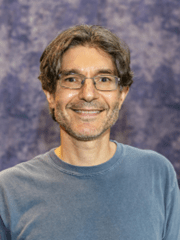
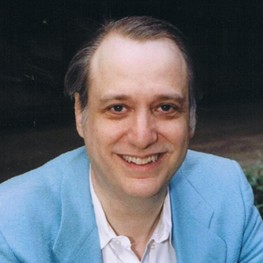
Featured Speaker: Eliot Quataert quataert@princeton.edu
Professor of Astrophysical Sciences Princeton University
“Cosmic Gold: Neutron Star Mergers, Gravitational Waves, and the Origin of the Heavy Elements”
Cosmic Gold: Neutron Star Mergers, Gravitational Waves, and the Origin of the Heavy Elements Scientists have recently developed a new way to `see’ the universe, using gravitational waves predicted by Einstein over a century ago. These waves can teach us about some of the most exotic objects known, including black holes and neutron stars. Remarkably, they have also helped solve a longstanding puzzle about where in the Universe some of the elements we know and love here on Earth are produced, including gold, platinum and uranium Eliot Quataert will describe the exciting and remarkable new results coming out of our first steps into the gravitational wave era.
Eliot Quataert is a Professor of Astrophysical Sciences and the Charles A. Young Professor of Astronomy at Princeton University. He is an astrophysics theorist who works on a wide range of topics, including stars and black holes, accretion theory, plasma astrophysics, and how galaxies form. His research utilizes both analytic calculations and numerical simulations. He teaches undergraduates and graduate students and also enjoys giving non-technical talks to the public on astronomical topics.
Prof. Quataert earned his undergraduate degree at MIT, his PhD from Harvard, and was a postdoc at the Institute for Advanced Study. He joined the faculty at UC Berkeley before moving to Princeton in 2020.
How to Participate (Links) Zoom& YouTube Live Amateur Astronomers Association of Princeton is inviting you to a scheduled Zoom meeting.
Topic: April 2025 AAAP Meeting-Eliot Quataert, Professor Princeton U, Cosmic Gold: Neutron Star Mergers, Gravitational Waves, and the Origin of the Heavy Elements Time: Apr 8, 2025 07:00 PM Eastern Time (US and Canada) Join Zoom Meeting
Meeting ID: 811 7384 9436 Passcode: 252509 Click the above icons for Zoom and YouTube
Date
Featured Speaker
Topic
May 13, 2025
James Stone Emeritus Professor of Astrophysical Sciences and Emeritus Lyman Spitzer, Jr. Professor of Theoretical Astrophysics Princeton University jstone@astro.princeton.edu
Dr. Hamer has expressed his intention to continue AAAP’s tradition to host the June meeting at the planetarium of the NJ State Museum in Trenton. The meeting will feature a presentation of the planetarium’s current sky show, a live planetarium tour of the night sky, and a guest speaker presentation.
July-August
No monthly meetings
Sept. 9, 2025
Edwin L. Turner Emeritus Professor of Astrophysical Sciences Princeton University elt@astro.princeton.edu
TBA Thanks to Bill Thomas for suggesting this speaker.
Nov. 11, 2025
Romain Teyssier Professor of Astrophysical Sciences and Applied and Computational Mathematics Princeton University teyssier@princeton.edu
TBA
As always, members’ comments and suggestions are gratefully accepted and much appreciated. Thanks to Ira Polans and Dave Skitt for setting up the online links and connecting the meeting to the world outside Peyton Hall.
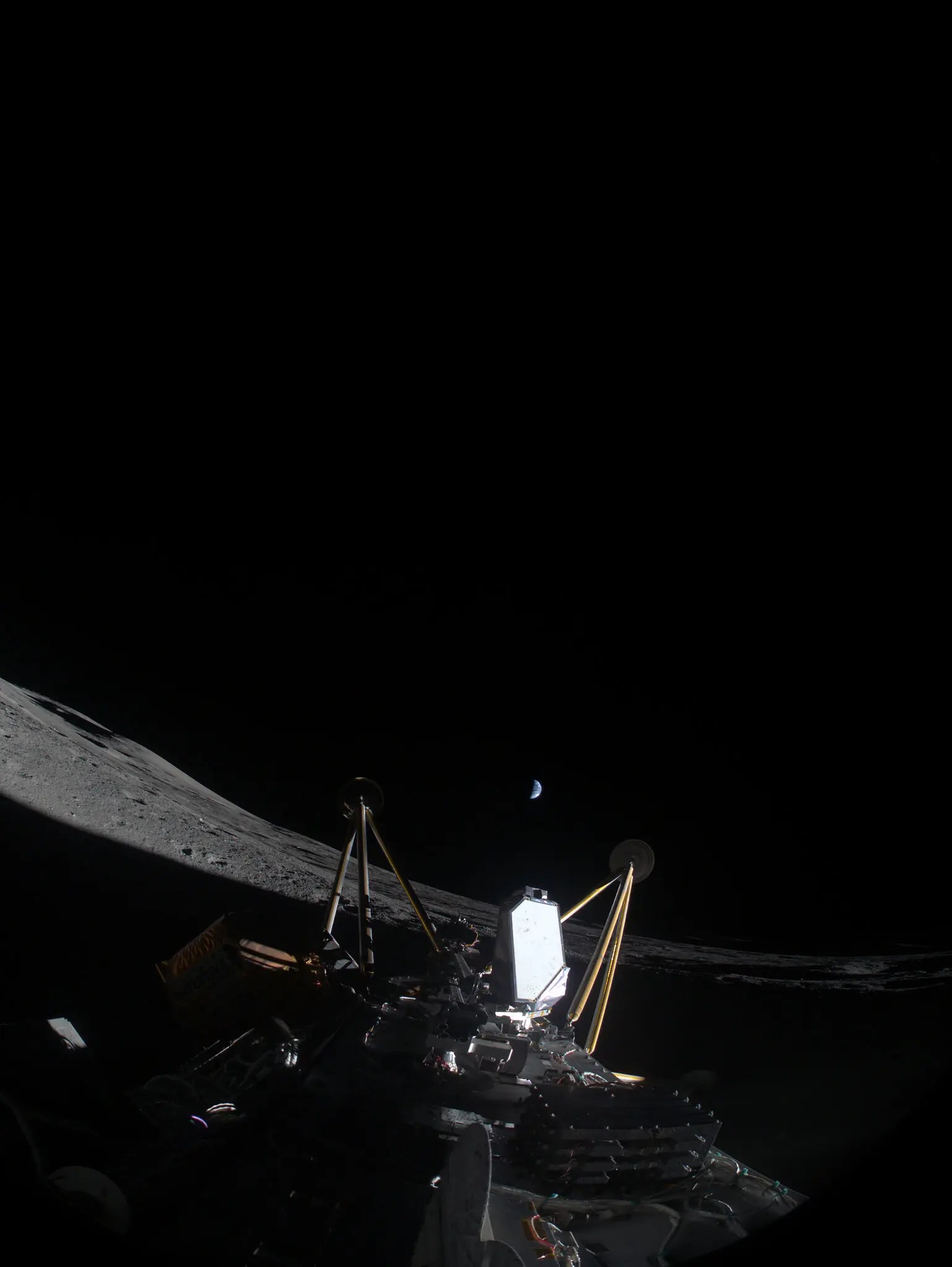
Director Rex Parker opened the meeting remotely via Zoom at 1930. There were 23 attending in Peyton Hall. He shared an astrophoto of Omega Centauri that he captured from a remote telescope he operates in Chile and pointed out the recent lunar landings of the Athena and Blue Ghost probes. While it fell over and died, the Athena probe landed closest yet to the south pole at 84.6◦S, just 62 miles from the pole, and he reminded us of the Lunar South Pole Observing Challenge, still ongoing since 2023. Launched on the same rocket as Athena, the Lunar Trailblazer orbiter lost communication with controllers the day after.
Program Chair Victor Davis introduced our speaker for tonight, J. Richard Gott III, Emeritus Professor of Astrophysical Sciences at Princeton University. His talk, Journey to the Cosmic Web and Back to Earth, was delivered remotely via Zoom. It included a brief presentation of much of the material in his books The Cosmic Web and Welcome to the Universe in 3D which he co-authored with our Assistant Director Bob Vanderbei.
Fifteen minutes of questions and a break followed the talk.
At 2102 Merchandise Facilitator Rich Sherman gave an Unjournal Presentation about his trip to visit the Kitt Peak National Observatory an hour south of Tucson. Rich shared what he saw on the most complete five hour, three-scope daytime tour.
Rex convened the business meeting at 2115 with 13 attending in Peyton Hall.
Outreach Chair Bill Murray reported on completed outreach events at the Plainsboro Reserve and Montgomery High School. Rex added his thanks for those who supported the Sky Gazing event at the IAS. Bill reminded us of the total lunar eclipse before dawn this Friday and the partial solar eclipse on March 29. Bill also reported that the proof of insurance document needed to reopen the AAAP observatory at the UACNJ facility at jenny jump had stil not been received from Treasurer Michael Mitrano.
A field trip to the National Air & Space Museum Udvar-Hazy Center at Dulles International Airport is under development.
An appeal was made for a member to organize the upcoming election of officers, and an immediate volunteer was appointed on the spot. Nomination Chair Dan Opdyke will serve in that role for 2025.
Observatory Co-Chair Dave Skitt reported that Alistair Adcroft and Josh Koslove have earned their keys and the 2025 Team Assignments will be adjusted soon. It seems that one leg of the power to the observatory has failed so that only half the circuits are poweredbut a request for service has been issued.
Victor Davis displayed the donated UniStellar eVscope 2 and described his experience with it to date. It is intended to become available in our telescope loaner program that is still awaiting someone to volunteer to organize it.
Rex asked us to be sure to see his article in Sidereal Times about Albert Michelson and the amazing accuracy of his calculation of the speed of light in 1879. He subsequently invented interferometry, which is the basis for radio astronomy today.
The meeting was adjourned at 2140.
As of March 9, we have 212 active members. So far in CY2025, renewals number 27 and expirations number 15, giving us a 64% retention rate. We have added 6 new members.
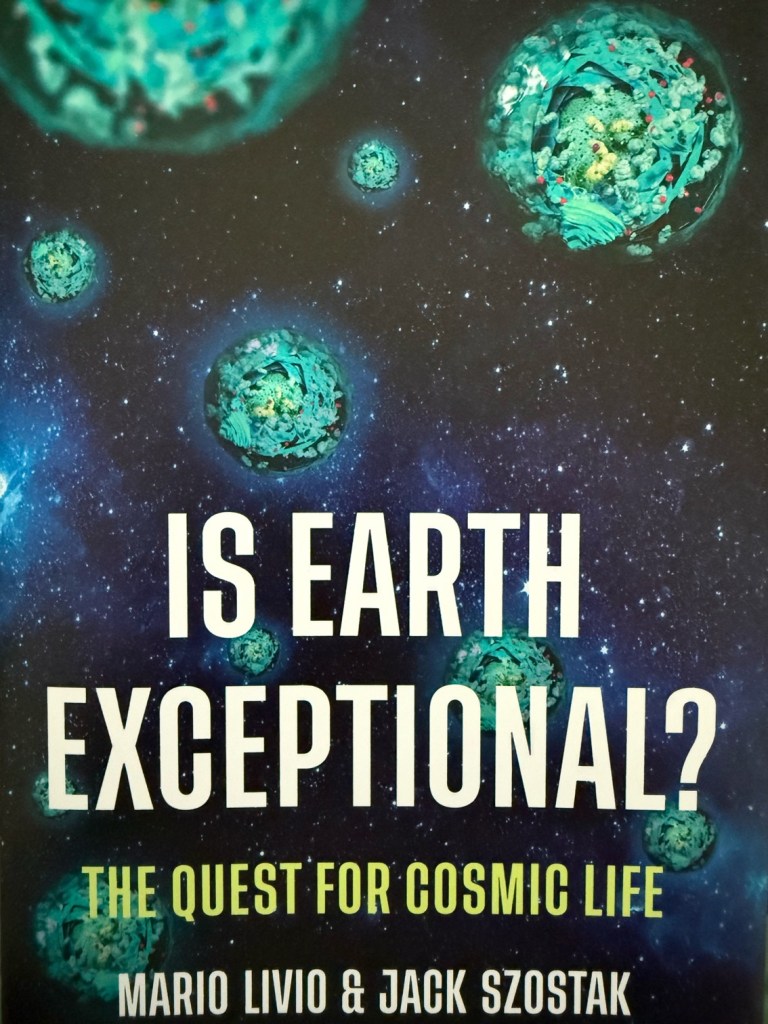
Title: Is Earth Exceptional? The Quest For Cosmic Life
Authors: Mario Livio & Jack Szostak
Publisher: Basic Books, New York, NY
Publication Date: 2024
Total Pages: 336
The origins of life on Earth may serve as a template for the beginning of life elsewhere in our solar system, newly discovered exoplanets, and the far reaches of the universe. However, the authors astrophysicist Mario Livio and Nobel Prize laureate Jack Szostak discuss in detail the complexities of life originating on Earth. The authors describe in technical detail how life’s building block of RNA to amino acids and cells may have emerged from the primordial Earth and as the result of the many consequences of geologic events. A few of the book chapters describe chemical and biologic processes promoting the origin of life in detail and maybe too technical for the less scientific reader. However, it is this basic understanding that is required to appreciate the intricate processes of the origin of life on Earth as well as the possibility elsewhere in our solar system and the universe.
I have found this book more comprehensive than others on this topic due to its amount of detail and explanation of the impact of external forces and the consequences on chemical and biologic processes. The references and suggestions for further reading is welcoming.
I logged in to the March 11th meeting late so didn’t really understand too much of the first part of Richard Gott’s talk. However, I thoroughly enjoyed the map projection discussion. My father was a navigator in the Air Force and used what we would now call primitive tools to direct his pilot around the skies. On some occasions he mentioned the great circle route to me and at the age of eleven I sort of understood it but didn’t really have the knowledge of how Euclidian geometry was transformed by a third dimension.
I have always been a map lover and in the past have used the AAA maps and books on many a cross country trip. Now and again I think that if my father was still alive how amazed he would be by our current GPS system and things like Google Maps. Almost all of my practical experience with maps covers such small areas that there is no concern of how they are distorted when displayed on flat surfaces.
But I still have an interest in how the different projections of a globe onto a flat surface produce different distortions and was enthralled by Gott’s talk on this subject. His double sided circular map minimizes distortion but does allow you to only see half of the surface at a time; although that is what you see when looking at a globe. His map is quite ingenious!
I was browsing the internet looking for more information on this map when I came across the following link: https://vanderbei.princeton.edu/planets_webgl/GottPlanets.html This shows an interactive Gott map with the circles side by side and allows you to set it spinning or pause it. You can also click anywhere and have that spot move to the center of the circle in either hemisphere; then you can hit reset and pick any other spot. You can also use a menu to pick other places to map like the Moon, Mars or Jupiter.
While Gott was speaking he mentioned his book, _Welcome to the Universe in 3D,_ so I went to Amazon while still listening to him and ordered it; the book arrived the next afternoon. The full Moon looks flat to us because our eyes are too close together relative to the distance to the Moon to get a stereo effect. With the 3D stereo viewer built into the book you can see the moon, and all the other images in amazing 3D. The book shows the varying distances of the stars that make up some of the constellations that we normally see as flat, and so much more.
My favorite image in the book is “Earthrise”, the famous Apollo 8 picture taken in 1968 by astronaut Bill Anders. It is one of the 20th centuries most icon images as it changed our understanding of our place in the Universe (as Time Magazine put it). I think Apollo 8 is underrated as it was the first mission to circle the Moon and return and showed that it could be done. The following link is a video that simulates the part of the Apollo 8 mission when the picture was taken.
I’ll end with one short funny story my father told me. In the 1950s he was a navigator for the Military Air Transport Service (MATS) flying out of Wheelus Air Base in Tripoli, Libya where our whole family lived. He was flying over the desert with a brand new Lieutenant that he was training. My father took a nap and told the Lieutenant to keep track of where they were. After a short while the Lieutenant shook my dad in a panic and said, “Peck, Peck, wake up I’ve lost track of where we are!” My dad, having flown the same route many times and was thus very familiar with the surrounding terrain, lifted his head, looked out the window, pointed to a place on the map, and said, “We’re right here.”
Astrobiology represents the human quest to find life outside of our planet Earth – whether it is in our Solar system or elsewhere in our Universe. It could be simple life like microbes or intelligent life like us or maybe even higher than us. I read an interesting book on this topic recently “The secret life of the universe” by Nathalie Cabrol.
Life appeared on Earth about 3 billion years ago. Conditions were favorable on Earth for formation of life. Recent discoveries suggest favorable conditions elsewhere too. Even on Earth life is found in extreme conditions like hydrothermal vents at the bottom of Oceans. But life has not yet been found anywhere else beyond our planet. It is difficult to believe that we are unique in our universe. By the same token as Enrico Fermi, the famous Physicist asked “Where is everybody” ?
Earth is at the right distance from our Sun. It is neither too cold nor too hot. It has abundant water in liquid form. It has plate tectonics which shift continents around like a jigsaw puzzle. In the process, they shuffle the nutrients from under the oceans to the land. A thick atmosphere to even out occurrences of extreme temperatures under light and darkness. A strong magnetic field, due to a molten iron core at the center, to shield us from ultraviolet rays and other harmful radiation. Significant gravitational force which holds the atmosphere. An almost even temperature which holds the water in all the oceans without excessive evaporation into space. These are Goldilocks conditions in which we find ourselves thriving.
The magnetic field on Mars was lost about 4 billion years ago. The atmosphere eroded due to the impacts from the solar wind and radiation. As a result, it is a barren land without any oceans. There is ice at poles. There could be microbial life beneath the surface or underneath the ice. But no evidence on the surface itself. Biosignatures indicating the presence of some chemicals could represent clues to the presence of life. One of them is methane found on Mars. It is still being generated. It can also be generated by geological processes, in addition to biological ones. It could be one or both of these processes at play. Further investigations are needed.
Venus is a very hostile place for life to exist. It is a runaway greenhouse with very high temperatures. Acids are present in its thick atmosphere. Yet phosphene was detected in its atmosphere. It can be generated by geological or biological processes. Missions are planned for the future which will investigate Venus further.
While Mercury is closest to the Sun and is hot, ice is still present today in the cold traps in those areas which are permanently shadowed from the Sun. Life could exist in such cold areas.
Ceres is a dwarf planet in the asteroid belt between Mars and Jupiter. It contains a deep reservoir of salt-enriched water beneath a fractured icy crust. It has organic molecules as well. Life may exist in this interior.
Jupiter’s moon Ganymede has plenty of water in oceans under an ice crust, a magnetic field, and a source of energy generated by tidal heating that triggers tectonic activity. Similarly Titan has an ocean of water under its surface. In addition, its thick atmosphere is rich in organic molecules. It does have oceans of liquid methane on the surface. While water would freeze at such temperatures, methane exists as liquid.
Outside of our solar system, thousands of exoplanets have been found. TRAPPIST-1e, Kepler 186f and Kepler 452b are some of the planets closer to Earth in size and reside in habitable zones around their stars. Looking for atmospheres and biosignatures on these planets demands more powerful telescopes both on the ground and in space.
All these investigations are a work in progress. They look for Goldilock conditions and biosignatures. Future missions like Europa Clipper and JUICE to the moons of Jupiter, and Dragonfly to Titan are very exciting to follow.
Organic molecules like methane, amino acids etc. have been found in various places in our Universe. In fact they were also created in an experiment conducted by Stanley Miller in the 1950s, simulating nature. The key question even for Earth is how the prebiotic chemistry consisting of organic molecules, turns into life.
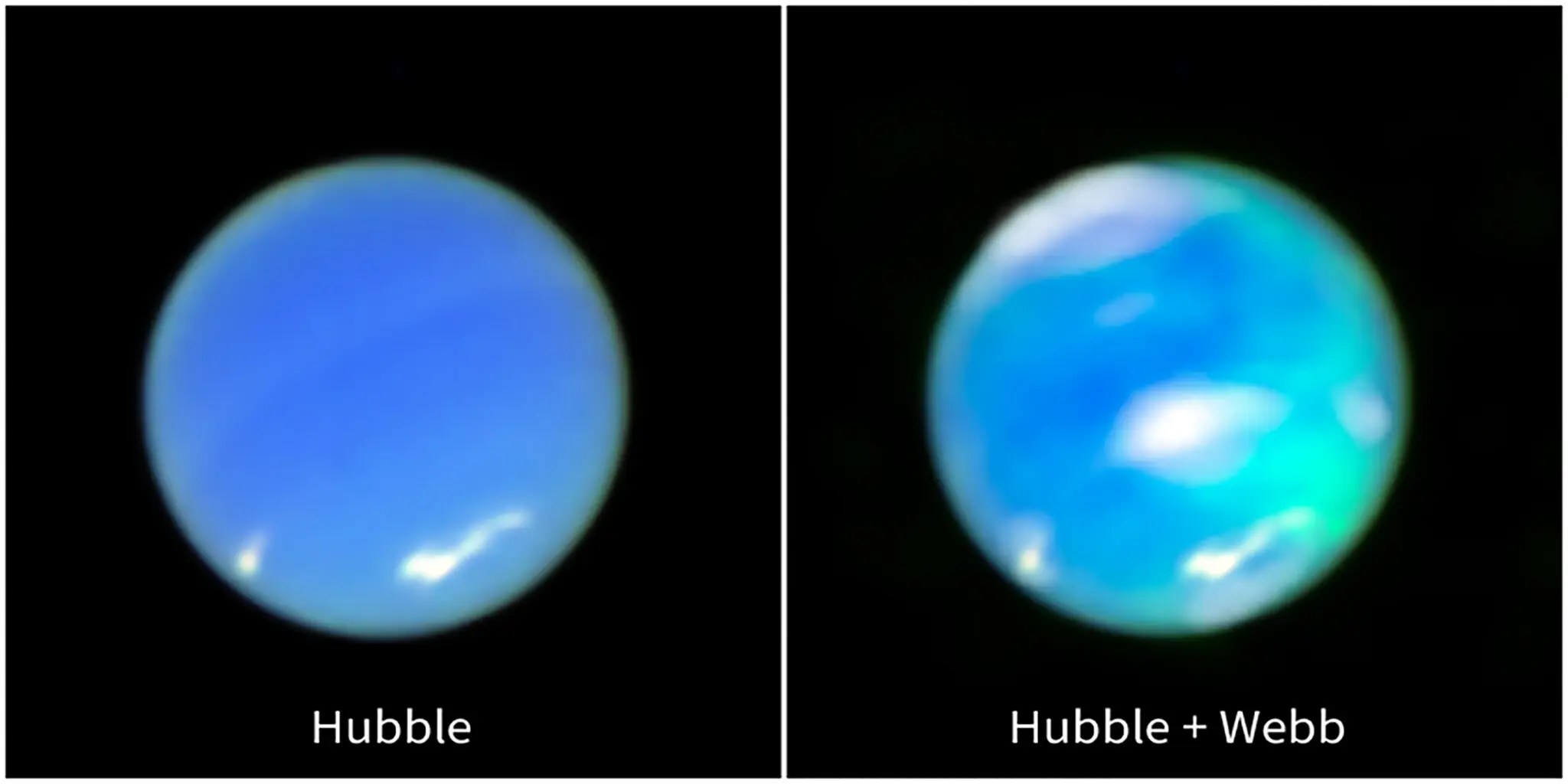
Auroras Are Spotted on Neptune for the First Time, and Lead to a New Mystery The vermilion, amethyst and jade ribbons of the northern and southern lights are some of Earth’s most distinctive features. But our planet doesn’t have a monopoly on auroras. Scientists have spied them throughout the solar system, weaving through the skies of Mars, Saturn, Jupiter and even on some of Jupiter’s fiery and icy moons….more
-scitechdaily
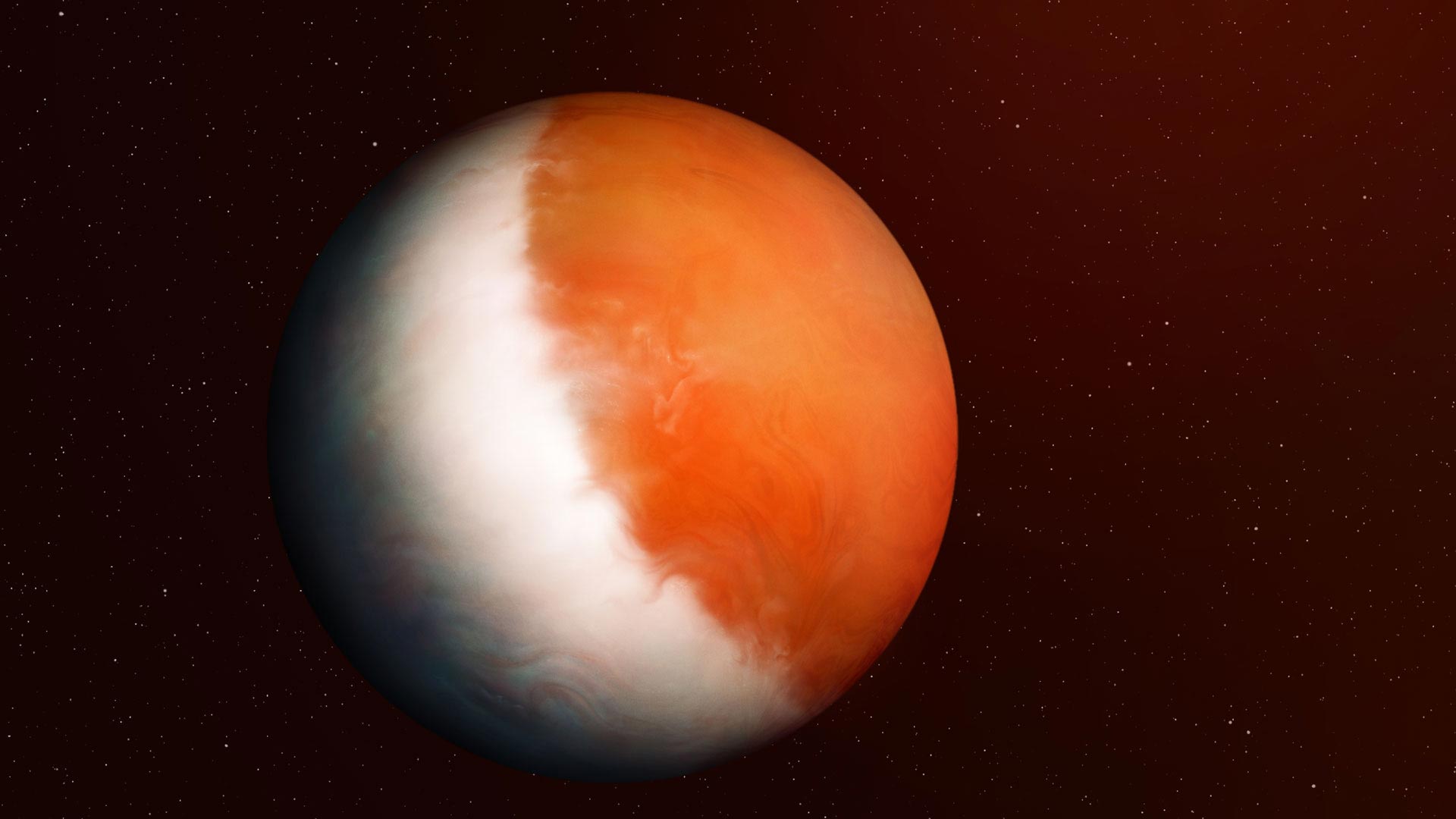
A Fiery Exoplanet With Mysterious Clouds Is Reshaping Our Understanding of Worlds Scientists using JWST have uncovered striking cloud formations and extreme heat contrasts on LTT 9779 b, a rare ultra-hot Neptune. This discovery reshapes our understanding of exoplanet atmospheres and how they endure intense stellar radiation…more
-NYT.com
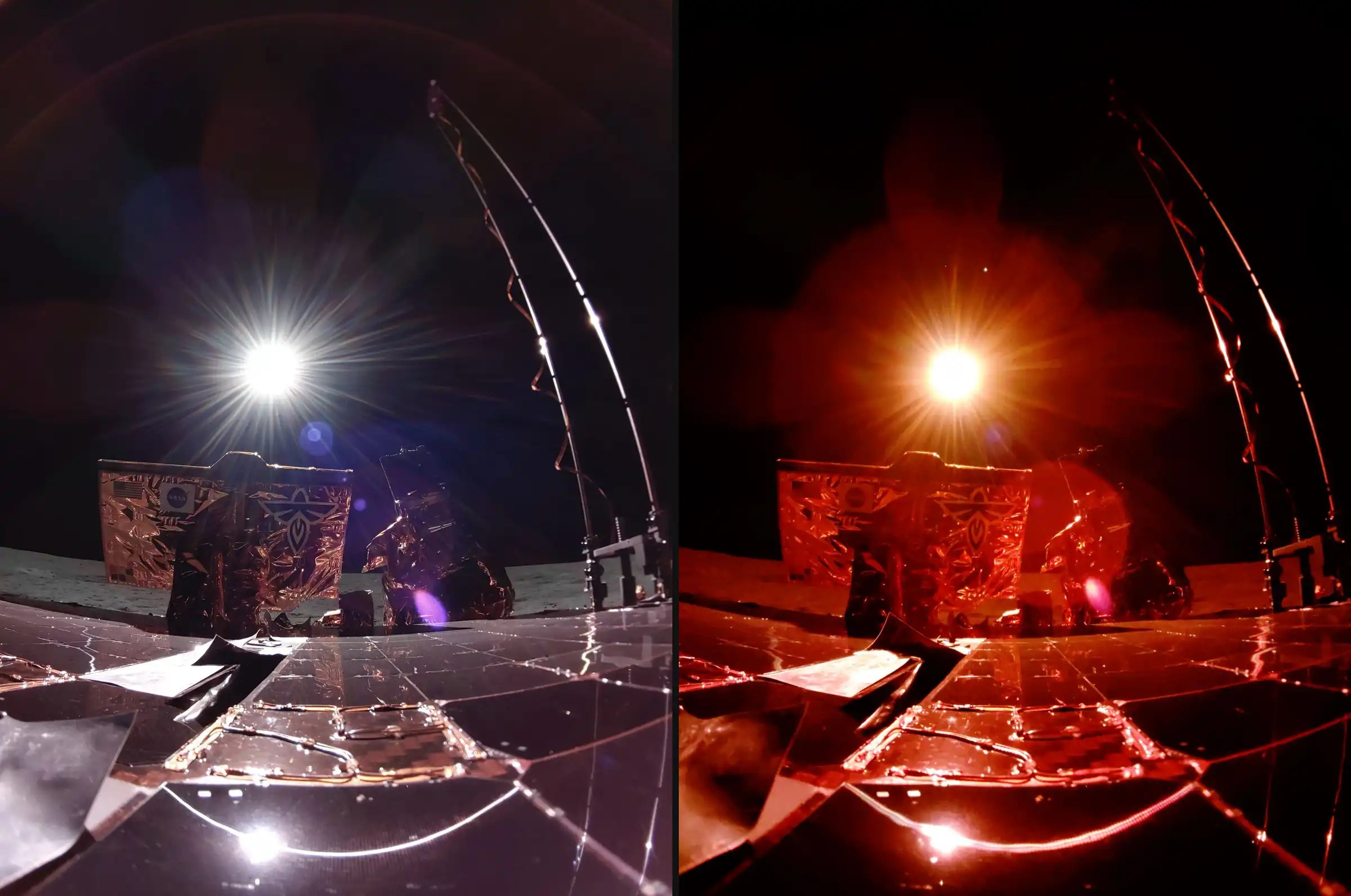
A Lunar Lander’s Busy Day: Eclipse Photos and Rock Collecting While people on Earth were taking in a blood moon and a total lunar eclipse on the evening of March 14, Blue Ghost witnessed and photographed a total solar eclipse. During the eclipse, temperatures dropped from 100 degrees Fahrenheit to minus 270 degrees…more
-NYT
‘More Than a Hint’ That Dark Energy Isn’t What Astronomers Thought An international team of astronomers on Wednesday unveiled the most compelling evidence to date that dark energy — a mysterious phenomenon pushing our universe to expand ever faster — is not a constant force of nature but one that ebbs and flows through cosmic time…more
-earth..com
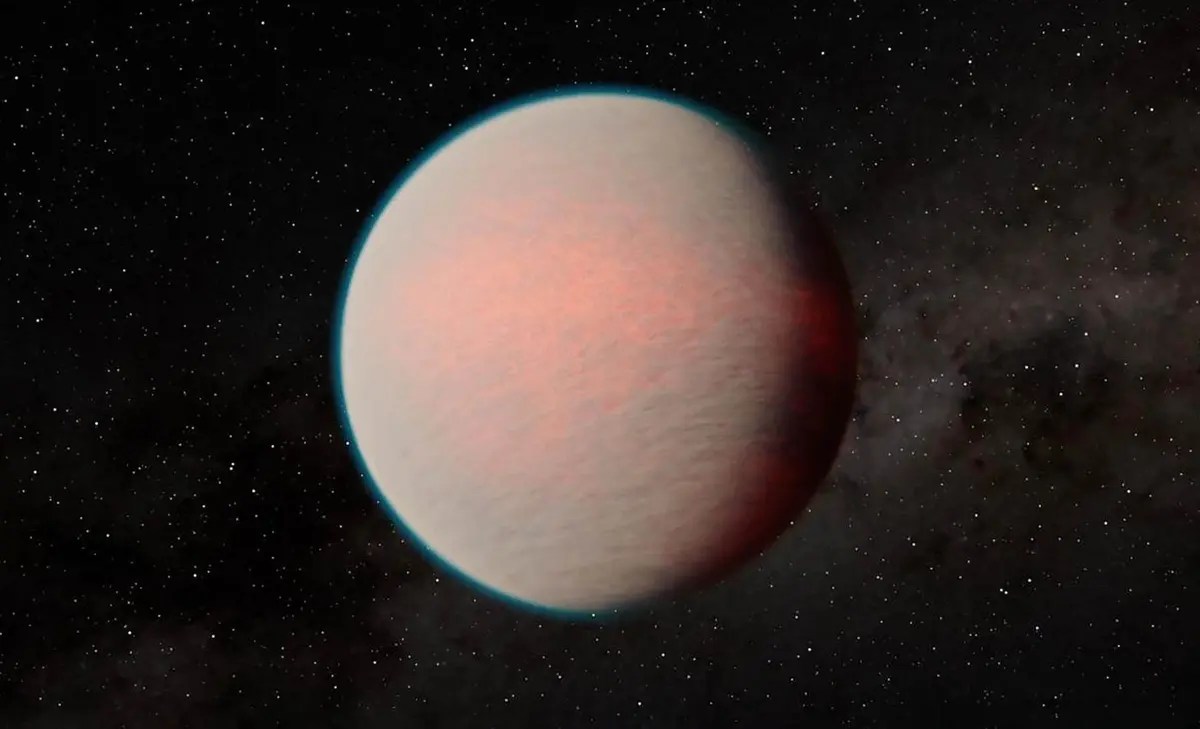
New planet named Enaiposha is unlike anything in our solar system It started as another exoplanet in a group labeled “ordinary.” No one expected that a world, once thought to be a mini-Neptune, would reveal traits of a super-Venus and change how we see certain planetary types. Astronomers used JWST data to learn more about an unusual place called Enaiposha, that orbits a red dwarf star about 47 light-years away from the Sun….more
-sciencealaert
We May Have Finally Laid Eyes on The Universe’s Very First Stars Once, there was a time before stars. In the primordial darkness, after the Big Bang, nothing drifted but a vast sea of hydrogen and helium. It wasn’t until stars came along, born from crushing densities in that clumping gas, that heavier elements emerged, forged by the fusion in their powerful hearts…more
-NYT
Texas Company’s Lander Dies on Moon the Day After Toppled Landing A day after landing on the moon, the robotic Athena spacecraft built by Intuitive Machines of Houston is dead. In an update on its website on Friday, the company confirmed that Athena had tipped onto its side — the same fate that befell its first lunar lander, Odysseus, last year…more
-dailygalaxy.com
Scientists Confirm The Moon Has A Solid Iron Core, Just Like Earth A major scientific breakthrough has settled a decades-old debate about the moon’s interior. Researchers have confirmed that the moon has a solid inner core, similar to Earth’s, composed of iron with a density of about 7,822 kg/m³. This discovery not only changes how we understand the moon’s structure but also provides new insights into the history of our solar system…more
-studyfinds.com
Cosmic anomaly: Webb Telescope finds ancient planetary disk that should have faded millions of years ago Astronomers have discovered a 34-million-year-old planet-forming disk around a small red star more than 30 million years after such disks typically disappear, challenging our understanding of how long planets have to form…more
-dailygalaxy.com
Astronomers Discover a Rare Magnetic White Dwarf System A team of astronomers has identified a new polar cataclysmic variable, a rare type of binary star system featuring a highly magnetic white dwarf siphoning material from its companion star. The system, designated ZTF J0112+5827, was discovered using data from the ROentgen SATellite (ROSAT) and has an unusually short orbital period of just 81 minutes…more
by Rex Parker, PhD director@princetonastronomy.org
The Ides of March Approacheth — Yet We Shall Nonetheless Meet. Shakespeare showed how the Ides of March (mid-month marked by the full moon) were treacherous times for Julius Caesar, but we’ll fearlessly convene at Peyton Hall auditorium on the Princeton University campus on Tues March 11 (7:30pm). Our guest speaker will be J. Richard Gott III, Emeritus Professor of Astrophysical Sciences at Princeton University. If you’re a newer member, be aware that due to the continuing campus construction project near Peyton Hall, automobile parking is in the garage at 148 FitzRandolph Rd, accessed from Faculty Rd, giving you a ~10 to 15 minute walk around the stadium to Peyton. If you just can’t make it physically, this again will be a hybrid meeting via Zoom; members receive the link by e-mail a few days in advance, and the Zoom link will also be on the AAAP website. For more information on the presentation and a walking route map to Peyton Hall, see Program Chair Victor’s article below.
Member Rich Sherman will do the Un-journal Club (from his AAAP-tropical abode in Florida) after the break this month. He’ll talk about his recent trip to famed Kitt Peak observatories near Tucson AZ. The un-journal club is a monthly tradition where a member gives a brief informal and fun presentation to begin the second half of the meeting. “Un-journal” means this is not grad school, you don’t need scholarly journal-like topics, just what you care about in astronomy. PowerPoint slides, JPEG’s, astro-images, travel pictures, book reviews, your imagination is the limit (bring a USB memory stick). To get onto the schedule for an upcoming meeting, please contact me or program chair Victor Davis (program@princetonastronomy.org).
Light Speed and the Invention of Interferometry. The fascinating presentation last month by Kim Burtnyk from the LIGO observatory in Hanford WA got me wondering how interferometry was invented. A major necessary step was the accurate determination in 1862 of the speed of light by Leon Foucault in France, probably more famous for his pendulum which demonstrated earth’s rotation. Albert Michelson in the US in 1879 refined and improved the method for light speed. By creating robust methods for precisely manipulating light beams through controlled reflection, their apparatus for light speed were keystones in the subsequent invention of the interferometer by Michelson in 1881. In 1907 Michelson became the first American to receive the Nobel prize. From a wonderful biography, The master of light: A biography of Albert A. Michelson, written by his daughter Dorothy Michelson Livingston, I learned a lot more about the man and the scientist. How he extended and improved upon Foucault’s method and succeeded in accurately determining the speed of light so many decades before electronics were developed is an amazing story.
Albert Michelson was born in Prussia (now Poland) in 1852 and emigrated to the US with his parents at the age of two. They journeyed across the sea and surmounted dangers in crossing the Panama isthmus years before the canal, settling in a wild west California gold rush town in the Sierra Nevada. Albert’s early promise led to his appointment by President Grant to the Naval Academy in Annapolis in the post- civil war years. It was there that, as an ensign in the Navy, he recreated Foucault’s light speed apparatus. The basis for the method was the measurable displacement of a light beam reflected from a rotating mirror, with calculations using a geometric equation. Of course, it was much harder than that may sound! In 1862 Foucault obtained c = 298,000 km/sec. Michelson with refined instrumentation obtained c = 299,944 km/sec (186,376 mi/sec), within 0.05% of today’s accepted figure! Accuracy here matters in countless ways for today’s precision electronics and GPS world, for example the meter is determined by the speed of light itself. Delving deeply into the instrumentation Foucault and Michelson figured out in the mid-late 1800’s is a fascinating read.
Going into the Field. We’re considering possible destinations for AAAP field trips It’s been years since our private tour of the PPPL in Princeton, and nearly a decade ago a group of us made an unforgettable field trip to D.C. to see the Smithsonian Air & Space Museum and the US Naval Observatory in Washington D.C. Now we are considering a visit to the other National Air and Space Museum, the Udvar-Hazy Center near Dulles Airport outside. If you have other proposals for a field trip, we would like to hear about it.
Unweaving the Cosmic Web The March, 2025 meeting of the AAAP will take place in Peyton Hall on the campus of Princeton University on Tuesday, March 11th at 7:30 PM. As usual, the meeting is open to AAAP members and the public. Participants can join the meeting in-person at Peyton Hall or log in to the Zoom session as early as 7:00 pm to chat informally before the meeting begins. The evening’s guest speaker is J. Richard Gott III, Emeritus Professor of Astrophysical Sciences at Princeton University. His talk is entitled “Journey to the Cosmic Web and Back to Earth.”
Options for Attending the Meeting You may choose to attend the meeting in person or participate via Zoom or YouTube as we’ve been doing for the past few years. (See How to Participate below for details). Due to security concerns, if you log in before the host has set up internet connectivity in Peyton Hall, you may need to wait in the Waiting Room for a few minutes until the host is prepared to admit you into the meeting. You’ll need to unmute yourself to make comments or ask questions. It’s polite, though not required, for you to enable your camera so other participants can see you. The meeting will be recorded and edited for posting to our club’s YouTube channel, but Prof. Gott has asked that we postpone posting the video until he gives the go-ahead.
Speaking Virtually Prof. Gott will participate via Zoom. There will be no “meet the speaker” dinner this month.
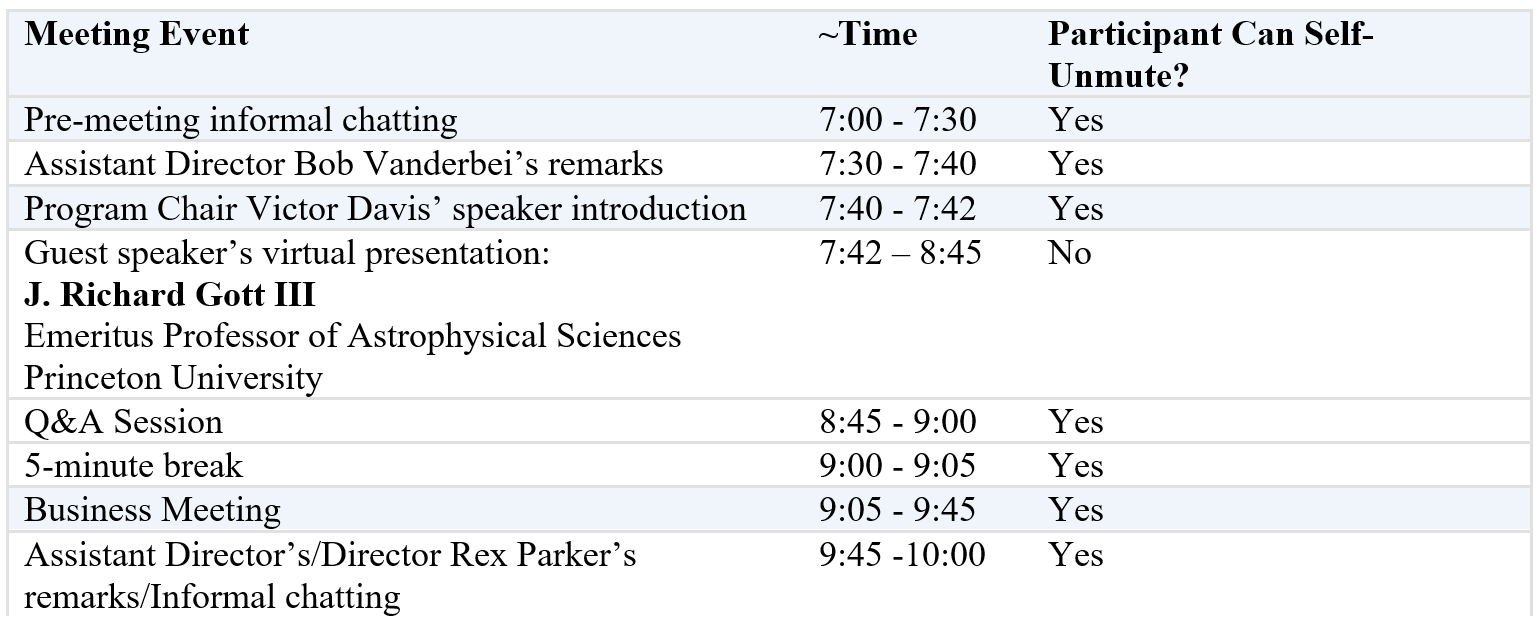
Here’s the anticipated agenda for March’s, 2025’s monthly meeting of the AAAP:
(Times are approximate)
Getting to Peyton Hall The parking lots across the street (Ivy Lane) from Peyton Hall are now construction sites, unavailable for parking. We’ve been advised by the administration of the astrophysics department that we should park in the new enclosed parking garage off Fitzrandolph street and walk around the stadium and athletic fields. Here’s a map of the campus and walking routes from the parking garage to Peyton Hall. The map shows the recently completed East Garage. Not shown is an access road Sweet Gum that connects from Faculty Road to an entrance at the lower left corner of the garage. Stadium Road connects from Fitzrandolph Road to another entrance at the opposite corner (and higher level) of the garage. It’s about a 10-15 minute walk from the parking garage to Peyton Hall.
Featured Speaker:
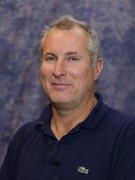
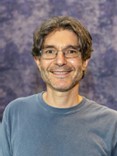
J. Richard Gott III kjrg@astro.princeton.edu
Emeritus Professor of Astrophysical Sciences Princeton University
“Journey to the Cosmic Web and Back to Earth”
Journey to the Cosmic Web and Back to Earth Professor J. Richard Gott will tell how his high school science project on spongelike polyhedra led him to a new understanding of the large-scale structure of the universe. If the large-scale structure was seeded by random quantum fluctuations in the inflationary early universe, then the topology of its large-scale structure should look spongelike today. This spongelike structure, with clusters of galaxies connected by filaments of galaxies, has been confirmed many times and is now known as the Cosmic Web. Prof. Gott will also tell how a new kind of polyhedron he discovered recently led him to make (with Goldberg and Vanderbei) the most accurate flat map of Earth yet. It was picked by TIME as one of the 100 best inventions of 2021 and featured on the cover.
J. Richard Gott III J. Richard Gott is noted for his contributions to cosmology and general relativity. He has received the Robert J. Trumpler Award, an Alfred P. Sloan Fellowship, the Astronomical League Award, and Princeton’s President’s Award for Distinguished Teaching. He was for many years Chair of the Judges for the Westinghouse and Intel Science Talent Search.
Born in Louisville, Kentucky in 1947, in high school, he won Second Place in the National Westinghouse Science Talent Search (1965) and First Place in Mathematics in the National Science Fair, St. Louis (1965). He graduated Summa cum Laude in physics from Harvard University (1969) and received his PhD in astrophysics from Princeton in 1973. After postdocs at Cal Tech and Cambridge he returned to join the Princeton faculty where he has remained.
His paper “On the Infall of Matter into Clusters of Galaxies and Some Effects on Their Evolution” co-authored with Jim Gunn is the most cited astronomy paper published in 1972 (over 4,000 citations). He proposed that the clustering pattern of galaxies in the universe should be spongelike–a prediction now confirmed by numerous surveys, as described in his book The Cosmic Web (2016).
In 1982 he was one of the first to suggest that bubble universes could form by quantum tunneling during a period of inflation, producing what we now call a multiverse. He discovered exact solutions to Einstein’s field equations for the gravitational field around one cosmic string (in 1985) and two moving cosmic strings (in 1991). This second solution has been of particular interest because, if the strings move fast enough, at nearly the speed of light, time travel to the past can occur. He wrote an article on time travel for Time magazine as part of its cover story on the future (April 10, 2000).
Gott and Mario Jurić are in Guinness World Records 2006 for finding the largest structure in the universe: the Sloan Great Wall of Galaxies (1.37 billion light-years long). Gott’s Copernican argument for space colonization was the subject of an article in the New York Times (July 17, 2007).
His new flat, double-sided map projection of the earth (with David Goldberg and Robert Vanderbei) was featured on the cover of Time magazine as one of 100 Best Inventions of 2021.
His book Welcome to the Universe in 3D (2022, with Neil deGrasse Tyson, Michael Strauss, and Robert Vanderbei) was a New York Times #1 Bestseller in Young Adult Nonfiction, reaching #1 on Amazon.com among all books.
How to Participate (Links) Zoom& YouTube Live Amateur Astronomers Association of Princeton is inviting you to a scheduled Zoom meeting.
Topic: March 2025 AAAP Meeting-J. Richard Gott, Prof Emeritus, Princeton U, A Voyage to the Cosmic Web and Back to Earth Time: Mar 11, 2025 07:00 PM Eastern Time (US and Canada) Join Zoom Meeting
Meeting ID: 813 0450 6946 Passcode: 814730 Click the above icons for Zoom and YouTube
Date
Featured Speaker
Topic
April 8, 2025
Eliot Quataert Professor of Astrophysical Sciences and the Charles A. Young Professor of Astronomy Princeton University quataert@princeton.edu
TBA
May 13, 2025
James Stone Emeritus Professor of Astrophysical Sciences and Emeritus Lyman Spitzer, Jr. Professor of Theoretical Astrophysics Princeton University jstone@astro.princeton.edu
Dr. Hamer has expressed his intention to continue AAAP’s tradition to host the June meeting at the planetarium of the NJ State Museum in Trenton. The meeting will feature a presentation of the planetarium’s current sky show, a live planetarium tour of the night sky, and a guest speaker presentation.
July-August
No monthly meetings
Sept. 9, 2025
Edwin L. Turner Emeritus Professor of Astrophysical Sciences Princeton University elt@astro.princeton.edu
TBA Thanks to Bill Thomas for suggesting this speaker.
Nov. 11, 2025
Romain Teyssier Professor of Astrophysical Sciences and Applied and Computational Mathematics Princeton University teyssier@princeton.edu
TBA
As always, members’ comments and suggestions are gratefully accepted and much appreciated. Thanks to Ira Polans and Dave Skitt for setting up the online links and connecting the meeting to the world outside Peyton Hall.










 Amateur Astronomers Association of Princeton