End of an era; potential new beginnings…

by Dave Skitt

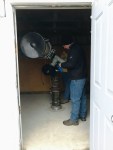
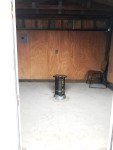
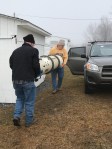
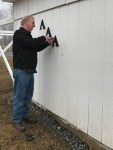
It was a gloomy day on January 21, 2017, when Bill Murray, my wife, Jennifer, and I, made a trip up to AAAP’s former observatory within the UACNJ consortium of observatories in Jenny Jump State Forest. Yes, you read correctly, AAAP’s former observatory. You see, earlier in the week and after much discussion, the AAAP board had voted to change the clubs’ status within UACNJ from “Supporting Member with Observatory” to just “Supporting Member”. Unfortunately, the “observatory” had become, as one board member put it, “just a shed” since the telescope inside was no longer operable. The goal of our trip was to remove the non-operating instrument and return the shed keys to UACNJ.

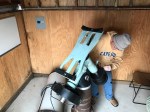
Removing the 12 ½”, F6 Newtonian built by late club member, John W. H. Simpson, and the Telescope World/Thomas Mathis Company equatorial mount, seemed simple enough. Just loosen a handful of nuts and bolts and carry everything out. First off was the OTA. It was considerably lighter than its former self as Bill had removed the beefy mirror, focuser and assorted accessories years before. Next were the mount counterweights, which slipped off their shaft with ease, seemingly relieved from being suspended motionless in space for so long.

At this point, the mount must have become aware of some looming fate in the astronomy scrap heap, as the bolts securing the latitude adjustment turnbuckle to the pier refused to give. However, after a few squirts of penetrating oil mixed in with a little patience and some sweet talk regarding the future of the telescope, the bolts finally let loose. The rest of the mount and pier relented with little effort, despite their mass.

What will become of the notable telescope and mount remains to be seen. They are currently being stored in my backyard shed. The hope and desire amongst those tasked with the dismantling is to find a home for them alongside the telescopes’ namesake observatory, the John W.H. Simpson observatory in WCSP. One option being considered is to reconfigure the OTA onto a mobile, Dobsonian style mount housed in its own small observatory. The scope and mirror would be refurbished and the Dobsonian mount would be all tricked out with digital setting circles, Wi-Fi module and laser pointer. These would give the scope near go-to simplicity and accuracy when coupled with a handheld tablet. Who knows – maybe we could even add tracking capabilities! A new era of 21st century observing could be in store for the former Jenny Jump observatory telescope.

Posted in February 2017, Sidereal Times | Tagged , | Leave a comment

Solar filter crafted for historic telescope

by Dave Skitt

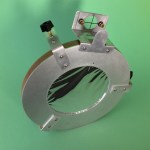
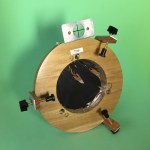
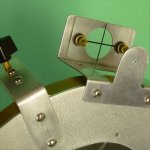
In early 2016, knowledge of the approaching May 9th Mercury transit and the absence of a suitable solar filter for our club’s historic, 6¼-inch Hastings-Byrne refractor, prompted me, as observatory co-chair, to look for a solution. Protruding thumbscrews on the objective cell had thwarted previous attempts to properly fit an off-the-shelf white-light solar filter. Therefore, I set about to construct a custom-made filter; one that would fit securely and complement the historic look of the scope. Using both purchased and re-purposed materials, I was able to craft a solar filter for about $50. [See “Front” and “Rear” Photographs]

The inspiration and final design were gleaned from a document entitled “Make Your Own Solar Filter” from the Kendrick Astro Instruments website (kendrickastro.com). Baader Astro Solar Safety Film was purchased from Kendrick Astro. The remainder of the materials came from my basement “supply” (it’s not junk!) pile or local hardware stores.

The finished product was completed and fully tested one week before the May 9th Mercury transit when hoards of boy scouts enjoyed a day of solar observing at our observatory. But the true test, which the filter and our legendary Hastings-Byrne refractor passed with flying colors, came at 7:14 am EST on May 9th, when the disk of Mercury could be confidently viewed against the face of the sun… what an extraordinary occasion for this historic telescope and its custom-made solar filter!

P.S. Newsflash – Use of the observatory is not restricted to nighttime viewing only! The club has white-light solar filters for not only the HB refractor, but also for the C-14 and the Explore Scientific refractor used with the Mallincam video camera. My wife, Jennifer, and I will be happy to train keyholders how to use the filters. We’d also entertain your ideas on how to possibly incorporate Hydrogen-Alpha solar observing into the observatory’s future capabilities. The August 21, 2017 Solar Eclipse is rapidly approaching…

Posted in February 2017, Sidereal Times | Tagged , | Leave a comment

A myth you can live by…

by Theo Frimet

Angular momentum and the space time ripple effect

I came. I listened. I learned. And all at last month’s lecture on how stars explode. I am writing here, today, to opine on how a software program running on modern supercomputers accounted for only hundreds of kilometers of space expansion during a novae event. And upon review of two recommended PDF’s, by our guest lecturer, I came to the conclusion that:

I know a whole lot less of what I should know about supernovae.
Neutrinos are far more fascinating than I had ever thought, as is Fermi pressure.
It appears to me that the only limitation in modeling the outlying progression of nova events lay in how long the simulation runs.

I found number three, above, to be profoundly disappointing. I was expecting a novice challenge. I was all set to argue the set of equations used, in cosmological modeling. And to suggest that Newton’s gravity was employed, instead of Einstein Gravity. No such luck.

Item number three, completely blew away what was going to be my answer to a disconnect between computational graphic output and observational astronomy. However, not wanting to waste any pablum, I hereby tip my hat to Kaluza of 1919 vintage, and present my contribution, not of an additional space dimension, but one of time. With your mind prepped to time warp, we dance about the head of the proverbial pin, and consider echoes in space-time.

Let’s dive right in, shall we?

There is change in angular rotation imposed upon space-time curvature by the frame dragging effect of the massive and fast rotating novae.

Each wave event, from the exploding novae, is captured in a spacetime slice.

The farther away we get, distance wise, from the novae core, the slower time becomes. That is a direct result of special relativity. To visualize this, think of a spinning bicycle wheel. For the core and outer rim to travel the same distance, the rim must travel at a greater velocity than the core. The faster something moves, the slower its clock becomes. Time, at the rim, is not the same, as time at the core.

Each novae wave moment traverses space and time, along an area defined by the angular momentum twisting effect. And propagates itself through its slice of space time. I believe the event occurs for each slice of space time. It is therefore, in my opinion, a recurring event. And each event has a time curve; fast at the core, and slow at the rim. I think of these events as pulses through spacetime. And each pulse having its own re-pulsing with an ever slowing velocity, a result of having lost its momentum to space-time.

As momentum is “re-expressed” in each occurrence, it is lost on the whole. Not unlike light propagating through a Bose-Einstein condensate medium, which loses its momentum upon re-radiation, and causes a decrease in kinetic energy. Which is why, the calculations of novae expansion terminate and are not observed to be infinite in the cosmos. I simply disagree with an infinite expansion model. And propose that time, more than space, in the fabric of space-time, puts a brake on expansion.

Sure, hot novae aren’t the cold containers that we find Einstein-Bose Condensates parked in. But sometimes we need myths we can live by. While I think that this part of science isn’t well understood, there can’t be much harm in using strong individual intuition to go farther than what supercomputer models for us.

Posted in February 2017, Sidereal Times | Tagged , | Leave a comment

Snippets

compiled by David Kaplan

Gas to solid. Credit: Harvard Univ.

Gas to solid. Credit: Harvard Univ.

Claim made for hydrogen ‘wonder material’
Scientists in the US say they have at last managed to turn hydrogen into a state where it behaves like a metal. If that is true – and it is a controversial claim – it fulfils a more than 80-year quest to produce what many have said would be a wonder material…more

The UK could have a spaceport by 2018. -BBC

The UK could have a spaceport by 2018. -BBC

Plans for Kintyre spaceport discussed at Westminster
The area’s MP Brendan O’Hara is hosted a reception detailing plans for the former NATO base at Machrihanish to be the center of space tourism in the UK.
Machrihanish is among five sites across Britain – three of which are in Scotland – hoping to be a spaceport…more

Peggy the, bright smudge at the edge of Saturn's A-ring. - NASA

Peggy the, bright smudge at the edge of Saturn’s A-ring. – NASA

To see finally the face of Peggy
Scientists studying the splendor of Saturn’s rings are hoping soon to get a resolved picture of an embedded object they know exists but cannot quite see. The moonlet is named after London researcher Carl Murray’s mother-in-law, and was first noticed in 2013. Its effect on surrounding ice and dust particles has been tracked ever since…more

Hakuto "White Rabbit",  Japan

Hakuto “White Rabbit”, Japan

Five in final stretch of Moon race
The race to put a privately funded spacecraft on the Moon has just five teams left in the competition.
The surviving groups all met an end-of-2016 deadline to obtain launch contracts – and these have now been verified by the organisers of the Google Lunar X-Prize…more

Posted in February 2017, Sidereal Times | Tagged , , , | Leave a comment

From the Director

Rex


by Rex Parker, Director

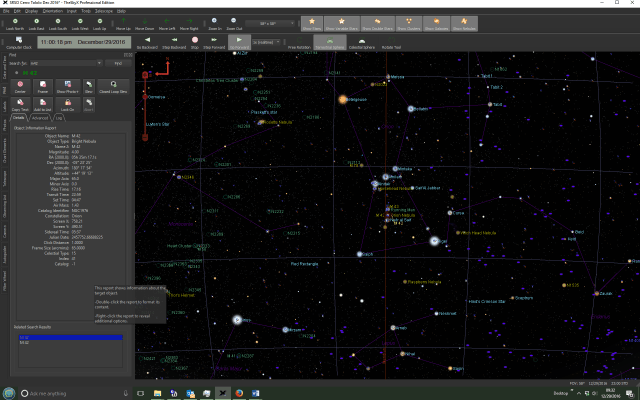
Help Make 2017 a Great Year for Astronomy! To help improve members’ direct access to astronomy, we’ve been updating and improving the hardware and software at our observatory at Washington Crossing State Park, NJ. The latest changes include installation of Software Bisque’s TheSkyX Professional Edition on the computers running the two Paramount ME equatorial mounts. These mounts carry several excellent telescopes: (1) 14” Celestron Schmidt-Cassegrain telescope piggybacked with a 5” refractor equipped with Mallincam video camera; and (2) the historic Hastings 5.25” refractor tandem-mounted with a 10” Takahashi Mewlon Dahl-Kirkham Cassegrain telescope. TheSkyX is a significant upgrade improving the utility and user interface of the current v6 of TheSky software, and offering many more databases. It also integrates camera control so that members can work with their own CCD or DSLR cameras or with the club’s SBIG ST-10 CCD camera. An interesting and very helpful feature of TheSkyX software is simulation mode, where the operation of the telescope mount or CCD camera, guider, or any other attached equipment can be simulated. This is a great way to learn! At the January regular meeting and the next Board meeting we will discuss the best and lowest cost ways for members to obtain a personal copy of TheSkyX to install on home computer to help with learning the software and getting ready to operate the observatory.

Screenshot of the TheSkyX showing the star map and user interface.

Screenshot of the TheSkyX showing the star map and user interface.


All AAAP members in good standing are entitled to use the observatory whenever a “keyholder” is present. Even better, becoming a keyholder yourself brings you 24/7 access to the Observatory. Please contact Observatory Chair Dave Skitt or me if you’re interested in learning more about the equipment or to join training sessions and obtain your own access key.

Beyond the observatory, upcoming AAAP events for this year will include field trips to regional astronomy venues, night sky refresher sessions at the NJ State Museum Planetarium, and astronomy outreach events at local schools and organizations. For those of you who know someone fortunate enough to receive a new astronomy-related item over the holidays (or whenever), we’re considering holding a “How to Use that New Telescope” event this winter at the Planetarium. Please let me or Bill Murray know if you think this idea is worthwhile. Finally, we all know and love the AAAP for its ongoing series of astronomy lecture presentations held at the main meeting each 2nd Tues of the month at Peyton Hall. This year will continue that tradition – see Ira’s article in this issue of Sidereal Times for information about the January 10 guest speaker.

Announcement: AAAP Board meeting. The next Board of Trustees meeting will be held Wed Jan 18. Board and committee members are urged to participate, and any member interested in the future directions of the club is welcome to attend. Please send me a note if you plan to attend. Time & place: Wed Jan 18 at 7:30pm, Dome Room, Peyton Hall (2nd floor), Princeton Univ.

NGC-1512

NGC-1512


One of my first “practice processing” images from Star Shadows Remote Observatory at Cerro Tololo in the Chilean Andes. NGC-1512 is a barred spiral galaxy about 40 million light-years away in the constellation Horologium, which we never see from New Jersey as it’s below the horizon.

Posted in January 2017, Sidereal Times | Tagged , | Leave a comment

‘Explosions in the sky’ – January 10, 2017 Lecture

by Ira Polans, Program Chair

We begin the New Year with a talk on “Explosions in the sky” by Dr. Ondrej Pejcha of Princeton University on January 10th at 7:30 PM in Peyton Hall on the Princeton University campus.
ondrej_pejcha
The appearance of “new stars” in the sky has captivated the imagination of astronomers for centuries. The interest in transient brightenings has increased tremendously in the past decade thanks to modern time-domain surveys. The wealth of new data has unraveled unexpected diversity in previously known phenomena such as the deaths of massive stars, and produced discoveries of many new classes of transients. The talk will discuss some of the extreme conditions and open questions posed by the menagerie of astronomical explosions.

His interests in time-domain astronomy started during high school when he was regularly observing variable stars visually and later with a CCD camera. After undergraduate studies in theoretical physics at Charles University in Prague, Czech Republic, he obtained his PhD in astronomy at the Ohio State University in 2013. Since 2013, He’s been a NASA Hubble Fellow and later Lyman Spitzer Jr. Fellow at Princeton University.

Prior to the meeting there will be a meet-the-speaker dinner at 6PM at Winberie’s in Palmer Square. If you’re interested in attending please contact program@princetonastronomy.org no later than noon on January 10.

We hope you join us for what will be an informative and interesting talk! You are encouraged to invite interested friends and family to the talk.

Posted in January 2017, Sidereal Times | Tagged , , | Leave a comment

Minutes of the December 13, 2016 AAAP Meeting

by James Poinsett, Secretary

Minutes of the December 2016 Meeting of the AAAP
• Director Rex called the meeting to order
• Ira introduced the speaker for the evening, Dr. Eric Gawiser from Rutgers University. His lecture was titled “The other 95%, Revealing the Dark Universe”.
• After a short break the meeting resumed with a re-cap of events from 2016.
    o Outstanding public outreach
    o Great speaker programs
    o Upgrades at the observatory
    o Improved website
    o Night Sky refresher classes
    o Third Mercury transit in 3 centuries for the HB Refractor
    o A successful Jersey StarQuest
    o Fate of the Jenny Jump Observatory
    o RIP Gene Ramsey
• Updated Sky10 has been installed on one computer so far, minor issues are being worked out.
• The Paramount mount has been cleaned and lubed and is working excellently.
• The ladder for the Mewlon scope is in place and works well.
• The website is good, always looking for new ideas. Online registration and payment is being set up.
• A discussion was held on reaching members and non-members.
• A date was proposed for the next board meeting, an email will circulate and a decision will be made.
• It is time to put In place a plan for the Jenny Jump observatory and execute it.
• John Church talked about the August 21st solar eclipse. A site has been picked in Oregon, near the town of Monmouth. If you plan on going contact John for details on the site.
• There are still a couple of openings for speakers for the rest of the year, contact the program committee if you have any suggestions.
• A brief discussion was held on a possible field trip to view a launch from the Wallops launch center in Virginia.
• Meeting was adjourned.

Posted in January 2017, Sidereal Times | Tagged , | Leave a comment

The Solar Eclipse of August 21, 2017

by John Church

As many club members are already aware, we have arranged for a prime viewing site in Oregon for this year’s total solar eclipse. Totality will last for slightly over 2 minutes, beginning shortly after 10 am PDT, and the weather is expected to be good. The site is on private property, and those who wish to participate will be given detailed directions. Members are kindly asked to not distribute this information on the Internet.

Our Assistant Director, Larry Kane, has arranged for a block of rooms in the area. Please contact Larry directly for further information. Accommodations are already very difficult to arrange, so if you are interested, you should act quickly.

There is also the good possibility that the property owner will allow camping. As soon as members who may choose this option have made firm plans, please contact this writer so that the owner can be contacted for full permission.

The nearest large airport is in Portland, Oregon. For those who want to fly, we suggest that you consider making reservations in the near future, as Oregon is going to be a popular eclipse destination.

This promises to be a spectacular event. The writer has been fortunate to have seen two total solar eclipses already; they leave overwhelming impressions that will never be forgotten. Photos from these eclipses are included here.

On no other occasion does one so directly experience the immense power of the motions of astronomical objects. Please join us if you can.

Posted in January 2017, Sidereal Times | Tagged , | 3 Comments

tabula rasa

by Theodore R Frimet

A photon, neutrino and graviton walk into a bar…

A photon, neutrino, and a graviton walk into a bar. Bartender asks, what’s with the graviton? The photon says, “let me explain”. The neutrino interrupts, and says, “Big Bang”.

The above joke has sufficient cognitive dissonance to explain all that follows. I am not so much inclined to produce new theory or hypothesis as I am set to undo some or all of what has been taught, recently, as cosmological theory. Although not a main philosophic tenet of John Locke, the expenditure of millions of dollars and commitment of close to a thousand educated minds in the pursuit of dark energy, and dark matter, may make an insensible impression upon those that simply do not know better. As a foundation of new observations will inevitably be laid down for future generations, now is time to express some thought on the matter. I think I know what dark energy is. Or at the least, you and I may have a meeting of the minds, in the few paragraphs that follow, and elucidate a new path.

So that we all know where the basis of my thought comes from, I’d like to share some news that might be disturbing to some readers. Having been fortunate enough to be introduced to the writings of Brian Greene, by a current AAAP member (thank you, and the wife for clearing out the bookshelf !) I find that Mr. Greene’s second book, “The Fabric of the Cosmos”, 2004 published by Random House, to be a much better read than, “The Elegant Universe”, 1999, published by W.W. Norton & Company, Inc. More to the point, I am only up to page 156 of the latter, so any hidden references to superstrings or hidden dimensions not so noted, are more likely rooted in the former. Not shocked ? It isn’t the page count that I thought would muster up your gall, however, the thought that the second was better than the first might get your grog into gear.

Ah, yes. The big bang. Or as one of our favorite cable TV shows might indicate, that there was not much of a bang. Unless you factor in the reading of the cosmic microwave background (CMB) and the derived plotting of baryonic acoustic oscillations. I swear to you, that during our last AAAP lecture on dark matter, dark energy, I truly believe that there is a missing amplitude curve to the BAO plot. Another hand-clap, if you must. But then, I digress, or rather regress into more of religious belief system, rather than one of science. On the face of it, it doesn’t appear rational, does it? However then, even Locke started his philosophical trendiness by first absorbing into his reality, that which was canonized. So, permit me the rather obvious treat of thinking as a member of the mid 1600’s and creating an artifact of illusion. I think modern science now calls this a hypothesis. Yes. The missing hand clap of genesis.

I was awed by Greene’s notion of less than 20 pounds of stuff being sufficiently expanded to fill the contents of our universe. I had already known and understood what it meant for an outer expanding bubble to, hold in place, and at the same time, move apart, its constituents on its surface. And much of what was written, I found totally enjoyable. But the sense of it, that so little genesis was needed to fill the void, was exciting to read and appreciate. I must render to you an apology, now and then. I am uncertain as to where, and when I read this in his book. But it does, inevitably come to mind, that the author of The Fabric of the Cosmos, is where the citation lay, in print, at the least. And it sparked an idea.

I shared this thought with our last AAAP speaker, and we all got a chuckle out of what could be the next venue for a movie. So, what follows is borrowed, from what I’ve read, and begged, from my peers, so that we might accomplish two things. The first being a source of entertainment. This being so, because so much of what follows that passes as cosmology is conjecture, and adding my thoughts, most certainly creates more of a movie event, than say, “real science”. And the second being, that as I will probably never win a big lottery, that the presentation of some liberal thought, could possibly link up, now or in the future, with solid observational evidence. Some look for Big Foot; I’d say I am looking for a cosmic string left over from before nucleosynthesis. Because if that’s possible, heck – what follows could be more than just feasible.

Accepted into the nomenclature of the big bang, is the hot and dense nature of our beginnings. And that in the absence of early matter coalescing into nuclei, and hydrogen, how even light could not escape the density of such extremes. Ah, but the wild card of neutrinos calls and beckons me. Like the musings of Khan, in a Star Trek episode, where he paraphrases Melville’s Moby Dick, “He tasks me. He tasks me and I shall have him!” If you have never read Melville, I encourage you to do so. It took me quite a while, and I must apologize to Melville, as I don’t remember quoting him as much as I recall a quote or few from the screen writers of our beloved Star Trek. On to neutrinos…

Neutrinos come forth, spewing into the void of the early universe, and not being massless, as they approach the speed of light, continue to increase in mass. Or if you prefer, they increase in energy – so that their velocity remains bound to the newest principle born of our cosmos, the limiting speed of light. And to make a poor reference to Einstein’s Special Theory of Relativity, a shift into motion slows down the clock of the matter at hand. By the time nucleosynthesis takes place, in Planck time, the clocks of the inner bang are not the same of the clocks of our early neutrinos. Let’s take a pause, here. Because some of you dear readers are asking the question, is our little fermion friend, shifting between tau, muon, and electron, in space-time, or are you calling an early bluff to my prose?

We have been told that in the birth of the bang, there were the consequences of quantum jitters that formed the basis of baryonic distribution in our developing universe. Here is where I go off the proverbial deep edge. Take a breath, as we are diving into the shallow end of the pool. This is not for the feint of hear. Here it is: I disagree. My hypothesis is that the time shifting neutrinos are literally slammed into by a raging photonic pressure wave. It is the very light of creation that was held in place, inescapably by the massive heat. And released, in outward expansion, at light speed, only when the first matter was formed. The dawn of light clock runs faster than the aforementioned neutrinos and hence, my photonic pressure wave crashes into a mass filled universe. Take a second breath. We are going into the deep end, now, my friends…reflections.

Not unlike seeing for yourself on a science show, the effects of a massive laser on a point carbon source and the observational results in a dynamic pressure wave; it doesn’t boggle the mind, in the least to see the way of wave interference, and reflection. And I postulate that our photonic pressure wave, doesn’t skip like a stone on the surface of neutrinos. They combine wave events. Something very unlikely, I’d admit. But this is where all the fun is at. Because just as 20 or so pounds of mass expands into something that is too great to imagine, we may have, at its crux, the energy relevant to what is needed, by cubic meter in the void, to accelerate the expansion of the universe. Now onto the reflection, and why jitters weren’t needed in early creation, until now…

Most of us have read, or have heard of the holographic theory. What follows isn’t that theory, however is inspired by it. A third breath, as we get pulled out of the water. Someone get ready with to do some CPR…

Each cosmic collision results in a point oscillation in reverse flight into an ever expanding cone to the core of the bang. The terminus of the cone bears down on our early matter synthesis with quantum jitters that were the result of neutrino transformations, and the varying degrees of space time distortion experienced by our earliest travelers reflecting back from the void. Neutrinos created the map of baryonic distribution. We read that as long as a science cannot probe to the finest of the imperfections of space time, some hypotheses are safe. For the moment at least. And in the colloquial nomenclature of football, I am doing a “hail Mary” pass, and will wait out until we can map the early universe with neutrino emissions, as has been done, for the cosmic background radiation.

I pray that it isn’t too narcissistic of me to suggest, that I have just broom swept out the proverbial pigeon droppings, as did two pioneers from Bell Labs…not too long ago, leading to the discovery of the CMB. My near infrared telescope will be ready by February, 2017. I have already anticipated a failure. Despite the real limitations of science, and budget, I haven’t ruled out the dream of a possibility of finding a cosmic string in the night sky. Right now, my tabula rasa (blank slate) is filled and I’ve got much to sleep on. Locke wouldn’t be proud. No doubt, he’d be confused. And we didn’t even get to talk about the graviton as a messenger particle. Perhaps, next time, when the bartender asks his ever recurring question, the graviton, and not the photon or neutrino, will speak for the cosmos.

Posted in January 2017, Sidereal Times | Tagged , | Leave a comment

So far away…

by Prasad Ganti

“Betelgeuse is 640 million light years away. It is a red giant, and is almost dying”. How do we know this, when it is difficult to find out what is happening in Syria or Russia? After all no one has visited our Sun carrying either a measuring tape or a thermometer. Indirectly measuring the brightness, luminosity and distances of stars and galaxies has been the hallmark of astronomy and astrophysics in the last century or so.

Firstly, it all started with our own planetary system. Ancient Greeks noticed that the ships disappear over the horizon, thereby concluding that the Earth is round. In fact, Eratosthenes found a well in Syene in Southern Egypt, where on June 21, the sun shines vertically all the way down to the bottom. He noticed that this event never happened in Alexandria. He used the difference in shadows cast in these two places on the same day of the year, the distance between Syene and Alexandria which could be measured with a tape, and some geometry to come up with an approximate circumference of the earth.

Aristarchus built on this idea, he said that at the time of half moon, the Earth, the Moon and the Sun must form a right angle triangle. He came up with approximate distance to the Sun. The Moon’s size can be estimated by the time the Moon takes to move through the Earth’s shadow during a lunar eclipse. Aristarchus predicted that Earth spun around its axis every twenty four hours. Ancient Hindus had similar views. But, for the next thousand years, the Church ruled claiming that the Earth was flat and at the center of our planetary system. Plunging Europe into dark ages.

Then came the Polish mathematician Copernicus who put Sun at the center of the model. Tyco Brahe, the Dane, took observational astronomy to its pinnacle using his observatory. Kepler took Tyco’s data and came up with his famous three laws of planetary motion. Galileo then used the newly invented optical telescope to observe the skies and more famously the four moons of Jupiter. Newton stood on the shoulders of these giants and came up with his famous law of gravitation.

Using Kepler’s laws and Newton’s law of gravitation, the distances within our solar system (up to Saturn) have been determined. Also, the obits have been accurately mapped out. Followed by Uranus, Neptune and Pluto in the next hundred years or so.

Next, moving out of our solar system, Cepheid variable stars were discovered. Whose brightness waned and waxed. Henrietta Leavitt found a relationship between the period of fluctuation and apparent brightness by collecting data from a group of Cepheids in the Magellanic cloud. A team of astronomers found the distance to one Cepheid. Henrietta’s theory was used to calculate the distances of other Cepheids.

Edwin Hubble had been the first to find Cepheids outside the Milky Way and thereby measure the distance to another Galaxy, namely the Andromeda Galaxy. Finding Cephids in distant galaxies was not possible. They are too faint. Astronomers made an assumption that the brightest star in all the galaxies have the same absolute brightness. By comparing the apparent brightness, a Galaxy’s distance could be measured. These stars are known as standard candles.

Another example of a standard candle is the Supernova. Type 1 supernova occurs when two medium sized stars collapse into each other. The resulting fireworks is uniformly luminous regardless of the galaxy in which it occurs. Type 2 supernova results from a massive star collapsing and forming a neutron star or a black hole. This type is not a good standard candle. Type 1 supernovae are used to measure distances to far off galaxies.

Most of the concepts summarized in this article have been borrowed from the book “The Big Bang” by Simon Singh. An excellent history of astronomy, astrophysics, and cosmology. So, we don’t really need a tape to measure larger distances!

Posted in January 2017, Sidereal Times | Tagged , | Leave a comment