Let’s go out on a limb

by Theodore R Frimet

and try not to hang ourselves with the truth


Space Force. Federal Employees get paid leave. Compromise. Whatever. Don’t attribute any of this to the current administration. We are ready to hand them their hats.

Let’s gain some perspective. National momentum provides a means and way of advancing space exploration. Another military branch development, specializing in space, appears to bear the weight of truth, if not a fact of necessity.

Consider the hundreds of thousands of orbiting space junk. One small, tidbit size piece, accelerated to faster than your fathers old jalopy, can bring death and destruction to an orbiting habitat. Toss the baby out with the bathwater, when these nondescript missiles cripple a multi-million dollars orbiting communication array.

While 500,000 pieces of debris are marble size or larger, there are millions of pieces of debris that cannot be tracked. (NASA – 2013). We find on Wiki (last accessed December 7, 2019), that as of January 2019, more than 128 million bits of debris. Debris amounts can be exponentially created, by design or by accident.

The Kessler syndrome was partially idealized by the movie industry, in Gravity (2013 Film). “Big sky – Little bullet” catastrophes such as this are a deliverable to be managed by a separate arm of the United States Military. And in my own humble opinion, I place this out of the budgetary constraints imposed upon NASA.

There is an associated billion plus in costs, not to mention, $10 million to $400 million to launch a single satellite. We have something concrete to measure against, for the outlay of budget for a separate arm of the service. No other service need now be concerned with their budget, while Space Force is busy taking out nuts and bolts from low Earth orbit.

And yes. Federal Employees will get paid leave. All things considered, the dog wags the tail.

afterward or epilogue?

you decide.

Imagine rethinking our power grid, and national infrastructure and bringing it into alignment with the needs of a modern, post-industrial, information centric society?

We could invest trillion$ from the upper 1% non-tax paying base, and have access to clean water, air, and non-contaminated food, all the while no longer paying lip service to the rising flood of attention that global warming requires.

If anyone thinks this off-topic, think again. Satellite imaging and intelligence systems, all the while, look down and provide the necessary measurements that dictate policy. That is, if policy makers pay attention, read, and act on the science that is available, each and every day.

Posted in January 2020, Sidereal Times | Tagged | Leave a comment

Sol Survivor

by Theodore R. Frimet

two cats enter. one cat leaves.

It’s late Sunday afternoon, the 22nd of December. I am still recovering from 6 hours of evening observations at AAAP Washington Crossing Park observatory. I don’t frequent there as much as I could. Clearly when we arrive at our New Years’, my resolution will be to make more observations, including astro-videography. Our AAAP club sustains me. They provide the nourishment for all Amateur Astronomers.

Two cats enter. One cat leaves. Two cats enter. One cat leaves. Two cats enter, one human leaves. I didn’t see that coming! Cats dominating the homestead, and kicking the human to the curb. Might make a run for it, while I can? Fritz the destroyer is up in his room, while the two dominatrix wait patiently for attention. Both stoically sitting back-to-back, in a more or less random assignment on the time line. Priss decides to leave. I pick up Big-Pussycat, as Fritz and Priss have clearly abdicated their role as Sol-survivor.

Big Pussycat and I look out of the sliding glass door. Door closed, of course. Last night was brutal in the 20’s and this afternoon shall not be a reprise. The sun appears to set, just at the tipping point below someones outside garage. Of course this is an illusion. The sun never sets, does it? It is more or less understood that the Earth rotates about its axis. It gives the illusion that the Sun rises in the East and sets in the West. Big Pussycat purrs on.

I nudge her gently, bringing my chin to nestle about her whiskers. I explain that the glory of the sun that she basks in, provides warmth. Her feline stare suggests otherwise, that it provides Energy. Sol never was that great provider. Here on Earth, and elsewhere, Nature requires many an element to create and sustain life. We have encountered many AstroPhysical moieties that give provision to Life’s Genesis. Today’s number one hit is the front page news of impending Super Novae. Yes, it is those prominent colossus’ that are the requiem of matter sustaining life.

It’s a great private email feed to read and listen in on UACNJ comments. Not to be undone by the history of the time line, we take notice of an alarm! Betelgeuse has dimmed. Well, the red giant found in the Orion Constellation is variable. That is it increases and decreases in luminosity according to its own timetable. This recent dimming is special. It is the preamble to a Nova. The likes, in my own humble opinion, that hasn’t been seen since two thousand Christmas’ ago.

I usually recall my dreams. Perhaps that is because my last stage REM occurs before I wake up for work. I have an uncanny ability to recall my dreams in detail. Yet, armed with the knowledge that most accessed memory is friable; who is to say that I just conjured up the whole imagery? Yet, here I am. Stuck with the knowledge that in one dreamscape, long ago, I recall seeing stars fleeing from the direction of Orion. Wait a minute. That animation is from a movie preamble. And it is copyright! I hope no-one speaks to a lawyer about rights infringement. I’d have to pay every time I have a Cosmological night time event!

I wake up, and nudge the cat once more. I tell her that very soon, in a cosmological time period, that Betelgeuse will slam dunk space-time. The great wave will compress matter and awaken new star formation and birth life anew. The matter that she will spew forth will form the basis of inner planets waiting to coalesce. On her time-scale, those planets will heave and hew until reasonably intelligent life takes hold. Maybe then, we can have a cogent conversation. Big Pussycat meows back. Eyes wide shut. Tail wags. Human leaves the stage. Big Pussycat wants to remind all of her readership that the Red Giants Nova may not take place for another one thousand years. Or maybe next Tuesday. The odds are better, she says, than winning a Regional Lottery.

Roof half open. Handle comes off. Make frantic phone calls. Get superb responses. All post-haste as the handle was reattached, with a little elbow grease, and some common sense. Roof securely open now, and I’m snug as a bug in a rug.

I am early to the observatory. The sun hasn’t even set yet. We open the observatory, and cool down the mirror. Seat. Coffee. Wait. Darkness descends. A star is born of the night sky.

Is that Taurus? Could it be a red star? No, it’s white. Castor is bright. Is it Aldebaran? That one was my friends favorite! Ah, it is Capella. I knew it. Capella was one of the brightest stars, a few out-reaches ago, in a Church parking lot. Due to security lighting, Capella was one of the few stars available to ogle at.

This time of year, Capella is taught to the amateur to be a “guide star”. Find Capella, and you can star hop! This is tough love, though. When there are clouds, and only one star, it becomes a guessing game. We guessed correctly. There’s an app for that.

I relax back in my seat, and await the star show. I casually look up. There I see an array of a neatly formed great square. Oh my gosh! The Great Square of Pegasus. More clouds part. The white wisps dissipate as if on command. More starlight shows the greater portion of those defined by Constellation Pegasus. This is going to be a good evening. My app was right. It will be clear skies, dominated by no moon, at all.

I was going to visit the numerous glowing bodies that appear in the vicinity of the Constellation Cassiopeia. It was mentioned to me, by a committee chair, long ago. I listened then, only to find the courage to come out, and do the astronomy by myself more than a year later. We are in the moment, and the moment is now. It took a right turn due to lesser luminous magnitudes competing for the night light pollution. Change in plans. Look for Andromeda.

Our sister spiral galaxy fills my 32mm 82 degree Explore Scientific (ES) eyepiece. Yet there is no detail I can discern. No structure, at all. I wonder as I gaze at her, if I needed more time to accede to the dimming of the night. No, I said. It isn’t dark enough here, at Washington Crossing Park. I would need to move my kit and caboodle to Jenny Jump State Park, at UACNJ. There, a year back, and in the September-November time frame, I spied not only the structure of this spiral; I beheld the two minor Messier objects that frame her vicinity. However, Andromeda was not my goal, this evening. I changed up to higher magnification, and then dropped back down to 24 mm. I got a good eye-full.

Desperately seeking another galaxy, I crossed the river Jordan. I stood the test of time as I learned advanced functions of TheSkyX software. It paired well with my arbitrary and desperate search for galaxies. I stumbled upon M77, a barred spiral galaxy.

This evening I start up my favorite home based Astronomy solution, Stellarium. I key in “M77” in the search bar. My screen lights up with familiar objects. Aldebaran, we briefly met earlier. Pleiades, aka the Seven Sisters – Subaru. I read off the technical detail that M77 has a magnitude of 8.87, and is reduced to 9.11 by our air mass. Given that the humidity level at achieved peak levels in excess of 85 percent, hindsight now tells me why I had trouble finding faint fuzzies last evening.

Cetus A was difficult to view. Despite the occasional visit to the computer monitor, my night vision had not been compromised. I had learned, long ago, to keep one eye shut. I decided that any magnitude of 8.9 or lesser (higher luminosity) would be my goal for the night. I wanted more. I was stubborn. The night sky, like deer in the forest, only present themselves when the confidence of the hunter has been won.

I keyed in advanced searches for galaxies in the few constellations that met my fancy. I augmented the search for lower magnitudes. Nothing returned other than M33. I could not get a fix on that Triangulum Galaxy. Perhaps this Pinwheel Galaxy is a non-visual emitter of light? Oh woe is to me!

I went to the task of resetting my query, and extended it to the realm of Globular Clusters. None. However there were a plethora of Open Clusters to be seen this evening. I looked at one, and was non-plussed. Despite there being a hot red star in the mix, I didn’t have it in me. I wanted closed clusters, or bright nebulae to be sure! Nothing else would do. And then I saw Uranus in the mix. It was 8:43 PM, and I had a 6.7mm 82 degree ES waiting for the planetary view. I remembered that it is colorful. A gray, pale-blue color – a vestigial reminder that Methane makes up her outer skirt.

I turned my attention onto Uranus. It was my first solo flight at the observatory for a planetary view. Three years earlier, I had found Uranus from my backyard. That was before the verge had overgrown. Here I was. Planet in sight. 32mm, 24mm, 14mm, 11mm, 6.7mm – lost detail. Here, tonight, there was nothing to be gained by over amplifying the visual. I put the 24mm back in, and set for a spell.

Knock Knock. Who’s there? Thump in the distance. The sound gets closer. The next song that plays over the clubs radio is Christmas music.

“He sees you when you’re sleeping”
“He knows when you’re awake”

This is the makings of a bad “B-movie”, when the lone Astronomer gets heisted by a tree dwelling elf. Ok. I watered that down a bit. I didn’t want you to get the willies and have bad dreams. I turned off the radio. Not a good idea. I focused on the silence.

By now it was getting past 10 PM, and I felt it was good goings to park the scope, and start packing it in. I had a few fences that I needed to hurdle, and Rudolf was on my tail this evening. I managed to shake off the elf, in exchange for holiday reindeer.

Roof closed. All secure. I’m on the road and make the nightly call to Janet. I’m on my way. “Home by mid-night?”, she asked. Why, no. I’m on I95 in Pennsylvania. “Oh, I thought you went to Jenny Jump”.

A moment of silence took to pause. I paid my dues, and found my guide star. The heavens rewarded me with an overhead, front row view to Pegasus. I rediscovered a bar galaxy, and remembered how to properly pronounce, Uranus. “Yes, I’ll be home in time for the holidays”.

The bane of your existence
shall be the ones that you love.

If god were my copilot
God would be laughing at me.

Happy Hannukah.

Posted in January 2020, Sidereal Times | Tagged | Leave a comment

Snippets

compiled by Arlene & David Kaplan

-BBC

The best space images of 2019
With some blockbuster space missions under way, 2019 saw some amazing images beamed back to Earth from around the Solar System. Meanwhile, some of our most powerful telescopes were trained on the Universe’s most fascinating targets. Here are a few of the best…more

space.com

The Biggest Black Hole Findings of 2019
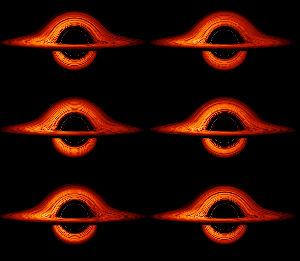
Black holes are dark spots in the fabric of space-time, incredibly dense singularities with such strong gravity that nothing can escape their clutches. They spend their time doing one thing: gobbling up matter…more

-BBC

Distant star’s vision of our Sun’s future ‘death’
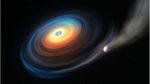
A newly discovered planet offers new insights into the Solar System after the Sun reaches the end of its life in 5-6 billion years. Astronomers observed a giant planet orbiting a white dwarf, the small, dense objects some stars become once they have exhausted their nuclear fuel…more

-BBC

Mars rover aims to grab a piece of history
British engineers have begun testing technologies that will be needed to bring samples of Martian rock to Earth. The Airbus team is training a prototype rover to recognize and pick up small cylinders off the ground…more

-BBC

Satellite constellations
Astronomers are warning that their view of the Universe could be under threat. From next week, a campaign to launch thousands of new satellites will begin in earnest, offering high-speed internet access from space. But the first fleets of these spacecraft, which have already been sent into orbit by US company SpaceX…more

-BBC

SpaceX satellites spotted over Derbyshire
Stargazers across Derbyshire were startled when they saw what appeared to be a new “constellation” in the night sky. The near-perfect line was in fact formed by the Starlink, satellites launched by Elon Musk’s SpaceX company earlier this year. They were spotted across Derbyshire and the Peak District…more

-SpaceX

Evolution of SpaceX’s Rockets
SpaceX began in 2002, when its founder, Elon Musk, took the first steps in his grand ambition to send a mission to Mars. More than 15 years later, the company is way beyond the space startup stage. The Hawthorne, California-based company regularly reuses rockets, sends cargo missions to the International Space Station…more

-space.com

Best Night Sky Events of January 2020
See what’s up in the night sky for January 2020, including stargazing events and the moon’s phases, in this Space.com gallery courtesy of Starry Night Software…more

Posted in January 2020, Sidereal Times | Tagged | Leave a comment

From the Director

Rex


by Rex Parker, Phd director@princetonastronomy.org

Transits and much more
Last meeting of the year coming up at Peyton Hall. See Ira’s section for more about the next guest speaker. It’s been another year of great presentations and discussions at AAAP. We certainly covered a lot of space, with perhaps more focus on our solar system than in other years that I can remember — from the Apollo moon landing with its undeniable nostalgia, to the edges of the solar system out to the mysterious Oort Cloud where long period comets originate.

The Mercury transit on the morning of November 11, 2019 was seen by several members at the AAAP Observatory in Washington Crossing Park (picture below). After a week of rains and cloudy weather the skies cleared before sunrise and the transit was completely visible in the telescopes set up with solar filters. It’s fortunate too, since the next one visible in the northern hemisphere will be in 2049. The Mercury transit was a perfect lead-in to the talk by Prof. Joshua Winn the very next night about transiting exoplanets. We learned how transits of exoplanets around nearby stars are the basis of the Kepler and TESS orbiting telescope projects. It’s amazing to see how much is being determined from the transit measurements (especially after viewing the Mercury transit), including orbital period, distance from the star, and size of the exoplanet. These emerging data are setting the stage for the upcoming James Webb Space Telescope with one of its primary goals the search for bio-signatures of potentially life-bearing exoplanets. We’re witnessing amazing advances in astronomy and the beginnings of astrobiology right before our eyes.

AAAP members at the Observatory Nov 11 for the Mercury Transit.

Seeking new co-editor for Sidereal Times
The departure of Prasad Ganti, whose efforts on the “Official Publication of AAAP” will be greatly missed, creates an opportunity for a new co-editor. The role is to organize and edit member submissions, and do the layout using WordPress software for uploading to the website. The responsibility would be shared with Surabhi Agarwal, who also serves as AAAP webmaster along with John Miller. Experience with WordPress is helpful but not necessary as you will quickly learn the skills and software. More importantly the position requires an affinity for astronomy and writing, with creativity and a willingness to contribute to others’ knowledge while gaining internet editing experience. If interested please contact Surabhi or me (director@princetonastrony.org or editors@princetonastronomy.org).

You could give the next 10 minute talk
We’re hoping to hear from you about giving a short talk in an upcoming monthly meeting at Peyton Hall. These are slotted for about 10 minutes following intermission after the main speaker. You can share tales of your recent astronomy-related experiences, perhaps a book review, travel to a science museum, what you observed in your telescope, new eyepieces or gizmos you’ve acquired. Slides are optional (bring a USB module and use the laptop up front). Contact me or Ira (program@princetonastronomy.org) to get onto the schedule.

Visitors from the stars
At the November meeting I described an interesting new discovery of another interstellar visitor. This is in the wake of Oumuamua, a name taken from Hawaiian which means “scout” or “messenger visiting from the past”. Its astronomical designation is less romantic, 1I/2017 U1. Originally thought to be a comet, Oumuamua was determined to be a very unusual asteroid. It created a stir in the astronomy community when it entered and swiftly left the solar system in the fall of 2017. Measurements released by NASA and other astronomers showed a length of perhaps 1000m and width of ~100m, an elongated shape never before seen for solar system objects. It had a very high speed which cannot be naturally achieved by objects originating in the solar system. These observations led to the interesting speculation that Oumuamua could be an alien space ship traveling between the stars. The studied conclusion was that Oumuamua is an unusual but natural asteroid-like body of extrasolar origin, the first such object ever discovered. However its star of origin is not known and it can’t be studied further because it travelled away so rapidly. Its speed after exiting the solar system indicates it will take about 10,000 years to travel one light year, according to NASA reports.

Considerable excitement therefore greeted the new extrasolar object now in our skies, discovered in Aug 2019 by Gennady Borisov, a Russian telescope maker and amateur astronomer who has discovered several comets. Comet 2I/Borisov apparently does exhibit a coma and faint broad tail with gas, dust, and nucleus similar to solar system comets. It is reportedly faint at present (magnitude ~15) making it challenging though maybe not impossible to observe with a telescope here through the end of the year. The perihelion date (closest approach to the sun) is Dec 8 when it will pass within 2 AU of the sun. Its unprecedented high angle of approach and very high velocity mean that it won’t be captured by the sun. This means it came from “out there” and it will leave the solar system. This makes 2I/Borisov only the second interstellar visitor to be discovered in the entire human history of astronomy.

While extrasolar comets have been anticipated, their detection is unprecedented, and they are undoubtedly rare events on human time scales. The recent advances in technology have enabled these discoveries, analogous to extrasolar planets which were long thought to be out there, but not detectable until the breakthroughs in astro-technologies and orbiting satellite observatories.

Skynet remote imaging for AAAP members
A good way to get going in astrophotography and learn more directly how modern astronomy is being done is to check out Skynet. This is being offered as a unique benefit of AAAP membership not provided by other astronomy clubs in the region. Skynet is the brainchild of Dr Dan Reichart of the Physics and Astronomy Dept at UNC-Chapel Hill. In June we renewed the contract with UNC-Chapel Hill for another two years. Skynet’s internet-based queue scheduling software program runs on UNC computers to connect a system of observatories around the globe established for remote imaging. The Skynet Robotic Telescope Network comprises more than a dozen telescopes in Chile, Australia, Italy, Canada, and the US. Each telescope is set up with robotic tracking mount, CCD camera, and filters for remote image acquisition. Tutorial videos are available when you obtain a user account.

For beginning or seasoned observers, Skynet’s easy-to-use interface taps into an extensive hardware network and large database of celestial objects from the Messier and NGC deep sky catalogs. It includes a basic image processing program “Afterglow” that runs on the server so you don’t need any special software on your computer. You can download the data files and process the images at home on your own PC. Skynet is intended as an introduction to modern astronomy and astrophotography, and is used by science students at UNC and other institutions. Interested AAAP members are urged to take advantage of the club’s investment in Skynet access. Send me an e-mail note to get your user account at no cost to you as an individual. Email director@princetonastronomy.org

Posted in December 2019, Sidereal Times | Tagged , | Leave a comment

From the Program Chair

by Ira Polans

The December meeting of the AAAP will be held on the 10th at 7:30 PM in the auditorium of Peyton Hall on the Princeton University campus. The talk is on Gamma-ray Bursts: Unraveling the mystery of the universe’s brightest explosions by Patrick Crumley Postdoctoral Research Associate at Princeton University.
Understanding the source of gamma-ray bursts–brief, extremely bright flashes of gamma-rays–was a driving force in high energy astronomy for more than 30 years. The mystery started when gamma-ray bursts were serendipitously discovered by nuclear anti-proliferation satellites at the height of the cold war, and the final piece of the puzzle came just 2 years ago in 2017 with the first simultaneous detection of a gamma-ray burst in both gravity waves and gamma-rays. I will give an overview of the history of high energy astronomy, and how satellites, ground based observers, and theorists all worked in concert to unravel the mystery of the gamma-ray bursters. Because of the hard work of several academic generations of astronomers, we now know that gamma-ray bursts are produced by luminous jets traveling close to the speed of light, launched by the most violent explosions in the universe: the death of massive stars in a supernova, or in the merger of two neutron stars.

We’re looking for a member to give the first 10 minute talk of the season. If you’re interested please contact me at program@princetonastonomy.org and let me know which month you want to give your talk. If you have an idea and are unsure how to present it please contact Rex at director@princetonastronomy.org or Ira at program@princetonastonomy.org. As announced earlier rather than give your talk at the beginning of the meeting your talk will be given after the break.

There will be a meet the speaker dinner at 6 PM at Winberie’s in Palmer Square prior to the meeting. If you are interested in attending please email me by noon on December 10 at program@princetonastonomy.org.

Posted in December 2019, Sidereal Times | Tagged , | Leave a comment

An Outreach Scope Takes Shape

by Gene Allen, Outreach Chair

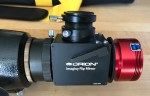
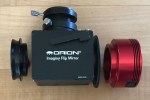
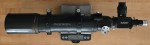
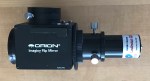
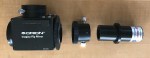
At the NJAA flea market in High Bridge, Dave Skitt and I agreed with Tom Swords in purchasing a used Orion ED80 refractor for use as an Outreach scope. A few years ago I had proposed that the club should have a scope that a member could take to an Outreach Event if they had no hardware of their own or had only top shelf gear that they chose not to put at risk. My concept was that it would be a simple, very portable rig with a flip mirror to be able to show both eyepiece and camera views. It would reside in the Observatory and be available as an additional scope on public nights if it was not otherwise occupied.


Tom is a refractor devotee and knew the history of their production and the quality of the glass in the lenses. The price was modest (half the price of new) and the seller threw in a flip mirror. Tom did a masterful job cleaning and tuning it up, and I have been gathering the additional pieces it needs to become operational: a super short 2” to T-thread nosepiece to connect the flip mirror to the focuser, a T-thread to 1.25” eyepiece holder to allow the Ultrastar astrocam to fit the straight-through port, and an inexpensive bag to keep it all together and protected. ZWO cameras can screw directly onto the flip mirror, and there is a locking ring that can secure a camera in the appropriate orientation once we figure out what that is.

For now it can ride my Porta II mount but I think it needs one that’s self-aligning and go-to so it’s easy for newbies to operate. It will probably ride my AZ Mount Pro for checkout, and that would be an excellent choice for it, but it’s pricey. The AZ-GTi also ticks those boxes for 75% less money, but it’s fairly new and may not yet be fully debugged.

The choice of camera is challenging. Do we pick up a used laptop to utilize either the Ultrastar we already own or a less expensive ZWO? Do we skip the laptop hassle and spring for a lower resolution Revolution Imager that comes with its own monitor? My assembly test-fitting checks so far have used my Lodestar X2 and ASI224MC that match the configuration of the club cameras.

The kit should probably have maybe two or three parfocal eyepieces and, once we get a bit more of these pieces figured out, some foam will get custom cut to properly cradle the scope and stuff in the bag. If you have an appropriate piece of hardware sitting unused, donate it. And stay tuned for further developments!

Posted in December 2019, Sidereal Times | Tagged , | Leave a comment

Minutes of the November 12, 2019 AAAP Meeting

by John Miller, Secretary

● Director Rex Parker opened the meeting, 7:30PM. Presented current events affecting the AAAP. This included various club activities (key holder procedures, field trips, outreach, guest speakers).

● Guest speaker Josh Winn, Princeton University Department of Astrophysical Sciences, was a popular draw. Discussion of Exoplanets. About 125 attendees.

● Professor Winn’s presentation focused of TESS: Transiting Exoplanet Survey Satellite.

● John Church gave a brief talk about the Mercury transit. The AAAP’s Hastings-Byrne refractor has observed 4 Mercury transits throughout its history.

● There was no Treasurer report.

● Rex did a post-lecture talk on current, selected objects in the November sky (Andromeda, Perseus, Pegasus, Triangulum).

● David Skitt, observatory chair, reported that the Sky 10 software had been renewed. The observatory pillar repair project remains under review for contractors.

● The meeting adjourned at 10PM.

Posted in December 2019, Sidereal Times | Tagged , | Leave a comment

this side of the truth

by Theodore R. Frimet

you may not see

The Martian Conundrum. Atmospheric Carbon Dioxide (CO2), seasonally freezes and coalesces into frozen ice, on the Martian poles. What should follow is that all gases will similarly ice up. That is, when measured, the atmosphere will have less Oxygen (O2) and less Methane (CH4). “the amount of the gas in the air rose throughout spring and summer by as much as 30%, and then dropped back to levels predicted by known chemistry in fall. This pattern repeated each spring, though the amount of oxygen added to the atmosphere varied, implying that something was producing it and then taking it away.” (1) There is a team looking at methane’s seasonal variability and wondering if it could be tied to O2 fluctuations, as well.

How? No one knows. Not just yet. Perhaps You and I, do.

Planetary scientists are caught up with the rise and fall of CO2, due to nominal seasonal fluctuations. They are flummoxed by increases of O2 and Methane that do not seem to follow the same predictable pattern.

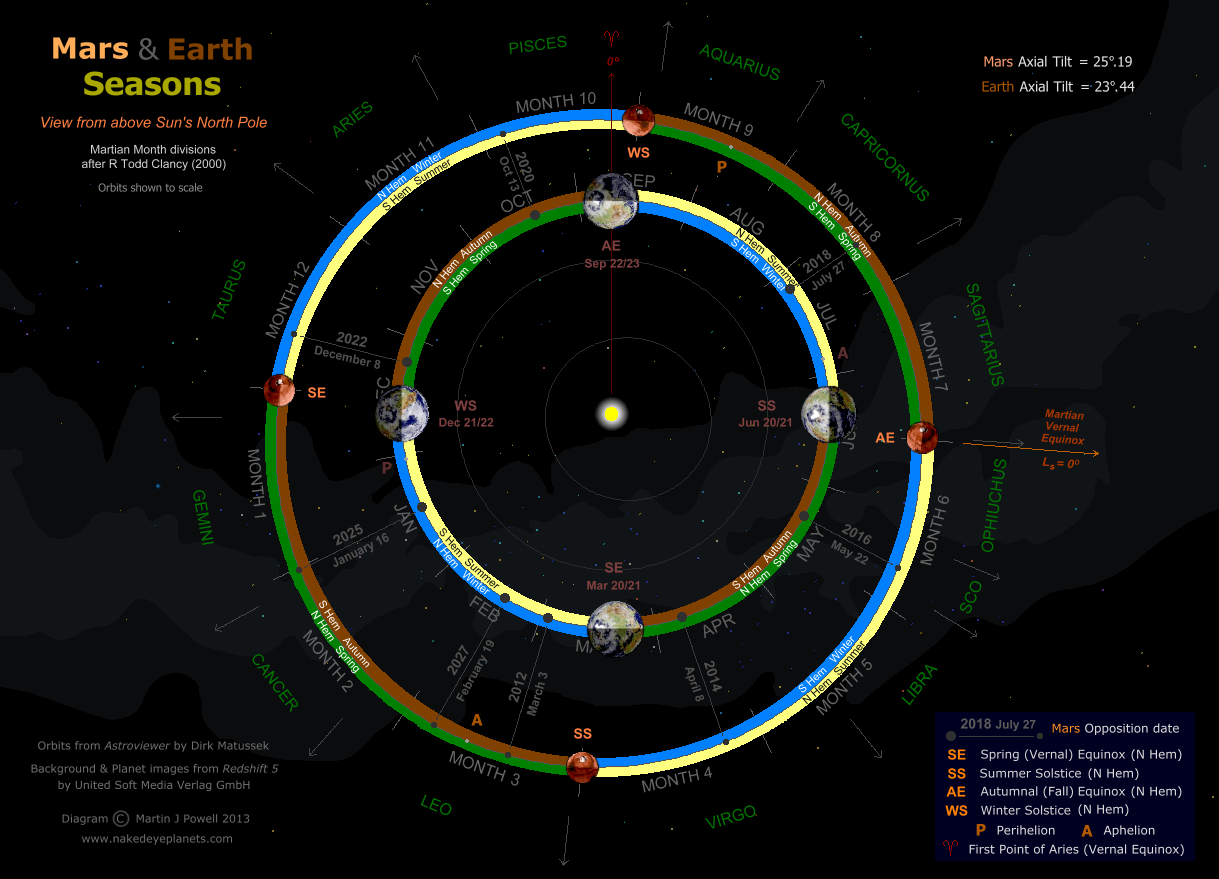
Without introducing biological devices as the overall causality for this non-linear event, this essay will introduce my Theory of Grignard Reactions at the Martian Surface, driving a proposed CO2-Carboxylic Acid Cycle. I additionally propose a Hypothesis of Earth’s contribution of her own Magnetic field. My thoughts are Terra’s orbital cycle and Mars Seasons co-opt the benefit of the tail end of Earths magnetic field. This seasonal adjustment of Earths residual affect guides Highly Energetic Solar Energy Particles (SEP) to the Martian surface. Both ideas may open the door to further discussion of the Martian atmospheric science conundrum.

Perhaps my use of the word, “theory” is too liberal. And clearly I have not done all of my homework, in studying Earth and Mars orbit. As it pertains to the “shadow” of Earth’s magnetic field, “my dog ate my homework”. Caution: be sure not to overuse the same reason for not turning in your homework. [see final notes at end of essay].

I was out, late last night, in the Soccer Field of Washington Crossing Park, from the hours of 6 PM until just past 10 PM. So, I am too bushed for more research, this Saturday, November 23rd morning. It was cold, outside baby! I was vetting my new purchase of an Explore Scientific (ES) 30mm 82 degree eyepiece, and the ES 99% Reflective 2″ Diagonal. I was tied at the knot to my push-to (often used in outreach), an 8” Meade LX200 GPS (Frankenstein’d), with 2″ Rear Port Adapter for Meade & Celestron SCT Telescopes. This simple, one-off adapter purchase from telescopeadapters.com made my evening a great view. Comfort was established with military surplus undergarments that wicked away moisture. My new overgarment, IRON-TUFF® COVERALLS WITH HOOD, from refrigiwear.com kept its promises on its minus 50 degree protection. Don’t get me started on my Baffin Impact Men’s Insulated Snow Boot rated to minus 148 F. Yet, when I woke up this morning, I had to crawl out of bed. Thankfully, Janet made an extra pot of coffee. We call her “the barista” of Lincoln Street.

I was looking for a swank title for this essay. Just the other day I got around to flipping thru the Collected Poetry of Dylan Thomas. I became a fan of Dylan, when I learned that he authored a favorite poem of mine, “Do not go gentle into that good night”. Regretfully, having now had two Poets to compare my likes, Dylan now goes the way of Robert Frost. I say regretfully, because my palette seems to hearken unto only one poem, from each. It has become evident that I have a distinct dislike for the remainder. So sad. Is there hope, yet for me? Probably not, as the current title is blase, and non-indicative of the Astrochemical Mars tour de force that I have in mind for you, below!

Fortunately, this essay will be brief, and easy to understand. However, it will not be complete. I have yet to aggregate the knowledge by which I can commit to the production of Oxygen and Methane. Read below, and you may acknowledge what was missing from the Science reports.

Grignard Reactions. Yup. When Grignard first published his work, nobody could reproduce it in the laboratory. That is until they figured out what was wrong. Grignard didn’t have fluorescent lights in his lab. Perhaps he couldn’t afford them? I dunno. When fellow scientists eliminated this source of Ultra Violet radiation from the experiment, Grignards’ reaction was faithfully reproduced. Or at least, so the tale was told to my classmates by my Organic Chemistry (OC) teacher of 1980/1981 moeity.

Disclaimer: I took an Incomplete on that first grade by virtue of deciding not to hand in my last lab (probably would have been a “D”), and took a Withdrawal upon attempting OC, during that summertime. They called it “OC jetlag” back then. I however had a bad case of undiagnosed hyperthyroidism, which interfered greatly with my learning process.

CO2 interferes with UV reaching the Martian surface. Yes, CO2 does not ONLY affect infrared sources of energy. So it goes, that with the off-season (non-winter) INCREASE in atmospheric CO2, there is an increased rate of reaction for Grignard reactants, (absent the interference of UV) resulting in higher concentrations of Carboxylic Acids.

Here, let’s summarize what we have so far. I’m not an organic chemist, and yet I am telling you that CO2 blocks UV. Grignard reactions result. An increase in CO2 yields Grignard reactions, and more Carboxylic Acids. With me? Good. Because a little faith is required in the below chemical statement:

RCO2H + NaHCO3 ==> [RCO2(-)Na+] + CO2 + H2O

Oops, did we just create water on Mars?
Wait a minute, you promised Oxygen and Methane!
Ok. ok. k.

In the absence of atmospheric gases, since they coalesced frozen at the poles, creates a thinning of the protective Martian blanket. My hypothesis is that Highly Energetic Solar Energy Particles (SEP) could penetrate to Mars surface. The Martian Winter Solstice and Earths Autumnal Equinox occurs when our orbits are closest together (1). That allows Earths magnetic field to outsource to Mars, aligning SEP hits to the Martian surface. This added energy, not including cosmic rays, can bounce CO2 around, releasing additional Oxygen:

CO2 ==> CO + O
Oops, did we just release a highly reactive Oxygen atom? Why yes, we did!
Now, I am not a chemist. Yet it doesn’t take much in the way of imagination to reorganize CH3COOH into:

CH4, CO2, or H2O

Let’s try and see if we can work out a formula?

CH3COOH ==> CH4 + CO2

There be Methane!

Where is the diatomic Oxygen?
CO2 ==> CO + O
O + O ==> O2

Ok, the above is a stretch of my imagination. However I have been working hard on the Grignard theory in the absence of seasonal atmospheric CO2. So this side of the truth, you may not get to see, or hear of from any other Amateur Astronomers on this topic. The chaos of combining seasonal Earths Magnetic shielding affect on Mars, which directs SEP hits, and the decrease in atmospheric CO2, which down-regulates the Grignard reaction, is too much to hoof about.

Wait, are we blind, here? If there is a decrease in CO2 in the atmosphere, there should be a decrease in the Grignard reactions! Um, Yes. Or rather, Alice, try the cake that reads, “eat me”. That is essentially correct. Fewer Carboxylic Acids are produced, and with less atmospheric CO2, the drive to produce more reactants occurs, as stated, again, below:

CH3COOH ==> CH4 + CO2

There be Methane! We were already presumptive on where the O2 came from, weren’t we, Old Sport? As for the “30 percent increase”, the rate of reaction is not tied to the rate of CO2 capture at the poles. This is because a new Calculus is required to accommodate seasonal CO2 flux, our SEP factor, the seasonal interaction of our magnetic fields, and Sun activity. Don’t even get me started on Cosmic Rays. Yawn. I need another poet.

Failure is abundant
To grasp the rewards
of failure is
To grasp the rewards
of success

That’ll do.

References:
http://www.nakedeyeplanets.com/mars-seasons.htm

copyright Martin J. Powel.

The Conundrum:

With Mars Methane Mystery Unsolved, Curiosity Serves Scientists a New One: Oxygen

https://iopscience.iop.org/article/10.3847/1538-4365/aa9f28/pdf

This laboratory study simulated the abiotic formation of carboxylic acids (RCOOH) in interstellar analogous ices of carbon dioxide (CO2) and methane (CH4) at 10 K upon exposure to energetic electrons.

Despite the importance of carboxylic acids in extraterrestrial environments, their detailed formation routes have not yet been resolved.

My notes:

Since Martian atmospheric CO2 is seasonally condensed, to a solid, at the poles, it follows that the rate of reaction, increases, forming up more product (CO2).

Methane (CH4) is released, while Carboxylic Acid is produced. Both are reasonable due to radiation exposure, in the laboratory, to disassociate a free O from CO2.
CO2 ==> O + CO

https://agupubs.onlinelibrary.wiley.com/doi/full/10.1029/2019JE006175
“Max CO2 pressure during Northern Fall shortly after perihelion”

and finally:

10 Best Excuses for Not Doing Your Homework, August 2, 2012 – by Ananya Rao-Middleton: https://blog.tutorhub.com/2012/08/02/10-best-excuses-for-not-doing-your-homework/amp-on/

Posted in December 2019, Sidereal Times | Tagged | Leave a comment

Two out of three ain’t bad

by Ralph Marantino

In 1994 I journeyed to the lighthouse at the Atlantic Highlands. In the dark I set up three optical units. First a Tele Vue Genesis SDF 101mm refractor with a Thousand Oaks glass white light solar filter. I soon followed with two Coronado Solar refractors a double stacked 40mm PST @ .5 Angstroms and a 70 mm Calcium K line telescope. I set up all of the telescopes to observe at 45X a perfect field of view. The sky was clear all day and I observed the entire transit.

I drove down to Columbia South Carolina for the past total Solar eclipse and was clouded out at the last fifteen minutes, enough said about that.

This past Monday I set up the Tele Vue refractor on my front lawn and gave the entire block and some children waiting for the school bus a good look at the transit of Mercury across the solar disk. I agree with Meatloaf that Two out of three ain’t bad.

I am ready to trade Tele Vue Bino Vue with Barlow and two 25mm Plossl eyepieces for either Tele Vue 41mm Panoptic or Tele Vue 31mm Nagler type 5 for my next transit. Anyone?

Posted in December 2019, Sidereal Times | Tagged | Leave a comment