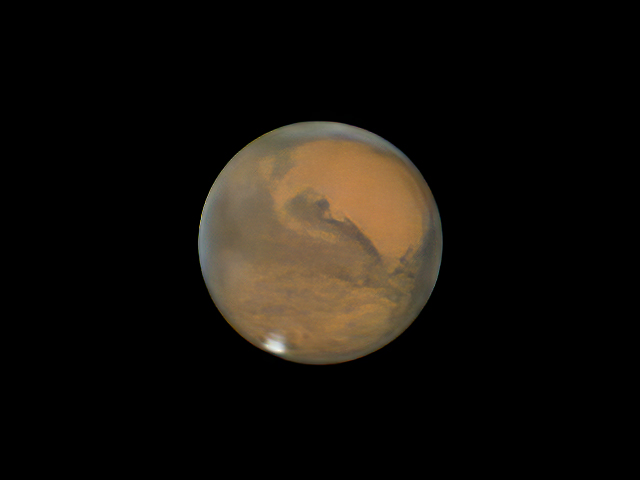
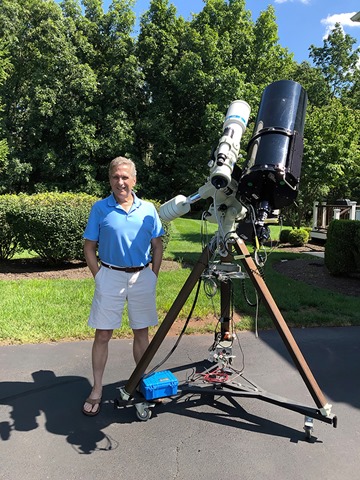
Bob Vanderbei is a professor in the Department of Operations Research and Financial Engineering at Princeton University. He is an amazing astro-photographer and a club member. His photo of Mars below taken at 3:15 a.m. on October 6 makes you want to visit the planet and perhaps make a stop at the resort on its southern tip!
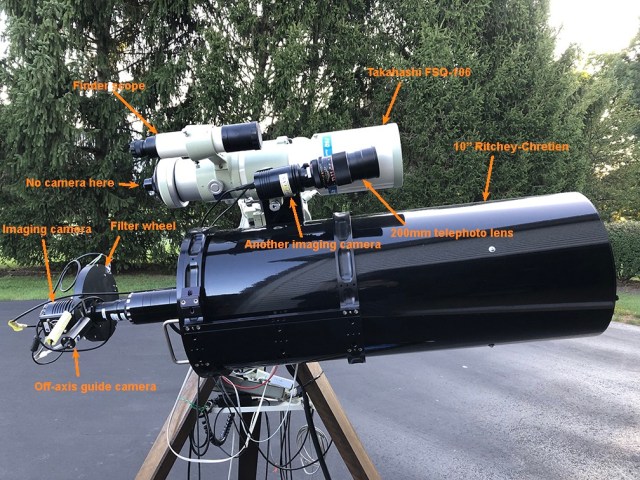
Bob’s telescope is a 4” f/5 Takahashi FSQ-106 refractor.
He uses it for imaging when the desired field of view is too large for his 10” RC. I does not use it as a guide scope.
The mount is a Takahashi NJP Temma-II equatorial mount.
His current astro-specfic camera is a StarlightXpress Trius SX-694 CCD camera.
It’s not a color camera and that’s why he has a filter wheel.
August 18, 1971 Edmund 4-inch refractor Angular diameter 24.7 arcsec. Central Meridian 10 º
Oct. 11, 1973 Hastings-Byrne 6 ¼ inch refractor Angular diameter 21.4 arcsec. Central Meridian 328 º Published in Sky & Telescope, March 1979
Left Picture: August 18, 1971 Right Picture: Oct. 11, 1973
Edmund 4-inch refractor Hastings-Byrne 6¼ inch refractor
Angular diameter 24.7 arcsec Angular diameter 21.4 arcsec
Central Meridian 10º Central Meridian 328º
Published in Sky & Telescope, March 1979
Back in the 1970’s I did not have today’s superb electronics, charge-coupled devices, and so on. All I had was fine-grain film, a home darkroom, and advice about special developing techniques from an advanced amateur photographer and a professional at work. Plus some good refractors. I still have my Edmund 4-inch which I occasionally use at home. I was lucky to have had custody of our fine Hastings-Byrne refractor from 1972 until it was installed at our Washington Crossing observatory soon after we had finished building it in the late 1970s.
Mars is a superb object at a good opposition when there isn’t a major dust storm, such as the one two years ago. We are having an excellent view at present and many surface features are visible. In my August 1971 photo, the prominent feature Syrtis Major had just rotated out of view to the east. Mare Serpentis extends upwards towards the south polar cap. Sinus Meridiani, at 0 degrees Martian longitude, had rotated slightly east of center. The south polar cap is prominent. The extensive dark area to the upper right is Mare Erythraeum.
In my October 1973 photo, Syrtis Major is the large dark area, with Mare Serpentis again extending upwards to the right. Sinus Meridiani is the rightmost small dark area. The south polar cap has shrunk considerably with the advance of summer in Mars’ southern hemisphere. We can also see a small change in the apparent tilt of Mars as seen from Earth. At the present opposition, the south polar cap is also quite small but still readily visible in our telescopes at the observatory.
Technology has advanced tremendously since the age of film. Our talented club astrophotographers are producing wonderful images of Mars and other objects with their fine equipment and techniques. I look forward every month to seeing the results of their extraordinary work in the pages of Sidereal Times.
For the October 3rd AAAP members observatory night, one of the target suggestions on my list was for a recently discovered SuperNova I had read about on Cloudy Nights.
The previous night I had attempted to capture an image of SN 2020ssf from my backyard with a 5.5” APO refractor and ASI385 camera with no success. Perhaps the C14 and camera could?
It was the end of the evening, we were winding down observing and I remembered that we had not attempted this target yet. I asked Dave Skitt if he wanted to try for it and he agreed to.
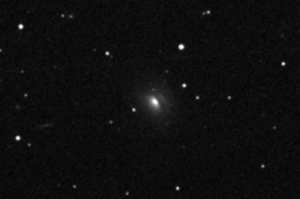
So off to NGC7722 in Pegasus we went. NGC7722 is a spiral galaxy at mag 13.4 and 2.1 X 1.6 Arc minutes in size. Small and dim even for the C14 at F6.3.
DSS image of NGC7722 from Sky Safari
I wasn’t expecting we would see much. The slew stopped and we saw nothing but a few brighter field stars in the preview window. Dave began the stacking process and increasing exposure. And there it was! Well at least we hoped it was what we though it was.
A few days later I saw an image of the Super Nova from these folks at the Virtual Telescope Project 2.0, they provide the information about the equipment and exposure used to capture the image.
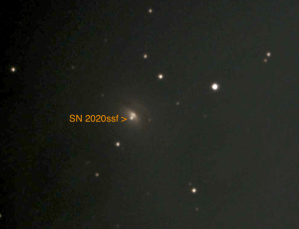
AAAP C14 at F6.3 Color image, imaged October 3rd, 2020 Same approximate area, note the same stars are in the FOV, just a bit bigger in scale.
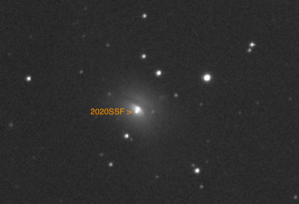
Dave later gave me a copy of the images that were captured with the C14. I thought to confirm that we had indeed captured an image of the Super Nova by comparing our image to the one provided by the virtual telescope team. I examined the two images, did some cropping to get the imaged area to be similar in FOV with identical field stars and the C14 definitely got it!
Virtual Telescope Project 17’ Plane Wave at F6.8, Monochrome image, imaged Oct 8th, 2020
I actually prefer our image in color because you can see that the nova is a brighter white than the surrounding galaxy.
This is a fun and rewarding part of being active with EAA. Engaging a reported new target, attempting to get an image and we did!
Asteroseismology is the use of sounds produced by the Sun and other stars to expand our knowledge of the physical traits and characteristics of stars and better understand our Sun. From the stellar sound we can learn about “the effective temperature, density, mass, age, and metallicity of stars.” Stars are three-dimensional, so their natural oscillation modes have nodes in three orthogonal directions. Those nodes are “concentric radial shells, lines of latitude, and lines of longitude in a spherical coordinate system.”
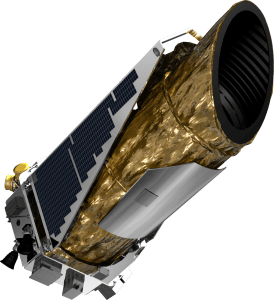
Kepler Space Telescope, Model 2 – NASA
From data collected by Kepler, K2, and in the future, TESS, we can translate the subtle pulsation of stars mathematically into a view of the number of modes and the displacement of each. After this is done, it is easy to determine the location of nodes on and within a star. Once this is determined, for modes that are not directed at the center of the star (nonradial modes) the lower part of the wave is in a higher temperature environment than the upper part of the wave. This means that it is in a region of higher sound speed. As a result the wave is refracted back to the surface, where it is reflected, because acoustic energy is trapped in the star. The location of this refraction can be predicted mathematically as a function of temperature. This means that we can probe the interior of our Sun and all stars where we perceive these modes.
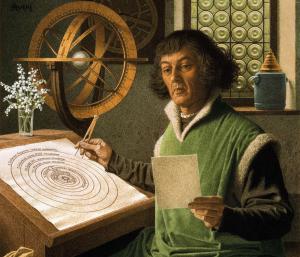
Nicolaus Copernicus -National Geographic
None of this data could be collected without the development of Copernican Heliocentric theory. This theory was published by Nicholas Copernicus, a Polish mathematician and astronomer, in 1543. His theory was important to Asteroseismology in multiple ways, but the largest was that it gave way to centuries of great minds seeking to correct errors he had made with his original theory. One of the most famous examples of someone who changed his theory was Kepler, who found the oscillation of the Suns and planets. Measuring the oscillations of the Sun is the basis from which the study of Helioseismology, a study closely linked to Asteroseismology, comes. Although it may seem obvious today, Copernican Heliocentricity put the Sun much closer to the Earth than any other star, making it ideal for studying the characteristics of stars. The understanding of the Sun being much closer to Earth than any other star is the basis understanding the Solar-Stellar Connection. The Solar-Stellar Connection explains the connection between the immensely more detailed collection of data we can collect about the Sun over any other star and how we can compare the data from the Sun to other stars to better place the information of our Sun into the proper context.
To collect the data needed to piece together the Solar-Stellar Connection, we have launched missions into space. The current data has come from the Kepler and K2 missions. Kepler was launched in March 2009 to “determine the percentage of terrestrial and larger planets that are in or near the habitable zone of a wide variety of stars and to discover the variety of orbit size and planet reflectivities, sizes, masses, and densities of short-period giant planets.” It was also sent to determine the properties of the stars that harbor planetary systems. By using data primarily for exoplanet transit detection, asteroseismologists were able to “infer the influence of stellar pulsations from companion stars.”
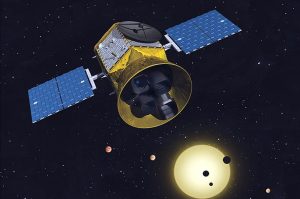
Transiting Exoplanet Survey Satellite (TESS) – NASA
Our data is limited to stars with solar-like oscillators, stars with convective zones, such as cool main-sequence stars, subgiants, and red giants (this does not include stars with surface radiative zones, as they behave very differently). If we know the mass and radius, we can easily find the star’s density, which can tell us about the star’s composition. These patterns help us situate stars on an HR diagram more accurately, and thus infer much about the age and metallicity of the star. It is important to note that the field of asteroseismology is in “its relative infancy.” Therefore, it will develop and evolve over time. The data that will be collected from TESS promises many more discoveries that will help develop our understanding of the Solar-Stellar Connection.
By Samuel Sherman[1], Kelly Al-Dakkak[1], Ashley Nalley[1], Rosanne Di Stefano[1, 2]
1. Dept of Astronomy, Harvard University, Cambridge, MA
2. Professor in the Department of Astronomy. rdistefano@cfa.harvard.edu
NASA Mission Springs a Small Leak After Touching an Asteroid The OSIRIS-REX spacecraft collected rock and dirt samples from Bennu, but it appears to be losing some of what it grabbed. NASA’s effort to grab a piece of an asteroid on Tuesday may have worked a little too well. The spacecraft, OSIRIS-REX, grabbed so much rock and dirt that some of the material is now leaking back into space….more
-NYT
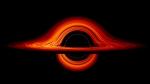
A Black Hole’s Lunch: Stellar Spaghetti Astronomers call it “spaghettification,” and it’s not a pretty idea: It’s what happens when you venture too close to a black hole and fall in. Tidal forces stretch you and break you like a noodle, then your shreds circle the black hole until they collide and knock each other in….more
-BBC
Sir Roger Penrose: The man who proved black holes weren’t ‘impossible’ If you ever struggled with maths at school, you were in good company. Sir Roger Penrose, who on Tuesday won the Nobel Prize for Physics, would also scratch his head in class. “I was always very slow. I was good at maths, yes, but I didn’t necessarily do very well in my tests,” the Colchester-born (1931) laureate recalled….more
-BBC
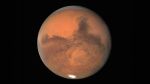
Planet Mars is at its ‘biggest and brightest’ Mars is at its biggest and brightest right now as the Red Planet lines up with Earth on the same side of the Sun. Every 26 months, the pair take up this arrangement, moving close together, before then diverging again on their separate orbits around our star…more
-BBC
Black hole breakthroughs win Nobel physics prize Three scientists have been awarded the 2020 Nobel Prize in Physics for work to understand black holes. Sir Roger Penrose, Reinhard Genzel and Andrea Ghez were announced as this year’s winners at a news conference in Stockholm. David Haviland, chair of the physics prize committee, said this year’s award “celebrates one of the most exotic objects in the Universe”…more
-NYT
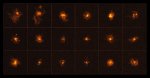
At the Edge of Time, a Litter of Galactic Puppies Astronomers announced on Thursday that they had discovered a giant black hole surrounded by a litter of young protogalaxies that date to the early universe — the beginning of time. The black hole, which powers a quasar known as SDSS J1030+0524, weighed in at a billion solar masses when the universe was only 900 million years old. It and its brood, the astronomers said…more
-NASA
Life on Earth: Why we may have the moon’s now defunct magnetic field to thank for it The habitability of a planet depends on many factors. One is the existence of a strong and long-lived magnetic field. These fields are generated thousands of kilometres below the planet’s surface in its liquid core and extend far into space – shielding the atmosphere from harmful solar radiation….more
-ALMA (ESO/NAOJ/NRAO)
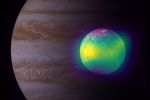
Volcanoes fuel gaseous atmosphere on Jupiter’s moon Io What is creating the bubbling, gaseous atmosphere on Jupiter’s moon Io? Scientists think they finally have the answer: volcanoes. Io, the solar system’s most volcanically active world, is one of four Galilean moons — the four largest moons of Jupiter, which were discovered by Galileo in the 17th century — and one of 79 total known satellites around the planet…more
-Rodriguez et al
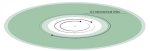
The first habitable-zone, Earth-sized planet discovered with exoplanet survey spacecraft TESS, the Transiting Exoplanet Survey Satellite, was launched in 2018 with the goal of discovering small planets around the Sun’s nearest neighbors, stars bright enough to allow for follow-up characterizations of their planets’ masses and atmospheres. TESS has so far discovered seventeen small planets around eleven nearby stars that are M dwarfs….more
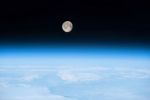
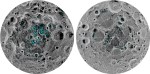
Water On The Moon Confirmed, And There May Be Much More Than We Thought NASA’s intriguing announcement last week that it would reveal an “exciting discovery about the Moon” led to a lot of speculation on what this big discovery might be. We can now all share in the excitement of the space agency: the Moon appears to have a lot of water, and this could make future exploration of our natural satellite much easier…more
-NASA
Water on the Moon could sustain a lunar base Having dropped tantalising hints days ago about an “exciting new discovery about the Moon“, the US space agency has revealed conclusive evidence of water on our only natural satellite. This “unambiguous detection of molecular water” will boost Nasa’s hopes of establishing a lunar base. The aim is to sustain that base by tapping into the Moon’s natural resources…more
-NASA
American astronaut casts vote in space for US elections Nasa astronaut Kate Rubins voted from the International Space Station last week for the US presidential elections. Rubins, the only American astronaut currently in space, is on a 6-month-long mission. Read on to know how an astronaut votes from space…more
by Rex Parker, Phd director@princetonastronomy.org
Ancient astronomy comes to life We’ll immerse ourselves in the history of astronomy from the ancient Greek perspective when we meet again via Zoom on Oct 13 at 7:30 (see Ira’s section below for info on the guest speaker and Zoom link). The Greeks developed an Earth-centered system of the universe that guided western thought for two millennia, although that was not the only view. Hipparchus, considered the father of trigonometry and one of the greatest ancient astronomical observers, compiled the first star chart (129 BC) with celestial longitudes and latitudes for 850 stars. This was the first astrometric survey. The catalog itself vanished in the fog of antiquity although it was drawn upon by Ptolemy centuries later in his profound work The Almagest. Interestingly, Hipparchus himself was one of the first to propose a heliocentric solar system, a radical alternative to the Earth-centric universe. Yet he later abandoned it because the calculated orbits were not perfectly circular, an absolutely mandatory criterion in the science of the era. The rejection of heliocentrism by Hipparchus and Aristotle dominated western thought for almost 1800 years, until the Copernicus revolution in the 1500’s finally got it right.
AAAP Astrovideo Project
Summary of Proposal
The trend to virtual meetings and audio-video technologies is widespread across the US and expected to continue in life after Covid. The obstacles to being an active astronomy club can be overcome by audio-video technologies, in fact we have few alternatives. I believe that AAAP should expand its involvement in these areas and help members apply them in an astronomy context. This will draw on the skills of experienced members and provide a path for all members to develop better skills and knowledge in the related hardware and software. The following goals are proposed.Note the proposed dates in the details section below.
(1) Provide members with regular opportunities to participate in live astrovideo in the form of Zoom sessions with electronically-assisted astronomy (EAA). Use these sessions to illustrate the techniques of astrovideo and also astrophotography, described below under Details of Proposal. Where appropriate these live sessions can also be recorded and made available on the website to members and the public.
(2) Encourage and assist members interested in taking part in audio-video recordings covering interviews, instruction about astrophotography, EAA technologies, reviews of software and hardware, and astronomy science topics in general. The recordings, for example MP4 files, would be made available on the club website and potentially elsewhere.
(3) Toward these goals, I propose once-a-month live Zoom video events (dates listed below). In clear weather these sessions would feature live astrovideo sky tours via Zoom originating from the club’s Observatory and members’ telescopes with EAA capability. On cloudy nights the sessions could be a forum for “how-to” discussions of astrovideo and astrophotography, hardware and software demo’s, and astronomy talk. If desired the Zoom sessions could be recorded, potentially providing content for goal (2) above.
Details of Proposal
1. Astrovideo is electronically assisted astronomy (EAA). EAA is telescope imaging with dedicated CMOS or CCD cameras with short exposures (often 5-20 seconds, repeatedly) using specialized software in real time to align and stack frames and reduce noise, giving a near-live video display of what the telescope is seeing. One key is having a sensitive camera capable of high speed download rates. With the right equipment, the method works remarkably well to show deep sky objects in color that are poorly visible by eyepiece, especially in light polluted skies. Examples include the recent astrovideo session in Sept using Zoom to stream EAA from a few members’ telescopes; and the videos Dave Skitt has posted on the AAAP website under “Member Videos” at the bottom of the front page of our website https://www.princetonastronomy.org/. There seems to be strong interest about this in the club.
2. Astrophotography is basically long exposure astrovideo with a lot of computer processing. Astrophotography is related to EAA but uses generally much longer exposures (often several minutes each) with specialized cooled CCD or CMOS cameras (sometimes DSLRs). There is plenty of overlap in the hardware choices, and some cameras can do well in either genre. The image sub-frames are saved on the PC and processed later for aligning, stacking, noise reduction, etc., to create high quality astrophotographs. This is closely related to EAA in telescope and camera technology and software, however, it is more demanding of equipment. An excellent-tracking telescope mount is needed and a guide-scope or off-axis guider is advised. Examples can found in the links on the club’s website at the bottom of the main page under “Club Astrophotography” at https://www.princetonastronomy.org/. There seems to be significant interest in this in the club.
3. Instructional audio-videos on astronomy and astrotech can help members on the learning curve. This means creating digital audio-videos about astronomy with members, for example using modern DSLR video-capable cameras with audio input (cell phones are not ruled out though they typically result in lower quality production). Future content could include a range of club members’ interests, such as technical instructional videos, software and hardware reviews, astronomical science topics. The output files, e.g., MP4 format, can be streamed via Youtube or Vimeo and linked on our AAAP website for member and public access. Examples include several videos produced this summer by member Rich Sherman with a few of us, also videos produced by Dave Skitt, available under the “Member Videos” tab at the bottom of the front page of the AAAP website https://www.princetonastronomy.org/. This is an opportunity for members to step forward to be interview subjects or producers of new videos. There seems to be substantial interest in having access to relevant “how-to” content on the website.
Please get these Zoom meeting dates on your calendars: Oct 16, Nov 13, Dec 11, Jan 15, Feb 12, Mar 12, Apr 09, May 14, June 11, July 09, Aug 06, Sept 10. These are the Fridays each month near the new moon, which provides optimal sky conditions for astrovideo and astrophotography. Starting times and Zoom links for members will be sent prior to each event.
I am asking members to think about whether we want to record these Zoom astrovideo events, and broadcast them as live or recorded video streams. If so, what about editing to make the content more enjoyable and cut out unproductive time. Think about how this could be done, whether it is desired, and who would want to spend time doing it.
I welcome your comments, either by e-mail (director@princetonastronomy.org) or at the Oct 13 AAAP Zoom meeting.
The October meeting is on the 13th at 7:30 PM via Zoom (See Using Zoom below for details). This meeting is open to AAAP members, UACNJ, and the general public. Due to the number of possible attendees we will re-institute the Waiting Room. This means when you login into Zoom you will not be taken to the meeting.
We are planning to make use of chat for the Q&A session. To address background noise issues, we are going to follow the rules in the table below regarding audio. If the background noise gets to loud during Q&A or the Business Meeting we will Mute All.
Meeting Event
Participant Can Speak?
Participant Can Self-Unmute?
Rex’ General Remarks
Yes
Yes
Ira’s Speaker Introduction
Yes
Yes
Speaker Presentation
No
No
Q&A Session
Start All on Mute
Yes
Business Meeting
Start All on Mute
Yes
Only the Business part of the meeting will be locked.
Featured Speaker: Dr. Alexander R. Jones of NYU will give a talk on The Antikythera Mechanism and Ancient Greek Astronomy. The Antikythera Mechanism was a complex geared “tabletop” instrument that was lost in a shipwreck off the Greek island of Antikythera about 60 BC, and recovered in corroded fragments in 1901. It was recognized almost at once as having something to do with astronomy. After three major campaigns of research since 1958, we now know a great deal about its functions and can describe it as a device for displaying coordinated cycles of time and astronomical phenomena simulated at an accelerated rate of time. This talk will focus on how the Mechanism fits within and expands what we know about ancient Greek astronomy.
Using Zoom: While we are, social distancing the AAAP Board has chosen to use Zoom for our meetings, based our belief that many members have already have used Zoom and its ease of learning. One of its great features is you can choose whether you want to install the software on your computer or use it within your browser.
How to Join the October Meeting: For the meeting, we are going to follow a simple two-step process:
Please make sure you have Zoom installed on your computer. You do not need a Zoom account or need to create one to join the meeting. Nor are you required to use a webcam.
Please visit our websitefor the link to the meeting
NOTE: We plan to open the meeting site 30 minutes to the 7:30 start time. This way you won’t have to rush to join the meeting. A maximum of 100 attendees can join the meeting.
More Information: The Zoom site has many training videos most are for people who are hosting a meeting. If you’re unsure how Zoom works you might want to view the videos on how to join a meeting or how to check your computer’s audio and video before the meeting.
The first on-line meeting of this committee will be held on Wednesday evening, October14 at 7:30 PM. This will be a “Zoom” meeting that I will set up and host. If you are interested in working on this committee to find ways of paying for the vital repairs on our observatory, please contact me and I will send you an invitation with the meeting details.
Thank you to those members that have already expressed their desire to help out. If you have any questions, please do not hesitate to contact me either by email or phone. My cellphone number is 609-273-1456. This is a project that is vital to the continued successes of the AAAP and its outreach programs. I welcome you to become a part of it.
Thanks and wishing you safety, health and clear skies!
This was the first AAAP for the club’s new 2020 – 2021 year. Again, due to the Covid-19 pandemic, this meeting was virtual using the Zoom interface. Approximately 60 participants were logged in during the first 15 minutes.
Director Rex Parker brought the meeting to order about 7:30 P.M. His intro included AAAP membership benefits, a welcome to new members and current sky highlights.
Assistant Director Larry Kane was not available, due to health, to give an update regarding fund-raising ideas and progress.
Program Chair Ira Polans introduced Princeton University astrophysicist Adam Burrows. Burrows’ presentation was titled: “Core Collapse-Supernova Theory.”
Rex emphasized his interest in having the club produce more online videos (tutorials, promotional, etc.). This follows member Rich Sherman’s successful production of member interview presentations.
Dave and Jennifer Skitt (observatory Co-Chairs) again reviewed the process to reopen the observatory and grounds to AAAP Key-holders and later the general public. Key-holders have already met at the observatory for Covid-safety training. Dave and Jen also discussed the EAA setup plans for the observatory.
John Church raised the idea to locate and inspect the condition of the observatory’s septic tank.



 Water On The Moon Confirmed, And There May Be Much More Than We Thought NASA’s intriguing announcement last week that it would reveal an “exciting discovery about the Moon” led to a

 Featured Speaker: Dr. Alexander R. Jones of NYU will give a talk on The Antikythera Mechanism and Ancient Greek Astronomy. The Antikythera Mechanism was a complex geared “tabletop” instrument that was lost in a shipwreck off the Greek island of Antikythera about 60 BC, and recovered in corroded fragments in 1901. It was recognized almost at once as having something to do with astronomy. After three major campaigns of research since 1958, we now know a great deal about its functions and can describe it as a device for displaying coordinated cycles of time and astronomical phenomena simulated at an accelerated rate of time. This talk will focus on how the Mechanism fits within and expands what we know about ancient Greek astronomy.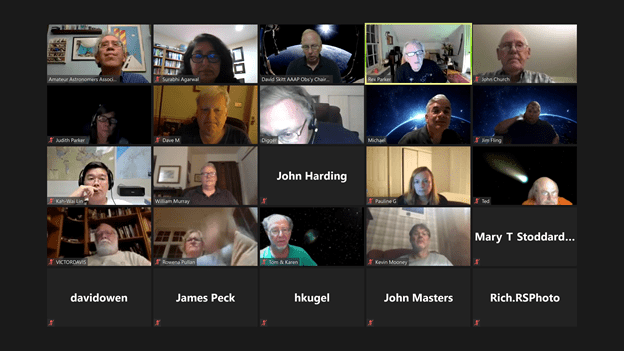

 Amateur Astronomers Association of Princeton