From the Program Chair

by Ira Polans, Program Chair

The Sun Dagger Film Introducing Archeoastronomy to the AAAP
The March meeting of the AAAP will be held on the 10th at 7:30 PM in the auditorium of Peyton Hall on the Princeton University campus. Parking is available across the street from Peyton Hall.

Presentation The originally scheduled speaker Kimberly Kowal Arcand is unfortunately unable to give her talk Visualizing the High Energy Universe, in 2D and 3D. I’ve rescheduled this talk for March 2021. Kimberly is the Visualization Lead for NASA’s Chandra X-ray Observatory, which has its headquarters at the Smithsonian Astrophysical Observatory in Cambridge, Massachusetts. I think the club will find this talk very interesting, but I am sorry that you’ll have to wait another year to hear it!

As a result, I decided to do something a bit different. We are going to be focusing on archeoastronomy. Archeoastronomy is study of how people in the past have understood the phenomena in the sky, how they used these phenomena and what role the sky played in their cultures. The example we will use is the Sun Dagger in Chaco Canyon, NM. The Sun Dagger is an ancient site (about 1000 year old) that marks certain celestial events. Chaco Canyon was a major center of culture for the Anasazi (Ancestral Puebloans).

The first part. of the presentation features “The Sun Dagger” film (video) narrated by Robert Redford:

Near midday in late June of 1977, while on a field trip to record Indian rock art atop a high butte in Chaco Canyon, New Mexico, artist Anna Sofaer was amazed to see a thin shaft of sunlight slowly streaming across an ancient spiral rock carving, and immediately suspected that she had found something extraordinary. Already a student in the astronomy of ancient cultures, she wondered, “Why does this vertical form of light move downward when the sun is obviously passing horizontally overhead?” To help her analyze this phenomenon, she enlisted the help of specialists in archaeoastronomy, architectural design, geology and anthropology. After months of thorough investigation, the researchers learned that the site precisely marks the seasonal solstices and equinoxes, and the extreme positions of the moon’s nineteen year cycle. They now believe this to be the first ancient calendar found in the New World that marks- at one site- the extreme positions of both the sun and the moon.

Because such knowledge is far beyond what scientists previously believed possible for these early people, Anna re-examines the Anasazi Indian culture that built this remarkable calendar and thrived in the harsh Chaco Canyon environment a thousand years ago. Ultimately, she asks us to recognize our responsibility for preserving the Sun Dagger, and to realize that as we gobble up the coal and uranium that lie beneath their exquisite ruins, the “Ancient Ones” still challenge us to emulate their example of harmonious living on Planet Earth.

In the second part, after viewing the film there will be a Q&A session. Since I have been to Chaco Canyon several times, most recently in 2016, I will answer your questions (hopefully!). To encourage member participation, I’d like to form a small panel to help answer your questions. If you’ve been to Chaco Canyon or to other Anasazi sites and wish to be on the panel please email me at program@princetonastonomy.org by noon on March 10. This way I will know if there will be a panel to answer questions at the meeting.

10-Minute Member Talk A After the break Robert Vanderbei will give a talk on the recent Mercury Transit. He will show some of the photos he took outside his home. Bob is an accomplished astro-imager. If you’re interested in giving a future 10 minute talk please either email me at program@princetonastonomy.org or speak with me during an upcoming meeting.

Meet-the-Speaker Dinner There will not be a meet the speaker dinner this month.

Posted in March 2020, Sidereal Times | Tagged , | Leave a comment

Outreach Blotter

by Gene Allen, Outreach Chair

Things have been pretty quiet these past few months. In late January, Jim Peck gave a presentation to a group of twenty some in Edison, using Stellarium to show things in the night sky. His audience was enthusiastic and they are considering having him come back again.

A special thank you to the six intrepid souls (Mary, Doug, Isabelle, Bill, Tim, and Dave) who stood ready to bring scopes to the annual stargazing event at Stuart Country Day School. Sadly, the clouds and rain on February 26 left us no opportunity to even try. Another six have pledged to suffer the frigid temperatures on Baldpate Mountain on February 29 to offer a presentation and star gazing to friends of Friends of Hopewell Valley Open Space. We have our fingers crossed, because early season dates are especially at risk of weather issues.

Coming up in March is another annual event, the Hopewell Elementary Science Fair and Community Science Expo on the 20th. This year they are requesting interactive experiences, so we will be doing the Pocket Solar System with them and, weather permitting, have a few scopes set up for early evening star gazing. Then, in the afternoon on the 26th, I will be giving my presentation to the Princeton Windrows Science Group.

In April, we have a small Trenton Boy Scout troop coming to the Observatory on the 17th, and Communiversity Day in Princeton on the 26th. This annual event gives us the opportunity to interface with hundreds of people, hopefully recruiting new members by sharing our enthusiasm about astronomy and all things scientific. A few solar scopes will be set up, and some others aimed at pictures tacked to trees (!). More than those scopes, though, we need members to come and fill our ranks. You do not need a degree in astrophysics, experience with telescopes, or intimate knowledge of the night sky. We set up tables on the lawn in front of Nassau Hall from 1-6, so bring your smile for at least an hour or two.

Members will be receiving emails with updates and additional events, and remember you can check the website calendar to see which of your friends have already volunteered, and how much we need your help to fill out our ranks.

We are well on our way to complete outfitting our Outreach Scope. It is an Orion 80ED refractor on an iOptron AZ Mount Pro. Our intention is that Members who have no hardware of their own, or only especially precious instruments, can use it at Outreach Events or at the Observatory on Public Nights.

Discussions are proceeding about a second event at Morven and a first event at Allentown High School. And please, remember that Friday Public Nights at the Observatory are Outreach Events. Each one is an opportunity to invite new folks to join. I try to attend even when my Team is not on duty. This year, maybe I’ll manage to bring a scope now and then.

Posted in March 2020, Sidereal Times | Tagged , | Leave a comment

Minutes of the February 11, 2020 AAAP General Meeting

by John Miller, Secretary

  • Assistant Director, Larry Kane opened the meeting, 7:30PM
  • Ira Polans introduced guest speaker, David McComas – PPPL and Princeton University. McComas’s presentation centered on the ongoing Parker Solar Probe mission, 2018 through 2025. There were about 55 attendees.
  • New member Vince DaGrosa brought a working model of his newly-designed and built parallelogram mount, carrying a pair or 20×80 binoculars.
  • Member Bill Murray gave a talk during the break titled “The Past and Future of Astronomy”.
  • Public Outreach Chair Gene Allen reported the following planned activities and projects:

February 26 – Stuart Country Day School, sky observing
February 29 – A Sky Safari at Baldpate Mountain, star party
March 3 – Stuart Country Day School, Science Independent Study Project, judging
March 20 – Hopewell Elementary Science Fair & Expo
March 26 – Gene Allen presentation to the Princeton Windrows Science Group
April 17 – Boy Scout visit to the AAAP Observatory
April 26 – Communiversity. AAAP multiple table displays and solar scope set-ups.

  • Observatory: David Skitt, Observatory Co-Chair, addressed the status of the pillar repair review. Vince DaGrosa reported his observations about the current condition of the pillars. Additionally, he has been in contact with a mason and plans an informal inspection trip to the observatory with this person. Vince said the current pillars are definitely made of cinder block.
  • Dave Skitt also detailed additional Night Sky participation requirements and AAAP opportunities.  He is still investigating how best for the club to utilize The Night Sky Network
  • The meeting adjourned at 10:00 PM.
Posted in March 2020, Sidereal Times | Tagged , , | Leave a comment

Freeman Dyson

contributing members of AAAP

Ad astra Freeman Dyson! 

One of the most significant and appreciated figures in the world of physics and in Princeton’s enduring scientific community, Freeman Dyson has passed away (Feb 28).  Freeman Dyson was an early and continual member of AAAP over the past 40 years, and gave several lectures to our club through the years.  He will be missed by the world and the entire science community.  His writings convey much of his wit and wisdom and will be read for decades to come.  To the stars, Freeman Dyson! – Rex Parker

We have lost a wonderful friend.  Very sorry to hear this. – John Church

Just saw on the news – Freeman Dyson passed away today. A loss for the whole world and also for the AAAP. – Bill Murray

The words composed to acknowledge this giant of a mind were issued with the recoil and report of an army cannon:

legendary

visionary

iconoclastic thinker

Freeman Dyson quotes, served today, from the search engines at Google:

Technology is a gift of God. After the gift of life it is perhaps the greatest of God’s gifts. It is the mother of civilizations, of arts and of sciences.

It is characteristic of all deep human problems that they are not to be approached without some humor and some bewilderment.

You ask: what is the meaning or purpose of life? I can only answer with another question: do you think we are wise enough to read God’s mind?

George Johnson, of the New York Times (1), writes:
Freeman J. Dyson, a mathematical prodigy who left his mark on subatomic physics before turning to messier subjects like Earth’s environmental future and the morality of war

Joel Achenbach, of the Washington Post (2), composes:
…a visionary physicist and technophile who helped crack the secrets of the subatomic world, tried to build a spaceship that could carry humans across the solar system, worked to dismantle nuclear arsenals and wrote elegantly about science and human destiny

Josh Siegel, of the Washington Examiner (3), opines:
Dyson was known for his “Dyson tree” concept, in which he envisioned that a genetically engineered plant could survive in a comet and grow in distant colonies. Another of his ideas, the Dyson sphere theory, was featured in Star Trek. The theory proposed that a technologically advanced society could surround its native star to maximize the capture of its available energy.

Freeman Dyson, born: December 15, 1923, died: February 28, 2020.


resources:

(1) Johnson, George. “Freeman Dyson, Visionary Technologist, Is Dead at 96.”, The New York Times, Retrieved February 28, 2020, from http://www.nytimes.com/2020/02/28/science/freeman-dyson-dead.html.

(2) Achenbach, J. (2020, February 28). Freeman Dyson, a visionary and renaissance physicist, dies at 96. Retrieved February 28, 2020, from https://www.washingtonpost.com/local/obituaries/freeman-dyson-a-visionary-and-renaissance-physicist-dies-at-96/2020/02/28/0ba462e0-5a58-11ea-ab68-101ecfec2532_story.html

(3) Siegel, Josh (2020, February 28) Prominent Physicist and Climate Change Skeptic Freeman Dyson Dies At 96, Retrieved February 28, 2020, from https://www.washingtonexaminer.com/policy/energy/prominent-physicist-and-climate-skeptic-freeman-dyson-dies-at96

Posted in March 2020, Sidereal Times | Tagged , , , | Leave a comment

From The Archives

Fifty Years

Comment for Sidereal Times, November 2012

by Freeman Dyson, Institute for Advanced Study, Princeton, New Jersey

Fifty years ago, when AAAP began, the piece of the universe that we had explored was tiny, just a little blob with us in the middle. We could see a lot of stars and galaxies, but the volume of space that we could see was only about a tenth of one percent of the universe. With our biggest telescopes we could measure distances of galaxies about a tenth of the way to the edge, if the universe had an edge. We did not imagine that within our lifetimes we would be able to see out all the way to the edge. Now, fifty years later, everything has changed. The whole shebang is pretty well explored. In any direction, if we look for faint objects, we can see almost all the way back to the beginning of time. Some huge gaps remain, but the entire universe is now within our field of view.

How has this change happened? It did not happen because we are smarter now than we were fifty years ago. It happened because we have better tools. The most important new tools were radio telescopes. Fifty years ago, we already had radio telescopes, and they had discovered large numbers of sources of radio waves in the sky, but only a few of them could be identified with visible objects. It seemed that the radio telescopes and the optical telescopes were looking at different universes. There was a curious lack of connection between the two universes. Amateur astronomers could only look at visible objects. They had not much reason to be interested in these radio sources that nobody understood. Nobody could tell how far away a radio source was if it did not have an optical identification. There was only one fact that suggested that radio sources might be at huge distances. If they were objects randomly distributed in space and time, we ought to have seen more faint sources. There were too few faint sources to be a random distribution. The radio astronomers explained the lack of faint sources by saying that they had hit the edge of the universe. If they were seeing sources all the way out to the edge of the universe, then the lack of faint sources made sense. The optical astronomers mostly did not buy this argument. The optical astronomers thought it was a weak argument for making such a big claim. If the sources were really out near the edge of the universe, they would have to be absurdly powerful.

The first big breakthrough happened in 1963, one years after AAAP began. Maarten Schmidt, an astronomer working at the Palomar observatory, photographed the spectrum of an optical object that coincided with a bright radio source called 3C273, and found absorption lines of hydrogen with a red-shift of 0.18. The optical object is magnitude 13, bright enough to be seen by amateurs with a six-inch telescope, and the red-shift says that it is two billion light-years away. That means that the object really is absurdly powerful. Both in visible light and in radio waves, it is putting out about a hundred times the power of a big galaxy. So the radio astronomers were right. The radio sources are absurdly powerful, and a lot of them are close to the edge of the universe. This discovery had two major consequences. Optical and radio astronomers started to work together, finding optical identifications for radio sources and measuring their red-shifts, which soon confirmed that optical sources can be seen as far away as radio sources. Also, the only plausible theory to explain a super-powerful source was a super-massive black hole at the center of a galaxy, sucking in gas which radiates away prodigious amounts of energy as it falls into the hole. Black holes quickly jumped from being esoteric theoretical toys to being big players in the evolution of the universe.

The second big breakthrough was the discovery of the cosmic microwave background radiation by Arno Penzias and Robert Wilson in 1965. It was another jump outward, with radio astronomers reaching further than optical astronomers could see. The background radiation gives us a picture of the universe about half a million years after the big bang, when the cooling matter first became transparent to its own radiation. We were lucky to have David Wilkinson, one of the world’s leading radio astronomers, here in Princeton. He organized the design and construction of two space missions, COBE, short for Cosmic Background Explorer, and MAP, short for Microwave Anisotropy Probe, to observe the fine details of the microwave radiation. To our great sorrow, David died soon after MAP was launched, and MAP became WMAP, short for Wilkinson Microwave Anisotropy Probe. The local variations in brightness observed by WMAP give us a direct view of the early stages of the evolution of everything in the universe.

The third big breakthrough happened in 1967, when Jocelyn Bell, a graduate student doing radio observations in England, discovered pulsars, the pulsating radio sources which turned out to be rapidly rotating neutron stars. Once more, radio and optical astronomers talking to each other could understand things much better than either could separately. One of the major mysteries in the old days was the Crab Nebula, an object that is probably familiar to most of the members of AAAP. It is number one on Messier’s famous list of fuzzy objects in the sky. The Crab nebula was known to be a supernova remnant, consisting of debris thrown out by a star that exploded in the year 1054. The supernova was seen by astronomers in Korea and China but not in Europe. The mysterious thing about the Crab Nebula was that it was too bright to be a passively expanding gas cloud. It must have an active source of energy causing it to radiate brightly. As soon as pulsars were discovered and identified as spinning neutron stars, it was obvious that the energy source keeping the Crab Nebula bright might be a pulsar. The pulsar would be unusually vigorous since it was only a thousand years old. As soon as people looked for it they found it, both as a radio source and as an optical source, spinning thirty times a second.

I was lucky then to be a friend of David Wilkinson. Just for fun, David invited me to spend a night observing with him at the Princeton campus observatory on Fitzrandolph Road, looking at the Crab pulsar. David made a shutter spinning thirty times a second and put it on the eyepiece of the one-meter telescope. We could see the pulsar appearing and disappearing as he varied the phase of the shutter. The pulses were so strong that we did not need to worry about all the background light from the town and the football stadium. We could make a quite accurate light-curve showing the shape of the double pulse with a period of thirty milliseconds. This spectacular object could have been discovered fifty years earlier if anyone had had the crazy idea of putting a spinning shutter onto a telescope. But until Jocelyn Bell found the pulsars, no astronomer in his right mind could imagine a star spinning thirty times a second.

Besides radio telescopes, we have many other wonderful new tools since AAAP began. One of the most important new tools is the digital camera, which collects light far more efficiently and measures it more accurately than the old-fashioned photographic plates. Megapixel cameras have now become standard equipment for amateurs as well as professionals. Here in Princeton, Jim Gunn designed and built the top-of-the-line digital camera that was used to do the Sloane Digital Sky Survey. The Sloane Survey was a project to photograph the entire Northern hemisphere sky with high resolution in four colors, and put the images into digital memory. It was a combined effort of a number of universities including Princeton. The Sloane Survey output is available to anyone with enough computer bandwidth to use it. If you have access to the output, you can study the sky in daytime or on cloudy nights, without the trouble and expense of traveling to a big telescope. The Sloane Survey is still going on. The original sweep of the northern sky took four years, and after that the camera came back to look more deeply at areas of sky that are particularly interesting for various reasons. The output is a huge gold-mine of astronomical information waiting to be excavated. With accurate four-color measurements of brightness, you can tell whether a point-like object is a nearby star or a distant galaxy, and you can measure its distance. You can do a rapid computer search and pick out large numbers of distant objects close to the edge of the universe. You have an unbiassed view of everything that shines in the sky, from near-earth asteroids to remote clusters of galaxies.

Another set of great new tools are the telescopes in space. The most famous is the Hubble Space Telescope, which is still up there after 22 years, making important discoveries about once a week. Two Princeton astronomers, Lyman Spitzer at the University and John Bahcall at the Institute for Advanced Study, were the most effective promoters of the Hubble telescope and persuaded the politicians in Washington to pay for it. As soon as it was launched and operating, John Bahcall used it to observe the bright objects that were believed to be super-massive black holes and to prove that they are really at the center of galaxies. The central objects are much brighter than the galaxies, so he needed the superior resolution of Hubble to see the galaxies. Hubble has ten times better resolution than any telescope on the ground, and as a result it can see objects that are about a hundred times fainter. Because Hubble can see ultra-faint objects, it was given the job of taking long exposure pictures of a small patch of sky known as the Hubble Deep Field. The Deep Field pictures give us our clearest view of the universe as it was in the remote past near to the beginning.

Besides Hubble, there are many other telescopes in space that are not so famous or so expensive but equally successful. The most recent is Kepler, which went up three years ago and discovered huge numbers of planets orbiting around other stars. This small telescope totally transformed our view of extra-solar planets. We had imagined that extra-solar planetary systems would be like our own Solar System, but they turn out to be quite different. Other space telescopes have looked at the sky in wave-lengths invisible from the ground, Chandra looking at X-rays, Spitzer looking at infra-red radiation, IUE, short for International Ultraviolet Explorer, looking at ultra-violet. Each of them found new kinds of objects and unexpected behavior of old objects. Together, they gave us a far more complete picture of the complicated ways in which the universe evolves.

One of my most vivid memories is a visit to the Goddard Space Flight Center in Maryland, the day after Hubble was launched. There were two buildings side by side, one containing the command center for Hubble, the other containing the command center for IUE. In the command center for IUE, there were only two people, both of them graduate students, calmly controlling the telescope and observing one ultra-violet object after another without any waste of time. The telescope was in geosynchronous orbit over the Atlantic, so it was working twenty-four hours a day. Observers at Goddard were taking turns with observers in Europe to use it. It was easy to use and produced a steady output of good science. In the command center for Hubble there were three hundred people in a state of total confusion. Nobody knew what had happened to the telescope. It was in a low orbit, spending only a few minutes within range of Goddard each time it passed by. After communications had broken down, it was difficult to regain contact. Three hundred people were all talking at once and nobody seemed to be in charge. After I left, the muddle was gradually sorted out and Hubble started to produce good science too. But the low orbit is still a big problem for anyone using Hubble. The earth is constantly interrupting the observations, and the telescope is actually observing less than a third of the time. A big bureaucratic organization is needed to schedule the operations. In the end, both Hubble and IUE did marvelously well. The low orbit of Hubble made it possible for astronauts in the Shuttle to go up to repair and replace instruments. Pictures from Hubble gave the public spectacular views of the universe. But if you measure cost-effectiveness by the output of scientific papers per dollar of input, then IUE comes out far ahead.

The most recent revolution in astronomy is the discovery that only three percent of all the mass in the universe is visible. All the stuff that we see, stars and planets and gas-clouds and dust-clouds, is only three percent. The remaining 97 percent is invisible. It consists of two separate components, dark matter which is about 27 percent and dark energy which is about 70 percent of the mass. Dark matter was first discovered by Fritz Zwicky in the 1930s, when he did the first sky survey with his little 18-inch telescope on Palomar Mountain. In those days the astronomers did not take Zwicky seriously because he was a physicist and not a member of their club. Now we take dark matter seriously because we can measure its gravitational effects accurately, and we find it to be distributed through the universe in roughly the same way as the visible galaxies. The dark energy was discovered more recently by measuring accurately the rate of expansion of the universe at various times in its history. Quite unexpectedly, the rate of expansion was found to be accelerating with time. The measurement is done by observing large numbers of supernovas exploding at various times, going back billions of years into the past. Zwicky was also the first person to observe supernovas systematically, but in the 1930s he could not observe enough of them to see the acceleration. Our knowledge of the invisible universe comes from our modern tools, big sky surveys and big computers. These tools collect vast amounts of accurate information and process it rapidly, picking out the evidence for gravitational effects of invisible mass from the behavior of the stuff that we can see.

Fifty years after AAAP began, our new tools have given us a new view of the universe. The new universe is full of violent events such as gamma-ray bursts and supernova explosions. It is full of invisible stuff which we do not understand. It is as full of mysteries as it was fifty years ago. But the new mysteries are not the same as the old mysteries. The old mysteries were mostly solved, and the new mysteries mostly discovered, as a result of new ways of observing. In the future, we can be confident that new tools will continue to solve old mysteries and discover new ones. Luckily for AAAP, the new tools are narrowing the gap between amateur and professional astronomers. Amateurs will play an even more important role in the future than they have in the past. Serious amateurs now have wide-field electronic cameras and computers that can produce data of professional quality. They also have one resource that the professionals lack, plenty of observing time.

Posted in March 2020, Sidereal Times | Tagged , , | Leave a comment

Inexperience and Chains

by Gene Allen, in shame

I have only been involved in astronomy for the past few years. I have often felt an utter noob and totally unworthy to hold an office in this hallowed organization. Last night on Baldpate Mountain my inexperience reared its ugly head and resulted in my failure to contribute. My fancy computerized mount was acting up, and there is no manual backup.

I spent my entire working life as a heavy equipment operator, a bit of it as an actual bus driver. It just so happens that the equipment I operated was made by Lockheed, Boeing, and –  you guessed it – Airbus. I have spent literally decades pondering accidents and the myriad what-if-right-nows that could adversely impact my workday. I have frequently remarked that the pilot is always the first to arrive at the scene of the accident, and on more than one occasion have told an anxious flight attendant, “Yes, we are all going to die, but it’s not going to be tonight.”

In aviation, some things just cannot be fixed and there is simply nothing that can be done to enable you to survive. Nothing constructive to be gained by pondering those, or anticipating them.  Most accidents, however, are the result of a series of events and decisions. Take one event out of the chain, or change one decision, and the crash doesn’t happen. You can usually get away with a mistake, but not if you start putting them together. 

My mount aligned itself fine, and I centered carefully on Venus to complete the process. Swapped to a high power eyepiece and described to observers how it looks flat on top because it is only partly illuminated by the Sun, having phases like the Moon. All of a sudden the mount up and moves – a bunch. I grabbed the hand control, and it’s offering me the alignment wizard, some dude I cannot remember ever having met. 

For the next half hour I was turning folks away with apologies as I watched my expensive hardware have fits. Figuring it was the cold, I put the hand controller inside several layers as I shared my exasperation with my far more experienced compadres. It wasn’t until Tom said, “Oh, you’ve got a power problem!” that my lightbulb finally lit. Of course! It was winking out, presenting me with the opening logo screen, and beginning another cold start alignment. The battery was providing insufficient voltage. It was literally turning itself off and on.

I could have just retrieved the extension cord from my truck, plugged in the charger, and done another alignment. In less than five minutes I would have been up and running. Did I do that? Nope. I am ashamed to report that by the time I had gathered all this wise, experienced counsel, I had already thrown in the towel and broken everything down. I was packed up and ready to go home. 

So, do you see the chain? My first mistake was not recharging the mount battery before the event. I have always done so, but this time I was worrying about creating unnecessary charging cycles. And hey, it’s always worked great. My second mistake was not reporting that neglected action when attempting to troubleshoot the problem. My third mistake was shutting down in angry frustration before troubleshooting was complete. Change any of those actions, and I could have been a contributing participant.

Ah, well, nobody died, and that won’t happen to me again!

Posted in March 2020, Sidereal Times | Tagged | Leave a comment

Sharing the Sky, April—May 2020

by Jeffrey Pinyan

April marks the opening of our 2020 season. We have about 30 Fridays ahead of us, and as long as the weather cooperates, we’ll have some special celestial treats to share with the public.

April
Venus and the Seven Sisters – Apr 1-5
Peaking on April 3rd (the first Friday of our season), Venus makes her way through the Pleiades. Venus, even half-lit, is hundreds of times brighter than the individual stars that make up this Dipper-shaped cluster. Because this conjunction occurs early in April, the skies will be dark enough to enjoy it before both Venus and the Pleiades set behind our observatory’s southwestern tree line. Continued observing until around 11 PM can occur out at the soccer fields.

This stunning April conjunction comes in three varieties, each of which repeats every eight years. This cycle (2012 – 2020 – 2028) occurs early in the month and has Venus passing directly through the Pleiades. Another cycle (2015 – 2023 – 2031) peaks near mid-April and has Venus pass some 2.5° south of the cluster; the third cycle (2018 – 2026 – 2034) peaks late in the month and is the most distant, about 3.5° south. The close encounter is due to the Pleaides’ location about 4 degrees north of the ecliptic, and Venus’ 3.4° tilt relative to that same plane. The cause of the reliable cycle is the orbital resonance between Venus and Earth: the two planets align 5 times every 8 terrestrial years (= 13 Venusian years). The 13:8 resonance might remind you of the Fibonacci sequence; indeed, the actual resonance ratio is less than 0.5% from the golden ratio Φ (phi), that value toward which the ratio of two successive Fibonacci numbers approaches (3/2, 5/3, 8/5, 13/8, 21/13, and so on)…

Planetary Close Passes – Apr 14-16
If you’re up around 5 AM on these three successive mornings, you can watch the waning Moon go from gibbous to crescent while skirting close to Jupiter, Saturn, and Mars. These are all low in the southeast (dropping from 20° to 12° in altitude) so you’ll need a low horizon, and you’ll have to act fast before the encroaching dawn drowns them out.
Unfortunately for us in New Jersey, the closest approach to Jupiter happens when both are well below the horizon (7:30 PM on the 14th), but Saturn will be a mere 3° above the Moon just before sunrise on the 15th, and Mars will be about the same at 5 AM on the 16th.

May
PANSTARRS at Perihelion – May 4
Comet C/2017 T2, also called PANSTARRS, will make its closest approach to the Sun at the beginning of May. Its position near the north celestial pole means it will be visible all night long. The current estimate for its brightest magnitude is 7, meaning it will be too dim for the naked eye.

It might be a worthy target for displaying to the public this month, especially with the long-exposure setup on the observatory’s permanent telescopes. Find it among the dim stars between Ursa Major and Camelopardalis, around 76° dec., and 06h20m r.a. (May 1st) to 09h0m r.a. (May 15th).

Jupiter Bids Saturn Adieu – May 18
Early on this Monday morning (4 – 5 AM) you can spot Jupiter and Saturn in the south-southeast, around 4.7° apart. These two gas giants have been creeping closer and closer together all year, as Jupiter has appeared to be trying to overtake Saturn. But on May 18th, Jupiter enters its retrograde motion and will begin slipping further west of Saturn. This will continue until the beginning of September, which marks the beginning of a 3½ month charge toward a stunning solstice conjunction on the evening of December 21st.

Posted in March 2020, Sidereal Times | Tagged , | Leave a comment

Fast Radio Bursts

by Theodore R Frimet

feast or famine

Exciting news awaits the general public. Fast Radio Bursts. FRB’s become the new darling of what’s up the in sky tonight! Starting with the MSN title of “Scientists detect an unexplainable radio signal from outer space that repeats every 16 days”, we are led into a cosmological brief that in and of itself, is fairly harmless. However the editorial content, is more akin to citing some other article, and repeating the news.

Sad, for me to say, considering my political leanings, yet here it is, “fake news”. Oh, woe is to me! Well, perhaps not fake, yet not original content. Chasing the story down this fabled rabbit hole, fortunately, yields only one other article cited. So, perhaps not so fake, as it was probably the authors intent to reach an audience, at MSN (1), that would otherwise not be in touch with Astronomy? I must genuflect, and pardon my purvey of the previous notion. The news, here, is not fake. It is a complex link; copying, pasting, and offering correct citation to the original author, Doyle Rice of USA Today.

MSN goes on to write, “This article originally appeared on USA TODAY (2): Scientists detect an unexplainable radio signal from outer space that repeats every 16 days”. True that! If we were to obtain our news source from Google News, we need only click, “view full coverage”, and be aghast with the same news feed, time and time again, being repeated to every Tom, Dick, and Jane. I suppose that is sauce for the goose, as the article could very well repeat, as many times as the oft cited FRB. Let’s move onto USA today, so we don’t miss any tidbits, shall we?

The article starts off with, “For the first time, scientists have detected a radio signal from outer space that repeats at regular intervals.” Let’s give them some slack, here. As most of you are respectful of me, and forgive my gaffs all the time. Observable radio signals that are cyclical are not new. I get it, though. The authors intent is to highlight FRB’s. However, is this a one off?

The Canadian radio telescope, CHIME (3), has mapped out a few FRBs. One of which was repeating. Although not at a regular interval. (https://arxiv.org/abs/1908.03507) Eight FRBs were detected. These 8 were indistinguishable from the first 12 CHIME/FRB sources non-repeating sources detected. So what is it that the paper boy has hoisted on top of our roof, today?

CHIME radio telescope.

The CHIME Telescope is located at the Dominion Radio Astrophysical Observatory (DRAO), a national facility for astronomy operated by the National Research Council of Canada. Image sourced from https://chime-experiment.ca/instrument

28 bursts followed. All came within a four day window. The periodicity is 16.35 +/- 0.18 day for the lonely FRB 180916.J0158+65. Sifting thru the journal report (4), a few methods are delivered for perusal. Notably, there is still some science to be performed, all in an effort to understand the relationship between burst activity and emission frequency. The report justly states burst rate activity is not consistent with the active phase, without definition.

Changing the observable interval, in days, the activity epoch varies. This is demonstrated for +/- 0.8 days (12 out of 28 detections with 95% confidence), and +/- 2.6 days intervals based upon 19 of the 28 detections. I could be wrong here, however, they are referring to mean peak burst delivery, within their stated 4 day window. So, where is the cliff hanger for the 16.35 days interval?

The periodicity is clearly there. FRB 180916.J0158+65 is a significant accomplishment.

It is duly noted (CHIME/FRB collaboration et al) in a periodogram of FRB 180916.J0158+65 and control samples. In their figure 1, the first 3 subharmonics of the 16.35 day periodicity are graphically depicted below. Look for the arrows.


The periodicity is clearly there. FRB 180916.J0158+65 is a significant accomplishment.

The periodicity is clearly there. FRB 180916.J0158+65 is a significant accomplishment.


References:
1) Rice, D. (2020, February 13) Scientists detect an unexplainable radio signal from outer space that repeats every 16 days. Retrieved from https://bit.ly/37udue6 last accessed Sunday, February 16, 2020 10:02 AM EST.
Non bit.ly URL: https://www.msn.com/en-us/news/technology/scientists-detect-an-unexplainable-%20radio-signal-from-outer-space-that-repeats-every-16-days/ar-BBZUUS5?li=BBnbf%20cL&ocid=iehp
(2) Rice, D. (2020, February 12 – USA Today header notes: Published 6:00 a.m. ET Feb. 12, 2020 / Updated 12:26 PM ET Feb 12, 2020.) Scientists detect an unexplainable radio signal from outer space that repeats every 16 days. Retrieved from https://bit.ly/2vAHLL2 last accessed Sunday February 16, 2020 10:07 AM
Non bit.ly URL: https://www.usatoday.com/story/news/nation/2020/02/12/fast-radio-burst-signal-outer-space-repeats-every-16-days/4726301002/
(3) CHIME – Learn more about the Canadian Hydrogen Intensity Mapping Experiment (CHIME), here: https://chime-experiment.ca
(4) The CHIME/FRB Collaboration, “Periodic activity from a fast radio burst source” https://arxiv.org/pdf/2001.10275v3.pdf last accessed Sunday, February 16, 2020, 10:26 AM EST. The article was archived in ARXIV on 3 February 2020.


Epilogue:

Watch this YouTube presentation on CHIME. Become acquainted with its ability to look at large swatches of the sky. CHIME is not a conventionally shaped radio antennae. It is composed of several half-pipes, oriented North-South. As the Earth rotates, CHIME listens in on the Northern Sky, each night. There are presumably thousands of FRB’s out there. With CHIME, the science continues with eyes wide open, to the larger, and grander scale of the known universe.

It is noteworthy that the YouTube presentation reminds us that radio wave pulses that are fractions of a second, and before they become Earth based detections they become stretched in time. This makes detection even more challenging.

Find the video here (last accessed Sunday, February 16, 2020, 10:22 AM):

Or visit the CHIME gallery, here:
https://chime-experiment.ca/gallery

Posted in March 2020, Sidereal Times | Tagged , , , , , , | Leave a comment

stellar parallax in the news

by Aram Friedman

unprecedented parallax measurement

The folks at New Horizon are going to make an unprecedented parallax measurement on April 22nd & 23rd (1) as reported in a news article by Applied Physics Laboratory of John’s Hopkins University.

They will compare images taken simultaneously from Earth and New Horizons
(47.31 AU or 4.4 billion miles).

Stellar parallax (triangulation) was first successfully accomplished by Friedrich Bessel in 1838 for the star 61 Cygni.

The observation is made from opposite sides of Earth’s orbit (a distance of 2AU).

The drawback of this technique (the only one available) is that the measurement contains proper motion of the stars over the 6 month period and the distance between observations is relatively short, the diameter of Earth’s orbit. In the case of the New Horizons measurement, the images will be taken simultaneously (eliminating proper motion) and the distance between observations is over 4 billion miles.

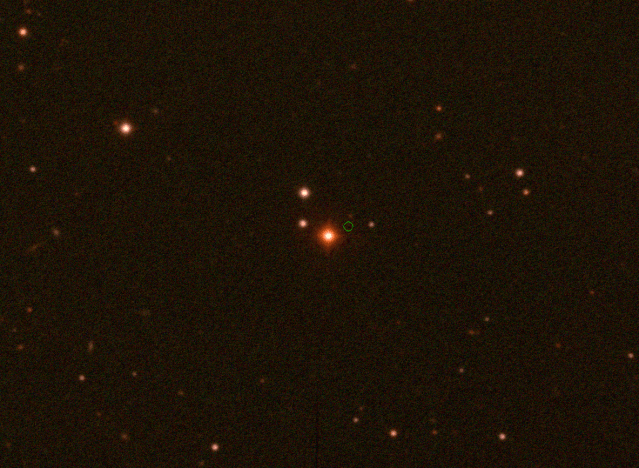
The red dwarf Proxima Centauri and surrounding star field. Width of field ~28 arc-min, about the size of the full moon. Alpha Centauri is out of the field ~2 degrees away. Image by RAParker using Skynet/PROMPT5.

The red dwarf Proxima Centauri and surrounding star field. Width of field ~28 arc-min, about the size of the full moon. Alpha Centauri is out of the field ~2 degrees away. Image by RAParker using Skynet/PROMPT5.

Color image of the Wolf 359 star field, obtained in late 2019.

Color image of the Wolf 359 star field, obtained in late 2019.
Credit: William Keel/University of Alabama/SARA Observatory.
Published on New Horizons, News Article, ibid – NASA/Johns Hopkins APL/Southwest Research Institute.

There are two target stars, Proxima Centauri and Wolf 359. According to Robert Vanderbie we should be able to see Wolf from NJ.

The article from New Horizons claims that a 6” scope is the minimum to see such a dim star. I have never tried, I suppose it depends on the camera used.

It is unclear if the folks at New Horizons are asking for images from the public (I hope they do).

Regardless it would be fun to try.

references:
(1) The Johns Hopkins University Applied Physics Laboratory, 2020 January 29, Seeing Stars in 3D: The New Horizons Parallax Program, retrieved from New Horizons
Posted in March 2020, Sidereal Times | Tagged , , , , | Leave a comment

Go To or Go Broke

by Theodore R Frimet

teach an amateur to fish

Year three in amateur astronomy. I’ve met friends along the way. Mostly thru business. They often times appeared to be larger than life. Then time and experience sets in. The veil is lifted and we begin to see the stars thru the cloudy nights. Mere mortals remain, untouched by the ambiguity of our hope filled senses. Someone or some Übermensch will guide the way, as we learn to walk the new path. This is sheer utter nonsense. You are alone in the universe.

May I remove some of the stones, and make them yield before you now?

The Meade LX200 GPS is vintage circa 2003. 2001 if you pay attention to the copyright writ onto the glowing red Autostar II. Originally a get from Long Island, hobbled together with love. It is, or rather was, the push-to telescope of my learning years. All two of them. A year later we embark upon another purchase. The very same model and nomenclature. However this one is a working GoTo telescope. Of course, it comes with its own vintage issues. Let’s muse together!

Cloudy Nights. eBay. Craigslist. Oh my! Find and find again. Emails tempting the sellers to lower their shields. To be honest, most have attached firm prices to their longest held possessions. I admire them for their steadfast nature. However the market is the jury. Judgement is swift to pass, as the price comes to greet the buyer.

Our seller, recently back from a trip overseas, reposts his offer as reduced in price. I take the bait. Haven’t you learned a thing, yet? Some fish react to scent, while another looks to color. The sport as taught to me by a lone fisherman, at Bristol Wharf, is to shake the money maker. Movement of the non-living material, floating astern the fish – triggers the massive wave of evolution that Darwin had instilled. To our benefit the prey lunges to and fro and attacks the non-tasty morsel. Tighten the line, and reel in the catch of the day! I am hooked. I buy a used Meade LX200 GPS, caveat emptor.

My PayPal shows total cost at $741.18. Factor in gas, and tolls to an out of state purchase, and we tally an additional $20/20. Moses, strikes the rock twice and $80 is the bill. $820, so far. The biblical punishment is lessened as an aircraft aluminum table, attached to the field tripod, comes with no strings attached. Retail be damned, as we knocked off $200 in savings. $620 – now stay the course!

This damsel is in need of a power source. Skip to my Lou as we venture to a super store for batteries. I am retarded if I insist on paying $7 plus for two batteries. Each nightly tee-time would rifle thru my purse at $40. Look no further, as we toss our lot into a Lithium power tank.

I cozied up to another amateur, last year. He was on battery power. I suggested a power tank. What is good for the goose is good for the gander! $169.38 to yield into my possession a Dynamo Pro Lithium Power Bank. $789. The mercury begins to climb.

An extended power line from battery to scope mandates the tour of AgenAstro Products. A foray to eBay for a trusted vendor, as well. Since we can observe in the backyard, and power is available, Monster Parts sets us up with the correct AC – DC converter, and male tip. $22, and $14 respectively to yield $825.

Set up the scope, with clear horizon. Power on. Power on. Power on, sesame! The GPS finds Easton Pennsylvania, as the closely held kin of Jenny Jump in New Jersey. She finds level, and North, post-haste. Yet neigh to find a star, despite her claim to align to Dubhe, and Sirius.

Days turn to weeks. Weeks to a month. Study and learn from those that have gone before. Cheat a technical discussion with vibrant thoughts and replace a worn battery. Days transpire. No cloudless nights. Take a spin during the afternoon. Knowing the limitations and features, I am stuck.

The firmware. The horror of knowing that the database and software is so far out of compliance, that there is no way to go ship to shore. Another purchase awaits, as Jim at Scopestuff accepts my meager order for an RS-232 and modern USB attachments. Add $50 plus and we total $875. We thank Jim, once again, for the sale of screw replacement parts, destined for the LX200 GPS. Partner, this isn’t my first rodeo.

What is the scope worth? Uncle Rod stopped at the LX200 Classic without data on the GPS version. “What would be “right price”? Certainly less than a grand. In the 700 – 800 neighborhood, for a later and well kept example.” Rod’s buying guide is 2013, and we are 2020. Evidently, being sold on Cloudy Nights had an interested party part with $1,250 of their hard earned paper. So, perhaps for all of my efforts, thus far, I am in the hobby end of the investment, and have not lost my shirt.

Factoring in my anxiety for tapping and reverse drilling a few stuck screws, replacing a battery, additional purchases, and pending a firmware update – I hold up fairly well these days.

Although your mileage may vary, I am not suggesting ever, that a newcomer purchase a used 8 inch SCT GoTo. Not without friends with benefits – those being an Astronomy Club membership, and a strong constitution to keep up with Clint Eastwoods’ quote: “a man’s got to know his limitations”. Nothing wrong with buying used, as long as the right people are consulted, throughout.

Remember, when you ask for help, this amateur friend, having gone thru this process before you will ask, “have ye updated the firmware, yet?”

Private sellers probably get all sorts of negative feedback, so I wanted to take the time and give you some good news.

I obtained the correct RS-232, and USB cables (not the inexpensive $4 ones), and successfully obtained, installed and linked, StarPatch (2). By the by, using a dual boot MacIntosh Laptop, running Windows 10, StarPatch will need to find COM PORT 8. I suppose that other personal laptops will be a different communications port.

After a missed attempt, last Friday evening – I did manage to download and install ALL of the patch, and firmware for the Meade LX200 GPS, this Saturday morning!

If an amateur should sell another LX200 GPS for your club, and someone gives you grief, feel free to write us a note!

There are some details that are missing in the mire of firmware. Cloudy Nights (1) poster (AstroPal – February 2017) recommends pressing “999” after powering on the telescope, but before the handset activates. And of course, plenty of patience, as the telescopes operating software may be painfully slow to some.

There is also plenty of confusion, out there, with people thinking that they can update the hand paddle for this older GPS model, while all the while the intelligence is built into the telescope base. Hence, the first item to swap out is the battery, followed by a firmware update with correctly sourced wires from ScopeStuff.

I have also had success, dual booting my Mac, into Windows 10, and remote operating the telescope in Stellarium. Right now, however, running the Mac OS only version – is proving to be a tad problematic. It is probably a software configuration that I need to pay attention to, so that when I slew to Polaris, the scope doesn’t point West. lol.

Problem will be solved when I buy a low cost Windows tablet, to run the maiden flight, truly out-of-doors.

It has been about 45 days since I made my decision to shop and purchase a used Meade LX200 GPS. I suppose that it pays to say, “caveat emptor” as I muse that the $200 extra value saved, truly didn’t factor out the final cost at roughly a baby grand.

References:
(1) AstroPal posts on Cloudy Nights, aka Cloudy Nights CNC Classifieds and Forums (2017, February 12). Thread LX200GPS gives proc trap 2 error during alignment/tracking. Started by Timmo, Dec 24 2016 09:43 AM (last accessed Saturday, February 15, 2020 4:54 PM) https://bit.ly/39Ansfs
(2) “StarPatch and the GPS Setup patch were designed and programmed by Chris Carson with the help of Dick Seymour and Andrew Johansen. The additional Autostar, Audiostar and Autostar II patches were developed by Dick Seymour and Andrew Johansen and are included with their permission.” – quotation last accessed from the below website on February 15, 2020, 5:24 EST https://www.stargps.ca/about.htm
Posted in March 2020, Sidereal Times | Tagged , , , , , | Leave a comment