by Theodore R. Frimet
oh baby, it’s cold outside!
I reached out to the universe, by email, on February 8th 2019, at 11:55 AM, with the following plea, and embedded an image from https://www.star.nesdis.noaa.gov/GOES obtained a few minutes before said cosmic transmission:
Could someone please push up some dry air, from our South ?
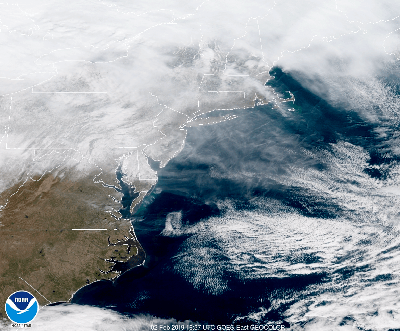
I would just love a clear sky, tonight ! I have given up all hope on barometric, snif snif, in dispersing cloud cover for my neck of the woods!
A response from the wild read that it’s been crystal clear the past few nights!
Ah yes. Past weather performance is an odd indicator of views to come. It’s all I’ve got, right now. Time to get out the telescope for a weekend look at my old friend, Orion!
Ok. Sure. This could become a checklist to help you out, into the cold, dark night. Or I could squeeze out of this lump of clay; an accounting of the foolishness, and haphazard method of preparing for a Saturday night view. I vote for the squish factor. And in no particular order, I bring you, the semi-play, hemi-prose, and somewhat astro-charged, “Oh Baby, It’s Cold Outside!”
Janet, before it gets dark, could you give me a hand with the Dob? Yes, remember it is a two part, 60 pound construction? And the cats just love to race out the door, when it is open for too long? Yes, we can do this just after 5 PM.
Five o’clock approaches, and I’m on the couch, watching the tube. Nothing special. Just flicking from one old movie, to another. Landing nowhere. Accomplishing nothing except laziness. And a small spark appears, from within. “Janet, I’ll need you in a few”, I said. Time to put on the new polypropylene liners.
At our last AAAP members only night, which was a hoot, by the way, member Tom Swords sold me on the idea of a polypropylene liner. Speaking with co-Observatory Chair member, Jennifer Skitt, the motion carried. Both are avid Amateurs, and Jennifer hikes her way thru mountainous regions of space-time. I would not fiddle around with either of their recommendations.
My first foray into the purchase of a polypropylene liner was by way of eBay. Top and bottom pieces, were both former military gear. New-old stock, and $40 including shipping. Large. It came in the mail quickly enough. Yet after putting it on, something did not quite gel. It wasn’t the sellers carcinogenic warning. I deduced it did not pertain to the 100% polypropylene. Probably it was directed at the previous use of flame retardants. Don’t take my word for it. Go to Walmart and buy a brand new polypropylene liner in the form of a shirt. See if you can get matching pants. The whole business behind the liner, is to wick away any sweat from your skin, and pass it thru the fabric. Dry skin equals warm body. I have been told that this material does an excellent job. It does. Amateur tested, Orion approved.
Ah yes. Something was off. It was the size. The ordered size was precisely a Large. And if I were a Large, all would be well in Astro-Land. I however, am not a Large. As Janet giggled as she saw the top over-stretching my belly, she said, “I always buy you Extra-Large!” I sighed, and took off the garb. Placed it onto my son’s bed for his use in his new job. Congratulations, Josh! Keep safe, and keep warm with the new poly.
Back to eBay. I scrambled to find a matching top and bottom. I almost fell into the trap of purchasing a couple of low cost pairs. However, that vendor was kind enough to capture a photograph of the material tag. And obscured the main ingredient. I surmised that it was cotton and not poly. And moved onto the next few matches.
I do purchase clothing from Goodwill, and will wear second hand, gently used material. However, poly-liners are not something that you want to buy used. At least, not for me. I draw the line, there. It is akin to wearing some other persons’s astro-underwear. Of course, you can wash it – be careful and don’t pill it up to become nearly useless in the dryer. Do a search on Google and see what others are doing to keep it tidy and clean. Oh, never mind. Here: hand wash with gentle soap, rinse and hang dry. There!
I had to settle on two different vendors. The first vendor did not have an XL. I used the watch list feature, and went back and forth to find the best price. It didn’t take too long before I had two separate orders in, net an additional $1 for my troubles to find the perfect fit.
Delivery. Cutting open one box, easy. Cutting open the soft packing for the other, not so. “Be careful”, I told myself. Or you risk cutting into the fabric of space-time and out will leak quantum foam! Ugh. Foam. It gets into all the cracks in the void. So I was careful. And finished opening up both packages. My eyes gleamed with happiness, as I laid out the two undergarments.
I put on the pants first. And then the top, overlaying the pants at the waist. There is a zipper at the neck, and I engage it gingerly. It had to last many, many more forays out into the cold. And I wasn’t taking any chances that my investment would fail prematurely. I coddled the clothing, and it was a success! Of course it helped somewhat that I went back into the gym, the previous week, slacked off on night time snacking, and put off a few pounds. Yes, I took no chances at any giggle factor, from Janet. It fit, just fine, thank you!
Last years purchase for cold weather included two pairs of long johns. One white, and one black. The black pair was XXL, so it would overlay the snug pair. I put the better fitting pair, aside for a snowy day. It no longer had any purpose in my cold weather viewing ensemble. It could not be up against my skin, as it would not wick away moisture. And it could not be a second layer, on top of the poly – as it would compress the underlayment.
Never compress your clothing layers. It is a bad idea. What you want are all those nice fluffy compartments of air to be open and not compressed. And loosely fitting clothing fits the bill. I put the larger black long johns on. Wait. Stop. Socks. Put the John aside, for now. We can play dress-up the Astronomer, later.
I had already purchased hunting socks, and underlayment socks. The first layer of socks are guaranteed to wick away moisture. Keep your feet dry, and they will not freeze in the cold of the night. The second layer hunting socks, were a size larger, and fit nicely over the first pair. And hugged right up, and over the calf, a tad. Calling Mr. John! Put on the second pair of XXL long johns, now. I notice it is starting to feel a little warm, in the bedroom.
Priss, I recall is on the stairs, on the second floor. Maybe my feral cat (she’s sweet) would like to accompany me outside, this evening? Probably not, as the temperatures will be at, or below 20 degree Fahrenheit. In my minds eye, I see her as she confidently nods off to slumberland. No, Mr. Amateur, you can go outside and play all by yourself. I will take a nap, at the high heat point of the house. I own your stairs. Meow.
I put on the top large long johns, and whine a little to myself that I need to purchase an XXL. Not perfect, yet it was stretched out sufficiently to not compress the poly. Just made it. Phew! Time for snow pants.
I put on the bib-snow pants. They are an over-all pair and fit nicely. The left hand pocket has a hole in it. I must remember to sew it up, before I lose some small iconic accessory to the night. Like all items lost to the back yard, either the good earth will swallow her whole, or a rambunctious critter will come by and add it to her nests’ collection.
I make some adjustments to the pant legs, and remember that they are zippered. I tug gently at the zipper, and close the bottom leg. And think ahead, in real-time, how I am going to put this leg into my cold weather boots? I make a mental note, “Should be OK”.
We already had a dry run, during our members only viewing. I struggled to put on the boots. And was too proud to ask for help. I finally got past the learning curve, and was able to get my right foot buried into the canopy of warmth, and buckled up. Repeated not-so-professionally for the left foot. Yes, your other right!
I was asked, that evening, why I hadn’t worn the boots to the observatory. I quipped that I wasn’t too certain about the stability, and didn’t want to walk from the car, let alone try to operate the vehicle. Don’t wear extreme cold weather boots in the car, and drive. “Not a good idea”, I told myself. And I wasn’t going to test those limits. Probably not ever. Wear sneakers, or other temporary cold weather gear for the feet, and change when you get to your destination. That, my dear amateur, seems to be a good compromise. And it worked out, just fine, thank you!
I am in the bedroom, again. And deciding if I should put on those boots, or continue with another layer of top clothing. I spy my red sweater. Red is a great color for me. It always tends to bring out the truth in a situation. That is, if I wear red, I must be prepared to learn new universal truths about myself, and my current situation. I become more aware with red, than with any other color. Some think it a superstition. Maybe. I don’t. Well, that red sweater was there, right at the end of the bed. So why fuss with what is in the closet? Put it on, and pay the piper later!
I adjust the snow bib straps, and lay them even, so that the suspenders aren’t cock-eyed and crushed at odd angles. I look in the mirror. Looks good. Grab the boots, and go into the living room. Janet is there, watching TV and playing Candy Crush. She turns up a small, wry smile, from both ends of her lips. And giggles. Just a tad.
I sit down on the couch. Opposite her gaze, I proceed to put on the left boot. And fail. I look at the boot, in hand. Almost quizzically, I am slightly perplexed as to why the boot does not go on, all by itself. The auto-on feature must be on the glitch! Janet asks me why am I putting the right boot onto my left foot? I look down. The boot construction is so defining that it almost appears, at a casual glance, that there is not a left, nor a right. However, there is. And upon further investigation, I determine that I do, in fact, hold the left boot in my hand. And proceed to slowly, dip my left foot, into the cavernous well. Success!
Baffin. Their trademark is Polar Proven. The style I chose, after two years cold, was a Mens Impact. Rated at -100 C / -148 F. This double buckling, waterproof and throughly insulated (upper included) will keep my feet warm.
I was on the fence into bowing to a lesser god. Perhaps this extreme warmth would make my feet sweat. And then I’d have cold cucumbers, and race away to put my astronomy equipment on the back burner, for the evening?
Not so. Despite Baffin no longer being produced by a Canadian company, and the box itself, most certainly made in China, the ultra-warm construction kept my feet warm, and dry. Let me repeat that: warm and dry. Very pleased.
There is a struggle in your acquisition of a good pair of warm foot wear. Many amateur astronomers take accounting of a few sizes and samples. You don’t have to buy polar proven footwear to be comfortable. Do your research on an over-sized shoe, and accommodate many layers of over-sized socks. Right up through last year, I used military surplus muc-lucs and the many layered sock approach. The downsize was I was not as stable, as I wanted to be, when I walked to my scope. So I decided, a year ago, to set my eyes on the best pair of cold weather gear, for my feet, that I could comfortably afford. And since budget is tight, I decided not to make any other purchases from the astro-department store.
Back to online shopping. The best advice I can give you is that you must know your size, ahead of time. If your novice instinct brings you to a shoe store – be prepared to accept that your salesperson will not be as knowledgeable as you portend them to be. Once you get a grip on that reality, it is time to toss the dice, and buy online.
Ah yes, size. I purchased one size LARGER. Read the comment sections, on online purchases, and a common thread emerges. The sizes are irregular. If you buy your exact size, you might get lucky. Not! Expect to return them for a larger size, and pay a restocking fee, not to mention you will bear return shipping costs. So, yes, do take my advice and buy one size larger. In any case, you are accommodating a couple pair of socks. If it is a wee slack, put on another layer!
As amateur astronomers, observing in the dead of winter, you are standing, or preferably, sitting still at the scope. And you will get cold. No amount of layering will intervene in the physical fact that your body warmth will breathe out of your clothing. Oh, wait. It’s that dream where I go to school, naked. Yes. Must put on the overcoat, tied at the waist. Add mittens that open at the fingers (best ever) and put on a ski mask. “Hoods up in five, people!” Time to get the telescope out the door.
Ah, time machine. Turn back the clock. Before I had saddled up, I cried to Janet. “Please open the door, and help me keep the cats in, while I struggle to get the Dob out the door!” As always, she obliged. Janet probably fathomed that if she put up with this mix of stellar anxiety, that once out the door, she could settle down and watch some of her favorite pre-recorded shows. I laid out the lazy susan and put the dob into place. Wired up the fan, to blow gently across the mirror, as the dob’s 12 inch mirror adjusted to the temperature change. And hooked up the push-to electronics to test drive an earlier purchase that was guaranteed to make my life a little easier.
I no longer had the benefit of sun light. I saw a forming crescent moon, in the West, and was silent. It was going to be a dark night. The weather reports were correct. Clear sky. Light, and I mean almost no wind. The verge and the neighbors fence provided ample cover.
Argh! The backyard neighbor’s dog. Woof! Woof! Intrusive lights, from a few meters away. I called out to my neighbor, thru the verge, and said, no worries it is only I. She called the dog in. Somehow, somewhere, and an hour or few later, the porch light was extinguished. Orion and I would be eye-to-eye, very soon.
50mm, 30mm, 14mm, 11mm…oops – no collimation. Eyepieces out, and laser collimator in. The secondary appeared to align quite easily. I was proud of myself. And then we had a red sweater moment. I could not seem to reconcile the red laser dot, from the business end of the mirror. Worse, I had a senior moment in not remembering it if was the black knobs or the white knobs that addressed mirror positioning!
I went back inside, and after a brief search gave up on any hope of reconciling the different knobs for my Zhumel Z8 Dobsonian. I turned on the outdoor lights, and sacrificed my night vision all-together. Armed with a flashlight, I relearned what I had forgotten. That in my installation, the black knobs control spring adjustment, while the white knobs are for lock down. I tried to collimate. And did feebly so.
Lights out. 30mm, 14mm, stop. Stars are skewing from right to left. No pinpoint. Is it my eyes? Do I need a pair of glasses? Perhaps it is the astigmatism that I’ve always been concerned about. No. I did not collimate.
Pull the optics, and put in the laser collimator, again. The neighbor dog barks. Incessantly. I get annoyed. I start the collimation procedure. Secondary looks good. Laser is pointed dead center at the mirror. I get on my knees, again. And look for the laser point of light. Dog barks. Woof! Woof!! Woof!!! I loosen all knobs, and tug down slightly on the mirrors armature. And then start to tighten up on the spring based knobs. A little at a time. Clockwise. Woof! “Would that dog please stop her incessant barking?”, I thought out loud.
And then I see it. A red dot appears at the two o’clock position. Keep on barking, old gal. You are now and forever to be known, as “Astro-Dog”. She quiets down, sensing my confidence at the business end of collimation. I make the final adjustments. I recheck the secondary, and all is well. I tighten the lock downs, being ever so careful to keep my laser dot in the middle. Collimation at last!
50mm, 30mm, 14mm, 11mm, 6.7mm. Happy is the man that can see pin-point precise stars. I am pleased, yet not overjoyed. I muse to myself that there must be a lot of pollen, from the last two years, and dust, that needs to be attended to on my 12 inch mirror. The stars are centered without distortion, although not pinpoint. It could be my eyes – although I would attribute that this is the finest resolution I can achieve, given the mirror condition, and that the sky is somewhat unstable. I look up, and see twinkling. Yes. The atmosphere did not provide me with a a perfect night. However, I agree with my red sweater and confided to AstroDog that this is “as good as it gets”.
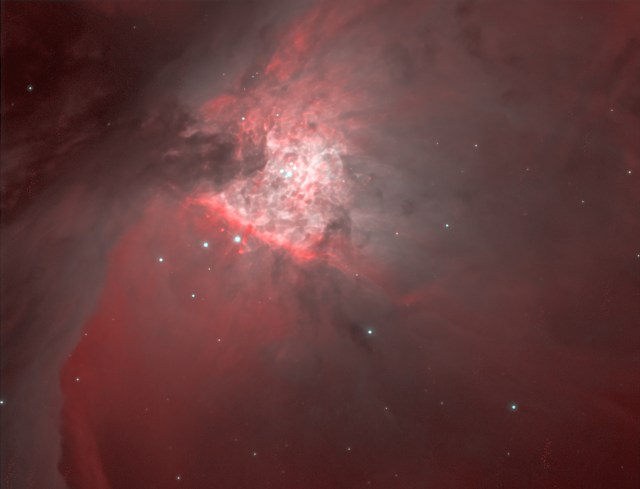
The quadrature showed me her soft underbelly, as there was a fifth star to behold that evening. And the glow of The Great Orion Nebula was my companion for hours, on end. Pleiades nestled me in her blue disquiet. I finally started to feel the cold settling in.
One last look for the dwelling of a spiral arm, and none to be found. Straight up, again, at the thinnest part of our atmosphere, and little compensation, here too to be found.
The inevitable night chill sets in. My coffee turns to ice. I strip down the optics, and put away our astronomy tools. I cover her nakedness with a cloth made from aluminum. Through the night, she would wait. Daybreak, it was agreed, we would put our dob away. “Oh baby, it’s cold outside!”




 The March meeting of the AAAP will be held on the 12th at 7:30PM in the auditorium (Room 145) of Peyton Hall on the Princeton University campus