From The Director

by Rex Parker, PhD director@princetonastronomers.org

Next meeting at the Planetarium – in Person Only.  We want to see you in person at the next monthly meeting of AAAP on June 13 meeting (7:30pm) at the Planetarium in Trenton.  This is the last meeting of the academic season and will be held in-person-only because of technical barriers to broadcasting the dome show.  For more info see Victor’s article below.

Profound Events.  Having spent a few days last week reflecting on the philosophical aspects of  life turning 70, there’s no experience more ineffable than the astronomical.  There may seem to be great portent in recent events here, which may resonate with AAAP members.  From a 4 billion year old meteorite landing close to the AAAP Observatory, with a black bear roaming around nearby (see photo below), to the sudden flare of a supernova in the great spiral galaxy Messier 101.  The M101 supernova SN 2023ixf first appeared on May 19 (my date of great reflection) and is well positioned for observing, transiting around 11pm locally now.  The credit for discovery of the supernova has gone to amateur astronomer Koichi Itagaki from Japan, confirmed the next day (May 20) by the Zwicky Transient Facility (ZTF) at Palomar CA.

Infrared photo of a bear in the Washington Crossing Park area near the Observatory taken on May 25 at night using a wildlife camera.

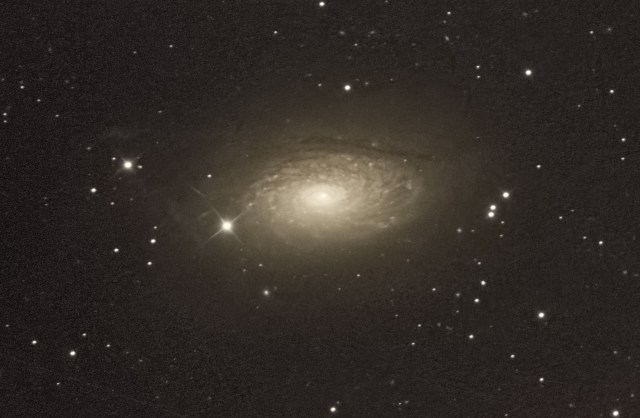
Several members of the AAAP astroimaging sub-group obtained interesting images of the supernova.  I offer mine here with some interpretation of the color. The galaxy M101 has a magnitude about 7.9, but low apparent surface brightness being a face-on spiral. Although it is 21 million light years away it is relatively close as galaxies go, and easy to find in a scope near the naked-eye double star Alcor and Mizar in the handle of the big dipper.  I used Maxim-DL’s Pinpoint Astrometry with the data in this image to obtain a calibrated magnitude = 9.37 for SN 2023ixf (see image below). Its color appears bluish-white. This is a type 2 supernova, formed from the rapid collapse and violent explosion of a massive star, and is typically low in red H-alpha emissions.  This is because the spectrum of type 2 SN’s have strong Balmer hydrogen absorption lines (remember my Unjournal talk a couple months ago!), including absorption in the well-known H-alpha band at 656nm (red).  This is one feature distinguishing Type 2 from type 1 SN. Absorption is the inverse of emission, and this aspect of the physics would appear to explain my observation that the SN starlight profile is deficient in red.  Shown in the graph on the right of the image, the RGB filters of the CMOS sensor array provide a form of rough spectroscopy.  It can be seen in the profile graph that the blue and green intensities are higher than the red in the profile, consistent with the physics of a type 2 supernova.   

The spiral galaxy Messier 101 with the supernova SN 2023ixf indicated by the cyan arrow on the left.  The graph shows the light profile of the SN recorded by the CMOS sensor R,G,B Bayer matrix filters. Image is the mean of 5x10min exp. with a ZWO ASI2400MC camera and 12.5” f/6.7 reflector.  Software is Diffraction Limited’s Maxim DL v6, image by RA Parker.

Posted in June 2023, Sidereal Times | Tagged , | Leave a comment

From the Program Chair

By Victor Davis

The June, 2023 meeting of the AAAP will take place on Tuesday, June 13th at 7:30 PM. The location, as has been the club’s tradition for many years excepting the recent pandemic years, is the planetarium of the NJ State Museum in Trenton. This special academic year-end meeting is traditionally hosted AAAP’s longtime member, current Outreach Chair, and planetarium staffer Bill Murray. This year’s presentation will be given by Bill’s new boss at the planetarium, Dr. Jacob Hamer.

The museum’s address is 205 West State Street, Trenton, NJ. There is plenty of free parking behind the museum, near the planetarium entrance.

Dr. Hamer will talk of the legacy of the Arecibo radio telescope and present a preview of the planetarium’s new sky show projected onto the dome by its recently refurbished projection equipment. This is an IN-PERSON ONLY event; you must be present in the planetarium to experience the program and participate in the meeting’s agenda. There will be no option to zoom at this meeting, nor will there be a recorded version to play back later.

Here’s the anticipated agenda for June’s monthly meeting of the AAAP:

(Times are approximate)

Dr. Jacob Hamer

Dr. Hamer received a B.A. in Physics and in Mathematics from the CUNY Macaulay Honors College at Hunter College in New York City, New York in 2017. While he was at Hunter College, he carried out research on galaxy evolution at the American Museum of Natural History. Jacob then completed his Ph.D. in Astronomy and Astrophysics at Johns Hopkins University in 2022. Jacob’s doctoral research focused on exoplanets, planets orbiting stars other than our Sun, the first of which orbiting a Sun-like star was discovered the day Jacob was born. He investigated how short-period exoplanets and their stars interact, and how those systems evolve over time. In February 2023, Jacob joined the NJ State Museum as Assistant Curator of Planetarium Education.

60 Years of Discoveries with the Arecibo Observatory

The Arecibo Observatory was founded in 1963 to study the ionosphere; its ability to carry out radio astronomy was merely a secondary benefit. But over the next 60 years Arecibo would become an astronomical powerhouse. It made important discoveries in planetary science as well as in the study of small solar system bodies. It also allowed astronomers to observe the raw material that will form the next generations of stars. Perhaps its most famous contributions to the field concerned the extreme fate of some high mass stars; its observations of pulsars would lead to not one but two Nobel Prizes. Finally, Arecibo allowed astronomers to consider the question “Are we alone?”.

As always, your comments and suggestions are gratefully accepted.

Posted in June 2023, Sidereal Times | Tagged , , | Leave a comment

Minutes of the May 9, 2023, AAAP Members General Meeting

by Gene Allen, Secretary

The meeting was convened in Peyton Hall and on Zoom by Director Rex Parker at 1935. Following a brief introduction and presentation of an agenda, Program Chair Victor Davis introduced Speaker Alain Maury, an international citizen and professional astronomer currently visiting the US. His topic was The Hunt for Near Earth Asteroids. From the dawn of the space age when only 20 Near Earth Asteroids were known, advancements in technology have enabled the count to exceed 30,000 by 2022. Mr. Maury described that progress and his long and still ongoing participation in the effort. His impressive accomplishments are detailed on the website that also describes his lodge and observatory in San Pedro de Atacama, Chile, just a few miles north of ALMA. https://www.spaceobs.com/en/Alain-Maury-s-Blog/Who-am-I

There were 31 attending in person and 33 on Zoom.

After questions and a brief break, the business meeting resumed at 2116 with only 17 still connected online and 20 in the auditorium. Contributions by members other than the elected officers were acknowledged.

               Surabhi Agarwal, longtime Webmaster and newsletter Editor

               Debbie Mayes, enthusiastic promoter recently named Promotions Chair

               Mike DeMario, astrophotography advocate recently named Astroimaging Chair

               Rich Sherman, singlehandedly established AAAP Merchandise

               Ira Polans, former Chair and continuing Program Committee contributor plus network coordinator

The AAAP Membership Roster had been updated that day to show 201 current members, meaning that the required 15% quorum amounts to 30. Nominations Chair Lee Sandberg reported that no further nominations had been received. A motion was made and seconded to accept the slate of incumbent officers.

Director: Rex Parker

Assistant Director: Larry Kane

Treasurer: Michael Mitrano

Secretary: Gene Allen

Program Chair: Victor Davis

Observatory Co-Chairs: Jen & Dave Skitt

Outreach Chair: Bill Murray

There were 17 members present in the auditorium and all voted in favor. Online another 9 votes in favor were received with no dissentions. The total, however, was only 26. John Church had given his proxy in favor and that made 27, still short of making it a valid election. It’s rather shameful that not even 15% can show up for an annual election.

The loaner telescopes are still not ready to loan out.

The eclipse travel group meeting came up with a weak consensus of a group willing to travel to Texas and another that might coordinate to some location in the middle of the country. Assistant Director Larry Kane is coordinating research and participation.

Ten minute Unjournal Presentations by members are still invited.

Outreach Chair Bill Murray will be following a star show at the NJ State Museum Planetarium with a convoy to Simpson Observatory on May 12 and 19, weather permitting.

The June meeting talk will be about Arecibo and held at the NJ State Museum Planetarium at 205 W State St in Trenton. A live star show will be included.

A wide field telescope field of view to compliment the C14 is being assembled. It currently consists of a SkyWatcher Evo 50 scope and a ZWO ASI585MC astronomical camera. The four Board members present in the auditorium approved spending up to $1,000 to complete that project.

Observatory Co-Chair Dave Skitt offered an update on the other projects at the Observatory.

  • We are still seeking someone to coordinate and oversee professional installation of new carpet.
  • Opening the observatory is planned to observe the occultation of Jupiter by the Moon at dawn on May 17
  • While the Nature Center post in the state park is currently vacant, the traditional solar viewing event held there over Memorial Day weekend is being planned as an AAAP event. Members able to help answer questions and manage visitors or who can bring a properly filtered solar scope are encouraged to be in contact with Dave.
  • A bear has been sighted near the park. Heads up!

The fate of the Holmdel Horn is still undetermined.

Monitor the increasing Sun activity for possible auroras reaching down into our area.

The meeting was adjourned at 2159.

Posted in June 2023, Sidereal Times | Tagged , , | Leave a comment

New Summer AAAP Merchandise

by Rich Sherman, Merchandise Chair

We are happy to announce that we have added a second merchandise vendor.  This new site offers a wide range of primarily non-apparel items—from bags and magnets, to towels and cups, and lots of stuff in between.  The website is:  https://aaap-next-gen-store.printify.me/products.  The password is: SiderealTimes.

Note that we now have TWO vendors to meet all your AAAP gear needs on our website.  Just click on the “Membership” tab and select “Merchandise.”  or click here AAAP Shopping

Why do we have two vendors?  One is apparel:  https://www.logosoftwear.com/shareandsell/?store=AAAP1962. The new vendor is primarily non-apparel:   https://aaap-next-gen-store.printify.me/products.  The password for both is:  SiderealTimes.  If you have any questions or need a custom order, send an email Rich Sherman at merchandise@princetonastronomy.org.

Posted in June 2023, Sidereal Times | Tagged , | Leave a comment

From the Observatory Chair

By David Skitt

The Solar Observing Memorial Day Weekend event on Saturday, May 27th, held at AAAP’s Observatory in Washington Crossing State Park was awesome! We had 10 volunteers/keyholders.  Not sure of the breakdown of members in attendance versus general public but we had at least 60 +/- people wander through.  Some said they follow us on SM or our website and that’s how they heard about it.  Some came because we talked about it Friday night.  There was a park musket firing demo at 2 pm which probably added some passers-by.  I gave some flyers to the visitors center around 12:20; there was no one manning the main entrance kiosk or I would have given them some.  I’ve been told the park entrance fees have been waived until the state budget is finalized.  One of the park park volunteers at the VC came by for a look.

We had two, dual setups with whitelight/hydrogen alpha filtered scopes, one single HA scope, three single whitelight scopes and one binocular/whitelight setup.  Inside the obs’y we had two whitelight visual scopes and were using the two cameras with whitelight filters. Plenty of options for the viewers.

I took some pictures as did Jen, Larry Kane and John Miller. 

Jen, John M. John H. and Larry manned the literature table under a canopy I brought.  The donation can attracted $109.  On Friday night, a friend of one (maybe several) of our members donated a used Celestron 114mm GT newtonian scope (yes, one of the bird-jones designs).  It needs some collimation but seems to track OK.   Tom and I will have a go at it sometime.

All in all it was fun and informative weekend at the Observatory.

Posted in June 2023, May 2023, Sidereal Times | Tagged , | Leave a comment

Safe Solar Viewer – The “Scope On A Stick”

by Tom Swords

At the 2023 AAAP solar event on Memorial weekend, I employed my “Scope on a Stick” solar viewer. It allows one or more viewers to easily and safely see the solar disk in white light cast onto a white screen.

I constructed the instrument using the instructions located here: http://richardsont.people.cofc.edu/safe_solar_folder/index.html

Here is the link to Surplus Shed. They have the lens kits.
https://www.surplusshed.com/search.php?search=safe+solar+viewer

The device can be hand held or mounted to a manual or guided mount with the appropriate hardware. There are alternative construction materials and designs in the instruction guide. The guide is being updated for the 2024 solar eclipse. See the link above for the instructions for details.

The instructions explain the different optical components and how to employ them. It makes for a great “hands on” project to see how the optical components work together.

I took the basic design and modified it for durability. I used aluminum square tubing, aluminum angle and wood that I had on hand.

I was fortunate to have a 60mm achromatic lens for my construction in place of the singlet objective that came with the kit. The singlet lens provided with the kit from Surplus Shed had worked just fine. I simply desired a larger image.

The instrument will provide for safe viewing of the solar eclipse in 2024.

This was an interesting project and I am quite pleased that it works as well as it does!

Posted in June 2023, Sidereal Times | Tagged , , | Leave a comment