From Hubble to the Webb Space Telescope

by S. Prasad Ganti

The first pictures from the James Webb telescope were released recently. The prize comes after decades of hard work by thousands of scientists and engineers and billions of dollars of cost overruns. In the end it was worth it. These are only the first pictures and there is a lot of science left to be done with this latest science-engineering marvel.  The story of the telescope starting from its inception to the first pictures has been captured eloquently in the recent TV program titled “The Ultimate Space Telescope” in the Nova series on the PBS. The link below can be used to watch the one hour video in its entirety. 

https://www.pbs.org/wgbh/nova/video/ultimate-space-telescope/

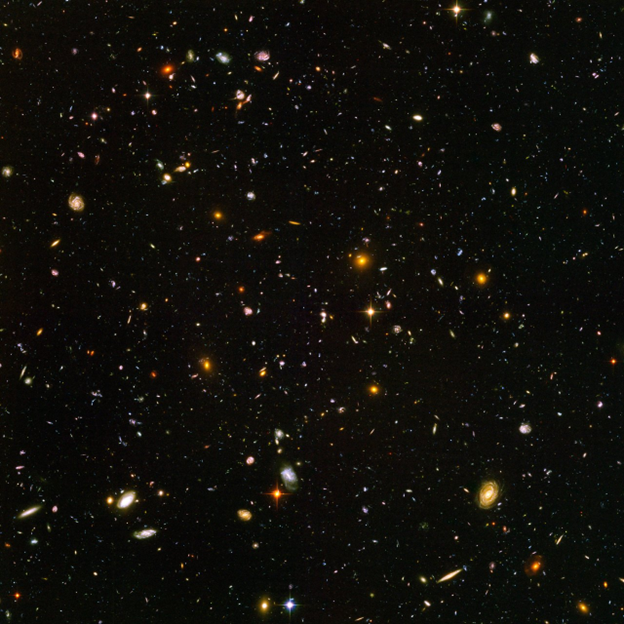
Webb’s predecessor is the Hubble space telescope. It is still going strong watching the skies and reporting back what it sees. While the new vanguard picks up the mantle. The time used on such expensive telescopes is really valuable and the watching projects need to be prioritized appropriately. In 1995, scientists took a gamble using Hubble. They decided to focus the telescope on a dark patch of the sky where there seems to be nothing visible either to the naked eye or the other powerful ground based telescopes. They were surprised to find thousands of galaxies from the early history of our universe showing up in this deep field image. They followed it up with an ultra deep field image in 2004. The image given below courtesy NASA, required 800 exposures taken over the course of 400 Hubble orbits around the Earth. Obviously, such complex images are assembled from thousands of individual pictures and colors are assigned based on the frequencies of the signals received. 
To enable us to look further out into the Universe and look back into the time when our Universe was in its infancy, there was a need for a more powerful telescope. The quest for the new Webb telescope started. After going through long travails of design challenges and increasing costs, it was launched on Christmas day in 2021. And everything happened in a text book fashion thereafter. The unfolding of the heat shield and the complex mirror in space and its travel of a million miles into space to L2 Lagrangian point where the gravity of the Sun almost cancels out the gravity due to Earth. And the telescope gets a free ride to watch the Universe.   

To watch the early Universe, the observations need to be done in the infrared region. Because the ancient light is red shifted due to the expansion of the Universe. So much red shifted that it has passed into the invisible infrared region. Hubble had some infrared capabilities but Webb is exclusively built for infrared observations. As a result, while Hubble can observe 500 million years after the Universe was formed, Webb pushes back the timeline to the 200 million year old Universe. These timelines are very early compared to its present age of about 13 billion years.

To meet the challenges of observing in the infrared region, there should be no other source of heat around the telescope or even from within itself. It has to be cooled to very very low temperatures, close to absolute zero. A giant heat shield was built to prevent the heat from the Sun, the Moon and the Earth reaching the telescope. The whole telescope is kind of a large freezer. 

The mirror is about an order of magnitude larger than that of Hubble. It is made of specially processed  material Beryllium whose expansion and contraction due to temperature differences is very minimal. It is very conducting with heat flowing uniformly across the complete surface. It is very stiff to encounter the harshness of the space. It is coated with a very thin film of gold to get the maximum reflectivity. Yet it is about a tenth as heavy as Hubble’s mirror. Unlike Hubble’s, the mirror was constructed from 18 hexagonal segments. Each of them could be moved very precisely using the attached motors. Very minute movements were required to align all of them to get a perfect picture. The movement of a millimeter took almost a day. Anything quicker would generate more heat and jeopardize the telescope. It was literally watching the paint dry. That is why it took several months to do the alignment. The engineering specifications are clearly mind boggling.       

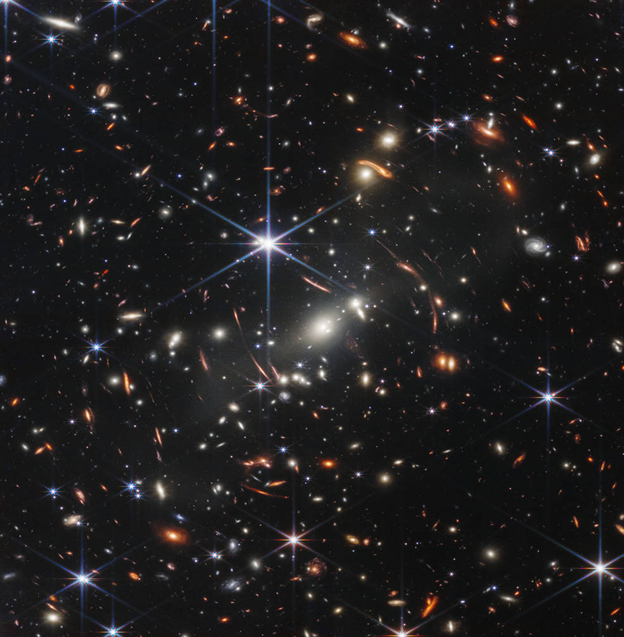
Electronics contained within are also state of the art. Having fancy acronyms, basically they are the infrared cameras and spectrographs (which analyze the spectrum of the infrared radiation received). The first pictures from the Webb telescope have been released recently. They are spectacular. More like Van Gogh paintings. My favorite is an equivalent of the Hubble extreme deep field and is shown below. Courtesy of NASA and titled “SMACS 0723 galaxy cluster”, it represents a tiny sliver of the sky, yet contains thousands of galaxies. 
Located at a vast distance where no human has ever gone, the telescope needs to be abandoned if it cannot be fixed. There cannot be any servicing missions of any sort. So far things are good. Let us hope for the best for the life of Webb. Such scientific observations triggered by engineering marvels inspire us. Coming in the wake of the dirty side of the human mind which results in divisive politics and territorial wars. Not long ago, Hubble was the ultimate space telescope. Now it is Webb. What would the future space telescope look like?
Posted in Mid-summer 2022, Sidereal Times | Tagged , , | Leave a comment

All My Planets!

by C. Todd Reichart

On Friday night, June 24, I fell asleep on the couch in front of the television. I woke up around 2:30 a.m. on the morning of Saturday, June 25, my body contorted and failing to get comfortable on the short couch. As I tramped toward my proper bed, I had just sufficient clarity to remember the planets-all-in-a-line observing opportunity that very night with my fellow amateur astronomers. I was awake, I was dressed in yesterday’s clothes, I could disguise my unruly hair with a baseball cap, so I had no good excuse not to get out to see this rare phenomenon. I confirmed that the sky was clear, grabbed my red-light headlamp, got in the car, and drove to the soccer fields at Washington Crossing Park. Wow! It was totally worth it!

I saw Venus, Mars, Jupiter and Saturn just by looking up along the ecliptic. I saw the moons of Jupiter and the rings of Saturn through reflectors setup by Dave and Jennifer Skitt. I saw Uranus and Neptune through a refractor setup by Tom Swords. And as day was just breaking through, I saw Mercury through a pair of borrowed binoculars. That’s seven planets in one night! I looked at the ground beneath my feet to add Earth to my list. Eight planets, the complete set! That was the first I’d ever seen Uranus and Neptune and the only time I’d ever seen all the planets in our solar system at once.

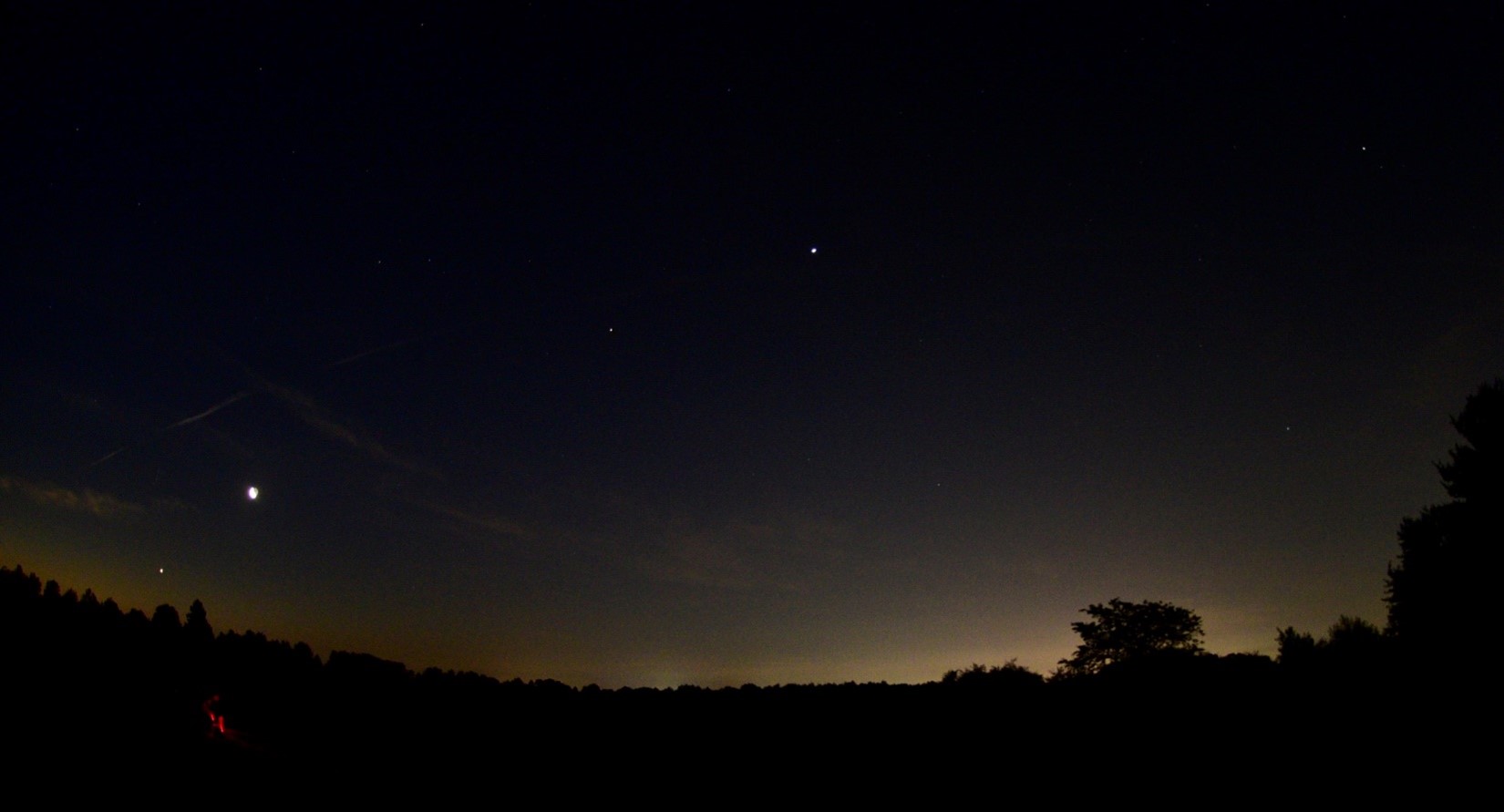
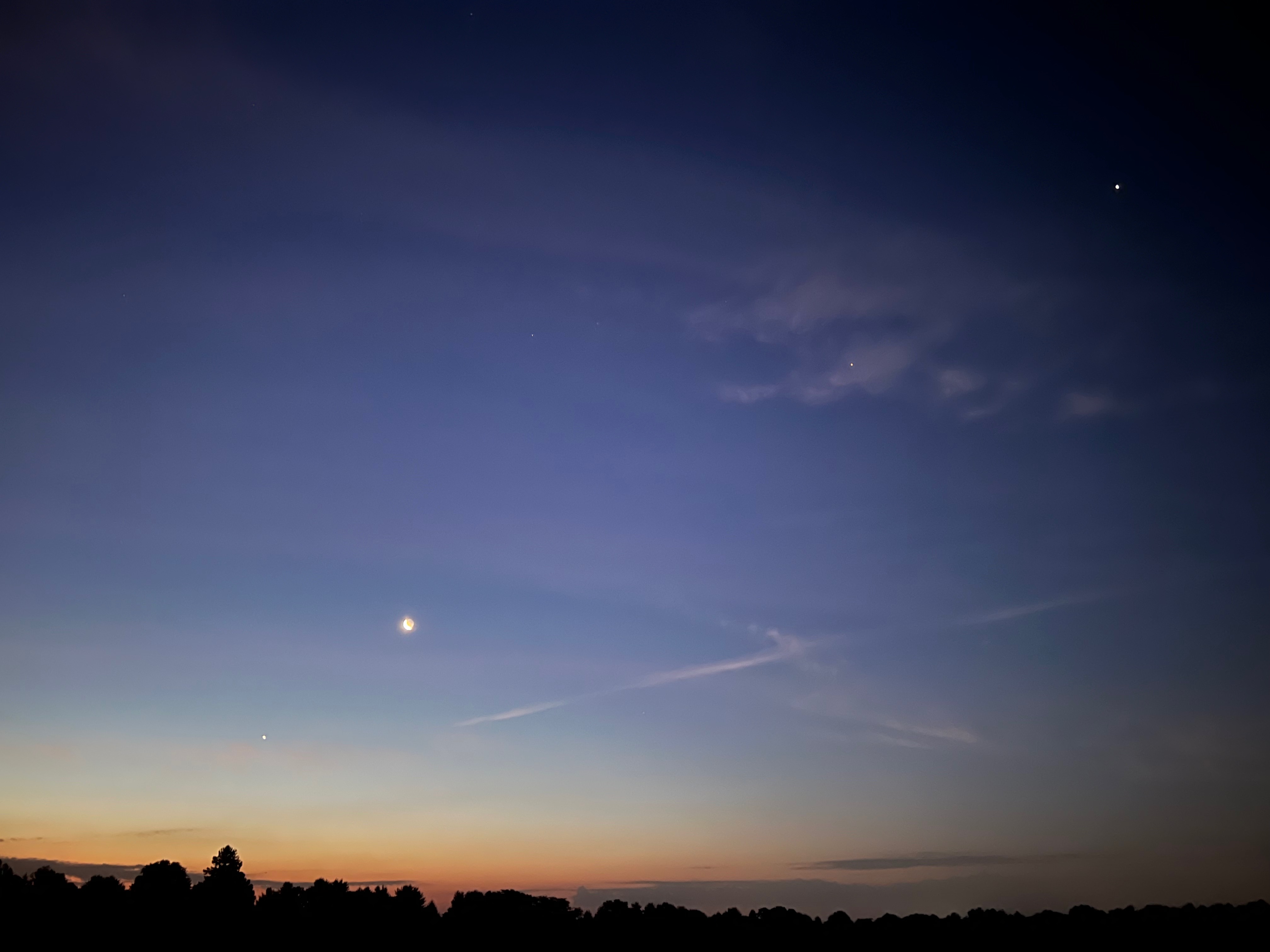
I managed to snap a photo handheld with my iPhone 13 Pro (attached). Along the ecliptic from left to right are Venus, the moon, Mars and Jupiter. The two stars paralleling the ecliptic between the moon and Mars are Hamal and Sheratan in Aries.

I have no recollection of what I was watching on TV earlier that night, but I’ll long remember what I saw in the sky that night into morning. Thank you so very much to the Princeton amateur astronomers who setup and shared their equipment to make that experience possible.

Posted in Mid-summer 2022, Sidereal Times | Tagged , | Leave a comment

I Tried!

by Gene Allen

Well, I did try to capture it on June 18. It was a fulfilling view: all the visible planets spread – in order – across more than half of the span of the brightening dawn. I walked away from home enough to see brilliant Venus low above the other houses. No way could I get clear of enough houses and trees to even think of glimpsing Mercury.

I had just woken on my own at 0417 and bolted up, realizing what might be visible if those persistent New Jersey clouds were not denying me yet another astronomical event. No, I would have had to set an alarm and driven somewhere to peer close enough to Mother Earth herself to tease Mercury from the impending daylight. It was too late for that.

Up quite a bit from Venus, hung dim ruddy Mars. Mostly to the right giant Jupiter glowed unmistakably, nearly as bright as Venus. Still more to the right, just above an expiring Last Quarter Moon, floated Saturn. I breathed in the expanse of it, inhaling the photons reaching me from all those distant worlds, cherishing them.

Then I tried. Set up the Nikon D750 on the Gitzo tripod. Tried the SharpStar2 focusing screen on the 20mm f/1.8 on Jupiter. Nothing. Couldn’t tell a thing. “Regular” Bhatinov masks are known to be unable to work on wide angle lenses, but the SharpStar claims to. I’ll research it more, try to see if it’s just that ever-threatening curse of “operator error” or I wasted money on the screen and a Lee 100mm filter holder. I know that the infinity focus stop on this lens is not at infinity, because that novice presumption trashed a couple dozen Milky Way photos from Monument Valley. Jupiter didn’t show big enough so I settled for making the Moon as small as I could. Then I reframed to get Venus in the lower left corner and Jupiter ended up near the upper right. Saturn and the Moon might have fit in the field of my 12-24mm zoom, but that is a DX lens, only f/4, and I hadn’t prepared to try that or my 10mm fisheye. Besides, the Moon was so much brighter it would have blown out that part of the sky. I began taking wide open aperture photos at all sorts of exposures.

The results were most disappointing, not worth keeping. One could make out only Venus and Jupiter. It was a bust.

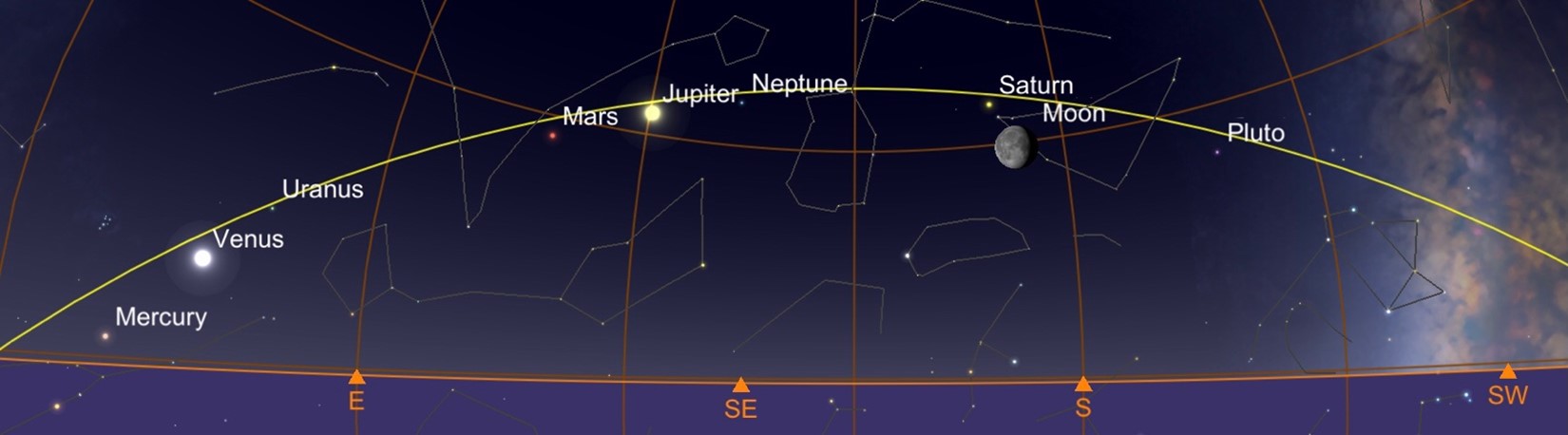
What you could have seen at 0430 on June 18, and what others have probably captured, is something like this:

Uranus, Neptune and Pluto joined the string, invisibly, making it indeed a full house. They were in sequence with each other, but displaced conveniently sunward, as if to make them all fit into the same sky. It was quite a show, and I was glad to have experienced it, even though I failed to capture it.

But hey, I got another chance! The Public Night at the observatory on June 24 was a good one, with decent skies and plenty of folks enjoying the views afforded by the eyepieces and the camera. We finally wound things down and closed up at midnight. A bunch of Keyholders and faithful had talked about gathering at the soccer fields at 0330 to experience the planetary alignment.

I had put the camera and tripod into the SQ5, along with the 10mm fisheye this time, just in case. That meant I could choose between making an hour round trip home for something like two hours in bed, or napping as much as I could in the car. The wild card, as always, is the cloud cover. From home, I could check and maybe save the return trip. Hanging out at the soccer fields, the whole night was pretty much trashed either way.

All nighters used to be what I did for a living, so it shouldn’t be all that big of a deal. Of course, the last time I captained a triple seven to Heathrow overnight was a month short of fourteen years ago. Whatever. I’d save the gas. I maybe slept an hour, in part because the fully reclined seat still needed a pillow, and that I had not anticipated.

The clouds did not encroach, and eleven hearty souls gathered to witness the alignment. It was somewhat more complete this time, because the Moon was less illuminated and had moved to properly represent Earth in the line up. There were several telescopes that nicely brought the planets to life, and my Fujinon 14×40 did a passable job revealing the four Galilean moons. Saturn was not so hot in them, looking just oval.

I set the camera on the tripod, this time with the 10mm. Its field got all the visible ones, and I shot a bunch of exposures a bunch of times. Several came out fairly respectably, capturing all the visible planets, but I have no idea how well it will show in the newsletter.

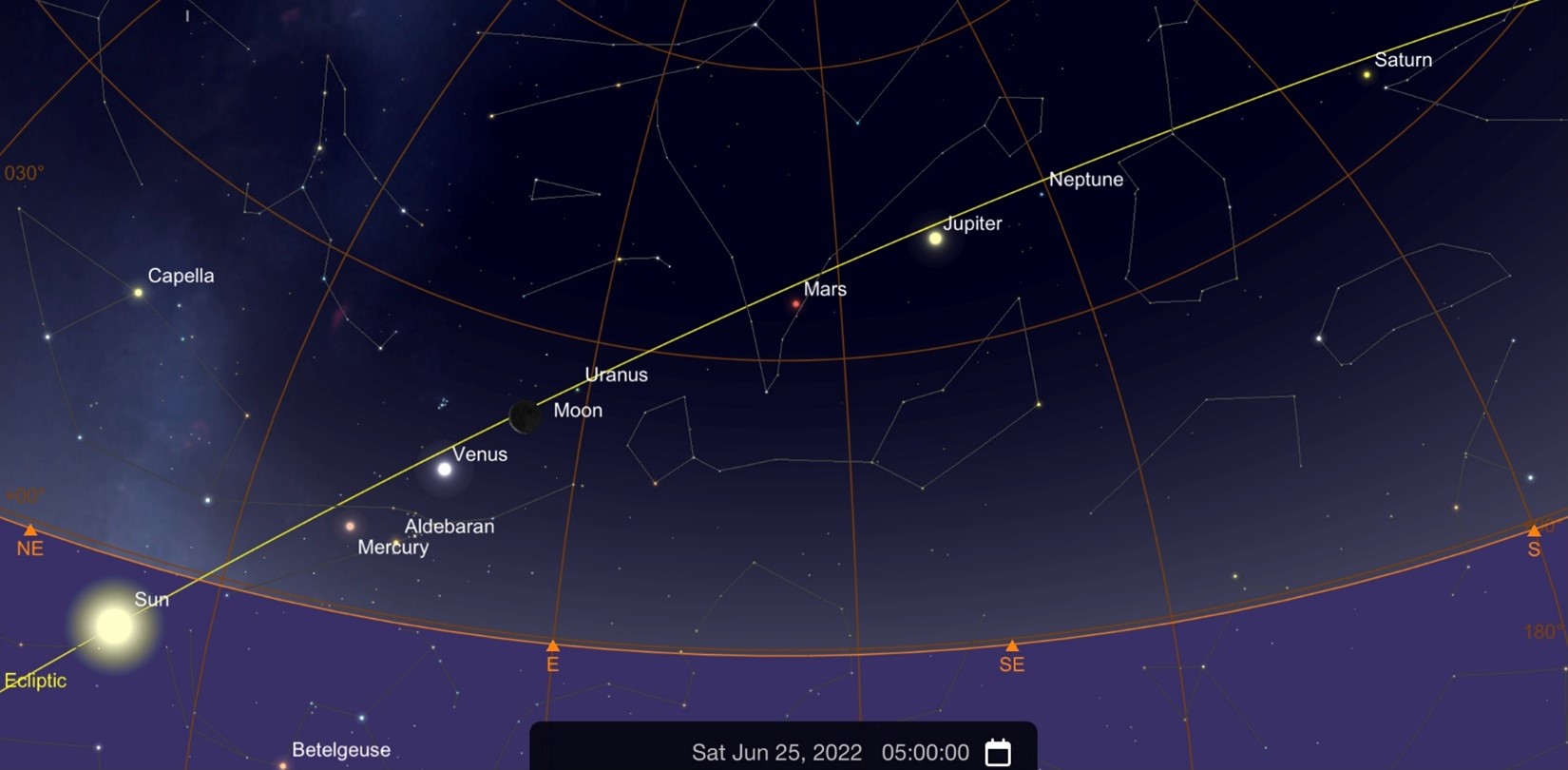
In case it shows poorly, or to provide labels for the photograph, here is the same view as shown by Sky Safari.

We hung around to try to catch Mercury, and we did! It rose above a low band of clouds, found first by a go-to scope but afterwards by even my binocs. It was great fun to experience the entire string of planets, and it was not all that painful!

Posted in Mid-summer 2022, Sidereal Times | Tagged , | Leave a comment

Planets from 43rd floor of a Manhattan Building

by Sulakshana Jain and Kurien Jacob

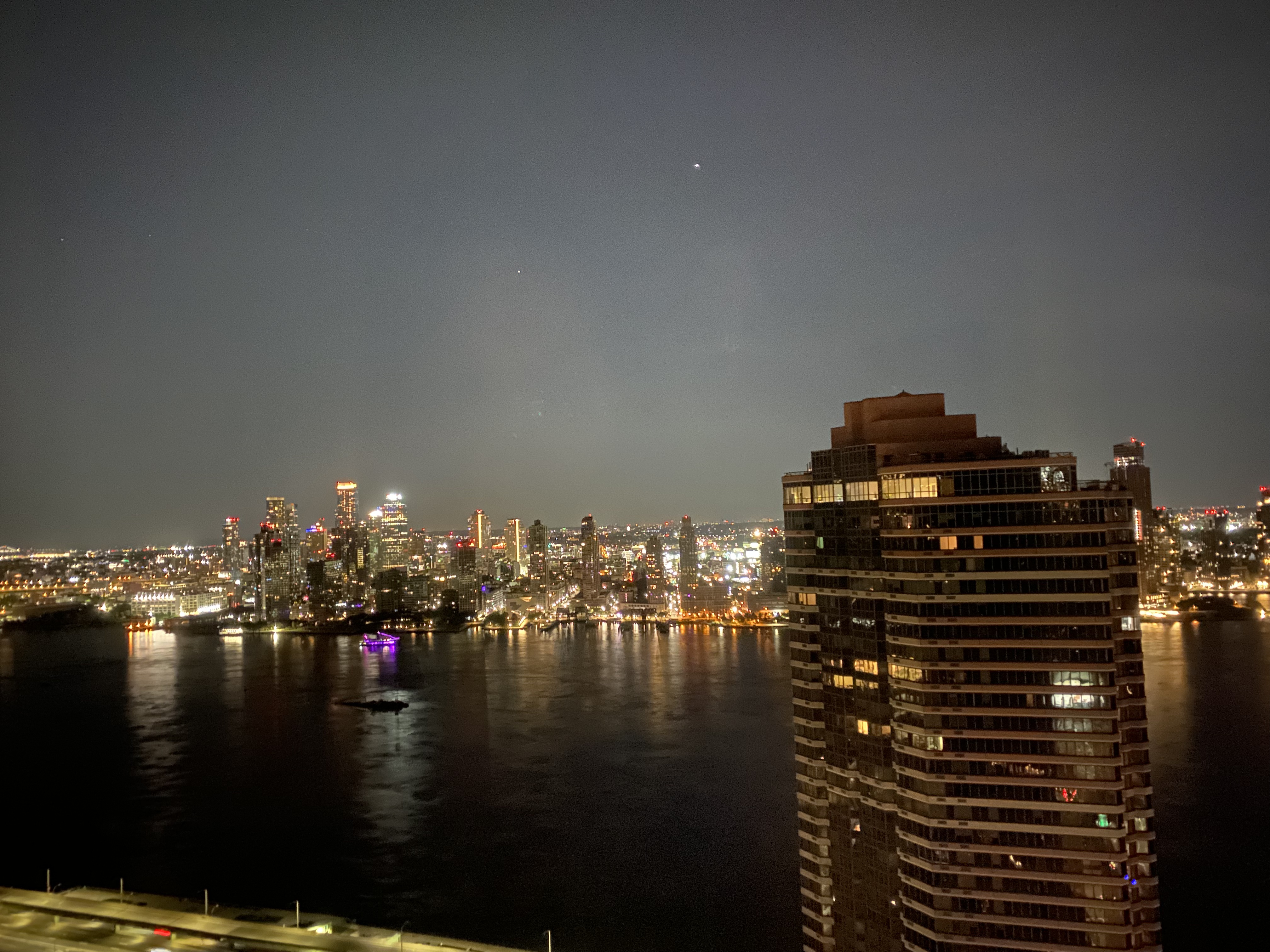
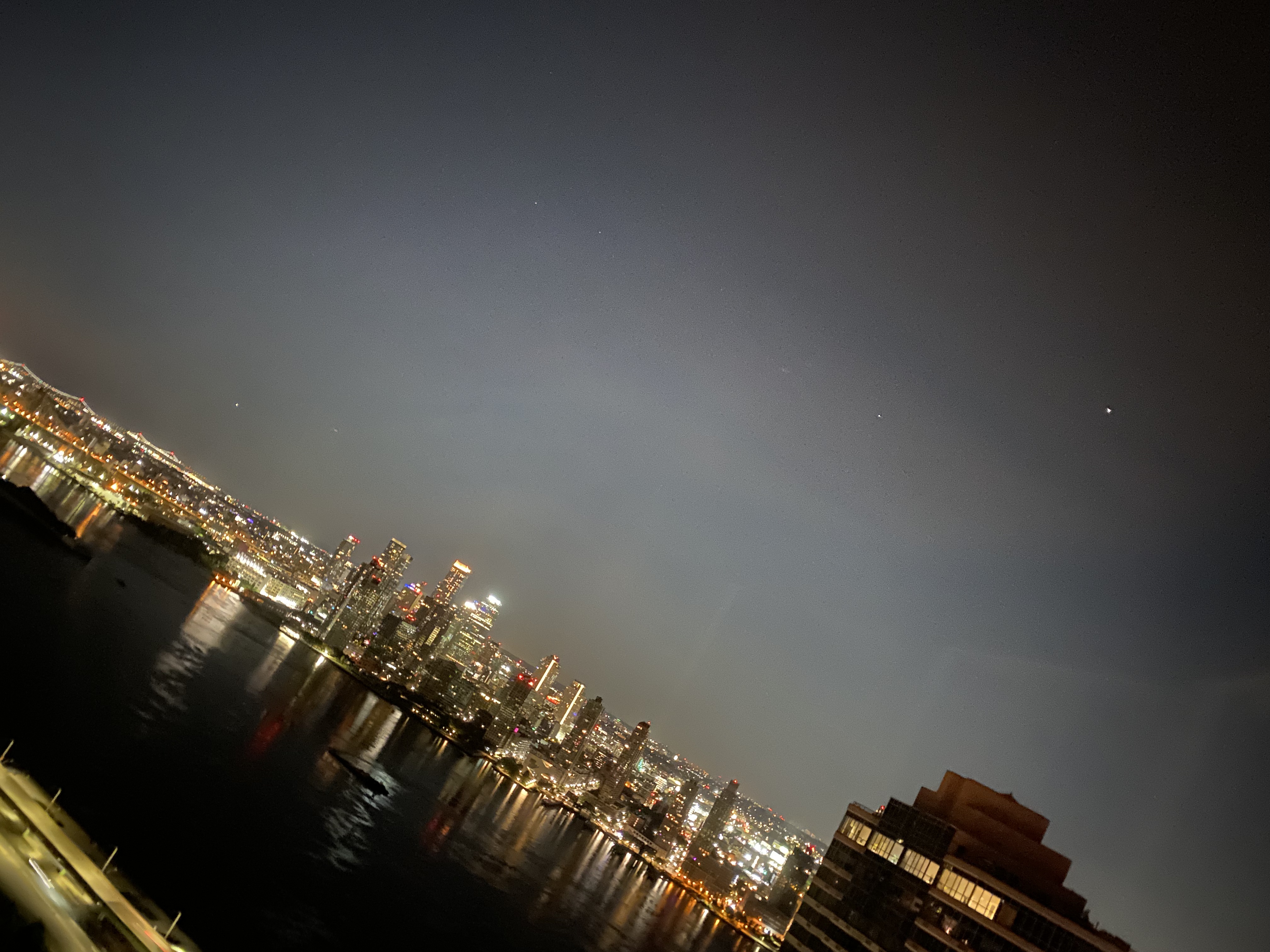
Sharing my sister Surabhi’s excitement, we went to our balcony to see whatever was visible in our light polluted city skies. Jupiter, Saturn and Venus, the three brightest were shining beautifully in our view. Hopefully you can find then in the pictures below.

Posted in Mid-summer 2022, Sidereal Times | Tagged , , | Leave a comment

From the Lens of Lisa

by Lisa Ann Fanning

The skies just haven’t cooperated in pursuit of some of my targets. On the few nights/ early mornings I managed to get out, I made some captures, and embraced the clouds in some cases! 

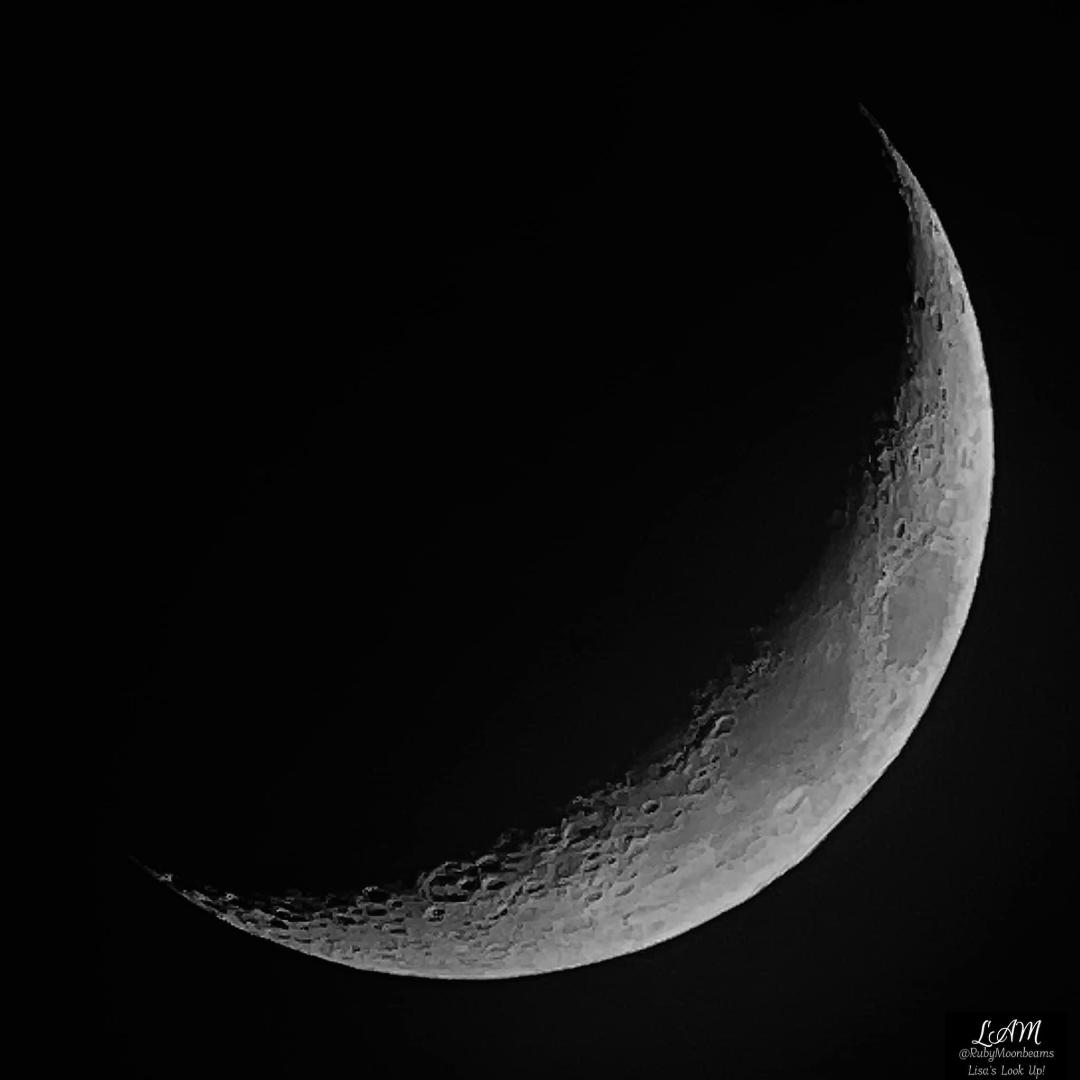
6/3/22 18% Waxing Crescent Moon

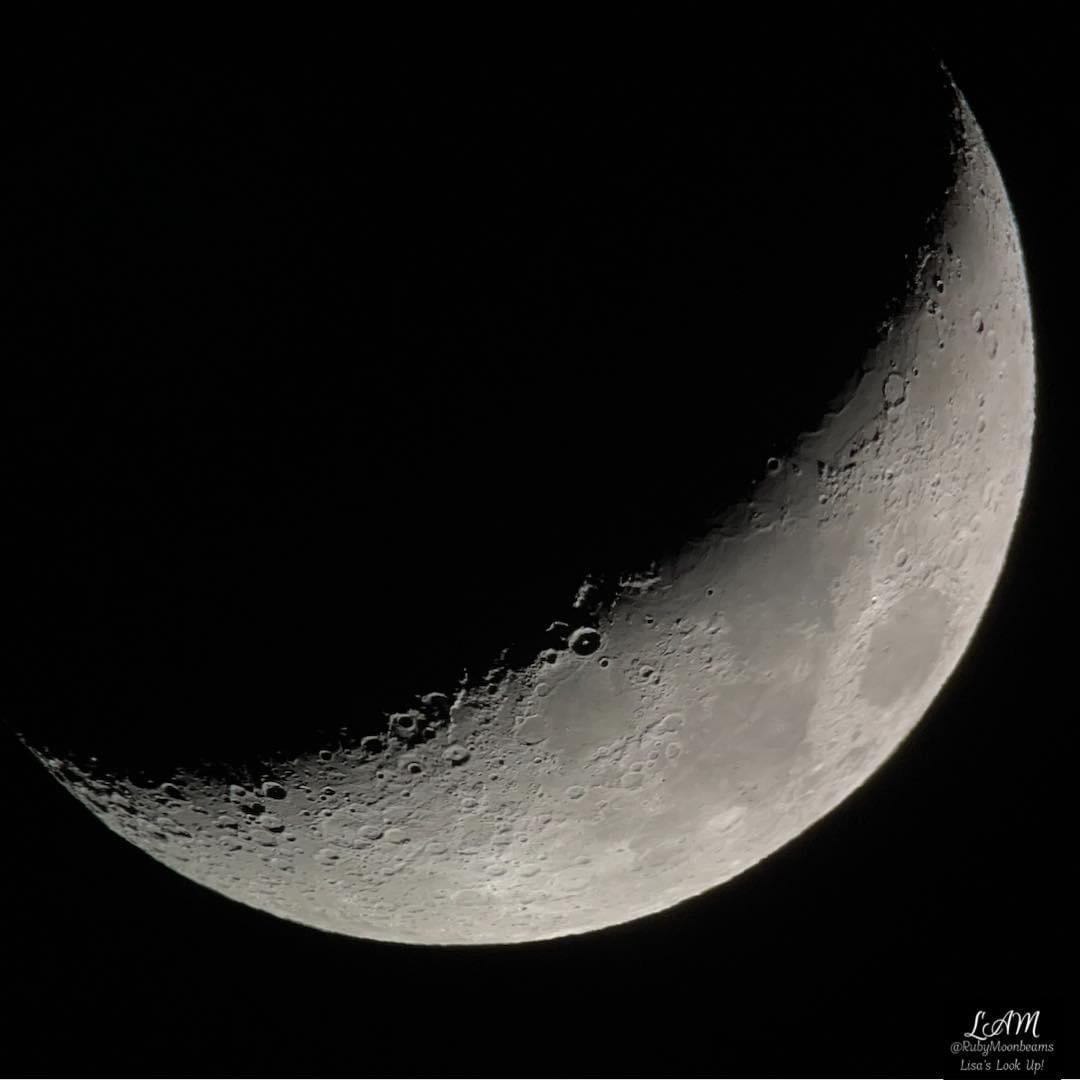
6/4/22  WaxingCrescent Moon (26% illuminated) 

📷: iPhone 13

🔭: Celestron NexStar Evolution 8

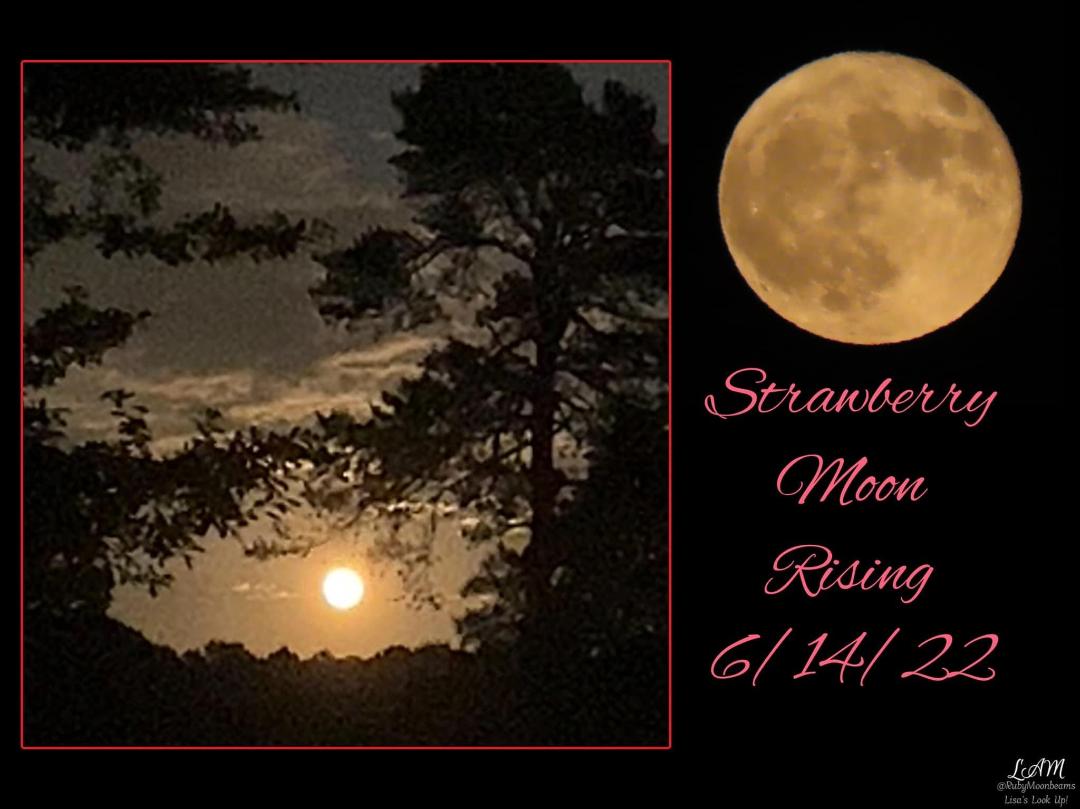
Full “Strawberry” Moon rises in the Southeast sky on a warm June night in New Jersey.  

6/14/22 9:52 PM EDT

📷:

(L) iPhone 13

(R) Canon PowerShot SX70 HS

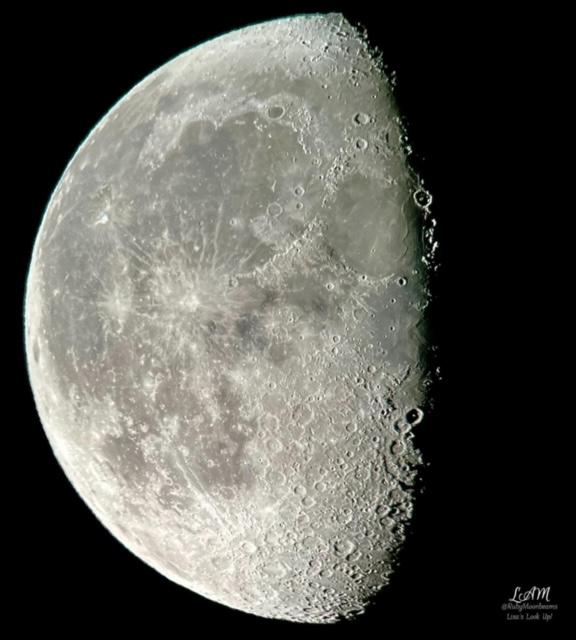
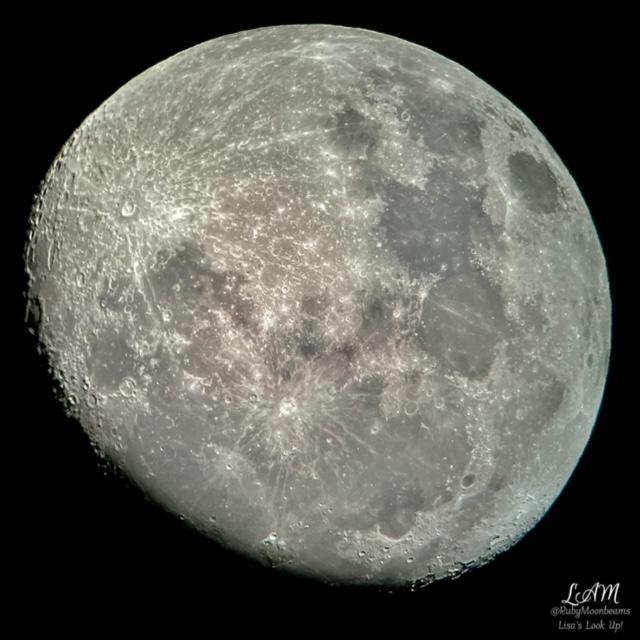
6/19/22 4:17 AM EDT A 70% illuminated Waning Gibbous Moon sits between Jupiter and Saturn (not pictured) this morning! Love the detail on the lunar terminator

📷 + 🔭 = iPhone 13 through Celestron NexStar Evolution 8

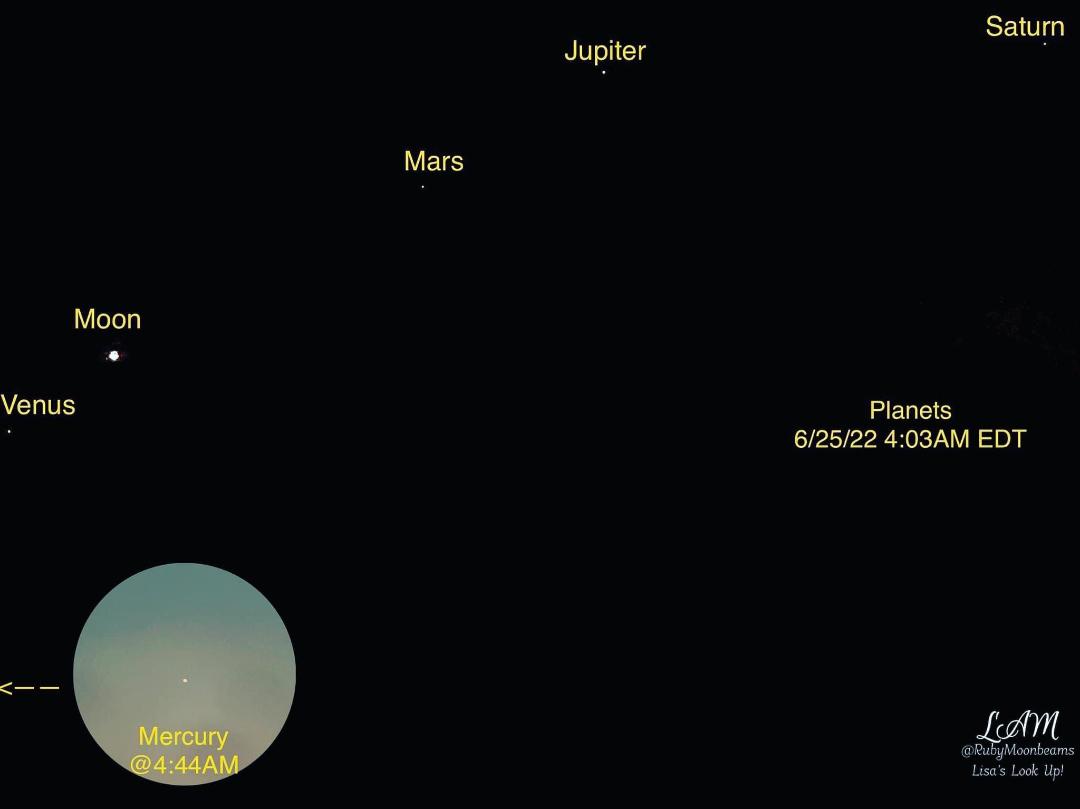
It was an early wake up, but so worth it! 🙂 6/25/22

📷 iPhone 13 for wide field 

📷+ 🔭 iPhone 13 through Swarovski Optik spotting scope for Mercury

💻 stitched in Bazaart

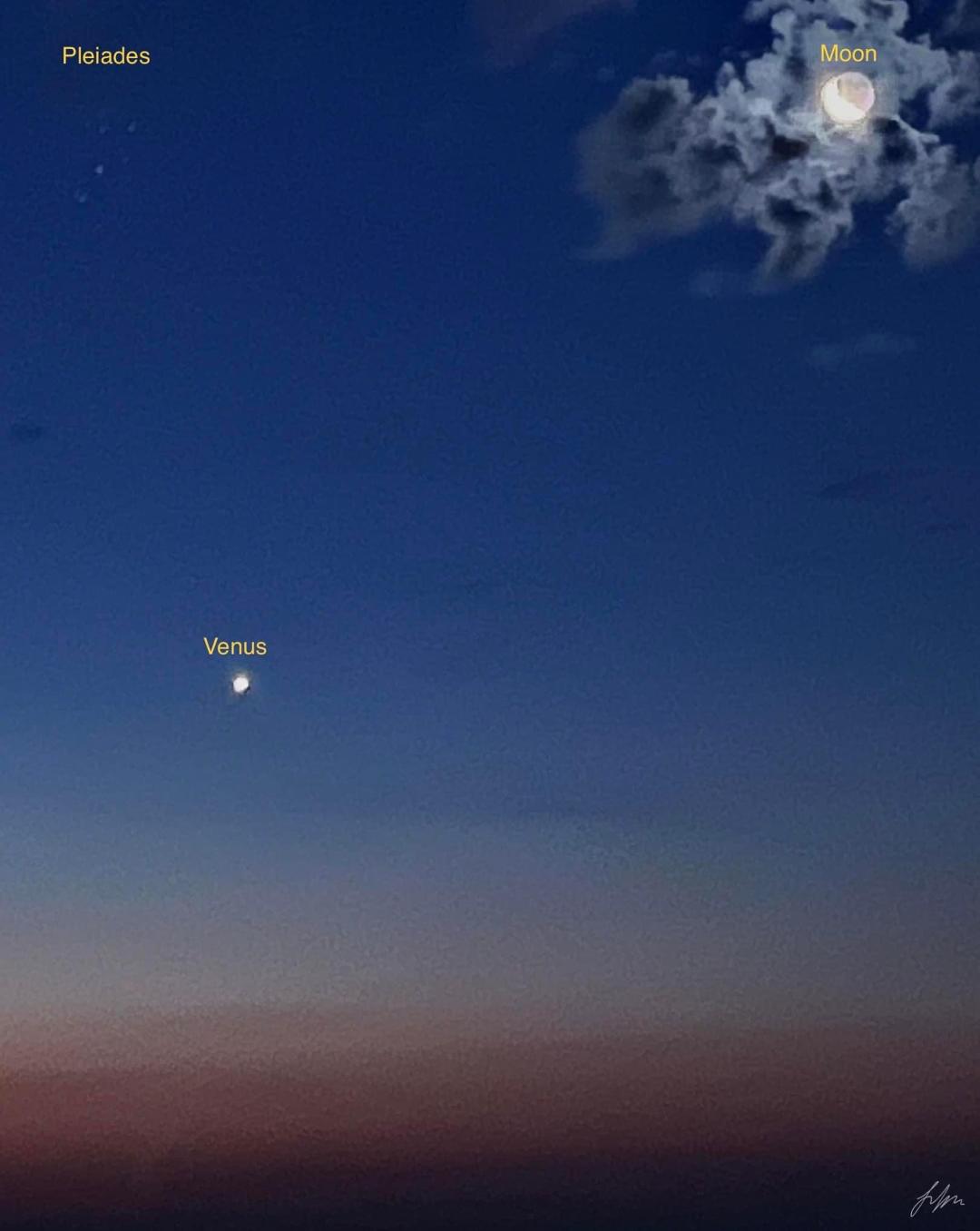
Another sight from 6/25/22 4:14AM EDT – Pleiades, Moon and Venus

iPhone 13 – night mode, 10 sec exp.

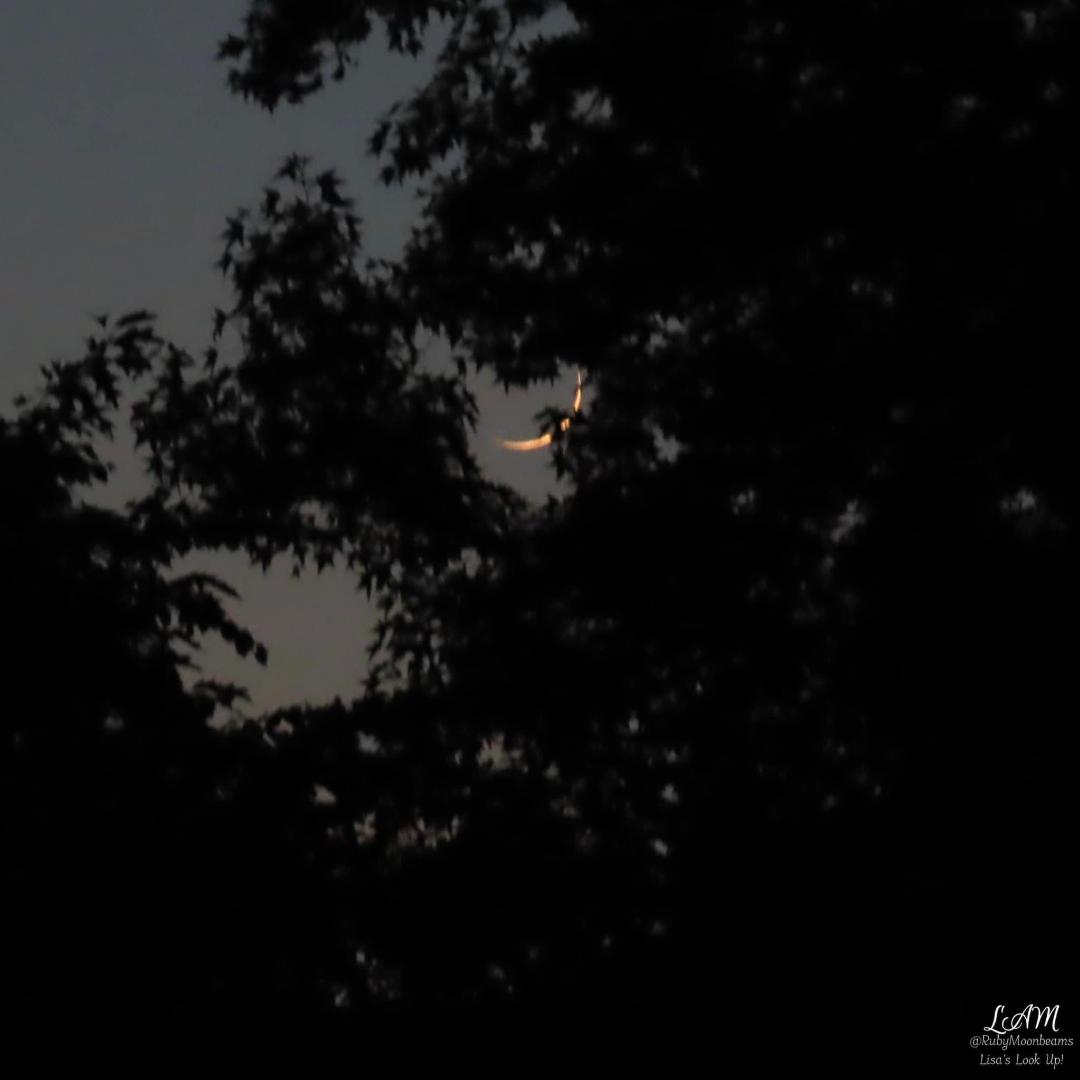
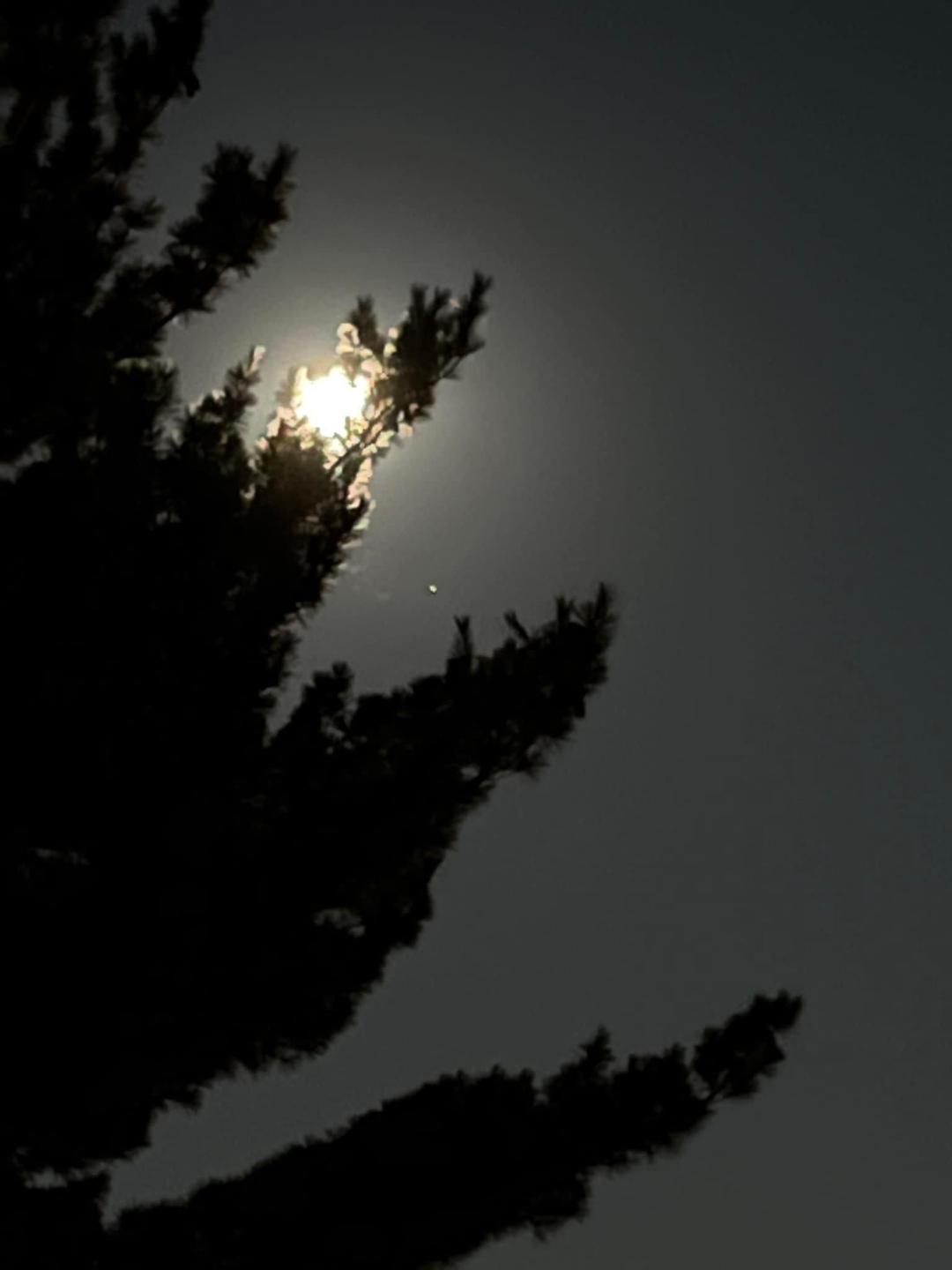
6/30/22 Waxing Crescent (~2% illuminated) Moon peaking out behind our trees.  

📷: Canon PowerShot SX70 HS 

💻: slight crop

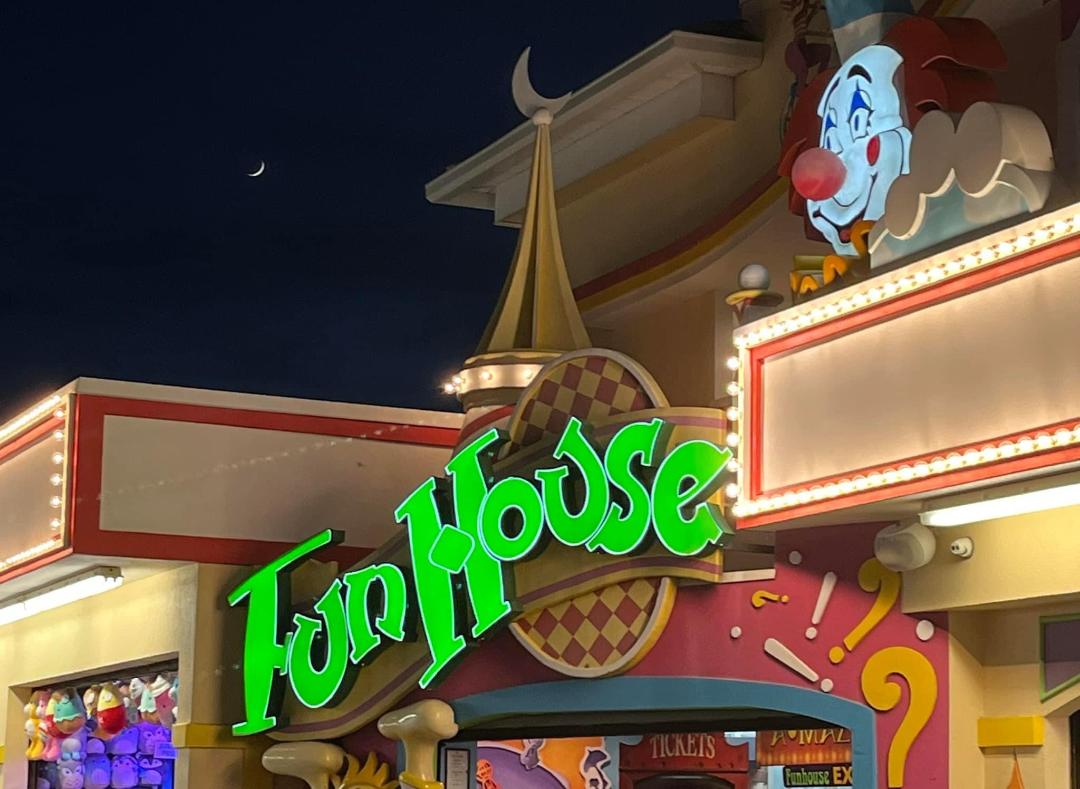
Double Moon? 

The real one is the 7% illuminated Waxing Crescent Moon 7/1/22 at Jenkinson’s Boardwalk. 

📷 : iPhone 13

Gave it a shot early this morning 7/11/22 to try to see the comet, but no luck with the full-ish Moon.  But seeing the Moon and Antares together were a nice consolation prize. 

Closeup of the Moon: iPhone 13 through Celestron NexStar Evolution 8 telescope 40 mm eyepiece 

Wide field: iPhone 13

7/13/22 9:58 PM EDT

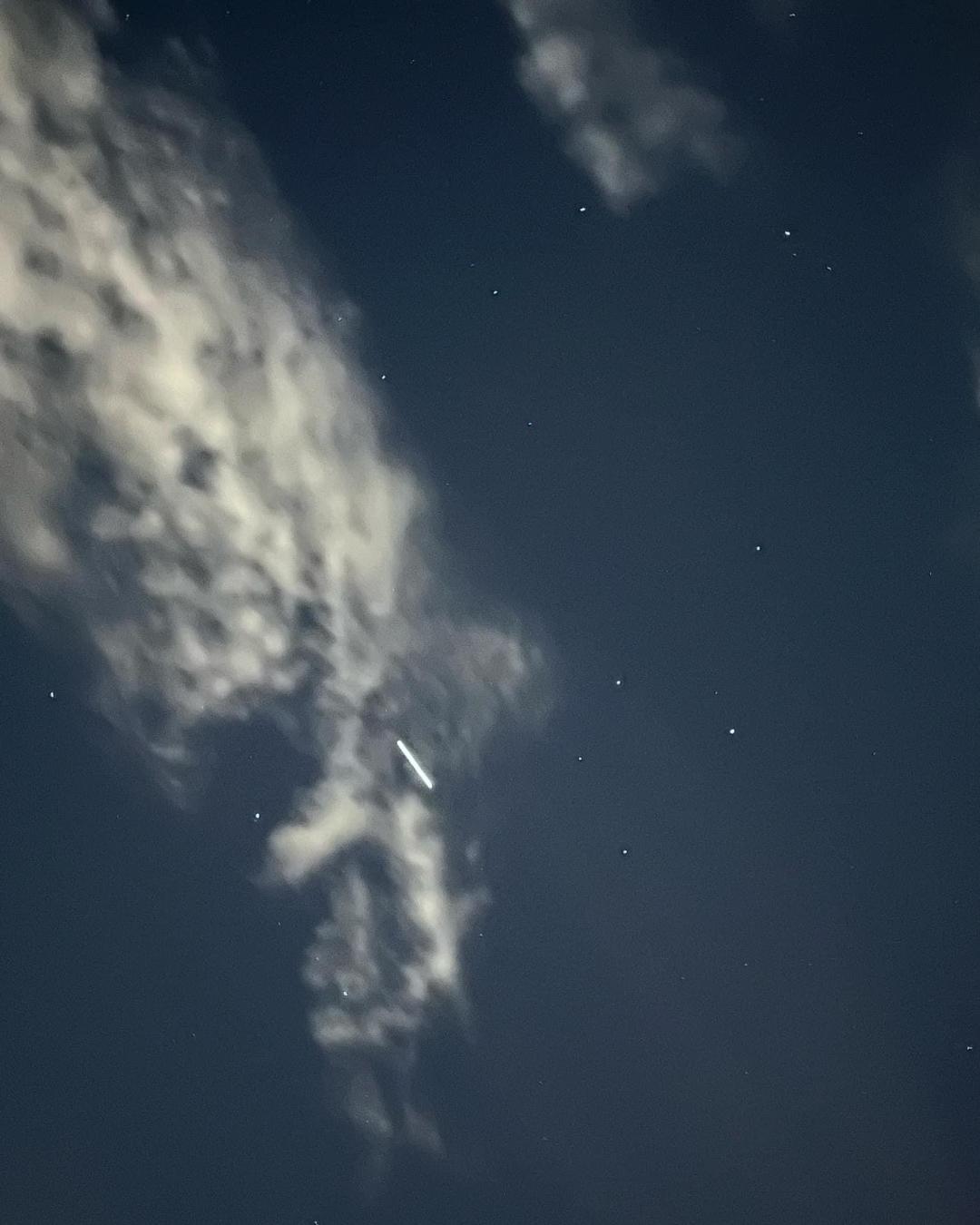
Ten second exposure of the International Space Station (ISS) 🛰 passing overhead, through the constellation Draco. 🐉 

📷: iPhone 13 ⏰: 10 second exposure 

Wishing everyone clear skies! 

Posted in Mid-summer 2022, Sidereal Times | Tagged , , | Leave a comment

Snippets

compiled by Arlene & David Kaplan

-NYT

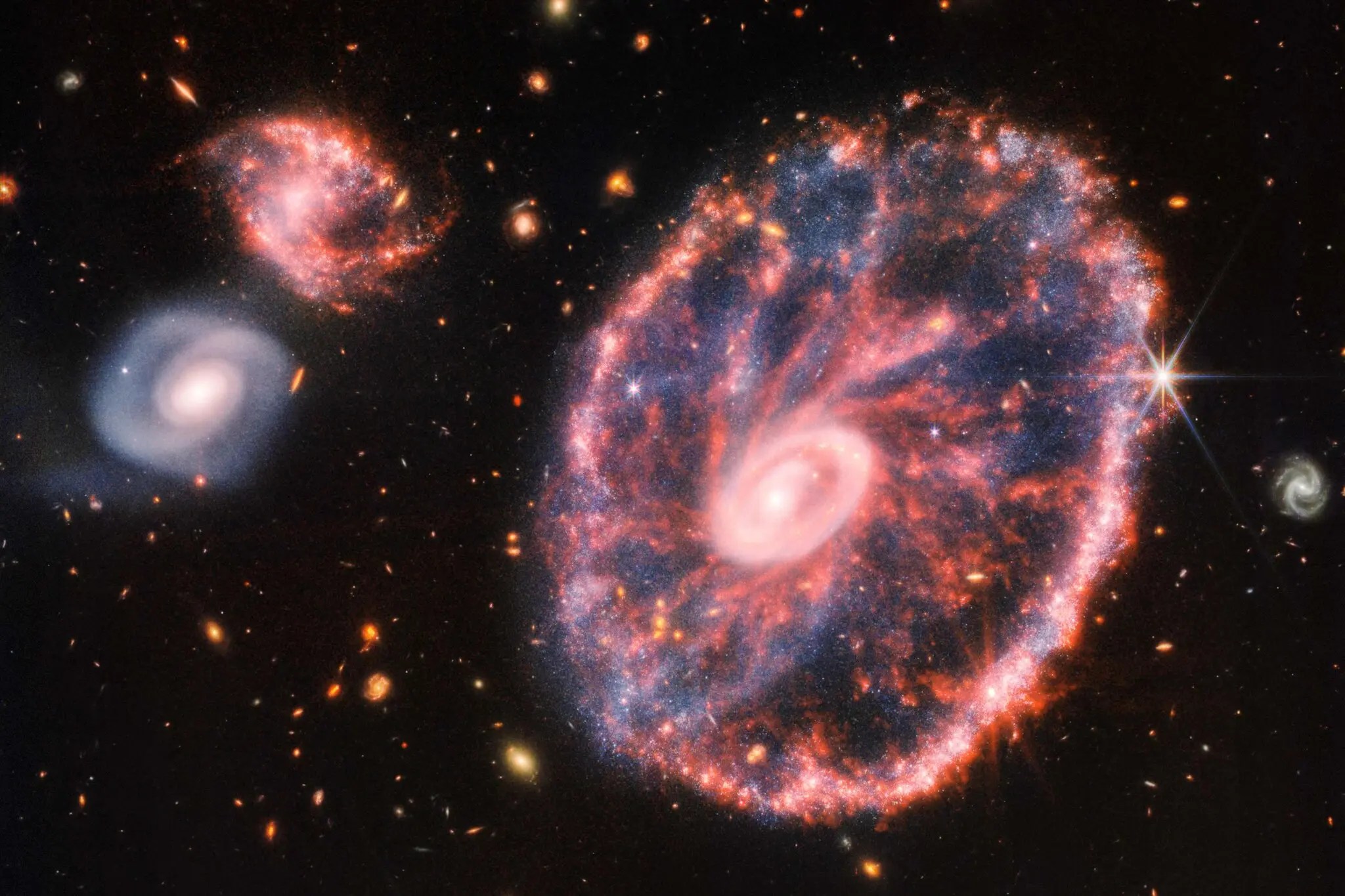
The Cartwheel Galaxy Scientists on Tuesday published the latest images from NASA’s triumphant James Webb Space Telescope. The newest release documents the Cartwheel galaxy, which is about 500 million light-years from our planet and is aptly named for its wheel-like appearance…more

-NYT
-NYT

Weave: New device will investigate Milky Way’s origins Scientists have supercharged one of Earth’s most powerful telescopes with new technology that will reveal how our galaxy formed in unprecedented detail. The William Herschel Telescope (WHT) in La Palma, Spain will be able to survey 1,000 stars per hour until it has catalogued a total of five million…more

-NYT

NASA Will Send More Helicopters to Mars The first helicopter that NASA sent to Mars worked so well that it is sending two more. The helicopters are similar to Ingenuity, the “Marscopter” that accompanied NASA’s Perseverance rover to Mars. But they’ll have the added ability of being able to grab…more

-BBC

UK Mars rover will have to aim for the Moon A plan to send another UK-assembled rover to Mars has been formally binned by the US and European space agencies. The vehicle was to have played a key role in getting rock samples from the Red Planet back to Earth so they could be studied in labs for signs of life…more

-BBC

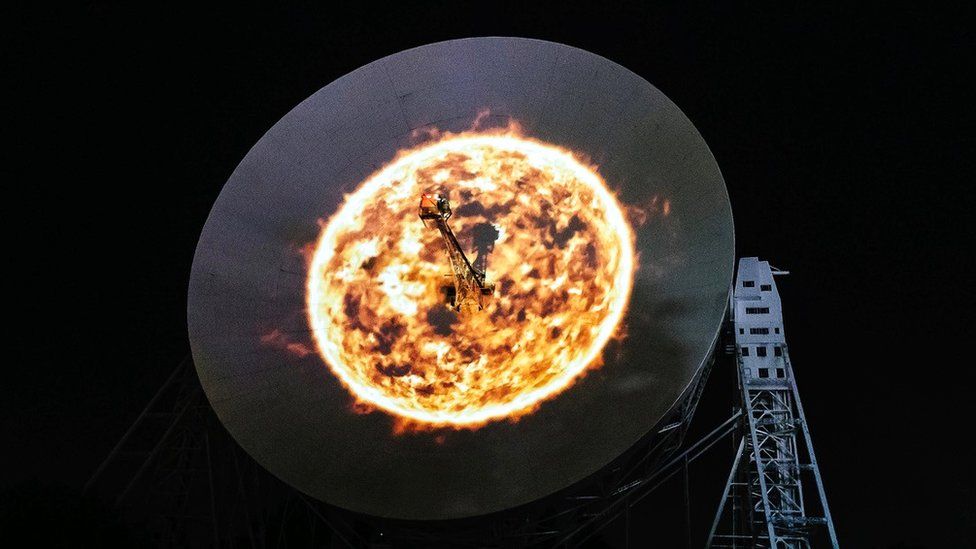
Giant Lovell radio telescope at Jodrell Bank to become space light show The UK’s largest radio telescope – the Lovell telescope at Jodrell Bank in Cheshire – is being turned into a light and sound show. For the first time since 2019, at the Bluedot festival, the giant radio telescope will take center stage. Images from space, including some stunning pictures from…more

-BBC

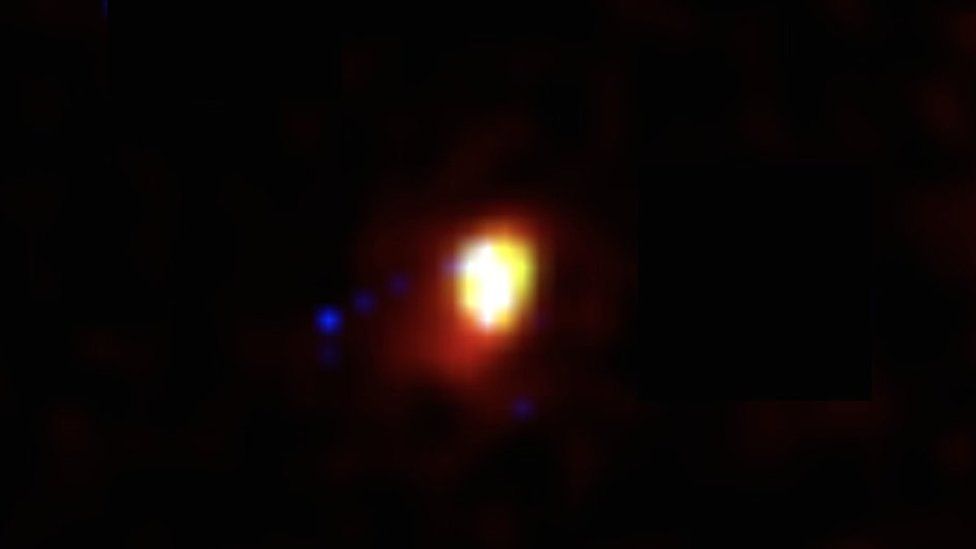
Scottish astronomers push James Webb deeper back in time Scottish astronomers have spied what they believe to be the most distant galaxy ever observed, using the new super space telescope, James Webb. The red smudge is 35 billion light-years away. We see it, as it was, just 235 million years after the Big Bang…more

– BBC

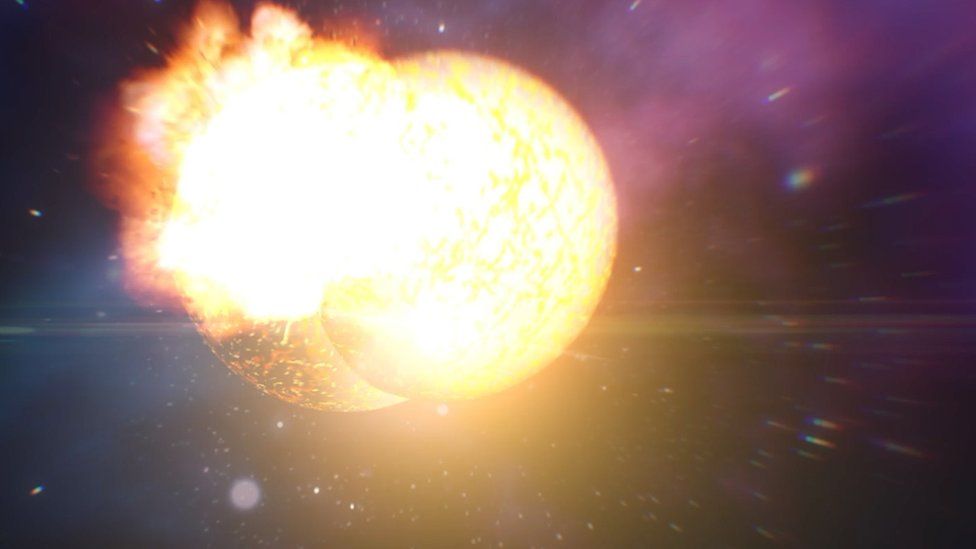
Neutron stars: New telescope detects dead suns colliding Astronomers can for the first time detect the smashing together of dead suns known as neutron stars, thanks to a powerful new telescope. Collisions of neutron stars are key to our understanding of the Universe. They are thought to have created…more

-NYT

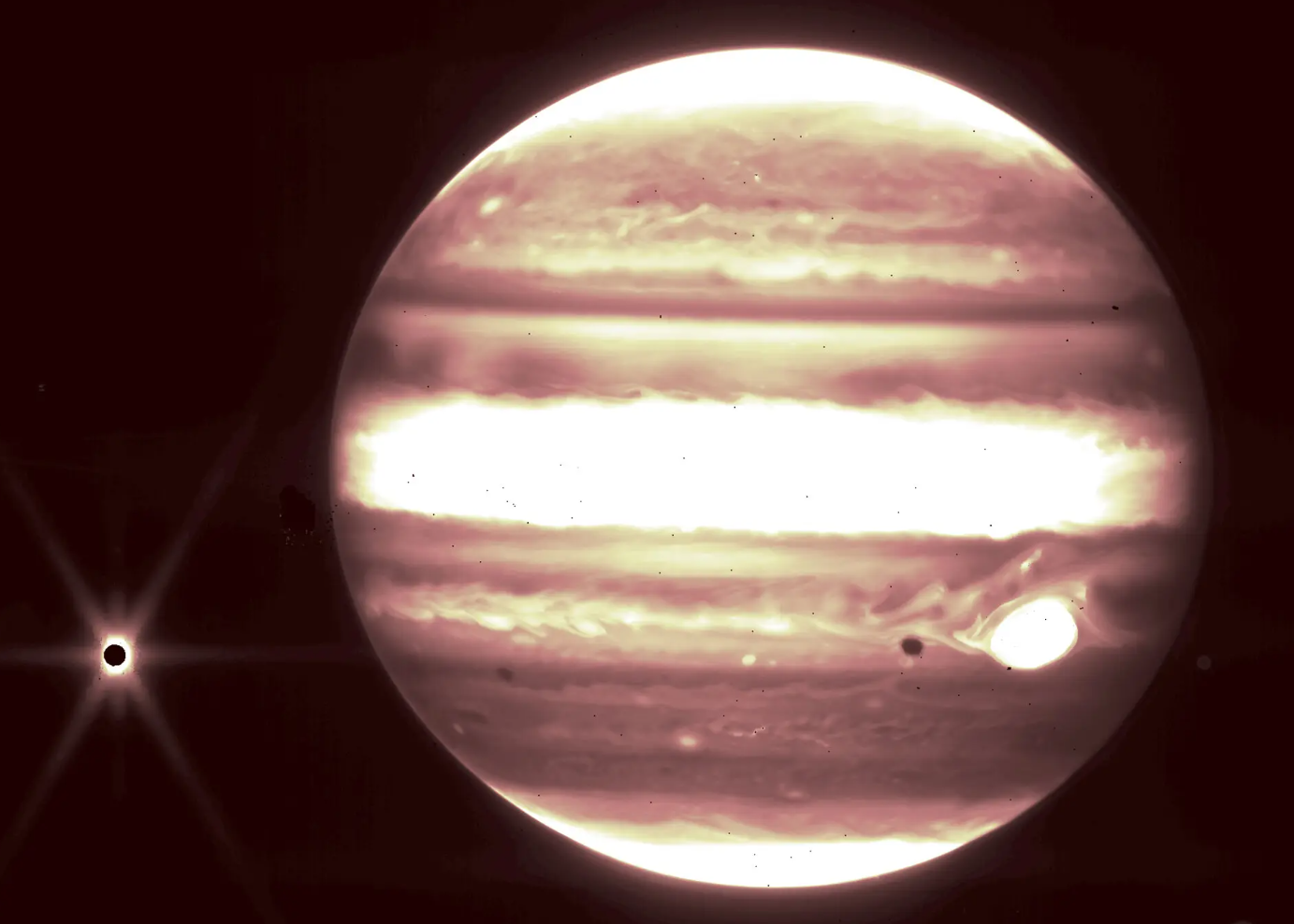
NASA Shows Webb’s View of Something Closer to Home: Jupiter The new James Webb Space Telescope can capture photographs not only of galaxies across the universe, but also of objects in our celestial backyard. NASA on Thursday released images of Jupiter, the largest planet in our solar system, which is currently just 430 million miles away from Earth…more

-NYT

The Lonely Work of Picking the Universe’s Best Astronomy Pictures After the image flashes up on the projector, a few quiet beats tick by, punctuated only by a soft “wow.” Everyone is processing. Then more “wows” bubble out, and people are talking over one another, laughing. Suddenly two astronomers, Amaya Moro-Martin and Karl Gordon, are out of their chairs, sticking their noses closer…more

-BBC

Why asteroids are the next big prize in the space race Asteroids hold large amounts of valuable minerals and metals. That is what International Asteroid Day is raising awareness about on 30 June. As resources are depleted on Earth, some scientists suggest asteroids could be mined instead. But could developing countries be left out of this new space race?…more

Posted in Mid-summer 2022, Sidereal Times | Tagged , | Leave a comment

From The Director

by Rex Parker, PhD director@princetonastronomers.org

Escape from the Black Hole of Relentless News Headlines.  Though we had a couple of rainouts for May events, the lunar eclipse AstroVideo Live was saved by member Rich Sherman broadcasting from Florida May 15.  We’ll keep going with Public Open House each Friday night at the Observatory at Washington Crossing State Park.  Join the adventure of direct astronomy with excellent telescopes, along with your own family and friends – spread the word about our Friday night sessions. 

We want to see you in person at the next monthly meeting of AAAP.  The last meeting of the academic season will be held in person — for the first time since March 2020! 

June 14 meeting (7:30pm) in person at the Planetarium in Trenton The meeting will also be broadcast by You Tube and Zoom from location, although the main planetarium show on the dome cannot not be shown.  Planetarium Technician Bill Murray, AAAP member and Outreach Chair, will run the celestial show featuring a new state of the art computing and projecting system.  For more info see the Program Chair article below.

Then, just when we needed some positive science news to cut through the background of chaos and continually worrisome news reporting, the astrophysics world came through!  Over the past month we’ve seen breakthroughs in both solar system and deep sky fronts. These results from long-term projects reaching pivotal moments are even more amazing when you ponder the degree of difficulty of engineering and the depth of scientific questions being asked. 

The first-ever telescopic image of our Galaxy’s supermassive black hole, called Sagittarius A* in radio radio-astronomy, was just published from the multiyear collaboration called the Event Horizon Telescope.  This is a network of large radio telescopes linked together around the world.  A very long baseline interferometer, this is the time the black holes at the center of our galaxy could be resolved.  By coincidence, the angular size of these two black holes is similar, so the resolution of the Milky Way’s black hole is the same as M87’s, and the images look surprisingly similar.  In the image published by the group, gravitationally lensed emissions glow around a dark shadow which is the event horizon of our galaxy. This publication and a set of related papers can be read in the May 12 special issue of Astrophysical Journal Letters.

Boeing’s Starliner spacecraft returned to Earth May 25 after the first successful uncrewed test flight, with 4.5 days at the International Space Station.  It made a picture-perfect landing in the desert and met all the mission objectives, a very big deal to the future of NASA and planetary space travel.  The James Webb telescope successfully collimated its mirror and is now testing the science instrumentation, and it won’t be long until the first actual data streams come forth.  And Solar Orbiter’s new images of the sun are as dramatic as we were hoping.  Late in March, the ESA’s Solar Orbiter made its closest approach to the Sun so far, inside Mercury’s orbit, to about one-third of the Earth-Sun distance.  With the most complex science lab ever sent to the Sun, Orbiter observes solar events in multiple modes and wavelengths simultaneously.  The recent data, images, and videos are totally engaging and can be reviewed at the ESA Solar orbiter site.

George Abell’s Amazing List from Palomar.  In 1966 the American astronomer George Abell published a list of 86 likely planetary nebula based on discoveries before 1955 from the National Geographic and Palomar Sky Survey with the 48-inch Oschin telescope at Mount Palomar, California.  This telescope, sometimes referred to as the world’s largest Schmidt camera, was the forerunner of today’s deep sky surveys and conducted a dozen other surveys since 1995.  As a quick aside, the glass corrector plate has a 48-in aperture and the primary is a 72-inch f/2.5 mirror. It was originally designed to use 14-inch square photographic plates, each covering 6×6 degrees of sky, and since 2000 has used CCD detectors instead of film.  

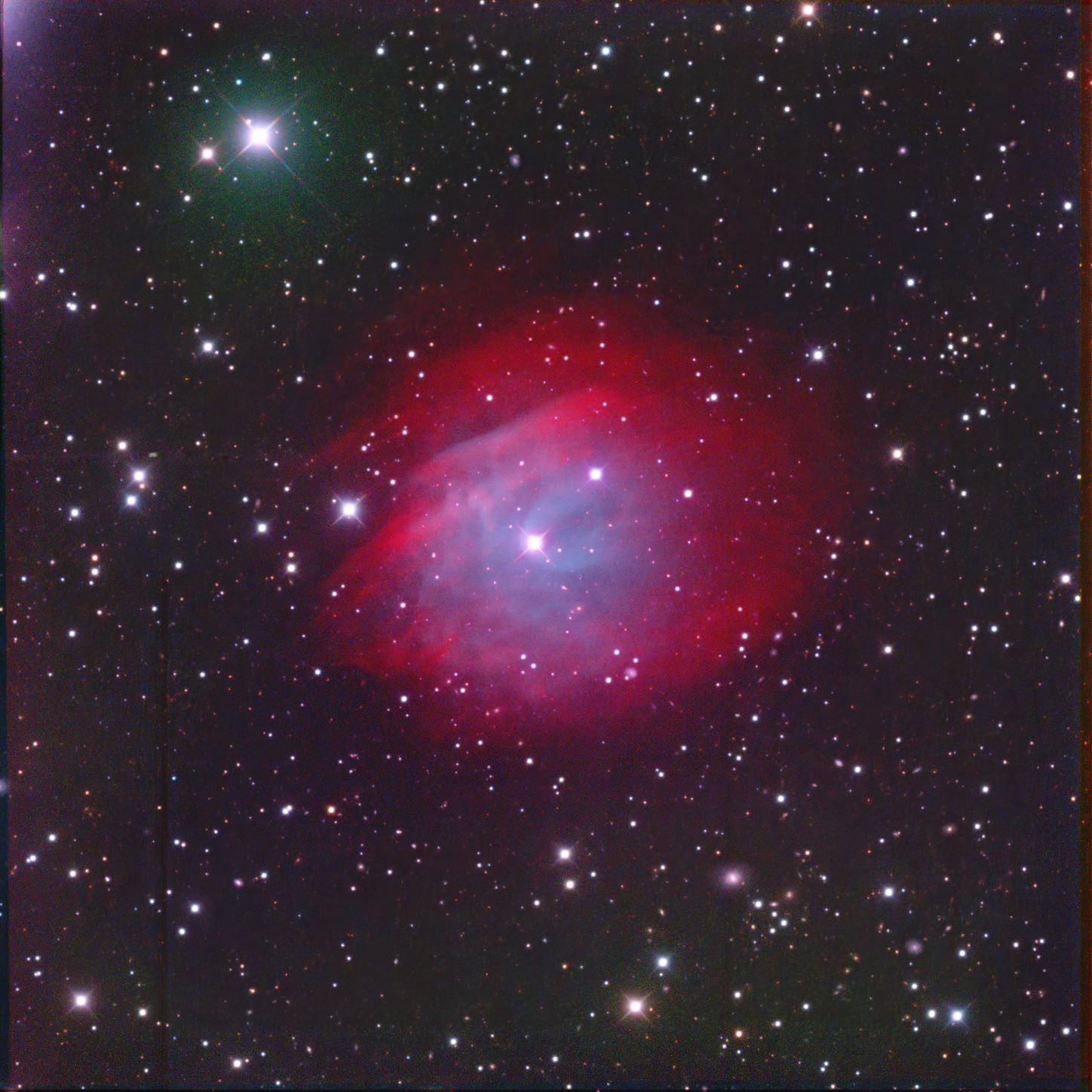
Not as well-known as the Messier list (which includes many objects that are not planetaries), the planetary nebulae on Abell’s list are fainter and more challenging to observe.  But when accessible under the right conditions they can be wonderfully mysterious with beautiful color and structure.  Last month I was fortunate to remotely observe Abell PLN 35 in the southern hemisphere constellation Hydra, using a 24” Planewave Telescope in the Chilean Andes.  The nebula emits strongly in the ionized oxygen (O-III, blue) and hydrogen (H-alpha, red) bands, with shock-wave like regions of density.  Located about 1200 light years away and about 5 light years across, Abell PLN 35 has a magnitude value 12.7 and angular diameter ~12 arc-min. 

Abell Planetary Nebula (PLN 35) Imaged with CCD Camera and 24” Telescope in Chile.  True colors are based on R, G, B filters plus H-alpha (red) and O-III (blue) narrow band filters.  Angular size, 31×31 arcmin.  The bright star in the field is magnitude 8.4.  Astrophoto by RAParker

Posted in June 2022, Sidereal Times | Tagged , | Leave a comment

From the Program Chair

By Victor Davis

The June 14, 2022 meeting of the AAAP will be an experiment combining in-person and virtual elements into a hybrid meeting.  The intention is to meet the needs of members eager to resume commiserating in person and also those who, due to inconvenience or Covid risk, choose to continue to participate virtually via Zoom. The club’s longstanding tradition is to have the final meeting of the academic year at the planetarium of the New Jersey State Museum, hosted by AAAP’s current Outreach Chair, Bill Murray. The planetarium is located at 205 West State Street, Trenton, NJ. There is ample parking behind the museum.

Unlike recent Zoom-only meetings, there will be no informal online chatting before the meeting starts promptly at 7:30 pm. In-person attendees will have the opportunity to socialize outside the planetarium building before the meeting starts. AAAP cannot access the planetarium prior to 7:00 pm, and Rex Parker, Bill Murray, and Dave Skitt will be setting up local and webcasting gear before the meeting begins.

The agenda for the meeting will be slightly different than the structure we’ve used for the past two years:

Masking

There is no masking requirement to attend this indoor, in-person meeting on premises owned by the State of New Jersey. Members who are immuno-compromized, senior citizens, or wary of respiring in close proximity to potentially infectious individuals may want to consider wearing a mask while inside the planetarium.

BillMurrayFeatured Speaker: William Murray,  Lecturer and Planetarium Technician, New Jersey State Planetarium, 

Outreach Chair, Amateur Astronomers Association of Princeton

( strgazr1@verizon.net )

“Touch the Stars”   This full-dome planetarium show dramatically showcases the robotic spacecraft used in the exploration of our Solar System and the galaxy beyond. The presentation traces the timeline to space through the history of NASA’s probes, orbiters, and landers—from the heart of our Solar System and the surfaces of its planets and moons to the grand tour of the Voyager spacecraft through the outer planets and on to interstellar space. Created with the cooperation of NASA and Lockheed Martin, “Touch the Stars” uses the latest high definition imagery, 3D vistas, and scientific data to transport the audience on a memorable voyage of discovery.

Bill will put the Planetarium’s new ultra-high resolution 8K digital video projection system through its paces for this main presentation. Unfortunately, due to copyright restrictions and the practical limitations of trying to image a planetarium dome through Zoom, virtual participants will see only a 1 ½ minute trailer of the film before the virtual meeting concludes.

A Bit About Bill Murray An amateur astronomer for more than 50 years, Bill Murray has been employed as a software engineer, physics and mathematics teacher and is currently planetarium technician and lecturer at the New Jersey State Planetarium in Trenton. He has owned more than a dozen different telescopes and is a past observatory chair, secretary, program chair, assistant director and director of the Amateur Astronomers Association of Princeton. His current position in the club is outreach chair. He observes the night skies, and dabbles in EAA, with a 130 mm Astro-Physics APO refractor from his backyard observatory.

If you choose to participate in the June meeting via Zoom:

  • Please make sure you have Zoom installed on your computer. You do not need a Zoom account or to create one to join the meeting. Nor are you required to use a webcam.
  • Please see below for the link to the meeting, or visit our website

Using Zoom: While we are social distancing, the AAAP Board has chosen to use Zoom for our meetings, based our belief that many members have already have used Zoom and its ease of learning. One of its great features is you can choose whether you want to install the software on your computer or use it within your browser.

How to Join the June Meeting: For the meeting, we are going to follow a simple two-step process:

  1. Please make sure you have Zoom installed on your computer. You do not need a Zoom account or need to create one to join the meeting. Nor are you required to use a webcam.
  2. Please visit our website for the Zoom link.

This session will be recorded and saved on YouTube. Send me an email at program@princetonastronomy.org if you have any concerns.

YouTube Link: Amateur Astronomers Association of Princeton, April 12, 2022 Meeting, 7:30 PM EST

NOTE: The Zoom site has many training videos. If you’re unsure how Zoom works you might want to view the videos on how to join a meeting or how to check your computer’s audio and video before the meeting.

Megaconstellation Webinar

In April, Dr. Paul Daniels spoke to our club on the Megaconstellation threat. He and his organization, the Federation of Astronomical Societies in the UK, hosted a webinar on 7th and 8th of May entitled, “The Challenge of Megaconstellations.” The aim of the webinar was to allow professional space operators and astronomers to explain to interested amateurs and researchers the many challenges posed by satellite megaconstellations. The event was very successful. An edited version is available online at:

https://www.youtube.com/channel/UCnmaTudqwjs9k7Gr-_WhUzw

The webinar is also available via the Federation of Astronomical Societies’ website fedastro.org.uk.

Manhattanhenge

For many of us, New York City is a magical place. It becomes a bit more magical twice a year, when Manhattan’s rectangular street grid aligns precisely with the setting Sun, creating a radiant glow of light at the end of Manhattan’s canyons of glass and steel. During these days, the Sun simultaneously illuminates buildings on both the north and south sides of every cross street of the borough’s grid. It’s a rare and beautiful sight, though drivers in cross-town traffic may be less concerned with its beauty than with pedestrians stopping in the middle of crosswalks to snap selfies.

Manhattanhenge takes place this year on May 29 and May 30, (sorry we missed it) and also on July 11 and 12. On Monday, July 11 at 8:20 pm ET, the full Sun will be setting over the Hudson River. On Tuesday, July 12, at 8:21 ET, half the Sun’s disk will meet the grid at sunset. These dates are spaced roughly equal time spans around the summer solstice. These dates work because Manhattan’s street grid is rotated 30 degrees east of geographic north. Had the streets been oriented north-south, Manhattanhenge would coincide with the equinoxes. The website of the American Museum of Natural History recommends that viewers find a spot as far east as possible that still has views of New Jersey across the Hudson River, and suggests vantage points at Manhattan’s main east/west thoroughfares:

  • 14th Street
  • 23rd Street
  • 34th Street
  • 42nd Street
  • 57th Street
  • Tudor City Overpass, Manhattan
  • Hunter’s Point South Park in Long Island City, Queens

Science popularizer Neil deGrasse Tyson invented the word “Manhattanhenge” to tie the artifacts of our modern civilization to humankind’s quest to understand the workings of the cosmos. He wonders what future archeologists might conclude from the fact that we engineered our city streets to revere sunsets on Memorial Day and Baseball’s All Star break.

Posted in June 2022, Sidereal Times | Tagged , , , | Leave a comment

From the Assistant Director

by Larry Kane, Assistant Director

At our last virtual membership meeting, I floated the idea of forming a “special interest” group within the AAAP that would work toward diminishing light pollution in the areas we do astronomy.   Based on demonstrated actions by AAAP members, these efforts will and should concentrate on locally driven efforts.  Past work by AAAP members has proven how this may be effectuated.  As a working group, we could concentrate our efforts locally and, with organizational resources from the International Dark Sky Association,, the Sierra Club and other organizations, build campaigns designed for  improvements at the municipal.

I recently rejoined both of these organizations and have found that the International Dark Sky Association (IDA) has a great numbers of ways they will support the efforts of concerned citizens to reduce light pollution.  These include videos that are available to download as well as many other resources.   To date, AAAP efforts have resulted in beneficial legislation being passed in Hopewell Township and campaigns being presented in townships of Monroe and South Brunswick.  These are only three of which I am aware of in New Jersey.

It is my hope that members Rex Parker and Surabhi Agarwal, would join in this effort to provide their experience and counsel based on their campaigns.  So I am hoping to generate real interest in the AAAP as we work to save our night skies.  When our interest group gets together, it will be via virtual meetings.   As I have a Zoom account, I can be the meeting host.  All AAAP members are welcome to be valued participants in this group.   Please let me know of your interest in doing so by sending an email to assist.director@princetonastronomy.org.  We can and will make a big difference.  Wishing all, Clear Dark Skies

Posted in June 2022, Sidereal Times | Tagged , | Leave a comment