From The Director

by Rex Parker, PhD director@princetonastronomers.org

October 10 Meeting at Peyton Hall on Campus.  We will meet once again in person at Peyton Hall for our next monthly meeting.  Thanks to Ira and Dave, we’ll also be running a hybrid meeting through Zoom.  For information about the guest speakers, please see Victor’s section below. We hope to see you there in person or on Zoom! 

Red Sky in Morning, Astronomers Take Warning.  Sailors and astronomers alike have witnessed an unwelcome physics experiment over the past summer.  Our G-type star, the sun,  normally appears white or yellowish, a blending of all the colors it emits.  This summer it turned red, as if it were an M-type red star such as those we sometimes observe through telescopes.  The cause was huge flaming wildfires in the boreal forests of Canada, with unimaginable volumes of smoke released into the atmosphere and spread by currents across the northern US skies.  Combustion of forest biomass produces a complex mixture of carbon-based particles and volatile organic compounds, nitrogen oxides, and other trace minerals.  It’s been estimated that over a million tons of smoke particles were released from the fires burning in Quebec alone this summer. 

The sun in its red costume as seen from southeast Alaska, July 2023. Photo taken without filters using a Canon Powershot SX70, by RA Parker.

So just why did smoke in the air this summer cause our sun to appear red, even at noon?  Of course, you should never look directly at the sun without proper filters even when it’s red!  This is a different physics phenomenon than the Rayleigh scattering that explains why the daytime sky is blue and turns red at sunset and sunrise.  Rayleigh scattering involves an interaction of air gas molecules with electromagnetic waves, where the molecules act as radiating dipoles whose radiation appears as scattered light.  The interaction occurs only when the molecular diameters of gases (particles) are much smaller than the wavelengths of light.  The shorter wavelength blue light is scattered much more by this mechanism, which we perceive as a blue sky.  When the Sun is lower in the sky the path length is greater, resulting in even more blue scattering, and thus red penetration to our eyes.

However, a very different type of light scattering results when the size range of particulates suspended in air is comparable to the wavelength of light.  The diameter of wildfire smoke particles typically ranges from ~0.5 to 1 micrometers, overlapping the wavelength range of red light but greater than blue light.  The scattering of light waves by particles of comparable size is known as Mie scattering, after the German physicist Gustav Mie who solved the physics of light scattering and absorption in 1908. Mie derived his solution from the famous Maxwell equations (which few could understand then and even today), where he quantified the scattering of an electromagnetic wave by spheres of defined radii.  One feature of Mie scattering is that certain sizes of particles scatter light especially strongly, known as the Mie resonances.  Wildfire smoke particles fall into such a resonance, so that Mie scattering dominates and results in a red sun and sky background. 

Gustav Mie’s papers were hardly noticed for 50 years, apparently because computers hadn’t been invented yet and the equations were quite difficult!  But more recently his works on scattering and absorption have been referenced over 4000 times in astronomy, meteorology, and fluid dynamics.  If you are interested in a deeper dive into the story, see this reference:  H. Horvath, Journal of Quantitative Spectroscopy & Radiative Transfer 110: 787-799 (2009).

Update:  Lunar South Pole Observing Challenge.  The members’ observing challenge which I presented last winter is still open, as we’ve had no reports of a successful observation yet.  The challenge is to observe with your telescope (and image, if possible) the extreme southern polar region of the moon around Shackleton Crater.  This region is hugely important to the future of lunar exploration for many reasons, with data from orbiting instruments strongly indicating the presence of water ice in permanently shadowed regions of Shackleton and nearby south pole craters.

It may sound simple, but observing the moon’s south pole is quite difficult.  The trick for earthly astronomers is to observe the moon at precisely the right time in the monthly lunar libration sequence when the extreme south pole craters become visible, perhaps one night a month.  This is described further in Sky & Telescope, March 2022, “Meet Shackleton Crater:  Future Moon Landing Site”.  Observing the south pole from an off-our-planet vantage point is another way to do it.  Indeed, this happened twice in the past couple of months!  So, here are two challenge “winners”:  the Indian Space Research Organization (ISRO) Chandrayaan 3 lunar lander, and NASA’s Lunar Reconnaissance Orbiter (LRO) together with the Korea Aerospace Research Institute (KARI)’s Korea Pathfinder Lunar Orbiter (KPLO) mission, also known as Danuri.   

On Aug 23, ISRO’s Chandrayaan 3 became the first spacecraft to land near the lunar south pole.  The Chandrayaan-3 mission is unfolding at a time when the US and China are planning future crewed missions to the region.  NASA aims to land astronauts and eventually build a base near the lunar south pole in perhaps 2026 on its Artemis 3 mission and beyond. This is essential to developing the Lunar Gateway, the first planned extraterrestrial space station in lunar orbit, eventually providing a path to Mars and beyond.

Last week NASA released the first-ever detailed photograph of the permanently shadowed Shackleton Crater located very close to the south pole last week.  This photo was an innovative mosaic of data from two sources:  the Lunar Reconnaissance Orbiter Camera (LROC) and a new NASA-developed instrument called ShadowCam aboard KARI’s Danuri orbiter. The super high resolution of LROC is half-a-meter per pixel, but requires bright illumination such as Shackleton Crater’s rim.  ShadowCam, about 200-times more light sensitive than LROC, was able to reveal details in the permanently shaded interior of the crater.  The resulting composite picture shows the 2 mile deep and 12 mile wide Shackleton Crater as never before seen by human eyes.  For more info, see this link: NASA shares unprecedented view of moon’s south pole region (axios.com)

The first detailed image of Shackleton Crater at the south pole of the moon, in a mosaic photo from two lunar orbiters.  See the text above for explanation. Credit:  NASA

Posted in October 2023, September 2023, Sidereal Times | Tagged , , | Leave a comment

From The Program Chair

by Victor Davis, Program Chair

Autumn at Peyton Hall

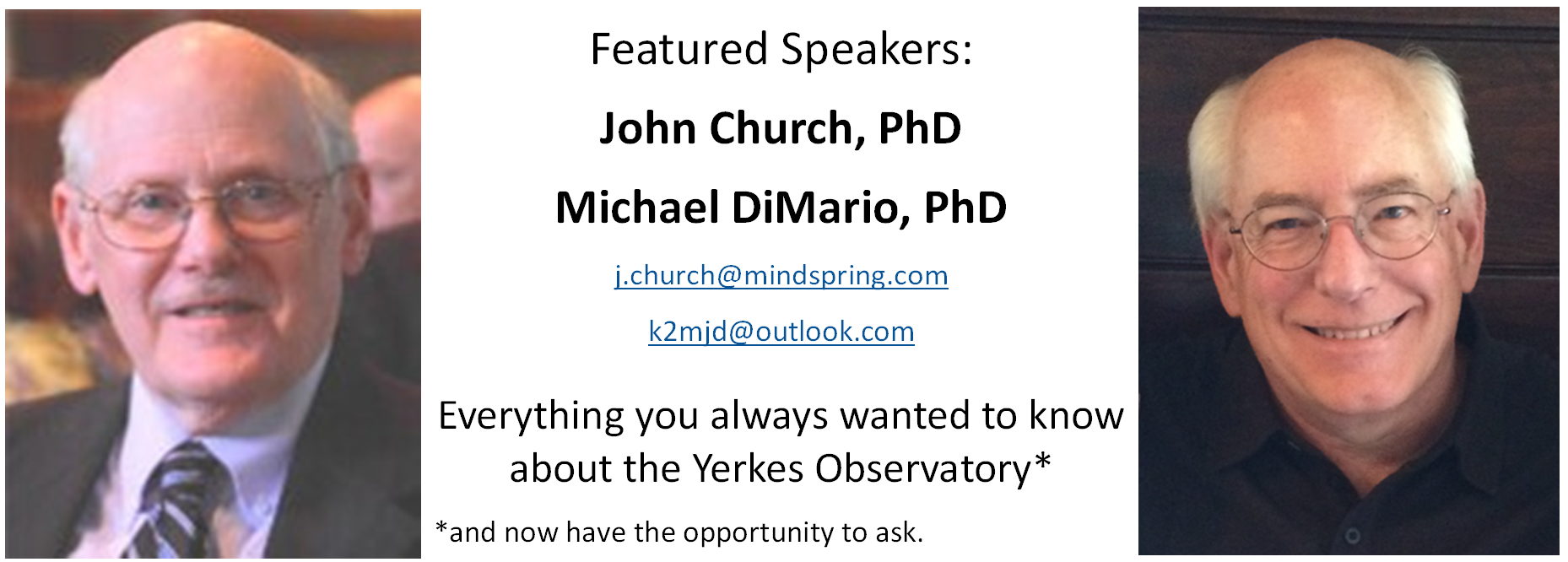
The October, 2023 meeting of the AAAP will take place in Peyton Hall on Tuesday, October 10th at 7:30 PM. As usual, the meeting is open to AAAP members and the public. Participants can join the meeting in-person at Peyton Hall or log in to the Zoom session as early as 7:00 pm to chat informally before the meeting begins. This evening’s guest speakers are AAAP members John Church and Michael DiMario. John will discuss the optical design of the famed Yerkes refractor, still the largest refracting telescope in existence. Michael will discuss the history of the observatory from its conception in 1892 to its recent revitalization.

Options for Attending the October Meeting

You may choose to attend the meeting in person or participate via Zoom or YouTube as we’ve been doing for the past few years. (See How to Participate below for details). Due to security concerns, if you log in before the host has set up internet connectivity in Peyton Hall, you may need to wait in the Waiting Room for a few minutes until the host is prepared to admit you into the meeting. You’ll need to unmute yourself to make comments or ask questions. It’s polite, though not required, for you to enable your camera so other participants can see you.

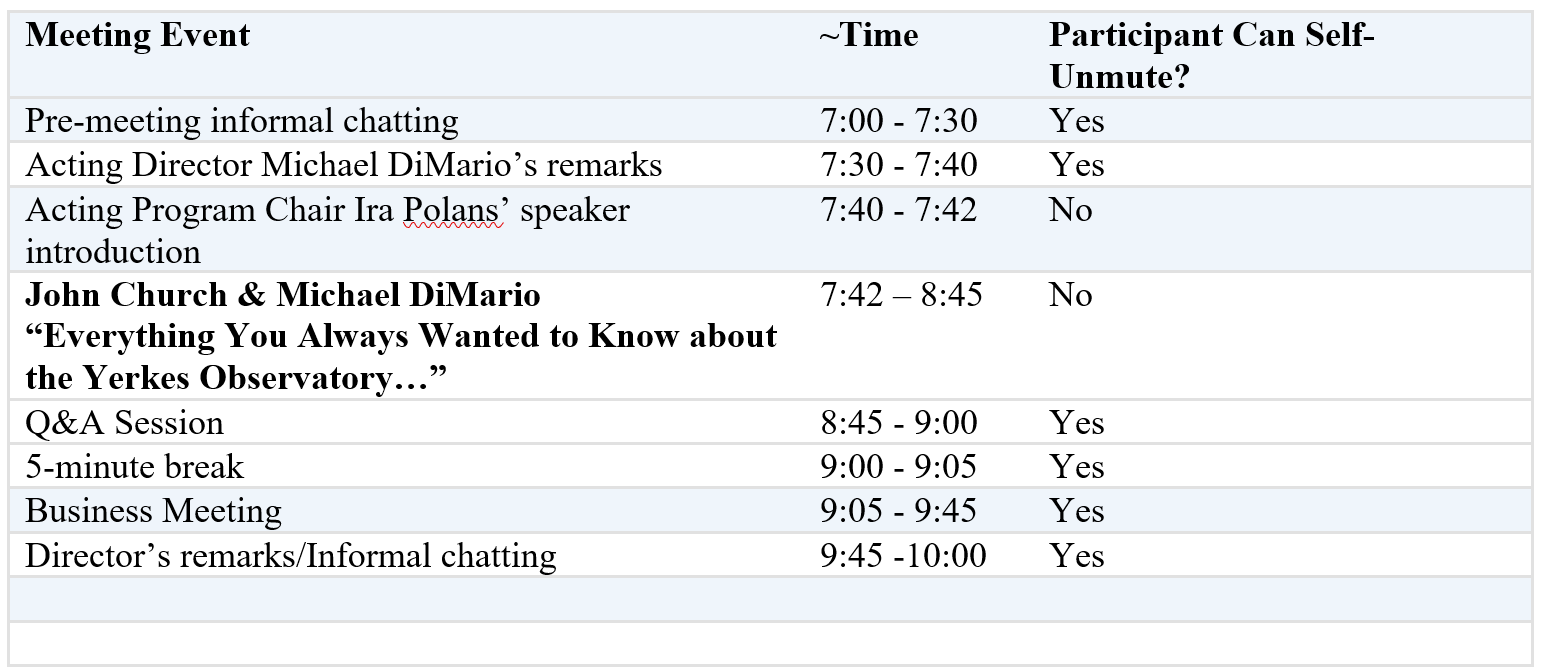
Here’s the anticipated agenda for October’s monthly meeting of the AAAP:

(Times are approximate)

“Meet the Speakers” at Winberie’s
Members are invited to attend the “Meet the Speaker” dinner at Winberie’s Bar and Restaurant before the meeting. Our reservation is for 5:45 pm. Please contact Acting Program Chair Ira Polans if you plan to attend.

Winberie’s Bar and Restaurant
1 Palmer Square E
Princeton, NJ
(609) 921-0700 princeton.winberies.com

Ira Polans, ipolans@princetonastronomy.org


Getting to Peyton Hall
The parking lots across the street (Ivy Lane) from Peyton Hall are now construction sites, unavailable for parking. We’ve been advised by the administration of the astrophysics department that we should park in the new enclosed parking garage off Fitzrandolph street and walk around the stadium and athletic fields. Here’s a map of the campus and walking routes from the parking garage to Peyton Hall. The map shows the recently completed East Garage. Not shown is an access road Sweet Gum that connects from Faculty Road to an entrance at the lower left corner of the garage. Stadium Road connects from Fitzrandolph Road to another entrance at the opposite corner (and higher level) of the garage. It’s about a 10-15 minute walk from the parking garage to Peyton Hall.

OCT-2023-Speakers

Optical Design and Characteristics of the Yerkes 40-inch Refractor
John will discuss the paths taken and not taken with the famed Yerkes 40-inch refractor; its basic optical design and what is known about the refractive indices and radii of its crown and flint elements. Building on a 1982 article he wrote for Sky and Telescope, Dr. Church will cover the various aberrations that can be deduced from the available data as well as those that would result from alternate radii that might have been used. He will also discuss how the objective’s performance would be affected by minor changes in the spacing of the lens elements. He’ll conclude by contrasting the design philosophies between the Yerkes Alvan Clark refractor and AAAP’s own Hastings 6 ¼ inch refractor.

John Church, PhD
A native of Richmond, John Church graduated from the University of Virginia with a bachelor’s degree in chemistry and then earned M.S. and Ph.D. degrees from Lawrence University in Appleton, Wisconsin.  His thesis work was concerned with the reaction of crystalline carbohydrate derivatives with oxygen under relatively mild conditions.  He spent his career in research and development with American Can Company at their Corporate R&D laboratory in Princeton and then with Colgate-Palmolive at their Corporate Research Center in Piscataway. He is now retired.

John is the author of sixteen scientific, historical, and technical publications, including several on the optics of refracting telescopes as well as one on close conjunctions of Jupiter and Saturn.  He holds ten U.S. patents and is the author of a book chapter on the chemistry of bleach. He has written three books and edited several others.  One of his Sky & Telescope articles traced the history of the 6 ¼ inch Hastings-Byrne refractor now installed in our observatory in Washington Crossing State Park, which he and many others helped build in the late 1970’s.

John has served as Assistant Director, Director, and Program Chair of the AAAP.  This September will mark his 53rd year as a club member.  His civic activities include presently serving on the West Windsor Township Zoning Board of Adjustment.  He is married and has three children and six grandchildren.

The History and Revitalization of Yerkes Observatory
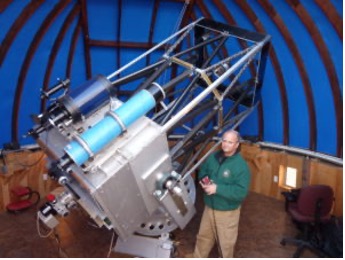
Mike will present the early history of the Yerkes Observatory from its construction in 1892 through two revitalizations in 1932 and 2020. He will describe the technologies used at its beginning and those still in use today. He’ll recount the use of the Edison dynamo the 15 ton observatory floor collapse 1n 1897, and give an overview of the present-day telescopes in three of the observatory’s domes.

Michael DiMario, PhD
Dr. DiMario is the founder and CEO of Astrum Systems, a global consulting venture focused on employing systems engineering methodologies in early research and development. Dr. DiMario holds an MBA in Management of Technology, an MS in Computer Engineering, and a PhD in Systems Engineering. He has completed significant course work in Space Science. Michael’s corporate career began at General Electric Medical. He served in several executive engineering roles at Bell Laboratories/Lucent Technologies, and at Lockheed Martin, from which he recently retired.

Dr. DiMario also operates a blog highlighting large university-based observatories including solar and radio-frequency telescopes. He has been granted five patents, is credited with numerous trade secrets, published a book and contributed a book chapter on systems engineering, and has written more than forty peer-reviewed papers on quantum magnetometry, systems engineering, and quality management. He has been interviewed by magazines including Wired, GPS World, Sifted, and Financial Times. He co-chairs the INCOSE Early Systems Engineering and Research Working Group, and leads AAAP’s astroimaging Special Interest Group. He holds an amateur radio Extra class license, call sign K2MJD.

How to Participate
Zoom Amateur Astronomers Association of Princeton is inviting you to a scheduled Zoom meeting.
AAAP-October 2023 Meeting-John Church & Michael DiMario-The Yerkes Observatory and the 40-inch Refractor

Topic:  AAAP-October 2023 Meeting-John Church & Michael DiMario-The Yerkes Observatory and the 40-inch Refractor
Time: Oct. 10, 2023 07:00 PM Eastern Time (US and Canada)
Join Zoom Meeting
https://us06web.zoom.us/j/85600238601?pwd=rLUESl9xxZVopM9HvX3WhIUeamZqK4.1
Meeting ID: 856 0023 8601
Passcode: 559172

AAAP webcast:  This month’s AAAP meeting, beginning with Rex’s opening remarks and ending at the beginning of the business meeting, will be webcast live on YouTube and recorded for subsequent public access on AAAP’s YouTube channel. Be aware that your interactions during this segment, including questions to our guest speaker, may be recorded for posterity.

Join YouTube Live to listen to the speaker using the link below –

Logo-with-play YouTubeAAAP October Meeting, 

A look ahead at future guest speakers:

November 14, 2023Dr. Gary Rendsburg
Distinguished Professor of Jewish Studies and History at Rutgers
Prof. Rendsburg will talk about “The Jewish Calendar,” with emphasis on its astronomical connections to lunar months, intercalated month to adjust to the solar year, festival days, and new moon observances. Suggested by Ira Polans.

Also, AAAP member Peter Wraight will show and discuss his 3D printed binoscope designs for which he won two awards for Mechanical Design at last year’s Stellafane convention.
December 12, 2023Dr. Mario Motta
Dr. Motta is a cardiologist and past president of AAVSO who uses his home-built 32” telescope to image various objects and to study variable stars. He will talk about building his telescope and the observations he makes with it. He would join the meeting via Zoom. Suggested by Michael DiMario.
January 9 2024Erika Hoffman

Graduate student, University of Maryland
ebhoff@umd.edu
Erika will describe her research using high-resolution x-ray spectroscopy to investigate ionized outflows from active galactic nuclei (AGNs). Suggested by Bill Thomas.
February 13 2024TBA
March 12 2024TBA
April 9
2024
Eclipse Observations
Since this meeting will take place the day after the Total Solar Eclipse of 08 April 2024, and many members will be out of town or returning from their trips, I’m suggesting that we host an online roundup of eclipse observations, with members (and perhaps others) Zooming in to share their experiences.
May 14
2024
Dr. Tea Temim

Research Astronomer, Princeton University Department of Astrophysics
Dr. Temim will describe her research using JWST imagery to study supernova remnants. Suggested by Gene Allen.
temim@astro.princeton.edu
June 11
2024
NJ State Museum planetarium’s Bill Murray, and Jacob Hamer, Assistant Curator

AAAP’s traditional annual pilgrimage to the NJ State Museum planetarium in Trenton, where members will experience a presentation and a preview of the planetarium’s latest sky show.

As always, members’ comments and suggestions are gratefully accepted and much appreciated.
victor.davis@verizon.net
program@princetonastronomy.org
(908) 581-1780 cell

The Out-of-Towners Just a note to let you know that Director Rex Parker and Program Chair Victor Davis will be out of the country in October, visiting different hemispheres. Michael DiMario has agreed to be Acting Director for the October meeting, and Ira Polans has agreed to be Acting Program Chair. Many thanks to each of them for stepping up so Rex and I can go gallivanting without worries.

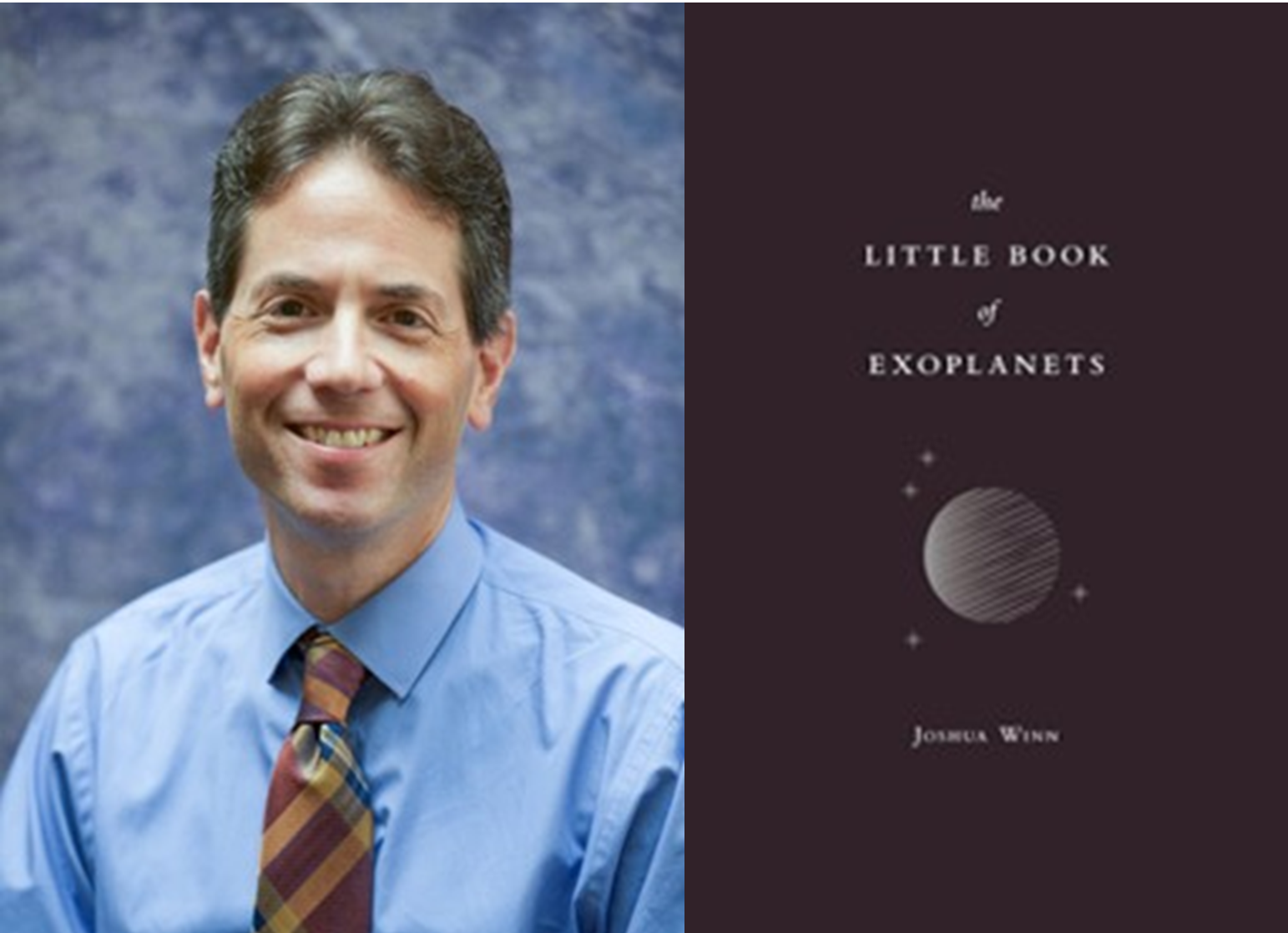
“Exoplanets: Science and Science Fiction” Now a Book!

Joshua_Winn_Book

Princeton astrophysicist Prof. Joshua N. Winn, AAAP’s guest speaker last December, has written a book based closely on his presentation to us. The book, “The Little Book of Exoplanets,” is written for the general public. The book describes what we know about exoplanets and how we know what we know about them.

The publisher’s link is:

https://princeton.edu/books/hardcover/9780691215471/the-little-book-of-exoplanets

Posted in October 2023, September 2023, Sidereal Times | Tagged , , , | Leave a comment

Minutes of the September 12, 2023 Meeting

by Gene Allen, Secretary

The meeting was convened in Peyton Hall by Director Rex Parker at 1930. His announcements included crediting India’s Chandraayan 3 lander with capturing the best images for his Lunar South Pole Observation Challenge, Member Dr. Bob Vanderbei’s excellent solar image using only the smoke from the Canadian wildfires instead of a filter, Rex’s plotting of the light curve as the M101 supernova has aged since its appearance on May 19. It has also turned much redder, as seen in both the images at the observatory on his heavily-attended Team 5 Public Night and in the data he collected for the light curve.

At 1943 Program Chair Victor Davis introduced Speaker Dr. Suzanne Staggs, Professor of Physics at Princeton University. Her lecture was entitled “Looking Backward with the CMB” and dealt with the discovery and the subsequent detailing of our knowledge of the Cosmic Microwave Background. After the talk, a few questions invoked very long answers.

The business meeting convened at 2120 with Member Peter Wraight describing of another impressive set of 3D printed right angle binoculars that he has built. These include a bracket for a smartphone running a planetarium program that is masked to match the 6.5 degree visual field. With a collimated laser pointer they serve as a simple but very effective non-electronic finder for a larger telescope.

Member Tom Swords was checking out a recently refurbished and collimated scope. When he used SkySafari to aim it at M39, there was a white streak across it because he had “show comets” turned on and comet C/2023 E1 Atlas was passing by. He had accidentally encountered and was able to image a comet!

The many Outreach events that have been requested were recapped again by Outreach Chair Bill Murray. While they have not been entered into the AAAP online calendar, they have previously been emailed to all members. He has adequate volunteers for most of the events, but members are still welcome to add on.

Rex wrapped up by sharing a special visit he managed to arrange to see the 20 inch refractor in the Van Vleck Observatory on the campus of Wesleyan University in Connecticut.

The meeting was adjourned at 2150.

We had 33 attend the speaker in person and 30 online. During the business meeting we had 17 remain in person and 18 continued with us online.

Membership currently numbers 205, with 40 having joined in 2023. There have been 80 renewals while 30 have allowed their membership to expire, giving us a 73% retention rate.

Posted in October 2023, Sidereal Times | Tagged , | Leave a comment

Minutes of the September 5, 2023, Board Meeting (Online)

by Gene Allen, Secretary

The meeting was convened at 1930 on Zoom by Director Rex Parker with the agenda for the evening. All other board officers were present: Assistant Director Larry Kane, Treasurer Michael Mitrano, Program Chair Victor Davis, Observatory Co-Chairs Dave & Jen Skitt, Outreach Chair Bill Murray, and Secretary Gene Allen. Other leaders in attendance were Editor Surabhi Agarwal, Promotions Chair Debbie Mayes, Astrovideo Chair Michael DiMario, and former Program Chair Ira Polans.

Monthly Meetings in the Peyton Hall Auditorium

Victor Davis will be the designated contact person for access to Peyton Hall. Our welcome was renewed by Department Manager Susan Duncan and Events and Communications Coordinator Stephanie Reif. They advised that class schedules, which have priority for use of the auditorium, will be available mid-September and offered a refresher on the use of the new A/V equipment. Dave Skitt and Ira Polans will schedule a session and Gene Allen offered to attend and provide backup/assistance. Dave requested that doors be unlocked by 6pm to allow him more time to get set up. He said some members start arriving by 6:30. We were all in agreement that we need to provide an electronic version of in-person meetings for those physically or geographically unable to attend. Making a recording for later display on YouTube prevents live participation but will be considered as a possible alternative to Zoom transmission.

Program Update

Victor recapped the speaker schedule published in Sidereal Times and brought up that a couple of our upcoming speakers will be Zooming in rather than presenting in person unless we are unable to handle the technicalities of double Zooming. He pointed out that our April meeting date is the day after the solar eclipse when many of us will be dispersed throughout the country and suggested that members Zoom in with their experiences.

Observatory Update

Dave reported that the first of two benches is popular with attendees but storing it inside is awkward and risks damaging the scopes. Permanent mounting outside presents an undesirable additional challenge to mowing and trimming. He will look into finding a way to hang them under the roof rails on the north side of the building.

Some testing of filters was accomplished during the previous public night, but it was so well attended that another opportunity is needed to decide on which ones the club should purchase.

Dave is planning a solar observing session from 1300-1600 on September 16 for members, family, and friends. It is not to be advertised to the general public.

It was suggested that the observatory be opened and staffed for the partial solar eclipse on October 14.

Outreach Update

Rex and Bill will appeal to Keyholder and Members to bring scopes to support a number of star party requests over the next few months. Bill indicated that if he does not get an adequate number of volunteers promptly, he will withdraw from participating in the event.

Promotions Update

Debbie reported that social media is contributing to attendance as well as the website. She created a couple of draft flyers advertising our monthly meeting and public nights at the observatory and sought approval to employ a professional graphic designer to amp them up. Officers pointed out that as a designated leader she may spend up to $1000 for flyers or other promotional materials before any board approval is required.

Everyone acknowledged that our website is functional but dated. Maintenance is challenging due to accumulated layers of uncommented and confusing code. Surabhi pointed out that WordPress web-building software is already available on our server. The approach would be to create a new website alongside the existing one and swap over when we are satisfied with it. Michael DiMario shared that both Delaware Valley and Southwest Florida astronomy clubs have much more appealing sites. Rex designated Debbie to lead a team of Surabhi, Jeff Pinyan, and Michael DiMario to begin the long and difficult process. John Miller’s long history of the creation and maintenance of the website and its hosting was acknowledged but no one thought it appropriate to formally burden him with this challenge given his continuing health struggles.

Astroimagers Update

Michael reported that while there are 44 members in the group, very few participate and there is disappointingly little traffic on Groups.io compared to some other small clubs. It was pointed out that many of the members are only aspiring astroimagers, and Michael realized that “how to” sessions might be popular. Larry suggested competitions but Michael countered that the same few experts among us would easily always win.

This and That

A bronze plaque honoring the memory of the late Gene Ramsey has been proposed. He served as Observatory Chair for many years, and those of us he trained would agree that he was our most passionate and dedicated outreach ambassador ever. Victor agreed to wordsmith an appropriate tribute. A source for a bronze version of a popular photo needs to be identified. His surviving family members would be invited to its dedication.

At Michael Mitrano’s suggestion the board voted to end our post office box lease. Infrequent mailings can be directed to his home or checks can be handed to him at meetings. Website pages will need to be revised.

Surabhi reported that a high school senior, Yugandhara Luthra, has volunteered to be an editor for the Sidereal Times. A bio and photo were published at:

< https://princetonastronomy.com/2023/03/05/introducing-new-student-member/ >.

An available eclipse ambassador outreach opportunity that includes training was brought up by Ira. Anyone interested should contact him for details.

The meeting was adjourned at 2127.

Submitted by Secretary Gene Allen

09/09/2023

Posted in October 2023, Sidereal Times | Tagged , , | Leave a comment

Equipment For Sale

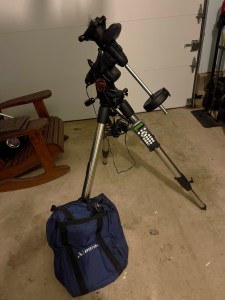
Member Joseph Matthews has an
1. AVX Mount,
2. TriPod,
3. Counter Weight,
4. Hand Controller
5. Travel Bag
to sell.  He also has the original packing and can pack it up if needed.

He is looking for $300 or best offer.

Please send him an email at  jwmatt55@icloud.com if you are interested.

Posted in October 2023, Sidereal Times | Tagged , | Leave a comment

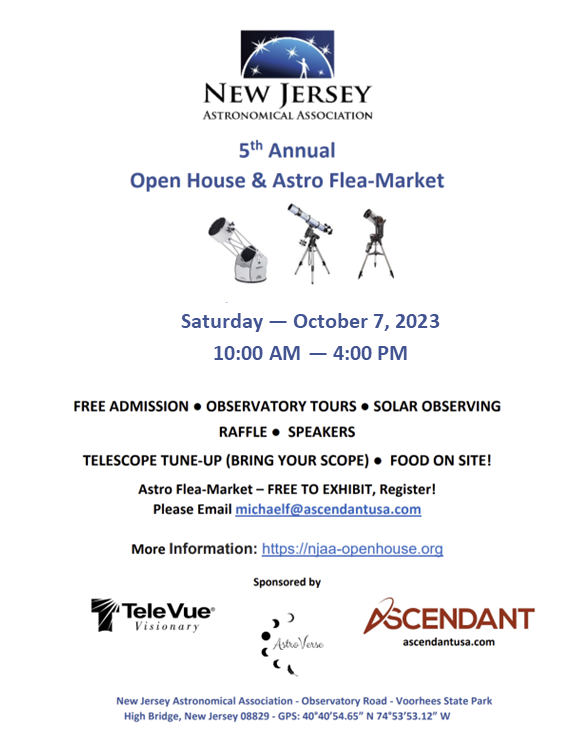
NJAA Update

Posted in October 2023 | Tagged | Leave a comment

Introducing New Member

I am Purnendu Gupta. an engineer and MBA by training, a management consultant by profession and a backyard astronomer by passion. I have been doing astrophotography for a few years and have discovered AAAP a few months ago and attended some in person and online events. I write an astro blog to document my learnings about the objects I photograph, the science and the people behind them. My observations are mostly from my backyard in Monroe, New Jersey using primarily a Mak-Cassegrain scope. My most recent notable astro adventure was the serendipitous pre-discovery imaging of a new Supernova 2023 ixf in M101 Pinwheel Galaxy in May 2023, a few hours prior to the official discovery. Some more public domain mentions can be found here. I am thoroughly enjoying the sessions and talks organized by AAAP and looking forward to more of them.

Posted in October 2023, Sidereal Times | Tagged | Leave a comment

The Last Sunset: A Final Bloom

by Purnendu Gupta

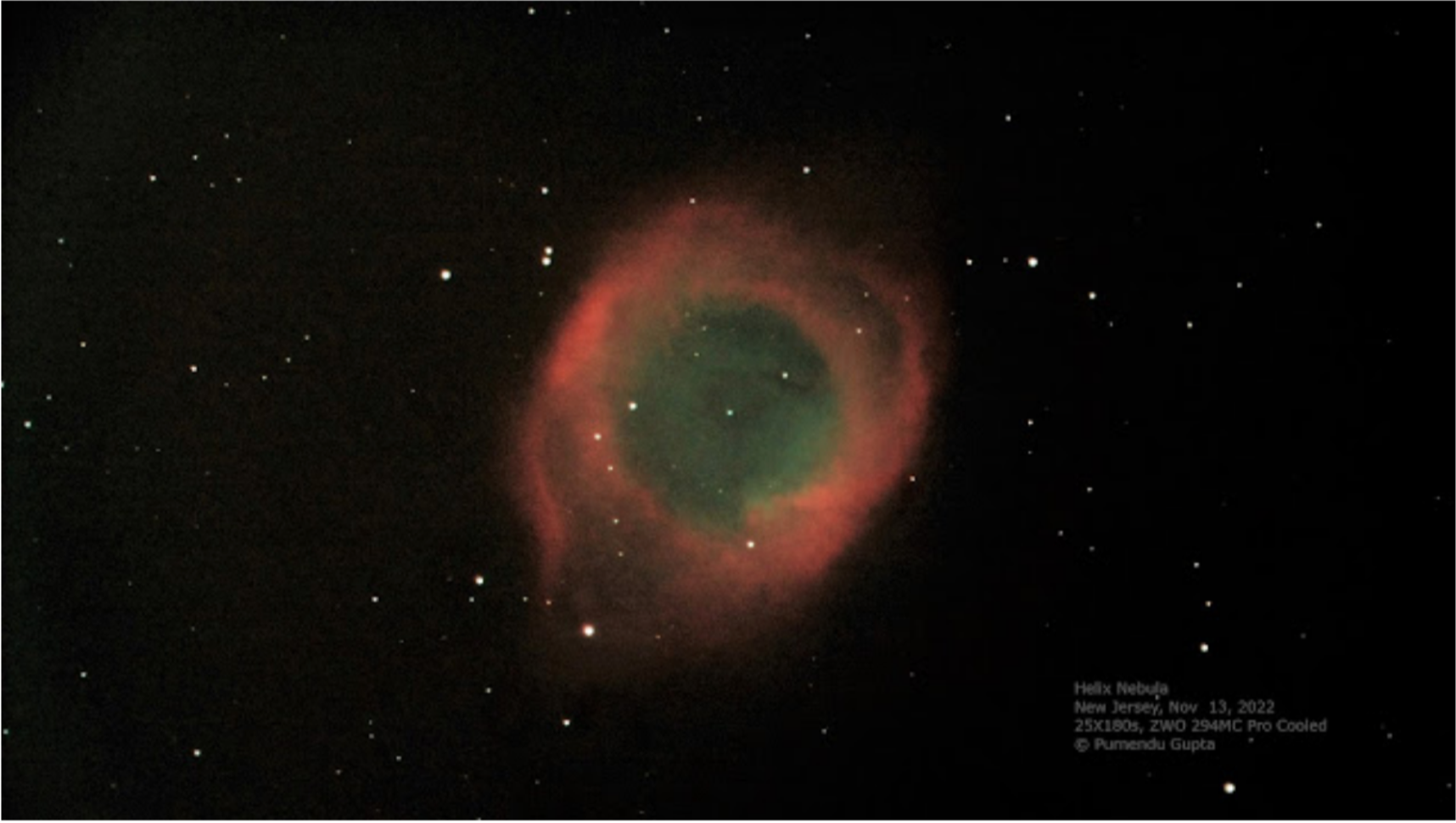
Helix Nebula (Eye of God). © Purnendu Gupta

End of Days

Where do stars like the sun go when they die? At five billion years old, our sun is a middle aged star. In the stellar spectral classification it is also a middle class, yellow star; neither too hot nor too cold.. When stars of this type reach the end of life, they do what humans do at the end of their working lives. They retire.

That’s right. They do not explode into a supernova like their big brothers, or collapse into black holes like their superstar cousins. They gently walk into … the sunset. And when they do, they leave behind what is known as a planetary nebula like the one you see in the image above. The Helix Nebula is also known as the Eye of God, for its unique shape. The nearest example of its kind, it is at about 650 light years distant in the constellation of Aquarius.

I took the image above from my backyard in November of 2022 using a five inch Maksutov-Cassegrain scope. This is light gathered over an hour and a quarter using a narrowband filter.

The image below is a false-color composite of the same object in visible and invisible “light” as seen by four special purpose NASA telescopes that see in different wavelengths. These include Infrared (Spitzer), optical (Hubble), UV (Galaxy Evolution Explorer) and X-Ray (Chandra) telescopes.

Helix Nebula, Composite X-Ray, UV, Optical, Infra Red. Source: NASA

Stars are nuclear fusion reactors that exist at a self adjusting balance between the inward pull of gravity and the outward pressure of hot fusing matter. A bit like a balloon that exists at the sweet spot between the compressing force of its skin, and the expanding force of the air inside. It first lights up when fusion is triggered in the core of the proto-star, among the simplest atom of all – primordial Hydrogen that has atomic number one. This is forced by enormous gravity to combine with its neighbor transforming into the next heavier element in the Periodic Table, Helium, with atomic number two. As Hydrogen is exhausted, three of these Helium atoms will combine to form Carbon with atomic number six and so on. The nuclear alchemy goes on to magically cook heavier elements from lighter ones releasing energy in the process.

About 12,000 years ago, the progenitor star of the Helix nebula started to run out of its hydrogen fuel. The star cooled some and lost some of its ability to hold itself up against gravity. The core shrank, and the outer layers slipped away from its grip into space cooling and expanding into a red giant. This was the end of the “middle class sun” phase of life of the star. Any planets that may have existed in that solar system experienced the last sunset as the red giant engulfed the inner planets.

The Star Within a Star

Once the outer veil got lifted what lay exposed was the star’s stopped nuclear engine. While no longer undergoing fusion, it is held up by another force known as electron degeneracy pressure. A bright core made mostly of a soup of electrons, carbon nuclei and some other elements, on its way to becoming a white hot midget star – a white dwarf.

A white dwarf contains about half the mass of the original star but is compressed by gravity into a ball merely the size of the earth or only 1/100th of the sun’s original diameter. As a result the densities are enormous. A teaspoon could weigh as much as an average car on earth. For comparison, a spoonful of the sun’s core would be much lighter at only 750 grams. By the time the white dwarf forms, the expelled shell has not had time to go very far – and is perhaps a light year or two away from the core. Instead of being a perfect sphere, the expanding shell takes on beautiful shapes due to pre-existing asymmetries. The radiation from the white dwarf core lights up the expanding gas in concentric shells of colors. The Hydrogen glows red and the Oxygen glows blue and green.

Our sun is expected to have a similar fate. In its first red-giant phase after all hydrogen is exhausted, it would engulf the orbits of Mercury and Venus. The next phase would comprise of a helium burn and as that fuel exhausts as well, it would undergo a second red giant phase known as a Asymptotic Giant Branch (AGB) red giant on the HR (Hertzsprung-Russell) diagram of stellar evolution. At this time it is expected to have a radius of once astronomical unit (1 AU), and will engulf the orbit of the Earth.

Eventually the sun will “retire” as a white dwarf that will last many tens of billions of years cooling very slowly. But before that happens, for a few thousand years, it will form a planetary nebula like the Helix. The whorls of colorful gas around it will expand into space and fade away relatively quickly, like a cosmic flower in final bloom. To an alien astronomer, this may be the only reminder that we were ever here.

Imaging Specs:
————————
25x180s light frames (total 1 h 15 min integration) with calibration frames. Optolong L-enhance narrowband filter. ASI294MC Pro cooled camera. Guided exposure with Celestron 127 SLT Mak-Cass on Celestron AVX mount

Posted in October 2023, Sidereal Times | Tagged , , , | Leave a comment

Point of View

by John A. Church

“You’re home early, Dad!”
“We only work half days at the office now because of the pandemic. I stopped on the
way home to get you something because I know how much you like astronomy.”
“Thank you! I bet it’s a telescope.”
“You’re right. Tonight’s going to be clear and we can try it out.”
“Can I see it?”
“Sure, let’s go inside and set it up.”
It was a small refractor, a good starter scope for a youngster. They positioned it on its
tripod and the father showed his child how to point and focus it. They could both hardly
wait for darkness to fall so that they could begin exploring the night sky. There was no
moon that evening, so it would be a good chance to get better acquainted with the
constellations.
After dinner they went outside and got oriented to the sky. The child looked up and said,
“I see a constellation that looks like a man. He has a belt of three stars and two other
bright ones near an arm and a leg.”
“Yes, and if you look real close you might even see a sword hanging from his belt. Point
your telescope at it and tell me what you see.”
“It’s kind of hazy. There are some faint stars inside it. What is it?”
“It’s called the Great Nebula. Some new stars are actually being formed within it right
now.”
“New stars? Do stars get born all the time? Do they die?”
“Yep. Just like us. But they live a lot longer than we do.”
“I’d like to have my own star that I could watch and make sure it doesn’t die. Can I have
one?”
“Absolutely! Why don’t you look around and pick one out. Try to get a smaller one that
nobody else will notice. That way it can be your own star.”

“OK, I think I’ve got one. I can just barely see it without the telescope. Do you think
that it might even have planets going around it like we have here? I’ve been reading that
astronomers have found that some other stars actually do have planets, but the ones that
they know about are mostly not very good places to live.”
“Well, this one might have planets. Who knows, maybe even life.”
“Can I name my own star?”
“Of course.”
“OK, I’ll call it Sol. Thank you for the telescope! Let’s go back inside and have a nice
cold glass of ammonia to celebrate!”

Author’s note: This story takes place on a fictional planet orbiting Gamma Serpentis, an
F6-type star about 37 light-years from Earth. In stellar mythology, it’s in the head of the
giant serpent being held by Ophiuchus. From there, our tiny Sol would be only a fifth
magnitude star, lost among the multitude of many brighter ones.

The Great Nebula (M42) is about 1340 light-years away. Rigel and Betelgeuse are about
870 and 600, and the three belt stars 1200 to 2000. Orion should look much the same
from this planet as it does from Earth, but somewhat smaller. Sol should be several
degrees away from Rigel. For Star Trek fans, Gamma Serpentis was near the heart of
Federation space.

I’ve worked with liquid ammonia, which boils at about 33 degrees below zero Celsius
under local atmospheric pressure. Ammonia-based life forms have been hypothesized. A
1962 New Yorker cartoon showed a crashed alien thirsting for it in a desert.
Apologies to anyone who may have already written a story similar to this one.

Posted in October 2023, Sidereal Times | Tagged , | Leave a comment