It’s the End of a World as We Know It Astronomers have witnessed a star gobbling up a planet, offering the first direct glimpse of a gnarly process called planetary engulfment that most likely awaits Earth in the deep future. Scientists serendipitously spotted a gas planet — like Jupiter but possibly larger…more
-NYT
This Is Not an Extraterrestrial Signal. This Is Just a Test. In the 1997 movie “Contact,” Jodie Foster plays an astronomer, Ellie Arroway, who detects an alien radio signal from outer space. Eventually the fictional Dr. Arroway goes on a trip through hyperspace to commune with an alien presence appearing in the form of her dead father…more
-NYT
The United Arab Emirates Is Heading for the Asteroid Belt Building off the success of its Hope spacecraft, which is still circling and studying Mars, the United Arab Emirates announced on Monday plans for an ambitious follow-up mission: a grand tour of the asteroid belt…more
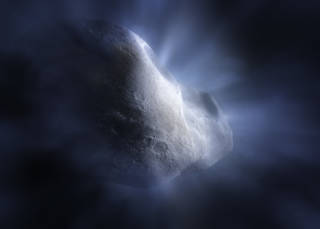
Comet Tempel
NASA’s Webb Finds Water, and a New Mystery, in Rare Main Belt Comet NASA’s James Webb Space Telescope has enabled another long-sought scientific breakthrough, this time for solar system scientists studying the origins of Earth’s abundant water. Using Webb’s NIRSpec (Near-Infrared Spectrograph) instrument, astronomers have confirmed gas – specifically water vapor…more
-NASA
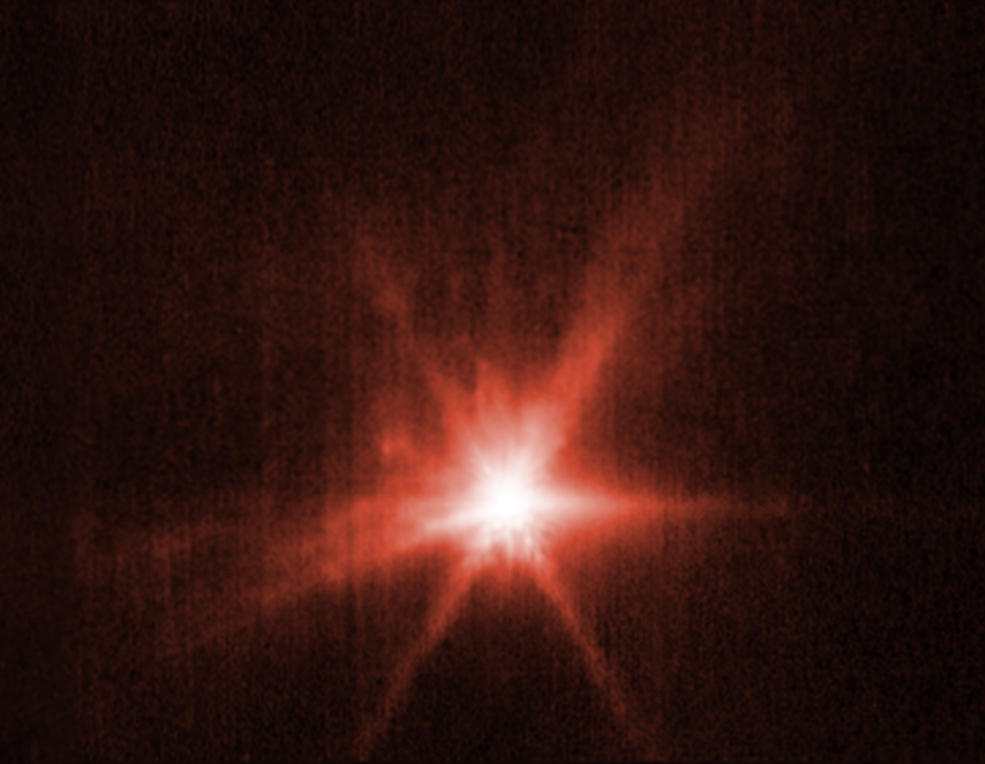
Webb, DART Missions Win AIAA 2023 Premier Awards The American Institute of Aeronautics and Astronautics (AIAA) honored NASA’s James Webb Space Telescope and Double Asteroid Redirection Test (DART) missions and contractors as three of the 2023 recipients of its most prestigious awards, the AIAA Premier Awards. The awards recognize the individuals in aerospace AIAA deems as most influential and inspiring…more
-NYT
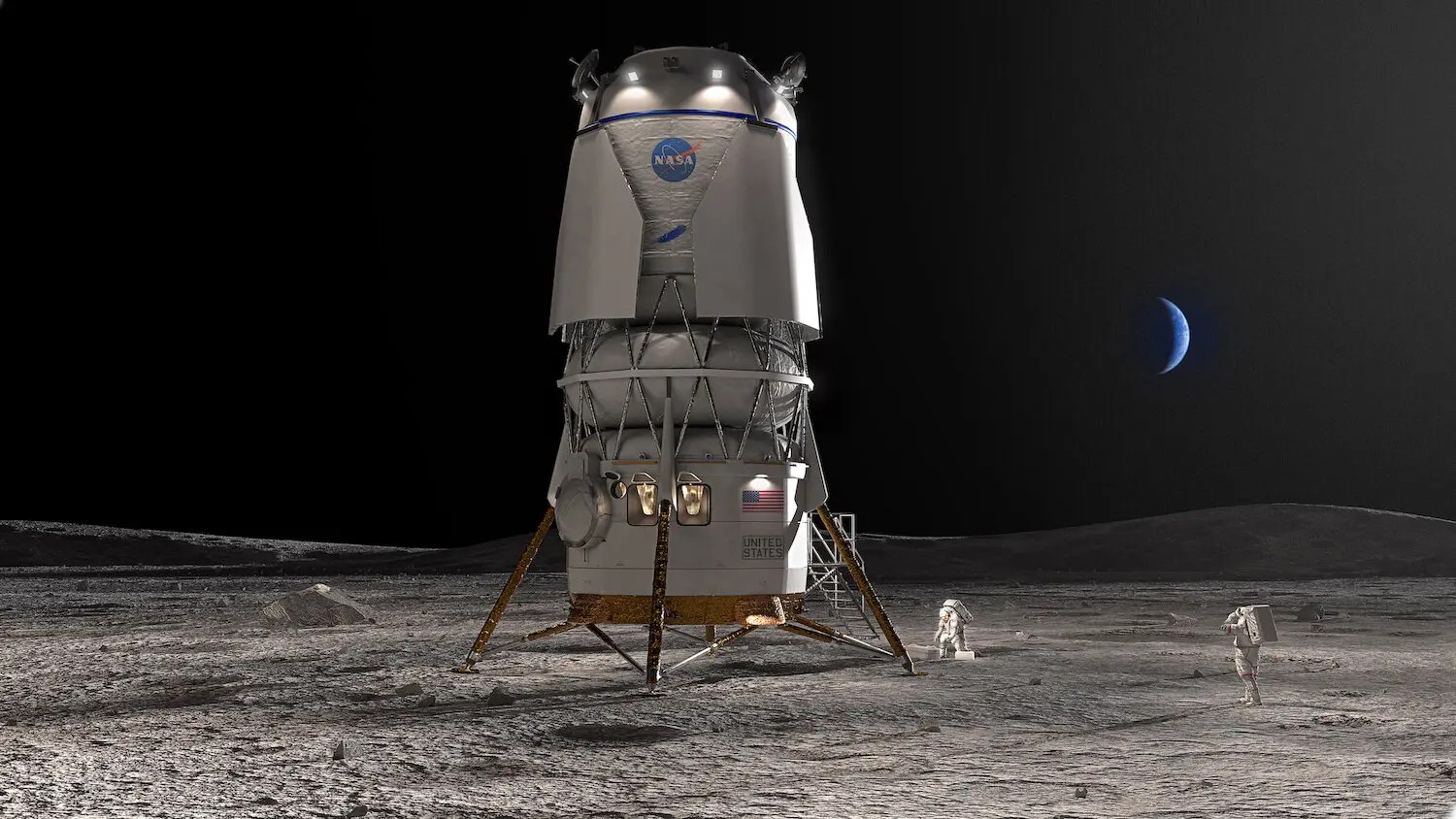
NASA Picks Blue Origin’s Blue Moon Lander for Artemis V Mission On their second try, Jeff Bezos and his rocket company have won a contract to take NASA astronauts to the moon. NASA announced on Friday that it had awarded a contract to Mr. Bezos’ company, Blue Origin, to provide a lunar lander for a moon mission that is scheduled to launch in 2029…more
-BBC
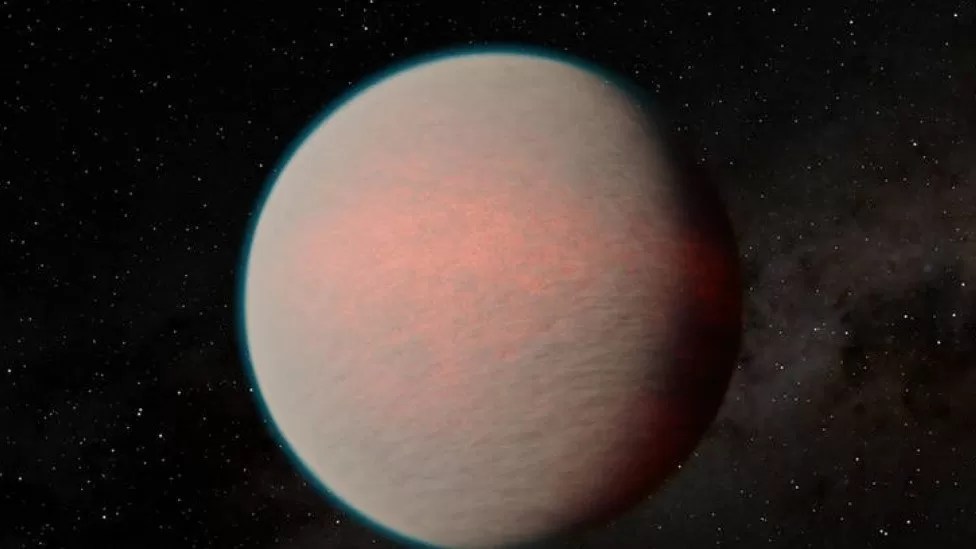
Scientist makes alien weather forecast for distant planet A scientist’s “alien weather forecast” for a distant planet has helped a NASA-coordinated team gain a new understanding of it. Dr Michael Roman, from the University of Leicester, made the observations about the atmospheric conditions on the planet GJ 1214b, which was discovered in 2009…more
-Nature
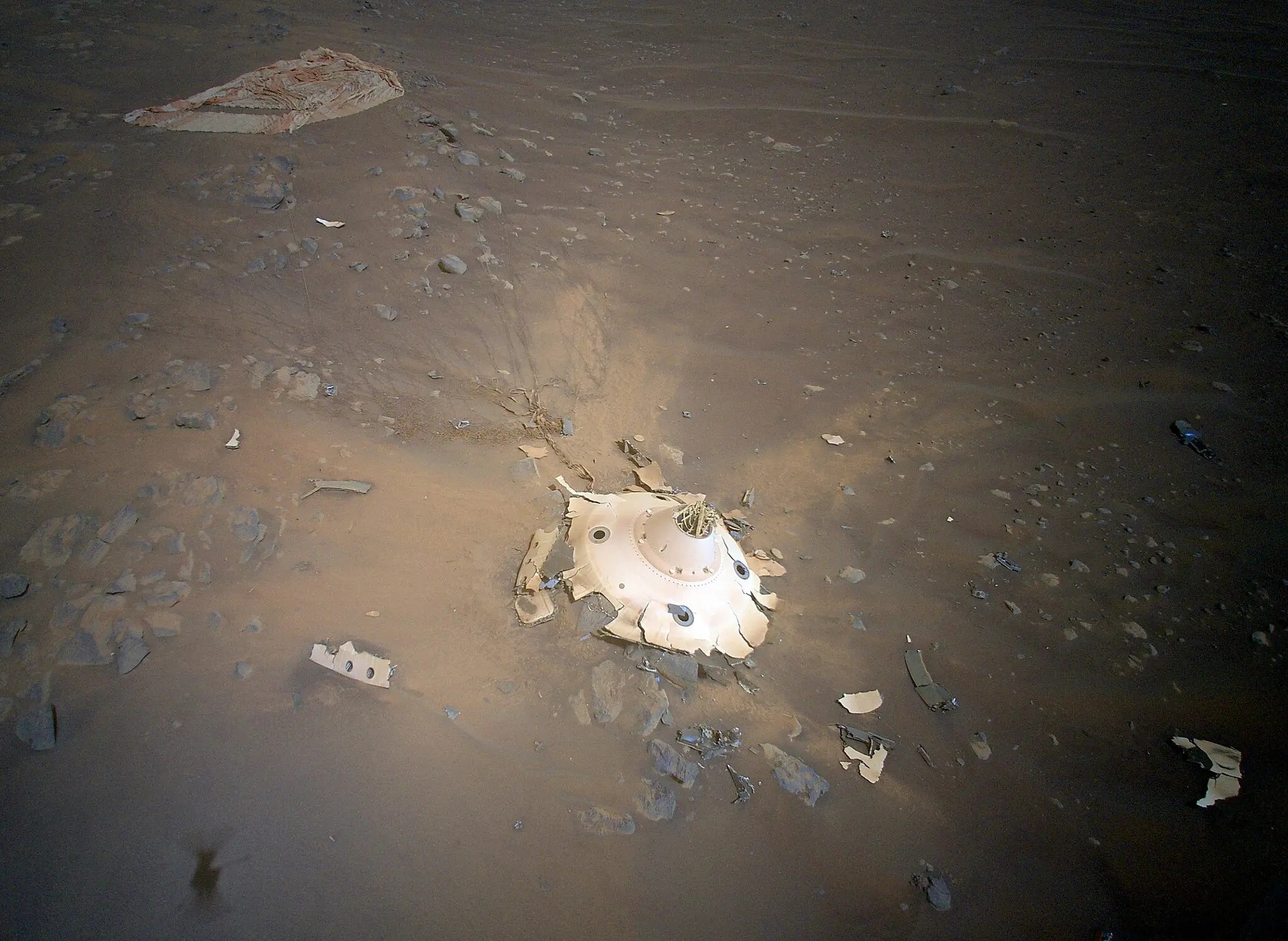
NASA Sees ‘Otherworldly’ Wreckage on Mars With Ingenuity Helicopter The object resembles a flying saucer that crashed on Mars. And indeed it is. But it doesn’t belong to aliens. Instead, the wreckage is the work of NASA, a component called a backshell that detached during the landing of the Perseverance rover on the surface of the red planet in February 2021….more
-BBC
James Webb telescope: Icy moon Enceladus spews massive water plume Astronomers have detected a huge plume of water vapour spurting out into space from Enceladus, an icy moon of Saturn. The 504km-wide (313 miles) moon is well known for its geysers, but this is a particularly big one. The water stream spans some…more
-BBC
Welsh space firm devises ‘shuttlecock’ heatshield A Welsh space start-up has developed a novel heatshield to enable it to re-use satellites brought back to Earth. It’s a large flexible sheet that can be folded tightly for launch but then spring out like a shuttlecock to protect a spacecraft when it returns. Cardiff-based Space Forge…more
-BBC
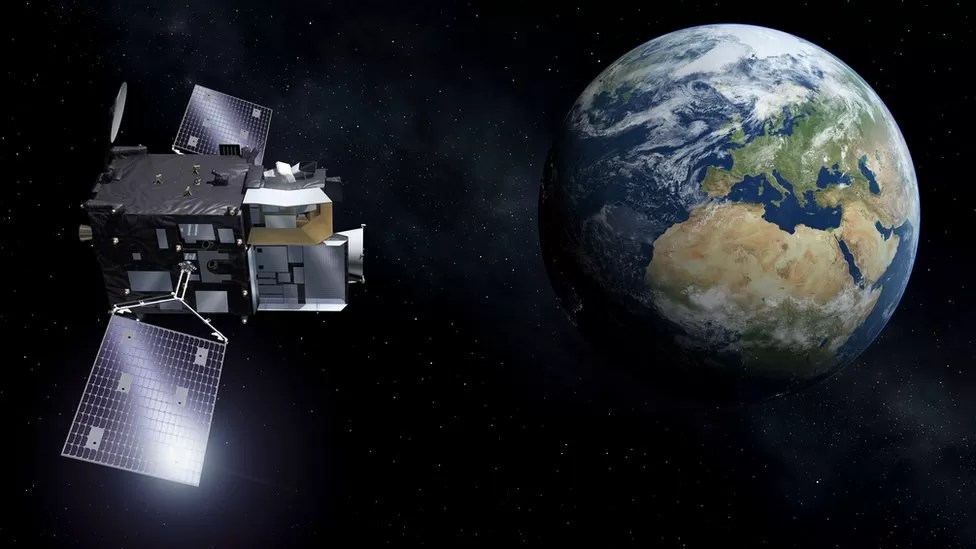
Meteosat-12: Europe’s new weather satellite takes first photos The first images from Europe’s new weather satellite, Meteosat-12, have just been released. The spacecraft, which sits 36,000km above the equator, was launched in December and is currently in a testing phase that will last most of this year…more
-NASA
NASA’s Webb Space Telescope Peers Behind Bars A delicate tracery of dust and bright star clusters threads across this image from the James Webb Space Telescope. The bright tendrils of gas and stars belong to the barred spiral galaxy NGC 5068, whose bright central bar is visible in the upper left of this image – a composite from two of Webb’s instruments…more
by Rex Parker, PhD director@princetonastronomers.org
May 9 Meeting – Election of Officers. Through our 60-year history we have elected officers (the Board of Trustees) for new 1-year terms at the May meeting as provided in the by-laws. Nominations committee chair Lee Sandberg has reported that each of the current officers is willing to serve again, forming a slate for the election. The 7 candidates for the Board positions are Rex Parker (Director), Larry Kane (Assistant Director), Michael Mitrano (Treasurer), Gene Allen (secretary), Victor Davis (Program Chair), Dave Skitt (Observatory Chair), and Bill Murray (Outreach Chair). For your information, the constitution, by-laws, and position descriptions are on the website https://www.princetonastronomy.org/club_by_laws.html.
After the Break. The tradition each month is for a member to give an Unjournal Club, a ~10 minute excursion into astro thoughts and activities, to begin the second half of the meeting. I call upon you to consider doing an Unjournal Club presentation to help the club as well as yourself get a little more involved in the flow of astronomy in AAAP. You can use PowerPoint slides, JPEG’s, astro-images, travel pictures, book reviews — your imagination is the limit (note: no need to bring a laptop computer, simply bring a USB memory stick). To get onto the schedule for an upcoming meeting, please contact me or the program chair.
Insects Share a Big Problem with Astronomers. Excess night lighting is as damaging to small flying creatures as it is for astronomers. As the stars fade from view we are blinded from seeing ourselves in relation to the cosmos, losing our perspective — just as moths are trapped in the glare of lamps. Entomologists are reporting that the decline of insect populations around the world is related to excess outdoor lighting at night. Why are insects drawn to light to their demise? This question becomes highly relevant amid recent increases in light pollution and the decline of insect populations, which threatens to crash entire ecosystems for which insects are an essential major component.
The underlying biological mechanism for nocturnal insects’ attraction and rapid flying around flames and lamps, often to their demise, has been difficult to determine. The 3-D tracking of small moving objects in low light is technically difficult (a challenge well-shared by astro-imagers), and necessary tools did not exist before. Previous theories include lunar navigation, escaping towards light as if it were a “gap” in the foliage, and blinding of sensitive eyes. All flying animals need a reliable way to determine orientation to the external world, especially with reference to the direction of gravity. Throughout insects long evolutionary history, the sky has been the brightest part of the visual field, making it a robust indicator of “up”. This is true also at night, especially at short wavelengths.
A new report (posted April 12, 2023) on BioRxiv, the preprint server for biology, provides novel insight to how this happens (Fabian et al., Why flying insects gather at artificial light | bioRxiv). This paper caught my eye upon return from a nature tour of Costa Rica – the authors’ field studies were conducted at Monteverde in Costa Rica. Fabian and colleagues used high-speed (500 fps) and high-resolution imaging in the field and lab to study the kinematics of insect flights around artificial light. They show that artificial point light source induces abnormal flight behavior in insects. But contrary to expectations of attraction, insects do not steer directly toward the light. Rather, they turn their backsides toward the light and fly perpendicular to the light source. They consistently fly orthogonal to the light source. Under natural sky light this dorsal tilting maintains proper flight attitude and control. But near artificial lamps, the dorsal light response causes steering around the light and traps the insect in endless loops.
The authors conclude that the dorsal tilting causes the erratic flight paths of insects near lights, providing the most plausible model for why flying insects gather and become entrapped at artificial lights. They suggest that light entrapment of insects at a local scale is due to a corruption of the insect’s attitude control rather than navigation. Bright nearby lights disrupt this mechanism and cause unintentional course alterations in insect flight. Reducing bright, unshielded, and upward facing lights will mitigate the impact on flying insects, simultaneously helping restore the sky to our own eyes and telescopes.
Welcome to Peyton Hall The May, 2023 meeting of the AAAP will take place IN PERSON on Tuesday, May 9th at 7:30 PM. As usual, the meeting is open to AAAP members and the public.
Options for Attending the April Meeting You may choose to attend the meeting in person or participate via Zoom or YouTube as we’ve been doing for the past few years. (See How to Participate below for details). This evening’s guest speaker is Alain Maury, discoverer of asteroids and operator and tour guide of a visual observatory in the pristine skies of Chile. He and his wife will join us for a “Meet the Speaker” dinner at La Mezzaluna restaurant in Princeton’s Palmer Square, then join us in Peyton Hall for his presentation “The Hunt for Near Earth Asteroids.”
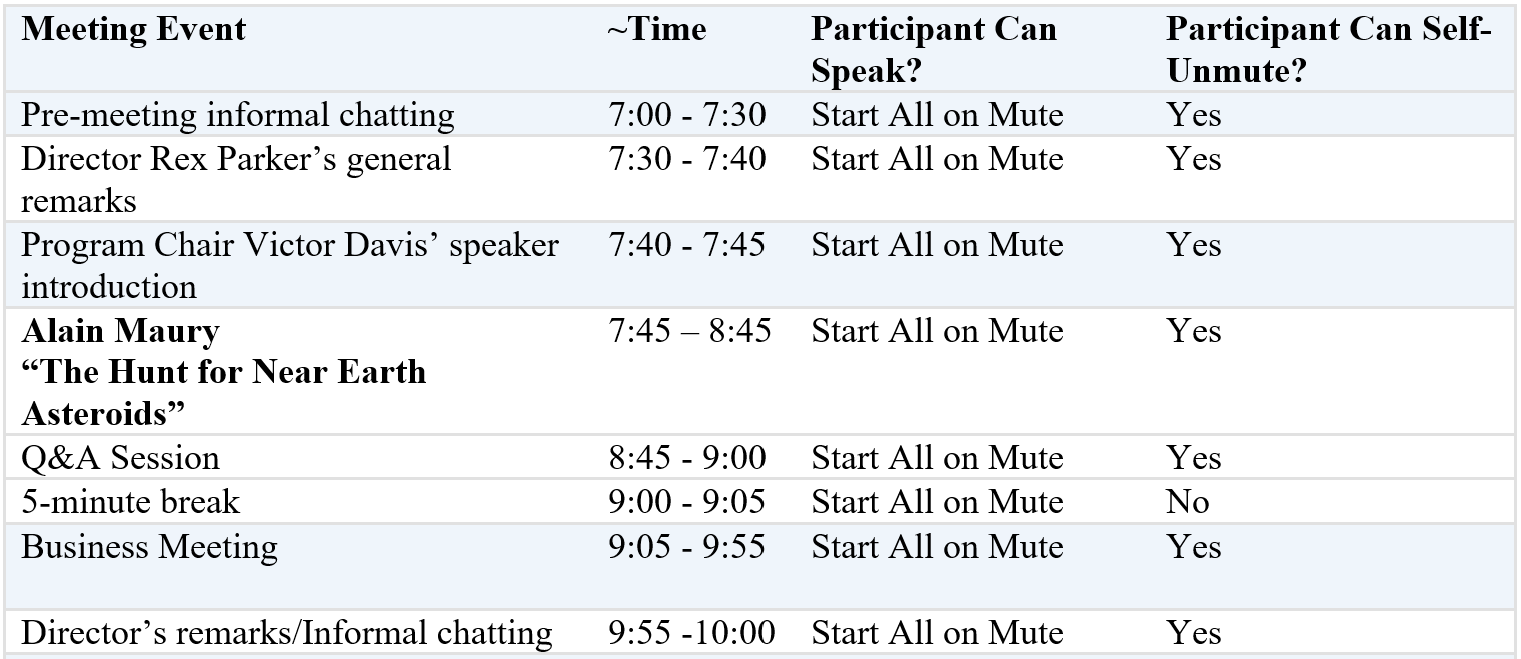
Here’s the anticipated agenda for May’s monthly meeting of the AAAP:
(Times are approximate)
Getting to Peyton Hall The parking lots across the street (Ivy Lane) from Peyton Hall are now construction sites, unavailable for parking. We’ve been advised by the administration of the astrophysics department that we should park in the new enclosed parking garage off Fitzrandolph street and walk around the stadium and athletic fields. Here’s a map of the campus and walking routes from the parking garage to Peyton Hall. The map shows the recently completed East Garage. Not shown is an access road Sweet Gum that connects from Faculty Road to an entrance at the lower left corner of the garage. Stadium Road connects from Fitzrandolph Road to another entrance at the opposite corner (and higher level) of the garage. It’s about a 10-15 minute walk from the parking garage to Peyton Hall.
Featured Speaker: Alain Maury Asteroid Discoverer and Observatory Operator and Guide amaury2020@spaceobs.com
The Hunt for Near Earth Asteroids Astronomers, admittedly not reputed for their robust sense of humor, sometimes joke that the world would be a very different place if the dinosaurs had in place a space program sixty-five million years ago. The dinosaurs’ demise, along with seventy percent of all species of life on Earth, plus more recent harbingers such as Comet Shoemaker-Levy 9 at Jupiter a few decades ago, motivated several apocalyptic (and abysmally bad) movies and an interest in discovering and characterizing Near Earth Asteroids (NEAs). Astronomers believe that with enough lead-time, perhaps measured in decades or centuries, potentially catastrophic impacts could be avoided by nudging dangerous objects away from Earth-intersecting trajectories. At the dawn of the space age, 20 Near Earth Asteroids were known; in 1980, the number reached 50. In 2000 we reached 1000 known NEAs. In 2022, we passed the 30000 mark, and counting… Mr. Maury will describe his own experience of how this revolution occurred, and why discovering more and smaller near earth asteroids is important.
Alain Maury Alain Maury started as an amateur astronomer. The first asteroid he observed with his 3-inch telescope convinced him that asteroids were the most boring things in the sky. He later changed opinion, discovered his first Near Earth Asteroid (NEA) in 1983 and has followed the field ever since. He has worked in several observatories (Observatoire de la Côte d’Azur, Palomar Mountain Observatory, European Southern Observatory). In 2003 he left the professional world to open a touristic observatory in Chile’s Atacama desert. SPACE (San Pedro de Atacama Celestial Explorations) receives about 15,000 tourists per year who can discover the beauty of the universe through several large telescopes. The largest has an aperture of 45 inches. This activity allows him to finance his own research with a group of friends. The MAP project (Maury, Attard, Parrott) is the 4th most successful asteroid search program in the world, after the 3 largest, NASA financed programs.
Thanks to Gene Allen for suggesting and following up with this month’s guest speaker.
This Month’s “Meet the Speaker” Dinner……will take place at La Mezzaluna restaurant. 25 Witherspoon Street (in Palmer Square) Princeton, NJ. (609) 688-8515
La Mezzaluna is an Italian restaurant that features outdoor dining under a canopy. We’ll be honoring recent guest speakers John Church and Ira Polans as well as Mr. Maury. Please take note of the new location. Our club’s reservation is for 5:45 pm Tuesday, May 9th.
Please contact me to reserve a spot if you’re planning to attend.
AAAP webcast: This month’s AAAP meeting, beginning with Rex’s opening remarks and ending at the beginning of the business meeting, will be webcast live on YouTube and recorded for subsequent public access on AAAP’s YouTube channel. Be aware that your interactions during this segment, including questions to our guest speaker, may be recorded for posterity.
Join YouTube Live to listen to the speaker Ira Polans using the link below –
This session will be recorded and saved on YouTube. Send me an email at program@princetonastronomy.org if you have any concerns.
Using Zoom: While we are social distancing, the AAAP Board has chosen to use Zoom for our meetings, based on our belief that many members have already used Zoom and have found it easy to use. One of its great features is you can choose whether you want to install the software on your computer or use it within your browser.
Please make sure you have Zoom installed on your computer. You do not need a Zoom account or to create one to join the meeting. Nor are you required to use a webcam.
Please see below for the link to the meeting, or visit our website.
There is no “Unjournal Club” presentation scheduled this month. As you may know, guest speakers receive a baseball cap with the AAAP logo embroidered upon it as a “thank you” for making a presentation to us. We’re expanding the hat giveaway to members who contribute an “Unjournal Club” presentation to encourage participation.
We hope to make these short presentations a regular feature of our monthly meetings. We’d like to know what members are doing or what members are thinking about in the broad range of topics encompassed by astronomy. A brief ten-minute (or so) presentation is a good way to introduce yourself and the topics you care about to other club members. If you are interested in presenting a topic of interest, please contact either director@princetonastronomy.org or program@princetonastronomy.org.
A look ahead at future guest speakers:
June 13, 2023
Bill Murray, AAAP’s Outreach Director and staffer at NJ State Museum planetarium Bill will give his traditional planetarium show at the New Jersey State Museum in Trenton.
Summer Hiatus
Later this fall
Gary Rendsburg, Distinguished Professor of Jewish Studies and History at Rutgers Prof. Rendsburg will talk about “The Jewish Calendar,” with emphasis on its astronomical connections to lunar months, intercalated month to adjust to the solar year, festival days, and new moon observances.
As always, members’ comments and suggestions are gratefully accepted and much appreciated.
The meeting was opened in Peyton Hall at 1931 by Director Rex Parker. There were 27 attending in person and 18 logged in on Zoom. After a brief summary of his agenda items, Rex invited Program Chair Victor Davis to introduce our speaker, Member Ira Polans. His presentation centered on a film about the archeoastronomy of the ancient residents of Chaco Canyon, New Mexico. He offered background on the Four Corners region and a thumbnail history of the early peoples. A DVD entitled The Sun Dagger was presented. Zooming of the in-person video was prohibited by copyright protections so home viewers were invited to rent a streaming version. The film ran from 1955 until 2055 and was followed by a ten minute break.
At 2105 we resumed with more comments then questions, with 16 attending and 14 on Zoom.
Rex convened the business meeting at 2125, opening with Nominations Chair Lee Sandberg reporting that all incumbent officers are willing to stand for reelection except Treasurer Michael Mitrano who has yet to respond. Nominations remain open until our May 9 meeting when the election will be held.
Assistant Director Larry Kane reported on Eclipse Trip April 8, 2024. We had a Zoom meeting of some 19 interested members but there was no consensus on going to any one location. From available climate data Texas will have the best prospect of cloudless skies. One member has a reservation in what is likely the best location at the cost of thousands just for accommodations. Three will search for accommodations and viewing opportunities and report back promptly. Since we may be scattered at different locations it was suggested that we set up a Zoom connection to share the experience in real time and afford those who get clouded out some idea of what they are missing.
Rex invited members to participate in observatory public nights and bring their scopes. He wants to set a record for the number of scopes on the field. He expressed appreciation for Debbie Mayes, newly designated our Promotions Chair, and her continuing work managing our social media presence and greeting the public at the observatory.
The current status of the threatened Holmdel Horn is unknown; maybe make it a field trip.
Visitor Pat Marcattilio read several vintage reports of UFOs seen in this area and noted that the US Navy has recently changed its policy and will start to take UFO reports seriously. Given the incredible number of planetary systems that exist in just our own galaxy, he recommends keeping an open mind.
Two questions interested me since my early years. One is what happened before ? Another is what lies beyond ? Scientific advances over the years have lighted these two paths to an extent. But the path stretches beyond the known horizons. Both the space and time seems to stretch beyond the known limits.
Let us get to what lies beyond. From the street we live in, we go beyond the city and the country to the whole world. Then the planets of the solar system. And the billions of stars like our sun, making up our Milky Way galaxy. Galaxies clustering together with intervening voids make up our universe. Galaxies also have corpses of dead stars like the white dwarfs, neutron stars, black holes etc. which are intensely gravitational structures. In fact an amalgamation of black holes exists at the core of each galaxy. Research in the last few decades is revealing the possibility of other universes.
What happened before ? The universe existed before we were born, before the earth was born, before the solar system was born, before the stars were born, before our Milky was born etc. Once we rewind this history we come to a point in time and space called the big bang which heralded the birth or our universe. A supergiant explosion from such a humble beginning and rapid expansion called “inflation” led to the universe as we know today. The expansion still continues, thanks to the dark energy (aka vacuum energy) about which we know very little. This expansion pales in comparison with the initial inflation which expanded the space twenty orders of magnitude (10 followed by 20 zeroes) in a very tiny fraction of a second. The initial inflation caused the space to expand faster than the speed of light. One of the rare instances when Einstein’s speed limit was broken. Given below is the picture from Wikipedia depicting the growth of our universe since the big bang. The vertical rise to the left is the period of rapid inflation.
Sounds similar to the conception, birth and growth of a baby. If the conception is like a big bang, when a sperm and an egg come together to form one fused cell. Rapid division and multiplication of the number of cells leads to an embryo and to a baby and so on. Growth continues well into adulthood. Eventually the old adult dies and the body decays. Is our universe an adult now or an old person ? Will the analogy to the growth of a baby stop here ? We dont know. Astronomers predict expansion for a long time to come. But let us see what future discoveries come up with.
What happened before the big bang ? Big bang is considered as a singularity where the clock is supposed to have started. Did something exist before the clock started ? This question is being increasingly linked to the one before. The possibilities of a multiverse (multiple universes). First posited by Hugh Everett under the guidance of John Wheeler and opposed by Neils Bohr, the idea tapered down with Everett leaving academia under intense criticism. The theory has been resurrected since then and is being viewed in the context of the recent string theory in an attempt to marry the macro gravitational force with the micro quantum mechanics.
String theory decomposes all the known elementary particles like quarks, electrons etc. into more fundamental structures called vibrating strings. These are so minute that no technology exists to view them. Vibration at different frequencies is supposed to lead to different kinds of elementary particles. There seems to be an elementary within an elementary! As a side effect, string theory also predicts the existence of ten spatial dimensions and one time dimension. But we only see and perceive three spatial and one time dimensions. Remaining dimensions are supposed to be curled up at the micro level or not perceivable by us.
All these concepts are being married together to form a theory of everything. There is supposed to be a higher dimension called a bulk in which multiple universes float as bubbles. The movie “Interstellar” tries to depict this concept well. Quantum mechanics specifies that particles at the micro level are also waves and are defined by the Schrodinger equation. Events are statistical and presence or absence of particles at different points in time are probabilistic and subject to Heiesenberg’s uncertainty principle.
The bulk is considered as a string landscape where each miniature bubble on a canvas is a potential universe. When a bubble has intense energy and a lot of quantum variations within, it is a good candidate for a big bang and a universe to emerge. Probability of the existence of multiple universes is not trivial. In the book “Before the big bang” by Laura Mersini-Hughton, it succinctly states that the Wheeler-DeWitt equation in quantum cosmology is the equivalent of Schrodinger equation in regular quantum mechanics. The book also talks about looking for the effects of multiple universes on our universe. Obviously, we cannot travel beyond our universe. Nothing can travel between universes – no light, no radiation etc. Only gravity can traverse between multiple universes.
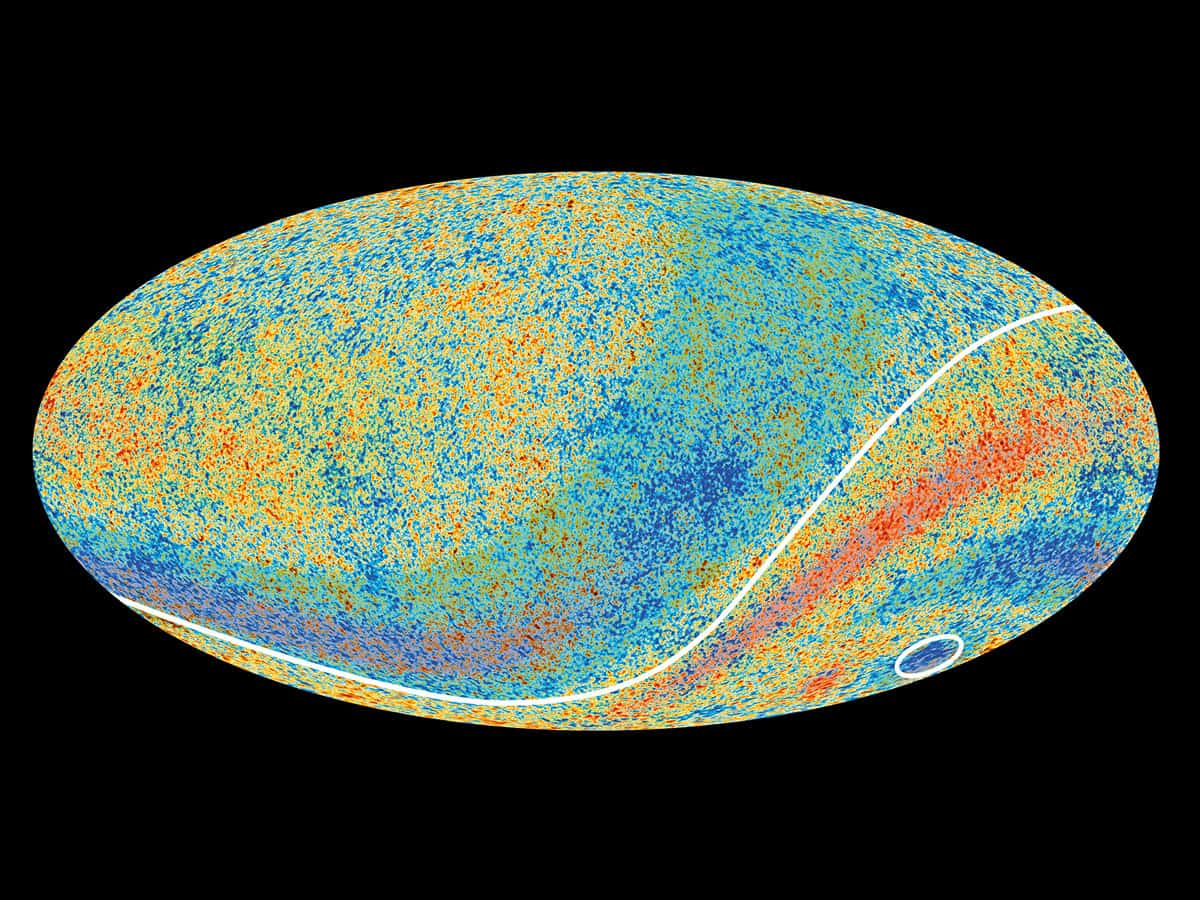
Gravity is the only means by which we possibly can detect the effects of our universes. Such gravitational interactions are very feeble, and often masked by stronger interactions like death of stars and galaxies, merger of black holes etc. The cosmic background radiation which proved the theory of the big bang, has been studied by successively sensitive satellites launched into space. The latest being the Planck satellite. A picture captured by Planck shown below courtesy Physics World, shows a circled “cold spot” to the bottom right, which is supposed to indicate the impact of surrounding multiple universes. The spot cannot be explained by anything related to the big bang or an to any of the the local events.
The conclusions are not a done deal. And the journey continues…
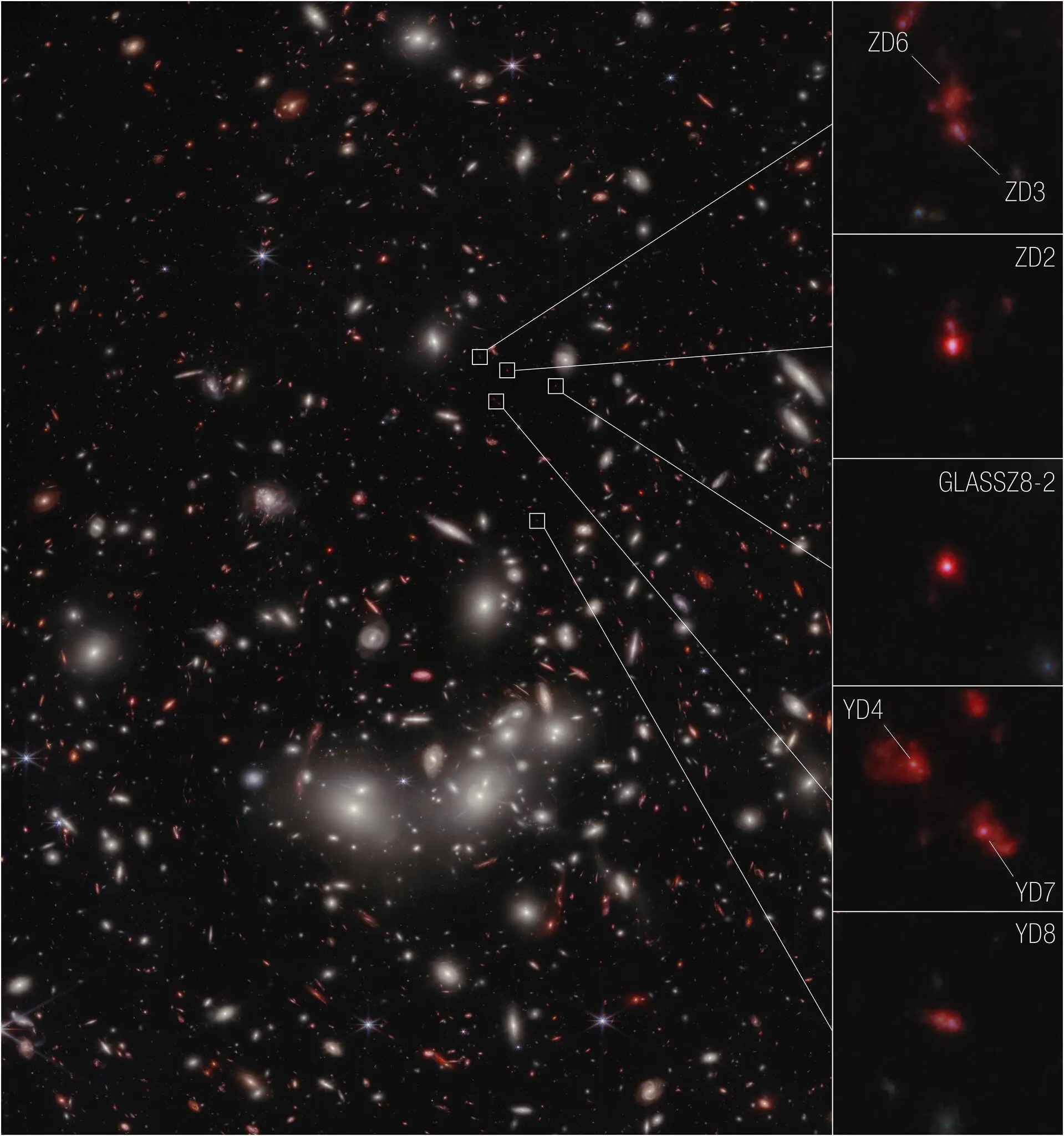
Back Then, Baby Galaxies. Next, a Super-Mega Galactic Cluster? Like basketball scouts discovering a nimble, super-tall teenager, astronomers using the James Webb Space Telescope reported recently that they had identified a small, captivating group of baby galaxies near the dawn of time. These galaxies, the scientists say, could well grow into one of the biggest conglomerations of mass in the universe, a vast cluster…more
-NYT
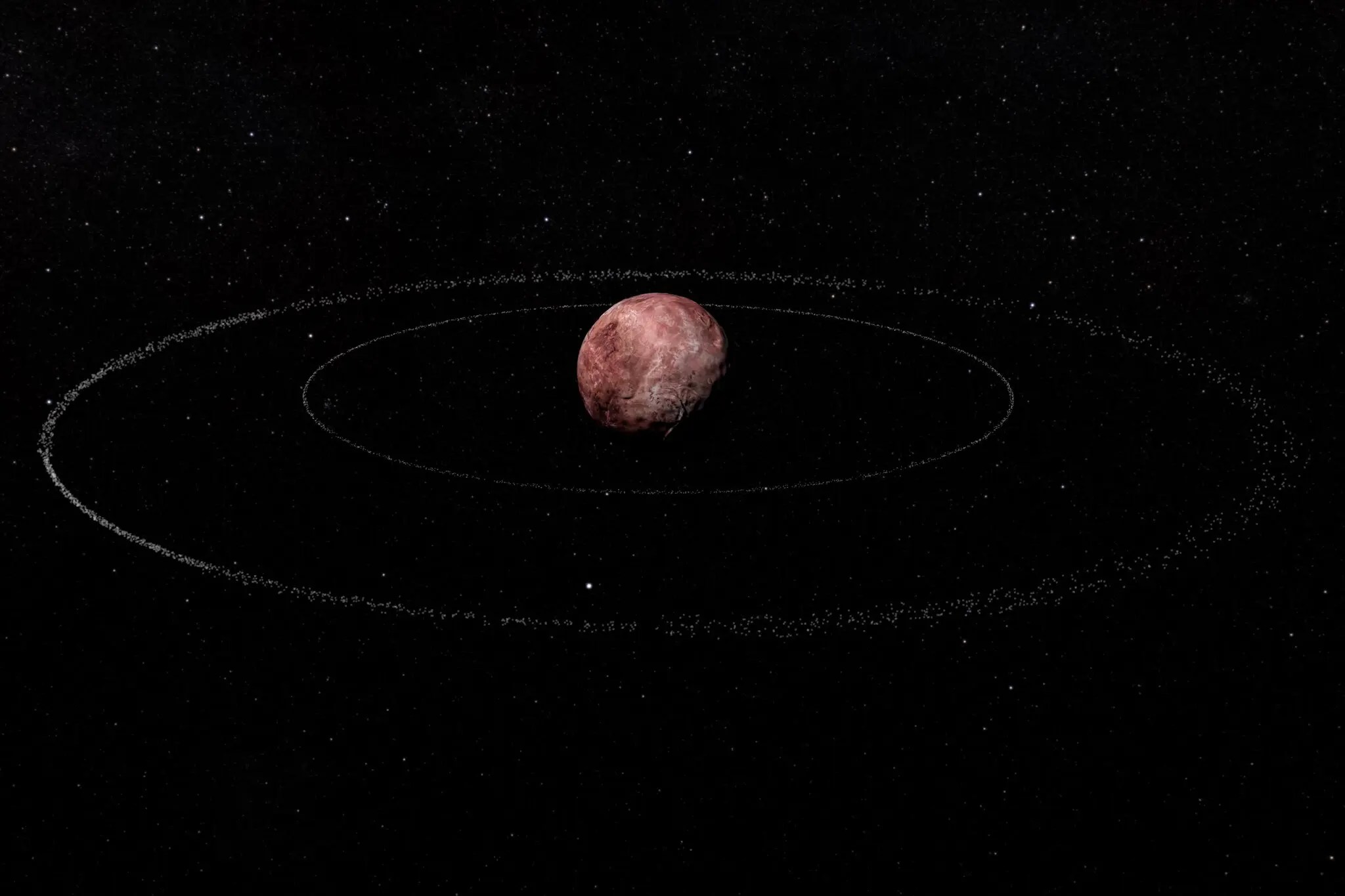
Second ‘Impossible’ Ring Found Around Distant Dwarf Planet Earlier this year, astronomers announced that a tiny world beyond Neptune with a diameter about one-third that of Earth’s moon possessed a Saturn-like ring that should not be there. It now turns out that there are two such “impossible” rings…more
-BBC
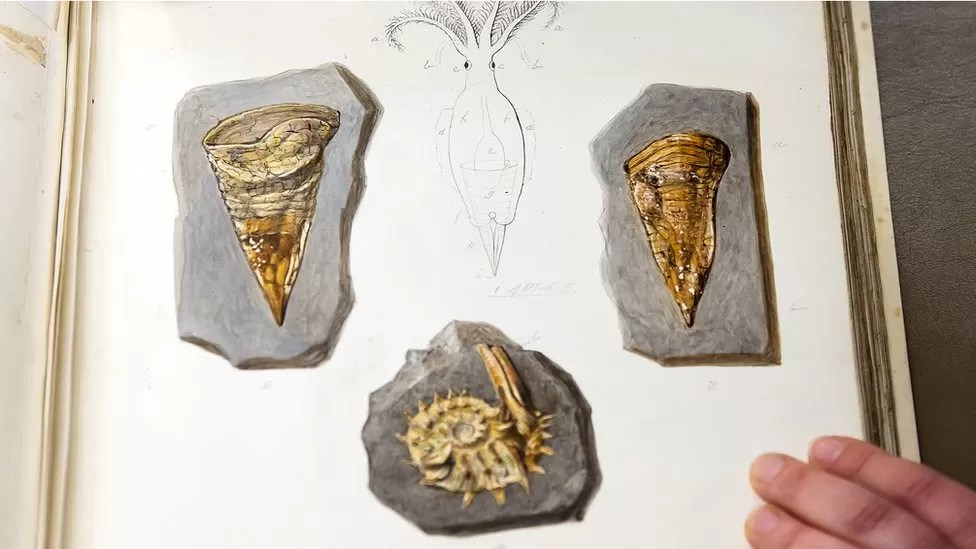
Royal Society: Four incredible objects that made science history One of the first scientific findings signed by a woman is now online for the public to see for the first time. Martha Gerrish’s descriptions of the stars in 1734 joins discoveries by Isaac Newton, Victorian fossil hunters and pioneer photographers…more
-NYT
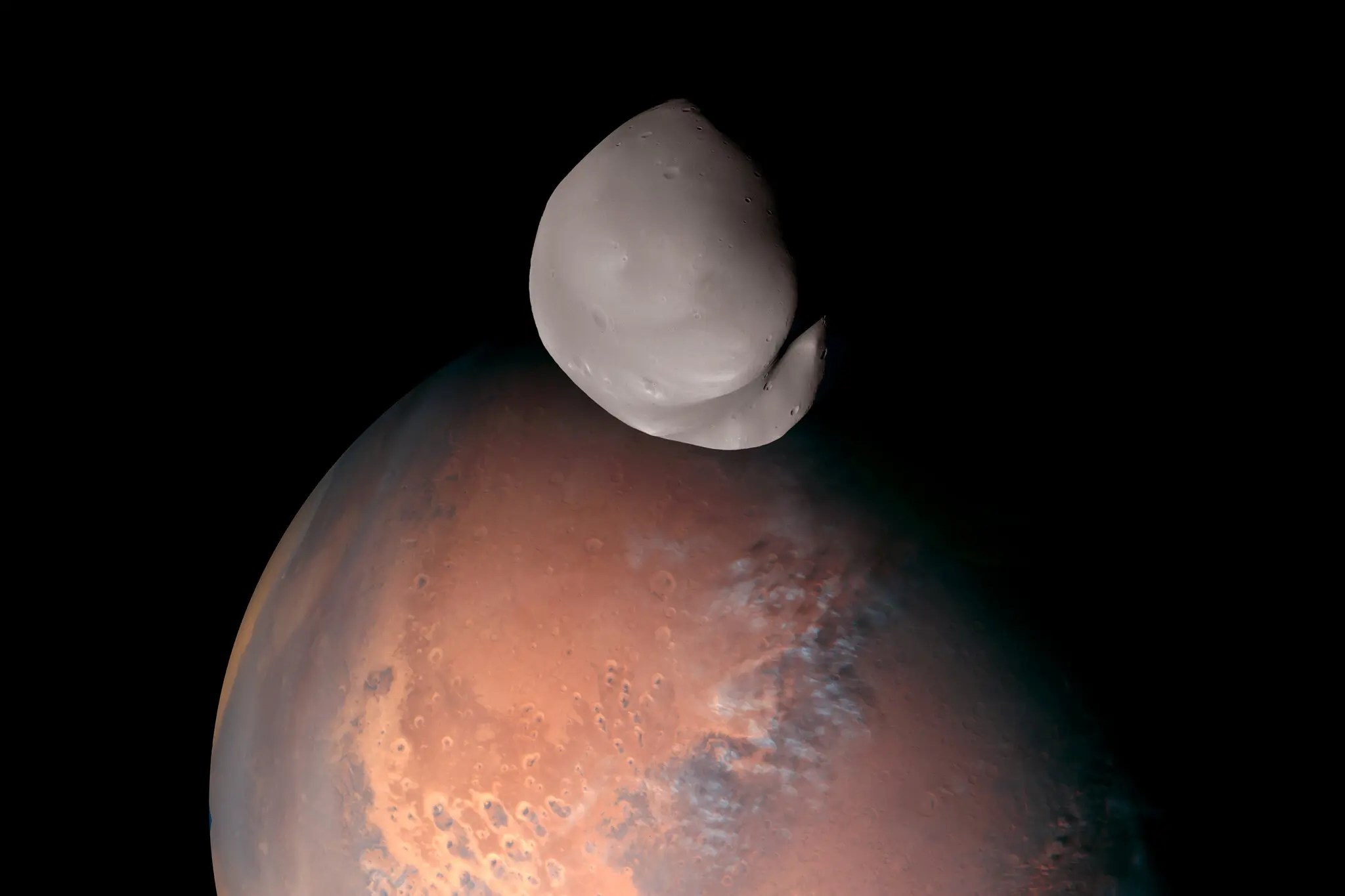
The Smallest Moon of Mars May Not Be What It Seemed New high-resolution images of tiny Deimos taken by an Emirati orbiter suggest that it may not be the captured asteroid that scientists once said it was. “We’re getting the highest resolution ever,” said Hessa Al Matroushi, the science lead on the mission at the Mohammed Bin Rashid Space Center in Dubai…more
-NYT
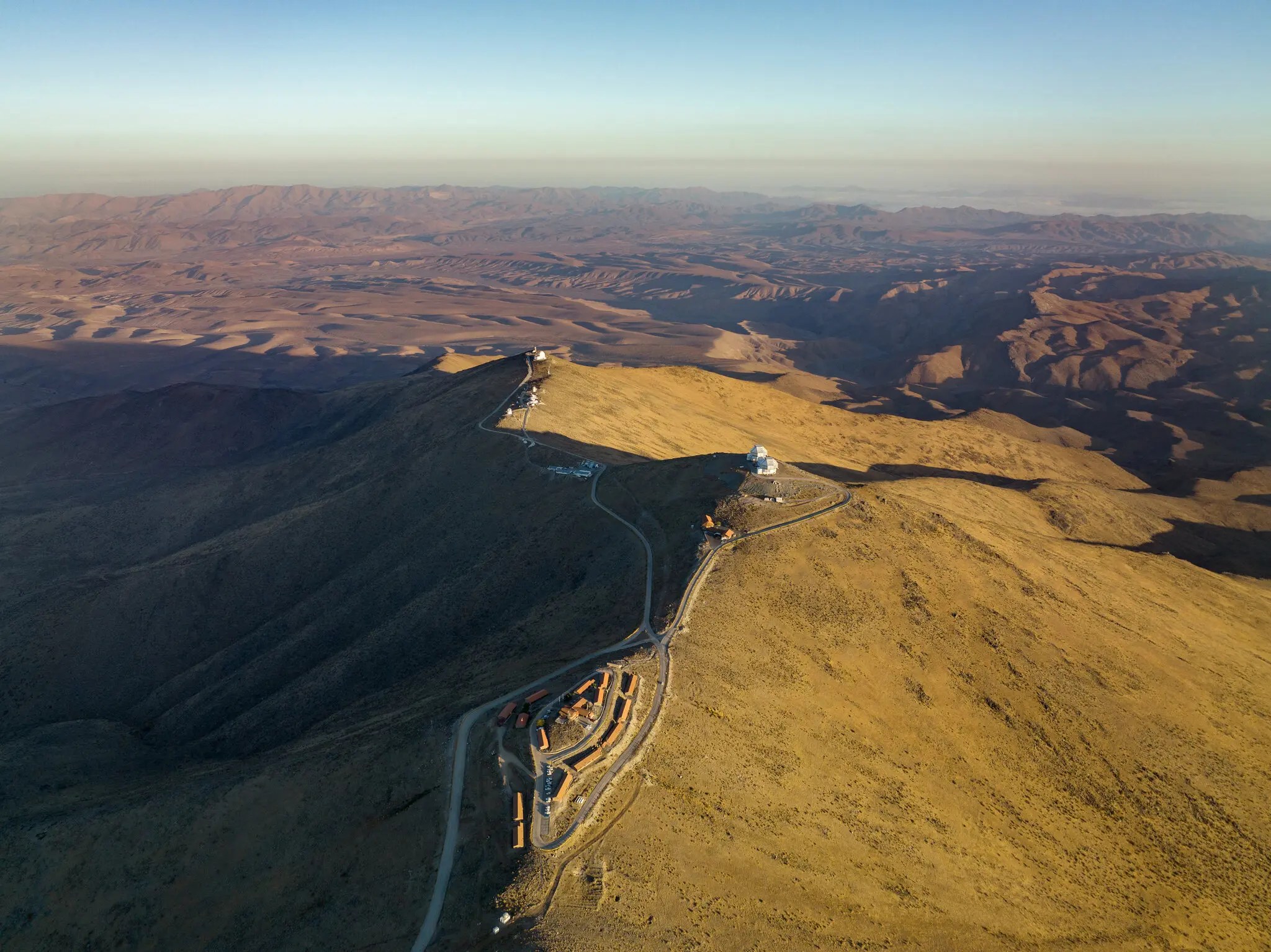
A Giant Telescope Grows in Chile LAS CAMPANAS OBSERVATORY, Chile — To walk among the observatory domes of the Atacama Desert is to brush your hair with the stars. The Atacama, on a plateau high in the Chilean Andes, is one of the driest and darkest places in the world. During the day one can see to Bolivia, far to the east, where clouds billow into thunderstorms…more
-NYT
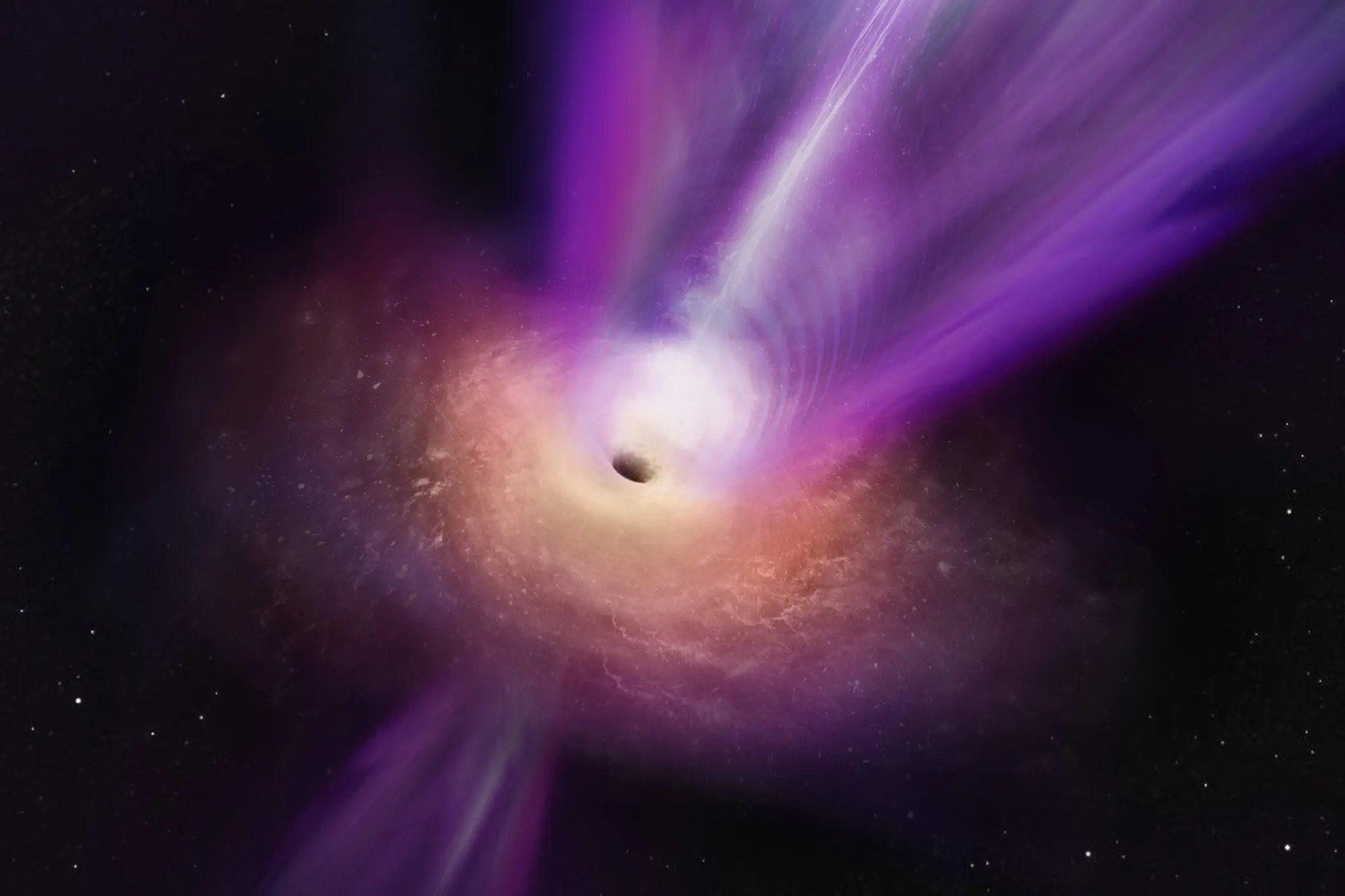
A Fresh View of an Increasingly Familiar Black Hole A patch of pure nothing in a faraway galaxy has lately become the gravitational center of attention for radio astronomers. That would be a giant black hole, with the gravity of 6.5 billion suns, that spits high-energy particles from the center of the galaxy Messier 87, which lies some 50 million light-years from Earth…more
-NYT
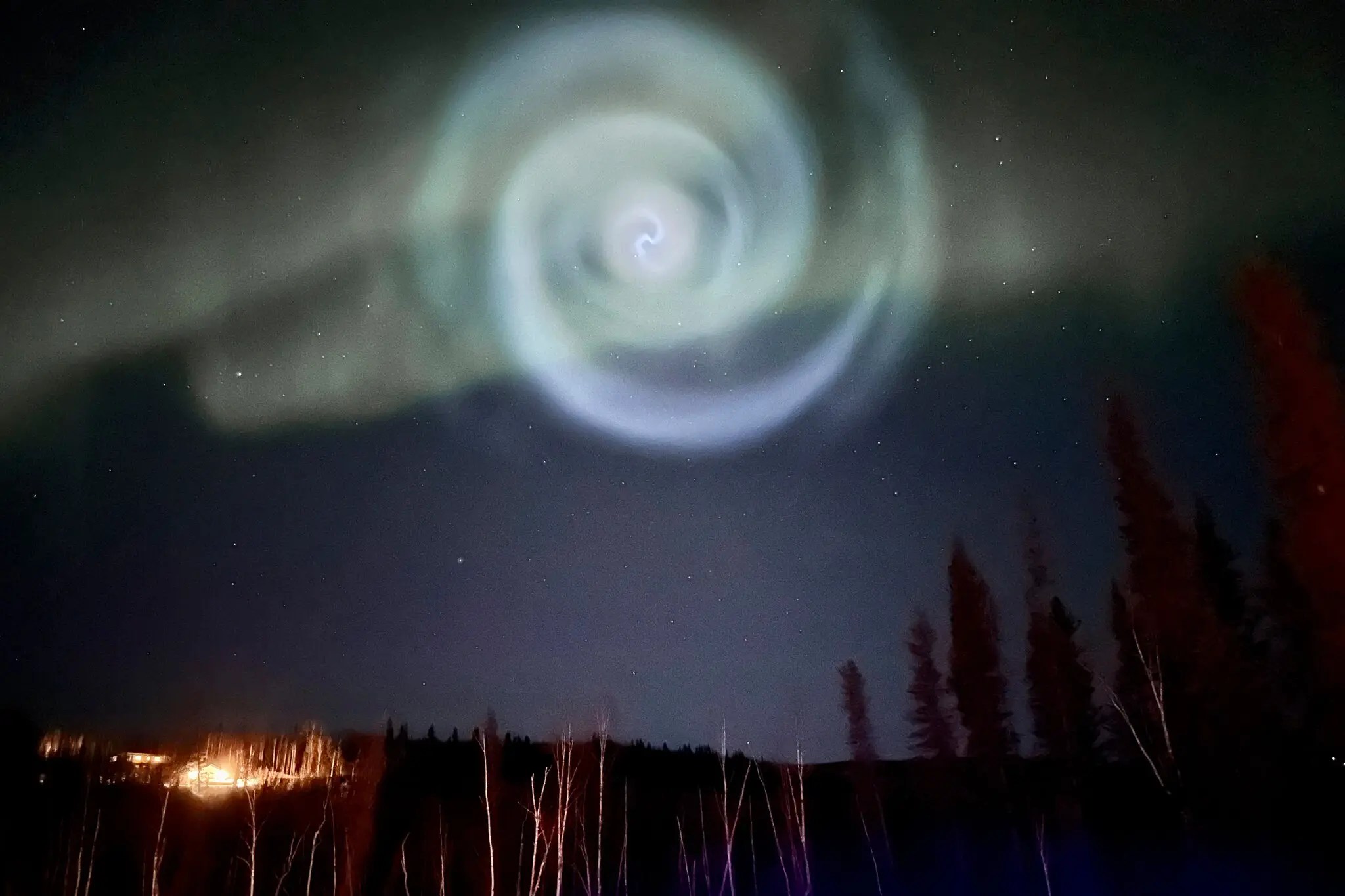
A Mysterious Spiral in the Alaska Sky Had an Earthly Explanation At first, Ronnie Cole thought the bright light in the sky over southern Alaska was an airplane.Mr. Cole, a tour guide with Alaska Photo Treks, was setting up a portrait with two of his clients in the early hours of Saturday when he noticed “there was something weird about the light”…more
-Nature
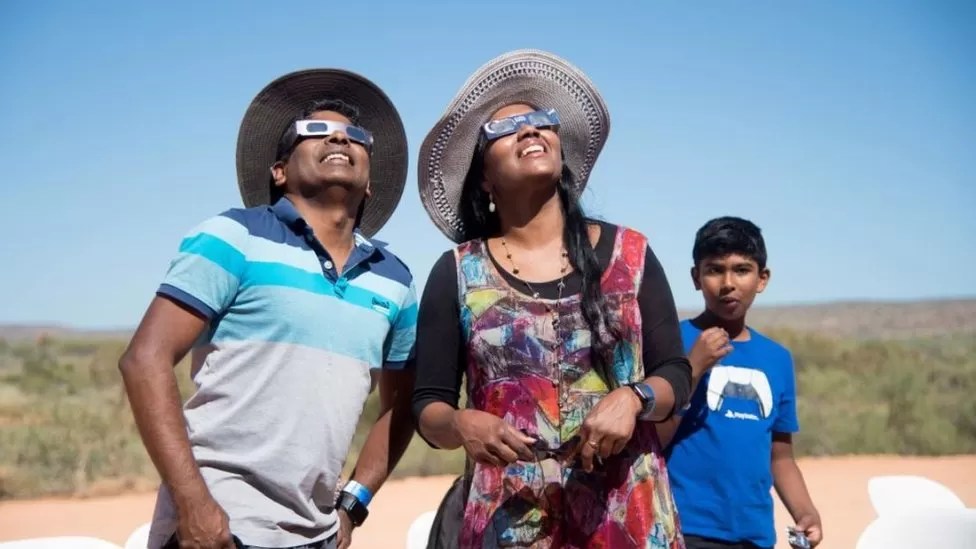
Solar eclipse: Thousands flock to remote Australian town for rare celestial event A rare solar eclipse has thrilled thousands of people who flocked to a tiny Australian town for one of the best vantage points on Earth to see it. The sky in Exmouth in Western Australia turned dark for about 60 seconds on Thursday, when the Moon cast a 25 mile (40km)-wide shadow over the area…more
-NYT
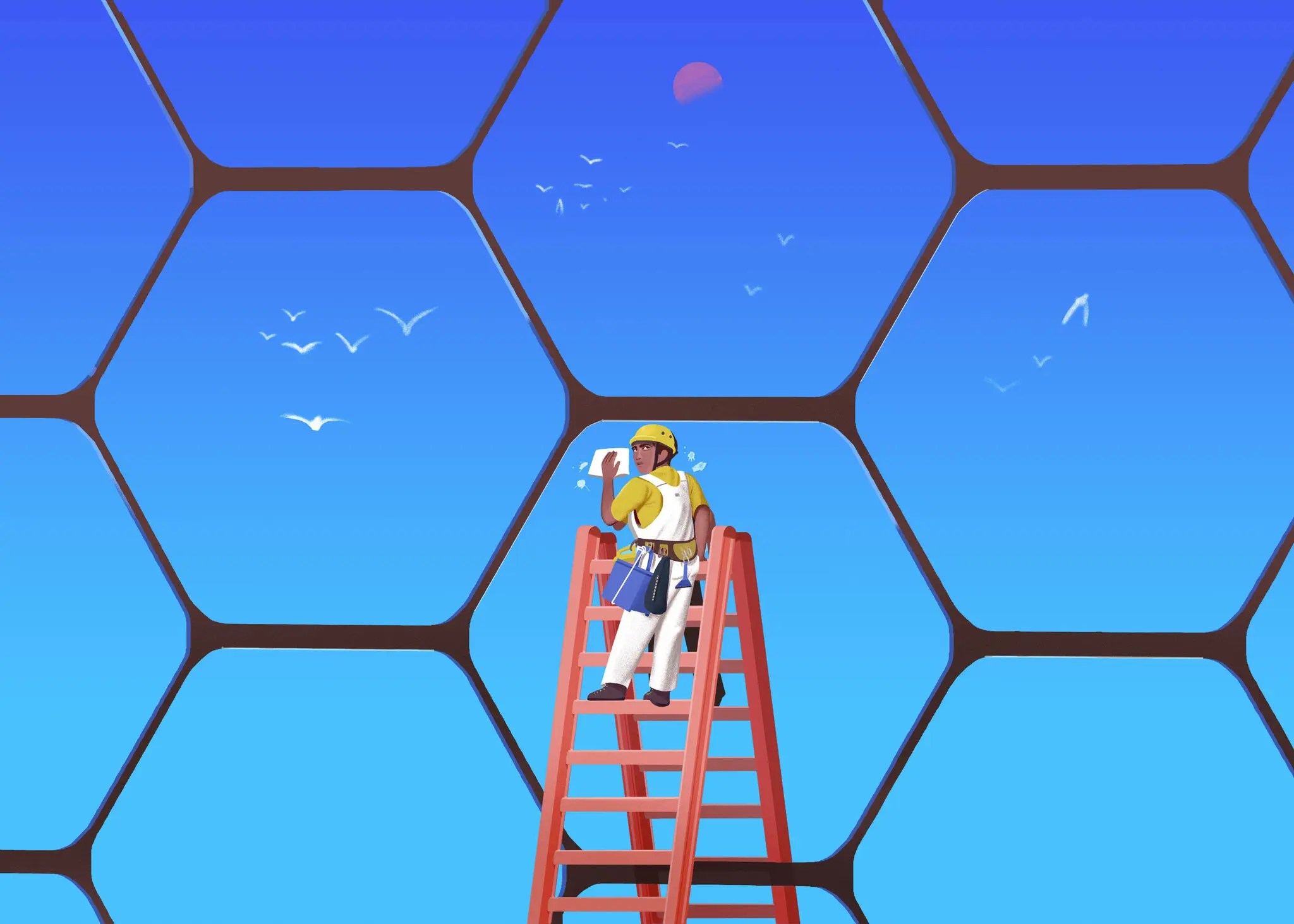
From Bullets to ‘Bird Residue,’ the Many Trials of Telescopes Few things in science appear to be as delicate or precarious as the giant mirrors at the hearts of modern telescopes. These mirrors — doughnuts of glass meters in diameter, weighing tons and costing millions of dollars — are polished within a fraction of a wavelength of visible light into the precise concavity required…more
-BBC
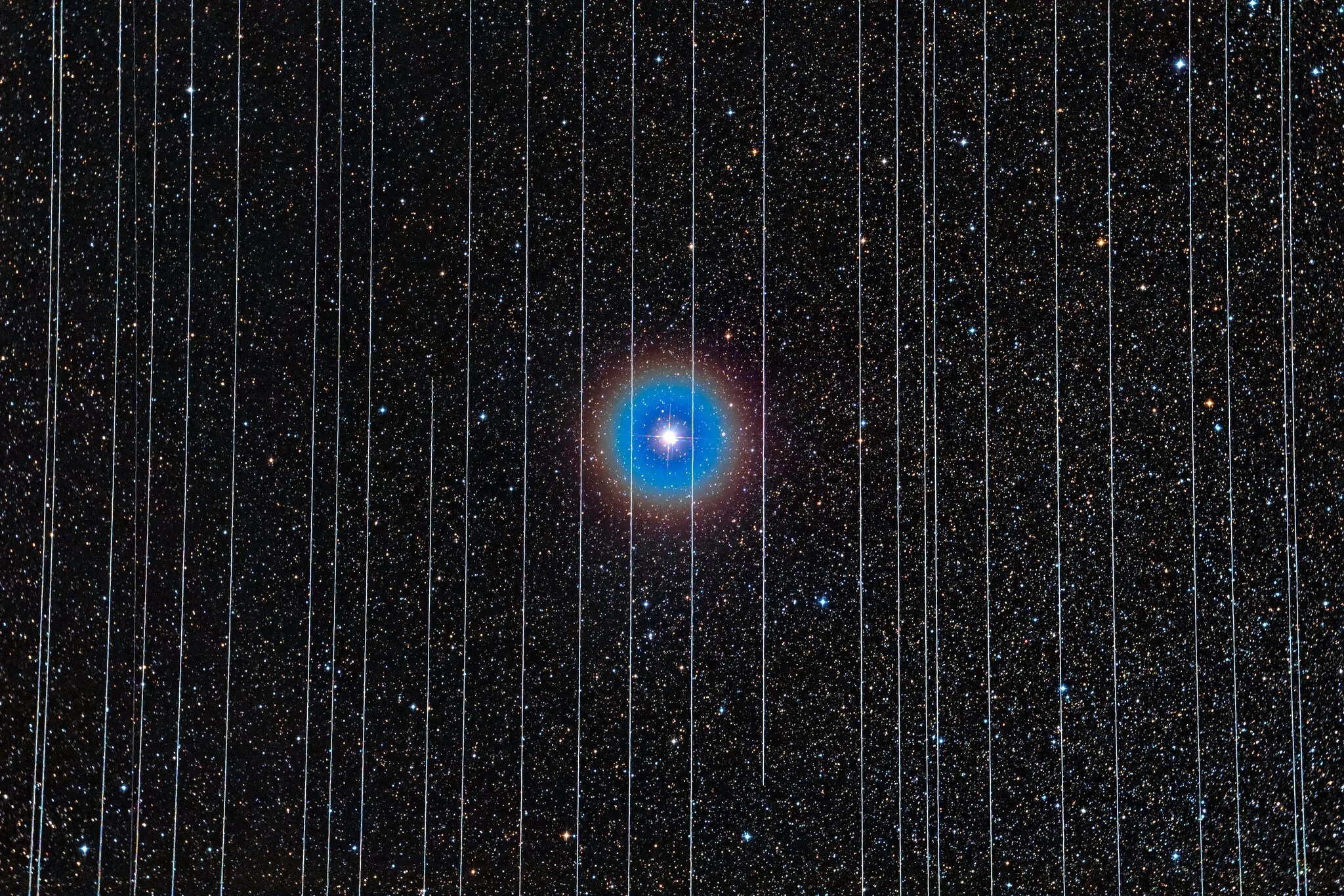
Satellites Threaten Astronomy, but a Few Scientists See an Opportunity Each night, the stars of the sky compete with thousands of satellites. The number of intruders is only growing as constellations of satellites proliferate, with companies planning to launch orbiters by the tens of thousands to transmit internet and other communications signals back to Earth…more
-NYT
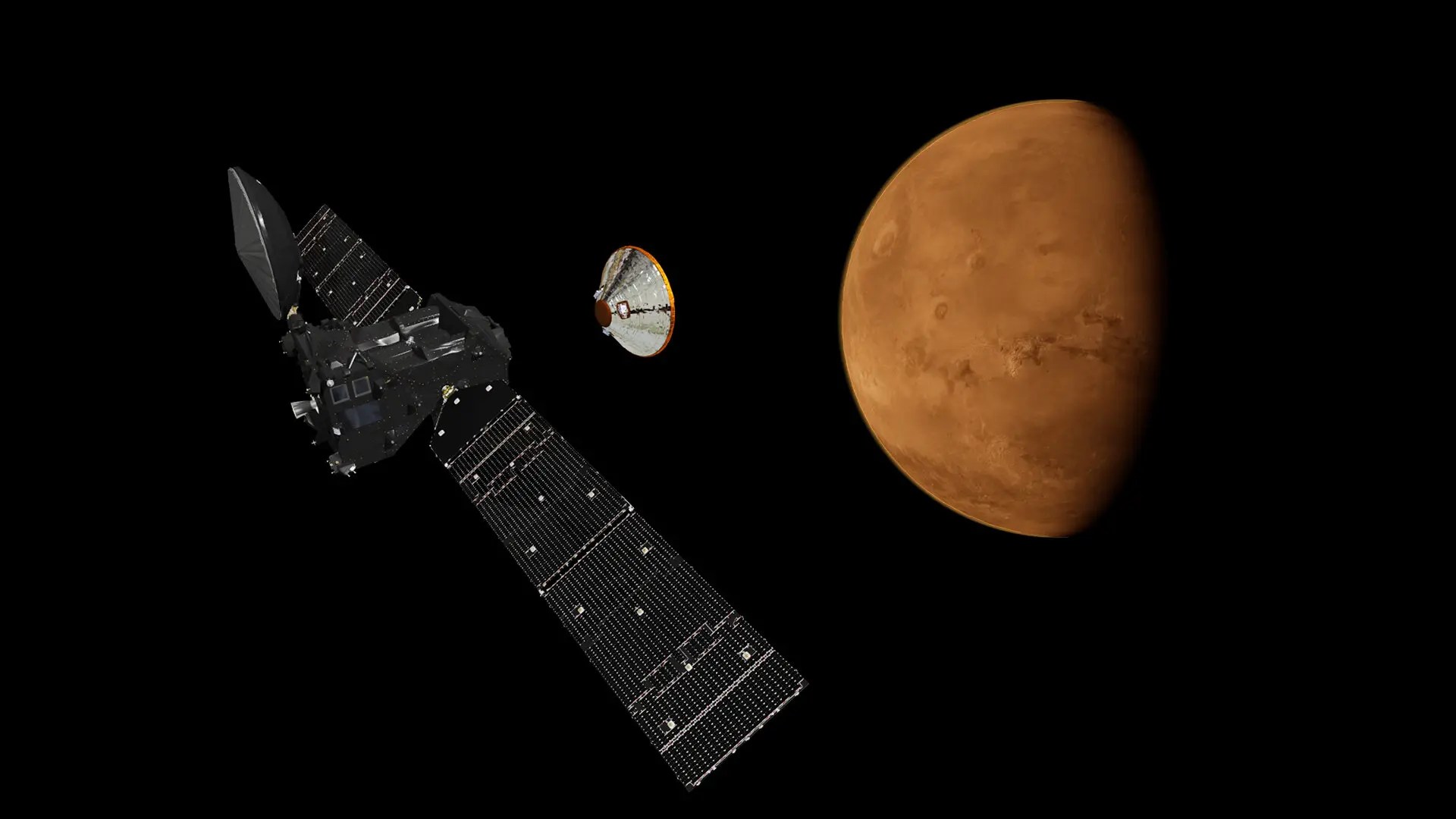
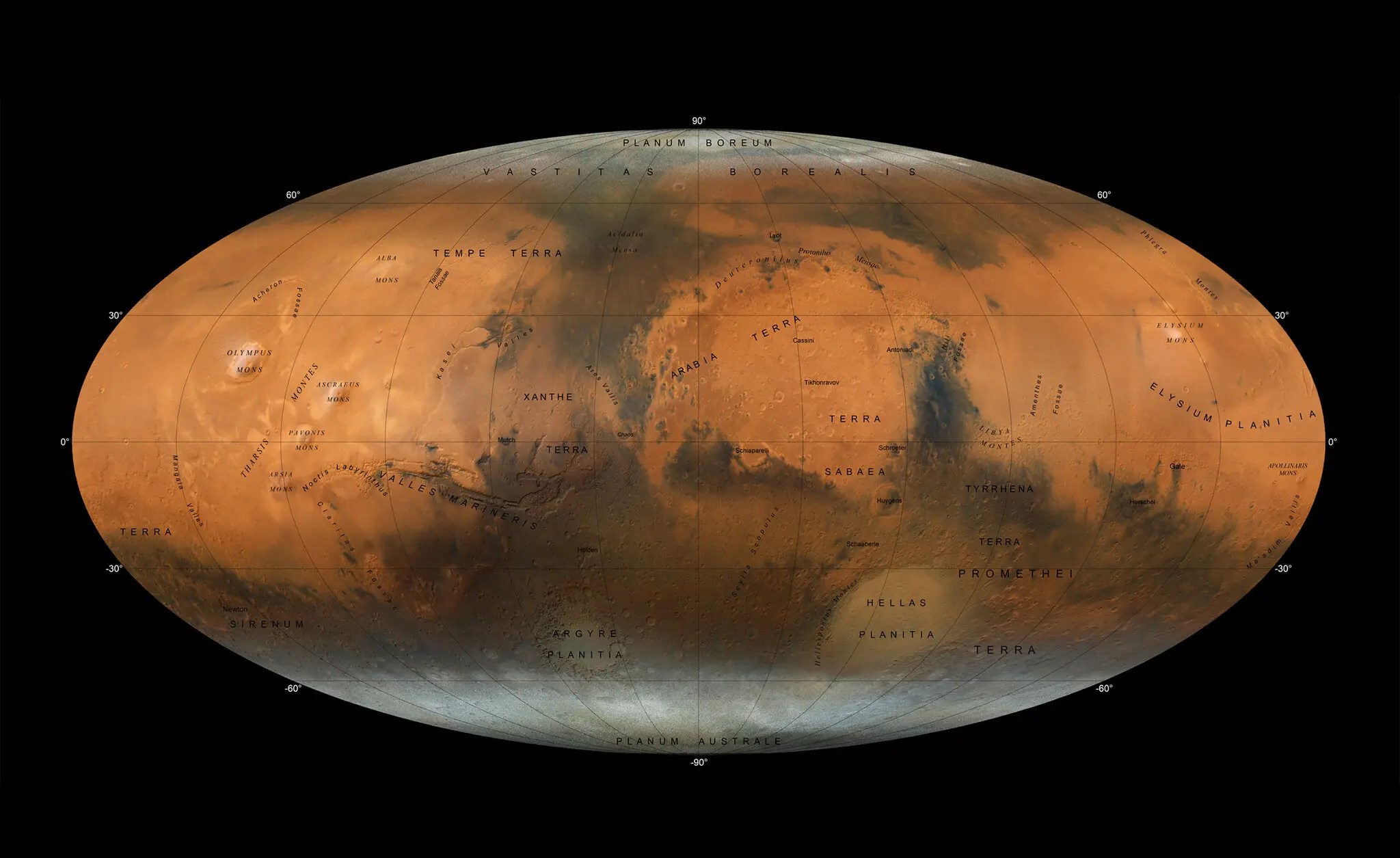
New Mars Map Lets You ‘See the Whole Planet at Once’ A new global map of Mars offers a fresh perspective on the planet. The map, released earlier this month, was pieced together from 3,000 pictures taken by the United Arab Emirates’ Hope spacecraft, and it shows the red planet in its true light. “These are all natural colors on Mars,”…more
by Rex Parker, PhD director@princetonastronomers.org
April 11 Meeting – Archeoastronomy. After last month’s wind driven last minute decision to go virtual only, we’ll again plan to convene at Peyton Hall on the Princeton campus on Tues April 11 (7:30pm). The University wants us to park in the new garage at 148 FitzRandolph Rd, off of Faculty Rd. Please arrive early enough for the walk from the garage (~15 min). This month we’re rolling out a very different guest presentation – cinema! It’s been an ambition for a few years to feature archeoastronomy, and one of the best movies ever made on the topic of southwest American Indian culture and knowledge of the sky is the movie Sun Dagger. This 1983 documentary is now considered a classic. Member Ira Polans will introduce the ~1-hour movie and guide a discussion afterwards. Sun Dagger reveals the remarkable celestial calendar in stone created in Chaco Canyon, New Mexico by the Anasazi over 1000 years ago. The film’s copyright status means that if you join the meeting by Zoom from home then you will need to pay a small fee to log in, while AAAP is covering for the Peyton showing. Please see Program Chair Victor Davis’s section below for more information.
After the Break. For the April meeting we’ll have a discussion of Archeoastronomy after the break to help coordinate the virtual and Peyton audiences. In addition to this, our tradition each month is for a member to give an Unjournal Club, a brief informal and fun astro presentation to begin the second half of the meeting. There’s plenty of time in the April agenda, or in future meetings, for you to contribute by giving an UnJournal presentation. PowerPoint slides, JPEG’s, astro-images, travel pictures, book reviews, your imagination is the limit (bring a USB memory stick). To get onto the schedule for an upcoming meeting, please contact me or the program chair.
Nominations for Club Officers. AAAP has a straightforward organization structure that depends on members stepping forward to positions on the Board of Trustees (the elected officers) as well as a few appointed positions. Through our 60-year history we have elected officers for new 1-year terms at the May meeting, as provided in the by-laws. Member Lee Sandberg has agreed to serve as Nominations Chair to identify candidates for the slate for this cycle. The elected positions are: Director, Assistant Director, Treasurer, Secretary, Program Chair, Observatory Chair, and Outreach Chair. The constitution, by-laws and position descriptions are on the website https://www.princetonastronomy.org/club_by_laws.html. I hope you will consider stepping forward for one of the positions. If you are interested, or want to nominate a fellow member, send a note to nominations@princetonastronomy.org.
Seasonal Time. Where did we get the idea for “Daylight Savings Time? The notion that clock time should spring forward and fall back with the seasons seems quite unnatural. Perhaps the least likable feature for amateur astronomers is that it makes summer sunsets so late, keeping telescopes waiting an hour longer than our internal biological clocks prefer. Of course, we could become early morning observers with that extra hour, but psychologically that seems harder to do. Messing with diurnal rhythms is never a good idea for mammals highly tuned to the solar cycle ever since their primordial beginnings on this planet. Modern human society bears the considerable burden of changing this rhythm, for the sake of – just exactly what?
The common story goes that an agricultural community benefits from a later work day, but this doesn’t match the reality that farmers also need to work in the early morning. Daylight Savings Time originated in the US and Europe a century ago with the idea of improving train schedule efficiency and saving fuel and power during World War I. Then WW2 led to enactment of year-round “war time” in the US for the same reasons. After spring forward/fall back was reinstated, permanent daylight savings time was again enacted during the 1970s energy crisis for the sake of power savings, but again this didn’t stick very long. Today the states are not required by federal law to switch time forward and back, yet only Hawaii and most of Arizona don’t.
Now the spring forward/fall back cycle is again being questioned. But rather than abolishing it for the sake of natural, longitude-based time zones, Congress is considering making Daylight Savings Time permanent again. In my opinion this would be the worst idea for amateur astronomers. Fortunately, we’re not the only ones who might feel this way and the argument is far from decided. There are plenty of economic arguments both pro and con. Next time you consider writing your representative, ask them to consider abandoning time tinkering altogether.
AAAP Observatory Opening in April. Thanks to observatory chair Dave & Jenn Skitt, the club’s facility at Washington Crossing Park is getting set for the new season. Public open house Friday nights, run by the Keyholders, will commence on April 7. The superb astronomy equipment at the observatory is listed in my section in last month’s Sidereal Times. Although we’d like to schedule a couple of member-only observing sessions, the vagaries of weather make it impossible to schedule in advance. Therefore, this season we are asking members to bring personal telescopes out to the observatory field each Friday night when weather supports a public session. This gives members a secure dark site to do astronomy and there’s plenty of room to set up with excellent sky views. Let’s see just how many member telescopes we can get onto the field (I recall the current record is 12). You can check for observatory opening status on our Twitter feed (https://twitter.com/princetonastro), the AAAP Discord server, or call the observatory phone at 609-737-2575.
Welcome to Peyton Hall The April 2023 meeting of the AAAP will take place on Tuesday, April 11th at 7:30 PM in Peyton Hall. As usual, the meeting is open to AAAP members and the public.
Options for Attending the April Meeting You may choose to attend the meeting in person or participate via Zoom or YouTube as we’ve been doing for the past few years. (See How to Participate below for details). This evening’s presentation is a film “The Sun Dagger” produced by Bullfrog Films. It will be proceeded by an introduction and commentary by Ira Polans and followed by Q&A conducted by Ira. Showing the film has a bit of a tortured history, and has had to wait for several years as we suffered through Covid and for Princeton University to welcome the club back to Peyton Hall. Ira acquired the film several years ago, pre-Covid, and, since copyright restrictions prevent the club from streaming the movie over the internet, we originally anticipated that viewing the film would be a strictly in-person experience.
A New Plan We are pleased to announce that there is now an option to view the film online. You may now open an account with Google or Vimeo and pay a $3.99 fee to view the 59-minute film on your digital device. You may stream the film at:
In order to accommodate this dual method of viewing while still maintaining a close approximation of our usual meeting agenda, we’ve modified the meeting agenda a bit:
(Times are approximate)
Please note that the break (extended to ten minutes) will occur following the film but prior to the Q&A. This will allow online participants time to log in to Vimeo, rent and view the film, and then rejoin the meeting in time for the discussion.
Getting to Peyton Hall The parking lots across the street (Ivy Lane) from Peyton Hall are now construction sites, unavailable for parking. We’ve been advised by the administration of the astrophysics department that we should park in the new enclosed parking garage off Fitzrandolph street and walk around the stadium and athletic fields. Here’s a map of the campus and walking routes from the parking garage to Peyton Hall. The map shows the recently completed East Garage. Not shown is an access road Sweet Gum that connects from Faculty Road to an entrance at the lower left corner of the garage. Stadium Road connects from Fitzrandolph Road to another entrance at the opposite corner (and higher level) of the garage. It’s about a 10-15 minute walk from the parking garage to Peyton Hall.
Featured Speaker: Ira Polans Former Program Chair AAAP sky_watcher72@yahoo.com
The Sun Dagger: Chaco Canyon and the Anasazi Archeoastronomy combines the disciplines of archeology, astronomy, and others to study how people of the past understood the sky and its phenomena. Examples of such sites include Stonehenge, Newgrange, the pyramid El Castillo, built in the center of Chichen Itza in Mexico. It also includes artifacts such as the Antikythera mechanism. Many sites around the world mark or seem to mark the solstices or the equinoxes. In this month’s meeting we will cover an example of a site that is closer to home.
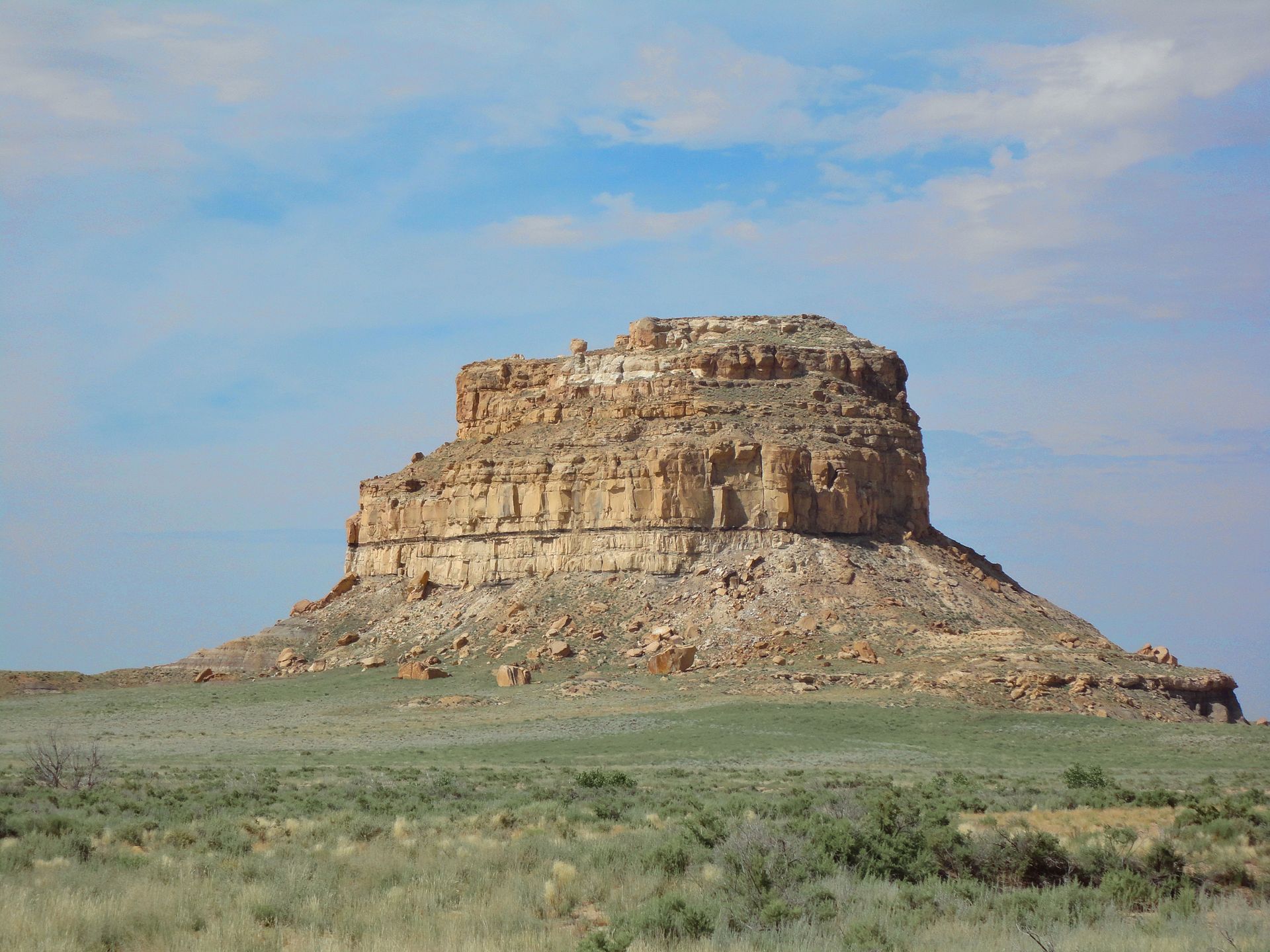
Chaco Canyon, the home of the Anasazi, showing Fajada Butte. Credit: Wikipedia
Several groups of indigenous people lived in what is now the four corners region of the United States where Arizona, Colorado, New Mexico, and Utah meet. This region is covered by hundreds, if not thousands, of ancient ruins. Some are excavated while others have not been. This month’s talk features a film on the Sun Dagger, which was found in the 1970’s by Washington artist Anna Sofaer in Chaco Canyon, NM. The Sun Dagger was built by the Anasazi (Ancestral Puebloan) Indians who built this calendar and thrived in the arid canyon environment a thousand years ago. Since then, the Sun Dagger has marked the seasonal solstices and equinoxes in vivid symbolic images of light and shadow on stone. To enhance your understanding of the film a brief introduction to the region and its people will be given prior to the screening.
Ira Polans Ira is a lifelong amateur astronomer, former Program Chair of the AAAP, AAAP keyholder, and former volunteer at the Franklin Institute, including during the Galileo exhibit in 2009.
As a teenager he spent several summers camping in the Southwestern United States where he first visited Chaco Canyon and other Ancestral Puebloan sites. He has been back to the Southwest several times as an adult. His most recent trip was in the Summer of 2016 for the camp’s 90 anniversary.
He has travelled to see Halley’s Comet in Australia in 1986, visited Italy in 2009 for the 400 anniversary of Galileo pointing his telescope to the sky, the Venus Transit at Kitt Peak in 2012, to the Total Solar Eclipse in Oregon in 2017 as part of the AAAP eclipse group, and to Yerkes Observatory in 2018. He is looking forward to next April’s Total Solar eclipse!
There will be no “Meet the Speaker” dinner this month. Weather and logistical considerations have prevented us from honoring John Church, Joe DePasquale and now Ira with free eats at Winberie’s, but please make plans to join us there next month when we honor them along with May’s guest speaker Alain Maury who’s driving down from NYC to be with us. Please let me know if you plan to attend.
Hats Are Here! …though I’ve yet to pick them up. The club has invested in a new stash of AAAP baseball caps, to thank our guest speakers and to try to shake loose “unjournal club” recruits. Contact me or Rex to line up your fifteen minutes of fame.
AAAP webcast: This month’s AAAP meeting, beginning with Rex’s opening remarks and ending at the beginning of the business meeting, will be webcast live on YouTube and recorded for subsequent public access on AAAP’s YouTube channel. Be aware that your interactions during this segment, including questions to our guest speaker, may be recorded for posterity.
Join YouTube Live to listen to the speaker Ira Polans using the link below –
This session will be recorded and saved on YouTube. Send me an email at program@princetonastronomy.org if you have any concerns.
Using Zoom: While we are social distancing, the AAAP Board has chosen to use Zoom for our meetings, based on our belief that many members have already used Zoom and have found it easy to use. One of its great features is you can choose whether you want to install the software on your computer or use it within your browser.
Please make sure you have Zoom installed on your computer. You do not need a Zoom account or to create one to join the meeting. Nor are you required to use a webcam.
Please see below for the link to the meeting, or visit our website.
There is no “Unjournal Club” presentation scheduled this month. As you may know, guest speakers receive a baseball cap with the AAAP logo embroidered upon it as a “thank you” for making a presentation to us. We’re expanding the hat giveaway to members who contribute an “Unjournal Club” presentation to encourage participation.
We hope to make these short presentations a regular feature of our monthly meetings. We’d like to know what members are doing or what members are thinking about in the broad range of topics encompassed by astronomy. A brief ten-minute (or so) presentation is a good way to introduce yourself and the topics you care about to other club members. If you are interested in presenting a topic of interest, please contact either director@princetonastronomy.org or program@princetonastronomy.org.
A look ahead at future guest speakers:
May 9, 2023
Alain Maury, Astronomer and discoverer of comets and asteroids. Alain Maury operates a time-sharing observatory near San Pedro de Atacama, Chile. He’s also an active observer and discoverer or co-discoverer of several dozen comets and asteroids, several of which (i.e. 3780 Maury) were named in his honor. He’ll talk about his observatory, its operation, and his numerous astronomical activities.
June 13, 2023
Bill Murray, AAAP’s Outreach Director and staffer at NJ State Museum planetarium Bill will give his traditional planetarium show at the New Jersey State Museum in Trenton.
Summer Hiatus
Later this fall
Gary Rendsburg, Distinguished Professor of Jewish Studies and History at Rutgers Prof. Rendsburg will talk about “The Jewish Calendar,” with emphasis on its astronomical connections to lunar months, intercalated month to adjust to the solar year, festival days, and new moon observances.
As always, members’ comments and suggestions are gratefully accepted and much appreciated.
Director Rex Parker convened the meeting at 1930 on Zoom due to inclement weather. He presented an outline of topics for the meeting that will follow the speaker.
At 1940 Program Chair Victor Davis introduced speaker Joseph DePasquale, and his presentation Unfolding the Infrared Universe with the James Webb Space Telescope. He is the Senior Science Visuals Developer in the Office of Public Outreach at the Space Telescope Science Institute in Baltimore, Maryland. He had wanted to drive up and address us in person, and hopes to be able to do so in the future. A question period followed the talk.
NOTE: The recording of this and other AAAP talks can be found on the AAAP YouTube page.
There were 79 logged in on Zoom during the talk.
Following a break, the meeting was reconvened at 2105 with an Un-Journal presentation by Director Rex Parker about the science and imaging of planetary nebulas.
Observatory Co-Chair Dave Skitt reported the preparations being made for reopening the observatory next month. Two 2’x4’ folding tables have been purchased to hold literature on public nights, so no one need bring them each month. Acquisition of benches is still under investigation, as is professional installation of carpet.
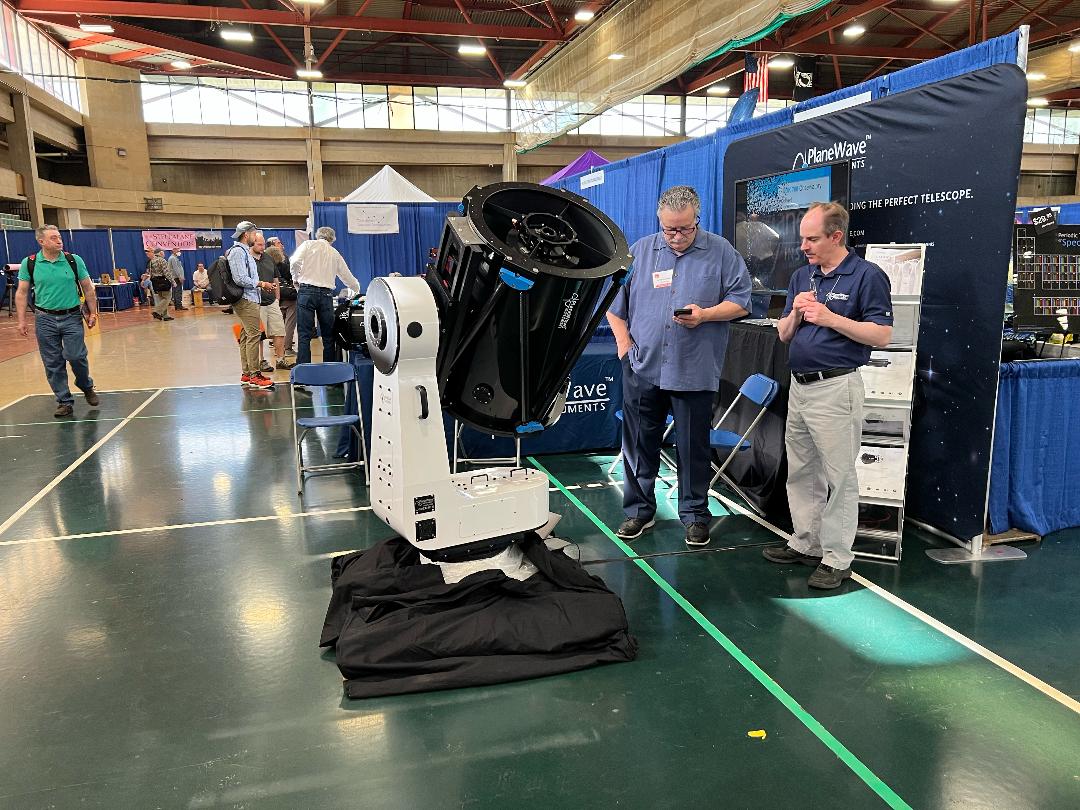
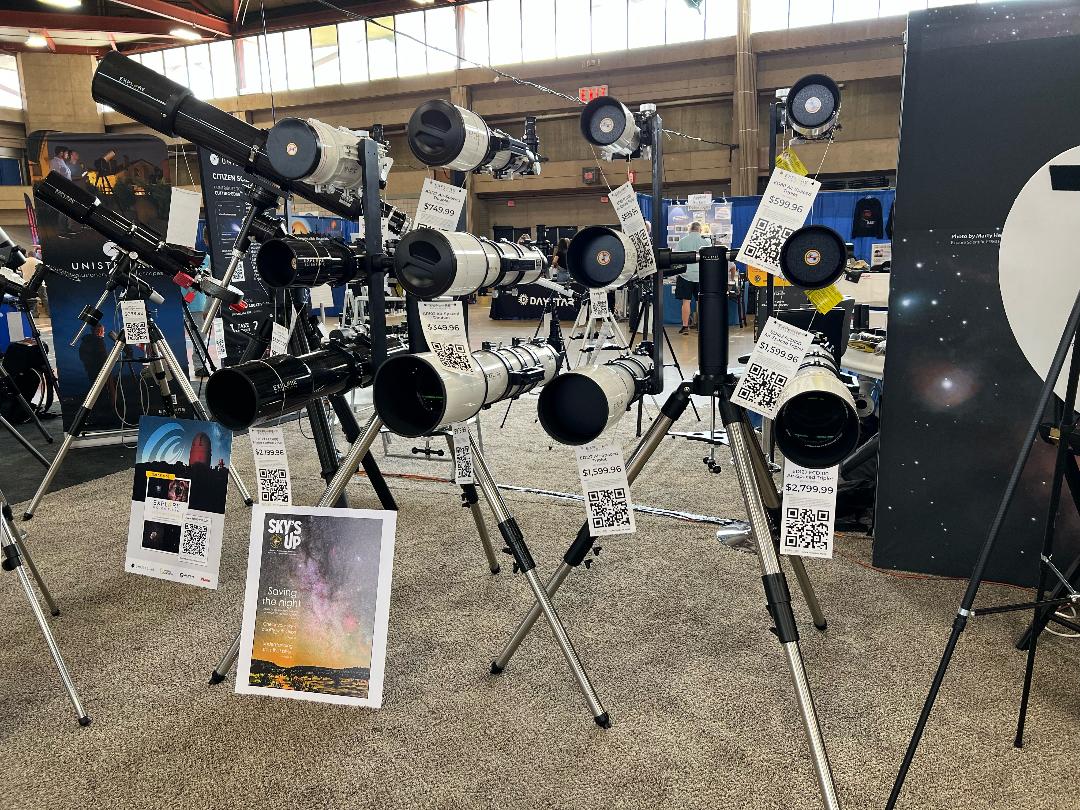
Mention was made of the upcoming astronomy fairs NEAIC on April 13-14 and NEAF on April 15-16. They are the world’s largest and should be experienced, even if one can manage keep the wallet securely in place.
Appreciation of the Astrovideo Live presentations was repeated along with the hope that one could be planned for March 24. It might provide an opportunity to view a selection of planetary nebulas.
Members were reminded that they can request to have the observatory opened for them on other than a public night. Obviously, our ability to meet the request depends on the availability of Keyholders to operate the telescopes.
There is still no response from the Washington Crossing State Park about making long overdue repairs to the gates and the shameful condition of our entrance road.
Merchandise Facilitator Rich Sherman is continuing his investigation into another vendor which can provide an expanded line of AAAP store items.
The meeting was adjourned at 2210.
Our membership currently numbers 206. 20 have joined so far in 2023. We have had 31 renew while 8 have allowed their membership to expire, giving us a 79% retention rate.














 Amateur Astronomers Association of Princeton