From the Program Chair

by John Church, Program Chair

In November we were treated to a fine presentation given by astrophotographer Jerry Lodriguss, featuring photos that he has produced over the years using advanced CCD and editing techniques.  The art of astrophotography has certainly progressed rapidly in the last decade or so.  Several of our own members are continuing to do excellent work in this area as well.

Our December 14 meeting will feature Prof. (and AAAP member) Bob Vanderbei  and Prof. J. Richard Gott of Princeton University discussing their new National Geographic book, “Sizing Up the Universe.”  The book will feature many of Bob’s photos taken from his driveway.  The authors will be signing copies of their book, which will be on sale during the intermission.

On January 11, we will have our own Dr. Ken Kremer to speak on “The Space Shuttle, The Space Station, and What’s Beyond for NASA.”  The talk will include many of Ken’s photos and descriptions from personal behind-the-scenes visits to the Kennedy Space Center at Cape Canaveral, where Ken has a press pass.

On February 8, Dr. Fronefield (Froney) Crawford from Franklin & Marshall College in Lancaster, PA, will be speaking on the topic of “New Searches for Old Pulsars.”

March and May are open as of this writing.  On April 12 we will have Michael Molnar speaking on “The Star of Bethlehem,” a topic he has extensively researched. Michael will be signing copies of his book on this subject during the intermission.  On June 14, we will be treated to another presentation by Bill Murray in the New Jersey State Museum Planetarium in Trenton.

Posted in December 2010, Sidereal Times | Tagged | Leave a comment

November 2010 Meeting Minutes

by Larry Kane, Secretary

Director Ludy D’Angelo called the meeting to order

Lunar Eclipse Event
Bill Murray announced that on the early morning of December 21, there will be a significant total lunar eclipse.  A discussion was held whether the AAAP should get together at our Washington Crossing observatory and invite the public.  Bill said that he would publicize the event at his showings at the New Jersey State Planetarium.  It was agreed that, weather permitting, the club will hold an eclipse event at the observatory.

Secretary’s Report
There was no report given.

Treasurer’s Report
The Treasurer’s Report appears in another section of the Sidereal Times.

Outreach
Outreach Coordinator Dave Letcher stated that the AAAP will conduct a Star Party at the Allentown Middle School this coming Friday.   Member Dee Bosh has requested a Star Party at the Pemberton High School on two nights, November 18 and 19.  Dave will contact Vic Ballenger to try to get some of the materials he used in his astronomy class.

Observatory
Co-Chair Gene Ramsey announced that the donation can, placed at the observatory, had over $100 in it.  Gene and Jeff Bernardis are looking at upgrades to the observatory security system.  John Giles announced that he contacted Scott Losmandy and was told that the refractor controller could be fixed for about $40.  Gene and John Church will winterize the observatory, this weekend.

Sidereal Times
The next deadline for articles is December 1.  Michael Wright is developing a mock-up of Sidereal Times at WordPress.

Posted in December 2010, Sidereal Times | Tagged | Leave a comment

Minimum of Algol by CCD Photometry

by Rex Parker, AAAP

Variable stars are not getting the attention they deserve in the AAAP these days!  Deep sky objects, planets & exo-planets, and intergalactic large scale structure are the hot topics.  Even double stars get more telescope time at the observatory.  Visually observing the changes in star brightness is slow and perhaps difficult.  Yet the science behind variable stars is fascinating, and the photomultiplier tube (PMT) detector has been displaced by the CCD as instrument of choice for their measurement.  A CCD camera on a telescope with a good tracking mount can accurately measure stellar magnitudes.  It occurred to me that for variables, the real obstacle is to actually set up and do the experiment.

Algol (β-Persei) is a variable star 92 light years away in the constellation Perseus which undergoes periodic variations in brightness every ~2.87 days.  It is the most famous example of an eclipsing binary star system;  when the dimmer star moves in front of the brighter (in our line of sight) the overall intensity decreases markedly.  November is the only time when the full light curve of Algol can be observed at our latitude.  This is because Algol stays at its minimum for ~ 2 hours and takes about 10 hours to complete the eclipse.

What is needed is a clear November night without a full or gibbous moon, and a minimum occurring around midnight.  Sky & Telescope publishes the “Minima of Algol” monthly in the magazine and website.  I had been keeping an eye on these tables and noticed a minimum predicted for Friday night (11/13) at 12:52 AM.

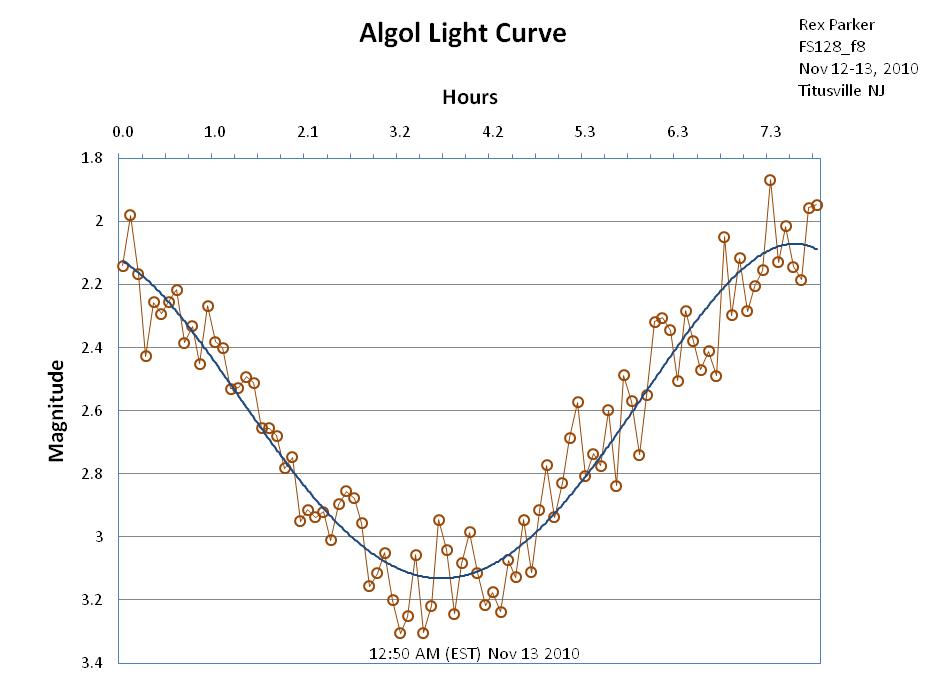
Non-anti-blooming CCD chips are linear photometric devices.  The wells (pixels) of the chip fill with electrons in linear proportion to the photon flux, as long as the full well capacity is not exceeded (controlled by exposure time).  For the data below, images at 0.2 sec each were taken with SBIG ST10-XME and Tak FS-128 at f/8 on a Losmandy G11 mount, with images taken every 5 minutes all night long and downloaded in real time to my laptop.  The data was processed the next day using a program (in Maxim DL) that compares the brightness of the target star to an invariant control in the same image field whose magnitude is precisely known (in this case, from NASA’s Hipparcos).  The reference star in this case was mag 8.6, so that probably gives rise to some of the noise in the plot (exposures had to be short to keep Algol’s pixels within full well capacity of CCD).  The resulting data are normalized brightness, given as magnitude, which allows construction of a light curve plot of magnitude vs time (figure below).  Recall that magnitude is a holdover from historical units in which each magnitude is 2.5 times brighter than the next, and the span of all stars visible to the naked eye are 1 to 6 (1 is brightest).

At last, a minima of Algol near midnight on a clear Friday night in November when I was home!

Algol Light Curve

Posted in December 2010, Sidereal Times | Tagged , , | 2 Comments

Robots Arrive at Kennedy Space Center

by Dr. Ken Kremer, Kennedy Space Center, Florida

Two of the world’s most advanced robots have invaded the Kennedy Space Center (KSC) as NASA prepares to launch Space Shuttle Discovery on the STS-133 mission to the International Space Station (ISS). These robots are friendly to earthlings  – at least for now.
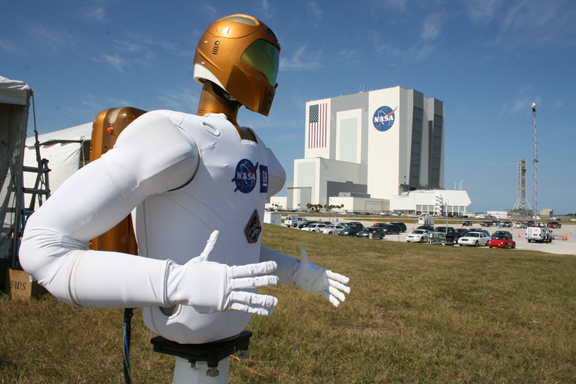
Robonaut 2A with the VAB in the background at KSC.

Robonaut 2A with the VAB in the background at KSC. Credit: Ken Kremer

The twin brother of Robonaut 2 – known as R2A – was standing guard at the KSC press site adjacent to the Vehicle Assembly Building (VAB) where I had the unique pleasure to meet him for an outdoors encounter.  R2A was gazing intensely at Launch Pad 39 A and shuttle Discovery where his sibling – Robonaut 2 – is set to meet his destiny and become the first humanoid robot in space. R2A is virtually identical to Robonaut 2.

The launch of Discovery on her final flight has been reset to no earlier than Dec. 17 after a hydrogen fuel leak delayed the blastoff.  Robonaut 2, also known as R2 or R2B, is stowed inside the “Leonardo” Permanent Multipurpose Module (PMM) which is the primary cargo loaded inside the shuttle’s payload bay.

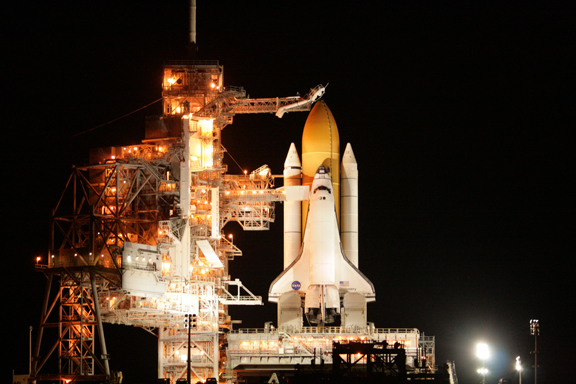
Discovery unveiled in darkness at pad 39 A at KSC.

Discovery unveiled in darkness at pad 39 A at KSC. Credit: Ken Kremer

R2 will be stationed inside the US built Destiny science research laboratory as a robotic assistant.  It will work together shoulder to shoulder with the ISS crew in space.

Robonaut 2A guards Launch Pad 39 A where his twin brother – dubbed R2 – will blast off to space inside shuttle Discovery at KSC.  Credit: Ken Kremer

Robonaut 2A guards Launch Pad 39 A where his twin brother – dubbed R2 – will blast off to space inside shuttle Discovery at KSC. Note US flag and world famous countdown clock at right. Credit: Ken Kremer

R2 will make history by becoming an official member of the ISS crew and the first non-human member to boot. The goal is to demonstrate how dexterous robots can operate in the zero g environment of space and how they can work to contribute to the maintenance and scientific output of the ISS.

R2 is the most dexterously advanced robot on Earth. When R2 boards the station, the ISS will become the most advanced robotics lab in human history and serve as an ideal  test bed for humans and robots working together to build a future of exploration and discovery.

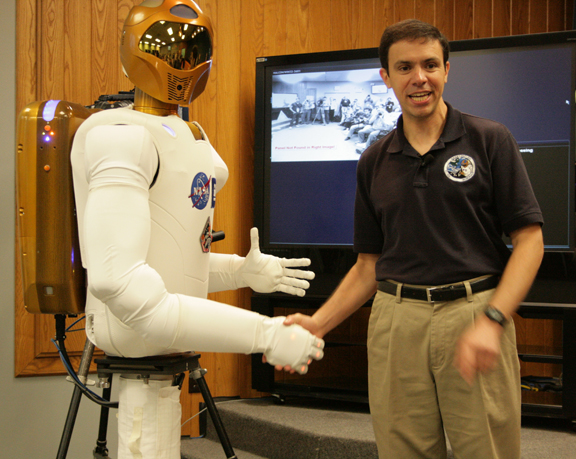
Robonaut 2A and Ron Diftler, NASA’s R2 project manager.

Robonaut 2A and Ron Diftler, NASA’s R2 project manager at the Johnson Space Center greet the media at a KSC press briefing for the STS-133 mission. The cameras provide eyesight for R2A and are projected live on the TV monitor at rear. Credit: Ken Kremer

“The chance to fly our robot to the ISS was a dream come true,” Ron Diftler told me in an interview at KSC. Diftler is NASA’s R2 project manager at the Johnson Space Center in Houston, TX.  “The human form is intentional and we hope it should help to motivate kids to study science.”

“We hope that one day, after further upgrades and the addition of a lower body and legs that R2 will even be able to venture outside and conduct EVAs to assist spacewalking astronauts,” Diftler added.

R2 weighs some 300 pounds and was manufactured from nickel-plated carbon fiber and aluminum. It is equipped with human like arms and hands as well as four visible light cameras that provide stereo vision.

Robonaut 2A and Ken Kremer shake hands at KSC.

Robonaut 2A and Ken Kremer shake hands at KSC. R2 has over 350 sensors. What a cool experience to meet and greet the most advanced humanoid robot in the world. Credit: Ken Kremer

The robot was developed in collaboration with GM. “NASA and GM pooled their resources and R2 was unveiled in February 2010,” according to Susan Smyth, GM Director of Research and Development.  “With R2 we will demonstrate ground breaking technology that will also have real world applications as GM works to build better and safer cars.”

The key point is that R2 can accomplish real work with incredibly dexterous hands and an opposable thumb as I witnessed in a live action demonstration at KSC.

R2A will be watching his twin brother’s blast off to space live from KSC.  Look here for more details about Robonaut: http://www.spaceref.com/news/viewnews.html?id=1473

Astronomy Outreach  by Ken Kremer

Upcoming Talks:
Gloucester County College Astronomy Club: Sewell, NJ, Dec 7, 7:30 PM.
“The Last Journey of Shuttle Discovery.”
Website:  http://www.gccnj.edu/news_and_alerts/rotating_ads/ken_kremer.cfm

Amateur Astronomers Association of Princeton: Princeton, NJ, Jan 11, 8 PM
“Whats Beyond for NASA: Shuttle, Station, Orion, SpaceX”
. I’ll speak about my up close experiences at KSC and at Cape Canaveral with R2, the Shuttle, Orion and SpaceX.  Website: http://www.princetonastronomy.org/

Ken Kremer:  Spaceflight Magazine  & The Planetary Society
Please contact me for more info or science outreach presentations at  kremerken at yahoo.com or my website:  www.kenkremer.com

Posted in December 2010, Sidereal Times | Tagged , , | Leave a comment

From the Director

by Ludovico D’Angelo, Director

It seems time goes so fast. Just yesterday (actually 2 weeks ago) we had our last meeting, and it is November already. I don’t mind, it just gets me to the next meeting of the AAAP just that much sooner. Our next meeting will be November 9th at 8 PM in Peyton Hall. Our speaker will be Jerry Lodriguss, a photographer and astro-photographer. As with the last meeting, it will be a fantastic program.

WELCOME!

There are also many new members who have joined the club recently. Some of them are Arthur Firestone, Eric Kauffman, Kevin Burkman, Steve Newfield, and Sanjay Phanse. There are several others, and I hope to introduce them at our next meeting. Please welcome them with me into this great club of ours and help them perpetuate whatever their interest is in our hobby of amateur astronomy.

Friday October 29th was the last public night out at the Simpson Observatory for the 2010 season. It ended with a clear night and a small crowd of enthusiastic campers and observers visiting. Overall, I think this season was a good one, and more clear nights than usual on the whole. But Friday nights are not the only times that the observatory can be open. For all of you, access to the observatory is one of the benefits of membership in the club. So don’t be shy, if you want to go out, call a keyholder you may know and do some observing.

There will be an AAAP Board of Directors meeting on Thursday, November 4th at 7:30 PM in Peyton Hall. If any one would like to attend, please let me know.

See you all on the 9th!

Posted in November 2010, Sidereal Times | Tagged | Leave a comment

November Meeting

by John Church, Program Chair

Our speaker for the November 9th meeting will be Jerry Lodriguss, amateur astronomer and astrophotographer par excellence for more than 40 years. The title of Jerry’s talk will be “Secrets of DSLR Astrophotography.”  He will talk about using your DSLR camera to photograph the most amazing show in the universe – the night sky. He will explain how to get started with very simple and easy methods such as a camera on a fixed tripod and advance to more sophisticated techniques such as stacking and narrowband hydrogen-alpha imaging. Secrets will be revealed. These include: determining the correct exposure, focusing with Live View, and correcting the color balance in the camera.

Jerry first became interested in astronomy at the age of seven when he looked through a “spyglass” at the Moon and was amazed to see that it had craters. He discovered his love for photography when he was 17 years old, when he bought a camera to take pictures through his homemade 10-inch reflecting telescope.

Jerry’s professional photography career began in 1974 while working part-time shooting high school sports for $5 per picture at a small suburban weekly newspaper in New Orleans. He has worked for the Associated Press, United Press International, Sports Illustrated, Time, Newsweek, New York Times, Washington Post, and USA Today. From 1987 until 2009 he worked at the Philadelphia Inquirer as their staff sports photographer.  An ardent Phillies fan, Jerry and the rival Yankee fans in this area share their mutual disappointment that their respective teams couldn’t meet in the World Series this year.

Today, Jerry is an author and photographer who has written for Sky and Telescope, Astronomy and other magazines. His astronomical photographs have also appeared in books and publications all over the world. He has written and published four books:

  • Photoshop for Astrophotographers
  • Catching the Light – A Beginners Guide to the Wonders of the Cosmos
  • A Guide to Astrophotography with Digital SLR Cameras
  • A Beginner’s Guide to DSLR Astrophotography

Visit Jerry’s website at www.astropix.com for more information.

There will be a “Meet the Speaker” dinner at the Triumph Brewing Company on Nassau Street, beginning at 6:00 PM before the meeting.  For reservations, please contact John Church via email by no later than 6:00 PM on Monday, Nov. 8th so that a table can be reserved.   (Note: this is earlier than usual due to travel arrangements.)

Posted in November 2010, Sidereal Times | Tagged | Leave a comment

Treasurer’s Report

by Michael Mitrano, Treasurer

Since my last report, dues payments have begun flowing in strongly.  To date we have 46 members paid up for the current fiscal year, totaling $1,840 in dues compared to the totals of $3,560 for all of last year and $4,147 for the year before.  If you have not sent in your dues, please do so.

StarQuest was a success financially as well as astronomically.  This fall’s event had a surplus – assuming that all expenses are in – of about $600 on revenues of $1,700.  This is close to the 2009 event’s results, where we had a $660 surplus on $1,900 revenue.  Thanks go to Ludy, the assistant chefs, and others who made StarQuest successful.

Other expenses thus far have been modest.  Later in the year we will incur our annual insurance expense, as well as an anticipated outlay for a new alarm system at the Washington Crossing observatory.

Our surplus for the fiscal year-to-date is approximately $2,000.  Our net assets on a cumulative basis are about $20,500.

Posted in November 2010, Sidereal Times | Tagged | Leave a comment

From the Program Chair

by John Church, Program Chair

The program lineup for the 2010-11 club season is coming along nicely.  On October 12, Suzanne Staggs of the Princeton Physics Department spoke to us on cosmology and the cosmic microwave background, with some extremely interesting results derived from Fourier analysis of slight irregularities in the CMB.

On November 9, a treat will be in store for our astrophotography fans when we will have Jerry Lodriguss, a well-known astrophotographer with several books to his credit, to speak on “Secrets of DSLR Astrophotography.” See the separate article in this issue. Jerry will have copies of one of his CD’s for sale during the break.

Our December 14 meeting will feature Bob Vanderbei, of both Princeton University and AAAP, to discuss his new National Geographic book co-authored with J. Richard Gott, “Sizing Up the Universe.”  The book, which will feature many of Bob’s photos taken from his driveway, will be in stores by late November.  Bob will be doing signings during the intermission.

On January 11 we will have our own Ken Kremer to speak on “The Space Shuttle, The Space Station, and What’s Beyond for NASA.”  The talk will include many of Ken’s photos and descriptions from personal behind-the-scenes visits to the Kennedy Space Center at Cape Canaveral, where Ken has a press pass.

On February 8 we have a tentative speaker lined up from Franklin & Marshall College in Lancaster, PA, with name and topic to be announced later.  Confirmation awaits the speaker’s determination of the springtime academic schedule.

March and May are still open as of this writing.  On April 12 we will have Michael Molnar to speak on “The Star of Bethlehem,” a topic he has extensively researched. Michael will be signing copies of his book on this subject during the intermission.

June 14 will feature a planetarium show by AAAP’s Bill Murray.  If the one he gave last June is any indication, we are in for another treat!

Posted in November 2010, Sidereal Times | Tagged | Leave a comment

From the Outreach Chair

by David Lechter, Outreach Chair

First, I would like to introduce myself as your new Outreach Chairperson.   My name is David Letcher and I have been a member of AAAP for a few years now.  I live in Ewing Township, and I am a Professor of Applied Business Statistics in the School of Business at The College of New Jersey.  I have taken over the job of Outreach Coordinator from Jeff Bernardis who has been very helpful to me during this time in which I am getting used to the job.

So far, we have had two Outreach activities this season.  One was giving a star party to two troops of cub scouts in the evening of Saturday, October 16th.  I initially scheduled one troop but another troop that was camping nearby took our invitation and attended too.  I guess we had approximately 50 scouts plus their parents!  It was a crystal-clear, but chilly evening, but the seeing was pretty good.    Gene Ramsey, David Zahler, and I brought our own scopes, and Jeff Bernardis operated the scopes in the observatory.  Apologies if I forgot other members who may have been there too.  It was crowded!

Wednesday afternoon saw me giving a PowerPoint presentation on the solar system to a girl scout troop at the Bear Tavern Elementary School in Hopewell Township.  One of my slides was a photograph of a region of the sky that included the constellation of Leo; just a lot of stars and nothing else.  So I asked the girl scouts to look at it and see if they see any patterns.  After just a few minutes they began to see the patterns of Leo and then one of the scouts said “That is Leo The Lion!”  It was a grand time had by all.

We have received additional requests from other people recently.  Right now I am talking with the following people about offering some sort of program to them:

1.  A request from a cub scout group in Colts Neck for a speaker about astronomy.

2.  The Upper Freehold Regional Elementary/Middle School PTA is asking if we want to participate in their Family Science Night on Friday, November 12, 2010.  I understand that AAAP participated last year.  This will be in Allentown, NJ.

3.  The Dutch Neck Elementary School PTA Fourth Annual Science Day event will be held on March 25, 2011.  It is a full day of scientific presentations and experiments for K-3 students.

4.  Dee Bosch, one of our own members, is asking for us to hold a star party in a school in Pemberton, NJ.  The date(s) haven’t been set up yet.

So far, those are the outreach items.  I’ll be sending out email notices about where and when these events will be held. Clear Skies!

Posted in November 2010, Sidereal Times | Tagged | Leave a comment