From the Program Chair

by Ken Levy, Program Chair

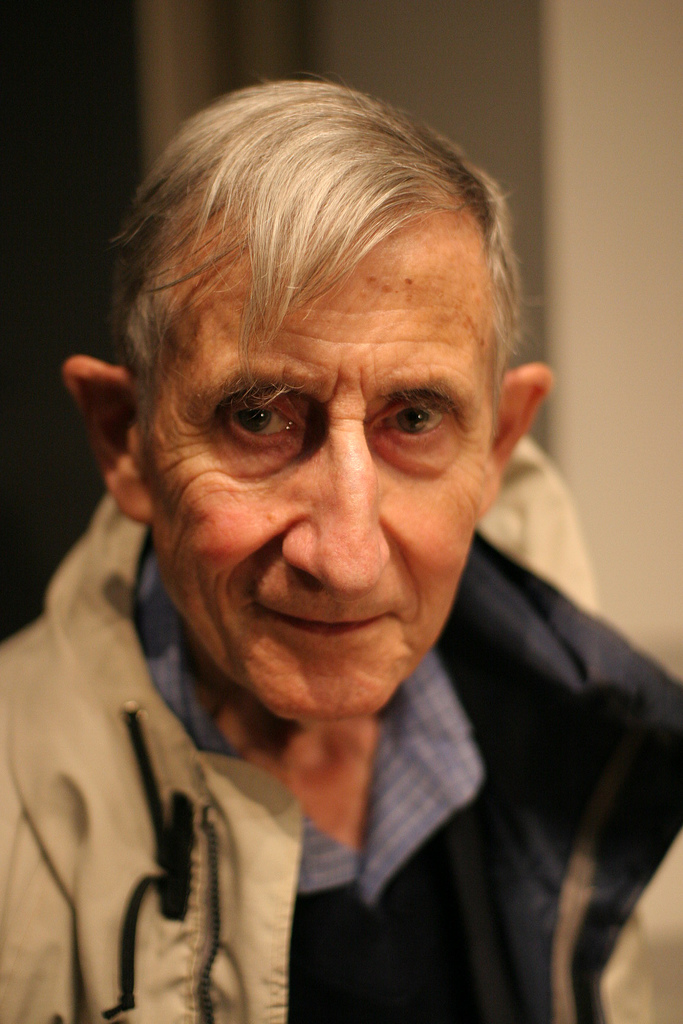
October’s lecture promises to be extra special with the appearance of eminent physicist Dr. Freeman Dyson. Dr. Dyson has contributed an incredible body of work from formulations of quantum electrodynamics in 1949 to being a regular contributor to the New York Review of Books in 2011. A member of the Institute of Advanced Study, an appointment conferred to him by Robert Oppenheimer, Dyson speaks with amazing insight, passion and humor on many topics.

Dr. Freeman Dyson

Dr. Freeman Dyson, eminent physicist

Dr. Dyson’s lecture will deal with the search for life in the universe, eschewing obvious targets like planets in favor of moons, asteroids and comets as more likely places to explore. Always able to present his many interests in a totally relatable way, this will be a lecture not to miss.

Other upcoming speakers for the ’11-’12 season include:

Nov 8: – Ken Kremer, NASA Fellow, “Atlantis, the End of America’s Shuttle Program and What’s Beyond for NASA”

March 13: – Mark Trodden, University of Pennsylvania, “Dark Matter”

April 10: – Gregory Matloff, NYC College of Technology, “Biosphere Extension”

TBA: – Mario Livio, Senior Astrophysicist, the Hubble Space Telescope Science Institute, topic to be announced

If anyone has any suggestions for future lecturers, please let me know.

We’re planning a “Meet the Speaker” dinner at the Triumph Brew Pub on Nassau Street at 6 pm on October 11. Please contact me (kenetics@me.com) for a reservation by no later than Monday, October 10 if you’d like to attend.

Posted in October 2011, Sidereal Times | Tagged , , , , , | Leave a comment

From the Outreach Chair

by David Letcher, Outreach Chair

I have three items to report. First, September 30th will see the first of four classes on backyard astronomy offered by the AAAP at the Nature Center at Washington’s Crossing State Park. Each class will be taught by member Dave Letcher with the assistance of member Gene Ramsey. The classes are designed for the preteen to adult age group.

The dates are on Friday evenings, September 30 and October 7, 14, 21 from 7:30 to 8:30 p.m. plus one Saturday afternoon for observing the sun and its sunspots.

Each class session will be followed by a visit, weather-permitting, to our observatory for evening observing of the sky.

Second, Cub Scout Pack 556 from in Hopewell has requested to visit our observatory on Saturday, October 22. Of course, this is not a regular open-house night but Jeff Bernardis and Gene Ramsey have volunteered to host the scouts. It would be great if you can help out that night! Bring your telescope if you can.

Third, on the star party front, we have been invited to participate at the Upper Freehold Regional PTA’s “Science Night Live” in Allentown, NJ on Friday, November 18th. This event will be held at the Newell Elementary School. I’ll be sending a request for volunteers and directions in the near future.

That’s all for now!

Posted in October 2011, Sidereal Times | Tagged , , , | Leave a comment

September 13, 2011 Board Meeting

by Larry Kane, Secretary

  • Director Ludy D’Angelo called the first meeting of the 2011-2012 season to order.
  • Observatory Report: Gene Ramsey announced that the park personnel need to be contacted concerning the ruts in the road that were created by the hurricane water and its effects on the gate need to be addressed.
  • Secretary’s Report: Larry Kane stated that he had added information about new members to the roster.
  • Treasurer’s Report: 2011-12 dues are due.
  • Public Outreach Report: Outreach Coordinator David Letcher indicated that the AAAP has been invited back by the Allentown Schools for their
    Science Night in November. The 17th is the tentative date. Dave also noted that he received a request from a Hopewell Scout troop requesting an event on Saturday, October 22, which is the evening they are camping in the park. He told them that he would send out an email to see if any members could bring their telescopes that night. Several members at the meeting responded that they could be there.
  • Sidereal Times: Michael Wright noted that Surabhi Agarwal agreed to be Co-editor. The next deadline is September 26.
  • Ludy noted that next year is the 50-th anniversary of the club and he requested sug-gestions on how to celebrate the event. Gene Ramsey noted that there will be a transit of Venus on June 5. Larry Kane suggested that we invite Congressman Rush Holt to such an event and advertise that he will be there.
Posted in October 2011, Sidereal Times | Tagged , , , | Leave a comment

Our Universe: Look Back In Wonder

by Edward Johnson

Late last month, Gene Ramsey was kind enough to show me around our observatory and let me take advantage of a break in the clouds to see the super-nova in M101, a star that exploded some 23 million years ago.

It took awhile to wrap my mind around what that meant. I was looking at light that was 23 million years old from a star that exploded during our planet’s Miocene Epoch. When that star exploded, the closest thing to a human walking the Earth was a small monkey-like primate called proconsul africanus. Hoofed animals and primates had just begun to diversify, charts from that period say.

The dictionary says astronomy is a natural science that studies celestial objects and phenomena that occur outside the Earth’s atmosphere. And while physicists with more knowledge than I’ll ever have fill charts with formulae that try to explain where our universe came from and where it’s going, my wonder is of a more simplistic variety.

I can scan the sky with a set of binoculars and look at objects that have kept their own watch for billions of years. Sometimes I have to pause and think about that—billions of years! It seems there’s a peaceful permanence in that. Long before I walked the Earth the planets of our solar system and the stars of our galaxy were there. They will, in all probability, be there long after I’m a memory.

The ancients studied the skies with wonder, some-times explaining what they couldn’t understand with fables and legends. Later, they tried to ex-plain their observations through mathematics, just as we do today as our quest to know continues.

Today’s professional astronomers work off radio soundings, satellite transmitted photographs and data, and mathematical formulae that are intimidating for someone like me to even look at. I read somewhere that most of today’s researchers don’t have to even see the sky to do their work. That certainly shows a form of technological progress and will probably lead to greater discoveries and understanding, even if it seems like less fun.

For me, there was something mystical in getting a clear telescopic view of Jupiter and its four visible moons; the same four moons Galileo first saw all those years ago. Those Jovian moons and that star that exploded some 23 million years, ago are true objects of wonder.

Posted in October 2011, Sidereal Times | Tagged , , , | Leave a comment

A Tour of the Famed Yerkes Observatory

by Rex Parker

An astronomy field trip to spice up the summer family visit back in the home state… destination: merely the birthplace of modern astrophysics!

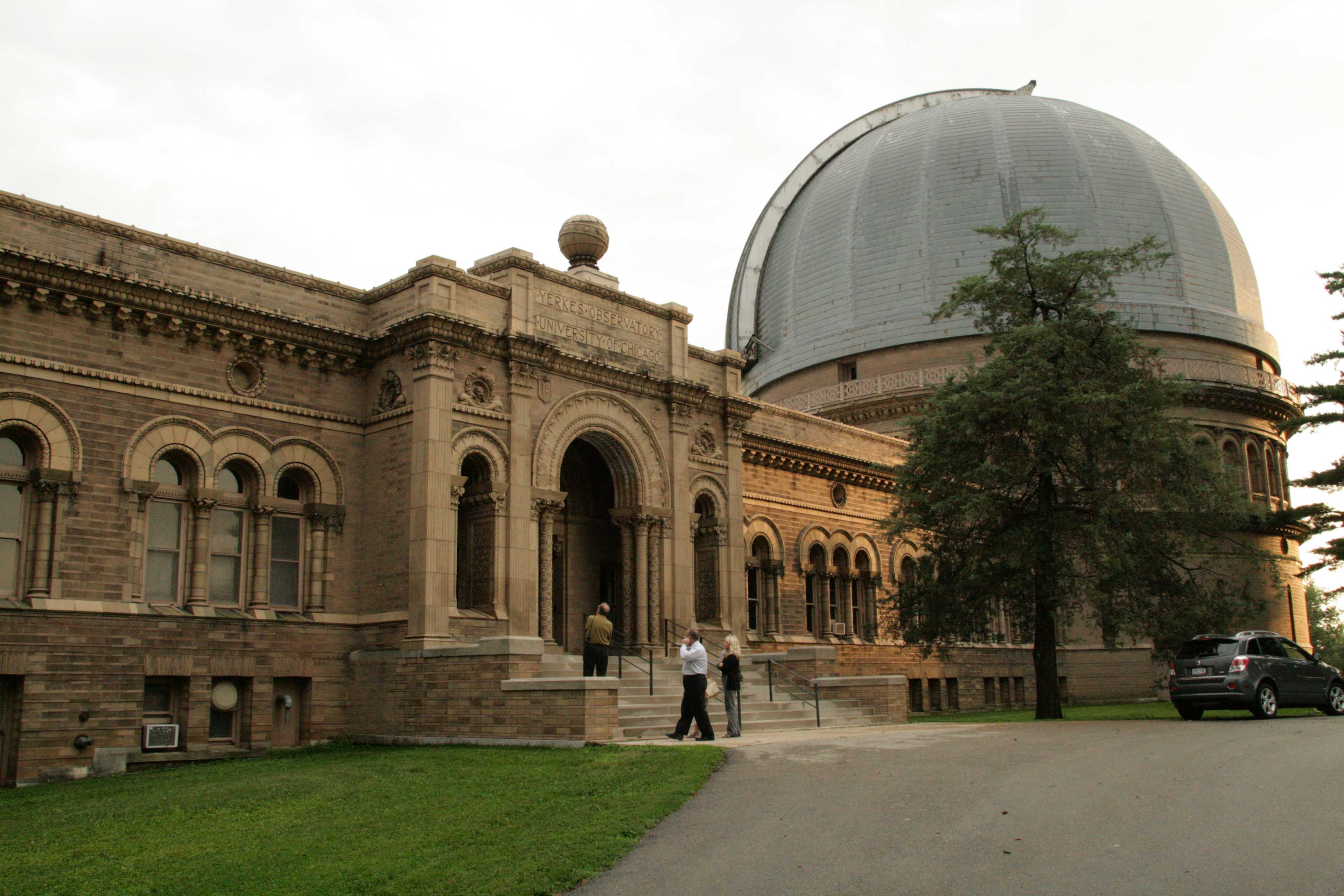
Yerkes Observatory

Yerkes Observatory. Credit: Rex Parker

I was bound for Yerkes Observatory, home to the world’s largest refracting telescope, the Clark 40-inch. Playing my AAAP, Princeton astronomy connections rather well it seems, I arranged for a custom personal tour graciously hosted by Yerkes expert and author, Dan Koehler. Dan agreed to meet me, my wife and two good friends from Indy, for a personal evening tour of the Observatory and telescopes on August 2. Yerkes is about 75 miles NW of Chicago, yet my enthusiasm wasn’t dampened when I realized this was a 260 mile drive from Indy!

Yerkes Observatory Front Entrance. Credit: Rex Parker

We arrived mid-day at beautiful Geneva Lake, which is pretty famous as a resort for well-to-do’s from Chicago. After a lake swim and lunch in town, we hopped on over to Yerkes just as a violent Midwestern lightning storm hit, complete with one-inch hail and 50-mph gusting winds. As suddenly as it started, the storm subsided, and we strolled the beautiful park-like grounds (designed by John Olmsted, brother of NYC Central Park’s famed landscape architect Frederick Law Olmsted). Dan Koehler arrived, and we embarked on a wonderful, informative four-hour guided tour back into time and space.

Dan Koehler is the executive producer of the well-received PBS video “400 Years of the Telescope”.

Yerkes in Dusk

Dome of Yerkes Observatory in dusk before the start of a magical night. Credit: Rex Parker

He is an amazing historian and astronomer who knows Yerkes inside-out, and is now writing a book on the life of George Ellery Hale and Yerkes. He has dedicated years of his life (and a lot of blood sweat and tears) to preserving Yerkes facilities, telescopes, and lore. We learned how Hale, as a young man fresh from MIT and now professor of Astrophysics at the new University of Chicago, in 1893 convinced the famed opticians, Alvan Clark and Sons, to figure a 40-inch objective lens from French blanks, which had become available only when USC abandoned plans to make the world’s largest telescope. Hale and William Raney Harper, the first president of the university, talked industrialist Charles Tyson Yerkes into paying for the immense and beautiful observatory structure to house the 40-inch in 1895. The choice of Geneva Lake as the site is an interesting one. History and scientific legends drip from the ceilings and domes. The architecture by Henry Ives Cobb is stunning neo-classical with hundreds of figures and gargoyles melded into the structure.
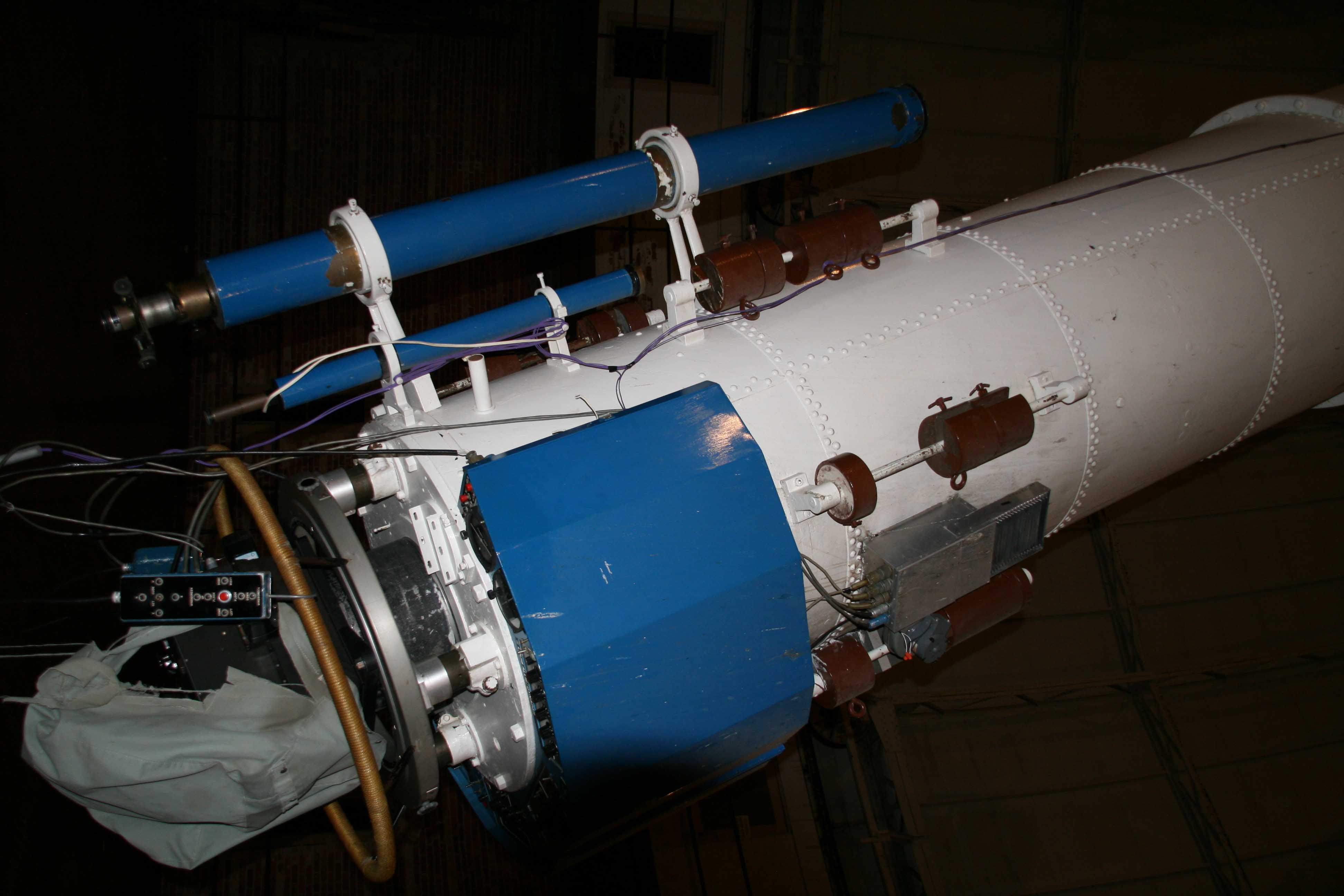
World's Largest Refractor

World’s largest refracting telescope at Yerkes Observatory. Credit: Rex Parker

Through the years, astronomical greats conducted cutting-edge research here. George Ellery Hale first detected carbon in the sun’s spectrum here, long before he moved on to become the force behind Mt. Wilson. Gerard Kuiper began his studies of solar system objects at Yerkes. Sherbourne Burnham and Edward Barnard conducted their binary star and stellar mass observations here. Frank Schlesinger developed the parallax methods using the 40-inch which led to precise distance determinations of nearby stars. Otto Struve developed his stellar spectroscopic techniques using the 40-inch, and Chandrasekhar (Nobel 1983) started his work on white dwarfs at Yerkes. William Morgan conducted studies of luminous blue stars here. The list goes on, true to the claim of being the birthplace of modern astrophysics.

If the stories weren’t enough, we were then taken into the main dome housing the 40-inch – what a gigantic yet stately telescope it is.

World's largest Refracting telescope

Another view of the world's largest Refracting telescope at Yerkes Observatory. Credit: Rex Parker

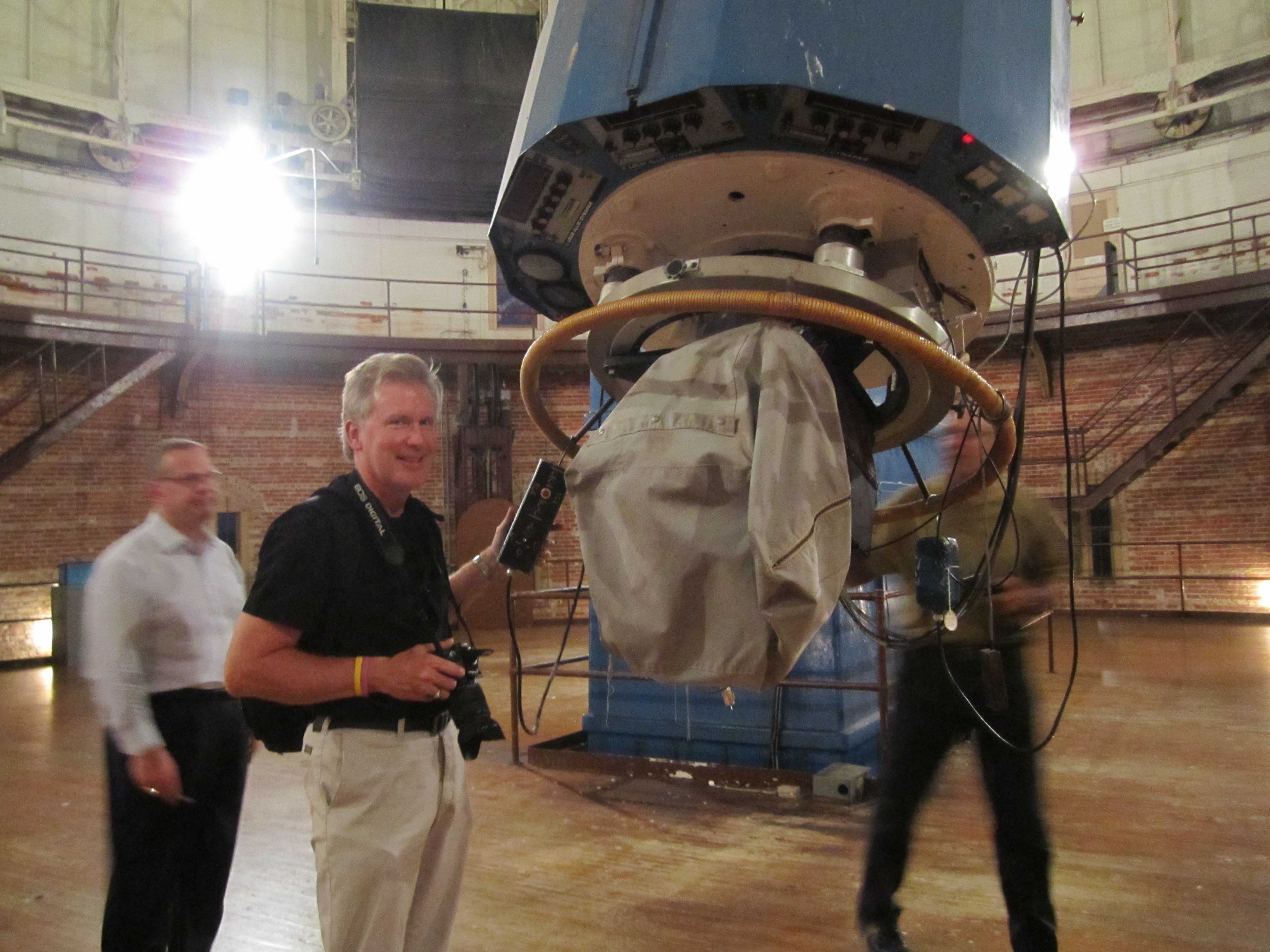
It became clear that the statement, “no one will ever build a larger refractor”, is very likely true (limited as much by the fluid properties of glass as much as money). Noble instrument indeed! The 65-foot long, f/19 telescope hangs in perfect balance on the four-story tall mounting edifice. It was built like a battleship using iron thick enough to stop an incoming six- inch shell. I personally activated the drive to open the dome, and with my pulse quickening I slewed the telescope in RA with push button controls. The immensity must be seen to believe. The entire floor rises up and down as a giant elevator to position the observer at the instrument/eyepiece end of the refractor!
Rex Parker in Yerkes

Rex Parker standing beneath the world's largest refracting telescope. Credit: Rex Parker

Amazingly, the huge original DC drive motors, which slew the scope and drive the dome, are still in place and working perfectly. While it has been upgraded to accept modern detectors and instruments, all components of the 40-inch scope are essentially original and working. The pictures give a glimpse of the uniqueness of this instrument. If you ever find yourself in the Chicago / Milwaukee area, take the time to visit this wonder of the astronomy world.

Posted in October 2011, Sidereal Times | Tagged , , | Leave a comment

Juno launches on Voyage to Discover Jupiter’s Genesis

by Dr. Ken Kremer

NASA’s solar powered Juno spacecraft was successfully launched towards Jupiter

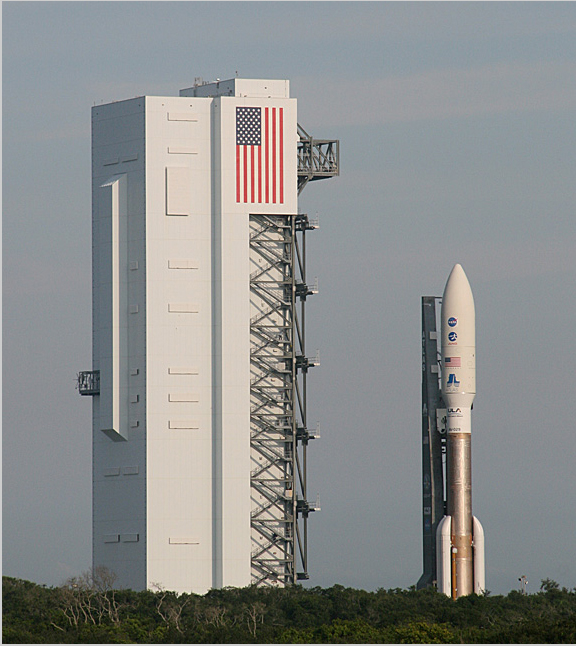
Atlas V and Juno

Atlas V and Juno emerge from the Vertical Integration facility (VIF) for rollout to Space Launch Complex 41 at Cape Canaveral, Florida. Credit: Ken Kremer

on August 5, 2011 to begin a five year and 1.7 Billion mile voyage to the gas giant.The goal is to unmask the hidden secrets of Jupiter’s genesis and planetary formation lurking deep below the turbulent cloud tops.

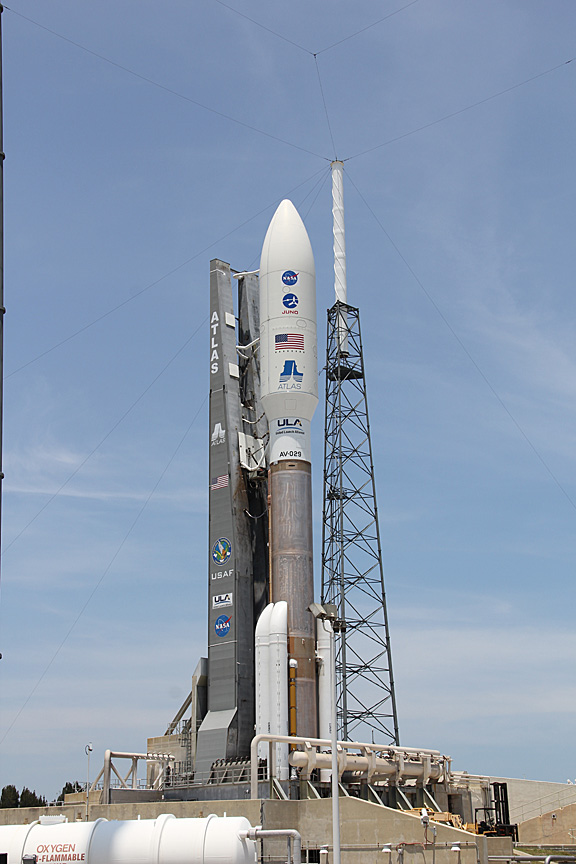
Juno’s spectacular lift off occurred at 12:25 p.m. EDT atop the most powerful version of the Atlas V booster rocket from a seaside launch pad at Space Launch Complex 41 at Cape Canaveral Air Force Station.  The Atlas V is a behemoth, standing 197 feet tall.

Atlas V and Juno spacecraft

Atlas V and Juno spacecraft poised at Pad 41 at Cape Canaveral, Florida. Credit: Ken Kremer


I had a magnificent view of Juno’s beautiful blast off from an outstanding  vantage point on top of the roof of the VAB (Vehicle Assembly Building), some 525 feet above ground. Check out my album of launch day photos taken from the VAB roof and pre-launch photos taken direct from the Atlas launch pad.

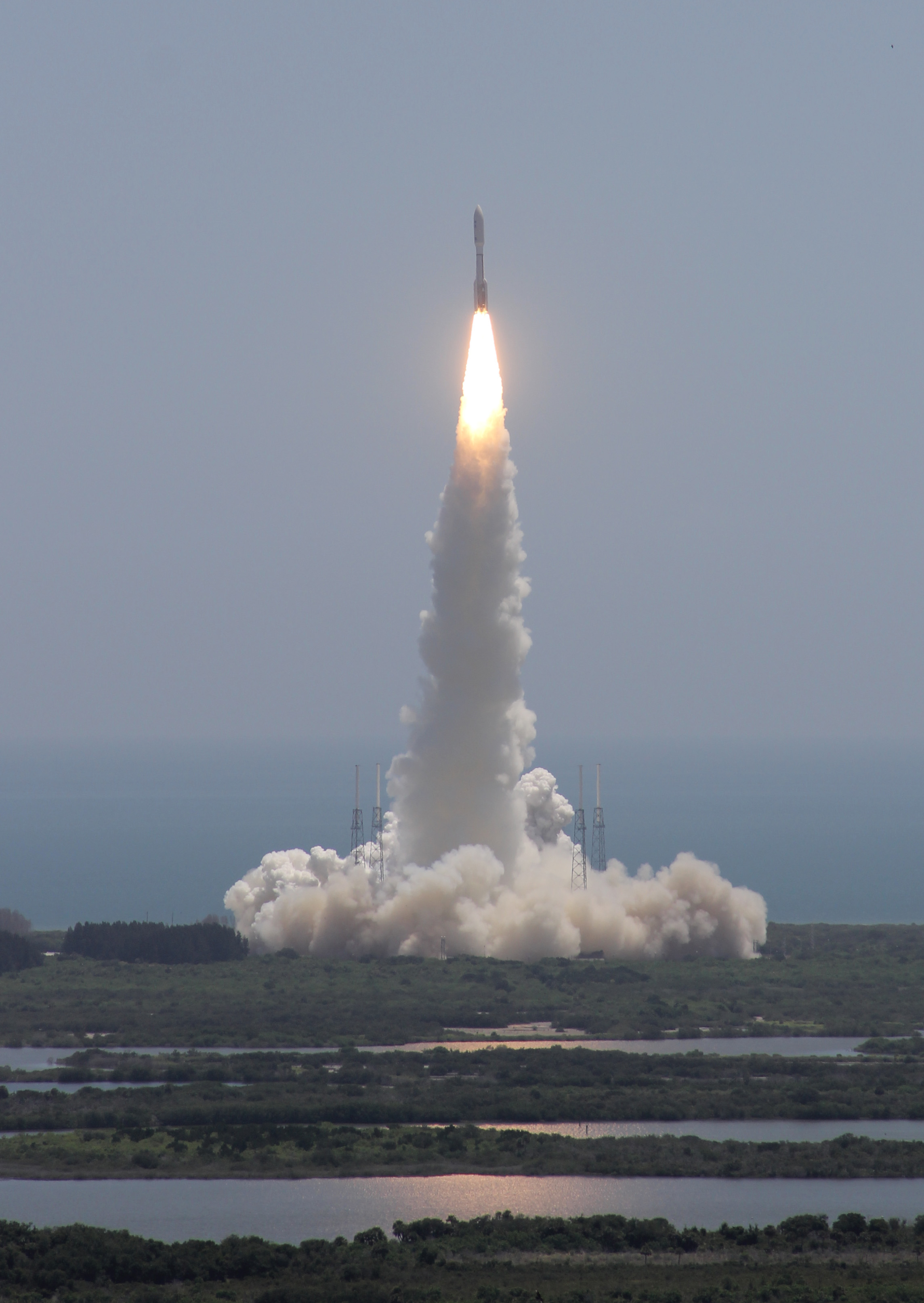
The crackling roar from the engines grew louder as the fiery exhaust accelerated the stack and reached a maximum some 30 seconds after blast off as the rocket arched over to the east. As the first stage continued to fire, the five solids jettisoned after burnout as planned almost two minutes later.
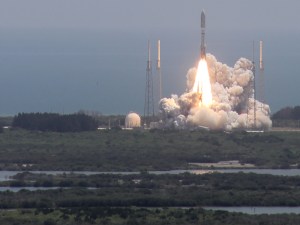
Juno blasts

Juno blasts to Jupiter atop an Atlas V on Aug. 5 from Space Launch Complex 41 at Cape Canaveral at 12:25 p.m. EDT. View from the VAB roof. Credit: Ken Kremer

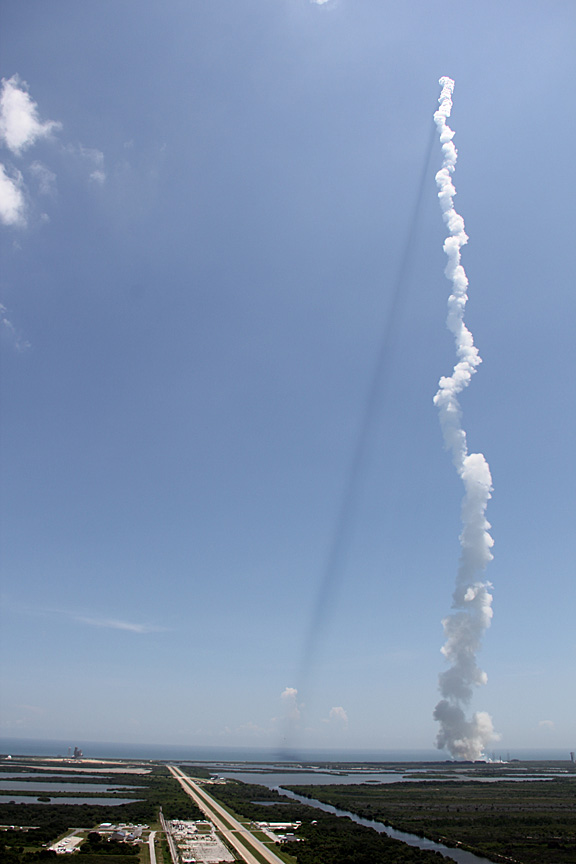
As Juno sped away into the clear blue sky on a sunny Florida afternoon, the sun was angled just right to cast an eerily dark and hazy shadow from the probe and exhaust plume back to Earth – nearly in a straight line!  It was a remarkable sight that I’ve never witnessed before.

Juno carries three giant solar panels, each spanning more than 20 meters (66 feet) in length. They will remain continuously in sunlight from the time they were unfurled through the end of the mission.
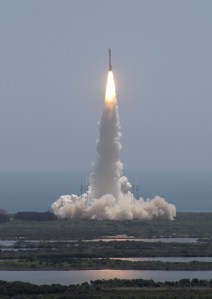
Juno soars

Juno soars skyward to Jupiter on Aug. 5 from pad 41 at Cape Canaveral at 12:25 p.m. EDT. Credit: Ken Kremer


Juno is the first solar powered probe to be launched to the outer planets and operate at such a great distance from the sun.  Jupiter receives 25 times less sunlight than Earth.

After cruising to Jupiter’s vicinity in July 2016, Juno will fire its main engine to enter an elliptical polar orbit. Juno will scrutinize Jupiter for about one year during 33 orbits lasting 11 days each, that skim to within about 3100 mi of the planets polar cloud tops.

Juno’s advanced suite of nine science instruments will investigate whether Jupiter has a solid planetary core, search for clues to the planets origins,  determine the water and oxygen content,  measure the interior structure, observe auroras and map the magnetic and gravity fields.

Juno casts a shadow

Juno casts a shadow back toward Earth and Space Shuttle Launch Pad 39A and the shuttle crawlerway (at left) seconds after liftoff from adjacent Pad 41 at Cape Canaveral, Florida. Credit: Ken Kremer


The payload of state of the art science instruments includes a gravity/radio science system, a six wavelength microwave radiometer for atmospheric sounding and composition, a vector magnetometer, plasma and energetic particle detectors, a radio/plasma wave experiment, an ultraviolet imager/spectrometer, and an infrared imager/spectrometer.

The mission will also provide the first detailed glimpse of Jupiter’s poles via a specially designed camera named JunoCam that will snap spectacular close-up color images that will be continually released to the public on a real time basis.

Check my Juno features online at Universe Today and Scientific American starting here:
First Image Captured by NASAs Jupiter bound Juno; Earth – Moon Portrait
Juno Blasts off on Science Trek to Discover Jupiter’s Genesis
Juno Jupiter Orbiter poised at Launch Pad for Aug. 5 Blastoff

http://www.scientificamerican.com/article.cfm?id=journey-to-a-giant-world

Astronomy Outreach      by Ken Kremer

Bucks-Mont Astronomical Association (BMAA): Doylestown, PA, Peace Valley Nature Center, , PA, Oct 5, Wed. 8 PM, “7 Years of Mars Rovers (in 3D)”   Website:  http://www.bma2.org

Amateur Astronomers Association of Princeton:  Princeton University, Princeton, NJ, Nov 8, 8 PM  “Atlantis, the End of Americas Shuttle Program and What’s Beyond for NASA”Website: http://www.princetonastronomy.org/

Washington Crossing State Park:  Titusville NJ, Nov 12, Sat, 1 PM.  “The Grand Finale of  Americas Shuttle Program and What’s Beyond for NASA”. Website: http://www.state.nj.us/dep/parksandforests/parks/washcros.html

Ken Kremer:  Spaceflight magazine & Universe Today

Please contact Ken for more info or science outreach presentations:

Email: kremerken@yahoo.com   website:  www.kenkremer.com

http://www.universetoday.com/author/ken-kremer/

Posted in October 2011, Sidereal Times | Tagged , , , , | 1 Comment

From the Director

by Ludovico D’Angelo, Director AAAP

Happy return to our next season of the AAAP. This is our 49th year. Next year is the 50th year since the club’s inception, and we should plan something special. So now is the time to plan, send your ideas along to a board member or me. Let’s have a great time celebrating our club’s longevity.

I hope everyone had a great summer. Write an article for the Sidereal Times if you went to an interesting star party, visited a deep sky site, or anything astronomically related. We want to hear from you!

My summer finds me on vacation in Minnesota. This year I brought my 9.25-inch SCT, hoping to use it. And I did use it, but not necessarily for astronomy. It did end up being a great way to see fledgling eagles from about half a mile away. Let me explain. My family and I go to a resort called Madden’s. It is 2 ½ hours north of Minneapolis. So it does get very dark there, but because it’s north, and because of the time of year, the sun does not completely set until around 10 PM. And then there is the state bird to contend with: The Mosquito. Those little varmints are so bad, that even after dosing myself with cans of Deep Woods Off, they still find an empty spot on my skin. I did do one night of observing, and I was able to show many of the guests an object or two through the scope before they had to run away to the protection of the indoors. The Milky Way was wonderful to see in all its glory. It certainly is one highlight of the vacation. I was not able to observe every night so I set up my scope so that people throughout the day could enjoy an eagle’s nest and the young eagles in the nest. It was quite a sight to see. Did you know that an eagle’s nest could weigh more than a ton?

At the last AAAP Board meeting, we discussed our annual StarQuest outing, which is open to everyone. StarQuest will be September 23rd to 25th. As usual, we will have the upper lodge at the Hope Center, catered food, and some great raffle prizes. We also will have club member Robert Vanderbilt give a talk on astrophotography on Saturday. The title of his talk will be “Astrophotography: From the Unusual to the Extreme”. So all in all, it’s shaping up to be another great StarQuest event. We are getting all the rain, wind, and hurricanes out of the weather pattern now so I am hopeful for the best clear skies this year in north Jersey. See you there!

Our next meeting will be September 13th at 8 PM in Peyton Hall. We are happy to invite back Dr. Gillian Knapp from Princeton Astrophysics as our guest speaker for the meeting. Our new program chair, Ken Levy, is doing a great job in inviting guests to speak at our meetings.

I’ll see you all on the 13th!

Posted in September 2011, Sidereal Times | Tagged | Leave a comment

From the Program Chair

by Ken Levy, Program Chair

I’m excited to announce the new season of speakers for our 2011/2012 lecture series. The lecturers represent an eclectic mix of backgrounds and topics. In case you miss a date or want to refer to a point, this season we’re going to record and post the lectures (with the speaker’s permission) on the AAAP website. The schedule is still a work in progress, so if you have any suggestions for someone you’d like to see, please let me know.

Sept 13, 2011  Jill Knapp, Princeton Astrophysics, topic to be announced

Oct 11, 2011  Freeman Dyson, Institute of Advanced Studies, Extraterrestrial Life

Nov 8, 2011  Ken Kremer, NASA Fellow, State of NASA

March 13, 2012  Mark Trodden, UPenn, Dark Matter

April 10, 2012  Gregory Matloff, NYC College of Tech, Biosphere Extension

Posted in September 2011, Sidereal Times | Tagged , | Leave a comment

From the Outreach Chair

by David Letcher, Outreach Chair

Member Gene Ramsey will be hosting two solar observation sessions at the nature center for all ages on Sunday September 4, and on Monday, September 5 each at 1:30 – 4:00. His description includes viewing naturalistic activity on the sun safely through a telescope equipped with a special filter. Observe sunspots, solar flares, prominences, and other solar phenomena as they are available. Learn how these storms can affect the earth as well as other interesting facts about our planet’s closest star. Let us hope for clear skies for these events!

September 30th will see the first of four free classes on astronomy offered by the AAAP at the Nature Center at Washington’s Crossing State Park. Each class will be taught by me with the assistance of Gene Ramsey. The classes are designed for the pre-teen to adult age group. Class size will be limited and registration will be available on a first come, first served basis starting on August 31. To register, call the Nature Center at (609) 737-0609. AAAP will issue a certificate of completion to anyone who attends all four classes.

The classes will be on Friday evenings, September 30 and October 7, 14, 21 from 7:30 to 8:30 p.m. plus one Saturday afternoon for observing the sun and its sunspots. Each class session will be followed by a visit, weather-permitting, to our observatory for evening observing of the sky.

The topics/themes are as follows:
September 30    Backyard Astronomy
October 7           Telescopes for Amateurs
October 14         The Solar System
October 21         Stars, Star Clusters, and Galaxies

On the star party front, we have been invited to participate at the Upper Freehold Regional PTA’s “Science Night Live” in Allentown, NJ on Friday evening, November 18th. This event will be held at the Newell Elementary School. I’ll be sending a request for volunteers to our membership in the near future.

Posted in September 2011, Sidereal Times | Tagged | Leave a comment