From The Director

by Rex Parker, PhD director@princetonastronomers.org

2024 Mid-Summer Edition of Sidereal Times.  I hope you’re enjoying your summer and getting a chance to do some astronomy on the occasional clear night here in central Jersey. Our summer hiatus for meetings continues until Sept 10 when we’ll resume meetings at Peyton Hall, home of the Princeton University Astrophysics Dept.  

Despite plenty of clouds this summer, so far we have not had the problem of forest fire smoke in the northeast US atmosphere as we did last year.  So, I hope to see you for some deep sky observing at the AAAP Observatory at Washington Crossing State Park (see Observatory tab on the website for directions).  We have some incredibly fine telescopes and video astronomy equipment all tuned up for members use, and to bring the stars to the public on Friday nights.  For observatory opening status on those Friday nights (weather dependency) consult the AAAP website or social media sites on Friday afternoons.  Lately we’ve had quite a few members participating on Friday nights with many different telescopes on the field for comparison.  

The Cometary Origins of the Perseid Meteor Shower.  This year’s Perseids meteor shower might provide a good show if weather cooperates, as the first-quarter moon will set before midnight on the peak dates around Aug 10-12. Perseid counts usually increase late in the night before twilight, and as many as 50-70 per hour are predicted for darker sky locations this year. 

But what exactly are the Perseid meteors?

A few years ago, I returned from the NEAF conference in April with a small meteorite specimen.  Many of us have marveled at the US’s largest meteor (the Willamette meteorite, found near Portland OR) weighing in at 16 tons, on display at the Hayden Planetarium in NYC.  My 50 gram NEAF specimen is a fragment of the Canyon Diablo meteorite (Meteor Crater AZ), whose ~30 tons explosively dispersed over a ~10 km radius upon impact thousands of years ago.  Both of these examples are composed mostly of iron with ~5-10% nickel and 0.5% cobalt. The origin of the iron-nickel class of meteorites can be traced to the cores of large asteroids, similar in composition to earth’s core.  

In contrast, meteor showers like the Perseids originate from cometary orbital material which is quite unlike the iron nickel composition of the large meteorites.  Spectroscopic analysis suggests carbonaceous chondrites found on earth are similar to comets in composition, and some specimens may be from meteor showers.  Of course, only the rare larger meteors ever make it to the ground, and most are only a few grams in mass or even less.  Despite their low mass during entry into the atmosphere, their very high kinetic energies derive from velocities on the order of 100,000 mph, producing a brilliant transient incandescence if we are lucky enough to see them. Meteor showers result from earth crossing the orbital path of periodic comets, which over time have “leaked” small particles of dust and debris from the nucleus along the entire orbit.  The Perseid meteor shower of August is associated with the periodic comet 109P/Swift Tuttle.  This is a large comet with nucleus ~16 miles across, and a 133-year elliptical orbit which intersects our plane of the ecliptic at a sharp angle of ~113 degrees..  The comet crossed the earth’s orbital plane most recently most recently in 1992 (see Figure below, which I made using TheSkyX software).  According to information from the American Meteor Society, most of the Perseid particles have been part of the Perseid meteor cloud for at least a thousand years.

The Perseid meteors originate from the orbit of comet 109P/Swift Tuttle which crosses the plane of earth’s orbit closest to us on ~August 10-13.  Earth is moving to the right in this orbital diagram.  Image by RAP made using TheSkyX software.


Observing Challenge Update – T CrB Nova.  The challenge for AAAP members is to observe and record the light curve of the impending nova of the faint star T CrB (in the constellation Corona Borealis).  The star is now in pre-nova stage, and the outburst event could happen any day through September.  The star is recorded in some stellar databases and programs as  HIP 78322 (Hipparcos Catalog). This famous recurring nova has an 80-year cycle, and is one of only five recurring novae known in our galaxy.  Its magnitude, currently around ~10, will increase suddenly in brightness to magnitude ~2.   The goal is to observe the T CrB nova event in a telescope, and especially to record its light curve with an astro camera, being sure to get baseline data before the nova outburst.  Once it peaks, it should be visible to the unaided eye for several days and with binoculars for a week before dimming for another 80 years.

Posted in Mid-summer 2024, Sidereal Times | Tagged , | Leave a comment

From The Program Chair

by Victor Davis, Program Chair

September Meeting
The September, 2024 meeting of the AAAP will take place in Peyton Hall on the campus of Princeton University on Tuesday, September 10th at 7:30 PM. As usual, the meeting is open to AAAP members and the public. Participants can join the meeting in-person at Peyton Hall or log in to the Zoom session as early as 7:00 pm to chat informally before the meeting begins. The evening’s guest speaker is Neta Bahcall, Eugene Higgins Professor of Astrophysics at Princeton University.

Options for Attending the Meeting
You may choose to attend the meeting in person or participate via Zoom or YouTube as we’ve been doing for the past few years. (See How to Participate below for details). Due to security concerns, if you log in before the host has set up internet connectivity in Peyton Hall, you may need to wait in the Waiting Room for a few minutes until the host is prepared to admit you into the meeting. You’ll need to unmute yourself to make comments or ask questions. It’s polite, though not required, for you to enable your camera so other participants can see you. A week or so after the meeting, the video of the lecture and Q&A will be posted on AAAP’s public YouTube channel.

Meet the Speaker Dinner
The status of the club’s traditional “Meet the Speaker” dinner is undetermined at this time. Please contact the Program Chair closer to the meeting date if you’d like to attend.

(Times are approximate)

Getting to Peyton Hall
The parking lots across the street (Ivy Lane) from Peyton Hall are now construction sites, unavailable for parking. We’ve been advised by the administration of the astrophysics department that we should park in the new enclosed parking garage off Fitzrandolph street and walk around the stadium and athletic fields. Here’s a map of the campus and walking routes from the parking garage to Peyton Hall. The map shows the recently completed East Garage. Not shown is an access road Sweet Gum that connects from Faculty Road to an entrance at the lower left corner of the garage. Stadium Road connects from Fitzrandolph Road to another entrance at the opposite corner (and higher level) of the garage. It’s about a 10-15 minute walk from the parking garage to Peyton Hall.

Featured Speaker:
Neta Bahcall
Eugene Higgins Professor of Astrophysics
Princeton University

neta@astro.princeton.edu
“Lighting Up the Dark: Where is the Dark Matter?”

Lighting Up the Dark: Where is the Dark Matter?
Gravitational lensing and other phenomena help to show the distribution of mass within galaxies and throughout the universe, revealing the connection between the dark and bright sides of the Universe. We’ve discovered that – at galactic scales – the observed mass distribution extends considerably beyond the dimensions we observe in luminous objects. This trend changes dramatically at scales larger than a few hundred kiloparsecs, where mass, light, and stars trace each other remarkably well. Contrary to earlier expectations, it seems that most of the dark matter in the universe may be located in large halos (~300 Kpc in extent) enveloping and surrounding galaxies as opposed to being found on larger scales throughout galaxy groups, clusters, and other large-scale structures.

How can stars, which represent only about one percent of the total mass of the universe, follow the total mass so well? Where are the rest of the baryons? How is dark matter distributed in the universe, and how does it relate to the underlying distribution of light, stars, and baryons? Prof. Bahcall will discuss the connection between baryons, stars, and mass at large scales, and the implications for galaxy formation, the mass-density of the universe, and cosmology.

Neta Bahcall
Neta A. Bahcall is the Eugene Higgins Professor of Astrophysics at Princeton University. She is Director of the Undergraduate Program in Astrophysics, and past Director of the Council on Science and Technology of Princeton University. 

Prof. Bahcall was born in Israel. She earned her PhD from Tel-Aviv University, working in Nuclear Astrophysics under the direction of Prof. William A. Fowler of Caltech. She was the first Head of the Science Program Selection Office and Chief of the General Observer Branch at the Space Telescope Science Institute (STScI) in Baltimore. Prof. Bahcall is a Distinguished Lecturer at various universities and has served on editorial boards of many organizations. She’s an elected member of the National Academy of Sciences, and past-chair of its astronomy section. She has won prestigious awards for her distinguished career in astronomical research. Prof. Bahcall married renowned astrophysicist John N. Bahcall in 1966, and has three children. 

Prof. Bahcall’s research work focuses on questions such as: What is the large-scale structure of the universe? How did structure form and evolve? How much dark matter exists in the universe and how is it distributed? What is the nature of dark energy? What is the ultimate fate of our universe? Prof. Bahcall and colleagues’ determination of properties such as the cluster correlation function, the cluster mass function and its evolution, the mass-to-light function from galaxies to superclusters, the geometrical shapes of clusters and of large-scale structure have provided powerful constraints on cosmology, including one of the first determinations of the mass-density of the universe and the amplitude of mass fluctuations. Prof. Bahcall works closely with students and postdoctoral fellows; their work is summarized in more than 300 scientific publications.

How to Participate (Links)

Zoom and YouTube links will be provided soon

As always, members’ comments and suggestions are gratefully accepted and much appreciated.

victor.davis@verizon.net
program@princetonastronomers
(908) 581-1780 cell

Posted in Mid-summer 2024, Sidereal Times | Tagged , , , , , , | Leave a comment

Gene Ramsey

Observatory Chair 2010 – 2016

The heavens declare the glory of God, and the firmament proclaims His handiwork.
Psalm 19:1

In his retirement years, Gene Ramsey pursued his passion for astronomy, serving as a diligent caretaker of this observatory and mentor to members of the Amateur Astronomers Association of Princeton who continue to use this facility for our own observing projects and for educating the public. Gene’s special joy was explaining the wonders of the universe to children. His knowledge of sky lore and enthusiasm for public outreach inspire the club’s “keyholders” and the observatory’s many visitors to share Gene’s sense of the transcendence of the human experience.

Posted in Sidereal Times | Leave a comment

Book Review

by Michael DiMario

Title: The Allure of the Multiverse
Author: Paul Halpern
Publisher: Basic Books, New York
Publication Date: January 2024
Total Pages: 320

In The Allure of the Multiverse, the author physicist Paul Halpern begins to describe the early ideas of the infinite cosmos with Giordano Bruno’s 1584 treatise On the Infinite Universe and Worlds. The author brings the reader through the history and controversies of not only our singular universe but of multiple universes before the Big Bang and of parallel universes. Time travel is discussed and the testing of time dilation brings the reader through an expanding topical discussion showing the interconnections of time, gravity, space, black holes, and a potential multiverse. Wormholes and time tunnels are discussed thoroughly as well as a description of our own Princeton J Richard Gott’s time loop.

This reader found the first half of the book a slow read delving into the history and controversies of the origins of the current multiverse theories. However, the read picked up in the latter half of the book as the reader is taken through time travel, worm holes, and the basis of the popular shows and movies of Interstellar, Star Trek, and faster than light tachyons. This is a great source to more fully understand the subject and origins of the concept of multiple universes.

Posted in Mid-summer 2024, Sidereal Times | Tagged , , , | Leave a comment

Mid-Summer 2024 Sidereal Times Astroimaging

by Michael DiMario, AAAP Astroimaging Chair

The summer thus far in eastern PA and NJ has been self-evident in poor weather from clouds, humidity, storms, and extreme heat making astroimaging difficult to say the least. However, a few tremendous images were taken by AAAP members concentrating on the northern constellation Cygnus. Cygnus is one of the most recognizable constellations of the northern summer and autumn sky, and it features a prominent asterism known as the Northern Cross (in contrast to the Southern Cross) with the brightest star in Cygnus and first-magnitude Deneb, a blue supergiant, forming at the head of the Northern Cross. Deneb also forms an additional asterism known as the Summer Triangle. The constellation is home to Cygnus X-1, a distant X-ray binary containing a supergiant and unseen massive companion that was the first object widely held to be a black hole. There are 97-star systems in Cygnus that have known planets as a result of the Kepler Mission.

Clear skies,
Michael DiMario, PhD
AAAP Astroimaging Chair

David Wilton – Cygnus Wall

The Cygnus Wall, part of the North America Nebula (NGC 7000), photons were collected multi-nights of 15–27 June 2024. Total integration time of 13 hours, 18 minutes using a Televue 127 refractor and ZWO ASI2600 monochrome camera on a Paramount MYT mount. Post processing with PixInsight. The nebula is in the “Hubble palette,” that is using narrowband sulfur II, hydrogen-alpha, and oxygen III filters in the red, green, and blue channels; the stars were imaged with red, green, and blue filters.

David Wilton – Witch’s Broom

Witch’s Broom (NGC 6960), part of the Veil Nebula, a supernova remnant in Cygnus. Image was captured 7–8 June 2024 with 7 hours, 56 minutes integration time, using a Televue 127 refractor and ZWO ASI2600 monochrome camera on a Paramount MYT mount. Post processing with PixInsight. The nebula is imaged with narrowband hydrogen-alpha and oxygen III filters (HOO palette); the stars were imaged with red, green, and blue filters.

Rex Parker – Bat Nebula (NGC 6995)

NGC 6995 or known as the Bat Nebula is part of the eastern Veil Nebula in Cygnus. The Veil Nebula is a supernova remnant from an event about 5000 years ago. Image was captured using a AGO 12.5” Dall-Kirkham Cassegrain scope, ASI2400MC Pro camera with an Antlia Triband filter. Integration of 41×10 min subs, gain 140 (unity). Processed in Astrometric Stacking Program (ASTAP) and minimally in Photoshop (PS).

Oleg Shargorodsky – Crescent Nebula (NGC 6888)

The Crescent Nebula (NGC 6888) is an emission nebula in the constellation Cygnus, about 5000 ly from Earth. It was discovered by William Herschel in 1792. It is formed by the fast stellar wind from the Wolf-Rayet star WR 136 (HD 192163) colliding with and energizing the slower moving wind ejected by the star when it became a red giant around 250,000 to 400,000 years ago. The Crescent Nebula image was captured using a ASKAR 108mm FRA600 Quintuplet scope, an ASKAR 0.7x f/3.9 Full Frame Reducer on an iOptron CEM40 mount using a ZWO ASl2600mc pro camera, ZWO ASI 120MM-mini guider, and an Antlia ALP-T Dual Narrowband OIII (5nm) and H-a (5nm) Filter. Image processing using PixInsight and Lightroom.

Posted in Mid-summer 2024, Sidereal Times | Tagged , , , , | Leave a comment

Snippets

compiled by Arlene & David Kaplan

-NYT

Moon craters with NASA’s Shadowcam When a NASA spacecraft passes over Shackleton Crater on the moon and peers in, it sees this: a sea of blackness and nothing more. This 13-mile-wide crater lies close to the moon’s south pole. Here, the sun never rises high above the horizon, and the rim of Shackleton blocks the sun’s rays from ever shining directly onto the crater floor…more

-NYT
-phys.org

NASA’s Curiosity rover discovers a surprise in a Martian rock Scientists were stunned on May 30 when a rock that NASA’s Curiosity Mars rover drove over cracked open to reveal something never seen before on the Red Planet: yellow sulfur crystals. While people associate sulfur with the odor from rotten eggs (the result of hydrogen sulfide gas), elemental sulfur is odorless…more

-phys.org

The Higgs particle could have ended the universe by now—here’s why we’re still here Although our universe may seem stable, having existed for a whopping 13.7 billion years, several experiments suggest that it is at risk—walking on the edge of a very dangerous cliff. And it’s all down to the instability of a single fundamental particle: the Higgs boson…more

-NYT

LAMOST J2354 binary hosts an unseen massive white dwarf, study suggests Astronomers from the Ohio State University (OSU) and University of Hawai’i have performed spectroscopic observations of a recently-discovered binary system known as LAMOST J2354, which contains a dark companion star. Results of the observational campaign, presented July 26 on the pre-print server arXiv, suggest that the unseen object is a massive white dwarf…more

-phys.org

Cosmic microwave background experiments could probe connection between cosmic inflation, particle physics Various large-scale astrophysical research projects are set to take place over the next decade, several of which are so-called cosmic microwave background (CMB) experiments. These are large-scale scientific efforts aimed at detecting and studying…more

-NASA

NASA Science, Cargo Launch on 21st Northrop Grumman Mission to Station Northrop Grumman’s Cygnus spacecraft for the company’s 21st commercial resupply services mission for NASA launched on a SpaceX Falcon 9 rocket from Space Launch Complex 40 at Cape Canaveral Space Force Station in Florida. New scientific experiments and cargo for the agency are bound for the International Space Station…more

-NASA

NASA Invites Media, Public to Attend Deep Space Food Challenge Finale NASA invites the media and public to explore the nexus of space and food innovation at the agency’s Deep Space Food Challenge symposium and winners’ announcement at the Nationwide and Ohio Farm Bureau 4-H Center in Columbus, Ohio, on Friday, Aug. 16.  In 2019, NASA and the CSA (Canadian Space Agency) started the Deep Space Food Challenge, a multi-year international effort…more

-phys.org

Astronomers discover new supergiant-rich stellar cluster Astronomers report the discovery of a new galactic stellar cluster located some 24,000 light years away. The newfound cluster, which received the designation Barbá 2, turns out to host at least several supergiant stars. In general, star clusters are groups of stars sharing a common origin and gravitationally bound…more

-space.com

Earth’s ‘evil twin’ Venus may have mirrored our planet more than expected New research may have brought Earth and its inhospitable, “evil twin” even closer together. Today, Venus seems to lack the tectonic activity seen on Earth, but surface features like faults, folds and volcanoes indicate the hellish planet — with intense temperatures hot enough to melt lead and fearsome surface pressures — was once tectonically active…more

-Crab Nebula, NYT

Watch These Supernovas Explode Across Time “The past is never dead,” William Faulkner once wrote. “It’s not even past.” Nobody knows this better than astronomers. Everything that has ever happened in the history of the universe has left a mark on the sky; with the right technology, much of it is now decipherable…more

Posted in Mid-summer 2024, Sidereal Times | Tagged , | Leave a comment

Calling All Amateurs: Do Your Bit to Save the Planet

by Surabhi Agarwal, Editor

As amateur astronomers, our passion for observing the cosmos often brings us face-to-face with the delicate balance of our planet’s environment. In the May 2024 article from The New York Times, astronomers emphasize the urgent need for collective action against climate change. The very close relationship between astronomy and climate science behooves each one of us, amateurs and otherwise to push ourselves to take steps to protect and enrich our local ecosystems.

First, we can leverage our knowledge of planetary science to educate the public about the effects of climate change. Venus, is often described as Earth’s “twin” due to its similar size and proximity. It provides a stark example of a runaway greenhouse effect. This transformation from a potentially habitable planet to a hellish landscape with surface temperatures hot enough to melt lead demonstrates the devastating impact of unchecked carbon emissions and atmospheric changes​ (Astronomy Magazine)​​ (AAS)​. By highlighting these examples during public stargazing events or educational workshops, we can draw parallels between Venus’ past and Earth’s potential future if climate change is not addressed.

Secondly, light pollution is an issue close to the hearts of astronomers, as it obstructs our view of the night sky. However, it also contributes to energy waste and disrupts ecosystems. By advocating for dark sky initiatives and promoting the use of efficient, downward-facing lighting, we can reduce light pollution and energy consumption simultaneously. Simple actions, such as promoting the use of shielded fixtures and advocating for “dark sky” ordinances, can make a substantial difference. Our expertise in understanding the night sky positions us well to lead these efforts and educate others on their importance.

Furthermore, our club can play a pivotal role in promoting sustainable practices within our community. This could involve organizing events to discuss the importance of reducing carbon footprints, encouraging the use of renewable energy, and advocating for local green initiatives. Small changes in our own lifestyle and surroundings can make big impacts. For example, planting native flowers in our yards will certainly give a boost to the local pollinator and insect populations. Installing bee hotels either store bought or homemade from recyclable materials would provide habitats for native bee populations. Collaborating with local schools and community centers to host informational sessions can amplify our impact and inspire collective action. Check out my blog for more ideas.

We are also well-positioned to contribute to climate science directly. Engaging with projects that track deforestation, ice melt, and other indicators of climate change can provide valuable data for scientists and policymakers. By participating in citizen science projects and sharing our observations, we can help build a more comprehensive understanding of the environmental challenges we face. We can and we should advocate for policies that support sustainable development and environmental protection. By using our collective voice, we can influence local and national policies to prioritize climate action.

We have a unique opportunity and responsibility to contribute to the fight against climate change. By educating the public, reducing light pollution, promoting sustainable practices, engaging in citizen science, and advocating for policy change, we can make a meaningful impact. Let’s harness our passion for the stars to ensure that future generations can continue to gaze upon a healthy and vibrant home planet, our Earth.
(Email me at editors@princetonastronomy.org for native flower seeds)

Posted in June 2024, Sidereal Times | Tagged , , , , | Leave a comment

From The Program Chair

by Victor Davis, Program Chair

June Meeting
The June 2024 meeting of the AAAP will take place Tuesday, June 11th at 7:30 PM.  The location will be the planetarium at the NJ State Museum in Trenton, NJ. The club’s custom for many years has been to travel to the planetarium for the last meeting of the academic year. The meeting will feature a sky tour of the Spring and Summer constellations, and a special showing of the planetarium’s new show from the American Museum of Natural History, “Worlds Beyond Earth.” Meetings at the club’s customary venue, Peyton Hall on the campus of Princeton University, will resume in September.

Options for Attending the Meeting
Please note that the meeting will take place at the planetarium of the NJ State Museum, 205 West State Street, Trenton, NJ. There is plenty of free parking behind the museum, next to the planetarium entrance.

This is an IN-PERSON ONLY event; you must be present at the planetarium to view the sky tour, experience the planetarium show projected onto its dome by the museum’s recently refurbished projection equipment, and participate in the meeting’s agenda. There will be no option to Zoom at this meeting, nor will there be a recorded version to play back later.

Featured Speaker:

Bill Murray

AAAP Outreach Chair

Soon-to-be retired staffer at the planetarium

strgazr1@verizon.net

Bill Murray will introduce members to the planetarium’s capabilities and lead a guided tour of the night sky. After a break, he’ll show the planetarium’s new sky show.

“Worlds Beyond Earth”
This 25-minute planetarium show produced by the American Museum of Natural History,narrated by Academy Award winner Lupita Nyong’o, tells the story of the dynamic worlds that share our solar system and the unique conditions that make life on Earth possible.

As always, members’ comments and suggestions are gratefully accepted and much appreciated. victor.davis@verizon.net
program@princetonastronomers.com
(908) 581-1780 cell

Posted in June 2024, Sidereal Times | Tagged , , , , , , | Leave a comment

Aurora from Titusville

by Dan Opdyke

Just wanted to share some time-lapse footage of the aurora over my house in Titusville NJ right down the road from the observatory. It was recorded on a Wyze V3 pan cam around 4 am. My son and I went out at 3am. There was an overwhelming pink glow in the sky but we did not see aurora until I looked at the security camera footage. I have included a google drive link to the time-lapse video that anyone can view. Aurora Link

Posted in June 2024, Sidereal Times | 1 Comment

June 2024 Sidereal Times Astroimaging

by Michael DiMario, AAAP Astroimaging Chair

The month of May has been one of the cloudiest months negating many DSO astronomical quests. However, solar activity has been the mainstay with April’s solar eclipse and May’s extraordinary Aurora Borealis visible to as low as 26 degrees latitude. The month of May 2024 solar storm may compete with some of the lowest-latitude aurora sightings on record over the past 500 hundred years.

Between May 3rd and May 9th, NASA’s Solar Dynamics Observatory, a satellite launched in 2010 to observe the Sun, cataloged 82 sizeable solar flares from two active regions on the Sun (AR3663 and AR3664). These clusters of sunspots were so active that they erupted repeatedly. Starting on May 7th, at least seven coronal mass ejections, or CMES, raced toward Earth reaching our planet May 10th, which was when the strongest auroras were seen. For example, AR3664 peaked in the early hours of May 10th at 2:54 am ET (0654 GMT) triggering temporary or complete loss of high frequency (HF) radio signals across Asia, eastern Europe, and eastern Africa. HF radio signals are interrupted because the radio waves are absorbed by the high energy upper atmosphere. The radiation, as ionizing X-rays, travels toward Earth at the speed of light and ionizes the top of Earth’s atmosphere. CMEs travel at slower speeds and often take several days to reach Earth.

CMEs do not always trigger extraordinary auroral displays. The degree of magnetic disturbance from a CME depends on the CME’s magnetic field and Earth’s. If the CME’s magnetic field is aligned with Earth’s, the CME will pass on by with little effect. However, if the CME is aligned in the opposite direction, it can cause Earth’s magnetic field to be reorganized, triggering impressive auroral light shows.

Scientists are very interested in studying the impact of Solar Particle Events (SPE) such as CMEs. CME AR3664 is reported to have been recorded on Mars. The reason for the great interest is that the ISS and astronauts in low earth orbit are generally protected from SPEs thanks to the Earth’s magnetic field. For astronaut crews and their spacecraft in transit outside the Earth’s protective magnetic field, SPEs will have a deleterious biological effect. Fortunately, most SPE events are a problem for 1-2 days, which allows for relatively small areas of confinement for a Lunar or Mars transit crew. This is also an issue for astronauts on the surface of the Moon and Mars since the Moon and Mars do not have a protective magnetic field. To minimize exposure, the crew would be restricted to a storm shelter during the most intense portion of the event, which may last for several hours. Shielding of approximately with 20 g/cm2 or more of water equivalent material will provide sufficient shielding to protect the crew. For relative comparison, the aluminum equivalent of the ISS United States Lab is 10 g/cm2, ISS average is 5.26 g/cm2, space suit is 1.22 g/cm2, and STS-66 cargo bay was 15 g/ cm2. However, SPEs are directional and may not always impact the Earth but could impact Mars or a transit crew.

The May storms registered as a G4 and G5 at Kp 8-9 on May 11th. Fortunately, one of our AAAP club members captured the Aurora Borealis at its peak of May 11th. See below for the tables of definitions, the storm effects as well as our AAAP member image.

Source: http://www.theusner.eu/terra/aurora/kp_archive.php?year=2024&month=5&day=1&ndays=7
Michael DiMario, PhD, AAAP Astroimaging Chair

Robert Vanderbei – Aurora Borealis May 11th

Aurora Borealis was captured using an iPhone 14 Pro (automatically) in Dark Mode. Exposure of 3 seconds hand held. No tripod was used.

The Aurora Borealis, aka Northern Lights, as seen from Bob Vanderbei’s front yard in Belle Mead, NJ at 4:33am on May 11th. The Big Dipper can be seen almost dead center. It is interesting that the double star system, Mizar and Alcor, can be seen as two stars. The bright star up near the top right corner is Polaris, aka the North Star.

Rich Sherman – M104 Sombrero Galaxy

M104, the Sombrero Galaxy was image May 8, 2024 using an ZWO ASI 2600 camera, Antlia triband filter, with a Skywatcher 100mm f/5.5 refractor. Image is an integration of 32 x 2 min frames at -10 C, Bin 1, at unity gain. Image cropped, processed in CCD Stack, Topaz DeNoise, and Lightroom.

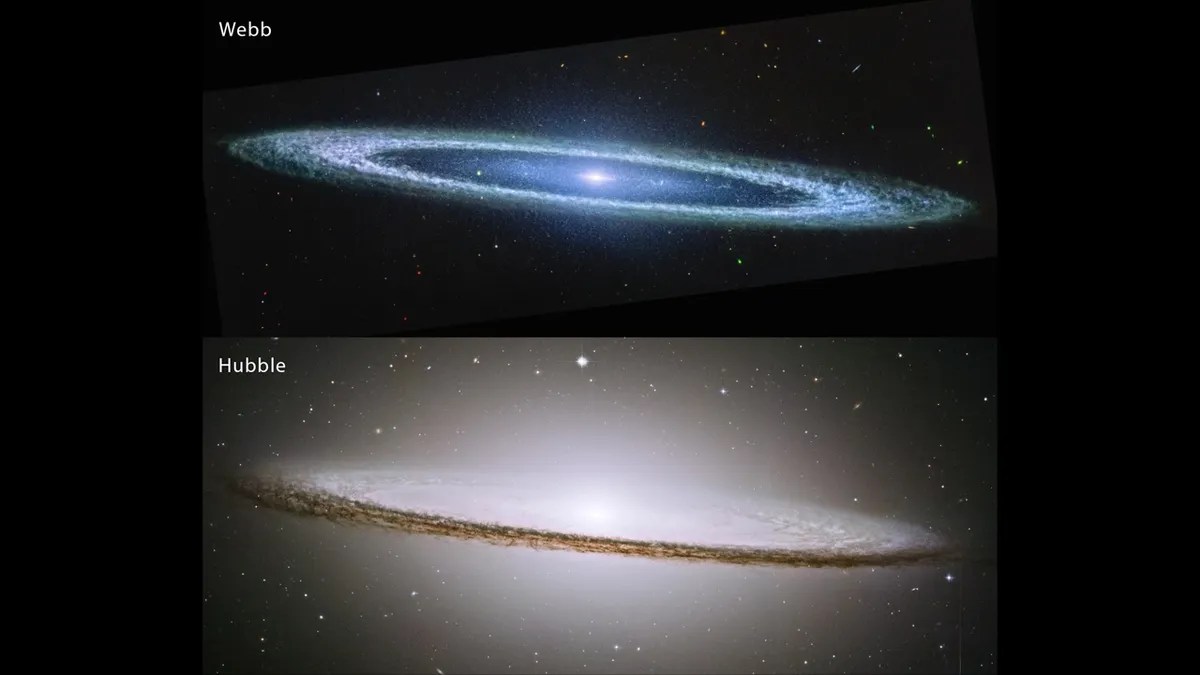
The M104 Sombrero Galaxy is a very interesting given its very bright center, at magnitude 8.0, making it one of the brightest galaxies. It is located between the constellations Virgo and Corvus 28 million ly from Earth. It is about 50,000 ly in across. M104 was initially thought to be a spiral galaxy but recent images from the Spitzer Space Telescope indicates it to be a giant elliptical galaxy. Embedded in the bright core of M104 is a smaller disk, which is tilted relative to the large disk. X-ray emission suggests that there is material falling into the compact core, where a 1-billion-solar-mass black hole resides. The Hubble space telescope revealed about 2000 globular clusters, 10 times as many as orbit our Milky Way galaxy. The ages of the clusters are similar to the clusters in the Milky Way, ranging from 10-13 billion years old.
(Passage by M. DiMario)

Daniel Mints – Crescent Moon

A May 3rd crescent Moon imaged using a Meade 10” SCT at f/6.3, a ZWO ASI533MC Pro camera and a UV/IR cut filter created from a 3-panel mosaic.

Posted in June 2024, Sidereal Times | Tagged , , , , , | Leave a comment