From the Program Chair

Ken Levy, Program Chair

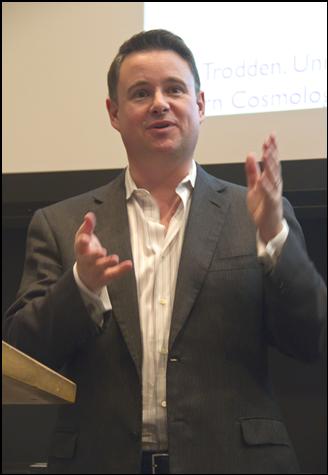
Many thanks to Dr. Mark Trodden for our March lecture “Modern Cosmology and the Building Blocks of the Universe”.

Dr. Mark Trodden, Photo credit: Ken Levy

Dr. Mark Trodden
Photo credit: Ken Levy

Our April speaker heralds from my home base of Brooklyn, NY. Dr. Greg Matloff is a leading expert in interstellar propulsion, especially near-Sun solar-sail trajectories that might ultimately enable interstellar travel. He is an emeritus and adjunct associate astronomy professor with the physics department of New York City College of Technology, CUNY; a consultant with NASA Marshal Space Flight Center; a Hayden Associate of the American Museum of Natural History and a Corresponding Member of the International Academy of Astronautics.

Professor Matloff’s presentation is “Biosphere Extension”. The early 21st century is a pivotal time for human civilization. The developing world is advancing quickly. Billions aspire to live at the level of Americans and Western Europeans. The human population of Planet Earth currently exceeds 7 billion and may reach 10 billion late in this century. How can we plan for a peaceful increase in human living standards without degrading the environment of our planet beyond repair? One way, perhaps the only option, is to alter our definition of the “biosphere.” To protect the Earth, it may be necessary for some component of the human population to leave it. It may be necessary to use the desolate wastes of the solar system both as a resource source and an effluent sink.

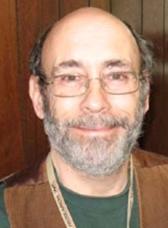
Dr. Greg Matloff

Dr. Greg Matloff

Perhaps the most evident justification for this extraterrestrial expansion is protecting the Earth from impacts by near-Earth objects (NEOs) of asteroidal or cometary origin. By 2025, many of the world’s space powers will be capable of supporting human expeditions to nearby NEOs to experiment with deflection techniques. If we have to divert some of these celestial rocks and icebergs, why not mine them? One product would be the construction of orbital solar-power plants that could beam copious amounts of energy to space and release waste heat well above the stratosphere. We could also deconstruct NEOs to build sunshades at the Earth-Sun Lagrange-1 point to reduce the amount of sunlight striking the Earth and partially compensate for global warming.

This presentation is an outgrowth of collaborations with Les Johnson of NASA Marshal Spaceflight Center and the artist C. Bangs. Much of it is based upon a book with Johnson and C. Bangs entitled Paradise Regained: The Regreening of Earth, (2010) and an artist-scientist’s self-published book with Bangs entitled: Biosphere Extension: Solar System Resources for Earth (2011).

Dr. Matloff’s other books include Paradise Regained, Living Off the Land in Space, The Starflight Handbook, Deep-Space Probes, Telescope Power, More Telescope Power and The Urban Astronomer. His papers on interstellar travel, the search for extraterrestrial artifacts, and methods of protecting Earth from asteroid impacts have been published in JBIS, Acta Astronautica, Spaceflight, Space Technology, Journal of Astronautical Sciences, and Mercury. His popular articles have appeared in many publications, including Analog. Dr. Matloff served on a November 2007 panel organized by Seed magazine to brief congressional staff on the possibilities of a sustainable, meaningful space program. In 2011, he co-authored with C. Bangs an artist’s book entitled Biosphere Extension: Solar System Resources for the Earth. Recently collected by the Brooklyn Museum for their artist book collection, some copies will be available for purchase after the presentation. Professor Matloff’s website is www.gregmatloff.com.

Posted in April 2012 | Tagged , , | Leave a comment

From the Outreach Chair

David Letcher, Outreach Chair

We had a star party at the Hopewell Elementary School on Friday evening, March 16.  The weather was touch-and-go and I was not able to attend but presumably the other volunteers were there. I know Gene Ramsey and Jeff Bernardis planned to attend. Apologies to anyone who was there but not mentioned.

Our next star party is on Friday, March 30th at the Stuart Country Day School.  As of this writing, the weather forecast is for cloudy weather.  March is always an “iffy” month for weather.

Looking ahead, we have Super Science Day at the State Museum on Saturday, April 21st.  We need telescopes with solar filters for this event.  We’ll have a table to display pictures, charts, and other items of interest too.

Director Ludy emailed me about the seventh annual Earth Day Fair in Montgomery on April 22nd.  His email includes the following information: “The Montgomery Township Environmental Commission/Sustainable Montgomery is pleased to announce the seventh annual Earth Day Fair at the Montgomery High School on Route 601 in Skillman.  It will be held Sunday April 22, 2012, 12-4 pm, indoors and outdoors, rain or shine.  Registration to participate as an exhibitor, sponsor or volunteer is now open.  The theme is: Every Day is Earth Day in Montgomery Township.”

“The fair is Montgomery’s biggest community-wide environmental event each year.  Come get involved!  Fairgoers get giveaways and tips on living a healthier, greener lifestyle.  And there’s lots of music, food, and fun for all ages,” said Environmental Commission Chairperson Mary Reece.”

And on Saturday, April 28th, we have Communiversity Day in Princeton.  This is a day during which we can set up telescopes for public viewing.

So these events plus our public open houses starting up, give us a busy season, but a season to enable the public to become more aware of our club’s activities.

Posted in April 2012 | Tagged | Leave a comment

Treasurer’s Report

Michael Mitrano, Treasurer

We have received eight membership renewals or signups during March, bring our total for the fiscal year to 89.  We have now met or exceeded total membership for the past two completed fiscal years.  With new members and tardy renewals, I hope we can get closer to 100 this year.

Expenses during the past month were few and our surplus for the fiscal year to date is nearly $1,800.

On a cumulative basis, our surplus has increased to about $22,500.


Posted in April 2012 | Tagged | Leave a comment

March 13, 2012 AAAP Meeting Minutes

Submitted by Michael Wright for Secretary Larry Kane

The meeting was called to order by Director Ludy D’Angelo.

Director’s Report

  1. AAAP Board Elections: Ludy announced that a new Board should be elected at the May meeting. Ludy asked for a volunteer to form and chair the 2012 Nominations Committee and explained the duties. Jim Poinsett volunteered and was appointed.
  2. Transit of Venus: BaldpateMountainParkhas been reserved for the event.  Michael Mitrano will check on insurance for the event.  A star party may be held after dark.  Members bringing equipment will be permitted to drive to the observing site.  A shuttle bus is being arranged to bus everyone to the observing field.  Ron Mittelstaedt said that he had hiked the site recently and the field is open to towards the NW horizon.
  3. Communiversity: An application has been submitted for Communiversity to be held inPrincetononSaturday April 28, 2012.  An answer is expected by March 28.
  4. Super Science Day at theStateMuseuminTrentonis onApril 21, 2012.  AAAP will participate again this year.

Secretary: Ludy said Larry Kane was unable to attend the meeting, but wants to thank the Sidereal Times editors for their patience this month.

Treasurer: Treasurer Michael Mitrano said that the clubs finances are sound.  The club has eighty-three dues-paying members.  Four keyholders have not renewed.  Gene Ramsey asked that he be notified when keyholders fail to renew so he can revise the duty roster.

Program Chair: The program is fully booked through June.

Outreach: Chair David Letcher announced the Friday, March 16 event atHopewellValleySchool.  Six members have volunteered.  The event will start around7:00 p.m.  The next event will be on March 28 (rain date March 30) at Stuart County Day School for which volunteers are needed.  Members were amused that the D&R Greenway requested the clubs participation in a Perseids Meteor Walk to be held between 7:00 and 8:00 p.m.  David pointed out to them that the best way to see meteors is to stand still after mid-night when it’s dark.  The club will participate.

David presented a request from PEI Kids for a star party at the observatory to be auctioned at a fund raiser.  The issue had been the subject of an email discussion among some members.  A long discussion of the pros and cons of allowing non-profits groups to use the observatory in this way ensued.  Cons: no benefit for AAAP, potential for many requests from other non-profits, no keyholders willing run the events. Pros: AAAP could help organizations with related interests such as dark skies or WC State Park.  The consensus was that this request should be refused because no keyholder was willing to take responsibility for organizing the event.

Gemini Mount:  John Church reported that he was waiting for warm weather to test the mount.  He could schedule a test with Rex Parker now that spring has arrived.

Coyle Field: Jeff Bernardis reported that a virtual astronomy club, East Coast Astronomy, has been established to work with the owners to re-establish observing at the field.  The owners like having astronomers use the field because it keeps undesirables away.  Anyone wanting to use the field will have to join East Coast and share in the expenses.  Dues are estimated to be $30, but could grow when all costs are identified.

50th Anniversary: Volunteers are needed to organize a 50th anniversary celebration.  A dinner in November was discussed again.  John Church recalled that Kirk Alexander organized a dinner in Frist Center for the 40th anniversary. John and Freeman Dyson gave talks and dinner was served.

UACNJ:  Michael Mitrano confirmed that AAAP’s dues and renewal was mailed to UACNJ.  Delegates Bill Murray and Michael Wright have not received confirming emails from UACNJ.  Mike and Ludy will attend the next meeting on March 31, 2012.  Ludy requested a work detail to make badly needed repairs to the AAAP observatory at Jenny Jump.

Sidereal Times: Co-Editor Michael Wright thanked everyone that submitted an article for the March edition.  The deadline for the April issue is March 29, 2012.  As usual, the deadline is twelve days before the next club meeting.

Observatory: Public nights will resume on April 6.  Gene Ramsey passed out a draft duty roster to the keyholders.  Some teams have new leaders because one keyholder turned in his key, and others have not paid their dues.  Water will be turned on within the week.  Gene will clean the eyepieces before the public nights start.  Jeff has emailed instructions for the new alarm to current keyholders.


Posted in April 2012 | Tagged | Leave a comment

Supernova 2012aw Discovered in M95

Michael Wright and Robert Vanderbei

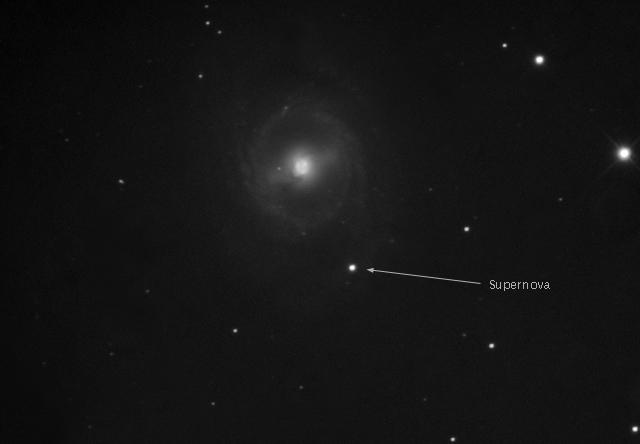
M95 and Supernova 2012aw

Click on image for full size photo
M95 and Supernova 2012aw
Photo Credit: Robert Vanderbei
20:29 EDT Mar 22, 2012.
Starlight Express SXV-H9 on 10" RC at f/9.
L = 108 min (guided 4-minute subexposures).
Log stretch

On March 16, 2012, a bright supernova was discovered in M95.  Member Bob Vanderbei wasted no time capturing the image above.  The supernova was around magnitude 13 as of March 21 so it is observable in large amateur scopes.  Has anyone tried to see it in the C14?

Finder charts and more information are available at here: http://astrobob.areavoices.com/2012/03/18/another-bright-supernova-goes-boom-in-m95-near-mars/.

Posted in April 2012 | Tagged , , , , | Leave a comment

The Astronomy of Shakespeare – Hamlet

The Bard is noted for his firm grip of history plays such as Julius Caesar, Macbeth, Henry V, etc. While not historically accurate in every respect, they are broadly faithful to the history of the events they portray. He drew heavily on Hollinshead’s Chronicles, and very clearly he was an educated man.  What has not been so widely recognized is his knowledge of contemporary astronomy. There are many examples in his plays of astronomical references which show both knowledge and great foresight in this regard.

Hamlet: “Last night of all, when yond same star that’s westward from the pole had made his course to illume that part of heaven where now it burns.” Scholars have long considered that means Bernardo is referring to a star west of the pole star. The hour has struck twelve and it is cold, so winter is assumed.

However, recent research suggests Bernardo could be referring to the Polish origin of Marcellus Sikorsky, the relevant star could depend on just where Marcellus was standing in Act 1 Scene 1. However, recent studies published by the Historical Faculty of Stolichnaya, suggest that the reference could be to the flagpole built by Marcellus’ father who migrated fromWarsawtoElsinoretwenty years previously and had crafted the flagpole for Elsinore Castle on commission by Hamlet’s father.

The question would be determined by just where the players were standing in relation to the flagpole.

Clearly it would have had to have been a bright star to have drawn attention, as one hell of a lot of stars would have been visible west of any of the three poles. If the first reference to the pole star is correct, perhaps Sirius, Procyon or Betelgeuse, or one of the others – any damn star.

Editor’s Note: This article was excerpted from a paper on astronomical references in Shakespeare’s plays published in Alternative Universe by the Astronomical Society of New South Wales: http://www.asnsw.com/universe/alternate/AU2/shakespeare.asp

Posted in April 2012 | Tagged , | 2 Comments

Barsoom

Michael Wright

Mars, Photo credit: Robert Vanderbei Canon XSi (450D) on 10" RC, 4x-Powermate  Video acquired with EOS_movrec ("1/6" second expo-sures), 2.00 minutes, 20 frames per second  22:50 EST, March 22, 2012  CM = 121.17deg

Photo credit: Robert Vanderbei
Canon XSi (450D) on 10" RC, 4x-Powermate
Video acquired with EOS_movrec ("1/6" second expo-sures), 2.00 minutes, 20 frames per second
22:50 EST, March 22, 2012
CM = 121.17deg

The sci-fi movie John Carter is currently in theatres.  Based on the Edgar Rice Burrough’s novels inspired by Perceval Lowell’s Mars, the movie is about the exploits of a Virginia “gentleman” magically transported to Barsoom where he battles Martians and rescues Dejah Thoris, Princess of Mars.

Coincidentally, Mars, along with Saturn, Venus and Jupiter, is visible in the evening sky this month.  Barsoom will be a prime target for the Hastings-Byrne for the next few months.


Posted in April 2012 | Tagged , , , | Leave a comment

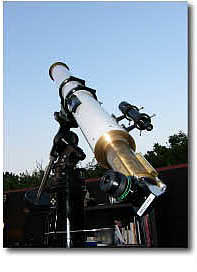
Geometrical Optics and the Hastings-Byrne Refractor: Part II

John Church

Hastings-Byrne Refractor

Hastings-Byrne Refractor

Last month I reviewed the “lens-maker’s formula” that allows one to calculate the focal length (the inverse of the “power”) of a thin lens, provided that one knows the refractive index of the glass and the radii of the two lens surfaces.  I also mentioned that the net focal length of a combination of two thin lenses close to one another or in contact is the inverse of the sum of the two powers of the separate elements.

However, if one doesn’t already have this information, there is a simple way to find the focal length of an unknown objective.  This makes use of the “lens formula” (not to be confused with the “lens-maker’s formula”).  I used this method as one way to determine the focal length of the H-B objective, and I described the photographic way last month.

Here’s how it’s done. I supported the objective in its cell, vertically between wooden blocks on a table in my back yard.  Then I clamped a penlight about 15 feet or so away from the objective so that the light would shine through the center of the lens and approximately perpendicular to it.  I then took a piece of white cardboard and adjusted it so that the image of the penlight bulb focused sharply on this screen, which I then fixed in place.  I measured the distances from the penlight to the center of the objective, and from the center of the objective to the screen. The focal length was then given by the lens formula:

1/f   =  1/p  +  1/q

where f is the focal length, p is the distance from the light source to the objective, and q is the distance from the objective to the screen.  I measured p as 170.5 inches and q as 195.5 inches.  This gave 91.07 inches as the focal length, agreeing well with the other method using the physical diameter of an eclipsed moon on a direct-objective slide taken through the whole scope.

This “back-yard” method works for any pair of p’s and q’s, as long as one is careful to keep both of them farther away from the lens than what you guess the focal length might be.  Otherwise you’ll get a “virtual” image, i.e. one that can’t be thrown onto a screen. In the limiting case where the “penlight” is an object at infinite distance, such as a star, 1/p vanishes and so f = q, i.e. the distance from the objective to the image.  You can measure this distance directly by casting the sun’s image on a screen.  This yields a good approximation of the focal length, but it’s awkward with a long refractor pointed up at the sky.

The next subject is achromatism, or color correction. Refractors have many advantages, but they are all subject to at least some degree of chromatic aberration, (i.e. the image of a bright star or planet will have at least a touch of color fringe). The usual type of astronomical objective is composed of two elements, a “crown” element of some variant of ordinary silicate glass and a “flint” element of heavier glass, typically containing lead.  Flint glass disperses white light into its various colors much more than ordinary glass and is therefore used in decorative glassware such as chandeliers and crystal goblets. In 1733, Chester Moor Hall in England, not accepting Newton’s premature statement that an achromatic lens was impossible, designed the first such telescope objective by using a crown and a flint element.  This allowed the objective to have the same focal lengths for two widely-separated colors of light, in the red and blue ends of the spectrum, with light in the middle of the spectrum focusing at a slightly shorter distance. Perfect achromatism across the entire visible spectrum isn’t achievable in a two-element objective, because no two kinds of glasses have exactly equal ratios of refractive indexes over this wide a range. Sometimes objectives known as “apochromats” can approach this ideal, but these usually have other disadvantages.

Before Hall’s invention, conventional single-element objectives spread light out into continuously varying focal lengths, and it was necessary to have telescopes with enormous focal lengths (“aerial” telescopes) to minimize this effect.  Hall’s work was the first great advance in refracting telescopes since the early 1600’s, as it made it possible to get relatively color-free images at convenient focal ratios of f/10 or so instead of f/100 and even higher.

To design an achromatic objective with a desired total power P, we have to first know the dispersive properties of two separate kinds of glass and then solve two simultaneous linear equations to find the powers P1 and P2 of the crown and flint elements.  The power of the more dispersive (flint) glass will have to be negative and that of the crown positive, but the total power P will have to be positive in order to get a real image at the focus.  The equations are as follows:

P1  +   P2    =  P    (total power  =  sum of the individual element powers)

P11  +   P22   =  0   (to make blue and red light come to the same focus)

In the second equation, ν1  =  (n middle  – 1)/(n blue  ­–  n red)  for  the crown element and  ν2  is  the same expression for the flint element.  n middle denotes the refractive indexes of the respective glasses for light at a wavelength near the middle of the visible spectrum, and  n blue  and  n red  denote the values of the refractive indexes for (typically) the bright F and C lines of the hydrogen emission spectrum at 486.1 and 656.3 millimicrons, respectively.  These wavelengths are often chosen because they are easily accessible in the laboratory when measuring the refractive indexes of test prisms made from the glasses that will be used to make the crown and flint elements.  The Greek letter ν (“nu”) is often called the “V” number or “constringency.”

Let’s flesh out these equations with some actual numbers for the H-B objective.  We already know by two separate experiments that P = 0.432 diopters (focal length = 2.31 meters or 91.1 inches).  Hastings used the green iron emission line at 561.4 millimicron as the wavelength for minimum focus. I found by trigonometric ray tracing that he achieved nearly complete achromatization for the F and C lines of hydrogen for paraxial rays (i.e. those passing near the center of the objective where our simplified theory works the best).  For the two glasses that he used, ν1 = 56.7 and  ν2 = 36.9.

Plugging in the respective numbers to the above equations, we have

P1  +   P2  =  0.432

P1/56.7  +   P2/36.9  =  0

Resorting to our old high school math, we find required powers of 1.237 and – 0.805 for the crown and flint elements in the middle of the spectrum.  In last month’s article, I noted that P1 had an experimentally-determined value of 1.239 diopters and P2 was – 0.807.  The agreement is close enough to confirm that we’ve done the math correctly and that the simple achromatization equations give results adequate for the preliminary design of an objective.

A major issue still remains; however, one that resisted the efforts of mathematical geniuses such as Euler for about 30 years after the first achromat was made.  Knowing the powers of the crown and flint elements isn’t nearly enough to finish designing a good achromatic objective, since for each element the first and second radii can have infinite numbers of paired values. How are we to select which pair of radii to use for each element?  This choice has far-reaching consequences for spherical aberration and coma, the two most important issues after achromatization.  This complex problem was finally solved in 1764 by Alexis Clairaut and his arch-rival Jean d’Alembert, two leading scientists of the French Enlightenment. I’ll talk about how they did it next month, and how closely the H-B objective satisfies their equations.

Posted in April 2012 | Tagged , , , , | 1 Comment

Robotics Research Success at the ISS

Ken Kremer of Spaceflight magazine, Universe Today & AAAP

Astronaut Mike Fossum rides on the ISS robotic arm as he carries the RRM experiment for installation on the ISS during final spacewalk of the shuttle Era. Photo credit: NASA

Astronaut Mike Fossum rides on the ISS robotic arm as he carries the RRM experiment for installation on the ISS during final spacewalk of the shuttle Era. Photo credit: NASA

From March 7 to 9, a combined team of American and Canadian engineers successfully performed groundbreaking robotics research aboard the ISS during first-of-its-kind joint operations between NASA’s new Robotic Refueling Mission (RRM) experiment – mounted on the stations exterior backbone truss – andCanada’s Dextre robot “handyman”.

The RRM robotics technology effort aims to repair and refuel already orbiting space satellites – never intended for refurbishment – and thereby extend their operational lifetimes by several years, resulting in billions of dollars in cost savings for the government and commercial space sectors. The project is a joint effort between NASA and CSA .

Gleeful researchers shouted “Yeah !!” after the first ever dual application of RRM and Dextre as a technology test bed to demonstrate that a remotely controlled robot in the vacuum of space could accomplish delicate work tasks requiring extremely precise motion control.

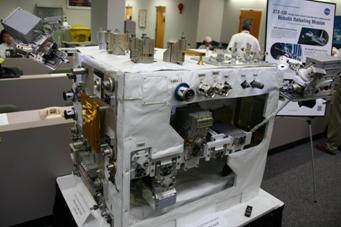
High Fidelity Mock up of RRM experiment box at KSC Press Site.  RRM was delivered to ISS during STS-135 mission.  Photo credit: Ken Kremer

High Fidelity Mock up of RRM experiment box at KSC Press Site. RRM was delivered to ISS during STS-135 mission. Photo credit: Ken Kremer

“After dedicating many months of professional and personal time to RRM, it was a great emotional rush and a reassurance for me to see the first video stream from an RRM tool,” Justin Cassidy told me in a post-op interview.  Cassidy is RRM Hardware Manager at the NASA Goddard Spaceflight Center in Greenbelt,Maryland.

The 500 pound, washing machine sized RRM experiment was carried to orbit inside the cargo bay of Space Shuttle Atlantisduring July 2011 on final shuttle mission STS-135.

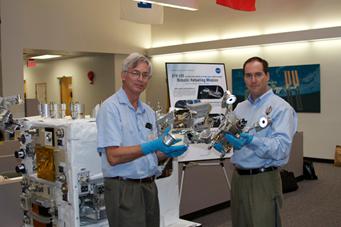
NASA Goddard RRM manager Justin Cassidy (right) and Ken Kremer manipulate RRM experiment tools.  Photo credit: Ken Kremer

NASA Goddard RRM manager Justin Cassidy (right) and Ken Kremer manipulate RRM experiment tools. Photo credit: Ken Kremer

I was quite fortunate to arrange an exclusive pre-launch visit to the actual RRM unit inside the Space Station Processing Facility (SSPF) at the Kennedy Space Center (KSC) prior to loading aboard Atlantis.  Cassidy also gave me a detailed RRM briefing at the KSC Press Site using a high fidelity mockup of the unit and with hands-on interaction to simulate servicing and maintenance techniques with the different satellite work tools, which have heritage in the Hubble Servicing Missions.

All of the RRM robotic operations at the station were remotely controlled by flight controllers on the ground, freeing up the human crew to conduct other important scientific research.

On day one of ISS ops, mission controllers on Earth deftly maneuvered the 12-foot (3.7-meter) long Dextre “handyman” to the RRM experiment box using the space station’s Canadian built robotic arm (SSRMS).  Under ground-based remote control, Dextre’s “hand” grasped and comprehensively inspected three of the four specialized satellite work tools housed inside the RRM stowage area. The Safety Cap Tool, the Wire Cutter and Blanket Manipulation Tool, and the Multifunction Tool were all functioning perfectly.

“Our teams mechanically latched the Canadian “Dextre” robot’s “hand” onto the RRM Safety Cap Tool (SCT) to mate it with the SCT’s integral electronics box and see the first on orbit video,” Cassidy explained.  “Our team burst into a shout out of “Yeah!” to commend this successful electrical functional system checkout.”

The key task was to use the Wire Cutter Tool to meticulously cut two extremely thin satellite lock wires made of steel and measuring just 20 thousandths of an inch (0.5 millimeter) in diameter.  During a total of about 43 hours of on-orbit operations, Dextre used all three tools to carry out tasks aimed at testing how well a variety of representative gas fittings, valves, screws and seals located on the outside of the RRM module could be manipulated.  It also released safety launch locks.  Everything went as nominally as could be expected and even finished slightly ahead of time.

This RRM exercise represents the first time that Dextre was utilized for a technology research and development project on the ISS and represents a major expansion of its capabilities beyond those of routine robotic maintenance of the massive orbiting laboratory.

Check Ken’s RRM feature online at Universe Today:

http://www.universetoday.com/94122/robotics-refueling-research-scores-huge-leap-at-space-station/

Astronomy Outreach by Dr. Ken Kremer

Rittenhouse Astronomical Society (RAS) at the Franklin Institute: Philadelphia, PA, June 13, Wed, 7 PM.  “Curiosity Mars Landing, DAWN at Asteroid Vesta & GRAIL Lunar Orbiters”

Adirondack Public Observatory – Adirondack State Park: Tupper Lake,NY, July 13 & 14.

“Eight Years of Mars Rovers & Search for Life – Mars & Vesta in 3 D”. http://www.apobservatory.org/pages/etc/events_KenKremer.html

Ken has a selection of his Shuttle photos and Mars mosaics for sale as postcards and frameable prints.

Email: kremerken@yahoo.com   website:  www.kenkremer.com

Posted in April 2012 | Tagged , , , | Leave a comment