Snippets

compiled by Bryan Hubbard

Asteroid nudged by sunlight: Most precise measurement of Yarkovsky effect
Published: Thursday, May 24, 2012 – 22:31 in Astronomy & Space

Scientists on NASA’s asteroid sample return mission, Origins, Spectral Interpretation, Resource Identification, Security, Regolith Explorer (OSIRIS-REx), have measured the orbit of their destination asteroid, 1999 RQ36, with such accuracy they were able to directly measure the drift resulting from a subtle but important force called the Yarkovsky effect — the slight push created when the asteroid absorbs sunlight and re-emits that energy as heat. “The new orbit for the half-kilometer (one-third mile) diameter 1999 RQ36 is the most precise asteroid orbit ever obtained,” said OSIRIS-REx team member Steven Chesley of the NASA Jet Propulsion Laboratory, Pasadena, Calif. He presented the findings May 19 at the Asteroids, Comets and Meteors 2012 meeting in Niigata, Japan.

The complete article may be found at: Most precise measurement of Yarkovsky effect

Herschel Space Observatory study reveals galaxy-packed filament
Published: Thursday, May 17, 2012 – 14:33 in Astronomy & Space

A McGill led research team using the Herschel Space Observatory has discovered a giant, galaxy-packed filament ablaze with billions of new stars. The filament connects two clusters of galaxies that, along with a third cluster, will smash together and give rise to one of the largest galaxy superclusters in the universe. The filament is the first structure of its kind spied in a critical era of cosmic buildup when colossal collections of galaxies called superclusters began to take shape. The glowing galactic bridge offers astronomers a unique opportunity to explore how galaxies evolve and merge to form superclusters.

For the full story go to – Galaxy-packed Filament

New IBEX data show heliosphere’s long-theorized bow shock does not exist
Published: Thursday, May 10, 2012 – 22:31 in Astronomy & Space

New results from NASA’s Interstellar Boundary Explorer (IBEX) reveal that the bow shock, widely accepted by researchers to precede the heliosphere as it plows through tenuous gas and dust from the galaxy does not exist. According to a paper published in the journal Science online, the latest refinements in relative speed and local interstellar magnetic field strength prevent the heliosphere, the magnetic “bubble” that cocoons Earth and the other planets, from developing a bow shock. The bow shock would consist of ionized gas or plasma that abruptly and discontinuously changes in density in the region of space that lies straight ahead of the heliosphere.

The complete article may be found at: Heliosphere’s bow shock does not exist

NASA’s Chandra sees remarkable outburst from old black hole
Published: Monday, April 30, 2012 – 15:35 in Astronomy & Space

An extraordinary outburst produced by a black hole in a nearby galaxy has provided direct evidence for a population of old, volatile stellar black holes. The discovery, made by astronomers using NASA’s Chandra X-ray Observatory, provides new insight into the nature of a mysterious class of black holes that can produce as much energy in X-rays as a million suns radiate at all wavelengths. Researchers used Chandra to discover a new ultraluminous X-ray source, or ULX. These objects give off more X-rays than most binary systems, in which a companion star orbits the remains of a collapsed star. These collapsed stars form either a dense core called a neutron star or a black hole. The extra X-ray emission suggests ULXs contain black holes that might be much more massive than the ones found elsewhere in our galaxy.

For the full story go to – Outburst from old black hole
Posted in June 2012, Sidereal Times | Tagged , , , , | Leave a comment

From the Director

Ludovico D’Angelo, Director

Since the last meeting, several things have occurred that are noteworthy to report. The first is that Baldpate Mountain will not suit for the Transit of Venus viewing. We are looking at alternative sites, but more than likely we will end up at Washington Crossing near the soccer fields.

The second noteworthy observation is that we have had four open public nights in a row. All with fairly clear skies! There has not been too much grumbling about walking from the parking area near the soccer fields to the observatory.

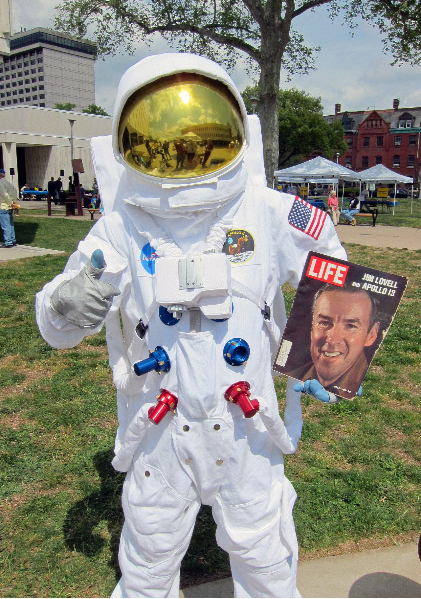
Jim Lovell had fun at Super Science Day. Credit: David Kaplan

Jim Lovell had fun at Super Science Day. Credit: David Kaplan

And thirdly, we had a very successful day at the NJ State Museum complex for Super Science Day on April 21st. We had five scopes set up: two in H-Alpha and three with white light filters. We gave out club info. Many people looked at the Sun and were very impressed by it. During the whole day, there was a significant solar prominence seen in H-Alpha, and there were at least seven sunspots seen in the other scopes. I want to thank those that volunteered: David Kaplan, Michael Wright, Larry Kane, Victor Davis, and Pat and Mary Hayes. Great Job!

I am hoping that we get as many for Communiversity on April 28th.

Our next meeting is May 8th at 8 p.m. Mario Livio will be our guest speaker. At that meeting, we will vote for the new Board of Trustees, it will be our last meeting this season with a guest speaker. In June we will gather at the State Planetarium where our member, Bill Murray, will show us great wonders of the universe inside.
See you on May 8th!

Posted in May 2012, Sidereal Times | Tagged , | Leave a comment

From the Program Chair

Ken Levy, Program Chair

Many thanks to our April lecturer, Professor Gregory Matloff, for his talk on Biosphere Extension.

Our 2011-2012 Peyton Hall lecture season concludes with a real cosmic bang – a definite not to be missed lecture by Dr. Mario Livio on the latest scientific discoveries of the Hubble Space telescope. Dr. Livio is a senior astrophysicist at the Hubble Space Telescope Science Institute. He joined the Institute in 1991 as head of the Archive Branch, and also served as the Head of the Institute’s Science Division. Prior to coming to the Institute, he completed his undergraduate studies at the Hebrew University in Jerusalem, his M.Sc. degree at the Weizmann Institute, and his Ph.D. (in theoretical astrophysics) at Tel-Aviv University. He was a professor of physics in the physics department of the Technion-Israel Institute of Technology from 1981 until 1991.

Dr. Mario Livio

Dr. Mario Livio

In the past decade, Mario focused particularly on the topics of supernova explosions and their use in cosmology to determine the rate of expansion of the Universe, on the nature of “dark energy”, on the formation of black holes and the possibility to extract energy from them, on the formation of planets in disks around young stars, and on the emergence of intelligent life in the Universe. Mario has published over 400 scientific papers.

In addition to his scientific interests, Mario is a self-proclaimed ‘art fanatic’ who owns many hundreds of art books. During the past few years, he combined his passions for science and art in three popular books: “The Accelerating Universe” (2000), which discusses the ‘beauty’ of fundamental theories of the Universe, “The Golden Ratio” (2002), which tells the story of an astonishing number, and “The Equation That Couldn’t Be Solved” (2005), which is the first extensive popular account of Group Theory – the language of symmetry. His new book, “Is God a Mathematician?” appeared in January 2009. The book discusses why mathematics is powerful at describing things ranging from the laws of nature to the properties of ordinary knots. Dr Livio lectures very frequently to the public. He has given more than 20 full-day seminars to the public at the Smithsonian Institution in Washington D.C, and numerous lectures at venues such a the Hayden Planetarium in New York, The Maryland Institute College of Art, The Cleveland Museum of Natural History, The Glasgow Planetarium, and many more.

Dr. Livio is also interviewed often in the media, including two appearances on “60 Minutes.” His book “The Golden Ratio” won him the “Peano Prize” for 2003, and the “International Pythagoras Prize” for 2004, as the best popular book on mathematics.

Posted in May 2012, Sidereal Times | Tagged , , | Leave a comment

From the Outreach Chair

David Letcher, Outreach Chair

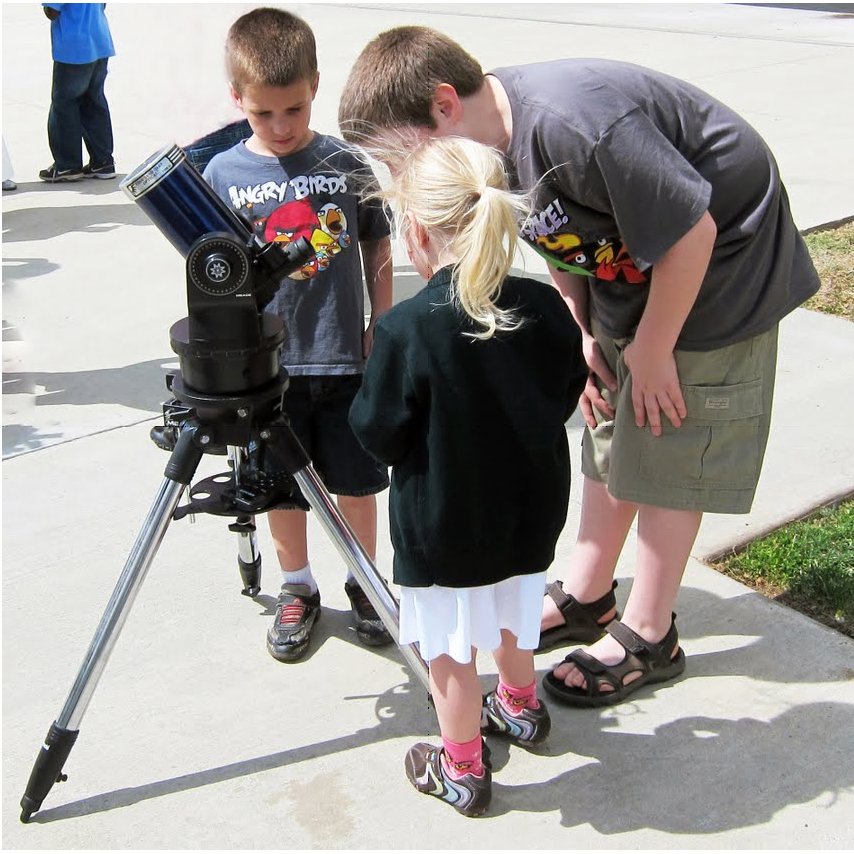
Future AAAP members confer about the merits of different solar filter types.  Credit: David Kaplan

Future AAAP members confer about the merits of different solar filter types. Credit: David Kaplan

Director D’Angelo reports that “we had a good crowd at the Super Science Day” during which the following members volunteered to help out: David Kaplan, Ludy, Michael Wright, Pat and Mary Hays, Victor Davis, and Larry Kane. We had two solar and three white light filtered scopes running.

Communiversity was held on Saturday April 28. I’ll have more to report on what happened at this event in next month’s issue.

And, of course, we are looking forward to hosting a “Transit of Venus” public event on June 5th, location to be determined. Additional details will be available at our May meeting and in future emails.

Posted in May 2012, Sidereal Times | Tagged , | Leave a comment

Treasurer’s Report

Michael Mitrano, Treasurer

As of April 27, there has been little financial activity during the past month.  Our member count now stands at 90, and our year-to-date surplus is about $1,700.  On a cumulative basis, our surplus remains about $22,500.


Posted in May 2012, Sidereal Times | Tagged , | Leave a comment

April 10, 2012 AAAP Meeting Minutes

by Larry Kane, Secretary

The meeting was called to order by Director Ludy D’Angelo.

  1. AAAP Board Elections: Ludy announced the nominees for the Board of Directors for the 2012-2013 year. They are:
    a.   Director                      Ludy D’Angelo
    b.   Assistant Director     Jeff Bernardis
    c.   Program Chair           Kathleen Otto
    d.   Treasurer                  Michael Mitrano
    e.   Secretary                   Michael Wright
  2. Director’s Report: Ludy described the new procedures set forth by the W-C Park administration. The public can no longer drive up to the observatory, but must park their cars before the gravel one-lane road leading to the second gate. Since last summer, some campers have complained about the noise of vehicular traffic going to the observatory. Anyone who cannot walk from the parking lot, or any member who has equipment to unload, will be permitted to park near the observatory, up to six cars at a time. We are hoping that by June, this will be resolved. Bill Murray suggested that the new procedures be put on our website with a suggestion that visitors bring a flashlight. Eventually, the park administration will put in a new gate where the gravel road starts at the parking lot. A discussion ensued regarding the AAAP’s responsibilities for parking enforcement. It was recommended that the observatory phone number be posted near the gate so visitors can call if they need special assistance. Ludy set out the idea of a work group for our Jenny Jump observatory.
  3. Treasurer’s Report: The Treasurer’s report appears in another section of the Sidereal Times.
  4. Observatory Report: Co-chair Gene Ramsey said the first public night of the season was a success. We need more than the six parking permits we were given. Gene thanked Jeff Bernardis for helping him fix the water leak in the toilet tank. They cleaned up the restroom and took out some materials that were placed there. We now have heat in the computer room, again. Therefore, we can make the observatory available to members during the winter. There may still be a bad breaker in the breaker box. Jim McHenry replaced all the bad breakers.
  5. Outreach Report: Outreach Chair, Dave Letcher announced that we had two successful star parties in March, at the Stuart Country Day School and at the Hopewell Elementary School. The skies at Hopewell clouded up, but the event was saved when they moved inside the school and Gene Ramsey put up pictures of the Moon, Saturn and Mars to focus the telescopes on. Super Science Saturday is coming up on April 21 and the following Saturday is Communiversity Day. For the latter, we will be on the campus grounds. There is also an event in Montgomery Township on Sunday evening after Communiversity Day.
  6. Secretary’s Report: Larry Kane thanked Michael Wright for taking minutes at the last meeting.
  7. Sidereal Times: Editor Michael Wright announced that the deadline for the next edition is April 26.
  8. Kathleen Otto is working on a new AAAP banner
  9. Transit of Venus Event: We should put information on our website and ask people to register if they intend to attend. Therefore we would have an accurate idea of how many to plan for. Ken Kramer stated that he can get observing glasses from NASA. The viewing site still has to be checked out before more planning can begin.
  10. 50th Anniversary Event:Ira Pollens raised the issue of a joint trip to New Mexico in October for a star party. Airfare would be about $350 roundtrip. He will put the details into a Sidereal Times article.
  11. Losmandy Mount for the Refractor: John Church has the materials to put together a “dummy” telescope to test the mount for compatibility. There was a discussion about the best way to test it.

The meeting was adjourned by the Director.

Spring twilight at Simpson Observatory.  Credit: Michael Wright

Spring twilight at Simpson Observatory. Credit: Michael Wright

Posted in May 2012, Sidereal Times | Tagged , | Leave a comment

First Ever ISS Sighting & Star Party at AAAP Monthly Meeting

by Dr. Ken Kremer

April was a great month for overhead viewing of the International Space Station all across the US and in our astronomy club’s hometown of Princeton. Coincidentally, there was an ISS over flight set for the evening of the monthly April AAAP meeting. As always, we needed a fortuitous combination of clear skies and a few free minutes to align during the meeting.

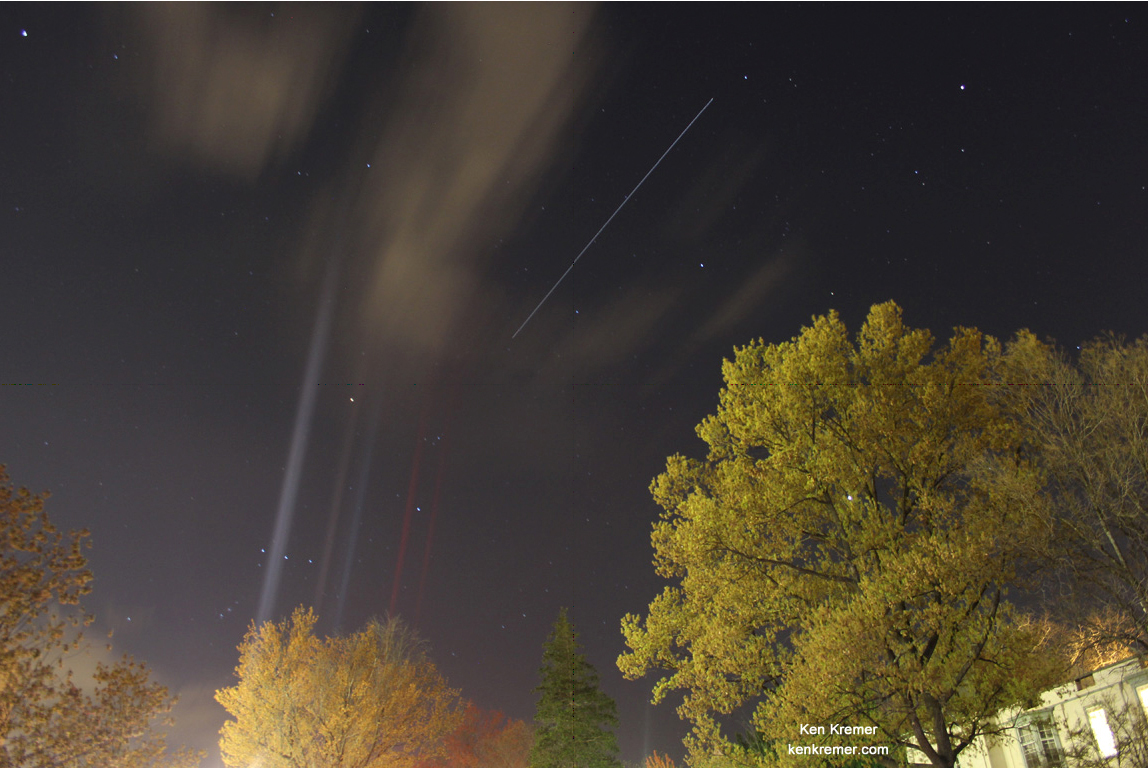
ISS over Princeton, April 10, 2012.  Credit: Ken Kremer

ISS over Princeton, April 10, 2012. Credit: Ken Kremer

Luckily, that evening’s presentation concluded just in time, and the overcast skies of barely two hours earlier totally cleared. So on Tuesday, April 10 well over 50 AAAP astronomers and friends gathered outside the doors of Peyton Hall along Ivy Lane for the first ever ISS viewing star party at an AAAP monthly meeting.

Then all of a sudden at 9:18 p.m., the ISS was there moving slowly and magnificently low in the sky at the end of Ivy Lane. It was a fantastic sight as it shined ever brighter and continued to climb up over the campus and even further above super bright Venus and nearly parallel to Nassau Street at over 30 degree altitude. In my time lapse photograph above, the ISS appears streaking outwards from Orion’s head. We had a really excellent four minutes of continuous viewing. Most of those gathered had never even seen an ISS over flight – much to my surprise. And everyone was thrilled.

In a rare occurrence, there were a few more excellent viewing opportunities that week, including one at the AAAP Friday public night at Washington Crossing State Park.

Check this NASA website link for specific ISS sighting opportunities::
Sighting Opportunities
Read more about ISS sighting in Ken’s Universe Today article here:
Great ISS Sightings – All Nights this Week of April 9

Astronomy Outreach by Ken Kremer
Rittenhouse Astronomical Society (RAS) at the Franklin Institute:Philadelphia, PA, June 13, Wed, 7 PM. “Curiosity Mars landing, DAWN at Asteroid Vesta & GRAIL Lunar Orbiters”

Adirondack Public Observatory – Adirondack State Park: Tupper Lake,NY, July 13 & 14.
“8 Years of Mars Rovers & Search for Life- Mars & Vesta in 3 D”.
http://www.apobservatory.org/pages/etc/events_KenKremer.html
http://apobservatory.org/pages/img/etc/kremer_poster_med.jpg

Ken Kremer:  Spaceflight magazine & Universe Today
Ken has a selection of his Shuttle photos and Mars mosaics for sale as postcards and frameable prints.

Please contact Ken for more info or science outreach presentations:
Email: kremerken@yahoo.com   website:  www.kenkremer.com
http://www.universetoday.com/author/ken-kremer/

Posted in May 2012, Sidereal Times | Tagged , , | Leave a comment

Snippets

South Pole Telescope provides new insights into dark energy and neutrinos
Published: Monday, April 2, 2012 – 15:02 in Astronomy & Space

Analysis of data from the 10-meter South Pole Telescope is providing new support for the most widely accepted explanation of dark energy — the source of the mysterious force that is responsible for the accelerating expansion of the universe. The results also are beginning to hone in on the masses of neutrinos, the most abundant particles in the universe, which until recently were thought to be without mass.
The data strongly support the leading model for dark energy, Albert Einstein’s cosmological constant — a slight modification to his theory of general relativity — even though the analysis was based on only a fraction of the SPT data collected and only 100 of the more than 500 galaxy clusters detected so far.
The complete article may be found at: Dark Energy and Neutrinos

Runaway planets zoom at a fraction of light speed
Published: Thursday, March 22, 2012 – 11:37 in Astronomy & Space

Seven years ago, astronomers boggled when they found the first runaway star flying out of our galaxy at a speed of 1.5 million miles per hour. The discovery intrigued theorists, who wondered: If a star can get tossed outward at such an extreme velocity, could the same thing happen to planets? New research shows that the answer is yes. Not only do runaway planets exist, but some of them zoom through space at a few percent of the speed of light — up to 30 million miles per hour.
“These warp-speed planets would be some of the fastest objects in our galaxy. If you lived on one of them, you’d be in for a wild ride from the center of the galaxy to the Universe at large,” said astrophysicist Avi Loeb of the Harvard-Smithsonian Center for Astrophysics.

For the full story go to – Runaway planets

A star explodes and turns inside out
Published: Thursday, March 29, 2012 – 13:38 in Astronomy & Space

A new X-ray study of the remains of an exploded star indicates that the supernova that disrupted the massive star may have turned it inside out in the process. Using very long observations of Cassiopeia A (or Cas A), a team of scientists has mapped the distribution elements in the supernova remnant in unprecedented detail. This information shows where the different layers of the pre-supernova star are located three hundred years after the explosion, and provides insight into the nature of the supernova. An artist’s illustration on the left shows a simplified picture of the inner layers of the star that formed Cas A just before it exploded, with the predominant concentrations of different elements represented by different colors: iron in the core (blue), overlaid by sulfur and silicon (green), then magnesium, neon and oxygen (red). The image from NASA’s Chandra X-ray Observatory on the right uses the same color scheme to show the distribution of iron, sulfur and magnesium in the supernova remnant. The data show that the distributions of sulfur and silicon are similar, as are the distributions of magnesium and neon. Oxygen, which according to theoretical models is the most abundant element in the remnant, is difficult to detect because the X-ray emission characteristic of oxygen ions is strongly absorbed by gas in along the line of sight to Cas A, and because almost all the oxygen ions have had all their electrons stripped away.

The complete article may be found at: A star turns inside out

‘Time machine’ will study the early universe
Published: Wednesday, April 11, 2012 – 22:33 in Astronomy & Space

A new scientific instrument, a “time machine” of sorts, built by UCLA astronomers and colleagues, will allow scientists to study the earliest galaxies in the universe, which could never be studied before. The five-ton instrument, the most advanced and sophisticated of its kind in the world, goes by the name MOSFIRE (Multi-Object Spectrometer for Infra-Red Exploration) and has been installed in the Keck I Telescope at the W.M. Keck Observatory atop Mauna Kea in Hawaii.

MOSFIRE gathers light in infrared wavelengths — invisible to the human eye — allowing it to penetrate cosmic dust and see distant objects whose light has been stretched or “redshifted” to the infrared by the expansion of the universe.

For the full story go to – Time Machine

Posted in May 2012, Sidereal Times | Tagged , , , | Leave a comment

From the Director

Ludovico D’Angelo, Director

Spring is here, and with that our renewed club activities. Starting April 6th and running every Friday until the end of October, will be the AAAP open houses in our observatory at Washington Crossing State Park. Keyholders of the club will be manning our telescopes on those Friday nights if the sky is clear, and showing the celestial sites to the public. This is also an opportunity for those of you interested in being a keyholder to come out and become involved in our public outreach on those nights.

AAAP will be involved in two major events in April: our traditional Super Science Day at the  Trenton State Museum and Planetarium on April 21st and the Princeton Communiversity Day on April 28th. We will have a table set up at both events and will have solar telescopes to provide astronomy of our Sun. Please consider being part of these events by volunteering for a few hours on each of these days.

At our last meeting, I appointed Jim Poinsett as Nominations Chair to establish our next Board of Trustees per our bylaws. I am hoping that he has found many willing prospects for the next Board. His results will be part of our next meeting on April 10th.

Some other activities to keep on your calendar:

In May, we hope to have our AAAP Picnic for members and their families, and in June, we will gather at Baldpate Mountain on the fifth to witness the last Transit of Venus in our lifetimes. Also in June, we will be doing some sidewalk astronomy by the Princeton Public Library. Look for an announcement of dates in the coming months.

See you all in Peyton Hall on April 10th at8 p.m.

Posted in April 2012 | Tagged , | Leave a comment