UACNJ Potluck Dinner at Jenny Jump, March 8

United Astronomy Clubs of NJ is holding a potluck dinner at their observatory in Jenny Jump State Forest on Saturday March 8 at 5 PM.  They request guests to please bring an appetizer, main dish, salad, or dessert to share. Beverages and table service will be provided. Following dinner, Gil Jeffer will present a program about his recent adventures in Antarctica. Observing on the UACNJ telescopes will follow if the weather is cooperative. Bring your own binoculars or telescope if you wish.

RSVP to Matt at matthewreiche@gmail.com with your party’s size and the dish you will be bringing.

Posted in March 2014 | Tagged | Leave a comment

India’s Space Program

by Prasad Ganti

I am a proud Indian American and enthusiastic and proud of both American and Indian space programs.
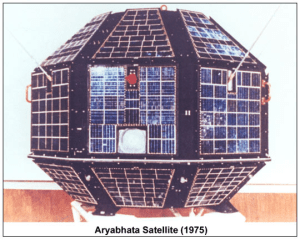
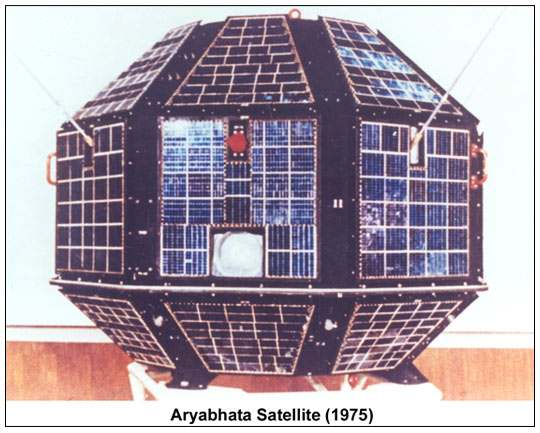
Aryabhata, India's first satellite, named after the great Indian mathematician- astronomer Aryabhata (476–550 CE)

Aryabhata, India’s first satellite, named after the great Indian mathematician- astronomer Aryabhata (476–550 CE). Photo Credit: ISRO

India launched a mission to Mars a few months back. The orbiter called “Mangalyaan” (Mars craft) is enroute to Mars now. A few years back, India sent an orbiter to the moon called “Chandrayaan” (Moon craft). The moon mission yielded a very high quality digital elevation map of the moon, and a global mapping of elemental abundance and mineral concentrations from spectroscopic studies. It even attracted international payloads from US and Europe in this remote sensing mission.

The Indian space program has come a long way in the last 50 years or so since its humble beginnings. Much of it did not make headlines as the cold war era space race was on. Back then, space was the prerogative of only the superpowers and the advanced nations. It all started after India got independence from Britain in 1947.

Dr. Vikram Sarabhai was the father of Indian space program. He was a very inspirational leader. The aim of the program was to achieve self-reliance in this critical technology and take the benefits to the common man, which was important because valuable resources were being expended by a developing country towards what was considered to be esoteric program akin to a rich nation’s adventure. India’s space program started in the early 1960s with the scientific objectives of exploring the earth’s atmosphere and ionosphere and studying astrophysical objects using rockets. Universities were involved right from the beginning of the program.

The program started off with building and launching sounding rockets for probing the near-earth environment including the upper regions of the atmosphere. They can carry scientific payload, but cannot impart the velocity needed to orbit the payload. A launch vehicle’s final stage provides the necessary velocity to put a payload into orbit.

Then the program moved to building of satellites and launching them on other countries’ launch vehicles. Satellites were used for communication and remote sensing. The first communication satellite was named “Aryabhata” and launched in 1975, named for an ancient Indian mathematician. Remote sensing was based on imaging. It is said, although never officially confirmed, that the images from these satellites were used to track Bin Laden to the Tora Bora mountains.

Next in the evolutionary stage was the development of launch vehicles. SLV3 (Space Launch Vehicle 3) was the first one to launch lighter payloads. Then it moved to ASLV (Augmented Space Launch Vehicle) before settling on PSLV (Polar Space Launch Vehicle) as the workhorse for launching different payloads to near-earth orbits. SRE1 (Satellite Recovery Experiment) brought back an orbiting space capsule to the earth demonstrating re-entry capabilities. There were failures along the way, as is the case with any space program.

Next in the series is the GSLV (Geostationary Space Launch Vehicles). There were early failures so it is still a work in progress. It is a three stage rocket with first stage powered by solid fuel, second by liquid fuel, and the third stage by a cryogenic engine. Fearing India might use cryogenic engines in its missile program, the US tried to discourage other nations like Russia from selling them to India. Politics apart, India has developed its own cryogenic engine. GSLV can place larger satellites and spacecrafts (up to 5000 lbs) into the Geosynchronous Transfer Orbit because of the higher thrust generated by the cryogenic engines,
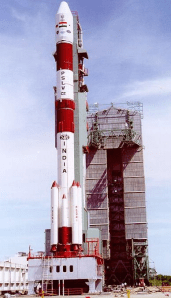
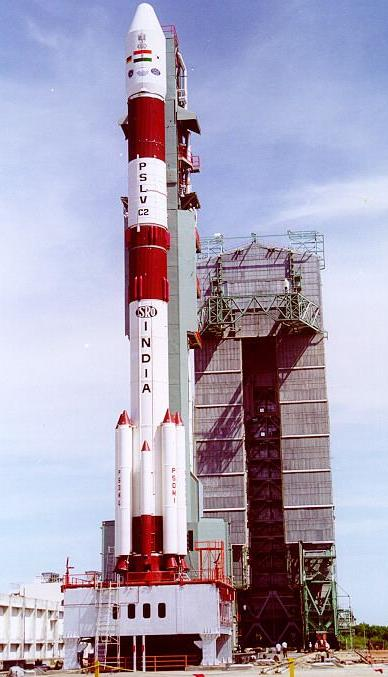
Polar Satellite Launch Vehicle (PSLV )

Polar Satellite Launch Vehicle (PSLV ). Photo Credit: ISRO

India’s rockets are launched from Sriharikota in South India. It is the equivalent of the Kennedy Space Center in Florida. Located on the east coast of Bay of Bengal, the space center is named for Satish Dhawan, an ex Chief of the Indian Space Research Organization (ISRO), the Indian equivalent of NASA. ISRO will construct a second vehicle assembly building at the second launch pad at Satish Dhawan Space Center this year, which would increase its launching capacity to 10-12 launches per year.

India’s space program has been a good commercial venture so far. Launching satellites for other countries and selling data from its remote sensing satellites generates revenue. Given India’s low costs, the space business is a good money earner for the country. Of what use is India’s space program for the Indian masses? Last year, a fearsome cyclone struck the east coast of India (hundreds of miles north of Sriharikota). Timely information by the satellite-based early warning system helped in mass evacuations and prevented of thousands of deaths. A logistics exercise by an otherwise listless Indian bureaucracy came in for much praise.

Why go to Moon and Mars? Madhavan Nair, an ex-Chief of ISRO commented “Twenty years from now when space travel is likely to become mundane like airline travel today; we don’t want to be buying travel tickets on other people’s space vehicles”!

Incidentally, a crater on the dark side of the Moon is named for Dr. Sarabhai. Also, India was the first country with whom the US shared samples of moon rocks that Apollo 11 returned to Earth.

Posted in March 2014 | Tagged , , , | Leave a comment

Japan Launches Next Generation NASA/JAXA Meteorology Satellite

by Dr. Ken Kremer, AAAP and Universe Today

NASA GODDARD SPACE FLIGHT CENTER, MARYLAND –  A next generation US/Japanese weather observatory aimed at gathering 3D measurements of global rain and snowfall rates  thundered to orbit during a spectacular night time blastoff from the Tanegashima Space Center, Tanegashima Island, Japan.  The Global Precipitation Measurement (GPM) Core Observatory launched at 1:37 p.m. EST (3:37 a.m. JST Friday, Feb. 28) atop Japan’s H-IIA rocket.

GPM will directly benefit society with improved weather forecasts and climate change research. Researchers will use the data to study freshwater resources, floods and droughts, hurricane formation and tracking. It will enable more advanced warnings of extreme weather conditions like superstorm Sandy and help identify and determine the effects of global climate change.

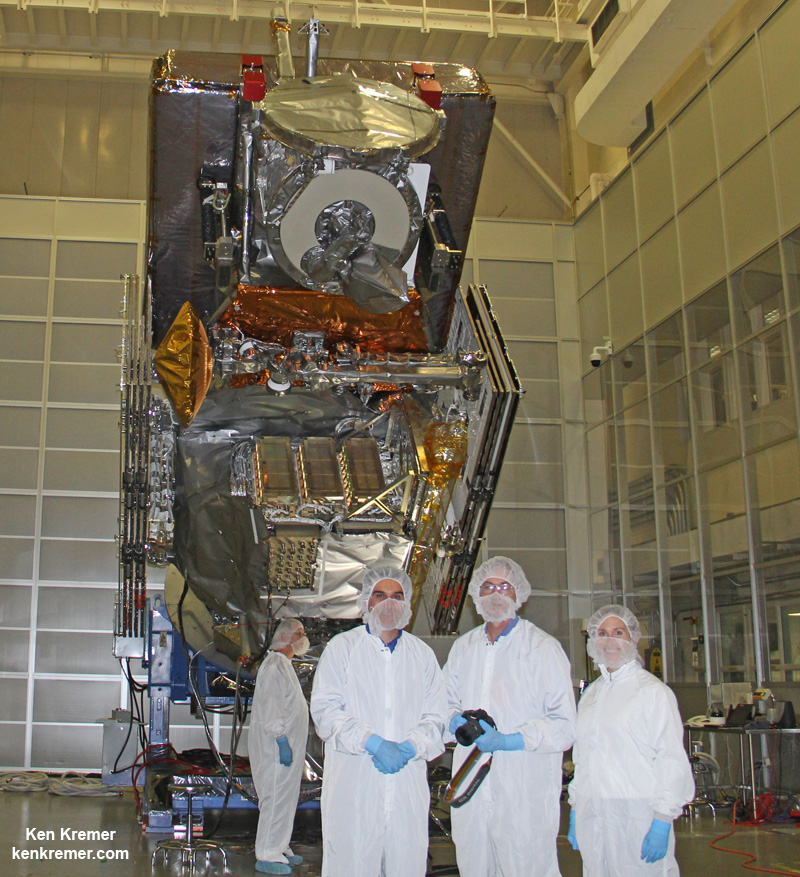
NASA/JAXA Global Precipitation Measurement (GPM) satellite

NASA/JAXA Global Precipitation Measurement (GPM) satellite inside the clean room at NASA Goddard.  Dr. Art Azarbarzin,NASA GPM Project Manager; Dr. Ken Kremer, Universe Today; and Dr. Dalia Kirschbaum, NASA GPM Research Scientist. Credit: Ken Kremer

“GPM will provide high resolution global measurements of rain and snow every three hours. It’s precipitation measurements will look like a CAT scan,” Dr. Dalia Kirschbaum, GPM research scientist, told me during a prelaunch interview in the cleanroom at NASA Goddard.  “The radar can scan through clouds to create a three dimensional view of a cloud’s structure and evolution.”

The four-ton GPM is the lead observatory of a constellation of nine advanced weather research satellites contributed by the US, Japan, Europe and India.  It is the first satellite to measure light rainfall and snow in addition to heavy tropical rainfall.

“GPM is the direct follow-up to the currently orbiting TRMM satellite,” GPM Project Manager Art Azarbarzin told me in a prelaunch interview in the cleanroom. “TRMM is reaching the end of its usable lifetime, and we hope GPM has some overlap with observations from TRMM.”

For more about GPM read my articles here:

http://www.universetoday.com/106727/powerful-new-next-gen-usjapan-gpm-satellite-to-revolutionize-global-precipitation-observations-and-climate-science-research/

http://www.universetoday.com/109673/nasajaxa-precipitation-measurement-satellite-go-for-feb-27-launch-watch-live-on-nasa-tv/

http://www.universetoday.com/109809/next-generation-nasajaxa-global-weather-research-satellite-thunders-aloft-from-japanese-spaceport/

The next Antares/Cygnus rocket launch from nearby Virginia to the ISS is set for May 1. Contact Ken if interested to attend.

NASA’s next generation Global Precipitation Measurement (GPM) observatory inside the clean room at NASA Goddard during my exclusive prelaunch tour. Credit: Ken Kremer/kenkremer.com

Astronomy Outreach      by Dr. Ken Kremer

Washington Crossing State Park, Nature Center:  Titusville, NJ, Apr 6, 1 PM.  “Curiosity, MAVEN and the Search for Life on Mars – (in 3-D)”and “May 1 Antares Launch from Virginia”

Northeast Astronomy Forum (NEAF): Suffern, NY, Apr 12 & 13. “Curiosity, MAVEN and the Search for Life on Mars – (3-D)” and “Future of NASA Human Spaceflight”

Antares Rocket Launch to ISS, May 1: NASA Wallops Island, VA. Evening outreach  at Rodeway Inn, Chincoteague, VA. 

Please contact Ken for more info, science outreach presentations and his space photos. Email: kremerken@yahoo.com   website:  www.kenkremer.com, http://www.universetoday.com/author/ken-kremer/

Posted in March 2014 | Tagged , , , , | Leave a comment

What Went Bang in the Night?

by Michael Wright

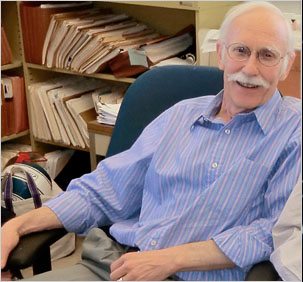
Craig Wheeler

Prof. Craig Wheeler Credit: J. C. Wheeler

Serendipitously, Prof. Craig Wheeler of the University of Texas will be in Princeton on Tuesday, February 11 and has agreed to speak to AAAP about the current supernova in M82.  AAAP is jointly sponsoring this meeting with our friends in the Princeton Astrophysics Department.     As usual, the meeting with begin at 8:00 p.m. in Peyton Hall, 4 Ivy Lane, Princeton.  Gene Ramsey has graciously agreed to yield the podium and postpone his talk originally schedule for Tuesday to April 8.  If the weather cooperates, we hope to observe the supernova after the talk.

J. Craig Wheeler is the Samuel T. and Fern Yanagisawa Regents Professor of Astronomy at the University of Texas at Austin, where he specializes in the astrophysics of violent events: supernovae, neutron stars, black holes, gamma-ray bursts and the relation of these events to astrobiology.  Prof. Wheeler has published about 200 papers in refereed journals and conference proceedings, has edited books on supernovae and accretion disks.  He published a popular astronomy book, “Cosmic Catastrophes: Supernovae, Gamma-Ray Bursts and Adventures in Hyperspace“.  Prof. Wheeler also wrote a novel, “The Krone Experiment“, and co-authored the screenplay, which was made into an independent film.

Posted in February 2014 | Tagged , , , | Leave a comment

From the Director

by Jeff Bernardis, Director

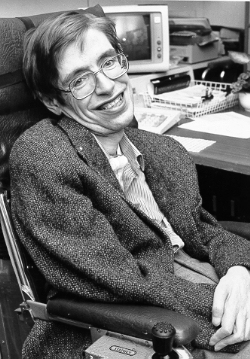
Stephen Hawking Credit: NASA

Stephen Hawking Credit: NASA

I’ve never been one to be into the cosmology aspects of our hobby, particularly in the areas dealing with general relativity.  Some of the concepts are really paradoxical to think about, although I can appreciate the way that great minds can conceive of them.  One of these great minds of our time is Stephen Hawking.  Despite his physical ailments, he is, in my mind, one of the most thought provoking people on the planet.  Just imagine what he could do if he had all of his faculties.

Back in the late 90’s, Stephen Hawking published a book entitled “A Brief History of Time”.  I figured that here was a brilliant mind that I have ultimate respect for, who has reduced this elusive topic down to just over 200 pages.  I purchased the book with the anticipation that I was finally going to be able to wrap my hands around these concepts.  I’m not sure I ever finished the book.  I think I got just past a discussion on event horizons when my eyes glazed over; it just wasn’t sinking in.

Through the years, I’ve gradually absorbed more knowledge about the subject, and while my level of knowledge is basic at best, at least I feel comfortable with it.

So now Stephen Hawking has raised his voice again with a somewhat controversial hypothesis.  In late January, Hawking published an article in which he contends that event horizons may not be as rigid as everyone has theorized to this point.  His hypothesis is that event horizons, as we have defined them, do not exist, but there are “apparent horizons” that persist for a finite amount of time.  As the quantum particles within the horizon shift, the horizons themselves shift allowing energy and matter to escape.

Who knows what is right?  This just a theory conceived to explain our observations.  It will be interesting to see how the cosmologists debate this question.

We in the AAAP are blessed in that we have some of these theoreticians right here on the Princeton campus right in Peyton Hall.  We’ve heard from some of them in the past at our meetings, and I’m sure we’ll hear more from them in the future.  We might not ever know the final answers to these questions, but we are certainly in the right place to be an audience to the debate.

Posted in February 2014 | Tagged , , , , | Leave a comment

From the Outreach Chair

by David Letcher, Outreach Chair

Another successful star party was held last week during the evening of January 23rd. It was a well-attended science night at Antheil Elementary School in Ewing Township. As it was extremely cold that night, we participated in the warmth of the school’s library. We placed a poster of the Andromeda Galaxy on a far wall and had the children look at it through my Astroscan telescope. It proved a fun experience for them and their parents. We also displayed a lot of club posters for all to see and demonstrated how the “Sky Safari” app on my Ipad showed what was in the sky that night. Thanks to Freddy Missel and yours truly for volunteering

Posted in February 2014 | Tagged , | Leave a comment

Treasurer’s Report

by Michael Mitrano, Treasurer

Paid membership for the 2013-14 fiscal year has climbed to 67.  In dollar terms, membership revenue is exactly the same as it was a year ago at this time.  My goal is for us to reach 100 as we did last year. If you have not yet paid your dues, kindly do so.

There have been no unusual recent expenses.  With our insurance and the observatory rent ($1) paid, our surplus for the year to date is about $1,200.

On a cumulative basis, the surplus is approaching $24 thousand.

Posted in February 2014 | Tagged , | Leave a comment

Business Meeting Minutes – January 14, 2014

Submitted by Mary Hays

The meeting was called to order at 9:23 p.m. by President Jeff Bernardis

Larry Kane, Assistant Director, reported that he has volunteered to be the club’s representative to the Friends of Washington Crossing State Park, NJ More information to follow.

Michael Mitrano, Treasurer, reported that there are approximately 65 members with dues outstanding.  Michael will be sending a reminder note to these members shortly.

Kate Otto, Program Chair, reported that there will be a meeting on Wed. Jan. 22 at 7:00 p.m. in the dome room of Peyton Hall to discuss the club’s 2014 StarQuest.  Discussion will focus on scope and type of star party (observing only, meals, guest speakers, etc.)  Everyone is invited to join in this open exchange of ideas.

Gene Ramsey, Observatory Chair, reported that Eric Kaufmann is a new keyholder, and that there are three other members in the process of keyholder training (Dan Wilson, Casper Sandburg, and Kevin Mooney).  Gene encouraged all members to consider this training as it gives those who complete the training independent access to the observatory at times convenient to keyholder’s schedule.

Gene reported that the club’s lock is once again at the Bear Tavern Road gate (the first gate).  He also informed members that the park does not plow the road leading to Brick Yard Road and it would be prudent to go to the observatory with a “buddy” especially during inclement weather.  He and David and Jennifer Skitt cleared heavy snow off of the observatory roof to prevent damage. Thanks goes out to these dedicated club members.  Gene has also been heavily involved with outreach programs with four science teachers at South Hunterdon High School, the Chapin School, Lawrenceville Prep. School, and Hopewell Valley High School.  These teachers had brought students to the observatory in late fall.

David Letcher, Outreach Chair, has called for volunteers to support two star party requests: one at Antheil School in Ewing, Thursday, Jan 23 and at the Lawrenceville Elementary School on Friday, Jan 24.  Anyone able to help is asked to contact David.

New Observatory Update:  It has been decided not to build a new observatory with the donated dome and scope.  Plans are to test the equipment to see what may work with the instrumentation already at the observatory and to possibly sell the dome.  John Miller and Bill Murray will do further investigation on these items.

The meeting adjourned at 9:40 pm

Posted in February 2014 | Tagged | Leave a comment

The Universal Dream

A Poem by Alison Lu

Shall the darkness of the world envelop you in
the cold silence of the night.
Shall the whispering owls lull you to sleep.
Shall you remain, undisturbed
by the din of the future.
Shall the stars stare bright at you,
and you will understand.

Shall your mind travel through a worm-hole,
and never to wake up.
To dream of things never seen
with the naked eye.
The vast nebula, the lake across the sunset,
and the creamy Milky Way.
Between the big dipper,
you are the bear,
and you shall guide the sailors.

Shall you travel the world,
maybe to meet an alien race.
Shall you never have to face,
the thought of waking up.
The sun will burn you,
the shadow will kill,
yet you will be safe.
For the technology of the earth,
will never achieve,
the wonders you see
when you believe.

Posted in February 2014 | Tagged , | Leave a comment