Minutes of the October 14, 2014 AAAP Meeting

by James Poinsett, Secretary

  • Rex opened the meeting and introduced Larry Kane.
  • Larry presented his refractor to the club.
  • Kate Otto then introduced Ken Kremer to give his talk on “The Future of NASA Human Spaceflight”.
  • After Ken’s talk, Rex called the business meeting to order. He called on Program Chair Kate Otto.
  • Kate informed the club that speakers were lined up for meetings through March except for December.
  • Talk continued on the Master Plan, specifically bringing video astronomy to the Washington Crossing Observatory. Larry Kane heads the committee and presented a progress report on the “Purchase and Implementation of an Observatory Video System”. The report recommended the board approve a proposal to spend $6000 for the video system. The board approved the proposal and will present the proposal to the membership at the November meeting for a vote.
  • The next topic at the meeting was the fate of the Hastings-Byrne refractor at the WCO. John Church’s history on the telescope was discussed along with his opinion that the scope should be donated or sold to an organization that will use it, not just display it in a museum. Another possibility discussed was obtaining an elevator mount to raise the scope. Discussion was tabled until the next meeting.
  • The fate of the donated equipment was discussed next. Bill informed us that the state museum has no use for the dome we were willing to donate. It was decided that Rex would place an ad in AstroMart and Michael Mitrano would handle all the responses. If we do not get a taker, the next step may be to scrap the dome.
  • Ludy will bring the camera from the donated equipment to the observatory to make it available for use by the members.
  • The C-14 will be brought to the observatory to do a comparison as to which one is better (the donated one or our current one). After a decision is reached the fate of the lesser of the two scopes will be decided by the club.
  • Peyton Hall will not be unavailable after the first of the year. Several possible locations for the meetings are being discussed. The main concerns were near-by parking and the ease of finding the hall. A decision needs to be made at the next meeting to give us time to reserve the hall.
  • Gene showed the club the pictures that are hanging by the locks on the gates that lead to the observatory. Hopefully, this will keep the gates from being locked so the club members cannot open them. He also reminded us to make sure we do not drive on the grass.
  • Larry informed the club that the Washington Crossing Park Association is having a membership drive and encouraged club members to join. He also said one of the goals of the association is to be an educational resource, and Larry wants astronomy to be part of that education.
  • The meeting was then adjourned.
Posted in November 2014, Sidereal Times | Tagged , | Leave a comment

From the Outreach Chair

by David Letcher, Outreach Chair

The mulled wine was delicious and the more we drank, the more double stars we saw.
Thanks go to member-volunteers Freddy Missel, Michael Wright, Jeff Bernardis, Dave and Jen Skitt and your truly for hosting a very successful and fun evening at the Unionville Winery in Ringoes on Thursday, October 30th.  The skies were exceptionally clear. About 50 people came by to view the moon, some double stars and clusters, the ring nebula, and Andromeda. We should do this again!

Posted in November 2014 | Tagged , | Leave a comment

Big History

by S. Prasad Ganti

Most of us are curious about how it all started. We study history of specific countries and periods like European history during the medieval ages or American history since the civil war, but not about everything in one stretch. The concept of Big History was started by Prof. David Christian as a multi-disciplinary study involving cosmology, physics, chemistry and biology from the Big Bang to the formation of simple elements like hydrogen, to stars and galaxies, to heavier elements, to our Sun and Earth and to the evolution of life up to the present.

Christian came up with the concept of how it all started in a very simple way and through eight thresholds increasing in complexity to our present state. He offered it as a one-semester course at the University in Australia. His course became popular enough to be sold through the Great Courses web site. He also gave a talk on TED (http://www.ted.com/talks/david_christian_big_history). Bill Gates was very impressed by this concept to the extent of sponsoring a simplified version of the course in middle and high schools across the US.

I was impressed when the New York Times covered it in their Sunday magazine a few weeks back. I saw the TED talk, took a five hour free mini course online and also got the DVDs from The Great Courses to view in detail. Each of the eight thresholds involves certain ingredients and certain Goldilocks conditions resulting in a new level of complexity. The next threshold then builds on this level of complexity. Goldilocks conditions involve considerations like not too far, not too close, not too hot, not too cold, not too big, not too small, etc.

The first threshold was the Big Bang itself. No one knows the ingredients nor the Goldilocks conditions. It led to protons and electrons forming the simple element hydrogen. Hydrogen and gravity formed the ingredients for the second threshold. The Goldilocks conditions were the tiny variations in density of matter. The Universe was not uniform all across. These variations led to star formation 200 million years after the Big Bang.

The third threshold involved very high temperatures and dying stars, leading to the formation of elements heavier than hydrogen like helium, carbon and oxygen. Threshold four led to creation of astronomical bodies like the Earth that are chemically richer than the stars. Nickel, iron and other heavy radioactive elements sank to the center of the Earth, while lighter ones like silicon floated. This led to the creation of a magnetic field. The comets brought water vapor to fill the oceans.

Threshold five led to creation of life on the Earth. Complex chemicals like DNA with the right amount of energy and liquids like water led to single-celled organisms at first. This was life in its simplest form. The evolution of life led to threshold six resulting from powerful brains producing symbolic language and shared ideas. Homo sapiens evolved to use collective learning and passed information to the next generation thereby creating the ability to adapt speedily without any genetic changes.

Threshold seven led to domestication of plants and animals and the agrarian civilization that resulted in increasingly dense human communities with knowledge about the environment. The last threshold utilizing the new energy resources like coal, oil and electricity led to the globally connected human society.

This is the gist of the eight thresholds, but many more details lies behind each of them. A very interesting set of concepts for those who want to know all about everything!

Posted in November 2014, Sidereal Times | Tagged , | Leave a comment

Looking at Stars from the Top of a Mountain

 by Robert Carnevale ©

I have come to where I’ve always been.
The other hills seems quite at rest,
no telltale sign of thoughts like mine
milling like fireflies about their crowns.

The stars keep on with their burning.
How can we say they don’t care
where there’s no caring to begin with?
I am glad they don’t stoop to our question.

I knew before I came up here
that I would not be able to stay –
where I’ve always been, always will be –
still, it seems strange I can’t be where I am.

Jiménez wrote: “I am not I.”
And yet the world is still the world,
and these stars, with few exceptions,
are the same ones that always turned there.

Up here I am the strange one.
I should be granite. I should be light.
I should be space. I should be wind.

And yet, however unlikely,
I am as real and as present
as they are.

Yes, it’s the dark shows us the stars but, even more,
it is the stars show us the dark.
I really would stay if the night would.

But it would be rude of me to turn my back
on a star that has no back to turn
on the worlds it has set turning.

Thank you to David Kaplan for finding this gem.

Posted in November 2014, Sidereal Times | Tagged , | Leave a comment

Snippets

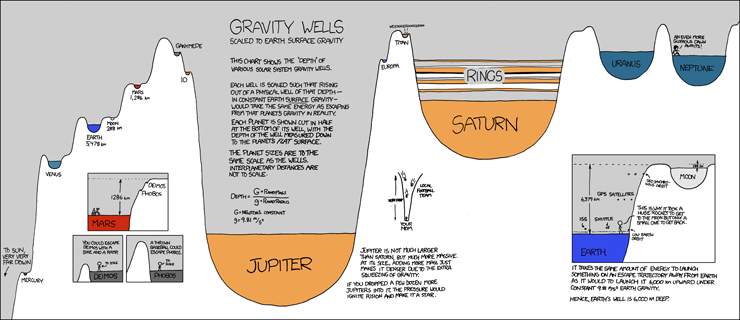
Gravity Wells According to XKCD (contributed by Michael Wright)

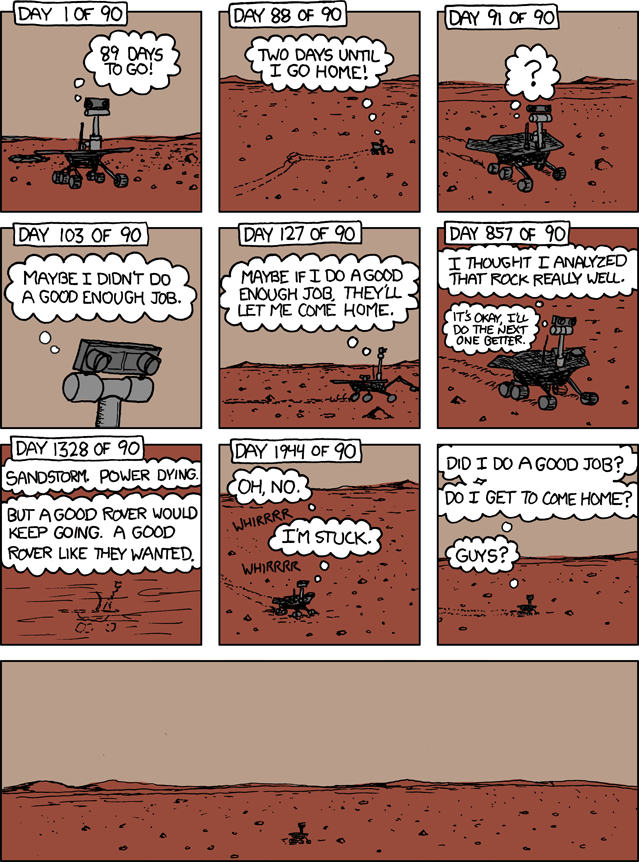
Rover Humor from XKCD (contributed by Ira Polans)

Cosmigraphics (contributed by David Kaplan)

Over thousands of years, humans have tried to represent the universe in graphic form, whether in manuscripts, paintings, prints, books or supercomputer simulations.

http://www.nytimes.com/2014/10/14/science/space/in-cosmigraphics-our-changing-pictures-of-space-through-time.html?smid=nytcore-ipad-share&smprod=nytcore-ipad

The Violent Universe (contributed by Ed Sproles)

Here is another free online class may be of interest:

EdX is running another class taught by Paul Francis and Brian Schmidt of Australian National University.  Brian Schmidt is a 2011 Nobel Prize winner in physics.  The class just started so you can join and catch up.

The class is titled “The Violent Universe” and covers White Dwarfs to Supernovae and black holes.  You can do as much or as little as you like in viewing the lectures and doing the problem sets.

A fun sideline in their courses is a “mystery” world where their universe obeys somewhat different laws.  They disclose a little more each week; it is a puzzle to figure what is going on in this world using the observations provided.

 Just Google “The Violent Universe” to find it in EdX.

Gerry Neugebauer, Pioneer in Space Studies, Dies at 82 (contributed by David Kaplan)

Dr. Neugebauer’s biggest achievement was in detecting and interpreting infrared radiation emanating from outer space to provide insights about the universe that radio waves or X-rays cannot.

http://www.nytimes.com/2014/10/03/us/gerry-neugebauer-pioneer-in-space-studies-dies-at-82.html?smid=nytcore-ipad-share&smprod=nytcore-ipad

Photo Nightscape Awards (contributed by Michael Wright)
The first edition of the Photo Nightscape Awards, PNA, has just ended…. 
The PNA (international photography awards) rewards the authors of nightscapes, growing trend of astrophotography. The PNA is openned to all ! Photographers and astrophotographers, pro and amateurs, adults and juniors participated and won great rewards offered by our partners :
Trip to ESO in Chile, Trip to the Alqueva Dark Sky Reserve in Portugal, binoculars and telescopes…
We are delighted to honor them in this video of the most beautiful pictures received for the first edition in 2014.

The first edition of the PNA was a great success, well beyond the of the astronomy borders! The second edition is coming and will begin in February 2015!  To participate or for more information, please send an email to: pna@cieletespace.fr

Posted in November 2014, Sidereal Times | Tagged | Leave a comment

Antares Rocket Launch Ends in Catastrophic Failure from NASA Wallops – Eyewitness Account

by Dr. Ken Kremer, AAAP, Universe Today

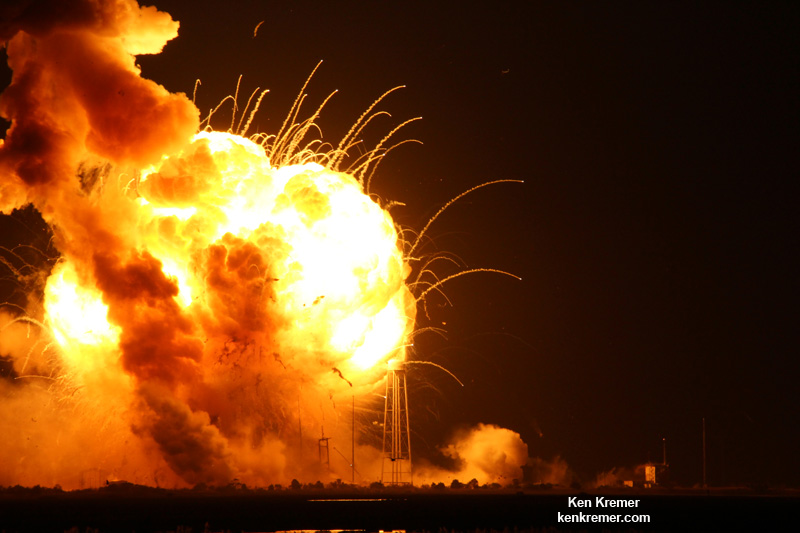
NASA WALLOPS FLIGHT FACILITY, VA –  Moments after a seemingly glorious liftoff, an Orbital Sciences Corp. commercial Antares rocket suffered a catastrophic failure and exploded into a spectacular aerial fireball over the launch pad at NASA’s Wallops Flight Facility on the eastern shore of Virginia that doomed the mission bound for the International Space Station on Tuesday, October 28.

The 14 story tall Antares rocket blasted off on time at 6:22 p.m. EDT from  the beachside Launch Pad 0A at the Mid-Atlantic Regional Spaceport (MARS) at NASA Wallops on only its 5th launch overall.

Orbital Sciences’ Antares rocket explodes into an aerial fireball seconds after blastoff from NASA’s Wallops Flight Facility, VA, on Oct. 28, 2014, at 6:22 p.m. Credit: Ken Kremer

Orbital Sciences’ Antares rocket explodes into an aerial fireball seconds after blastoff from NASA’s Wallops Flight Facility, VA, on Oct. 28, 2014, at 6:22 p.m. Credit: Ken Kremer

I was an eyewitness to the awful event and photographed the launch from the press viewing site at NASA Wallops from a distance of about 1.8 miles away.  I never expected to see anything like this, although it’s always possible because space is a risky business.

My Antares interview with NBC News correspondent Tom Costello appeared the next evening on NBC Nightly News with Brian Williams on Oct. 29, along with a bunch of my launch explosion photos.  Watch the entire NBC News report here

Watch my Antares interview with at Universe Today on Oct 31 here

The highly anticipated 1st night launch of Antares would have wowed tens of millions of spectators up and down the eastern seaboard from South Carolina to Maine.
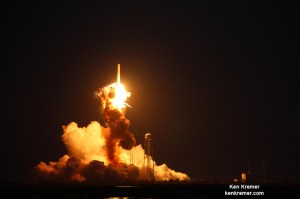
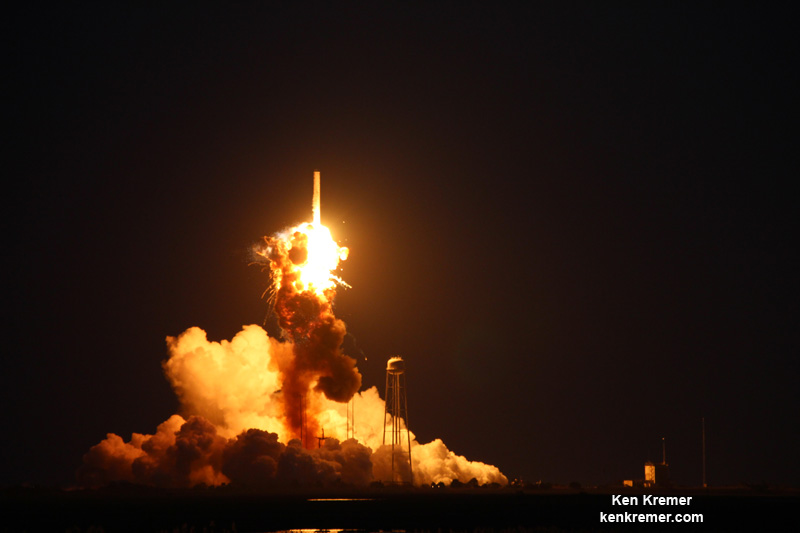
Base of Orbital Sciences’ Antares rocket explodes moments after blastoff from NASA’s Wallops Flight Facility, VA, on Oct. 28, 2014, at 6:22 p.m. Credit: Ken Kremer

Base of Orbital Sciences’ Antares rocket explodes moments after blastoff from NASA’s Wallops Flight Facility, VA, on Oct. 28, 2014, at 6:22 p.m. Credit: Ken Kremer

Antares was carrying Orbital’s privately developed Cygnus pressurized cargo freighter loaded with nearly 5000 pounds (2200 kg) of science experiments, research instruments, crew provisions, spare parts, spacewalk and computer equipment and gear on a critical resupply mission dubbed Orb-3 bound for the International Space Station (ISS).

It was the heaviest cargo load yet lofted by a Cygnus. Some 800 pounds additional cargo was loaded on board compared to earlier flights. That was enabled by using the more powerful ATK CASTOR 30XL engine to power the second stage for the first time.

Everything appeared normal at first. But within about five seconds or so there was obviously a serious mishap as the rocket was no longer ascending. It was just frozen in time. And I was looking directly at the launch, not through the viewfinder of my cameras.

Something was noticeably amiss almost instantly as the rocket climbed only very slowly, barely clearing the tower it seemed to me. The rocket failed to emerge from the normal huge plume of smoke and ash that’s purposely deflected away by the flame trench at the base of the pad.

I was stunned trying to comprehend what was happening because it was all so wrong. It was absolutely nothing like the other Antares launches I’ve witnessed from the media site.

I knew as a scientist and journalist that I was watching a mounting disaster unfolding before my eyes.

Instead of ascending on an accelerating arc, a mammoth ball of fire, smoke and ash blew up the entire sky in front of us like a scene out of hell or war. Literally the sky was set on fire unlike anything I’ve ever witnessed.

A series of mid-air explosions rocked the area. I could feel a slight pressure wave followed by a mild but noticeable heat wave passing by.

Then the rocket began to fall back to Earth. Then the ground blew up too as the rocket pieces hit the ground and exploded into a hail of smithereens in every direction.

By this time our NASA escorts starting yelling to abandon everything in place and head immediately for the buses and evacuate the area. The ground fire spread mostly to the northern portion of the pad and the expanding air-borne plume also blew northwards. The ground fire was still burning over a half hour later.

Thankfully, everyone got out safe and there were no injuries due to the excellent effort by our NASA escorts trained for exactly these types of unexpected circumstances.

It’s heartbreaking for everyone’s painstaking efforts to get to the point of liftoff after years of effort to fulfill the critical need to resupply that station with the science equipment and experiments for which it was built.

A prime suspect in the disaster could be the pair Soviet-era built and US modified AJ26 engines that power the rocket’s first stage.

Another AJ26 engine failed and exploded during acceptance testing on May 22, 2014 at NASA’s Stennis Space Center in Mississippi. An extensive analysis and recheck by Orbital Sciences was conducted to clear this pair for flight.

“The root cause will be determined and corrective actions taken,” Frank Culbertson, Orbital’s Executive Vice President and General Manager of its Advanced Programs Group, said at a post launch briefing at Wallops.

For complete details check out my articles, photos and cell phone video online at Universe Today and NBC News:

http://www.nbcnews.com/nightly-news/nasa-orbital-sciences-look-answers-rocket-explosion-n237051

http://www.universetoday.com/115787/catastrophic-failure-dooms-antares-launch-to-space-station-gallery/

http://www.universetoday.com/115796/antares-commercial-rocket-destroyed-in-devastating-fireball-video/

http://www.universetoday.com/115826/antares-launch-calamity-unfolds-dramatic-photo-sequence/

http://www.universetoday.com/115856/launch-pad-damage-discernible-in-aftermath-of-catastrophic-antares-launch-failure-exclusive-photos/

http://www.universetoday.com/115863/weekly-space-hangout-oct-31-2014/

Astronomy Outreach by Dr. Ken Kremer

Orion and SpaceX Launches Dec 4 & 9: NASA Kennedy Space Center, FL. Evening outreach at Quality Inn, Titusville, FL.

The Future of NASA’s Human Spaceflight Program with Orion and Commercial Astronaut Taxis: March 2015, DVAA, PA

Please contact Ken for more info, science outreach presentations and his space photos. Email: kremerken@yahoo.com   website: www.kenkremer.com, http://www.universetoday.com/author/ken-kremer/

Posted in November 2014, Sidereal Times | Tagged , , , | Leave a comment

From the Director

Rex

by Rex Parker, PhD  director@princetonastronomy.org

A crispness to the skies and a sense of urgency with the temperatures give October an auspicious feel for amateur astronomers.  New constellations well positioned include Perseus, Andromeda, and Pegasus – three of the original constellations of the famed Almagest thought to be written by second-century astronomer Ptolemy.  It’s impossible to ignore the Milky Way stretching overhead to the southern horizon, and the great galaxy in Andromeda (Messier 31) can be discerned by naked eye in mid-evening if light pollution isn’t too severe.  Indeed, that galaxy was visible without aid and a glorious sight in telescopes under the pristine clear skies at StarQuest last weekend in north Jersey.  Pegasus, the winged horse constellation, is seen by some today as merely a big empty square of stars (what was Ptolemy thinking?) and devoid of deep sky objects.  Yet the databases list nearly a hundred “NGC” and “IC” deep sky objects (star clusters, galaxies, and various nebulae) within the great square.  Though challenging, some of these are accessible to AAAP members through the 14-inch Celestron telescope at the club’s Washington Crossing Observatory, though of course many are visible only with electronic enhancement (CCD, DSLR or video cam). Pegasus is also a good test of limiting magnitude, because a dozen stars inside the square are magnitude 6 or brighter, the level generally considered a threshold for good skies.  I counted ten at StarQuest.

A much more visible and dynamic celestial event takes place on October 8 early in the morning.  A total lunar eclipse will be in progress as the sun rises here in central Jersey.  You’ll need to have a clear view of the western horizon in the early morning hours.  In counterpoint to the rising sun, the moon sets with the eclipse in totality, adding a twist to previous recent eclipses.  The next total eclipse of the moon at our location won’t occur till next September, after which we’ll have to wait for a total eclipse here until 2018 when there are two (there are partial and penumbral eclipses before then).

As the pictures and articles in this issue attest, StarQuest 2014 was a great success with some of the clearest, darkest skies we’ve ever had.  I’d like to give special thanks to Michael Wright for the “heavy lifting” organizing of the event and for the creative and very cool Solar System Walk (a scale model of the solar system on the grounds of the conference center) which surprised us all with the immense distances between the planets!  Special thanks also to Ludy D’Angelo for the excellent StarQuest Trattoria!

Our tradition of great speaker presentations continues this month (7:30 pm, Oct 14 at Peyton Hall) with a talk on the future of human spaceflight by Dr. Ken Kremer of Universe Today, AmericaSpace, and AAAP.  Check out the article in this issue and the AAAP website (http://www.princetonastronomy.org/) for more info.

Important note:   AAAP meetings at Peyton Hall now begin at 7:30 pm.

Posted in October 2014, Sidereal Times | Tagged , | Leave a comment

Next AAAP Meeting – October 14 at 7:30 p.m.

IMG_3410a_STS 135_ Ken KremerAAAP’s next meeting and lecture will be on Tuesday, October 14 at 7:30 p.m. in Peyton Hall.  AAAP member and NASA Ambassador, Dr. Ken Kremer, will present “What’s the Future of America’s Human Spaceflight Program with Orion and Commercial Astronaut Taxis”, an eyewitness account of NASA’s future plans to resume launching humans to space from American soil. NASA’s new Orion and commercial capsules from Boeing and SpaceX will end our dependency on Russia. Ken will give an inside accounts of NASA’s multipronged strategy to develop private astronaut ‘space taxis’ to Earth orbit and for ambitious human expeditions to deep space with Orion to the Moon, asteroids and Mars. Ken will discuss the critical Fall 2014 launches of Orion from the Kennedy Space Center and Antares/Cygnus from Wallops Virginia and how you can see them. Ken will briefly give an update NASA’s Mars rovers and orbiters including Curiosity and MAVEN. Ken will have a selection of his Space photos for sale.

Ken Kremer is a journalist, Ph.D. research scientist, speaker and photographer based in New Jersey. His space and Mars imagery and writings have been widely published on TV, magazines, books and websites including National Geographic, NBC, ABC, BBC and Fox News, PBS NOVA TV, Scientific American, APOD, NASA, Aviation Week, Astronomy, Astronomy Now, Space.com, Spaceflight Now, Spaceflight, New Scientist, Planetary Society, Popular Mechanics, AmericaSpace, Universe Today, NASA Watch, Wired, Science News, All About Space, NPR, Mars Society, International Year of Astronomy, 2010 Year in Space Calendar and the covers of Aviation Week, Spaceflight and the Explorer’s Club. Ken’s Curiosity Mars mosaic is on permanent display on the US National Mall at the Smithsonian National Air & Space Museum, Washington, DC.

Ken Kremer website – http://www.kenkremer.com

Posted in October 2014, Sidereal Times | Tagged , | Leave a comment

October 7 Board Meeting

The next meeting of the AAAP Board will be at 7:30 p.m. on October 7, 2014 in Room 140 of Peyton Hall.  All members are invited to attend.

Posted in October 2014, Sidereal Times | Tagged | Leave a comment