Neutrinos and the 2015 Nobel Prize in Physics

by S. Prasad Ganti

Last year I wrote about neutrinos, the mystery particles, based on the book I read entitled “The Neutrino Hunters” by Ray Jayawardhana. This year, the Nobel Prize in Physics went to Takaki Kajita and Arthur McDonald who led two different neutrino experiments in two different parts of the world. In fact, the book by Jayawardhana is referenced on the http://www.nobelprize.org site, which has more details on the prize and the prize winners. The site is very informative compared to what gets reported in the general media.

Around the turn of the millennium, Takaaki Kajita discovered that neutrinos from the atmosphere switch between two identities on their way to the Super-Kamiokande detector in Japan. Meanwhile, Arthur McDonald in Canada demonstrated that neutrinos from the Sun were not disappearing on their way to Earth. Instead they were captured with a different identity when arriving at the Sudbury Neutrino Observatory.

Neutrinos are mysterious particles. Italian for “little one”, they weigh very little and do not have any electrical charge. Earlier in the nineteenth century, Wolfgang Pauli found some energy missing when a beta decay occurs. A beta decay is a form of radioactivity in which unstable elements change their form and structure. For example, C14 (carbon) has eight neutrons and six protons. During a beta decay, one of the neutrons splits into an electron and a proton. The new nucleus with seven protons and seven electrons is N14 (nitrogen). Pauli explained the missing energy as that of a neutrino.

When passing through a huge tank of water in a detector, a large number of neutrinos may produce a few muons that produce a blue light called Cherenkov cones. Cosmic rays also generate muons in Earth’s atmosphere. Going deep inside Earth’s surface or underwater is filters out the cosmic ray muons. Cosmic rays decrease as one goes deeper inside the Earth, but upward moving neutrinos from other side of the Earth also pass through the detector.

In 1956, Frederick Reines and Clyde Cowan detected neutrinos near a nuclear reactor for the first time. The 1995 Nobel Prize in Physics went to Reines. In 1968, Ray Davis detected solar neutrinos deep inside Homestake mine in South Dakota. Kamiokande detector in Japan, also known as Super K, detected the first neutrinos from outside of the solar system from the 1987A supernova in the Large Magellanic Cloud, a satellite galaxy of the Milky Way located 160,000 light years away. Ray Davis and Masatoshi Koshiba,the Director of Super K, won the Nobel Prize in Physics in 2002.

The third Nobel Prize for neutrinos in 2015 was given for discovering a new phenomenon – neutrino oscillations, which means that neutrinos change their form between three different types. Unless all the three type are detected, it is not possible to account for all the neutrinos generated in the Sun and come to the Earth. That is what Takaki Kajita and Arthur McDonald did to win the prize in 2015. They solved the mystery of the missing neutrinos.
Posted in November 2015, Sidereal Times | Tagged , , , | Leave a comment

From the Director

Rex

by Rex Parker, PhD, Director 
director@princetonastronomy.org


Astro Auction – success!  Members browsing the equipment on display at the Washington Crossing Park pavilion on Oct 18 could hardly believe the great prices and values offered! From 3”, 4”, and 6” refractors to 6”, 8”, and 10” reflectors, several good equatorial mounts and a variety of eyepieces. Almost all the items were sold and taken home.  Through Astromart.com, we sold the classic red 6” Edmund Newtonian the next day – the buyer was thrilled and grateful.  The only items remaining now are a few eyepieces and books which will be available at upcoming regular meetings.  As result, we gained a lot of space at the Observatory where all the items were stored.  I’d like to extend a big thank you to all AAAP’ers who participated in the auction, and especially thank Jim Poinsett for storing some of the equipment at his house for almost a year, and Gene Ramsey for running the eyepiece auction at the event. In all, the club Treasury gained over $2800 and put some excellent astro equipment into members’ hands.AAAP 2a

AAAP 11a

Tour of USNO and Smithsonian Air and Space, Washington.  Fourteen intrepid AAAP members and spouses travelled to Washington D.C. on November 2 for a special tour of the US Naval Observatory.  Located not far from DuPont Circle, the USNO has a long history of serving the Navy and the nation’s astrometry needs (http://www.usno.navy.mil/USNO). Their mission is to determine the positions of celestial bodies, the motions of the earth, and precise time.  USNO provides the astronomical and timing data required by the Navy, Air Force, and other parts of the DoD for navigation, precise positioning, and command, control and communications.  They also make these data available to other government agencies and to the public — the essential basis for the GPS we’ve come to depend upon in our daily lives.

AAAP 6aAmong several telescopes on the premises are two Clark f/15 refractors, a 26-in and a 12-in (photo below) from the 1860s.  The night was clear, so the 26” was in use and off-limits to us, but we did get to observe the double star Albireo through the 12”.   We toured the main building (Richard Morris Hunt architect), which includes a circular library containing perhaps the most complete collection of astronomical titles anywhere in the US.  On display were some valuable and very rare books including a 1500’s printing of Copernicus’ De revolutionibus orbium coelestium (“On the Revolutions of the Heavenly Spheres”) and Newton’s 1700’s Philosophiæ Naturalis Principia Mathematica (“Principia”).
AAAP 5b
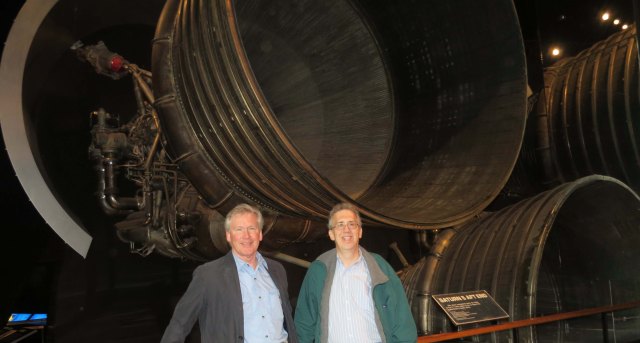
Earlier in the day some of us visited the Smithsonian Air and Space museum.  That’s a picture of Ira and me next to the business end of an Apollo Saturn-V rocket!  I’d like to thank Ira for arranging the USNO tour, on behalf of all who went on this fascinating field trip to Washington D.C.

Paul HalpernNext Meeting at Peyton Hall (7:30 pm, Nov 10). Our tradition of interesting and inspiring speaker presentations continues this month with a talk by Paul Halpern.  He is Professor of Physics at the University of the Sciences in Philadelphia, and author of the book Einstein’s Dice and Schrodinger’s Cat.  Check out the announcement by Program Chair Ira Polans here for more information.

Posted in November 2015, Sidereal Times | Tagged , | Leave a comment

Boeing ‘Starliner’ Astronaut Taxi Spaceship Takes Shap

IMG_0937_1a_CST 100_Ken Kremer

Mockup of Boeing CST-100 crew capsule that carries four person crews to the ISS. Credit: Ken Kremer/kenkremer.com

KENNEDY SPACE CENTER, FL – ‘Starliner’ is the new name of America’s next spaceship. The new commercial craft from Boeing will restore America’s capability to launch American astronauts from American soil to the International Space Station (ISS) in 2017.

The magnificent  capsule is already taking shape! Built by Boeing, Starliner was officially announced by Boeing and NASA as the new name of the company’s CST-100 commercial crew transportation spacecraft during the Grand Opening event for the craft’s manufacturing facility at the Kennedy Space Center on Friday, Sept 4. 2015, which I attended as media for Universe Today.

IMG_9471_1a_Boeing CST-100_Ken Kremer

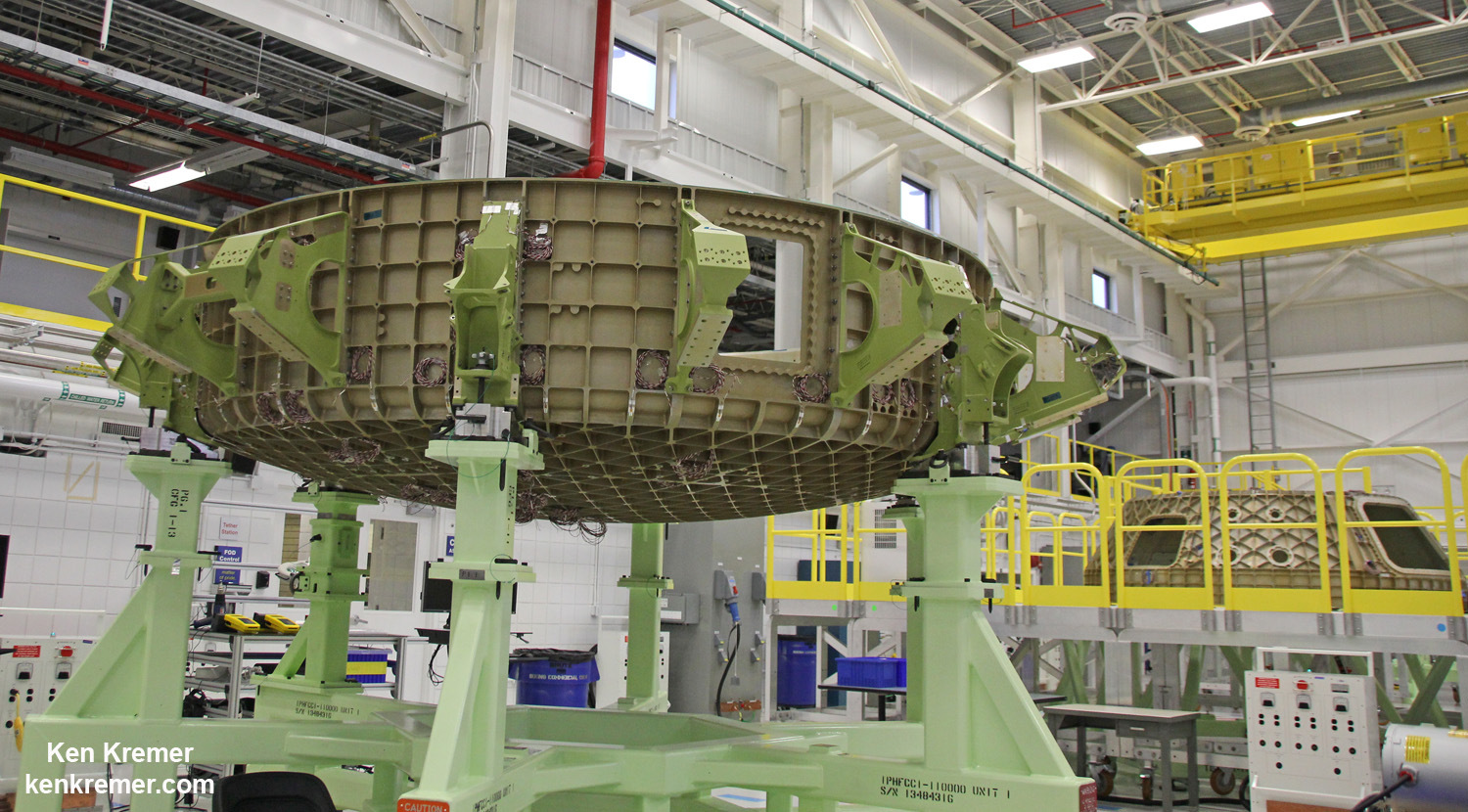
This is the lower segment of the first Starliner crew module. Credit: Ken Kremer/kenkremer.com

Starliner counts as history’s first privately developed ‘Space Taxi’ to carry humans to space – along with the Crew Dragon being simultaneously developed by SpaceX.  It is ushering in the new commercial era of space flight and will completely revolutionize how we access, explore and exploit space for the benefit of all mankind.  The vehicle is mostly automated for ease of operation and is capable of transporting astronaut crews of four or more to low Earth orbit and the ISS as soon as mid 2017, if all goes well and Congress approves the required funding.

The ‘Starliner’ will be produced in Boeing’s newly revamped manufacturing facility dubbed the Commercial Crew and Cargo Processing Facility (C3PF) on site at the Kennedy Space Center in Florida.   The building was previously known as Orbiter Processing Facility-2 (OPF-3) and used by NASA to process the agency’s space shuttle orbiters between crewed flights during the three decade long space shuttle program.

IMG_3550_1a_Boeing CST-100_Ken Kremer

Upper half of first Boeing CST-100 ‘Starliner’ space taxi unveiled on Sept. 4, 2015 at NASA’s Kennedy Space Center. Credit: Ken Kremer/kenkremer.com

Starliner will launch on an Atlas V from pad 41 at Cape Canaveral Air Force Station in Florida. It can dock at the ISS within 24 hours and can stay docked for 6 months.  NASA Administrator Charles Bolden awarded Boeing a $4.2 billion contract in September 2014 to complete development and manufacture of the CST-100 space taxi under the agency’s Commercial Crew Transportation Capability (CCtCap) program and NASA’s Launch America initiative.

The commercial crew program is designed to return human spaceflight launches to the United States and end our sole-source reliance on Russia and the Soyuz capsule for all manned flights to the ISS.

For complete details about the Boeing Starliner, see my recent articles and photos at Universe Today and Facebook: https://www.facebook.com/kremerken1

http://www.universetoday.com/122156/boeing-starliner-crew-spaceship-americas-next-ride-to-space-takes-shape/

Astronomy Outreach by Dr. Ken Kremer

Atlas/Cygnus Launch to ISS: Dec 1-3, NASA Kennedy Space Center, FL. Evening outreach  at Quality Inn, Titusville, FL

America’s Human Path Back to Space and Mars with Orion, Starliner and Dragon: Dec 8, 7:30 PM, AAAP, Princeton University, Princeton, NJ

Please contact Ken for more info, science outreach presentations and his space photos. Email: kremerken@yahoo.com   website:  www.kenkremer.com http://www.universetoday.com/author/ken-kremer/ https://www.facebook.com/kremerken1


Posted in November 2015, Sidereal Times | Tagged , | Leave a comment

Minutes of the October 13th, 2015 AAAP Meeting

by James Poinsett, Secretary

  • Rex called the meeting to order and listed a few items for discussion after the lecture.
  • Ira introduced the speaker, Scott Nammacher and his talk “Observatory Design, One Person’s Approach”.
  • After a short break Rex re-convened the meeting.
  • The topic of “StarQuest” was brought up; Rex wants members to think about it. Keep it an observing only event, try to expand its scope or drop it all together. This will be discussed at a future meeting.
  • The lunar eclipse of late September was clouded out, no local viewing possible.
  • There is a planetary conjunction coming in the morning sky. Three planets in one binocular view.
  • A tour of the US Naval Observatory is set for November 2nd. Those who expressed interest have the information.
  • There were no volunteers to organize the club picnic on October 18th. The auction and observing session will go on as planned; Rex discussed many of the items that will be available. There will be snacks provided by the club.
  • Michael Mitrano brought to the club’s attention the problems with the flat roof portion of the observatory and how to repair it. He volunteered himself and a few other club members to do the work. The board approved $750 for materials.
  • Specifications for the new computers for the observatory will be finalized for the next meeting.
  • Speakers have already been lined up for the next several meetings.
  • The updated website is almost ready to go live.
  • The club is seeking more publicity than the traditional print outlets to announce club events. Rex is going to write an article about the club to be distributed.
  • We have several outreach opportunities coming up:
    • October 20th – North Brunswick
    • October 27th – Kendall Park
    • November 12th – Stuart Country Day School
  • There being no further new or old business the meeting was adjourned.
Posted in November 2015, Sidereal Times | Leave a comment

Simpson Observatory Roof Repairs

by Michael Mitrano

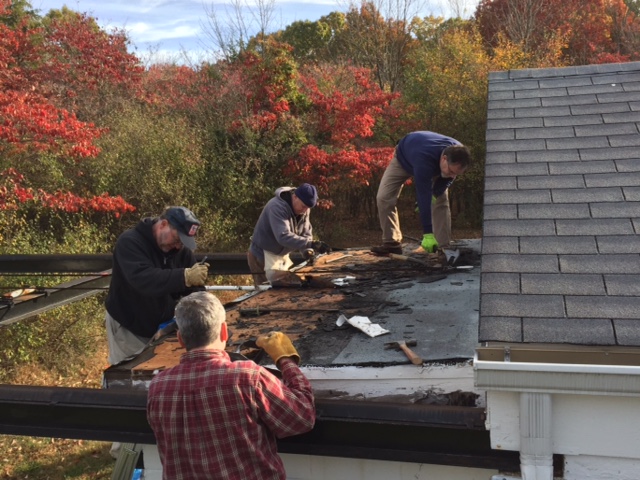
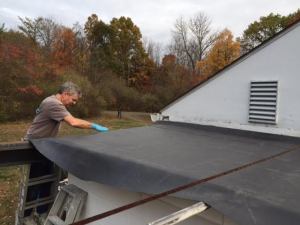
image001The roof repair team had a productive day and a half this weekend (10/31 and 11/115) at the observatory.  Many layers of old roofing, the plywood roof deck, a rotted rafter, and all of the exterior trim around the north (fixed) roof were removed on Saturday.  The new rafter, decking, trim, and roof membrane are in place.  We made adjustments to the roof pitch so that the lower half of the roof chain (which travels through a pipe) no longer penetrates the roof surface.  A little work remains to be done around the edges of the roof, where the membrane needs to be folded down over the trim, glued with a different glue, and held permanently in place with aluminum “termination bars”.  The roof will be fine in ordinary rain for a while, and I hope that Dave and I can take care of this within the next 10 days.  We also need to add a new vent for the lavatory.  The roof is now operable.

unnamedMuch sawdust has been cleaned up from the interior, but the bathroom and control room are mostly empty with all the computer equipment having been moved to the other end of the observatory away from the mess.  I’d suggest that we not put the old computer back, but wait for the new one – hopefully we can discuss this at the next meeting.
I suspect that we will have much less winter roof jamming in the future.  The new membrane is thinner than the old roofing material, and in some places it looked like we removed four to five layers of old roofing.  The old framing also ran “downhill” into the observatory on part of the west edge of the roof. We made adjustments to the framing so everything now pitches in the right direction.

unnamed (1)unnamed (2)

I’d like to thank Dave Skitt, John Delaney, and Gene Allen, who worked hard on both days.  Tom Swords helped rip off the roof on Saturday.  John Church and Gene Ramsay supported us and were also kind enough to bring in lunch.  We all had a good time and the results look great.

Posted in November 2015, Sidereal Times | Tagged , | Leave a comment

Einstein’s Dice and Schrödinger’s Cat – Nov. 10

Paul HalpernOur November 10th public lecture and AAAP meeting will be held at 7:30 PM in Peyton Hall. The talk will be presented by well-known physicist and science author, Paul Halpern.

Dr. Halpern will discuss his latest book – “Einstein’s Dice and Schrödinger’s Cat; How Two Great Minds Battled Quantum Randomness to Create a Unified Theory of Physics.”   This new publication will be available for sale at the meeting, along with a book-signing.

Dr. Halpern was the recipient of a prestigious 2002 John Simon Guggenheim Memorial Foundation Fellowship Award. He was among 184 artists, scholars and scientists nationally selected to receive a fellowship from more than 2,800 applicants. Guggenheim Fellows are appointed on the basis of distinguished achievement in the past and exceptional promise for future accomplishment. He used the fellowship award to examine the history of the notion of higher dimensions in science, as well as the impact of this idea upon popular culture. His research, “The Concept of Dimensionality in Science,” covered the period from the mid-19th century, when the idea of the fourth dimension was first introduced, until the late 20th century, when scientists developed 10 and 11 dimensional models of the universe.

A recipient of the Athenaeum Society Literary Award, he has published numerous research articles in the fields of general relativity, cosmology, chaos theory and complexity. In 1996, he was a Fulbright Scholar to Humboldt University in Berlin, Germany, where he studied evolutionary algorithms. Please join us for what will be an informative and interesting talk!

A members-only, meet-the-speaker dinner will begin at 6:00 PM at Winberie’s Restaurant. Members, please RSVP via email to program@princetonastronomy.org for a reservation.

Peyton Hall is home to the Department of Astrophysical Sciences, and is located on Ivy lane next to Palmer Stadium on the Princeton University campus.

Posted in October 2015, Sidereal Times | Tagged , , , | Leave a comment

Snippets

Compiled by David Kaplan and Michael Wright

NASA JPL latest news releaseHubble Maps Show Jupiter Changes and Prepare for Juno: New maps of Jupiter, produced using images from NASA’s Hubble Space Telescope, provide a detailed window on the giant planet’s dynamic features. The views come as the agency prepares for its Juno mission to arrive at Jupiter in a little less than a year.


Closest Northern Views of Saturn’s Moon Enceladus: NASA’s Cassini spacecraft has begun returning its best-ever views of the northern extremes of Saturn’s icy, ocean-bearing moon Enceladus. The spacecraft obtained the images during its Oct. 14 flyby, passing 1,142 miles (1,839 kilometers) above the moon’s surface. Mission controllers say the spacecraft will continue transmitting images and other data from the encounter for the next several days.

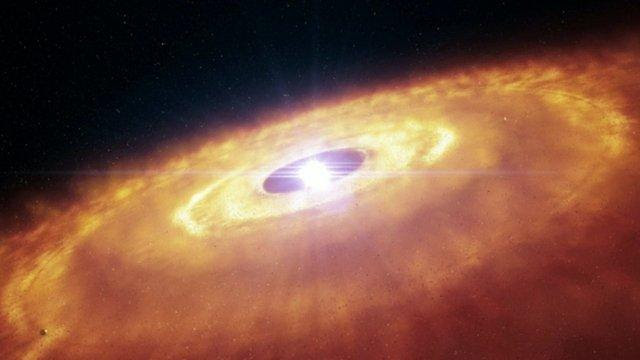
New images from the European Southern Observatory have revealed mysterious ripples around a star close to Earth.


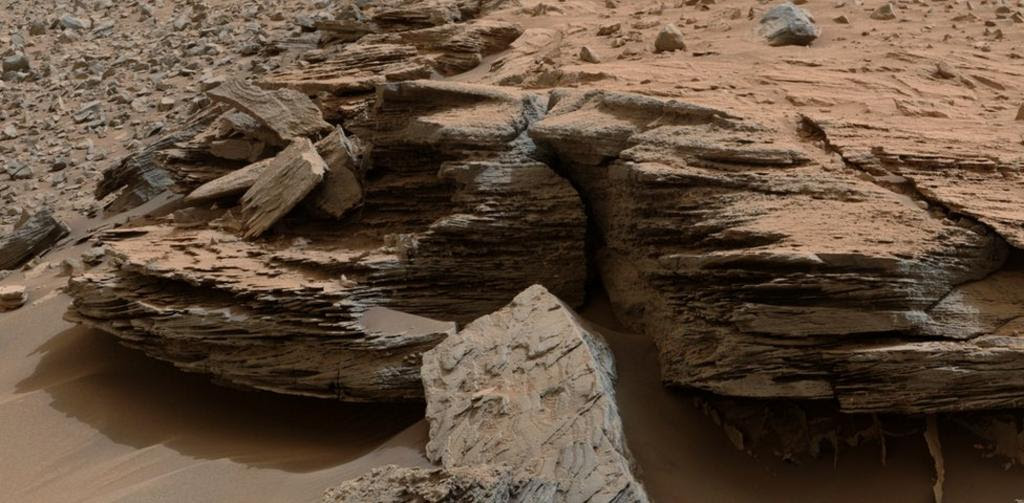
Curiosity rover: The reward for ‘whale watching’ on Mars: When scientists first saw Whale Rock in images returned from Nasa’s Curiosity rover on Mars, they really weren’t sure what to make of it. Since then it’s become the linchpin in a story about water on early Mars.

Let’s Have a Star Party Here:Sark (Channel Islands) Image Sark, a Channel Island protectorate of the United Kingdom near the coast of Normandy, is Europe’s first International Dark Sky Community. The island’s blend of history and culture attracts up to 40,000 tourists per year. Sark has neither public lighting nor motor vehicles beyond tractors used for farming; life on this singular island connotes a step back in time. A rich Milky Way is visible thanks to Sark’s offshore location, its generally low use of residential and commercial electricity, and its striking absence of public street lights.

Exoplanet Anniversary: From Zero to Thousands in 20 Years
October 6 marks the 20th anniversary of the first discovery of a planet orbiting a sun-like, or “normal,” star beyond our solar system.


Curiosity’s Drill Hole and Location are Picture Perfect: On Tuesday, Sept. 29, NASA’s Curiosity Mars rover drilled its eighth hole on Mars, and its fifth since reaching Mount Sharp one year ago. The drilling of the hole 2.6-inches (65 millimeters) deep in a rock the team labeled “Big Sky” is part of a multi-day, multi-step sequence that will result in the analysis of the Martian rock’s ingredients in the rover’s two onboard laboratories – the Chemistry and Mineralogy X-Ray diffractometer (CheMin) and the Sample Analysis at Mars (SAM) instrument suite.

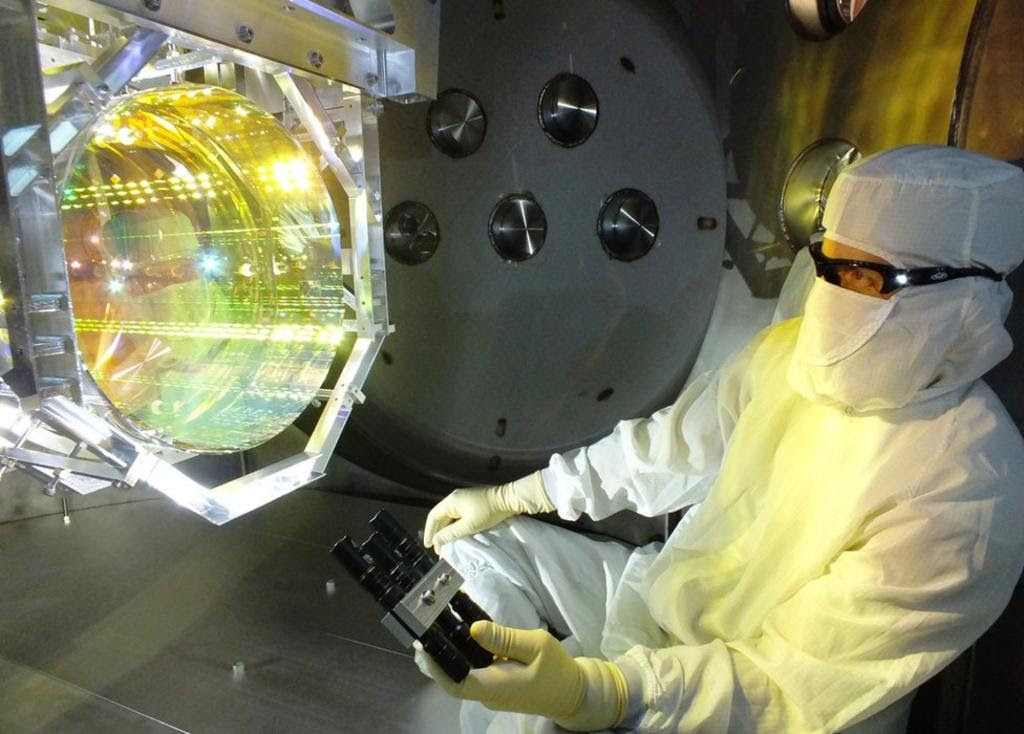
Advanced Ligo: Labs ‘Open their ears” to the cosmos: The Advanced Ligo experiment in North America formally begins the observations that will seek finally to detect the ripples in the fabric of space-time predicted by Einstein.


Rosetta’s First Peek at the Comet’s Dark Sides: With no direct illumination from the sun, these regions could not be imaged with Rosetta’s OSIRIS (the Optical, Spectroscopic, and Infrared Remote Imaging System) science camera, or its Visible, InfraRed and Thermal Imaging Spectrometer (VIRTIS). For the first several months after Rosetta’s arrival at the comet, only one instrument on the spacecraft could observe and characterize the cold southern pole of 67P/C-G: the Microwave Instrument for Rosetta Orbiter (MIRO).

Map of Approved Ceres Names: A new color-coded topographic map shows more than a dozen recently approved names for features on Ceres, all eponymous for agricultural spirits, deities and festivals from cultures around the world. These include Jaja, after the Abkhazian harvest goddess, and Ernutet, after the cobra-headed Egyptian harvest goddess. A 12-mile (20-kilometer) diameter mountain near Ceres’ north pole is now called Ysolo Mons, for an Albanian festival that marks the first day of the eggplant harvest.

Posted in October 2015, Sidereal Times | Tagged | Leave a comment

Observatory Design and Astrophotography: One Person’s Approach

by Ira Polans, Program Chair

Nammacher headshotThe October meeting will be held on the 13th at 7:30 PM in Peyton Hall. The talk entitled “Observatory Design and Astrophotography: One Person’s Approach” will be by amateur astronomer Scott Nammacher, who will speak about the building of a private remotely controlled observatory in upstate NY. He will also discuss the equipment and the processes used to take astronomical images. The talk ends with the showing of some of his images. His web site is http://starmere.smugmug.com.

Prior to the meeting there will be a meet the speaker dinner held at Winberies, Palmer Square in Princeton at 6PM. If you wish to attend, please email program@princetonastronomy.org no later than noon on October 13.

Scott Nammacher grew up in Minneapolis, MN and as a small boy was first was introduced to astronomy by way of a “Star Party”. Also in college he took a course in astronomy. He then moved to New York to pursue a career in publishing and later in the financial field. Over the years, he commuted through Grand Central Station where Meade telescopes were prominently displayed in one of the stores. In 2003 he bought an 8-inch Go-To telescope to introduce his children to the wonders of the universe above. His interest grew as well, and he started doing astrophotography shortly afterwards. In 2008, he became interested in building a fixed-place observatory to expand his hobby. He found a place in upstate NY and built a full observatory by early 2009. He restarted his astrophotography work, but with a 12.5” and a 5” telescope and two specialized CCD cameras.

In 2012 he mounted his first one-man show, a three-month show at the Hudson Opera House in Hudson, NY. In 2015 he did his second full show with pictures from two remotely operated telescopes (one in Australia and the other in New Mexico) at the Pound Ridge Library.

Now through October 29 Scott’s photos are on display at the Somers Library, Route 139 & Reis Park, Somers, NY 10589. The exhibit is called “Treasures of the Northern and Southern Night Skies.”

Please join us for what will be an informative and interesting talk!

Posted in October 2015, Sidereal Times | Tagged , , | Leave a comment

From the Director

Rexby Rex Parker, PhD  director@princetonastronomy.org

Two down, two to go.  If the law of averages holds sway, the two special members’ events planned for October should take place in fine weather, since rain and clouds dismissed the two big events we’d arranged for September.

  • Astro Equipment Silent Auction & Picnic, Sunday October 18, 3:00 pm. The auction will go even if cloudy weather, but in even of rain the date is Oct 25.  Location is the Pavillion next to the Nature Center at Washington Crossing State Park.  AAAP members and family/friends are invited to participate.  See the detailed list of equipment to be auctioned below.  The club has recently acquired through donation several useful pieces of astronomy equipment, and it’s time to put these items in the hands of members.  This is your chance to pick up good a telescope, mount, eyepiece, book, and more, at unbelievably low prices.  Whatever doesn’t go at the auction will be sold on AstroMart.
  • Field Trip to the US Naval Observatory and Smithsonian Air & Space Museum in Washington DC, Nov 2. All day field trip with a special guided tour of USNO in the evening.  The lucky 19 AAAP members and significant others who replied “yes” in the Survey will receive e-mails with logistics and travel info.  Thanks to Ira Polans for arranging the tour!

Just couldn’t persuade the weather makers.  After so many clear nights in August and early September there was reason to believe in Jersey StarQuest Sept 11-12.  Yet it was not to be.  The new walk-in registration strategy with minimal advance work by members was the right one, as Saturday was rainy.  Despite Friday the 11th actually being clear, dew was a big problem on the field after rainy days earlier.  Silver lining:  9-11 was a great night with large turnout at the AAAP Observatory at Washington Crossing – special thanks go to Team 6 and the Observatory Chairs for running an excellent deep sky show.  Similarly, the Sept 27 lunar eclipse session at the Observatory was announced to much interest by members and public.  Given the highly touted “blood moon” PR and the fact that this would be the last eclipse visible here for a few years, we aimed for a good turnout. Yet, again after a week of clear weather, the sky on the 27th was pasty white and not a single glimpse of the moon was seen here.

Next Meeting at Peyton Hall (7:30 pm, Oct 13). Our tradition of interesting and inspiring speaker presentations continues this month with a talk by amateur astronomer Scott Nammacher, who will speak about building and operating remotely controlled observatories in upstate NY and more distant locations.  Check out the article by program chair Ira Polans in this issue and on the AAAP website http://www.princetonastronomy.org/

List of Astro Equipment to be Auctioned by AAAP

Oct 18 at 3:00pm at WC State Park

Auction is restricted to members and family and friends.

Caveat emptor, AAAP does not warrant any item.  The buyer may need to find additional parts to fully use some of the equipment.  For reference the estimated price when new is listed for some items, but this is not to suggest selling price.

  • Telescopes
    • Celestron Omni XLT102 refractor (Model #21088), 102 mm D, 1000 mm focal length, Starbright XLT coatings. Matches CG4 mount, below.  $410 with mount
    • Explore Scientific AR152 refractor, air spaced double achromatic, f/6.5, 152 mm diameter, 988 mm focal length, doublet air spaced achromatic refractor, with Vixen-type mounting rings (fits any V-type dovetail). $750
    • Edmond 8 inch, f/5 Newtonian reflector telescope, model 4001, “classic” (late70’s -early 80’s), with unique Edmund tripod mount, with RA clock drive, all original. In very good condition considering the vintage, mirror looks good.
    • Meade 10 inch f/10 Schmidt-Cassegrain reflector telescope, model MTS SC10, “near-classic” (mid-80’s), with fork mount and pedestal (original); no electronics included although it appears the scope originally came with Meade LX3 drive.  In good condition, optics in good shape.  Could be adapted to other mounts.
    • Orion Newtonian Telescope (Astrograph), 10 inch diameter, f/3.9, with cooling fan, and Vixen-type mounting rings (can put on any V-type dovetail). $690
    • Skyquest 6″ Dobsonian Newtonian reflector, $310
    • Orion ED80 short tube refractor, 80 mm, f/5. Good scope to use as CCD autoguider or for lunar or wide-field observing.  $110
    • Polar finder scope, 6 degree FOV, 50 mm
  • Mounts & Tripods
    • Celestron Omni XLT CG4 equatorial mount; matches Omni XLT scope above.  Includes counterweight bar and weights, controller for a motor drive with parts (uncertain if drive is complete;  new CG4 motor drive price $140).
    • Ioptron iEQ-G45-GTN equatorial mount with heavy duty tripod and hand controller, weights, power supply. $1800
    • Orion Atlas EQ-G mount, with heavy duty tripod, but no counterweight or bar. Includes hand controller and power cord. $1500 (with all parts)
    • Losmandy G11 equatorial mount, complete with counterweights and bar, drive motors, control electronics, hand controller. Very good condition. $2000.
    • Losmandy G11 equatorial mount, Gemini Go-To version 1, complete with counterweights and bar, drive motors, Gemini Go-To v.1 computer control electronics, hand controller. Very good condition.  $2500
    • Small equatorial mount head, inexpensive but could be good for small refractor such as the Orion ED80 above.
  • Eyepieces & filters
    • Edmund RKE eyepiece collection, match the Edmund 8” Newtonian above.
    • Tele Vue Radian 18 mm 1.25″
    • Celestron Ultima LX 17 mm 1.25 – 2.0″ 70 degree fov
    • Orion Stratus 24 mm 1.25″ 68 degree fov
    • Orion Stratus 5 mm 1.25″ 68 degree fov
    • Orion Lasermate deluxe collimator, 1.25″
    • High Point 2x barlow, 1.25″
    • High Point 2x barlow, 2.0″
    • Explore Scientific 11 mm, 1.25″ 82 degree fov
    • Explore Scientific 4.7 mm, 1.25″ 82 degree fov
    • 6 lesser 1.25″ eyepieces
    • 7 color filters
  • Books and discs etc
    • Several DVDs
    • Astronomy Magazine Infinite Cosmos series – many of these
    • Sky at night CD ROMs
    • “The Great Courses” on DVD, college courses
    • Intro to Astronomy
    • Black Holes Explained
    • Dark Matter, Dark Energy
    • Life in our universe
    • Physics and Our Universe
    • DVD Math Courses, Algebra through Calculus
    • Several dozen books on astrophotography, star maps, dark matter, black holes
    • More…
Posted in October 2015, Sidereal Times | Tagged , | Leave a comment