Minutes of the January 2016 AAAP Meeting

by Jim Poinsett, Secretary

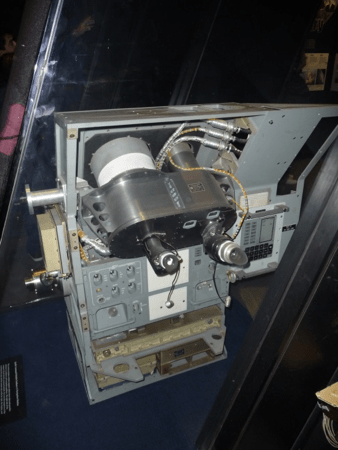
  • The speaker for the evening was Frank O’Brien who gave a lecture entitled “Navigating to the Moon – The View from the Apollo Guidance Computer”.
  • Director Rex Parker called the meeting to order at 9:00 pm and talked about where the club is and where it is going:
    • Great presentations by pros and amateurs
    • Access to members knowledge
    • State of the art observatory
    • Public outreach opportunities
  • Projects for 2016
    • Observatory structure improvements
    • Telescope equipment upgrades
    • New website migration
    • Keyholder public outreach astronomy refresher course
    • Astrophotography 101
    • Interesting new field trips
  • Observatory news – the original plan to increase the size of the flap to accommodate additional equipment has been changed to removing the flap entirely and making the south wall solid to the peak. There would be almost no limit on the height of any additional equipment we decided to add.
  • A refresher course in astronomy for keyholders before the new observing season begins is being discussed. Several ideas were listed and discussion will continue at the next meeting.
  • Rex is trying to gauge if there is enough interest to host a basic astrophotography class for club members.
  • A weekly newsletter/update on astronomical events has been suggested for keyholders.
  • Gene Ramsey has made a dustcap for the Mallincam refractor.
  • There was a discussion of the new vs old website. Several suggestions were made and people have been assigned to provide some materials to Surhabi and Mike. More discussion will follow as we hope to go live with it very soon.
  • Two possible field trips were discussed. One was to Goddard Space Center and the other was a late spring/early summer trip to Cherry Springs State park in Pennsylvania.
  • Sidereal Times is going back to a deadline format as the quantity and quality of submissions has dropped significantly.
Posted in January 2016, Sidereal Times | Tagged , , | Leave a comment

“The Martian” and Ernest Shackleton

by Prasad S. Ganti

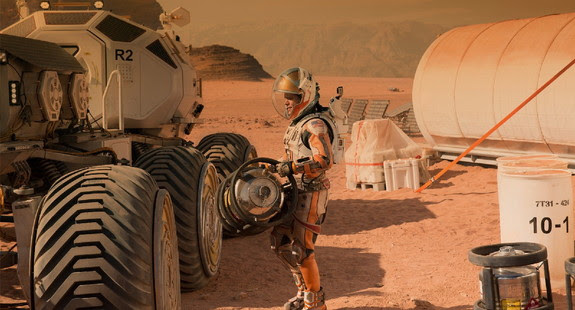
Actor Matt Damon portrays an astronaut stranded on Mars in the Martian.

Actor Matt Damon portrays an astronaut stranded on Mars in The Martian.

“The Martian” is a science fiction book written by Andy Weir. It was made into a movie starring Matt Damon as a Mark Watney, an astronaut stranded on Mars who was certain to be the first man to die there. The book is written well with lots of details about Mars and space travel to make it realistic enough. The story is very gripping indeed. Equally good was the movie, well made with the assistance of NASA who saw an opportunity to promote travel to Mars to the general public.

The Ares mission involves a group of astronauts riding in a Hermes spacecraft to reach Mars and land on Mars using a Mars Descent Vehicle (MDV). A Mars Ascent Vehicle (MAV) is already placed there by an earlier mission for departing the Martian surface and reaching the orbiting Hermes. The mission runs into trouble when hit by a fierce Martian storm. Fleeing Mars becomes the only option. In the confusion of the escape, Watney is given up for lost and presumed dead. When he regains consciousness, he finds himself stranded and unable to communicate either with Hermes or with NASA.

This is where a personality of an astronaut becomes important. Mentally tough, with a sense of optimism and hope, and a little bit of humor, he works on survival. The next human mission to Mars is a few years away. The food supplies are likely to last only for a few months. Using his knowledge of botany, he starts growing potatoes in the habitat. He starts getting used to living on a desolate planet using the life support systems, which miraculously escape destruction by the storm. Watney realizes that his only chance of escape is to to travel 2000 miles across to the another part of the planet where another MAV is ready to receive the next human mission to Mars.

In the meantime, NASA detects some human movement on the planet and start tracking his movements. Watney’s dilemma makes good news back on Earth. The rest of the movie is suspenseful and portrays Watney’s and the Hermes crew’s heroics to try and save him.

Incidentally, the mission director at NASA  is named Venkat Kapoor, an odd combination of a south Indian first name and north Indian last name.

Knowing where movies depicting other planets are shot is interesting. The Martian was shot in Wadi Rum in Jordan. Its terrain does resemble the red colored Martian surface. The potato farm was shot in a studio in Budapest where it was built. The recent Star Wars movie was shot in Abu Dhabi (the planet of Jakku). But that is a topic of another blog.

We know of human beings being stranded on Earth in different places, like Ernest Shackleton and his team in Antarctica for 18 months in the early years of the twentieth century. This story is an extension of such incidents to space. Shackleton exhibited great leadership qualities to keep his team intact. He along with a small team ventured 800 miles in choppy seas to reach South Georgia Island and get a rescue ship. This happened around the time of World War I when there were no wireless or satellite radios. Shackleton did not lose even a single man. As a parallel, Shackleton’s 800 mile journey is similar to the 2000 mile journey which Watney undertakes to stay alive. Watney is alone whereas Shackleton had a team. By the same token, Watney is fictitious while Shackleton was real. Fiction thrives on individual heroics while real life needs team work!

Posted in January 2016, Sidereal Times | Tagged , , , , | Leave a comment

New C-14 Installed at the Observatory

Photos by John Miller

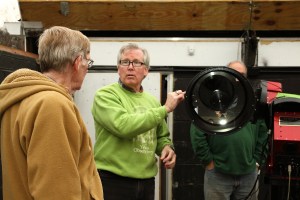
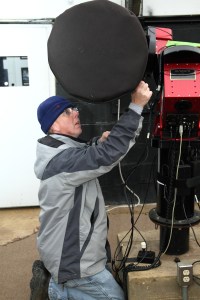
On Nov. 22, 2015, a keyholder team swapped the donated C-14 for the club’s old C-14 at the club’s observatory at Washington Crossing Park. See more photos at AAAP’s Flickr site

Ludy D'Angelo

“That little screw fell right about here.”

gene-rex

“A piece of velcro would fix that.”

ludy-rex-scope

Ludy D’Angelo

IMG_0004

Dave Skitt

Posted in January 2016, Sidereal Times | Tagged , , | Leave a comment

Moon Occults Venus in the Daytime

by Michael Wright

IMG_0088_PS_2-2

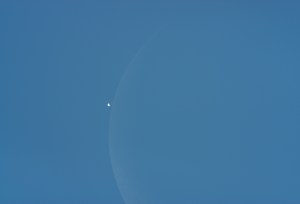
Venus and the Moon moments before the occultation. Credit:Robert Vanderlei (Canon 450D DSLR on 10″ RC, exposure 1/1600-th second, ISO 400 )

On December 7, 2015, a daytime occultation of Venus by the Moon was visible from most of North and Central America. I observed from my office parking lot at lunchtime using IS binoculars, but member Robert Vanderbei created a video from stills he shot during the event with his R-C scope. Check it out on Bob’s website.

Posted in December 2015, Sidereal Times | Tagged , , , , , | Leave a comment

Snippets

compiled by Michael Wright and David Kaplan

NASA’s Juno Spacecraft Breaks Solar Power Distance Record
NASA’s Juno mission to Jupiter has broken the record to become humanity’s most distant solar-powered emissary. The milestone occurred at 11 a.m. PST (2 p.m. EST19:00 UTC) on Wednesday, Jan. 13, when Juno was about 493 million miles (793 million kilometers) from the sun.

Bow waves betray dozens of runaway stars
Researchers identify dozens of fast-moving stars in the Milky Way by combing the galaxy for the curved waves of material they plough before them.

Event horizon snapshot due in 2017
A global network of nine radio telescopes is set to take the first ever picture of a black hole’s event horizon in 2017.

Largest ever ‘age map’ traces galactic history
By measuring the age of 70,000 stars across the Milky Way, astronomers make a “growth chart” for our galaxy.

‘Case is made’ for Anthropocene Epoch
The evidence suggesting we have entered a new geological epoch defined by humanity’s impact on the Earth is now overwhelming, believes an international scientific panel.

The Secret City of the Cosmonauts
From the 1940s to the 1990s, the secretive USSR created a massive constellation of ghost geography. Hundreds of cities. In one of these secret cities, established in 1960 and known as “Military Unit 26266 in closed townlet number one,” young Russians were trained to be launched into the skies and beyond. Star City, located just east of Moscow, became the home of the Cosmonauts.

Runaway Stars Leave Infrared Waves in SpaceAstronomers are finding dozens of the fastest stars in our galaxy with the help of images from NASA’s Spitzer Space Telescope and Wide-field Infrared Survey Explorer, or WISE.

Found: Four New Elements
At the tail end of 2015, the periodic table gained four new members—elements 113, 115, 117, and 118. But blink and you’d definitely miss them.

Posted in January 2016, Sidereal Times | Tagged , , | Leave a comment

Minutes of the December 2015 meeting of the AAAP

by James Poinsett, Secretary

  • Rex called the meeting to order.
  • Bob Vanderbei showed the club the gif he made using his photographs of the Moon occulting Venus.
  • Rex then showed pictures from the field trip to the US Naval Observatory.
  • The roof on the north side of the observatory has been finished. We are advised not to lean a ladder against the roof, if you need to clear snow off the roof use a step-ladder and broom so you don’t damage the roof.
  • Mike Mitrano talked about enlarging the flap at the south end of the observatory to enable adding additional equipment to the mount with the HB refractor. His request for $600 for parts and labor was approved by the board.
  • The C-14s have been swapped. The new one is mounted, balanced and is running. Some minor alignment may need to be done. Rex will place an ad on Astromart to sell the original C14.
  • Suggestions are being taken for equipment to add to the south mount at the observatory.
  • The lock has been moved to the first gate.
  • John and Gene are going to winterize the observatory on Dec 9th.
  • On January 9, the closest conjunction of Venus and Saturn for a decade will occur.
  • On May 9th, there is a transit of Mercury across the sun. Plans will be made to view it with the HB refractor making it one of the few telescopes to view transits in 3 different centuries.
  • It was noted that the club should start making plans for the August 2017 total solar eclipse.
  • There being no further business the meeting was adjourned.
Posted in December 2015, Sidereal Times | Tagged , , | Leave a comment

Navigating to the Moon: a View from the Apollo Guidance Computer – Jan. 12

by Ira Polans, Program Chair

The January AAAP meeting will be held on the 12th at 7:30 PM in Peyton Hall on the Princeton University campus. The talk will be by Frank O’Brien, an expert in spaceflight history, and is entitled “Navigating to the Moon: a View from the Apollo Guidance Computer”.

Prior to the meeting, there will be a meet-the-speaker dinner at Winberies, Palmer Square in Princeton at 5:45 PM. This is 15 minutes earlier than the usual start time. If you wish to attend please email program@princetonastronomy.org no later than noon on January 12.

A flight to the moon seems impossibly complex, especially given the technological state of the art in the 1960’s. While the details are indeed formidable, the concepts are shockingly easy to understand.

Frank O’Brien

Frank O’Brien

Frank O’Brien will discuss the major hardware elements used in the Apollo spacecraft to voyage from the Earth to the Moon and back home again. The three key components—the computer, inertial platform, and the optics system will be presented as an integrated system. The basic questions of spaceflight navigation (i.e. Which way is up? Where am I? Where am I going?) will build upon one another to show the techniques to navigate to our nearest celestial neighbor. Although we will focus on flights to the Moon, the concepts are applicable for missions throughout the Solar System.

As a bonus , he will discuss the details of how to land on the Moon (If you find yourself in such a situation, it’s best to be prepared!)

Apollo Guidance Computer

Apollo Guidance Computer

Frank O’Brien has lent his spaceflight history expertise to NASA for 20 years as a contributing editor for NASA’s Apollo Lunar Surface Journal and is co-editor the Apollo Flight Journal. From this work, Frank was invited to the Cradle of Aviation Museum on Long Island to help in their May 2002 reopening. He prepared a rare Lunar Module Mission Simulator for exhibition, wrote software for their Lunar Module cockpit trainer, and prepared an Apollo space suit for the museum’s Apollo 11 diorama.

His background on the lunar missions and computing led him to write a well-received book on the Apollo Guidance Computer, which will be available for purchase and signing following the talk. Frank is now working on a new book on Apollo spacecraft engineering. In 2011, Frank became a Solar System Ambassador for NASA’s Jet Propulsion Laboratory.  He lectures several times a year on a range of space topics. Frank has always been passionate about aviation, and was a pilot and aircraft owner for 25 years.

Since 2003, Frank has volunteered at the Infoage Science/History Center in Wall, New Jersey where he curates an early Apollo Guidance Computer, lectures, gives tours and helps with the organization’s public outreach efforts. Located at the site of Camp Evans, a National Historic Landmark, Infoage was recently awarded the IEEE Milestone Award for its TIROS 1 tracking station.

Frank is a 1979 computer science graduate of Rutgers University, and he later returned to Rutgers to earn his MBA. His day job as a database administrator for Colgate-Palmolive is far less interesting than thinking about trips to the moon.

Posted in December 2015, Sidereal Times | Tagged , , , , , | Leave a comment

From the Director

Rexby Rex Parker, PhD  director@princetonastronomy.org

Solar Eclipse Triptych by Howard Russell Butler.  Last month before the AAAP speaker dinner, six of us were escorted to an upper floor of the Princeton Firestone Library to see the famed Howard Russell Butler solar eclipse paintings from the 1920’s.  These scientifically and historically significant renderings are perhaps the highest expression of eclipse art, which dates as far back as the early Renaissance interpretations of the phenomenon.  We were amazed at the shimmering colors and detail of the prominences and corona in these remarkable paintings.

Butler was invited to participated in the 1918 solar eclipse expedition with the US Naval Observatory because of his uncanny ability to paint detailed astronomical images using contemporaneous notes on spatial and color details of the object.  The newly conserved paintings at the Firestone are the half-size version of the larger triptych which wound up at the Hayden Planetarium when it was first built in the mid-1930s.  A small version is also at the Fels Planetarium at the Franklin Institute and another series of solar prominence art by Russell are held by the American Museum of Natural History.  His paintings of Mars as seen from its moons Phobos and Deimos, and the Earth from our Moon, are also owned by Princeton University.  His technique and astronomy knowledge enabled him to surpass the quality of solar photography at the time.  (citation: Pasachoff JM and Olson RM, abstracts, American Astronomical Soc. Meetings, 2013 and 2014).

AAAP members visit the Princeton Firestone Library to view the Butler eclipse paintings Nov 10, from left: John Giles, Henry Kugel, Tony Coventry, Ira Polans, Rex Parker, Arshad Gilani

AAAP members visit the Princeton Firestone Library to view the Butler eclipse paintings Nov 10, from left: John Giles, Henry Kugel, Tony Coventry, Ira Polans, Rex Parker and Arshad Gilani

Year in the Mirror.  As we head toward solstice and the conclusion of 2015, a look into the mirror seems appropriate.  It’s been a wonderful year for me as Director of the AAAP.  We’ve had great speaker presentations and outstanding public outreach and astronomy experiences at the observatory.  Here are a few highlights of what we accomplished together in the AAAP over the past year.

December 2014:  The 3-meter aluminum Observa-Dome was donated to the Carolina Skies Astronomy Club.  We transferred it from storage, and they trucked it to NC to be part of their new observatory for outreach and community college programs.

January 2015:  Moved our monthly meetings to Green Hall as Peyton underwent extensive renovations.  Acquired significant new astro hardware from the family of Roy Thomas Dixey of Manalapan NJ.

February:  Special AAAP tour of Princeton Plasma Physics Lab (PPPL) highlighting the fusion research program.

April:  Equipment upgrades at Washington Crossing Observatory:  installed a new Paramount ME to control the historic Hastings refractor and a 5-in apochromatic refractor with a Mallincam video camera on the old C14 and Paramount.

May:  Unveiled the new astro equipment at the Observatory.  Membership approved expenditure proposal for $5000 for continued computer and equipment upgrades.

June:  Cherry Springs observing trip rained out so we made up for it with a well-attended members’ night at WC Observatory.  All summer long the Observatory Keyholders did a great job running the facility with large public turnout on clear Friday nights.

September:  Returned to the renovated Peyton Hall for our monthly meetings.

October:  The club’s first-ever Astro Auction was held at the pavilion in WC Park on Oct 18, with a good turnout and excellent results. The club made nearly $3000 and placed many telescopes, eyepieces, mounts, and books into the hands of club members.

November:  Field trip to the US Naval Observatory in Washington, DC on Nov 2.  Fourteen members and significant others made the special night tour of the historically and scientifically important USNO.  Reconstruction of the WC Observatory north roof, a long-standing problem, was completed by dedicated core team of members.  On Nov 10 prior to the monthly meeting, several members joined for a brief viewing of the famous but rarely seen Howard Russell Butler solar eclipse triptych in the Firestone Library.

December:  Replaced the original Celestron C14 with a newer C14 – an instrument with better optical performance and Fastar capability.  The hardware swap was completed and alignment of the telescope is underway.

Timekeeping Insights from the USNO. Clocks are based on exactly 24.00 hour days, while a solar day (the period between solar transits) varies and is seldom exactly this value.  In December, the span from one solar noon to the next is 24 hours plus about a half a minute.  For example, the sun reaches its southernmost (noon) position about seven minutes earlier on Dec 7 than Dec 21.  The function expressing the relationship between apparent solar time and accurate clock time is more complex, as shown in the graph below (credit, U.S. Naval Observatory) which shows the equation of time. Above the axis the sundial is faster than the clock, and below the axis the sundial lags behind the clock.

Equation of Time

Equation of Time

Next Meeting at Peyton Hall (7:30 pm, Dec 8). Our tradition of interesting and inspiring speaker presentations continues this month with a talk by NASA Ambassador Ken Kremer, PhD.  He will discuss “America’s Human Path Back to Space and Mars with Orion, Starliner, and  Dragon”.  Check out the announcement by Program Chair Ira Polans and on the AAAP website http://www.princetonastronomy.org/.

Posted in December 2015, Sidereal Times | Tagged , | Leave a comment

America’s Human Path Back to Space – Dec. 8 Meeting

by Ira Polans, Program Chair

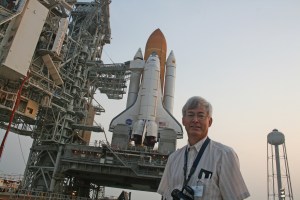
IMG_3410a_STS 135_ Ken KremerThe December meeting will be held on the 8th at 7:30 PM in Peyton Hall. The talk will be by Dr. Ken Kremer of Universe Toady and AAAP. The talk is entitled “America’s Human Path Back to Space and Mars with Orion, Starliner, and Dragon”. After the talk, a selection of Ken’s Space photos will be available for sale.

Prior to the meeting, there will be a meet-the-speaker dinner at Winberies, Palmer Square in Princeton at 5:45PM. This is 15 minutes earlier than the usual start time. If you wish to attend please email program@princetonastronomy.org no later than noon on December 8.

Dr. Ken Kremer will outline NASA’s plans for resuming a human path back to space and the road to Mars from American soil aboard the new Orion and commercial Boeing Starliner, and SpaceX Dragon capsules. Ken will give an inside account of NASA’s development of private astronaut ‘taxis’ to the ISS in Earth orbit and the manned ‘Journey to Mars’ with Orion and the mammoth SLS rocket. He will discuss the critical Dec. 2014 first test-flight of Orion from the Kennedy Space Center and the NASA’s next steps in human spaceflight to the space station and beyond. Ken will briefly update us on NASA’s ongoing Mars rovers, Curiosity and Opportunity, and the upcoming InSight Mars lander and Webb space telescope.

Ken Kremer is a journalist, Ph.D. research scientist, speaker and photographer based in New Jersey. His space and Mars images and writings have been widely published by National Geographic, NBC, ABC, BBC and Fox News, PBS NOVA TV, Scientific American, APOD, NASA, Aviation Week, Astronomy, Astronomy Now, Space.com, Spaceflight Now, Spaceflight, New Scientist, Planetary Society, Popular Mechanics, Universe Today, NASA Watch, Wired, Science News, All About Space, AmericaSpace, NPR, Mars Society, International Year of Astronomy, 2010 Year in Space Calendar, Aviation Week, Spaceflight and the Explorers Club. Ken’s Curiosity Mars mosaic is on permanent display on the National Mall at the Smithsonian National Air & Space Museum, Washington, DC. His Starliner photo was featured in a new book by Buzz Aldrin. Please visit Ken’s website for more information.

Posted in November 2015, Sidereal Times | Tagged , , , | Leave a comment