

by Rex Parker, PhD
director@princetonastronomy.org
Meeting January 14, 2025, at Peyton Hall and Zoom. We hope you’ll join us in person at Peyton Hall on campus for the first meeting of the new year on Jan 14 (7:30pm). This month our guest speaker will present remotely from outside of New Jersey, so the live meeting will be Zoomed and You Tubed to members as always. Yet despite the excellence of Zoom, we encourage the mind-to-mind connection of the face-to-face variety, an important part of AAAP culture which we don’t want diminished for the sake of electronic convenience.
You may, like me, have sometimes thought of the moon as an unwelcome intruder obscuring views of the glories of the deep sky. Our speaker this month will dispel you of that illusion. Acclaimed science writer and Scientific American Contributing Editor Rebecca Boyle will discuss her recent book, the national bestseller Our Moon: How Earth’s Celestial Companion Transformed the Planet, Guided Evolution, and Made Us Who We Are. By chance I happened to read the book in April, borrowed from the Mercer County Library System (also available at Amazon). It’s a captivating read with a unique perspective on Selene, the Greek Goddess, driving her chariot across the sky. See Victor’s article below for more information about the presentation on Jan 14, including where to park your vehicle for the walk to Peyton Hall as well as Zoom information.
If you’d like an opportunity to speak with fellow members about your interests in astronomy, please read on. At each month’s meeting we reserve a slot after the intermission for the Unjournal Club, in which a member has the floor (and screen) for 10-15 min to discuss recent astro-related magazine articles, books, or other personal astronomy experiences and projects to share with the membership. In November, for example, we had a very cool presentation by member David Ackerman about his progress programming and using a spectroheliograph to image the sun in astonishing detail. In order to get on the schedule for an unjournal club presentation, please send an email to me or the Program Chair. Remember that if you want to share astro images or other slides live in the auditorium, experience has shown that it’s better for connecting with the Peyton Hall projector and Zoom input to bring the file on a USB drive to insert into the laptop already connected up front during the meeting. Your brief presentation can also be done via Zoom if you aren’t in Peyton Hall.
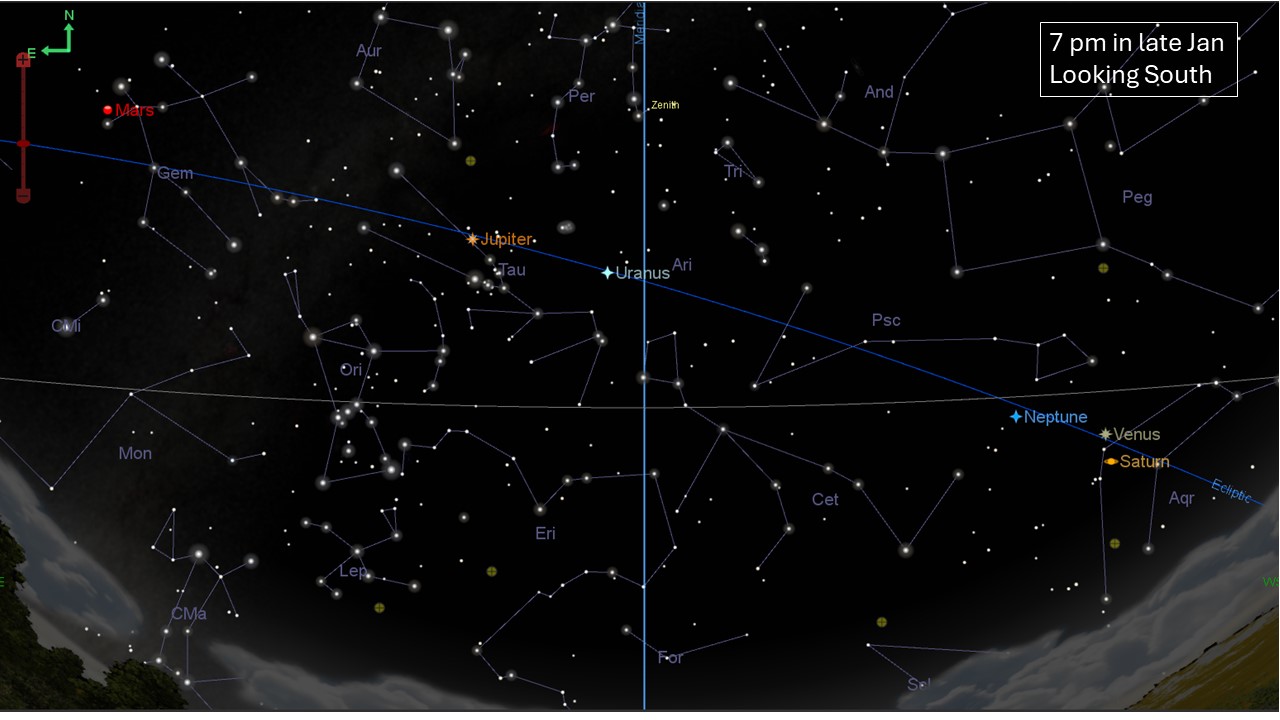
An Unusual Line-Up of the Planets in January. It’s a rarity for all seven of the planets to be visible in our sky during a single night. This arrangement happens a few times a decade at most, with all except Neptune and Uranus being naked eye visible. I generated a sky chart for our location for the early evening in late January using TheSkyX program that runs the AAAP Observatory equipment at Washington Crossing State Park (see below). Saturn and Venus will drop below the horizon shortly after sunset so don’t wait too long if you plan to observe them. Mercury will be visible during the same night, technically, but will require an alarm just before sunrise. Mercury rises at around 6:50am in late January so will be quite difficult to see in the glare of the rising sun (sunrise at around 7:15am).
Sky chart for Princeton area in late January 2025 looking south. Six of the planets can be seen at this time, a rare arrangement. The curved blue line is the ecliptic; the vertical blue line is the prime meridian. Chart prepared using TheSkyX program from Software Bisque.

 Amateur Astronomers Association of Princeton