

by Rex Parker, PhD director@princetonastronomers.org
Meeting December 10 at Peyton Hall. We hope to see you in person at Peyton Hall on campus for the next monthly meeting on Dec 10 (7:30pm). Our speaker will be Jesse Christiansen, Senior Scientist at NASA’s Exoplanet Science Institute at Caltech in Pasadena. She will describe her research and the overall status of exoplanet discoveries. Exoplanets are planets beyond our solar system orbiting other stars, an area of astronomy that has taken off exponentially over the past 20 years with over 7000 total having been detected. For a bit more background check out the NASA Exoplanet Science Institute website, NExScI. More information on the presentation at AAAP can be found below in program chair Victor Davis’s section. The meeting will also be available via Zoom (see AAAP website for link) and recorded on YouTube; past meeting recordings can be found here: https://www.youtube.com/@amateurastronomersassociat1439
At each month’s meeting we reserve a slot after the break for the Unjournal Club, in which members have the floor (and screen) for 10-15 min to discuss recent astro-related magazine articles, books, or other personal astronomy experiences and projects to share with fellow members. Last month, for example, we had a very cool presentation by member David Ackerman about his progress in making, programming, and using a spectroheliograph to image the sun in astonishing detail. To give an unjournal club presentation send an email to me or the Program Chair to hold a place on the agenda Dec 10. This can also be done via Zoom if you are attending virtually. Please remember that if you want to share astro images or other slides live in the auditorium, experience has shown that it’s better for connecting with the Peyton Hall projector and Zoom input to bring the file on a USB drive to insert into the laptop already connected up front during the meeting.
December Observing: Early Winter Jewels in Taurus (the Hyades and Crab Nebula). Looking upwards toward the eastern sky in early evening in December, the rising constellations of winter offer striking forms that we recognize at a glance, reminding us of the oncoming solstice and holidays. One of my favorite constellations, Taurus, is well positioned for small telescope and binocular observing. At low power/wide field, the Hyades open cluster makes a beautiful sight forming the “V” near the red giant star Aldebaran. The Hyades is the closest star cluster to us, a mere ~140 light years distant and about 70 light years across; the denser central group is about 10 light years in diameter. The Hyades in Greek mythology were the five daughters of Atlas and were half-sisters to the Pleiades. Based on the Hertzsprung-Russell diagram, the Hyades are much younger than our own sun at around 600 million years.
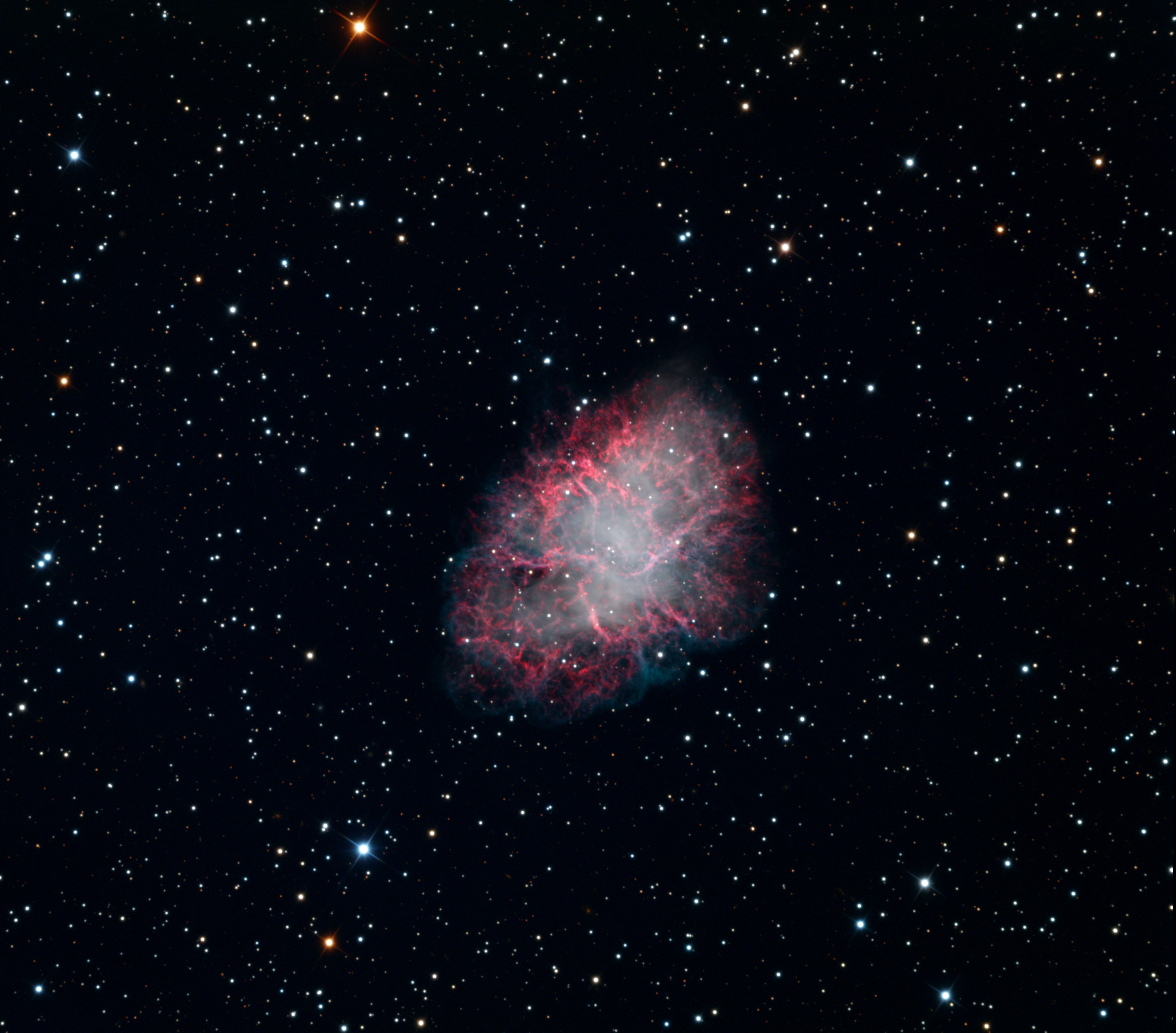
Also in Taurus is one most amazing sights one can see and photograph in amateur telescopes, Messier 1 – the Crab Nebula. The astrophoto below shows the eerily glowing filamentous detail in M1, which covers an area of about 6 x 4 arc-min. To see M1 visually, larger telescopes have the advantage, and waiting for culmination on a clear moonless night plus using a deep-sky filter will help. The annals of both Chinese and Arab history revealed notations which correspond to 1054 AD of a reddish-white new star shining as bright as Venus in the daytime sky for weeks. The supernova explosion resulting in M1 must have been impressive to see. Early observations of M1 as a radio source showed that the intensity of the emitted radiation increased with increasing wavelength, that is, it generates “non-thermal radiation”. The mechanism for this effect remained for many years one of the deep mysteries of astrophysics, and eventually in the late 1950’s was understood as an example of the synchrotron mechanism. The synchrotron process at the core of M1 is based on a binary pulsar at the center, the subject of the 1993 Nobel Prize in Physics won by Princeton University’s Russell Hulse and Joesph Taylor. The Princeton team drew heavily on observations of M1 in their research in the 1970’s, leading to the theory of binary pulsars and subsequent tests of General Relativity. This was the topic of a memorable AAAP talk back in the 1990’s by Russell Hulse (who was also a longstanding AAAP member).
Messier 1, the Crab Nebula in Taurus. Astrophoto by Rex Parker, data from Mt Lemmon AZ and Adam Block using the Shulman 32” telescope and SBIG CCD camera).
Happy Holiday Season to AAAP members as we spin onwards to Winter Solstice! — Rex

 Amateur Astronomers Association of Princeton