Thunderbird and the seven girls

by Ted Frimet

Thunderbird

and the seven girls

Thunderbird and his seven girls grew up to know dark skies. Their view was a serene night time walk-about. Every evening, they would naked eye peer into the blackness. Then they would bear witness to the sacred agreement.

Each passing Spring evening, Hehaka the Elk would shelter under Canhasa the Red Willow. And the seven girls awed with wonder seeing them together. If only I were the Elk, and my sisters were the Willow, mused one of seven. I would then know what lay beyond the Earths horizon.

Thunderbird taught the seven girls their relationship with the night sky. He reminded them not to be indifferent to it. They were taught to embrace Oceti the Fireplace and Mato Tipila the Bear’s Lodge, rising in the East. And remember well to say their evening goodbyes to Thunderbird and the Elk, in the setting West.

Time passed, and Earth became a smaller place. Newcomers came to the land where Thunderbird and the seven girls lived. And for awhile, they shared their skies with the newcomers. It was a sharing, after all, gifted from a people that knew the night stories and spoke often of their responsibility to sky and earth.

Over the passing of many seasons, the newcomers commitment was not honored. And Thunderbird grew old and tired. To Tun Win, the Blue Birth Woman, whispered into the ear of Thunderbird. She softly spoke to him his real name. “Wakinyan”, she said. Now gifted with the knowledge of his true nature, Wakinyan, dove from the North and descended into the West, never to be seen again.

The seven girls were troubled. Why, To Tun Win, did you whisper the true name to our father, Thunderbird? He is now gone from us, forever. To Tun Win told the seven girls that they needed to understand the world as being deeply interconnected. That they, the people and the few they privileged, were held accountable to sky and earth. And that the newcomer’s lights’ casted an ugly gray hue.

Wearily, To Tun Win told the seven girls that she longed for seeing Anpo Wicanhpi Sunkaku, the Younger Brother of Morning Star. And to do so with her naked eyes. The gray hue of scattered light kept her from Anpo, she said.

Now forlorn, To Tun Win gathered the seven girls about her. She spoke hesitantly of the passed time for dark skies. She said quietly, “Our reservation has no boundary”. We shared our imaginary lines in the sky. We showed them where we store our history. Where we hunt and where we fish. And despite what stories we tell, we have no real protection.

The newcomers continue to bring the scattered lights. Thunderbird, she exclaimed, is gone forever. He did not protect the night sky. However, you can bring me back my Anpo Wicanhpi Sunkaku.

“How, shall we?”, the sisters asked. Once again To Tun Win whispered softly. Although she spoke to all, each sister felt as if To Tun Win whispered into only her ear.

You must reach out to the seven lands of Mother Earth. You must teach all newcomers. Remind them of their interconnectedness of Sky and Earth. Then they too will know the nightly whisper of To Tun Win. Until the darkness comes back to me, they will only know the story of Thunderbird.

Remember the darkness of the night sky, and pay homage to this relationship. Understand the interconnectedness of the whole World, below and above. Know that you have no higher sovereign authority than to grant, protect, and preserve the night sky.

When you turn off the lights, you unite mother and sun.

Posted in June 2018, Sidereal Times | Tagged | 1 Comment

From the human eye to AI

by Prasad Ganti

From the human eye to AI

It all started with humans observing points of light in the sky with their naked eyes. The quest to understand our planet earth, our solar system, our galaxy, and ultimately the whole universe. Astronomy grew from such humble beginnings. Aided by imagination, technology inventions, growth in science, we have come a long way. And astronomy today is no longer just looking at the sky with the naked eye. Although that task still forms the basis of human curiosity.

Some material for this article has been taken from the book “The Big Bang” by Simon Singh. This book had a great impact on me by laying down the astronomy timeline very clearly. The AI (Artificial Intelligence) part is an addition of my 2 cents. Observation of the skies with naked eye reached its peak with the Danish astronomer Tyco Brahe’s gathering a lot of experimental data which Johannes Kepler used to firmly establish the sun centric model of our solar system with the planets going around. Planets up to Saturn were known and distinguished from stars which stayed relatively fixed in the skies. Comets were known as well.

Hans Lippershey, a Flemish spectacle maker invented the telescope in 1608, which Galileo Galilei made use of. Galileo first observed that Jupiter had four moons and also discovered the rings of Saturn. The telescope extended man’s vision to distant skies. Telescopes became more and more powerful as time went by. Also enabling seeing near objects in much greater detail.

After Galileo, William Herschel was a great user of the telescope. He discovered Uranus, who was the father of Saturn and grand father of Jupiter in Greek mythology. Other than the planets and the stars, there were hazy objects called nebulae. Charles Messier compiled a catalog of 103 nebulae in 1781. These are distant objects, like M31 (31st object in Messier catalog) which is Andromeda, now known as a separate galaxy.

The next milestone came when John Herschel, son of William, started photographing stars. This let the pictures to be analyzed by different teams at future points in time. John Goodricke discovered the Cepheid stars which have variable brightness. Because they go through contraction and expansion cycles. Henrietta Leavitt found a relationship between the period of fluctuation and the apparent brightness by collecting data from a group of Cepheids in the Magellanic cloud. A team of astronomers found the distance to one Cepheid. Henrietta’s graph was used to calculate distances to other Cepheids. Thus Cepheids are known as standard candles.

Edwin Hubble has been the first astronomer to find Cepheids outside the Milky Way and thereby measure the distance to our neighboring Galaxy, namely the Andromeda Galaxy. Finding Cepheids in distant galaxies was not possible. Astronomers made an assumption that the brightest star in all the galaxies have the same absolute brightness. By comparing the apparent brightness, a Galaxy’s distance could be measured.

After Isaac Newton used a prism to split the sunlight into rainbow colors, Joseph Von Fraunhofer, Robert Bunsen and Gustav Kirchhoff built a spectroscope for measuring wavelengths of lights emitted by an object. Each element has its own characteristic emission and absorption line. A great achievement of this technique has been the discovery of an absorption line in sunlight which did not match any element on the earth. It was called Helium. This technique is used to find the contents of a remote object and its atmosphere.

William Herschel accidentally discovered infrared rays. He placed a thermometer in different colors produced by a prism. He tried to measure the temperature of something invisible beyond the red light. He found that portion to be the hottest. Heat radiation is now what is known as infrared rays. In the last half century or so, astronomy galloped to detect other parts of the electromagnetic spectrum, ie. radio waves, infrared waves, ultraviolet waves, x-rays, gamma rays etc. Different telescopes detect different parts of the electromagnetic spectrum. Astronomical objects in the Universe emit more than light. In fact, the complete story of an object can be constructed by detecting emissions at various frequencies.

Radio telescopes began with the accidental discovery of a Bell Labs engineer named Karl Jansky. A radio telescope is set of radio antennas connected to a radio receiver receiving. It does not resemble an optical telescope in any way. Bell Labs also contributed to Astronomy with another accidental discovery of what now is known as cosmic background radiation at microwave frequencies.

Most recent trend has been the discovery of exoplanets. Planets which are outside of our solar system and which can harbor life. Obviously the stars cannot harbor any life. The exoplanetshave to be discovered indirectly, by the dimming of the light from its parent star, or by the wobble it causes to its parent star. It means measuring very subtle variations in light and movement and interpreting the data. This is where AI comes into picture. Recent trends in machine learning involves taking vast amount of data and finding hidden patterns. Quicker than what a human being could have done. In fact with Google’s help, some exoplanets were found using the gathered data. This bodes well for astronomy.

Telescopes have moved to space to avoid the terrestrial disturbances. While bigger and bigger ones get built on the ground. Reams of data is being collected and analyzed by the computers. Big data and AI are coming to the aid. Newer discoveries are being made. We certainly have come a long way from the days of gazing at the night skies or peeping into an optical telescope.

Posted in June 2018, Sidereal Times | Tagged | Leave a comment

Snippets

compiled by Arlene & David Kaplan

Insight mission -BBC

Insight mission -BBC

InSight Diary: Mars mission ready to rumble
The InSight mission will investigate the interior structure and composition of Mars. Prof Tom Pike from Imperial College London is part of the science team on the US-led InSight mission to Mars. His group has supplied seismometers that will enable the Nasa lander to detect “Marsquakes”, which should reveal…more

Many universes -BBC

Many universes -BBC

Prof Stephen Hawking’s final paper resolves universe paradox
Prof Stephen Hawking’s final research paper suggests that our Universe may be one of many similar to our own. The theory resolves a cosmic paradox of the late physicist’s own making. It also points a way forward…more

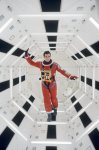
2001: A Space Odyssey - NYT

2001: A Space Odyssey – NYT

‘2001: A Space Odyssey’ Is Still the ‘Ultimate Trip’
In honor of its 50th anniversary it is being rereleased at the Cannes Film Festival. Stanley Kubrick’s masterpiece encourages us to reflect again on where we’re coming from and where we’re going…more

The Big Falcon Rocket (BFR)

The Big Falcon Rocket (BFR) – SpaceX

SpaceX flies ‘lessons learned’ rocket
The California rocket company SpaceX has conducted what is arguably its most important launch to date. Flying out of Florida, the firm’s Falcon-9 vehicle lifted a standard telecommunications satellite for Bangladesh into orbit. But the booster incorporated everything SpaceX has so far learnt …more

Calendar of astronomy/space events
Sync your calendar with the solar system…more

A view of the Milky Way and neighboring galaxies, containing more than a billion stars, released by the European Space Agency’s Gaia mission.CreditESA/Gaia/DPAC

A view of the Milky Way and neighboring galaxies, containing more than a billion stars, released by the European Space Agency’s Gaia mission.CreditESA/Gaia/DPAC

Gaia’s Map of 1.3 Billion Stars Makes for a Milky Way in a Bottle
Call it a galaxy in a bottle….more

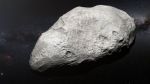
Illustraion: 2004 EW95 orbits four billion kilometres from Earth

Illustraion: 2004 EW95 orbits four billion kilometres from Earth

Lonely asteroid tells Solar System story
Researchers have observed the first object of its kind – a carbon-rich asteroid in the Kuiper Belt…more

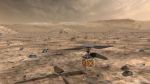
Nasa provided this computer-generated image of the helicopter's design

Nasa provided this computer-generated image of the helicopter’s design

Nasa will send helicopter to Mars to test other worldly flight
Nasa is sending a helicopter to Mars, in the first test of a heavier-than-air aircraft on another planet…more

Illustraion: 2004 EW95 orbits four billion kilometres from Earth

Illustraion: 2004 EW95 orbits four billion kilometres from Earth

Lonely asteroid tells Solar System story
Researchers have observed the first object of its kind – a carbon-rich asteroid in the Kuiper Belt…more

MACS1149-JD1 was originally found by Hubble, but was analysed using the VLT and Alma The team is not quite finished

MACS1149-JD1 was originally found by Hubble, but was analysed using the VLT and Alma
The team is not quite finished

Scientists detect oxygen legacy of first stars
They observed it in a galaxy of stars that existed just 500 million years after the Big Bang…more

In pictures: Astronomy Photographer of the Year 2017
The winning images from this year’s competition have now been announced, with Artem Mironov’s vibrant clouds of dust and gas in the Rho Ophiuchi Cloud Complex scooping first place…more

An illustration of a grey/white asteroid on a starfield

An illustration of a grey/white asteroid on a starfield

‘Permanent’ interstellar visitor found
An asteroid in Jupiter’s orbit may have come from outside our Solar System, according to a new study…more

The satellites were assembled in Europe by Airbus

The satellites were assembled in Europe by Airbus

Grace mission launches to weigh Earth’s water
The Grace satellites are replacing a pair of highly successful spacecraft that stopped working last year…more

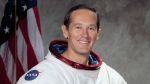
Charles Duke is the youngest person to have walked on the moon

Charles Duke is the youngest person to have walked on the moon

Moon walking: Ex-Nasa astronauts describe lunar experience
The last US mission to the Moon, Apollo 17, blasted off shortly before midnight on 7 December 1972. Its crew spent three days on the lunar surface, collecting samples and conducting experiments…more

Posted in June 2018, Sidereal Times | Tagged , | Leave a comment

From the Director

Rex


by Rex Parker, Director

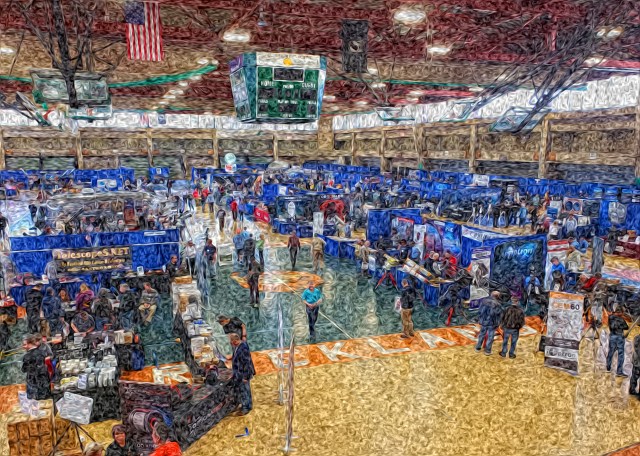
NEAF Impressionism. Energized from attending the Northeast Astronomy Forum (NEAF), I returned to Princeton contemplating our roles on the stage of science, exploration, and community. The “World’s Largest Astronomy & Space Expo” was conceived and produced for the past 20 years by members of the Rockland (NY) Astronomy Club. It has grown remarkably with 120 exhibitors participating this year. Advances in technology, telescope instrumentation, and knowledge were evident in every direction. Talks on stage at the “Celestron Theatre” were inspiring and wide-ranging. Young speakers confirmed the importance of mentoring by local astronomy clubs and spoke glowingly of that first (and second!) telescope and their growing interest in science and math as they head to college. 2006 Nobel physics laureate John Mather gave an exciting preview of the James Webb Space Telescope, future successor to Hubble, where he is a senior project scientist.

On display throughout NEAF were telescopes large and small, precision equatorial and portable alt-az type mounts, camera systems using the latest CCD and CMOS sensors, cool gadgets, devices, inventions, innovative software and techniques for displaying astro images. The AAAP was an active participant in acquiring some of this new technology in the form of new high sensitivity astro cameras soon to be ready for member use at the Observatory. NEAF was all about depicting the visual impression of the moment, especially in terms of the shifting effect of light and color – the very definition of impressionism!


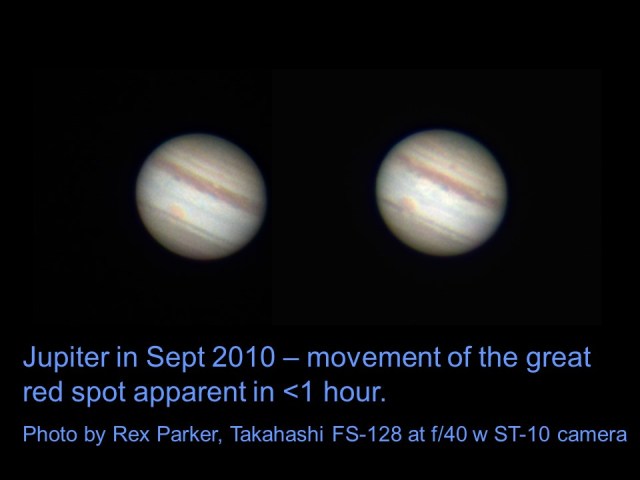
Jupiter the Star of Show on Member Night at Observatory, Sat. May 12 (rain date May 19). The new moon is May 15, so this get-together for members and family/friends will be a good opportunity to see the deep sky as well as planets. Sunset will be at 8:09 pm and Jupiter rises in the SE by mid-evening May 15. It will be one of the best weeks of the year to observe Jupiter, which reaches its closest point to earth (opposition) the week before. Below is a photo of Jupiter taken in Sept 2010, showing movement of the Great Red Spot in two images taken less than 1 hour apart tin time. In May 2018 Jupiter will be very bright reaching magnitude -2.5, and large approaching 45 arc-sec diameter (this is huge by planetary observing standards!). Come out and learn more about observing and telescope equipment, get to know others in the club, and see if you can detect the Great Red Spot on May 12.

Posted in May 2018, Sidereal Times | Tagged , | Leave a comment

From the Program Chair

By Ira Polans

James Lowenthal

James Lowenthal

The May meeting will be held on the 8th at 7:30PM in the auditorium (Room 145) of Peyton Hall on the Princeton University campus.

Featured Speaker: The featured speaker is Dr. James Lowenthal of Smith College. His talk is on “Stalking the most luminous galaxies in the Universe with Hubble and the Large Millimeter Telescope”.

Most stars that formed in the first half of the Universe’s lifetime were made in massive, dusty starburst galaxies that are largely hidden from view but shine brightly in far-infrared wavelengths. The FIR light from those galaxies is red-shifted by the Universe’s expansion into the sub-millimeter. We used the Planck satellite to select the most luminous sub-millimeter galaxies at high red-shift and refined the list and confirmed them with a battery of other telescopes including the Herschel satellite, the Very Large Array, the WISE satellite, and the 50-m Large Millimeter Telescope. None of those provided a sharp view of the distant dusty starbursts. New images from Hubble Space Telescope, however, have unveiled a spectacular view: nearly all the brightest SMGs at high red-shift are strongly gravitationally lensed by massive intervening galaxies and groups or clusters of galaxies: most show simple or complex Einstein rings, while others show giant arcs implying lensing masses M>10^14 solar masses. These new images, supplemented with follow-up data from the 8-m Gemini South telescope and ALMA, provide a path to study the most extreme star-forming galaxies known at spatial scales of 100pc or even less, letting us address a fundamental question: what process fuels the extraordinary activity of SMGs?

Member Talk: This month’s 10 minute talk is by Bill Murray on Stellafane. If you don’t know about this event, you will after Bill’s talk!

We are looking for members to give a talk for next year. Maybe you’re doing something astronomically interesting during the summer break? Perhaps you want to share why astronomy is so fascinating to you? If you are interested in giving a talk please contact program@princetonastronomy.org.

Pre-Meeting Dinner: Prior to the meeting there will be a meet-the-speaker dinner at 6PM at Winberie’s in Palmer Square. If you’re interested in attending please contact no later than Noon on May 8.

We look forward to seeing you at dinner and the meeting!

Posted in May 2018, Sidereal Times | Tagged , | Leave a comment

Naming Uranus

by David Lechter

While looking through a cornucopia of astronomical images at the Pinterest web site I came across the following image that is actually page 49 of an old book entitled “Smith’s Illustrated Astronomy”(3).

I was able to download a digital copy of the book from (1) and the following quote from the Preface helps explain the purpose of Smith’s book:

“It has been the object of the author of this Illustrated Astronomy, to present all the distinguishing principles in physical Astronomy with as few words as possible; but with such occular demonstrations, by way of diagrams and maps, as shall make the subject easily understood. The letter press descriptions and the illustrations will invariably be found at the same opening of the book; and more explanatory cuts are given, and at a much less price than have been given in any other elementary Astronomy.

This work is designed for common schools, but may be used with advantage as an introductory work in high-schools and academies. In the preparation of these pages most of the best works in our language have been consulted, and the best standard authorities, with regard to new discoveries and facts, have governed the author’s decisions”.

The image follows:

Orbits of the Planets

Orbits of the Planets

What struck my eye is that the image shows not only the known planets and some asteroids but their orbital inclinations with respect to the ecliptic. You’ll agree that it is very difficult to read the planets’ names and inclinations recorded in the image; some are relatively clear but some are not. Noteworthy, and difficult to see, is the planet labeled as Herschel, the discoverer of Uranus. William Herschel discovered Uranus in March 13, 1781.

Despite the difficulty in reading the orbital inclinations, a check with Wikipedia(2) shows the image is correct in Smith’s illustration of the planets’ orbital inclinations as seen in Table 1.

Table 1. Inclinations of the Planets (as seen in the image)

Planet Inclination
Venus 3.39
Mars 1.85
Hershel 0.77
Earth 0
Jupiter 1.31
Saturn 2.49
Mercury 7.0

Neptune is notably absent in the image. Neptune was observed with a telescope on September 23, 1846 by Johann Gottfried Galle, a director of the Berlin Observatory just three years before the first edition of Smith’s textbook. One can only imagine why Neptune is left out of the image. In fairness to Smith, he does discuss Herschel (Uranus) and Leverrier (Neptune) on page 30. Maybe the image got too crowded or maybe it was an oversight on the artist’s part. We’ll never know I suppose.

We can get a taste of the debate over what to name Herschel’s newly-discovered planet by reading a letter written by Caroline Herschel, William’s sister, to Maria Mitchell and quoted by Dava Sobel in her book on the planets(4). Maria Mitchell, incidentally was an American Astronomer and discoverer of “Miss Mitchell’s Comet”! Caroline’s letter describes how William wanted to name the planet “Georgium Sidus” acknowledging the King’s kindness, while some people in France campaigned for “Planet Herschel”. Sobel mentions that “many other names came forward” too. Herr Bode, director of the Berlin Observatory suggested “Uranus” who “sought safety in mythology”. Sobel notes that sixty years were to pass before the name Uranus was generally accepted. (Incidentally, during this time a German chemist, Martin Heinrich Klaproth, extracted a metal from pitchblende and called it Uranium).

Perhaps we now know why Smith used the name Herschel instead of Uranus in his diagram seen above.

History shows us that continuing studies of ‘Uranus’ a planet with a perturbed orbit led to the discovery of Neptune, a planet that may have been observed by Galileo(5), but was discovered mostly through mathematics!

Sources:

  1. Smith’s illustration

  2. Orbital inclination

  3. Smith, Asa. Smith’s Illustrated Astronomy. New York: Daniel Burgess & Co. 1855.

  4. Sobel, Dava. The Planets. New York: Penguin Books, 2005.

  5. Neptune
Posted in May 2018, Sidereal Times | Tagged , | Leave a comment

Daystar

by John Church

Fear no more the heat o’ the sun,

Nor the furious winter’s rages.

– Cymbeline, Act IV

Whenever I have trouble getting to sleep, which sometimes happens to people as they get older, I just think about the sun.

I first learned interesting things about the sun from “The Beginner’s Star-Book,” a delightful and classic introduction to astronomy by Kelvin McKready. My father brought it home from the Virginia State Library when I was about ten. I devoured every page, although many of the technical details were way over my head. This book was largely responsible for my lifelong interest in astronomy, some bits of which I have written about elsewhere. When I left Richmond after finishing college, the book stayed in my parents’ home, having been discarded by the library. My father gave it to me, and I have it still.

McKready’s excellent exposition was interspersed with astronomy-related poetical selections from Victorians such as Matthew Arnold and Alfred Tennyson. A sample of the latter will suffice:

My mood is changed, for it fell at a time of year

When the face of the night is fair on the dewy downs,

And the shining daffodil dies, and the Charioteer

And starry Gemini hand like glorious crowns

O’er Orion’s grave low down in the west …

A ten-year-old boy cared little for the maudlin sentimentality of Maud (he might, later on), but he was greatly impressed by such imagery. For he himself had seen Auriga and the Heavenly Twins keeping vigil above the place where the Giant Hunter rested of a delicious late April Richmond evening. And he had shared the thrill of chill November twilights such as those watched by the narrator of Locksley Hall:

Many a night I saw the Pleiads, rising thro’ the mellow shade,

Glitter like a swarm of fireflies tangled in a silver braid.

There was a chapter in McKready’s book describing the sun. Now the sun is something we all take for granted: rising early in the morning to send us off to school or work, then setting in the evening as we reflect on the day and prepare for dinner. It can get in our eyes during our morning or evening commutes in wintertime, might burn us in the summer, and doesn’t always shine when we most want it to. Reading McKready, however, gives us a little more respect for this monstrous thing that heats the earth and keeps it in its orbit.

Anthropocentric conceit would have us imagine that the sun exists for our benefit alone, but some elementary facts disabuse us of this notion. As seen from the sun, the earth is nothing but a ridiculously tiny speck, no bigger than a gnat would appear from several yards away. The earth catches only one part in two billion, two hundred million of the total energy that the sun pours out into space. Put another way, the sun could light up and power well over two billion earths at once. Imagine the amount of energy that the total daylit side of earth is receiving at any one instant, multiply it by this factor, and you will have some remote idea of the sun’s power. And it has been doing this for billions of years and will continue to do so for billions more. (Peace, Carl Sagan, I didn’t mean to overuse your proprietary word.)

Well over a million earths could fit inside the sun’s globe. If the earth were at its center, the moon in its orbit would be only a little more than halfway out to the sun’s surface. What an enormous thing.

Scientists sometimes entertain themselves by doing approximate calculations in their heads. (Yes, aren’t we such jolly people?) Lying in bed once, I was curious as to about how much of the sun’s surface would be required to take care of the entire earth’s solar energy budget. As we learned in elementary geometry, the surface area of a sphere is four times pi times the square of the sphere’s radius. Astronomy buffs know, or ought to know, that the sun’s radius is 432,000 miles, or 4.32 times 10 to the 5th power (expressed this way for ease in handling such large numbers). Square this in your head and you will have roughly 20 times 10 to the 10th power. And four times pi is about 12. So the area of the sun’s surface must be about 240 times 10 to the 10th power square miles; simplify this to 2.4 times 10 to the 12th power. In other words, 2.4 trillion square miles.

Now we already know that the sun can light up 2.2 billion earths, as McKready told us. Therefore, it would take only about eleven hundred square miles of the sun’s surface to give full daylight and heat to the entire sunlit side of the earth. Now eleven hundred square miles is not really very much; it’s about the size of two average counties in the small state of New Jersey where I live. So the sun must be incredibly hot and bright. Well, any fool knew that without doing the calculation, but it did help put me to sleep.

Deep inside the sun, five million tons of matter are being tortured to death every second in nuclear reactions and converted to energy by the enormous gravitational pressure of the overlying material. The sun would really like to explode from all this released energy, but it can’t because of this same gravitational confinement, and everything stays almost perfectly in balance. As it slowly loses mass – the rate is about one earth equivalent per 40 million years – it continually expands at a very slow rate, partly because of decreased gravity, but mostly because its power output gradually increases due to complicated changes in its mode of energy generation. After many billions of years it will become a “red giant,” swelling to about the size of the earth’s orbit and melting it completely. Long before things get to this stage, we shall have had to move; it’s not too early to begin thinking about it.

Now for some more illuminating facts. I couldn’t figure these out in my head the other night because I was already bored to death and sound asleep (see, this technique works). The total power being continually released by the sun is about 5 times 10 to the 23rd power horsepower. A number of this size is especially interesting to chemists, because it’s close to what’s known as “Avogadro’s number.” This latter number, about 6 times 10 to the 23rd power, is the number of molecules in what’s called a “gram-molecule” (also known as a “mole”) of any chemical compound.

Take water as an example, made of two hydrogen atoms and one oxygen as we already know. Hydrogen has an atomic weight of very close to 1 (convenient, since it’s the lightest element), and oxygen is 16. So the molecular weight of water is 18 (18.02 if you want to get technical). Now a mole of any compound is defined as the number of grams of that compound numerically equal to its molecular weight. So a mole of water has a mass of 18.02 grams. Volumewise, this is between three and four teaspoonfuls of water. This small swallow has more molecules in it than the horsepower of the sun! Hard to believe, but true.

One more factoid for insomniacs and I’m done. How much of the sun’s surface do I personally need to keep me alive? An average person’s metabolic power consumption is about a hundred watts, or like one bright conventional light bulb. This is the power output of a little under two square millimeters of the sun’s surface. If you do the math, to power all the seven billion people on earth would theoretically require a piece of the sun only about the size of the playing surface at a baseball stadium.

Play ball! But please put on some sunscreen.

Posted in May 2018, Sidereal Times | Tagged , | Leave a comment

Communiversity Day 2018

by Larry Kane, John Miller

We had a great turnout by AAAP members and we had an opportunity to speak with, and provide literature to, a lot of attendees. When I had the time, I took a few pictures, shown below. This event continues to be a major recruiting effort for the AAAP and should be a part of our our outreach efforts in the future.

Posted in May 2018, Sidereal Times | Tagged | Leave a comment

Wiggly Jiggilies

by Ted Frimet

or when black holes collide

Commercial break. All had a great time, during our AAAP outreach. Three telescopes were present, one manned by Dr David Letcher, the other by Outreach Chair, Gene Allen. The third telescope, my 8” SCT push-to, used for hands on – in my own humble opinion, was the star of the show. As you all know, most of our equipment is very expensive. So it goes. An observer must retain domain over his or her telescope and mount. However, this eight inch lady of the light is forever in the public domain. You should see kids faces light up. Even parents. Yes, even with Venus as the only “star” of the show due to light pollution and a sliver of the moon. The experience is especially rewarding. I can’t say enough good things about the Amateur Astronomers Association of Princeton for sponsoring Outreach. Welcome back, audience.

How best to solve a maze? I’ve always been fond of working backwards. For the most part, maze designers made them difficult. They are, or were, a source of entertainment, if not simply down right time consuming. Most persons solving a maze, take the time of an eyepiece view to solve. As astronomers, we take in the scenery, sweeping from West to East. And lastly drop in on the latent glowing red of a binary system at a higher magnification. Was I alluding that a maze is like the night sky? Maybe so. If you like mazes, then I challenge you to backtrack from the end to the beginning of this passage!

Determined as you may be to solve to the bards room, from entry to exit, and not vice-versa, my maze may be somewhat challenging. I intend to tease and defeat those that are back-door solvers. And you few that dip the ink into an old fashioned labyrinth, now manage to make my mental glee that much harder to obtain. However, the vocabulary to describe said “maze-management” remains a constant. Or at least a scant web search suggests that to be so.

Welcome to my reverse maze. As of the time of this writing, the Lyrids are not at full peak. And I will be a tired soul for staying the course, late into the evening to view them. And at first light, I will engage the star drive to Sunday’s North East Astronomy Forum (NEAF 2018 – Yes, Saturday was a sleep-in). Yes. Definitely tired. Maybe skip the Lyrids, and go to bed early?

Friday was a Minatour. I found him imprisoned in the labyrinth of Knossos. It was the Annual Meeting of the International Occultation Timing Association (IOTA) of North America. And lest I am questioned to answer for myself, you will find me as the center focus of King Minos of Crete. You’ve got to admit, though. Minatour is such a cool sounding maze based name. Truly, the IOTA meeting was more of maze junction, or a decision point. It was a place where we have to decide between at least two alternative paths. Keep alert! Be certain that all discussions held, here, at the Crowne Plaza in Suffern, NY were all revelations. And many silent decisions were being made by the nube in the back row. And it is here, in brief that I present the alternative path I have discovered. You knew it already. I simply did not say so, up front.
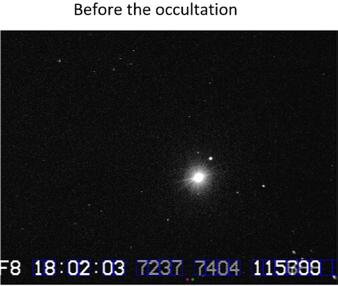
Regulus before the occultation.

Regulus before the occultation. Courtesy David Dunham
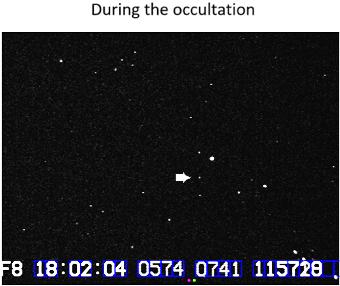
White Dwarf during the occultation.

White Dwarf during the occultation. Courtesy David Dunham

Regulus is such a bright star. He is why we use him as a guide, during the spring night. With the help of fellow Amateur Astronomer John Miller, my sighting of Leo’s alpha is now correct. A knowledge of one more star locus meets my monthly quota. And then came IOTA. I learned from two still pictures that an occultation event dims even the mighty Regulus. And in doing so, revealed the secret of his binary accomplice; a White Dwarf. I am still uncertain as to how a high UV emitter was revealed by white starlight. Still – the evidence lay before me in the images portrayed on the projection screen, during an IOTA talk. The Regulus occultation by the asteroid 268 Adorea appears above. Let us forgo the aforementioned question on account of my humble learning process. We now delve into the more mysterious nature of the occult.

We can discover binary star systems while being visual observers. The fainter, gravitationally bound doublet was previously obscured by the Regulus’ absolute magnitude [-0.57]. The dwarf remained cloaked until a passing asteroid blinked her twin into a temporary visual oblivion. Our three actors; the guide star, a dwarf, and asteroid formed the maze vortex. Ultimately they were linked together, if only for a brief instant in time, and in space. And then the asteroid continued on thru her passageway, bound to repeat her spiral retreat to the outerwall. And once again, orbit back thru the maze.

There is no rest for the weary. However, do take a breath, and have a snack. I’m getting up to get a cup of coffee… Fear not, ye star traveler. I promise not to lead you into the cul-de-sac of Troy. I will not lay before you the blind alley of the maze.

This month might have been, for me, a classical bottleneck. Outreach to scouts, we were told, were for fourth graders in attendance. How difficult could it be? Plan on a chance encounter on my ruse in “how to ride a light beam”, in this months Sidereal Times. There you will find the result of an ask for an academic paper. Never an easy task. And then to convey the essence of the essay message into a hands on experiment? Maybe a little more difficult? I dare say.

After the fact, but before the outreach encounter, I looked up some data on our scouts. Those in attendance were not your everyday fourth graders. These were STEM participants. And I will tell you, frankly, how their behavior was outmatched only by their scientific prowess. They were knowledgeable, and formed solid, lucid questions. Clearly, even as I strike the keys, I show my mazes end. I let you all know that these STEM scouts are a replacement for me. In so very short years, they too will search and find AAAP and the wonders of Sidereal Times!

The paper was a mazes’ bottleneck, and so it was not presented at outreach. It did become the backbone for replying to the Scout Master, as well as document in hand for Ms. Gold. She was the main point of contact, at the Scouts outing. Ms. Gold is the noteworthy STEM teacher for these participants. Reading my information paper was clearly off the menu. Ms. Gold made sure that the essay would be in the hands of those few that were up to the task, including Mr. T – a parent that was acutely aware of the many color palettes of Hubble Space Telescope astrophotography.

There was a diverse range of cosmological knowledge spread upon the 15 astronomers in our STEM group. A later night topic, staved off until the last possible minutes, was on Cherenkov radiation. Followed by a discussion of white dwarf UV emissions and the nebula that re-radiate their light. In demonstration, we shone a small UV flashlight onto some uranium glass; while we all went a-gaze with wonder at the glowing yellow-green light of re-radiation under then, darker skies.

Push back the clock, even earlier. All were in attendance. Due to an abundance of artificial light in the parking lot, more con-fab was called for. And then we showed, with two outstretched arms a demonstration of two black holes in a death spiral. My impression was wanting. All remained well mannered. And then came the question, “what sound does 63 solar mass’ of black holes make when they collide” ? Fortunately for us, AAAP was graced with the LIGO talk of Princeton University Professor Frans Pretorius. And I had the good luck to have heard a reinforced lecture by Kip Thorne, a few days later. Now, how to transcend the lecture room to the parking lot? Simple. Wait on the kids to answer. And answer, they did! “Boom, arrrgh, howl”, loud noises!! Maybe even a bang and crash!! And then I lamely said, “chirp”.

They looked at me, like I as out of my mind. Ok, they got me. Even if they don’t read my essays, they know I’m unusual. Since I listened to Drs. Thorne and Pretorius, I became Daedalus, anew. Yet here as craftsman, a skilled artisan, I had to manage a conveyance of a song bird. With the words of two Phd’s (Pretorius and Thorne) in my mouth; I uttered again, “chirp”. Yes. I explained that as the scientists used the interferometer to monitor one dimension of a gravity wave – our first – they decided to funnel it into a speaker. And our STEM kids were wide eyed with wonder. Although I must admit, in a less than passing fashion, that some body language expressed contempt for a bird call from a black hole. Really? Could you blame them? Chirp? Yup. Thanks, Kip. Diddo to you, Frans.

Earlier, Ms. Gold had described that they had created a model of our solar system. And pointed out how they learned how massive Jupiter was and how tiny the inner planets were by comparison. More than one scout mentioned this to me, in passing. Where was this Ven I searched for? Where is the knowledge point, a nexus where we can transcend the solar system of old, and introduce the galaxy of new? And what of the Universe of greater ascent? Asking for a volunteer; one STEM participant became the “galaxy center point”, while others formed up the many arms of our spiral galaxy. And around and around they walked – dancing the dance of the ever whirling galactic outreach. They were impressive. I am so proud of them. They produced a great spiral, that evening!

Fortunately outreach does not have to come at a high price; nor does it need to be overly complex. With six tea lights in hand – LED lights – a version for 50 cents a pop – a volunteer was selected to choose a remaining five. And six scouts sought to line up the lights, at a distance. Some close. Some from afar. And all within the safety of oversight of parents, and leadership.

Having first observed all lights at the same distance; and same brightness; they learned absolute magnitude. And now given the opportunity to see their lights close and far – they learned apparent magnitude. Here’s the tricky part. Asking our STEM participants the hard question. If two stars appear to have the same brightness, and yet are hundreds of light years apart, how do you account for this? And to my excitement, my new peer group, a group of 15 exceptional minds, gave me the answer. Among them was a spokesperson who sang out! I was so proud. So very happy not to have answered myself. If you want the whole tale of two magnitudes, please read, “how to ride a light beam”, also found in this months Sidereal Times.

If Aristotle were here, he would be analyzing this tome, a Poetics of sorts. I was going to stop. But I could not help myself. The kids were introduced to Minkowski space of length, width, height and time. And when confronted with passing thru the event horizon of a black hole – having time swap out for a dimension and having that dimension of time flowing in against them – they intuitively agreed that this flow into the black hole would never let anything escape against this arrow of time. Yes. Truly our STEM kids will need the shield of Achilles to accompany the sword of Aegeus in our maze. My essays’ are insufficient. Perhaps the AAAP outreach was never needed. There is a complication in the continuum. Due to a non-anticipated fold in space-time, it appears that all fifteen students were already in attendance at Princeton University. In which case, I was never here. And neither are you. Where is that second cup of coffee? A brief reference to Douglas Adams reveals that the cup appeared in the many worlds version of where lost pens go to. Say “hello” to Douglas, for me, when you see ‘em. Tell him I want my coffee mug back. It was my favorite.

Ah yes. The beginning of the maze presents itself. Now, stand up – raise up your arms and wiggly jigglie all that extra energy! I, as Theseus, lead the way back to the beginning. However, if you took the challenge of paragraph two, you’ve started here. Whoops. Endless loop. Or was it particulate matter, in the forms of electrons, traveling faster than light in an optical density greater than one ? Blue light, or sound waves compressed into a sonic boom? Take your pick. There lay your Minotaur in sight and in sound.

Posted in May 2018, Sidereal Times | Tagged | Leave a comment