by Rex Parker, PhD director@princetonastronomy.org
Skynet Update – Remote Imaging for Members
AAAP is sponsoring member access to remote astro-imaging through UNC-Chapel Hill’s Skynet robotic telescope network. The telescopes are located all over the world, typically are 16” imaging scopes of Ritchey Chretien pedigree with high quality large format CCD cameras. To date we have provided accounts for 21 AAAP members, and so far 6 have begun making observations using the system. If you’re interested but not yet involved, send me an e-mail note to get set up. Details are explained in the June issue of AAAP’s Sidereal Times. Also see the Skynet web site, https://skynet.unc.edu/skynet
Proxima Centauri Photographed Using Skynet
The southern sky brims with amazing celestial sights if only we have the opportunity to see it – and this is one of the very cool things about joining Skynet. Even more, you can explore these distant realms from the comfort of home with your PC!
Recently our nearest neighbor the south sky star Proxima Centauri was in the news for the very significant discovery of an earth-like exoplanet orbiting it. This is part of a major ongoing effort to identify exoplanets around the nearest stars. With a declination of 62 degrees it’s not visible from our latitude, and it’s also very faint at magnitude 11, so Proxima Centauri is seldom seen by amateur astronomers and few images are on the internet. It’s story goes back to the 1915 discovery in South Africa of a star with the same proper motion and parallax as the closest star at the time, Alpha Centauri (itself a binary pair, A and B) also known as Rigel Kentaurus about 4.4 light years distant. The new star Proxima (also called Alpha Centauri C) proved to be a loosely bound companion orbiting at a large distance, ~0.2 light years (~10,000 times the earth-sun distance). It is a low mass dim red dwarf, the lowest luminosity star ever measured when discovered, though slightly closer to earth than Alpha A and B, about 4.2 light years. In 2016 the European Southern Observatory announced the discovery of an earth-like exoplanet “Proxima b” orbiting the star at a distance of only ~0.05 AU (~1/20 the earth-sun distance) with orbital period ~11 earth days and mass ~1.3 earth mass. Current evidence suggests that such a planet around a red dwarf star is unusual.
What would this close but dim southern red dwarf look like? Using Skynet from my home office in New Jersey I queued up a request for imaging time on the PROMPT 5 telescope, a 16” RC f/11.2 scope located at CTIO at 9000 ft elevation in the Chilean Andes, 30 degrees south latitude. Within 24 hours the job was completed and my data was ready for downloading from my observation list. The image below was created from 4×15 sec exposures each with red, green, blue, and luminance filters. Proxima Centauri is the reddish star to the left of center in the image below. It looks brighter than most of the other stars in the field because the others are more distant. How to know which is the target among a field of hundreds of stars? I used the Image Link astrometric program in TheSkyX software to precisely confirm which was Proxima Centauri. But it’s up to the imagination to visualize the earth-like planet in this picture.

The red dwarf Proxima Centauri and surrounding star field. Width of field ~28 arc-min, about the size of the full moon. Alpha Centauri is out of the field ~2 degrees away. Image by RAParker using Skynet/PROMPT5.
First Light with the Ultrastar-C: Electronic Assisted Astronomy for Outreach
Recently outreach co-chair Gene Allen proposed that the club acquire new technology to help improve the quality of what can be shown to others in outreach. Advances in CCDs and software is making live-view imaging more feasible than ever. We’re considering a fast-download-rate CCD camera with real time stacking software linked to a portable telescope, and also linked to one of the telescopes at the observatory. I was fortunate to acquire on Astromart a leading current example of this type of camera, the Starlight Xpress Ultrastar-Colour. This camera has the excellent Sony ICX825AL color sensor which is larger and therefore has a wider field of view than many previous fast cameras.
-
-
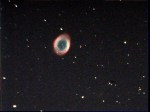
Ring nebula M57 with Ultrastar-C/Starlight Live 8 sec image/stacking mean.
-
-
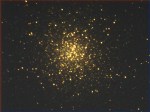
Hercules cluster M13 with Ultrastar-C/Starlight Live 8 sec image/stacking mean.
-
-
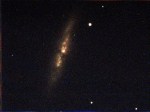
Bodes galaxy M82 with Ultrastar-C/Starlight Live 8 sec image/stacking mean.
Member Tim Donney joined me recently to test the Ultrastar-C with Starlight Live stacking software at the Observatory. We got it working with the Mewlon-250, which is really more focal length than ideal but allowed a decent test. The pics below have no processing at all, they are merely ~8 sec images with stacking/mean using Starlight Live software, and they represent what we saw on the screen live. Keep in mind this is with full moon coming up. It will be interesting to test with a smaller/wider field telescope as Gene proposed. It’s noteworthy that the power requirement of the Ultrastar allows running from laptop USB port so it’s simple to set up in the field and AC adapter not required for laptop in many cases, a big difference from our version of the Mallincam.
Jersey StarQuest (Sept 22-23). Once again we’ll be hosting Jersey Starquest astronomy weekend at the Hope Conference and Renewal Center in north Jersey http://camphope.org/. This is an observing-oriented event for both Friday and Saturday nights at one of the best relatively dark sky locations in the state. The Hope Center is located just north of I-80 a few miles north of Jenny Jump forest, and offers clean bunkhouse accommodations or camping on-site and a kitchen for cooking if desired. Restaurants are within a few minutes’ drive. If you’re experienced or just beginning, a new member or veteran, even if you don’t own a telescope, here’s your chance to learn hands-on about astronomy and observing.
o Walk-in registration, no advance payment or pre-registration needed. You can decide to attend at the last minute. We will ask that you send in a non-binding intent-to-participate form to help estimate needs for Hope Center.
o AAAP member-oriented event, a chance to make friends in the club. You’re also welcome to invite family and friends who may not yet be members.
o Low costs. The club subsidizes the costs, we do not make money on the event but the more people attend the better the economic outcome for the club.
o No meals will be provided by the club. You should bring your own food and plates etc. The Center’s well equipped kitchen will be available, and we may self-organize for carry-out food from local establishments. Hot and cold drinks will be provided.
RiP George Walker. Long-time AAAP member George Walker has passed away, succumbing swiftly after a medical event. Throughout the 1990’s George was an observer and active member of the club.


 It was a very hot day and it was quite the effort for John and Bob to tote those telescopes to Princeton and deliver three plus hours of viewing to the public, but that’s one of the primary missions of the AAAP and people were delighted to say the least.
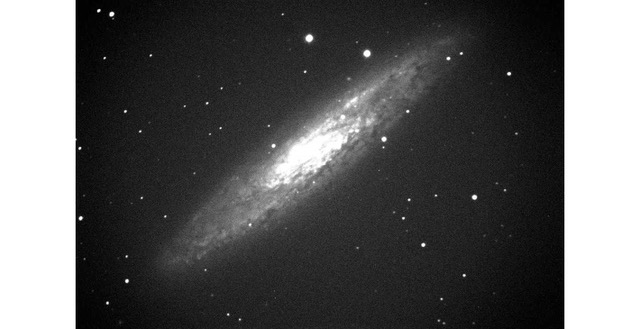 Open aperture, no color filters. RA | Dec: 00:47:33.1, -25:17:19.6





 Amateur Astronomers Association of Princeton