
This is why my wishes were never fulfilled!
This is why my wishes were never fulfilled!
July’s last week was a boon to Mars lovers. Mars, at its closest approach came at a distance of 35.8 million miles to Earth. It was hard to miss in the sky from July 27 to July 30. Its closest approach was July 31, 2018 around midnight. Some of our astrophotographers have taken amazing pictures of the event.

Photo by Robert J. Vanderbei

Another one by Robert J. Vanderbei
by Prasad Ganti
Flying towards the Sun
Sun, the source of energy for our planetary system, has been an object of reverence since times immemorial. The relentless quest to understand what goes on in the Sun which causes so much energy to be generated. In the last century or so, with the knowledge of nuclear reactions, it was determined that Sun is a huge nuclear reactor. Yet, the nuances of different layers and their temperatures and the solar winds which emanate from the Sun have been uncovered and much remains to be studied. Towards this end, the recently launched Parker solar probe is an exciting mission which will go closer to the Sun than any human made object has gone so far.
The core of the Sun is the hottest about 15 million degrees. This temperature is enough to cook the reserves of hydrogen into helium in a process called nuclear fusion. The temperature gradually reduces till the surface which is known as photosphere. This is the place from which we receive our light and heat. The temperature there is about 5800 degrees. Which gives the yellow color to the Sunlight. There are other stars in the night sky which are bluish or reddish in color. Blue stars are hotter and the red stars are relatively dim.
The outer layer of the Sun is the Corona, which is visible during a total solar eclipse. Like it happened in 2017. It is very hot, running into ten to twenty million degrees. It is strange that Corona which is the outer layer is hotter, compared to the inner photosphere. In addition to the light and heat, Sun also gives out charged particles, which are a mix of electrons and protons which shoot out at high speeds. This is known as the solar wind coming out from the Corona. The solar wind can be very dangerous to life on Earth. Fortunately, the Earth has a surrounding magnetic field. This field deflects the solar wind away and acts as a protective blanket. The clash of the charged particles and the magnetic field of the earth is visible as auroras closer to the poles. In the north, known as aurora borealis or the northern lights, it is visible from Alaska, Siberia, Scandinavia etc.
Sometimes, the solar wind is very intense. Called the Coronal Mass Ejection (CME), the solar flare charges outward. If the earth is in its path, the storm can cause havoc. It happened sometime in the nineteenth century when the electrical and communication infrastructure was a tiny fraction of what exists today.
The very existence of the solar wind was postulated by a scientist named Eugene Parker. The scientific community was skeptical. In fact, Parker had a tough time getting a job after he completed his Phd. Chandrasekhar Subrahmanyan, the nobel prize winning astrophysicist known as Chandra, helped him get a job. The postulation of the solar wind was rejected for publication. Chandra as the editor of the journal, overrode the objections and got the research paper published. Since then, the solar wind has established itself as more evidence came in during the ensuing decades. The space probe to study the Sun has been named in Parker’s honor, who is still alive to see his namesake galloping towards the Sun.
The space travel is not simple, like a direct point to point navigation like it is on the Earth. The probe will travel towards Venus by late September. It will use the gravity assist of Venus to slow down and move closer to Sun. The probe will then begin its first of the twenty four orbits around the sun. It will be an elongated orbit. The closest approach to sun, called perihelion will happen on Nov 1. With each orbit, the spacecraft will move closer and closer to the sun, eventually coming to less than 4 million miles above the photosphere, taking measurements in its environment. Along the way, it will get six more gravity assists from Venus during the next seven years.
Given below is the picture of the trajectory of the Parker probe as it ventures into the sun’s neighborhood.
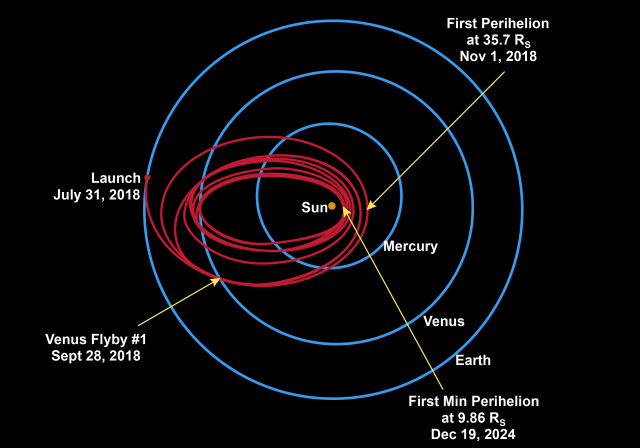
Parker probe trajectory, courtesy planetary.org
A carbon disk protects the probe and its electronics from getting fried. Going to so hot a neighborhood, yet keeping its cool ! That is the miracle of modern day technology, being used to probe the mysteries of the nature.
compiled by Arlene & David Kaplan
Hayabusa 2 will use a projectile to excavate fresh material from beneath Ryugu’s surface
Japan’s Hayabusa 2 spacecraft reaches cosmic ‘diamond’
A Japanese spacecraft has arrived at its target – an asteroid shaped like a diamond or, according to some, a spinning top…more
-NASA
Settling Arguments About Hydrogen With 168 Giant Lasers
Liquid metallic hydrogen does not occur naturally on Earth, except possibly at the core, but scientists believe the interiors of Jupiter and Saturn are awash in hydrogen in that state. Scientists at Lawrence Livermore National Laboratory said they were “converging on the truth”…more
-NASA
Parker Solar Probe: Nasa launches mission to ‘touch the Sun’
Nasa has launched its latest mission – a special spacecraft that will travel closer to the Sun than any spacecraft has done before. The Parker Solar Probe lifted off in the early hours of Sunday 12 August from Cape Canaveral in Florida, USA…more
-BBC
Earliest galaxies found ‘on our cosmic doorstep’
Some of the earliest galaxies to form in the Universe are sitting on our cosmic doorstep, according to a study.
These faint objects close to the Milky Way could be more than 13 billion years old, researchers from the universities of Durham and Harvard explain…more

Moon’s south pole (left) and north pole (right) -NASA
Water ice ‘detected on Moon’s surface’
Scientists say they have definitive evidence for water-ice on the surface of the Moon. The ice deposits are found at both the north and south poles, and are likely to be ancient in origin. The result comes from an instrument…more
-BBC
Astronomer’s revelation is star attraction at new exhibition
A book which turned scientists’ beliefs on their heads is the star attraction at an exhibition in Edinburgh.
The publication of Polish mathematician and astronomer Nicolaus Copernicus’ work “On the Revolutions of Heavenly Bodies” just before his death in 1543…more
-BBC
Einstein theory passes black hole test
The black hole at the center of our galaxy has helped astronomers confirm a key prediction of Albert Einstein’s ideas. By observing a cluster of stars near the hole, they were able to confirm a phenomenon known as “gravitational redshift”…more

-NYT
79 Moons of Jupiter and Counting
The latest survey of the region around the gas giant turned up a dozen new moons, including an oddball that was going in the wrong direction. On Tuesday, scientists led by Scott S. Sheppard of the Carnegie Institution for Science announced the discovery of a dozen moons around Jupiter…more

Farah Alibay – BBC
When flying to Mars is your day job
Sending missions to Mars for a living sounds like a dream job. But not every day can be launch day – so what do Nasa’s spacecraft engineers get up to the rest of the time?…more
by Rex Parker, Director
Welcome to the Mid-Summer 2018 Edition of Sidereal Times, the official publication of the Amateur Astronomers Association of Princeton. We hope you’re enjoying the summer and getting a chance to do some astronomy as well. We’ll resume regular monthly meetings on Sept 11 at Peyton Hall, home of Princeton Astrophysics Dept. Meanwhile, we hope to see you at the AAAP Observatory at Washington Crossing State Park (see Observatory tab on the website).
Perseid Meteors (August 11-13). A few of us returned from the NEAF conference in April with out-of-this-world specimens – meteorites! At the Hayden Planetarium in NYC last week we marveled at the Willamette meteorite, the largest ever found in the USA (found near Portland OR) weighing in at 16 tons! The 50 gram specimen that I brought back from NEAF is a fragment of the Canyon Diablo meteorite (Meteor Crater AZ), whose ~30 tons explosively dispersed over a 9 km radius on impact thousands of years ago. Similar to the Hayden giant, the Diablo meteorite is mostly iron with ~7% nickel and 0.5% cobalt. The origin of the iron-nickel class can be traced to the cores of large asteroids and is similar in composition to earth’s core. In contrast, meteor showers originate from cometary material, and from spectroscopic studies appear to have the composition of carbonaceous chondrites. Of course only the rare large meteors make it all the way to the ground, whereas most are only a few grams in mass or even less. Despite low mass, the brilliant incandescence comes from very high kinetic energies with velocities on the order of 100,000 mph.
Meteor showers result from earth crossing the orbit of periodic comets, which over time have “leaked” small particles of dust and debris from the nucleus stretching out along the entire orbit. The Perseids are associated with comet Swift–Tuttle, which has a 133-year elliptical orbit crossing down through the earth’s orbital plane, most recently in 1992 (see Figure below, made using TheSkyX software). According to information provided by the American Meteor Society, most of the Perseid particles have been part of the Perseid meteor cloud for at least a thousand years, while a younger filament in the stream sometimes gives an early mini-peak the day before the main shower. This year the Perseid shower is predicted for the nights of August 11-12 and 12-13 and may reach 70 meteors per hour. The moon’s presence, along with earthly weather and light pollution, are the biggest factors in successfully seeing meteor showers. This year the timing of the Perseids is perfect with only a crescent moon setting early in the night well before the shower intensifies around midnight.
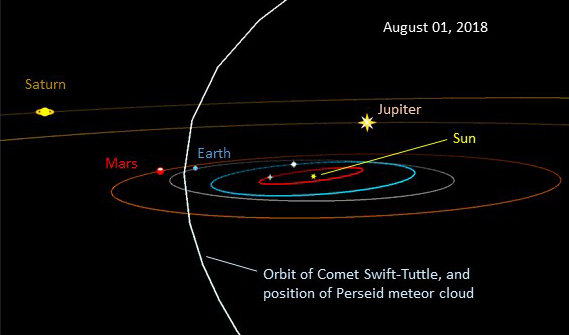
The Perseid meteors originate from the orbit of comet Swift-Tuttle which crosses the plane of earth’s orbit – we come closest on August 11-13. Image by RAP from TheSkyX software.
Mars Dust Storm. The planets have been perfectly positioned this summer for telescope observing. Venus, Jupiter, Saturn, and Mars are all readily accessible now from dusk to midnight. In June, I raised the prospect of top quality Mars observing – at AAAP observatory or wherever you may be – as the red planet approaches opposition (closest approach to earth, within 36 million miles, at the end of July). Unfortunately, the opposition has arrived with a major planet-wide dust-storm raging on Mars. This is bigger in scale than the storm portrayed in the movie “The Martian”, based on the best-selling book by Andy Weir. The dust-storm has obscured surface markings and even major geographic details such as the polar ice caps (not to mention the canals : >). All we can see through telescopes is the intense red color of Mars disk. There is still hope that the storm will abate while we are close to opposition, but there appears to be a correlation of large Martian dust storms and orbital position of the planet. As you’ve probably read, the NASA Mars rovers are affected. The atmosphere became so opaque with dust that Opportunity rover was shut down because its solar panels are unable to recharge batteries. Fortunately, Curiosity rover is powered by plutonium thermo-electricity and is not threatened.
Skynet – Remote Astro-Imaging for Members. AAAP continues to sponsor member access to remote astro-imaging through UNC-Chapel Hill’s Skynet robotic telescope network. The telescopes are located all over the world, typically 16” imaging scopes of Ritchey Chretien pedigree with high quality large format CCD cameras. AAAP has paid for member access to the system under a contract with UNC Astronomy Dept, extending through next June. If you’re a newer member and have not yet tried this out, send me an e-mail note to get set up (). Training videos are included and you do not need prior imaging experience to begin learning with Skynet! Full details are in the June 2017 issue of
Sidereal Times available on the website under Newsletter/Sidereal Times Archives). Also see UNC’s Skynet website, .
Announcement – Mark Your Calendar
Jersey StarQuest (Oct 5-6, 2018). Once again we’ll be hosting the Jersey StarQuest astronomy weekend at the Hope Conference and Renewal Center in north Jersey http://camphope.org. This is a fun, educational, and inspiring observing-oriented event for both Friday and Saturday nights at one of the best relatively dark sky locations in the state. The Hope Center is located just north of I-80 a few miles north of Jenny Jump forest, and offers clean bunkhouse accommodations or camping on-site, and a kitchen for cooking if desired. Restaurants are within a few minutes’ drive. If you’re experienced or just beginning, a new member or veteran, even if you don’t own a telescope, here’s your chance to learn hands-on about astronomy and observing.
By Michael Mitrano
The income statements and balance sheet below show the AAAP’s financial results for the fiscal year that ended on June 30, 2018, and the AAAP’s financial position at the beginning and the end of the year.

The AAAP had a $457 deficit for the fiscal year. As during the year before, we made significant investments in the observatory. In fiscal year 2018 we replaced the Mallincam with two digital cameras and added the device that permits precise alignment of the two scopes on the south mount. StarQuest also had a substantial loss, as it did the year before.
Membership for fiscal year 2018 was good, with a total of 97 paid members by year end.
 Our cash balances and cumulative reserves remain close to $15 thousand, equaling roughly two years of the association’s expenses.
Please email to treasurer@princetonastronomy.org if you have any questions about the report.
by Richard Sherman
Mt. Lemmon Digital SLR Wide-Field Photo Class
WHO: minimum of 3 and maximum of 6 AAAP members for a private class with Sean Parker, professional photographer.
WHAT: Digital SLR wide-field private photographic class
WHEN: TBD, new moon; (from the Instructor: “they do have a heating room to stay warm while we shoot”). Upcoming new moons:
WHERE: Mt. Lemmon Sky Center. 90-120 minutes from Tuscon. More info at: https://skycenter.arizona.edu/content/welcome-skycenter
HOW MUCH? Total cost is ROUGHLY $650-$700 which includes:
What personal equipment will you need? (taken from last class offered March, 2017)
Recommended lenses from “Photography – Night Sky” by Jennifer Wu and James Martin:
————————
Other Details from the last public class offered (March, 2017)
What will you learn?
What is the workshop schedule (approximate)? (from the last public class offered March, 2017)
by Ted Frimet
carmen sandiego ?
A few months ago, AAAP Program Chair, Ira Polans, invited Dr. James Lowenthal of Smith College to lecture our club on a Tuesday night, in Princeton. Dr. Lowenthal wooed us with his Hubble Space Telescope (HST) time, and his nascent discovery of multiple gravitational lensing events. I am especially indebted to Dr. Lowenthal for taking the time, and for extending an invitation to peruse his name, on open source images. All of which can be found as a MAST data retrieval request from, the archival hot seat at STSCI.
If you go back a few issues, and re-visit Fiddle-Dee-Dee (https://princetonastronomy.wordpress.com/2018/05/01/fiddle-dee-dee/)
you will find our first attempt to colorize HST images.
Now that time permits, post lecture of course, we visit, however contritely, three images produced by the progeny of of Dr. Lowenthal’s space telescope time.
Below is a reprint of HST Proposal 8191, obtained from
http://archive.stsci.edu/proposal_search.php?id=8191&mission=hst
last visited on July 7, 2018
We propose deep WFPC2 imaging and STIS slitless spectroscopy of two of our ultra-deep VLA fields. Those 4- and 6-cm maps have 1-Sigma levels of 3 and 11 Mu-Jy, respectively, comparable to VLA observations of the HDF, and show 14 and 9 sources in statistically complete samples. Keck spectroscopy and imaging to B, R, I ~26.5 have identified most of the sources as compact, luminous starbursting and interacting galaxies at redshifts z es1; about 25 at z>1.5. Our goals here are: {1} identify the remaining sources; {2} pinpoint regions of star formation; {3} quantify the incidence of interaction using spatially-resolved kinematics; {4} quantify morphologies; and {5} constrain the evolution of these faintest of radio sources. Only the HDF and one other field have such deep VLA, HST, and Keck data, and there is strong evidence that field-to-field variations are significant. WFPC2 images with F814 will provide the resolution needed to measure morphologies on sub-kpc scales, identify interaction- induced star-formation, and distinguish AGN from non-AGN components. Slitless spectroscopy with STIS will reveal faint emission-line sources invisible in our Keck images and will provide spatially-resolved kinematics, necessary to disentangle the star forming components in interacting systems. The VLA fields extend over some 8 min each, so both WFPC2 and STIS can be used simultaneously.
Giddy with the tedious nature of the above abstract proposal, we ventured forth, with the good doctor’s permission, to colorize some, if not all of his open source material. It is in the spirit of this good old graphic digital designers intent; an attempt to highlight what may not have been visible in the plain, and very ordinary black and white deep field HST images, for our lecturers intended purpose.
Clearly, what you are about to view are not the many-color girded view of HST deep space photographs. It is, however, the result of combining three very well related images that represent the gravitational lensing effects that Dr. Lowenthal was studying. It is noteworthy and memorially correct to note, here, that Dr. Lowenthal discovered more gravitational lensing effects, than any other well placed study, in recent memory. I could further enhance the image to produce a self-evident Einstein Ring. However, that would be as mischievous as the HST graphic artist painting an UV emitting White Dwarf, well, white!
So, without further adieu, here is my first, and probably last attempt at false-coloring Hubble Deep Space, highly luminous, and strongly lensed sub-millimeter galaxies. All source images used are public release in the Mikowsky archives, with study done by Dr. James Lowenthal.
red channel:
O5G101010
RA (J2000) 08 44 44.043
Dec (J2000) +44 31 58.56
start time 2001-01-25 14:58:28
end time 2001-01-25 15:05:52
exposure time 400.000
green channel:
O5G102010
08 44 43.981
+44 31 59.91
2001-01-22 11:24:44
2001-01-22 11:32:08
400.000
blue channel:
O5G103010
08 44 44.149
+44 32 00.79
2001-01-27 10:24:56
2001-01-27 10:32:20
400.000
Each frame was “centered-on” in Photoshop, and a minor curve was applied
Further credit to:
Papers related to proposal id:
The morphology of nine radio-selected faint galaxies from deep Hubble Space Telescope imaging — Roche, Nathan D. et al 2002MNRAS.337..840R
Here are the three “untouched” images:
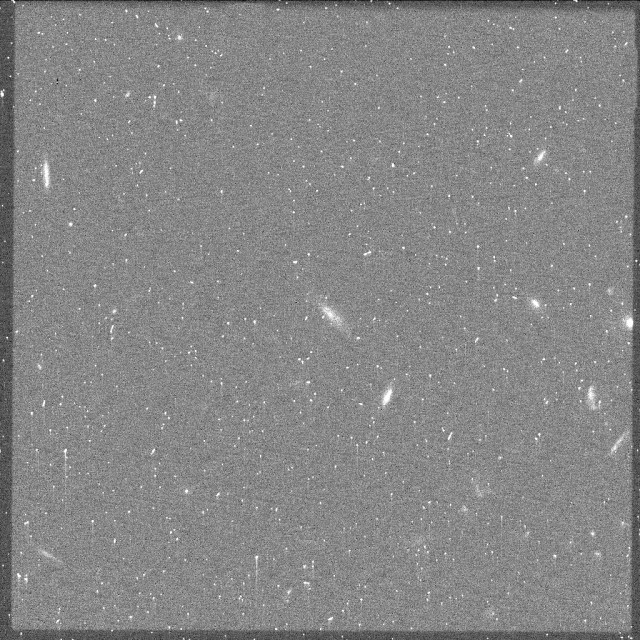
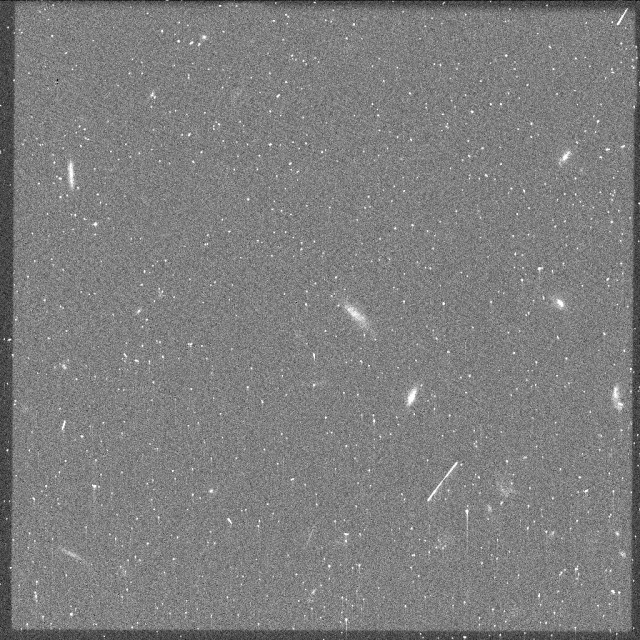
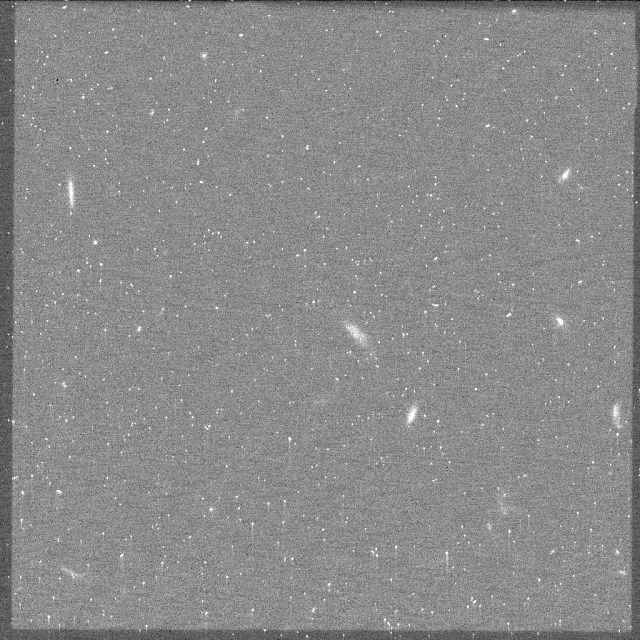
And here is our composite graphic:
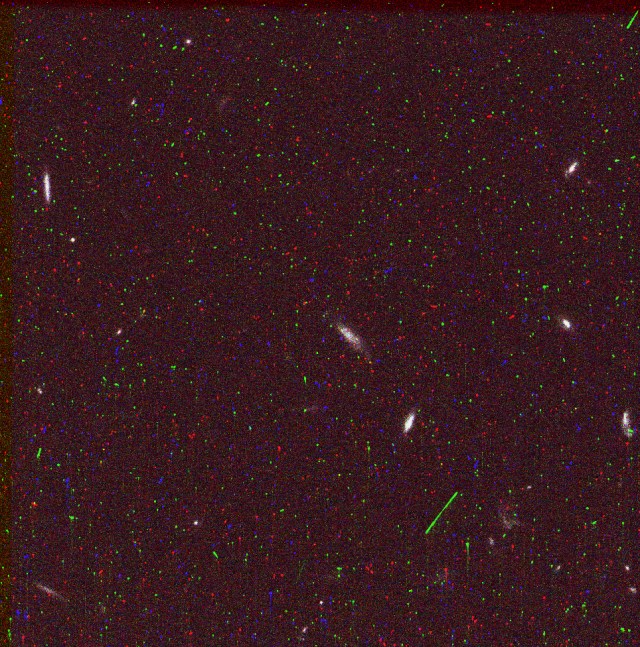
by Ted Frimet
Blazing Saddles!
Astra inclinant, sed non obligant.
In the Verge(1), Loren Grush reports neutrino detection from a Blazar, as does author Daniel Clery in this weeks Science(2).
Good articles, easy to read and learned a pant-lode.
I took a great deal of notes, from the D. Clery write-up, and wanted to get an input on the below. So I scrambled this write up, and posted to my Google+ Astronomy hang-out. So far, no taker on my commentary or question. I suspect that, unlike the multi-messenger service provided to the likes of Blazar identification, and neutrino co-relation, my flaring source of “irridium” will take the slower, anthropoetic observers trail.
Okay. Anthropoetic. I just made that up. So I better come up with some Anthro-poetry, post-haste!
Look out the window and what do you see
A bird, a bee, and a reflection of me
I might need to reconnect with an Astrophysicist or two. Neutrino astronomy is making me daffy! Would someone step up to the plate and recommend one for me? I am being left with the confounded notion that high energy gamma ray producers are knocking head and tails against cosmic rays, accelerating them to evolve to high-energy neutrinos. The likes of up to 400 GeV.
Has Blazar TXS 0506+056 been co-related with IceCube-170922A at 290 GeV ? Despite the alert, and crucial observations across a broad range of wavelengths, a 5-sigma has not been established. Clery reports that IceCube and other observers agree on a one in 740 chance. Still looking for love in the all the wrong places? Scientists will require a confirmation at 1 in 3,500,000 probability for other than coincidence.
Daniel writes, “If the IceCube team is right, blazars could be the first confirmed source of these cosmic rays”. I am pretty sure he was referring to this specific neutrino detection. Or at least, I was hopeful. Although, I didn’t “feel it”. Hence this essay.
Because the different parts of my brain, have a jitter pattern that is unparalleled in all of neuroscience, you know that didn’t sit quite right in ye crawl space. Forgive me my rant, as I recall a Princeton lecture, hosted by our club, given by Dr Jia Liu.
The talk was given on September 13, 2016 at 7:30PM in Peyton Hall on the Princeton University campus. Titled, “Neutrinos: Their discovery, detection, and future prospects” by Princeton University Postdoctoral Fellow Dr. Jia Liu.
I commiserated, this past Friday night, as I substituted on Team One observation duty, with fellow Amateur Astronomer, Thomas Swords. Tom pointed out how our lectures eventually reinforce a knowledge base and understanding for more recent developing events. He was so, spot on!
In her lecture, Dr Liu taught us about the three flavors of neutrinos that evening, long ago, and spoke of the many detectors, then in place. It prompted my to poke a little further, and stir my memory. More jitters.
In his compositional essay, co-editor S. Prasad Ganti, writes:
The “Kamiokande detector in Japan, also known as Super K, detected the first neutrinos from outside of the solar system from the 1987A supernova in the Large Magellanic Cloud, a satellite galaxy of the Milky Way located 160,000 light years away. Ray Davis and Masatoshi Koshiba,the Director of Super K, won the Nobel Prize in Physics in 2002.”(3)
Am I off base, in suggesting that Clery might have been more precise writing: “the first confirmed source of these cosmic rays from a blazar”. I am nit-picking. Am I not? Or did the Super K team not confirm the the first neutrino detection, from outside our Milky Way?
I could yield to the Neutrino Antarctic detector IceCube and the confirmation by the Fermi Gamma Ray Space Telescope. No yielding, unless I feel it. And I am not getting that warm fuzzy feeling. Not just yet. Especially so, when a summary reporting author over looked the Super K.
In the Dalai Lama’s ideation there are three types of wisdom (4). We have already surpassed the first stage of hearing, or reading. As of the time of this essay, I have placed us at the second stage, immersed with the constant familiarity of a topic. Have we arrived, finally at the third stage? Are we able to feel it?
When you feel it, let me know. I don’t want to be out in the cold, during the next confirmed Antarctic light show. I want to believe. Really, believe. Though, Astra inclinant, sed non obligant.
Finding the birthplace of a deep-space neutrino
This is an in-depth news story review of research articles pp. 146-147 lbid
Prasad is the current co_editor of the Sidereal Times, The official publication of the Amateur Astronomers Association of Princeton
by Ted Frimet
man bites dog
There comes a time in every amateur astronomers life, when they have to come to terms with real astronomy. I used to be fond of saying, from time to time, that “real men eat quiche”. Now-a-days, I am fine tuning my hind-brain to accommodate a phrase, “real amateur astronomers understand what makes a cepheid variable, variable”.
Too long? Yeah, I get that all the time. In a Dale Carnegie course, I was taught to make it simpler, smaller, and with fewer words. How about, “helium sucks light”? That might be more akin to “man bites dog”. For Astronomers, anyway, it entices you to read on. Where is Hubble, when you really need him? Probably lurking in the shadows of my discontent, stroking along with Schroedinger’s cat. Meow.
At one or more points in time, over the last two years, I managed to get confused between type 1A supernovas and Cepheid variables. I know, I know – “how is that even possible”, you ask? It is because in the ven diagram of my mind, I see them both as astronomical distance measurement tools. And now, sitting down to one, or the other, to study, I choose to make short work of the cepheid variable. I do this, because I don’t want to visit fermi pressures on compressed star matter before it nova’s. It is simply not in my wheel house, this fine Fourth of July morning. You know, on second thought, a nova is more akin to galactic fireworks display. And truth be told, it is simply more like fireworks, to me.
However, today I am in a particularly gaffy mood. I have not been able to coordinate two telescopes for a parallax study. Hence, I am not entirely pumped up for a fireworks display. And this is to your benefit, as we get to get a closer look into not what a cepheid variable is, but the more pedantic reason as to the how, or why the light intensity is periodic in the first place. And when we’re done, please do not think the lesser of me, when I suggest, now, that Cepheid Variables are reminiscent of first light in the Universe. Oh, come on now! Keep an open mind for my cat’s’ sake?
I started to draw upon reference to laboratory exercises, on Cepheid Variables and the Cosmic Distance Scale (1). And within their reprint, lurking on a page, I find Shapley’s Calibration. A formula of M = m + 5 – 5 log d. I can’t express my happiness in finding such consolation in a mathematical formulae. That is, having used it, previously in magnitude calculations essays’ of old, it is like stumbling across an old friend. I never knew that math could be that way. I understand, at least from the froth of a good cup of coffee, why professional mathematicians get all gawky eyed. Like adolescents at their first dance party, they see and appreciate simple quantifications.
I’ve read the article, and didn’t want to mess up the virgin grid, provided in the fold-out. Hence, I didn’t forge forward to Baades’ Calibration. Frankly, I didn’t want to get further distracted by how the early distances to Andromeda were poorly estimated. I recall, from recent memory, how I’ve been off by more than 20 percent, in my own error. (Ok, for those of you that remember my early asteroid VT calculations, it had more error than our ancestral astronomers, not named above.) And why should I drag you to the depths of our earliest primordial history, too? Instead, let’s hop over to “The Universe Around Us”, by Sir James Jeans.
Sir Isaac Newtown, gave us gravity with an explanation left to the likes of Einstein, 228 years later. Sir James, it appears, went the same route. “Whatever their mechanisms may be [cepheid variables], observation shews that these stars possess a certain definite property, which proves to be of the utmost value.” (2) Published September 1929, perhaps we are making some progress, as our musing are now only 90 years apart? The Universe(s) may be vast, and the study of its Cosmology appears to us in the blink of an eye. Two shakes of a lambs tail? A blink of thine eye? No, just kidding. Almost a century passes us by, and still it falls upon the shoulders of the amateur to breach the dam, bypass the scholastic, and come to the point! If ye be bored, tarry here, no more. I’ve got more interstellar molasses to wade thru, before I blow up my birthday balloon.
It is a tantalizing read, that is, on the light curves of variables. Especially so, when I muse out loud, “As we go from the ultraviolet to the red end of the spectrum for any particular Cepheid, the light curves flatten out, indicating that the range of variation in luminosity is much wider in the ultraviolet than it is in the infrared” (3). Ah, music to my ears, a delight to the mind to read. Almost, we get the tantalizing taste of a spectrum of color, from the less human visuals of ultraviolet (bugs be damned, as they can sense UV quite well!) to the lovely warm cloaca of infrared. And as we stumble across the work of A.H. Joy, on the interesting characteristic of the period of W Virginis stars (2 to 75 days – ibid p214), a probability occurs to that author. That some “material” is going thru an expansion and contraction. Oh, so close! So close, indeed.
As I peruse The AAVSO Variable Star Atlas (4), a tome, titled, “Sky and Telescope”, pops out onto my table, before me. Ever so hopeful to study matter, over time. Mattei, Mayer and Baldwin, bring to my attention that more than 25,000 stars are variable. (as of the time of their editing, circa 1980). And their time scales ranged from fewer than minutes to centuries. I would be remiss not sharing with you my opinion, that time does not matter, here. That the curtain of gas, that periodically hides the light from my telescope, is what is of importance. Here, it is matter, and not time that I seek. And what is that, which matters most? How do I find it? Do we set the stage, and let Shakespeare determine both our entrance and exit? Let us move to the beginning, and bring to life the Boatswain. He sweeps us aside during the tempest, and conveys that we have enough room to run around the storm!
I crawl from under the weight of my books, my tempest, and key into Wikipedia, https://en.wikipedia.org/wiki/Cepheid_variable (5). It’s author(s), brings to light so simply that it is the veil of Helium that obscures our light. That during the due course of ionizing helium, the ionized gas becomes opaque, even more so, when both electrons are stripped off. The trapping of heat, that is an increase in temperature, causes an expansion. And with this expansion comes a subsequent cooling; it becomes less ionized, permitting contraction, and allowing starlight to escape. It is known as the Eddington Valve (or kappa-mechanism).
I leave you with the pedantic solution we agreed upon, at the beginning, where I suggested that Helium sucks light. If you were to stay the course, with me, to this point – I shall now beg your forgiveness over the time-length of the essay, as the books, were truly so heavy that they imbued their own gravitational effect and were a cause of space-time dilation. Just ask Einstein.
Citations and References:
1) Pasachoff, J. M., & Goebel, R. W. (1979). Laboratory Exercises in Astronomy – Cepheid Variables and the Cosmic Distance Scale. In Reprinted from Sky and Telescope (pp. 241-244). Cambridge, MA: Sky Publishing. p243 referenced, in the essay.
2) Jeans, J. (1934). The Universe Around Us p62 (3rd ed.). NY: The MacMillan Company.
Sir James Jeans, M.A., D.Sc., Sc.D., LL.D., F.R.S.
3) Motz, L., & Duveen, A. (1967). Essentials of Astronomy. p415, Belmont, CA: Wadsworth Publishing Company.
4) Scovil, C. E., & Robinson, L. J. (1980). The AAVSO Variable Star Atlas (2nd ed.). Cambridge, MA: Sky Publ., with The “Sky and Telescope” Guide to the Heavens, Edited by Leif J. Robinson, Sky Publishing Corporation, 1980.
5) Cepheid variable. (2018, June 27). Retrieved July 4, 2018, from https://en.wikipedia.org/wiki/Cepheid_variable. detail: Smith, D. H. (1984). “Eddington’s Valve and Cepheid Pulsations”. Sky and Telescope. 68: 519. Bibcode:1984S&T….68..519S. Eddington’s Valve and Cepheid Pulsations Smith, D. H. Abstract. Please note: No abstract found. Publication Sky and Telescope, Vol. 68, NO. 6/DEC, P.519, 1984 Pub Date: December 1984 Bibcode 1984S&T….68..519S

 Amateur Astronomers Association of Princeton