string of pearls…

by Theodore R. Frimet

…and puddle ducks

A while ago, I acquired a Swift phase contrast microscope. It became a replacement for my failed attempt to revive a binocular, standard light version. It did not, however, replace my single ocular Reichart-Jung, which continues to give me the occasional Waa-hooh ! It takes the brain, a few days, to synchronize the binocular views, though.

Invariably, without some acquired experience, a first time user for a binocular version, might very well become quickly disenchanted with the view. Almost. I almost quit the scope. I lingered on, adjusting the inter-pupillary distance, while making some small, unnecessary eye-to-lens distance shifts. All was well, within a few days, perhaps a week, or two. I do not remember.

Janet has, of course, been very supportive. There never would be a quarrel of selling off one microscope, and then acquiring another. Let’s keep it between you, and me, though, that a phase contrast view has been my dream, in the makings, for many years. And it finally became prioritized, care of eBay. And of course, my former bino ‘scope became someones enchanted value of the day.

About two weeks ago, I recalled that I had acquired a pencil set. It was purchased to expand my ever recurring art desires in pastel, oil, acrylic, watercolor, and charcoal. It lay forgotten, in a bag, not retrieved since our trip to the South of France, in the Principality of Monaco, and of course, Paris. The pencils made their appearance only twice, on that single solitary trip of ours. One was to capture the inner court of our state room, and the second to capture a beach side scene. Both at Monaco. The beach scene probably survives, somewhere in the cavern of my closet. While the former was given as a gift to the hotel concierge. It was at that point, where the hotel thus increased its four star rating, to a five star. Or so I felt, at the time. Happy thoughts, and good times.

Where is the tie-in for Astronomy, you query? Well, look over our first paragraph. And relish in the thoughts that astronomers are known for their take on binoculars for the beginner, as well as for the intermediate user. And those of us that are advanced, are quick to espouse the binocular hands held version for a quick peek into the night sky, where a more elaborate set-up would simply take too darn long.

And now the epiphany. My binoculars do not take hours, days, or weeks to adjust to. There must be something incorrect with the Swift! By now, of course, having my biological vision auto-adjusted, has probably done something to my human depth of field view. I wouldn’t know, of course, as I stream through most of my daily life, leaving the interweaving of reality to my hind brain, and turn off the fore-brain. Yes, I steer from behind, with rear wheel drive! Perhaps I should invest in an all wheel version just as Janet has in her Nissan Rogue. I dunno.

And then there is mention, in the third paragraph, of a sell off. Yes, come clean, all of you! How many telescopes have you acquired, and told your significant other, friends or family, that the old scope will be sold off? Some do, some don’t? Doubtful. You are all complicit in the conspiracy of telescope inventory. Yes, you say there is merit in that old scope, even in the sixth or seventh one that you hold near and dear. You find utility in each and every one of them. Well, perhaps not that third telescope. It can go.

Will you accept a diminished amount for that dear scope that you once cherished? Believe you, me, that when we depart into the great abyss that is the Heart and Soul of Orion, your second hand telescopes will find their way to Earth bound friends, and charity alike. Do part with what you have now, and do so quickly and on the cheap.

Puddle Ducks and Benjamin Bunny, alike, were initially imagined by Beatrix Potter to appear on her pages as black and white images. Ms Potter preferred this thought, upon greeting her first publisher. She desired to make her first new book financially available to as many people as possible. Her publisher, knew better as a printer, that by limiting the illustrations that many could appear on one sheet. Together, they would drive the immense publishing costs down. Beatrix, not knowing that this was possible, was very pleased to find out that she could publish in color, and make her first book very affordable! Imagine, dear amateur, if you unleashed your inventory, onto thirsting eyes, and did so at the scale of economy of Beatrix. Telescopes for all ! Eyes, new and old, will begin to see anew, and at very, very affordable prices.

Ah, the pencil set. I recalled I had it, somewhere, found it and liberated it, once again. All that was needed was a quick stop at the craft store to purchase a small format sketch book. I am an artist, although not a very good one. I find it very effort intensive to look into the microscope, and draw what my eye sees. By making the sketch, I know that I am reinforcing a learned view into the environment of the very small. It can be very rewarding. So I wait for the reward. The epiphany. And it comes. Some days the effect is stronger than others. Today it was a triple wave of goose-bumps. You know, the same you get when you peer into the night sky for that evasive cluster of star light wonder!

As I am drawing the view of a motor neuron, at 400x, phase contrast, I make observations post haste. The visual is now one of what is on the paper, and not relied upon from the birds eye view at the scope. That magical eye hand connection that has been forged into the recess of my neurological essence, breathe life anew. I look at the extrusions of cellular material making up the axons, as they reach out on the sketch paper below – surrounded by glial cells. And I wonder where all the astral-cells have gone to?
I ponder the relationship that all cells have in common. And of course, come to the conclusion that all cells are the same. Yes, structure is different, here and there. Yes, our genetic differentiation has turned off some pathways, and turned others on. And yet, here we are. All biological beings composed of basic cellular units. One cell, is not superior to any other. My goose bumps now comes in waves.

When I compare the singularity of cellular make up, at they eyepiece, I find all images not being the greater, nor the lesser. When I extrapolate what I see, and fail me not – our tissues, organs, and systems are neither more or less the complex. If we, by extension, think of other completely self contained biological beings as being more or less complex, we fail in our theory to suggest that one is grander than the other. My neurological complex is more capable of my cats. So, we must be superior? Well, my cats’ biology contains within features that are far superior in many ways. So why do we make comparison by way of neurology, when all life, it would seem, is in need of equal recognition? Yes, we are separate, and we are all same. Our cells are very telling.

Our brains, and sensory based systems, coupled with cognition permit our experiencing a wide sense of who you are. Cells. Evolution has driven them to exact from our environment all that we can perceive to be real. Could there be a universal evolution that transcends our minor standing in the Cosmos?

For others it would take a leap of faith to comprehend that the universe evolves. For amateur astronomers, it is pretty much a more simpler fare. What then is the cellular system that makes up the universe? At first, I thought, stars. Then it occurs that the material that accretes and in basic theory requires a blasting gravitational shock wave to coalesce into a vast self-igniting massive sight of brilliance. I relish for a brief moment in permitting my mind to recreate stellar nurseries. And then my mind drifts to Earth. Planets. Could they be the cell that we build up our universe with? There are so many. I thought, no, wrong banana peel. Yet, the thought of planets took hold. If cells communicate with each other (they do by the way – interstitially and all the time) then our cell of an earth must have tell tale signs of an intra-universal conversation.

Does it ring out if struck? Where are our vibrations, from the core of our very planets existence. Does our geology ring out with a regular tune of life, singing out to the void that, “we are here”? Perhaps not. Don’t worry. Be happy. It is in your very cellular make up to contribute a conversation to the universe.

We are remote, and separate and all so distant from every other galaxy, known or not. Not to worry. Even the saplings root system reaches out laterally and most aggressively in the absence of water. When nature does not provide us with the nourishment of life’s sustenance, our cells are programmed to begin its inevitable search. The cooperative birthings that we are of our planets geology coupled with the living representation of spent stars of old, both fuels the saga and sanguine search thru our Cosmos. And where the light fails, we are programmed to reach out and become anew.

You are, remember, made up of the stuff that stars are made up of? And even though that you do not burn the wick at both ends, your biology has made a compromise with organelles, such as mitochondria, to power you up with immense fortitude and the certainty of a battery at large. What combination of microcellular life or elemental material is then necessary to communicate across the void? What is within the earth and its inhabitants that enable us both to speak across the vastness of spacetime?

I think it is you, dear amateur. You embody the richness of energy and capability to transit spacetime. You all are enablers of consciousness and communicate with and thru the depths of space. Hearken all my Benjamin Bunnies, and Puddle Ducks! Whenever, and where-ever you peer into the night sky, you make connections that others are simply unaware of. It is profound, that you all make the connections of inter-galactic intelligence possible at the eye piece. It is a scary thought, though, that I am part of that consciousness. You are always transcendent. Even when the skies are cloudy. When you steep your soul at the scope, you appear with all your being, your Gaia, Sol, our great Spiral, and Local Group. Perhaps we are not cells. Perhaps we have evolved to be something more. Yes. We are a string of pearls.

Posted in February 2019, Sidereal Times | Tagged | Leave a comment

Magnetar Extinction

by Theodore R. Frimet

Why earth lets us live

You know, sometimes it really is the simple things in life that I enjoy the most. Microscopy is among one of them. Imagine my glee upon rediscovering the less obvious connection between neuronal axons and loose connective tissues filaments. Not there yet? No prob, Bob.

Both loose connective tissues and neural cells have their own associated glutamate receptors. In the case of neural tissue, the presence of excess glutamate (processed from MSG) can be deleterious to the cell. MSG is a known excitotoxin. It will excite the neurons to death. Ca+ ions will stream into the cell. The neuron will pump water across the membrane in attempt to mitigate the influx of Ca+. There will be a downstream, to the death, excitation of other neurons. Entire populations of neural nets can be lost in this fashion.

Ok – such a stretch, I know – yet the affects are so well known that scientists use MSG to burn out optic nerves for biological testing protocols. Too much? Where is the link to loose connective tissue? And where is the tie in to Astronomy, Astrophysics, or even, dare I say, Cosmology? Patience, my dear Astronomer, as I attempt to weave a short story for you, combining the Good Earth, Evolution and our Cosmos.

Ah, yes. How then ‘the link’ to loose connective tissue? As I had the little beastie prepared for me, under a phase contrast microscope at 400X, a hypotheses blinked into existence. Could it be possible that loose connective tissue, as being sensitized at glutamate receptors, also carry a pseudo axonal message, alongside her fibre? And further exchange this lost message, interstitially, and chaotically? All the while being interpreted as pain? Hmmm.

A Google search later, and a paper of a few years old found me relishing in the work of where drugs were sought after, and used. The sample study effectively blocked glutamate receptors, and subsequent pain from being transmitted thru the loose connective tissue network. Ok, so no longer a hypothesis. It was an older groundbreaking theory, of science long proven. A decade ago.

Which further got my old noggin thinking that drugs weren’t key. What was needed was an active way to induce endocytotic activity to engulf, absorb, and destroy the very receptors for these agonists. And when the local chronic pain had subsided, to cease said therapy. I pressed the hypothesis further to allow loose connective tissue to rebound and re-establish its network of glutamate receptors.

I bare my hypothetical hope at the ground before you. The natural reintroduction of these necessary receptors would no longer induce the agony of pain, in the form of Fibromyalgia. A short email to the papers author, and his subsequent reply, suggested that I as an amateur I should continue to pursue this study. It was a pretty good idea.

I realized that I needed to up my ante, and read a good book. However, texts are very expensive. I do not have the finances to further any microbiological study for a few hundred dollars. Ah, yes! Astronomy will have its way with my fancy – yet my other passions will continue to “take a number, please”. I shall be forever patient for social security to kick in, as an income supplement. However, there will still persist prima facie financial priori.

Of course there is the premise of used books. There is amongst us a treasure trove of decently discounted tomes. A few minutes searching comes up with a 4th edition version of the 8th edition available for Molecular Cellular Biology. Lodish, circa 2000, it seems, comes highly recommended. Having wrent the first chapter as an easy read – it blazes before me the old human thought – that we are so very complex.

I hold an integrated view of the last 65 million years or so. We have graduated by ways of evolution from my favorite cousin, the Lesser Tree Shew, to human beings (sans the narrative of genetic suppression and an expanded brain case and associated psychopathy). Shall we mention the great dying of the Permian about 250 million years ago (no shrews, I guess)? Let us toss back to about 4.7 billion years of alternating wet and dry periods, producing ribonucleic acid (RNA)? Yes, this is post the time when we had a catastrophic encounter with a massive wanderer that not only birthed our moon, it yielded a rather equal distribution of iron throughout old Gaia. Yes, “rust never sleeps” – Neil Young.

What the heck!? My toy train left the station on the wrong track. Just for a moment. Ah, yes. Evolution. We should not be here, and yet here we are.

I am a fool for the old girl and her coddling. We hold a common genetic heritage that remains a constant reminder of not what we kept intact. Evolution has suppressed or thrown out much of the grist mill of my genome and made us unique. Nature has conspiratorial forces at work. You just didn’t know you were the 2nd stringer. No more bench warming for the human race. Coach says, “it is almost time to get skin in the game”.

There you have it. Life evolves on the basis of a driving force that we have all learned to respect. And yet, we are still here. Perhaps not for very much longer. And I got to thinking, that maybe, after all, we will be here for quite a spell? So sit down, and pull up a chair, if you will. Ok, stand if you must. This one is going to be a real knee slapper!!

Earth will permit us the grace of continued existence and to evolve a bit further. It will be her effort to drive off the inevitable destruction of all life. Gaia is a good mother, and would never permit it, again. She might give us all a good spanking, as she did during the Permian, though.

Evolution has learned a few new tricks, and the human experience is one of them. Gaia is banking on the cosmological currency that a magnetar will star quake. At the speed of light, we will be hit with disastrous amounts of highly energetic particles. It will leave us us naked, and dead.

Fortunately, cosmological distances are huge. The extreme vastness of space blankets us with an extensive time delay. However, believe you me, if the source of a magnetar on steroids happens, there will be some serious accounting in the works. So Gaia has established that you will evolve, and give her earthlings the help that they will need to survive. No sentient mother wants another great Permian die off. Vulcanism aside, neither are the great asteroid impacts on anyones shopping list.

What? Move the planet? Relocate species? I dunno. A lady doesn’t tell all, does she? However, for as certain as I am that salmon swim upstream, spawn and die, so shall we all meet our greatest definition of “why are we here”.

Answer? In the event of a cosmological catastrophic event, please remain calm, as you will reach your own genetic potential, and save the Earth. However, after consulting the 1995 film, Braveheart, “The Almighty tells me he can get me out of this mess, but he’s pretty sure you’re ****ed.”

Posted in February 2019, Sidereal Times | Tagged | Leave a comment

New Horizons

by Prasad Ganti

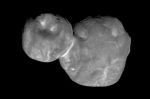
On the new year’s day, 2019, NASA’s New Horizons spacecraft passed the most distant object in our solar system, which any human made spacecraft came close to. This object is about four billion miles away from Earth, and a billion miles away from Pluto, the demoted planet and furthest one from Earth and thus the Sun. New Horizons is now so far that the radio signal takes about six hours to reach the Earth. At just twenty miles in size, shaped like a snowman with two spheres, it was a challenge to identify the new destination once New Horizons reached Pluto, and even greater challenge to navigate towards such a nondescript object at such a vast distance.

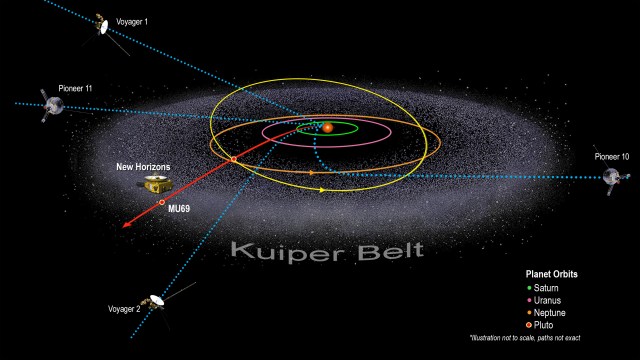
Pluto and Ultima Thule belong to the part of the solar system called Kuiper Belt (picture shown below), consisting of bits and pieces of rock and ice. They are supposed to be remnants of the formation of our solar system, much like the asteroid belt between Mars and Jupiter. New Horizons joins the club of spacecraft like Pioneer 10 and 11 and Voyager 1 and 2, which are at the edge of the solar system. Picture below shows the Kuiper belt and the different spacecraft and where they are relative to each other.

New Horizons is the fifth spacecraft to traverse the Kuiper Belt, but the first to conduct a scientific study of this mysterious region beyond Neptune. Credit: NASA/JHUAPL/SwRI/Magda Saina

The pictures we got of Ultima Thule are very rudimentary, with fewer pixels in them. That is because of the slow speeds of data transmission at thousand bits per second, all of it relayed by a radio transmitter sending out fifteen watts of energy. Such feeble energy is caught by NASA’s deep space network. The transmission can be done when Sun is not in the path to Earth. It will take roughly twenty months to send home all of the newly collected seven gigabits of data about Ultima Thule. The geology and composition, as well as the potential for rings or moons, will be beamed home first.

The data transmission speeds and the radio transmitter appear to be primitive. Considering that the New Horizons was launched in 2006 after years of design, it is a wonder that the technology works so well at such huge distances. The saga of conceiving, designing, launching and operating of New Horizons is well chronicled in the book “Chasing New Horizons” by Alan Stern who is the PI (Principal Investigator) for the project. The PI is the person who conceives the idea and sells it to NASA and carries it to fruition.

When Voyager 1 and 2 were launched in 1977, they went on a grand tour of all the outer planets. While Voyager 1 went towards Jupiter and Saturn, it was pulled off path to investigate Titan. It then veered off from the plane of the planets, with no chance of ever going to Pluto. Voyager 2 went to Uranus and Neptune, it was not destined to travel towards Pluto, as Pluto was at a different place in its orbit around the Sun at that time. Thus Pluto became the only planet not to have been visited by any spacecraft.

NASA has many competing proposals, all vying for the reducing budgets. Pluto mission, titled New Horizons, barely won the competition at the beginning of the century. Work started at a feverish pace. New Horizons was to be the fastest launched spacecraft, given the vast distance it had to traverse. Atlas V was the launch vehicle, with a custom built third stage solid rocket added atop to boost the fastest launched spacecraft towards Jupiter. Going so far away from the Sun meant that it had to use nuclear power (solar power is too feeble at such distances from the Sun). RTG (Radioisotope Thermoelectric Generator) uses plutonium packaged in small pellets made of plutonium dioxide. Clad in iridium and bottled up inside a black graphite casing. The radioactive decay produces heat which is used in a thermocouple producing 250 watts. 250 watts is equivalent of about four ordinary electric bulbs, During the long journey, all the systems in the spacecraft were put into hibernation. This also meant that the staffing at mission control was down to bare minimum. The systems on the spacecraft were very skeletal. There was no scan platform to turn the instruments during a flyby. It was simply too heavy. Cameras (capture light to take pictures) and spectrometers (which analyze the various frequencies present in a given sample of light) are the typical instruments used for such exploration.

On such a long journey, re-orienting the spacecraft is required. The initial aim may not be very accurate. ALMA (Atacama Large Millimeter Array), the ground based radio telescope in Chile, was used to correct the path of the New Horizons, as it sped towards Pluto after getting a gravity assist from Jupiter. With the proper maneuvering as it neared Jupiter, it got flung by Jupiter’s massive gravity towards Pluto. Like getting a free push.

As it neared Pluto in 2015, the mission control came back fully staffed to prepare for the flyby procedures. Days before the flyby, mission control lost communication with the spacecraft. During those nervous moments, the staff correctly guessed that the on-board computer became overloaded while compressing images. They restarted the computer and were able to recover most of the image files. And then loaded the computer with the sequenced commands for the flyby mission. Everything went well thereafter.

The space telescope Hubble was used to identify the distant object Ultima Thule, and when this small object moved in front of a star, its size was estimated as twenty miles (due to the dip in light from the star). The flyby of Ultima Thule was an accomplishment made beyond the initial goals of reaching Pluto. New Horizons is still alive and going. What is the next destination ? The excursion across the solar system covering tinier masses at the extreme edge is something amazing. These achievements are nothing short of a miracle.

Posted in February 2019, Sidereal Times | Tagged | Leave a comment

Snippets

compiled by Arlene & David Kaplan

NASA

-NASA

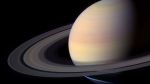
Saturn’s spectacular rings are ‘very young’
The end phases of the Cassini mission should yield new information about Saturn’s interior.
We’re looking at Saturn at a very special time in the history of the Solar System, according to scientists. They’ve confirmed the planet’s iconic rings are very young – no more than 100 million years old…more

China Moon probe-CLEP

China Moon probe-CLEP

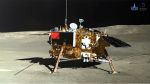
Chang’e-4: China Moon probes take snaps of each other
A Chinese rover and lander have taken images of each other on the Moon’s surface. Also released are new panoramic images of the landing site, along with video of the vehicles touching down. The Chang’e-4 mission is the first to explore the Moon’s far side from the surface…more

-Griffith Observatory

-Griffith Observatory

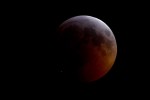
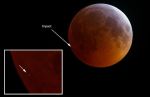
During the Lunar Eclipse, Something Slammed Into the Moon
A white dot in the bottom left corner of the moon captured by livestreams during this week’s lunar eclipse was a flash from a collision with the lunar surface likely caused by a tiny, fast-moving meteoroid left behind by a comet. Anthony Cook, an astronomical observer at Los Angeles’ Griffith Observatory which streamed the eclipse…more

NYT

-NYT

What Happened to Earth’s Ancient Craters?
Where have Earth’s craters gone? Certainly we have the striking Meteor Crater near Winslow, Arizona, and Chicxulub, which lies beneath Mexico’s Yucatán Peninsula, the 100-mile-wide scar of the meteor that likely killed off the dinosaurs. The pace of space rocks pummeling Earth and the moon was relatively infrequent, but then doubled or tripled for unknown reasons, a new study finds…more

-JAMIE COOPER PHOTOGRAPHY

-Jamie Cooper

‘Super blood wolf moon’ meteoroid strike photographed
A photographer has said capturing the rarely seen sight of a meteoroid crashing into the Moon was “just beautiful”. The odds of it happening in an area of darkness were “astronomical”…more

-NASA

-NASA

Nasa’s New Horizons
Best image yet of ‘space snowman’ Ultima Thule The New Horizons probe has sent back its best picture yet of the small, icy object Ultima Thule, which it flew past on New Year’s Day…more

Before we explored outer space, we tried to paint it
In 1939, artist Charles Bittinger imagined worlds we hadn’t traveled to yet—sometimes with impressive accuracy…more

Posted in February 2019, Sidereal Times | Tagged , | Leave a comment

From the Director

Rex


by Rex Parker, Director

Eyes and Instruments on Solar System Astronomy in 2019. A wonderful way to receive the new year’s promise of discovery is to get outside and engage in astronomy during these cold winter nights. Observing with whatever scope you have is best, and of course AAAP members have top notch instruments available at Washington Crossing Observatory. Historically our club has thrived on a steady diet of cosmology, but recent trends in solar system and exoplanetary astronomy are en vogue now for us as well as the professional community at Princeton and beyond.

This might reflect the remarkable and numerous exoplanet discoveries by NASA’s Kepler mission. The heliophysical boundary has recently been traversed by Voyager 1 & 2. Astrobiology and the origin of life is a hot, emerging interdisciplinary field in the scientific community. Both the Voyager and Cassini missions have revealed that Saturn’s moon Enceladus has conditions that are likely suitable to the origin extraterrestrial life. Ground-based telescopes have enticed the imagination with sightings of the enigmatic interstellar visitor, Oumuamua. NASA’s OSIRIS-REx arrived at the asteroid Bennu on Dec 3 after a 1.2 billion mile journey. The “Asteroid Redirect” project is advancing at NASA as a component of a future Mars mission. New data suggest hundreds of thousands of 100km class icy objects orbit within the Kuiper belt (outside Neptune) – and perhaps billions of comets! And the first human approach to a Kuiper belt object will happen around New Year’s Day, when NASA’s New Horizons spacecraft encounters the Kuiper Belt object “Ultima Thule”. The stage is set for the new year 2019 to fulfill a great potential for further advances in astronomy and allied sciences.

My First Asteroid. The idea that there are more, far more, solar system objects than commonly believed hit home for me this December. I had collected telescope imaging data overnight, photographing the seldom seen nebula LBN 741 located near the variable star Algol in the constellation Perseus. The LBN catalogue (Lynd’s Bright Nebulae) can be loaded with the database manager subroutine in TheSkyX software at AAAP Observatory. LBN 741 is a colorful though faint nebula unusual in having both emission and reflection components making it glow red and blue. When processing the data, a moving object that didn’t fit the main star chart jumped out. Might it be an asteroid? To check this I loaded The SkyX’s Large Asteroid Database (currently 789983 objects, available online from the Minor Planet Center of the Smithsonian Astrophysical Observatory) and set the Date/Time fields to match the image files. From this it was clear that I’d taken a photograph of Asteroid 584 Semiramis while it was crossing through Perseus that night, Dec 9. Semiramis of antiquity was the legendary queen regent of Babylon in the Assyrian empire in the 800’s BC. Semiramis of astronomy is a minor planet orbiting the sun in the main asteroid belt between Jupiter and Mars. It was discovered in 1906 and has since been found to have a radius of ~26 km, orbital period 3.7 years, rotation period of 5 days, and magnitude ~11 at the time of these images. Below is a video assembled from frames from the imaging, showing Semiramis moving across the field of the nebula over a couple of hours (taken with 12.5” telescope at f6.7 with SBIG-ST10 CCD camera). The finished astrophoto below the video link is LBN-741 showing its colors after about 18 hours of total data collection.

Asteroid Semiramis moving across the field ofLBN-741 in Perseus. Taken by Rex Parker with 12.5” f6.7 Cassegrain telescope and SBIG-ST10 CCD camera.

LBN-741 emission/reflection nebula in the constellation Perseus. The moving asteroid seen in the video has been “averaged out” in processing the final image. Astrophoto by Rex Parker from central NJ; taken with 12.5” f6.7 Cassegrain telescope and SBIG-ST10 CCD camera.

Posted in January 2019, Sidereal Times | Tagged , | Leave a comment

From the Program Chair

By Ira Polans

Frank Reed

Frank Reed

This month’s featured talk is by Frank Reed on “Celestial Navigation: History and Future”. Before GPS and radio-based navigation aids, mariners crossed the oceans by observing the Sun, the Moon, and the stars and planets. Celestial navigation or “nautical astronomy” was a science practiced by ordinary men and women. Anyone could learn to find latitude and longitude using the Sun and stars, and anyone can learn how today, by applying just a little math to observations made with an optical instrument known as a sextant. In this presentation, In this talk Frank Reed will describe some of the science underlying celestial navigation, as well as some of the history. We’ll also consider how this ancient science remains relevant in modern contexts, even on the surfaces of other planets, like Mars.

After opening remarks and before the featured talk, member Jeff Pinyan will give a 10 minute talk on the 342nd anniversary of the determination of the speed of light by Danish astronomer Ole Rømer. In 1676, a Danish astronomer named Ole Rømer predicted an eclipse of Jupiter’s moon Io would occur 10 minutes later than expected. In so doing, he presented the first demonstrable proof that light has a finite velocity.

Prior to the meeting a meet-the-speaker dinner will be held at Winberie’s in Palmer Square. If you’re interested in attending the dinner please let me know at program@princetonastronomy.org by noon on January 8th.

If you’re interested in giving a 10 minute talk please speak to me after the presentations are completed during the meeting or by email at program@princetonastronomy.org.

Looking forward to you joining us at the January AAAP meeting!

Posted in January 2019, Sidereal Times | Tagged , | Leave a comment

November 2018 meeting minutes

by Jim Poinsett

Rex called the meeting to order following the lecture on “Measuring the Historic Sky – DASCH – Digitizing a Sky Century at Harvard”

  • Rich Sherman proposed a field trip to Mt. Lemmon Sky Center near Tucson Arizona for an Astrophotography seminar using DLSR cameras. Weekend of March 9, 2019. There is room for 3-6 members, cost is $600 -$700 plus flights. Contact Rich at if interested.
  • Rex expressed the board’s thanks to all the keyholders for a successful 2018 observing season. The observatory was only open 11 out of 30 possible nights due to weather. A tweet was sent out on 28 of the 30 nights.
  • All 5 pins marking the observatory property have been located, there are no wetlands on the property.
  • The dew-shield on the C-14 was repaired.
  • The water supply was protected, it will be shut off by the time you read this.
  • The alignment of the Mewlon and H/B refractor will be worked on over the winter.
  • Rex showed examples of his color photography from his central NJ location. His point was to emphasize that there is color out there for the amateur to catch.
  • Next was a discussion on the report about asteroid Oumuamua being an alien light sail. It’s trajectory was definitely from outside our solar system. It slowed down as it approached the sun and sped up as it moved away, the opposite of gravitational attraction. It’s mass to surface area was less than 1 gram / cm2.
  • There will be an eclipse of the moon in January 2019.
  • The meeting was adjourned.
Posted in January 2019, Sidereal Times | Tagged , | Leave a comment

Page From the Past – March 1996

by Dave and Jennifer Skitt

The attached page from the AAAP Simpson Observatory Log Book dates back to March of 1996. The AAAP astronomers mentioned are Darryl F., Ralph Marantino, Saul Moroz, Chris Moser, Jim McFee, Bill Murray, Ron Mittelstaedt and G. Maro. The object of interest was “The Great Comet” Hyakutaki.

Comet Hyakutaki had been discovered barely two months earlier by Japanese amateur comet hunter Yuji Hyakutake. It was predicted by NASA to make its closest approach to earth on March 25, 1996. It is no wonder why there was so much activity at the Observatory during the week shown in the log!

According to the log, our amateur astronomers were successful in viewing and sketching the comet with binoculars (which is how the comet was discovered) and the 12.5 inch diameter Newtonian telescope present at the time. Some of the astronomers even managed to image the comet with 35mm film cameras piggybacked to the telescope. What an accomplishment!

Below, is a NASA press release from the period.

Douglas Isbell
Headquarters, Washington, DC March 21, 1996
(Phone: 202/358-1547)

David Morse
Ames Research Center, Mountain View, CA
(Phone: 415/604-4724)

James Wilson
Jet Propulsion Laboratory, Pasadena, CA
(Phone: 818/354-5011)

RELEASE: 96-57

NASA TO OBSERVE AND PUBLISH IMAGES OF COMET HYAKUTAKE

NASA is conducting a variety of activities designed to study the approaching Comet C/1996 B2 Hyakutake and will share this information, and on-going amateur and student observations of the comet, with the general public.

Discovered on January 30 by Japanese amateur comet hunter Yuji Hyakutake using powerful binoculars, the comet is expected to be as bright or brighter than the stars of the Big Dipper. The comet will make its closest approach to Earth on March 25 at a distance of about 9.3 million miles.

It should be visible (weather and light pollution permitting) as a dimly glowing cloud in the northern night sky to the left of the handle of the Big Dipper, as seen from North America.

Several NASA spacecraft, including the Hubble Space Telescope, will attempt to take images of Comet Hyakutake.

Hubble has an especially rare and challenging task. Astronomers say it is unlikely such a comet will ever come this close to Earth again during Hubble’s planned operational lifetime. Since Hubble is not actively controlled from the ground and the comet’s position is not precisely known, viewing the speeding visitor will be especially tricky. The telescope will be preprogrammed to point at a selected spot in the sky where the comet will be at a specific time.

Planned Hubble science observations of Comet Hyakutake include high-resolution imagery and ultraviolet spectroscopy. Near the time of the comet’s closest approach, Hubble should be able to see details as small as four miles across. Astronomers also hope to see jets of dust emerging from the comet’s nucleus.

NASA’s recently launched Near Earth Asteroid Rendezvous (NEAR) spacecraft is scheduled to take images of the comet as a calibration exercise. Although NEAR offers a different vantage point from Hubble, its camera was not designed to image objects at such large distances.

Several NASA-supported ground-based observatories also will be studying the comet during late March and in April as the comet approaches perihelion (its closest distance from the Sun.)

NASA’s Infrared Telescope Facility (IRTF) on Mauna Kea, HI, will dedicate several days of observing time to study the release of dust and ice grains from the nucleus of the comet. These ices are composed primarily of water. Spectral observations of the molecules vaporized from the nucleus should provide samples of molecular abundances that were present at the time of the formation of the Solar System. The Extreme Ultraviolet Explorer spacecraft will make observations of neon and helium for comparison with the water production rates to be measured by the IRTF.

Images from IRTF and many other sources will be posted to a “virtual star party” on the Internet called the “Night of the Comet,” sponsored by NASA’s Ames Research Center, Mountain View, CA, NASA’s Stratospheric Observatory For Infrared Astronomy (SOFIA) program, and its K-12 Internet Initiative. This home page allows anyone with access to a computer and a modem to post and observe Hyakutake images, track the progress of the comet, converse with NASA experts, learn about astronomy and participate in experiments.

“Although the project is just getting started, the initial response has been tremendous,” said SOFIA project educator Bob Hillenbrand. “Virtually every state is covered, plus Puerto Rico, and observers are participating from every part of the globe, including Taiwan, Australia, Africa, Russia, South America and Europe.”

“Night of the Comet” can be accessed via the Internet at URL:

http://www.comet.arc.nasa.gov/comet/

Students in California, Virginia, New York, Delaware and Japan have begun a regular campaign of observing Comet Hyakutake using an automated 24-inch telescope at Mount Wilson, CA, through the NASA-supported Telescopes In Education (TIE) project.

“We are scheduling one school or group to observe each day of the week,” said Gilbert Clark, TIE project manager and organizer of the comet campaign. He expects the observations to continue, weather permitting, through at least part of April, as the comet moves from an early- morning object in the southwest sky to an early-evening object in the northwest sky.

Students will control the telescope and receive their images via telephone lines at their schools, using desktop computers and commercial software. The software package allows them to perform digital image processing to enhance contrast and other features, as is done with spacecraft images. They will send their observation notes and images to the TIE project’s World Wide Web page.

A comet is a small, icy body that orbits the Sun in an elongated orbit that can be disturbed by the on-going orbits of the planets. Resembling a “dirty snowball,” a comet typically has a relatively tiny nucleus, often less than six miles across. When radiation from the sun warms a comet, ice particles from its nucleus tend to “steam” outwards, creating a large coma or surrounding atmosphere and a tail of material that streams away from the Sun. In some cases, the coma and tail can be thousands or even millions of miles across, offering dramatic viewing opportunities. Comet Hyakutake has the potential to provide just such a spectacle.

According to the Harvard-Smithsonian Center for Astrophysics, Cambridge, MA, Comet Hyakutake will make the nearest passage to Earth of any comet since 1983, and the fifth closest this century.

We hope you enjoyed this Page from the Past. Looking forward to more pages from the past, present and future!

Path of comet Hyakutaki, courtesy: How Stuff Works

Posted in January 2019, Sidereal Times | Tagged | 1 Comment

Journey to SPACE

by Gene Allen

On our way to Antarctica, we flew from Santiago up to northern Chile to spend a few days in the Atacama Desert. One of the many highlights of our visit there was an evening at SPACE, the acronym for San Pedro de Atacama Celestial Explorations (http://www.spaceobs.com/en/Informations). It is a lodge and observatory in a suburb community a few miles south of the oasis town. The owner and founder is Alain Maury, a professional astronomer currently engaged in private research into near Earth asteroids and comets. Wikipedia credits him with the discovery of seven asteroids and two comets, and asteroid 3780 Maury was named in his honor. They accommodate quite a number of people, dividing folks up into groups by language and loading us into small buses from a street corner in town. We never felt crowded or herded, and had decent access to telescope views.

It is thrilling to just look up and see the Large and Small Magellanic Clouds floating overhead, and rather disorienting to see Orion upside down, balancing awkwardly on his right shoulder. The Pleiades were easy to pick out nearby, and Sirius was rising, mistaken by several for Venus. In their summer, the Milky Way is disappointing, laying flat and low along the northern horizon, mostly lost in the minimal sky glow from San Pedro. Saturn was riding our galaxy’s western end down and was a poor target, but Mars shone clearly much higher.

Valeria Heindl, the young lady doing the sky tour for us in English, did an absolutely wonderful job. She kept the group of twenty some entertained and engaged, guiding us through the visible constellations, inviting impressions, and asking questions. Although I am a neophyte compared to so many of the AAAP members, I surprised her by having many of the admittedly rudimentary answers. They had more than a half dozen manual telescopes aimed at various available targets. She described and re-centered each for the next few to grab a quick peek. The scopes grew in aperture, and shrank in field of view, up to the 72 cm (28.3”) Dobsonian, aimed at the Tarantula Nebula in the LMC. The eyepiece view lacked the colors we have come to expect from the spectacular astrophotography with which we are blessed today, but it was still visually impressive. As she became swamped with questions, I was awarded the job of re-centering it, which had to be accomplished after just two or three observers. There was no time to learn how well the finder was centered, and delicate positioning movements were easier from the eyepiece end, so I was repeatedly scrambling up the rather substantial ladder in the dark.

It was a chilly but rewarding evening. Valeria invited all of us to return in winter for a more dramatic Milky Way display, and Alain responded to my email with news that a new 45 inch telescope is expected to see first light this month. By next month, I will have been able to gather a few photos of my most fortuitous visit to ALMA.

Alain Maury with his new 45 inch telescope.

Alain Maury with his new 45 inch telescope.

Posted in January 2019, Sidereal Times | Tagged , | Leave a comment

Happy New Year

by Theodore R. Frimet

I was going thru my notes, from last year, of what would not pass for muster in our Sidereal Times. I decided that if this doesn’t end up with old Aesop being tossed off the mountainside, then the anthropomorphic and political forces that are compromising the very existence of all remaining vertebral Earth based life may not truly be all that difficult to overcome.

Does it Matter?
It has always been about rotational force. As the false vacuum expanded outwards, forming our universe – rotational forces were constrained – yielding to create the incredible expansion forces needed to inflate our universe.

The resulting universes’ (ours in particular) are in rotation. Observe deep field star shift, factor in known horizon and calculate our universe’s rotation velocity (or angular momentum). If that sounds too deep, consider postulating the recurring pulsating effect that results in multiple time dilations? Where does all that excess energy that didn’t make it into rotation go to? Someone call my accountant, please!

some notes from Guth read:

“false vacuum driving the inflation has a mass density of 10 to the 80 power grams per cubic centimeter.

Time for child universe to disconnect is 10 to the power of minus 37 seconds.

Black hole left behind evaporates in 10 to the power of minus 23 seconds with energy equivalent release of 500 kiloton nuclear explosion.”

back to me, now…

The everyday matter that you see (baryons – which are in essence neutrons and protons) were first created by the twisting and warping of the early universe. That is – when you twist and distort space-time you get matter.

You see, the trees, and the birds that you see, in everyday life, are not mere projections of matter into the fabric of space-time. They are, quite matter of fact, made up of space-time. It is the universe inventing itself.

The interaction of baryonic matter with space-time is very interesting. And a leap of faith is made in comparing it to the instant creation of matter – and its destruction upon meeting with anti-matter. That is, to me, that baryonic matter interaction with space-time is a very natural occurrence and not anything that is truly awe inspiring. Well, at least not after the first few seconds of realizing the true nature of matter, is anyway.

matter = space*time

What will really “bake your noodle”, is when you realize what is produced when you distort matter, and end up with new regions of space time. You birth new universes.

Or does it not Matter?
In my nutshell: “To establish virtual particle equilibrium, during interactions with Bose-Einstein Condensates, formed from Hydrogen, momentum is shifted into dark matter.

Hence, dark matter cools Hydrogen.

Sorry about flapping my gums on condensates. Yes, I thought that up. Thanks for calling me out on it. Now I have to share some brain pan space with my Sunday afternoon cup of coffee. My parietal lobes aren’t going to like this. They were expecting a natural brain chemical pump day, listening to Pink Floyd. Maybe the first tune I listed to, was sufficient pump. Who knows?

A while back a co-worker introduced me to a couple of terms, like Bose-Einstein condensates (BEC), and Cooper pairs. And like all good things in science, for me, some terminology tends to take hold. It took awhile to learn the basics. I am a little past the basics, now.

The BEC is in the lowest energy state. And it behaves quantum mechanically. When a non BEC particle interacts, there is no absorption and re-radiation. There is either a reflection, or quantum tunneling thru the BEC, or so I thought. ==> It was due to my misconception that there is a tunneling effect thru a BEC, as opposed to the “true” measurement of the condensate doing the tunneling, itself. That is, some small part of a BEC tunneling thru a barrier.<==

So, lets work with my misconception (aka “yes I thought that up”) : Non BEC particles can tunnel thru a BEC. And then, here I stumbled across a comment about Dark Matter not interacting with regular matter. And I got to thinking, Hydrogen has an even number of fermions, and of course can be a BEC.

I am trying my best. So hang on, for a little while longer..should have listened to all of the Floyd playlist. sigh. Here it is: Virtual particle interactions with the BEC – one part of the virtual pair is reflected, while the other quantum tunnels.

Probably easier to test than looking at what happens at the event horizon of a black hole, and virtual particle pairs, per Dr. Hawking. My apologies, Dr. Hawking. I probably ripped him off, by extrapolating his hypothesis of what happens to virtual particle pairs that are too close to a black hole. ( Wow. Floyd just kicked in. Two black holes, and two virtual pairs. One for each micro-black hole at the time of the big bang. Now that would make some physicist turn his string theory loopy instead of straight ! )

In reflection (in the part of the virtual pair that got reflected), time is lost, and space is expanded. I guess it is more way cooler than to say it lost momentum. To establish an equilibrium, the momentum is shifted into dark matter. Hence, dark matter cools Hydrogen. And momentum wasn’t really lost – it was conserved.

Anyway, I am fond of at least finding an abstract to deal with the subject. I wouldn’t have looked it up, however, I need another cup of coffee, and have to stare down some photonic lunch.

Below is a link to a PDF. This is the closest I can get, to getting me to understand the vectors of momentum-energy and space-time. It does little, however, to "prove" momentum conservation by a shift into dark matter. That too, I must admit. The author, also, is speculative: arxiv.org – arxiv.org/pdf/0704.3521.pdf.

Want some Richard Feynman and cat photon referenced with your lunch? Read here: "Ice cream has no bones" https://princetonastronomy.wordpress.com/2018/03/04/ice-cream-has-no-bones/

arxiv.org/pdf/0704.3521.pdf
arxiv.org

No Soap Radio:
Space-time contractions and expansions are not limited to the speed of light. So two entangled particles, separated by space-time – can communicate instantaneously, because the space-time between them instantly collapses into mutual proximity; and then instantly dilates to a distance between the two entangled particles. In no time, what-so-ever.

Further… an electron pair will be contained in its space-time cone. There are multiple dimensions at play. The distance between the two are dictated by a higher dimension. It is that one, single, solitary dimension that collapses, bringing the electrons into mutual proximity. They exchange information by virtue of a “new” Pauli exclusion principle, and then the dimension is restored – resolving the dilated space between them.

Change the Channel, please:
Did Kepler ever describe why elliptical orbits exist instead of circular? Or did he, like Newton on gravity, leave it to someone else to tell us the why?

Orbits are elliptical because our bodies (sun, earth, etc.) are in motion in a straight velocity line. The expected circular orbits are compressed into an ellipse.

Other objects, not bound to our solar system that may “visit” have orbits that are tangential, or hyperbolic, and not elliptical. They are not stretched from an expected circular orbit into an elliptical one. Oumuamua, there she goes!

O Woe is to Me:
I had a problem writing the next essay for our astronomy club. It must be astronomy related or at least astrophysical.

As I completed reading the first two chapters of Einsteins Mirror (Tony Hey & Patrick Walters) I realized that the Bohr model of quantum mechanics, Fermi and Pauli are being read right to left. That is, electron’s don’t move to contract or expand from shell to shell. It is space-time that moves, and yields either the position or the momentum of the electron.

No, Einstein didn’t say that. Neither did the other players, as far as I read of Lorentz, Lamar, and Fitzgerald. Although, if there were something of a sort, buried in history, it would have been Fitzgerald that would have married himself to the idea. Having been quoted himself as saying, “I am not in the least sensitive to having made mistakes, I rush out with all sorts of crude notions in the hope that they may set others thinking and lead to some advance”. p39 ibid Hey et al.

Space-time expands or contracts, yielding new position and momentum to the electron. That is space-time dilation is represented on a very small level.

Stars are in motion, and have velocity relative to each other. All (galaxies) are moving away, relative to us, due to the expansion of the Universe. You see, the galaxies move? Not quite so. The space-time of the Universe expands, taking with it, the galaxies on their inevitable journey. Perhaps that is the tie-in for the essay?

In the few paragraphs above – we have linked the very large scale (The Universe) with the very small scale (quantum mechanical world of the electron) by restating that it is space-time that dilates or contracts and not small or large scale matter movement.

Or am I blowing wind up my skirt ?

Because if I am not, then time vacillates both forwards and backwards, on very minute levels and also on larger grander scales. Which makes it possible to move both forward and backwards in time. Ok, that was a stretch. You didn’t read it here. “These aren’t the droids you’re looking for.” – Obi-wan, Star Wars.

Cosmic Comprehension:
Human brains have evolved, we are told, to accommodate current facts and to predict an immediate future. Be not skeptical, because this is a flat fact. Some call this clairvoyance.

I think it more likely that we owe our precognition to a quantum mechanical aspect of our very existence in the universe. Again, be not skeptical about the quantum mechanical relationship of biology to physics. As it is also a flat fact that quantum plays out in the retina of something as complex as a birds eye. We have many solemn years ahead of us, until we complete that final map of a quantum relationship of our biology to our being present in the moment.

Take a split second – dilate it to the largest extent that you imagine – and fill it with matter that has activity both in position and momentum. The void you fill is space-time. And what you fill it with is energy (matter).

The fact of law is that energy can neither be created or destroyed. Same goes for matter. However my hypotheses leads me to the dogged sense that space-time can be created and destroyed.

It can grow to an eternity, or be contracted to a non-existence. A zero. A nothing. Less than a void, and devoid of any quantum foam. Time has no singularity. Isn’t that inconvenient, now? Tic the toc. Where did all the space go to, then? It inverted when time ran backwards, into the convenient construct of an imaginary number system. A place where negative values rule the void.

We are there, and then again we are in the present. Our current state of evolution not only permits us to perceive the comings and goings of space-time vibrations – we are permitted the sanctity of retaining our sanity, while positing the impossible truth of it.

That reality, once again, is only what we perceive at the moment. And then the moment is gone. The new
twist to this old saga, is to ask the question. Where did the moment really go to? Did it expand (forward) or contract (backwards)?

Please proceed to the front of the line:
Could you require less than one quarter of a second to form up cognition based upon your senses? By the time you dilate space time to make perception out of what you sense, you have already proved the quantum mechanical aspect of your very existence in this Universe.

O woe is to me. The musings of an artifice, as we patiently wait for evolution to provide us with what we so desperately need to survive this Anthropomorphic demise of our species: an astro-morphological change.

Perhaps all we need is cosmic bombardment on our way to Mars? Think of it as a self-induced injury to recombine the macromolecular moieties that we already possess, and elucidate during our process of self repair. Let’s not be naive about this.

“Now it’s time to leave the capsule if you dare” – David Bowie, Space Oddity

Batteries not included:
The pulsing action of virtual particles are responsible for the momentum of electrons.

When metals disassociate in solution in ionic form, their electrons give off photons. These photons of course have wavelengths specific to the metal. Fe would be different, say from Cu.

If you pump light back into the solution, matching the wavelength, you would recharge the “battery”.

Time does not have to meet the conservation of energy principle. By my musings, when you create excess time, you will produce new space.

Due to the actions of virtual particles, and that the reverse time effect does not match the forward time effect in conservation of energy, there would appear to now be a boundless form of energy available to the battery equally I dare say in excess of 100 percent.

Ok. I left the capsule. The above is heresy, and despite you thinking that Nicolaus C. handed out his leaflet on his deathbed, you are entirely out of order. And by the way, the grass is greener on the other side of the mountain. Just ask Aesop. Maybe the grass there has more virtual exposure, and Earth’s natural biological batteries are fully charged?

Or as I once told a classroom of Astronomers, green is Earths’ waste color. It is reflected, while it appears that most all other wavelengths, not being reflected, are very useful to the cause of biology. Consider this a new light on an explosion of rarefied nonsense.

By the by, I disagree with Virgils’ quote, “Fugit inreparabile tempus”. I say that “time flies with return”. It is just that the batteries were never included.

Posted in January 2019, Sidereal Times | Tagged | Leave a comment